Puzzle(r)s in Pop Culture: Superhuman

Superhuman is a television show on FOX that combines elements of game shows and talent shows, wherein people with exceptional mental abilities are tested on the air, competing for a $50,000 grand prize.

The show has featured exhibitions of memorization, visual acuity, math and puzzling skills, and more, offering people the rare opportunity to show off the mind’s amazing capabilities. (It also bucks the trend of modern reality competition shows by not having the contestants judged by a smug British man.)

Actor Kal Penn hosts the show, and the three panelists who comment on performances and help choose the winner are boxer Mike Tyson, singer Christina Milian, and neuroscientist Dr. Rahul Jandial.

And on last week’s episode, “All Parts Extraordinary,” a face familiar to puzzlers and crossword fans appeared on the show: Tyler Hinman.

The former 5-time American Crossword Puzzle Tournament champion was pitted against four other contestants with impressive mental abilities.

Chris Authement, a math whiz, was tasked with adding up all the pips on giant dominoes as they fell, correctly counting 535 pips in the time allotted.

Tatiana Marquardt, a mother of three with impressive memory recall, was tasked with memorizing five days of scheduling for three different kids. Each day had four activities. The judges then randomly chose a child and a day of the week, and she had to pack their backpacks for each day’s agenda. And she nailed all three days.

Dave Farrow, a computer scientist with a focus on robots, memorized a grid of 108 blue and red balloons (laid out in an 18×6 grid). Then, based on the judge’s choices, he was asked to recall the color of a particular balloon, the pattern of a particular column of balloons, and finally, a particular row of balloons. Recited backwards. And he did so.

Luke Salava, a lawyer with a knack for facial recognition, had to learn the faces of 100 members of the studio audience. Then, three of those people were removed, and that entire section of the audience was reshuffled. His task was to identify the three new people in the crowd. And he did so with ease.

When it was Tyler’s turn to show off his puzzly skills, he had a serious challenge ahead of him.

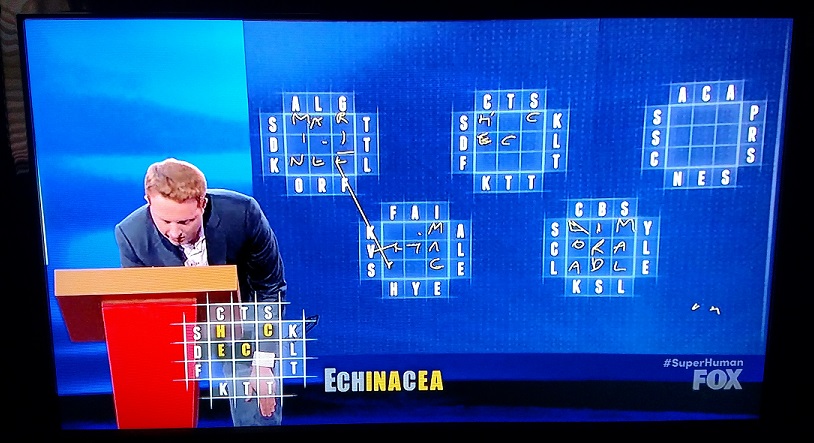
This grid of crisscrossing 5-letter words can only be completed with the letters in a 9-letter word provided alongside the grid. But Tyler had five of these grids to solve, and he wasn’t told which of the five 9-letter words went with which grid.
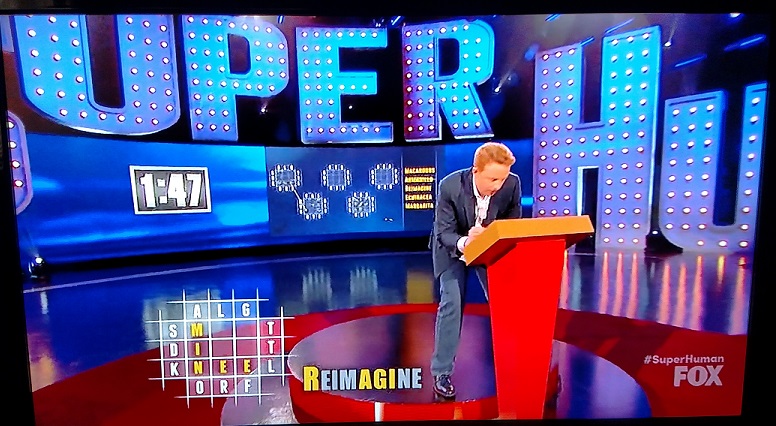
Oh, and he only had 3 minutes and 30 seconds in which to solve all five grids.

He went right up to the wire, but solved all five grids, showing off not only his deductive reasoning, but his vast vocabulary and his speed-solving technique, honed by years of crossword solving and tournament competition.
After all five competitors had their time to shine, the judges narrowed the field to three: Chris, Dave, and Tatiana. And the audience voted electronically for the winner: Dave Farrow, master of balloons.

Honestly, I thought both the judges and the audience picked wrong. Tyler was the only one who really had to work out his technique in front of the crowd, showing missteps and false paths that he corrected on the fly.

He actually talked through the process as he solved, which to me was more engaging and interesting.

Don’t get me wrong, the acts of memorization were very impressive, but only Tyler and math whiz Chris were really under a time limit. (Tyler’s was literal, while Chris’s was kinetic, since the dominoes were toppling.)

Also, I can’t believe that Luke didn’t at least make the top three, let alone win. 100 faces to memorize and reshuffle in your head? That’s mind-boggling to me.

Alas, such is the flying fickle finger of fate. Still, it was a strong showing for a world-class puzzler, an exhibition of puzzly talent that did not fail to impress.


Thanks for visiting PuzzleNation Blog today! Be sure to sign up for our newsletter to stay up-to-date on everything PuzzleNation!

You can also share your pictures with us on Instagram, friend us on Facebook, check us out on Twitter, Pinterest, and Tumblr, and explore the always-expanding library of PuzzleNation apps and games on our website!

Puzzles in Pop Culture: Twin Peaks: The Return

On Tuesday, I concluded a multi-part series about the history of American codebreaking. In a related story, a fellow puzzler pointed out that there might be a new code out there awaiting an enterprising codebreaker.

In a recent episode of the television show Twin Peaks: The Return, there was a brief scene with an airplane flying over a snowy mountain. Sharp-eyed viewers noticed that the plane’s windows seemed to disappear and reappear as it flew.

Naturally, when you have a show that’s all about trying to unravel mysteries and finding deeper meaning in even the most obscure clues, fans leapt onto this possibility and began trying to crack the code of the windows.

There are six windows, and they disappear and reappear numerous times in the brief scene. (There’s also a spot closer to the tail that also appears and disappears.)

[One solver’s breakdown of the plane window pattern.]

Charting out a possible pattern in the windows has led to several intriguing theories. While attempts to translate the pattern into morse code, binary, and other languages have yielded nothing so far, some fans posit that it’s a musical pattern, since one of the characters, FBI agent Gordon Cole, plays a 6-hole flute. (A villain from the original series, Windom Earle, also played a flute.)

While this may simply be a red herring, I suspect there’s more to the window mystery than just providing a distraction in a show littered with distractions.

People have gone so far as to track down the original footage of the plane flying, so they can see what was altered to produce the window pattern:

What do you think, PuzzleNationers? Is there a message or a tune lurking in plain sight on Twin Peaks: The Return? Or is this much ado about nothing?


Thanks for visiting PuzzleNation Blog today! Be sure to sign up for our newsletter to stay up-to-date on everything PuzzleNation!

You can also share your pictures with us on Instagram, friend us on Facebook, check us out on Twitter, Pinterest, and Tumblr, and explore the always-expanding library of PuzzleNation apps and games on our website!

The Diabolical Long Division Brain Teaser!

From time to time, I’ll receive an email with a brain teaser I’ve never seen before. Sometimes they come from friends, or fellow puzzlers. Other times, PuzzleNationers will ask for my assistance in solving a puzzle that has flummoxed them.

That was the case with today’s puzzle, and I’ll admit, this one was a bit of a doozy to unravel.

longdiv1

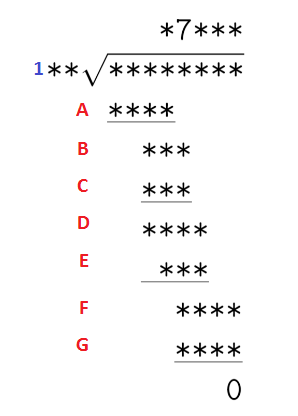
Yup, an entire long division problem with only a single digit set. No letters or encryption to let us know which digits were repeated, as there are in Word Math puzzles published by our friends at Penny Dell Puzzles.

Just a 7 and a bunch of asterisks. “Is this doable?” the sender asked.

Yes, this is entirely doable, friend. Let’s break it down step by step.

First, we need to know our terminology. The 8-digit number being divided is our dividend. The 3-digit number we’re dividing into it is the divisor. The 5-digit number on top is our quotient.

For the other lines, let’s label them A through G for ease of reference later.

longdiv2

There we go. Now, where do we go from here? We start with what we know.

We know that 7 is the second digit in our quotient.

So our divisor, times 7, equals the number on line C. That’s a 3-digit number, which means the first number in our divisor is 1. Why? Because if it was 2, 2 times 7 would give us 14, which would be a 4-digit number on that line.

longdiv3

That means the quotient is somewhere between 100 and 142. (Why 142? Easy. I divided 1000 by 7, and 142 is the last 3-digit number you can multiply 7 against and still end up with a 3-digit answer for line C. 143 times 7 is 1001, which is too high.)

What else do we know from the puzzle as it stands?

Well, look at lines E and F. We bring both of the last two digits in the dividend down for the final part of the equation. What does that mean?

Remember how long division works. You multiply the divisor by whatever number gets you closest to the given digits of the dividend, subtract the remainder, bring down the next digit from the dividend, and do it all over again until you get your answer.

You multiply the first digit of the quotient times the divisor to get the number on line A. You multiply 7 times the divisor to get the number on line C. You multiply the third digit of the quotient times the divisor to get the number on line E.

Following this route, you would multiply the fourth digit of the quotient against the divisor to get the number on line G. But bringing just one digit down didn’t give us a number high enough to be divided into. Instead of needing more lines (H and I, in this case), we bring the last digit of the dividend down and press onward.

That means the fourth digit of the quotient is 0, because the divisor went into the dividend zero times at that point.

longdiv4

And there’s more we can glean just from the asterisks and what we already know. We know that every one of those 4-digit numbers in the equation begin with the number 1.

How do we know that? Easy. That first number in the divisor. With a 1 there, even if the divisor is 199 and we multiply it times 9, the highest possible answer for any of those 4-digit numbers is 1791.

So let’s fill those numbers in as well:

longdiv5

Now look at lines D, E, and F. There’s nothing below the 1 on line D. The only way that can happen is if the second digit in line D is smaller than the first digit on line E. And on line F, you can see that those first two columns in lines D and E equal zero, since there’s nothing on line F until we hit that third column of digits.

That means the second digit on line D is either a 0 or a 1, and the first digit on line E is a 9. It’s the only way to end up with a blank space there on line F.

longdiv6

I realize there are a lot of asterisks left, but we’re actually very close to knowing our entire quotient by now.

Look at what we know. 7 times the divisor gives us a 3-digit answer on line C. We don’t yet know if that’s the same 3-digit answer on line E, but since it’s being divided into a 4-digit number on line E and only a 3-digit number on line C, that means the third digit in our quotient is either equal to or greater than 7. So, it’s 7 or 8.

Why not 9? Because of the 4-digit answers on lines A and G. Those would have to be higher than the multiplier for lines C and E because they result in 4-digit answers, not 3. So the digit in the first and fifth places in the quotient are higher than the digit in the third. So, if the third digit in the quotient is 7 or 8, the first and fifth are either 8 or 9.

So how do we know whether 7 or 8 is the third digit in the quotient?

Well, if it’s 7, then lines C and E would have the same 3-digit answer, both beginning with 9. But line C cannot have an answer beginning with 9, because line B is also 3 digits. The highest value the first digit in line B could have is 9, and 9 minus 9 is zero. But the number on line D begins with 1, ruling out the idea that the numbers on lines C and E are the same.

That makes the third digit in the quotient 8, and the first and fifth digits in the quotient 9.

longdiv7

We know our quotient now, 97809. What about our divisor?

Well, remember before when we narrowed it down to somewhere between 100 and 142? That’s going to come in handy now.

On line F, we know those first two digits are going to be 141 or below, because whatever our divisor is, it was larger than those three digits. That’s how we ended up with a 0 in our quotient.

So, the number on line D minus the number on line E equals 14 or below. So we need a 900-something number that, when added to a number that’s 14 or below, equals 1000 or more. That gives us a field from 986 to 999.

And that number between 986 and 999 has to be divisible by 8 for our quotient to work. And the only number in that field that fits the bill is 992. 992 divided by 8 gives us 124, which is our divisor.

longdiv8

From that point on, we can fill out the rest of the equation, including our lengthy dividend, 12128316.

longdiv9

And there you have it. With some math skills, some deduction, and some crafty puzzling, we’ve slain yet another brain teaser. Nice work everyone!

[After solving the puzzle, I did a little research, and apparently this one has been making the rounds after being featured in FiveThirtyEight’s recurring Riddler feature, so here’s a link.]


Thanks for visiting PuzzleNation Blog today! Be sure to sign up for our newsletter to stay up-to-date on everything PuzzleNation!

You can also share your pictures with us on Instagram, friend us on Facebook, check us out on Twitter, Pinterest, and Tumblr, and explore the always-expanding library of PuzzleNation apps and games on our website!
Crossword History: Dawe and D-Day

approaching_omaha

[Image courtesy of Wikipedia.]

June 6, 1944 is a date that will continue to resonate for decades to come, and perhaps centuries. On that day, D-Day, the largest amphibious military attack in history was launched as the Allied forces landed at Normandy. This was one of the major offensives that helped bring about the end of World War II.

But a few days before that, a curious confluence of events brought crosswords to the attention to British agents, namely those of MI5.

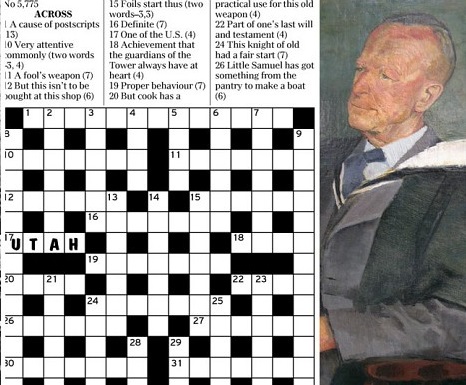
Yes, tomorrow, June 2, 1944, marks the anniversary of the day a physics teacher and crossword constructor named Leonard Dawe was questioned by authorities after several words coinciding with D-Day invasion plans appeared in London’s Daily Telegraph newspaper.

crosswords_2893522b

More specifically, the words Omaha (codename for one of Normandy’s beaches), Utah (another Normandy beach codename), Overlord (the name for the plan to land at Normandy on June 6th), mulberry (nickname for a portable harbor built for D-Day), and Neptune (name for the naval portion of the invasion) all appeared in Daily Telegraph crosswords during the month preceding the D-Day landing.

So, the authorities had to investigate the highly improbable, yet still possible, scenario that Dawe was purposely trying to inform the enemy of Allied plans, and scooped up the constructor to investigate.

In the end, no definitive link could be found, and consensus is that Dawe either overheard these words (possibly mentioned by the loose lips of soldiers stationed nearby) and slipped them into his grids unwittingly, or this is simply an incredible coincidence.

Some crossword fans suspect that there’s more to the story, though.

history_post

According to The Guardian newspaper:

During the celebrations of the 40th anniversary of D-day, one of Dawe’s former pupils approached the Telegraph and insisted that as a lad, he had overheard US and Canadian soldiers discussing the plans, picked up on the codewords, and suggested them to his headmaster as possible entries.

This has been dismissed by most historians as an attempt to rewrite or embellish an already baffling story.

Nonetheless, it’s possible that, somewhere, some document connecting Mr. Dawes and the codewords is waiting to be discovered.

Until then, it simply remains a curious moment in crossword history.


Thanks for visiting PuzzleNation Blog today! Be sure to sign up for our newsletter to stay up-to-date on everything PuzzleNation!

You can also share your pictures with us on Instagram, friend us on Facebook, check us out on Twitter, Pinterest, and Tumblr, and explore the always-expanding library of PuzzleNation apps and games on our website!

May the Fourth Be With You!

may-the-fourth_6

Hello fellow puzzlers and PuzzleNationers! It’s Star Wars Day, and what better way to celebrate than with a puzzly Star Wars brain teaser!

A fellow Star Wars fan found this logic puzzle online and tasked us with solving it. Can you unravel the fiendish Imperial plot? Let’s find out!


Rebel Roundup

The Empire came up with a brilliant plan in order to trap various members of the Rebel Alliance: creating a fake Rebel summit. Each Imperial agent involved would invite a Rebel to the summit while posing as one of the Rebels being invited.

It would have worked perfectly, except for the fact that Admiral Ozzel posed as the person that he had invited. OOPS. Courtesy of Ozzel’s bumbling, the Rebels were warned ahead of time and armed themselves, hoping to turn the tables on the Empire.

Thanks to Han Solo’s timely warning, Luke had hidden his lightsaber and a vibroknife with R2-D2 and C-3PO respectively. These extra weapons allowed the seven Rebel agents of them to escape. It also helped that Admiral Ackbar arrived last in his ship, Home One.

Each Rebel arrived in a different spaceship, but two Rebels hitched a ride with fellow agents, so only five spaceships were involved.

Answer these questions:

  • Who traveled with Leia?
  • Who traveled with Luke?
  • What vehicle did each Rebel arrive in?
  • Which Imperial invited which Rebel?
  • Who did each Imperial pose as?
  • What weapon did each Rebel carry?

Here are your clues:

1. Leia, having been warned by Han, carried a concealable Holdout Blaster. She did not arrive in an X-Wing, nor did she fly the Millennium Falcon.

2. Han wouldn’t let anyone fly his baby. Han carried his Heavy Blaster Pistol, ready to shoot the Imperial who invited him while posing as him. This naturally made Han suspicious.

3. When Admiral Ackbar saw who invited him, he put his Force Pike to the Imperial’s throat. He was not invited by Darth Vader, who had posed as R2-D2.

4. C-3PO arrived on the Tantive IV, along with another passenger. This was not the ship Lando used.

5. The Lady Luck was flown by the man invited by Admiral Piett. Its pilot, who traveled alone, carried a Blaster Rifle with him. He gambled a bit, and almost crashed into Luke’s X-Wing. The Imperial who invited him posed as Admiral Ackbar.

6. Grand Moff Tarkin invited Admiral Ackbar. He did not pose as Luke Skywalker, nor did he pose as Leia.

7. General Veers invited R2-D2. Veers posed as R2-D2’s best friend. Captain Needa did not pose as Lando.

8. Leia was led to believe that Luke invited her to the summit. Emperor Palpatine invited Luke while posing as Leia. R2-D2 delivered his weapon to the Rebel so he could keep his father busy long enough for everyone to escape.

tfa_poster_wide_header-1536x864-959818851016

Good luck, fellow puzzlers! Although the puzzle is a bit easier if you’re familiar with the Star Wars Universe, any solver should be able to crack this puzzle with the clues provided!

Let us know if you solved it in the comments below! And May the Fourth Be With You!


Thanks for visiting PuzzleNation Blog today! Be sure to sign up for our newsletter to stay up-to-date on everything PuzzleNation!

You can also share your pictures with us on Instagram, friend us on Facebook, check us out on Twitter, Pinterest, and Tumblr, and explore the always-expanding library of PuzzleNation apps and games on our website!

Doing Crosswords at Home: The Artistic Way

A few years ago, I wrote about one of the biggest crossword puzzles in the world: the 100-foot-tall Lviv, Ukraine, crossword painted on the side of a building.

OLYMPUS DIGITAL CAMERA

But as it turns out, this isn’t the only supersized crossword to grace the side of a building in Europe. In a book about German street art, I saw a picture of a house with a facade painted to resemble a crossword puzzle.

Doing a bit more research, I discovered that the house was located in Dusseldorf, Germany, on a street called Kiefernstrasse, which is one of the world’s largest graffiti walls. Residents use the walls of their homes and neighboring buildings to make artistic and political statements.

kiefernstrasse-graffiti-houses-dusseldorf-germany-1

[Image courtesy of CherylTiu.com.]

It’s a vibrant, fascinating part of the city — one where personal expression trumps traditional aesthetics. Be warned, though: Travel and lifestyle blogger Cheryl Tiu advises tourists to visit only in the daylight hours, and in the company of others. In the 1980s, Kiefernstrasse was home to gangs, political dissidents, and squatters, and it retains some of that anarchic spirit to this day.

kiefernstrasse-graffiti-houses-dusseldorf-germany-3

[As a Tsuro fan, I appreciate this work in particular, one of hundreds of works in an overlapping, constantly changing canvas. Image courtesy of CherylTiu.com.]

But the crossword house, located at #31, is what brings us to Kiefernstrasse today.

tumblr_n0j257odmh1rsxhyjo1_1280

[Image courtesy of Daily Dose of German.]

The artists (and residents) of #31 view the house as a microcosm of the world; all of the overlapping, interconnected entries — many of which are political — representing the complexity of our world.

It’s kind of interesting that such a layered statement literally appears in black and white. It feels quite apropos, though, since crosswords are both a cultural barometer — updating and evolving with the times — and a cultural artifact from another time, building upon the knowledge of the past.

As of writing this blog post, it’s unclear whether the piece is actually finished, since the artists said that the final words and clues for the grid were going to be painted on a gate or fence nearby.

Nonetheless, they’ve created a striking and intriguing work of art, one that says as much about crosswords as it does about the world.


Thanks for visiting PuzzleNation Blog today! Be sure to sign up for our newsletter to stay up-to-date on everything PuzzleNation!

You can also share your pictures with us on Instagram, friend us on Facebook, check us out on Twitter, Pinterest, and Tumblr, and explore the always-expanding library of PuzzleNation apps and games on our website!