PuzzleNation Product Review: Retro Loonacy

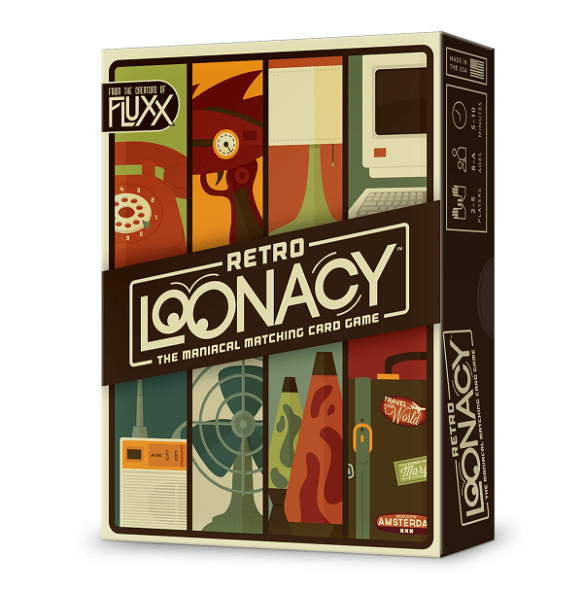
retroloonacy-box-3d

It has been a banner year for the folks at Looney Labs. They’ve already released Just Desserts, Fluxx Dice, Batman Fluxx, and Adventure Time Fluxx, all to excellent reviews, as well as announcing the upcoming Nature Fluxx (a redesign of their environmentally conscious Eco Fluxx) and Firefly Fluxx (for all the Browncoats in the puzzle/game audience).

But, somehow, that’s not all. They’ve also launched a companion game to their pattern-matching game Loonacy, which brings us to the subject of today’s product review. Let’s take a closer look at Retro Loonacy!
retroloon1

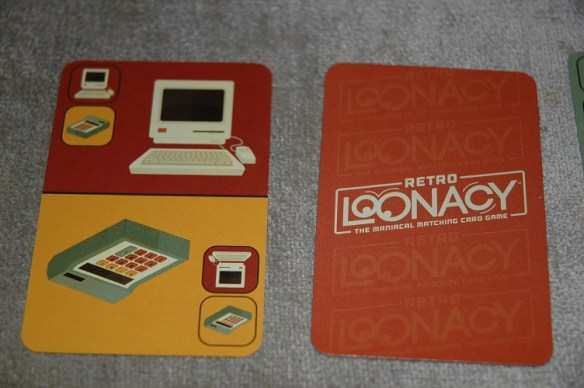
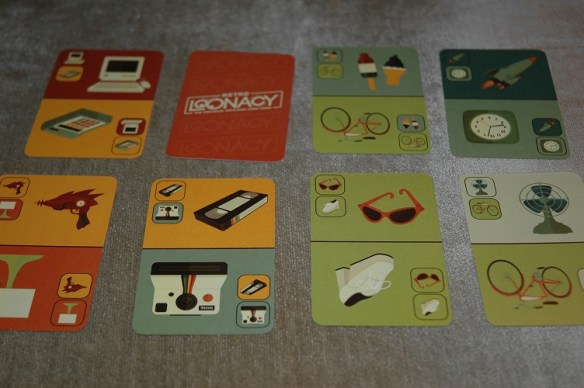
Retro Loonacy replaces the wacky, more cartoonish illustrations of the original with a more subdued assortment of images, evoking sentimental stirrings for trappings and technology of the past (Polaroid cameras, rocketships and rayguns from Golden Age science fiction films, etc.).

It almost feels like looking through one of those old issues of Popular Mechanics that purported to predict the future. Everything is hard angles and earth tones, carefully repackaged nostalgia given form.

Now, I am focusing quite a bit on the art instead of the gameplay, and there’s a reason for that. Unlike each new version of Fluxx, which seems to bring something new to the table — whether it’s a new type of card like the creeper or simply a few clever innovations in the rules tailored to that specific brand — Retro Loonacy is played exactly the same as Loonacy. You’re still trying to empty your hand of cards as quickly as possible by matching one of the two images on your card with one on the board. There are no new wrinkles or variations. This is a repackaging, plain and simple.

retroloon2

[Retro Loonacy side-by-side with the original Loonacy.]

And, quite honestly, it’s for the better. Retro Loonacy‘s artwork is charming in the extreme, and the game feels more suitable for adults than the bright, silly, madcap images you must match in Loonacy. It presents itself as a game for adults, even if the frenetic gameplay might appeal more to younger players.

The style and execution elevate Retro Loonacy above many contemporary card games, placing it in the same aesthetic upper echelon as 12 Days (which features the most beautiful cards I’ve ever seen in a card game) and some of the more ambitious decks of Pairs offered by our friends at Cheapass Games.
retroloon3

In short, Retro Loonacy is a strong pattern-matching game with oodles of style. Another terrific offering by the game masters at Looney Labs.


Thanks for visiting PuzzleNation Blog today! Be sure to sign up for our newsletter to stay up-to-date on everything PuzzleNation!

You can also share your pictures with us on Instagram, friend us on Facebook, check us out on TwitterPinterest, and Tumblr, and explore the always-expanding library of PuzzleNation apps and games on our website!

PuzzleNation App Review: Can You Escape?

Welcome to the another edition of PuzzleNation App Reviews! Today we continue our quest to explore the world of puzzly games and apps for your tablet or smartphone!

Our resident app player and puzzle fiend Sherri has a new game for us today, so let’s get down to business and dive into her review of Can You Escape? for iPhone and iPad!


You’re trapped! You are faced with a closed elevator and no way to open it. What do you do? Well, you search the floor for the way to open the elevator! You need to solve puzzles and find hidden objects in order to unlock the elevator, proceed to the next floor, and begin the hunt anew.

Can You Escape? is a very interesting iOS game. Your goal is break out of each room, but since you don’t know why you are trapped on each floor, I think this also counts as a choose-your-adventure game.

This is a variation on an escape-the-room game, and it was a lot of fun. I had never played that type of game before. In order to open the elevator, you have have to search each floor for the key. Some floors have more than one room to search. There isn’t a story to this game, so you need to use your imagination to figure out why you need to break out of each room.

Throughout the many levels, there are mini-games and hidden objects you have to find. For example, in the first room on the first level, there is a chest featuring a scrambled picture. You must rotate the pieces of the puzzle to complete the picture and to open the chest.

[One of the many puzzles you’ll encounter along the way.]

You also have to search each room thoroughly in order to find the objects hidden in each level. The items aren’t labeled, so there is a bit of guesswork on what to do with each object. However, it is fairly easy to figure out what to do on each level.

This is a game that requires patience. You need to explore every nook and cranny. And use your imagination.

Ratings for Can You Escape?:

  • Enjoyability: 3/5 — This is rather dependent upon the player. Because there isn’t a back story, you are limited only by your imagination. Why are you escaping these floors? The possibilities are endless.
  • Puzzles incorporation: 4/5 — This game is chock full of puzzles, as you have to solve various mini-games and search for hidden objects on each floor.
  • Graphics: 3/5 — The rooms on each floor are nicely detailed but are static for the most part.
  • Gameplay: 4/5 — I had never played an escape-the-room type puzzle before, and I found it to be quite fun. The story I chose is that I lost the key to each floor’s elevator, and I had to search the rooms in order to leave the building for work!

Thanks for visiting PuzzleNation Blog today! Be sure to sign up for our newsletter to stay up-to-date on everything PuzzleNation!

You can also share your pictures with us on Instagram, friend us on Facebook, check us out on TwitterPinterest, and Tumblr, and explore the always-expanding library of PuzzleNation apps and games on our website!

PuzzleNation Product Review: ThinkFun’s Laser Maze Jr.

Whether you’re unraveling locks and ropes in Houdini, bending gravity to your will in Gravity Maze, making music note-by-note with Compose Yourself, or mastering the basics of programming in Robot Turtles, playing with the puzzle games by ThinkFun always encourages you to learn while you solve.

Today, we see if Laser Maze Jr. matches the high standard set by those other puzzly products.

Now, for those of you familiar with the original Laser Maze, you might be expecting a simplified version, akin to the Jr. versions of Rush Hour or other puzzle games where the difficulty lessens but the game remains the same. Worry not. Laser Maze Jr. is actually a heavy redesign that keeps the best aspects of the original and tailors itself to players as young as 6, both in gameplay and in safety.

Perhaps the biggest change from the original is the board itself.

Not only is the laser fixed in place, but the board is surrounded by red plastic barriers that both protect young eyes and highlight where the beam is projecting at any given time. You would have to seriously tamper with the game to endanger your eyes with this layout; with the original, there was a greater (though still quite slim) chance that unmonitored gameplay could lead to an accident.

The laser also has a switch instead of a button to press, so if you choose, you can leave the laser on and see the beam’s path change as you add elements to the game board. As a learning tool, this is a super-helpful feature for younger minds. (The original encouraged more of a wait-and-see approach to placing the elements.)

The final change to the board’s layout involves the cards that provide the specifics of each puzzle. Instead of small cards that tell you which elements are fixed and which you add in order to solve the puzzle and light up the targets, the new cards actually slide into place beneath the board, showing you where to place the set pieces. Again, ease of setup and play is a main consideration.

The game pieces also got retooled. Instead of the gateway piece that players had to direct the laser beam through en route to the targets, Laser Maze Jr. has large rocks that block the laser’s path. This is a simple, effective way of providing obstacles for younger solvers to overcome.

The three light-up targets have been replaced with two light-up rockets. While this does eliminate some of the most complex puzzles from the original game, that’s forgivable, given that this is intended for younger solvers.

I was slightly disappointed with the laser, though. It’s less powerful than the previous one (either that or the rockets don’t light up as brightly as the original targets), and to be honest, part of the appeal of the puzzle is seeing your targets light up when you’re done!

[Taken at night with most of the lights off. Unless you’re willing to play in near-darkness — and use the night feature on your camera — the end result won’t be as bright.]

The 40 puzzles (2 on each challenge card) range from easy to super-hard, and solving them in order is a great way to slowly introduce new players to the game. Although “super-hard” is clearly a ranking for kids, not adults, the challenge of placing the beam splitter properly and avoiding the rocks is still a lot of fun for an older solver.

(Be careful when getting started, though; one of the explanatory graphics in the instructions is wrong. ThinkFun is aware of the error, and they’ll be correcting it on their next printing.)

In the end, I was pretty impressed with Laser Maze Jr. and the many changes made to tailor it to younger solvers, both in terms of safety and gameplay. While the laser is a little underwhelming, it doesn’t impact the gameplay too much, and the same solid foundation of logic and experimentation that drove the fun of the original is alive and well here.


Thanks for visiting PuzzleNation Blog today! Be sure to sign up for our newsletter to stay up-to-date on everything PuzzleNation!

You can also share your pictures with us on Instagram, friend us on Facebook, check us out on Twitter, Pinterest, and Tumblr, and explore the always-expanding library of PuzzleNation apps and games on our website!

PuzzleNation Product Review: Tak•tak

When it comes to strategy puzzle games, no matter how complex or how simple the actual game mechanics, the game itself hinges on the two players involved. After all, two extremely tactical puzzlers can make checkers look like chess.

Now, imagine a game that combines the pattern-matching of Uno, the strategy of chess, and the mechanics of Upwords, and adds a scoring element to boot. It might sound complicated, but I promise, it’s as simple as checkers.

Tak•tak is a two-player strategy scoring game designed by the folks at Twizmo Games, and it’s another puzzle game brought to life thanks to a successful crowdfunding campaign. Although Twizmo Games is best known for twisty puzzles (or Rubik’s Cube-style puzzles), they’ve taken a strong step into the traditional board game market with Tak•tak.

Each player starts with 12 tiles, each tile bearing a different score (10, 20, 30, or 40) and a different color (green, blue, or yellow). The two rows nearest the player form that player’s safe zone. The three rows in the middle are the war zone.

Your goal is to get as many points as possible into your opponent’s safe zone by stacking your tiles, crossing the war zone, and either capturing or maneuvering around your opponent’s tiles. You can only move forward (either straight or diagonally), so this is a game about tactics and initiative.

You build your stacks by matching either point values or colors. For instance, you can stack a yellow 20 and a yellow 40, or a yellow 30 and a green 30, and either of those new stacks would represent 60 points. This enables you to move more tiles around the board quickly. (But careful: once you’ve stacked tiles, they stay stacked for the rest of the game.)

But those matching rules also apply to your opponent’s tiles! When you and your opponent cross paths in the war zone, you can stack your tiles onto theirs and steal those points for yourself. (The stacks you make from your own tiles can only go three tiles high, but stacks made from your tiles AND your opponent’s tiles can go as high as you want! Heck, a stack might change owners several times and tower over the game board!)

The game ends when one player has no more available moves. (There are other ways to end the game if you choose to use the advanced game play rules, but we’ll stick with the basic rules for now.) And then it’s time to count your tiles.

You earn points for all of the tiles you’ve moved into your opponent’s safe zone (including any of your opponent’s tiles that are in stacks you control), plus points for any tiles your opponent never moved into the war zone. (Meaning they were never “in play.”) Highest score wins!

Tak•tak builds a lot of versatility and play possibilities into a game with checkers-simple mechanics, and the more you play, the more fun it is to delve deeper into tactics and strategy. It was worth losing 50 points for keeping a few tiles in my safe zone when they prevented a stack of my opponent’s tiles from scoring.

The clever mix of classic game-play elements not only makes Tak•tak so easy to dive into, but also ensures new players can more time actively playing and less time worrying about learning the rules (a common downfall for more complicated strategy games).

The designers claim the game is appropriate for ages 8 through 108, and I think they’re right on the money.


Thanks for visiting PuzzleNation Blog today! You can share your pictures with us on Instagram, friend us on Facebook, check us out on TwitterPinterest, and Tumblr, and be sure to check out the growing library of PuzzleNation apps and games!

PuzzleNation Product Reviews: Fluxx Dice and Adventure Time Fluxx

fluxxdice1

The flagship game of the Looney Labs brand, Fluxx, at its core, is a card game that mixes flexibility and strategy in gloriously chaotic fashion. The basic mechanics of Fluxx — collecting keeper cards in order to complete a certain goal — remain the same each time you play, but with constantly shifting rules and goals (as well as obstacles your fellow players employ), every time you play, it’s a brand new game.

And quite honestly, given how often the rules change during a game, I didn’t think Fluxx could get more chaotic.

Enter Fluxx Dice.

fluxxdice2

Fluxx Dice adds five cards to your Fluxx deck, and they all concern using (or not using) the two Fluxx Dice to change how many cards you draw per turn and how many you play per turn.

The addition of dice-rolling randomness to an already hectic game offers a level of unpredictability that even a well-shuffled deck cannot. Especially since a sufficiently tactical Fluxx player can often overcome the game’s inherent instability with the proper strategy. But no one can prepare for a chance roll of the dice!

Although I’ve only tried Fluxx Dice with the standard game, Batman Fluxx, and today’s other review product so far, I can confidently say that you will not believe how big an impact five little cards and two dice will have on your gameplay. What a terrific way to add a touch more luck and consequence to a game that already employs both so deftly.

This brings us to Adventure Time Fluxx.

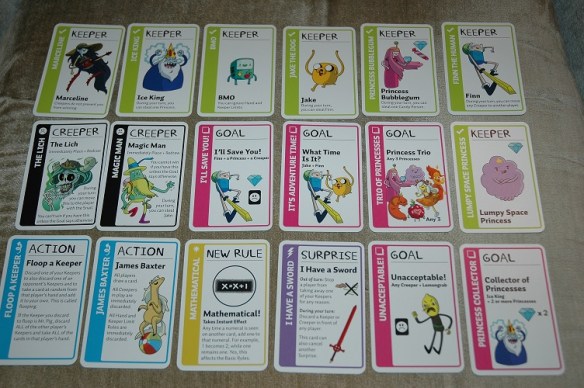
adventuretime1

[A small sampling of cards given the Adventure Time touch.]

Adventure Time is a Dungeons and Dragons-inspired cartoon show about a boy named Finn and his best friend, a shape-shifting dog named Jake, as they have adventures in the Land of Ooo. In a world populated by talking sweets, numerous princesses, and monsters galore, Finn and Jake must deal with the return of magic to the world and the aftermath of the Great Mushroom War.

As you can see, the show’s fingerprints are all over this themed Fluxx deck, and given that the show itself has a very strong “anything can happen” vibe to it, this is clearly a match made in heaven.

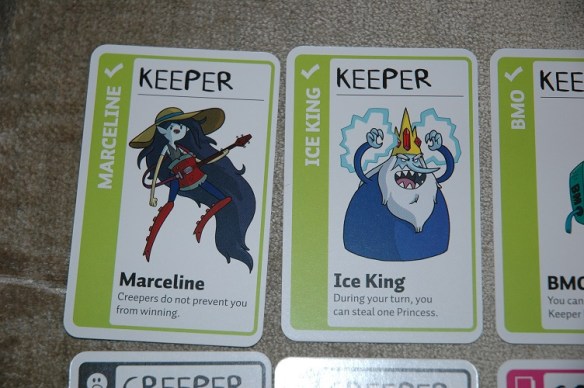
adventuretime2

[Two of my favorite characters become valuable Keeper cards in this edition of Fluxx.]

Although I hoped some of the cards would offer fans of the show gameplay incentives — akin to the Batman Fluxx card that rewarded players wearing something with the Batman symbol on it — my fellow players and I did come up with an appropriate Adventure Time-fueled variant.

Each time a keeper card was played, the person who played it had the opportunity to repeat a quote or popular line from that character. If they did so, they received either an additional card to be played immediately OR a roll of the Fluxx Dice to alter the current rules of the game.

For a show that rewards sharp-eyed attentive viewers with in-jokes and humor, this felt like a suitably Adventure Time-y wrinkle to add to the game.

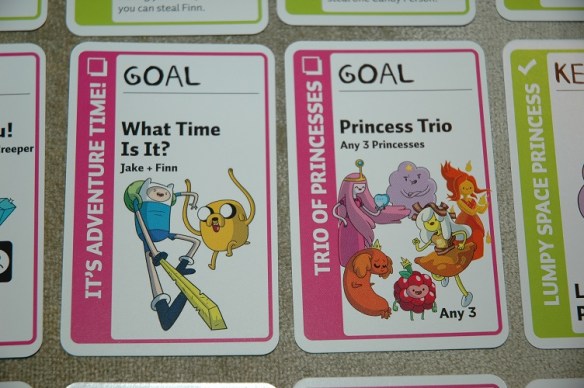
adventuretime3

The family of Fluxx games continues to grow, and although Adventure Time Fluxx didn’t really bring anything new to the table gameplay-wise, the immense charm of its themed cards and references to the show still make it a worthwhile addition to any Fluxx fan’s collection.

And as for Fluxx Dice, it may be a small set, but in terms of sheer gameplay impact, it packs one heck of a punch.


Thanks for visiting PuzzleNation Blog today! You can share your pictures with us on Instagram, friend us on Facebook, check us out on TwitterPinterest, and Tumblr, and be sure to check out the growing library of PuzzleNation apps and games!

PuzzleNation Product Review: Compose Yourself

Compose Yourself, ThinkFun’s latest offering, is unlike any product I’ve ever reviewed before, and that’s part of what makes it special. It is a single unending puzzle and a million different smaller puzzles all at once. It is literally as simple or as complex as you choose to make it.

You’re given sixty transparent cards (two copies each of thirty distinct note patterns). Each card features four different codes: one for the notes as they appear, one for the notes rotated 90 degrees, one for the notes backward, and one for the notes backward AND rotated 90 degrees. This allows for a staggering number of choices for a budding composer.

As you play around with placing the transparent cards in various order, you can log into the ThinkFun website and use the code provided to access a digital composing program.

[A picture of my first composition in progress…]

Input the codes from your layout of transparent cards in groups of four — as many as you wish! — and then click play. You can hear your new composition played on marimba, performed by an orchestra, or in both modes simultaneously!

Now, I confess, I am not a musically inclined person, but after fifteen minutes or so playing around with random cards — placing, flipping, reversing, and rotating them — I finally clicked play, and I was surprised by the results. (I’d unintentionally created a tune that felt perfect for the background of a Legend of Zelda game. *laughs*)

It feels like your work comes to life at your fingertips. And all you can think about is how to improve it, how to make the most of it, and how new cards will change it.

Each card represents part of a puzzle, and you may have no idea what the finished product will be, but that doesn’t make the process any less satisfying. This is old-school free-form creativity, like dipping your hands into a bucket of LEGOs, pulling out some pieces, and seeing what you can create.

ThinkFun has challenged us in the past with puzzlers like Houdini and Gravity Maze, and they’ve offered younger solvers the chance to learn coding in Robot Turtles and optics in Laser Maze, all while enjoying an experience that feels like play because it IS play.

But they’ve truly outdone themselves with Compose Yourself; it’s a learning experience, a creative experience, and a puzzly experience all at once. What a treat.

Thanks for visiting PuzzleNation Blog today! You can share your pictures with us on Instagram, friend us on Facebook, check us out on TwitterPinterest, and Tumblr, and be sure to check out the growing library of PuzzleNation apps and games!