PuzzleNation Product Review: Schrodinger’s Cats

Even if you don’t know the science behind it, you’ve probably heard of Schrodinger’s cat at some point in your life. If you haven’t, let me give you the short short version: there’s a box with a cat in it, and a substance that may or may not release inside the box and kill the cat.

So until you open the box, there’s no way of knowing whether the cat is alive or not. Schrodinger posited that, since we can’t know which is the case, both are true until the box is opened. It’s essentially a thought experiment which delves far deeper into quantum mechanics and particle physics than I’m going to in this review.

But the idea that someone created a card game based on the concept of Schrodinger’s cat is not only audacious, but pretty impressive. (And the puns are just the icing on the cake.)

[Some of the cat physicists in the game: Sir Isaac Mewton,
Sally Prride, Madame Purrie, and Neil deGrasse Tabby.]

Schrodinger’s Cats was funded through a Kickstarter campaign last year, and it’s the brainchild of Heather Wilson, Heather O’Neill, and Chris O’Neill. A mix of bluffing, deduction, and wagering, this game combines Name That Tune-style bravado and strategy with Poker-style game play.

Each player is a cat scientist forming hypotheses on how many boxes contain live cats, dead cats, or nothing at all. (While Schrodinger is away, of course. As the old saying goes, when the scientist’s away, the cats will play. Or something like that.)

Every player receives one box card for each player in the game (so if there are three players in the game, each player receives three box cards), as well as one cat scientist card.

Once the cards are dealt, players look at their box cards and see what each box contains, hiding this info from the other players. Then the players begin hypothesizing. They wager on how many of each result are in ALL of the boxes on the board. So, in the game layout above, there are nine boxes, and each scientist has to wager what’s in all the boxes.

But instead of starting with a high guess and then wagering lower totals (as you would in Name That Tune), you start low in Schrodinger’s Cats and wager upward. Scientists can also affect the wagering by “showing findings” — revealing one or all of their own boxes to either prove their hypothesis or make the other players doubt their own — or by swapping out some boxes. (Each cat scientist card also allows for a one-time-use special action for a player, which can also prove useful.)

When a player either refuses to wager higher or challenges another player’s hypothesis by yelling “Prove it!”, all of the boxes are revealed and the hypothesis is proven or debunked (meaning the player stays in the game or leaves). After multiple experiments (rounds of play), one character remains and wins the game (and an honorary doctorate from Cat Tech University).

What I enjoyed most about this game (other than all the pseudo-scientific jargon involved in playing the game) was the wagering, bluffing, and reading of opponents that is integral to the game play. With so few possible cards to reveal (only four, in varying quantities, as opposed to 13 different cards across four suits in poker), it’s not nearly as challenging as the classic card game, but offers a lot of similar game mechanics.

It’s great fun to try to outwit or read your fellow players in order to make the best hypothesis, and that’s a sort of puzzling that is often left behind in puzzle games. Often, you’re so busy trying to achieve a certain goal or acquire points that you stop actively interacting with the other players; but in Schrodinger’s Cats, a lot of puzzling and game play takes place in the actions and reactions of the other players. It’s a delightfully social game.

Although you can play with as few players as two or as many as six, I recommend playing with at least four characters to keep the game moving and interesting. Between raising hypotheses, showing findings, and trying to puzzle out what your fellow players are hiding, the more uncertainty you can introduce to the game, the better.

Schrodinger’s Cats is available from 9th Level Games and can be found here.


Thanks for visiting PuzzleNation Blog today! Be sure to sign up for our newsletter to stay up-to-date on everything PuzzleNation!

You can also share your pictures with us on Instagram, friend us on Facebook, check us out on Twitter, Pinterest, and Tumblr, and explore the always-expanding library of PuzzleNation apps and games on our website!

PuzzleNation Product Review: Scrimish

The best card games are simple. People love War and Poker and Hearts and Go Fish because, at their core, they’re games you can learn quickly and play endlessly. There are no long tutorials or play-throughs, so you can learn all the complexities and rules with ease.

It’s difficult to find puzzly card games that are as accessible and replayable. Scrimish, a card game created by Danny Zondervan and recently funded through Kickstarter, fits the bill nicely. The rules are simple, but the strategy in the actual game is what gives Scrimish major replay value.

[On a very festive battlefield, I’ve finished setting up my cards
(bottom of the frame), while my opponent is still working on hers.]

Scrimish is an elegant mix of War, Chess, and Memory.

Each player gets a set of 25 cards, arranging them into five piles of five cards each, face down. The goal? Find your opponent’s crown card before they find yours.

Then you take turns drawing a card from the top of one of your piles and attacking the top card of one of your opponent’s piles in a one-on-one battle. Here’s where the War aspects begin. You see, each card has a number value, and the higher number wins. The losing card is discarded, and the winning card goes back to whatever pile it came from.

So in every encounter, both players learn something, because even if you lost that attack, you’ve learned the value of one of the cards on top of one of your opponent’s piles.

That’s where the Memory aspect comes in, because you have to remember what cards of your opponent’s you’ve seen. (You can check your top cards or your piles as often as you and your opponent see fit.) Then you can plan other moves and try to uncover their crown card.

You’ve got shield cards to defend with, archer cards to attack with, numbered weapon cards to battle with, and one crown card to defend. So, essentially, you’re playing a miniature game of chess with your opponent, except your pieces are hidden from them.

And that’s what makes for such a satisfying playing experience. You’ve got all sorts of strategy going on, plus chances for misdirection in both your attacks and your placement of cards at the beginning of the game. Do you go out heavy with high numbered cards early, or do you test their defenses with low cards? Do you arrange attack stacks and defensive stacks, or do your spread your resources out across all five stacks?

Plus, every card you attack with is one less you have in your stacks. So you’ve got a resource management aspect as well. All of this gameplay and puzzly potential, with fewer cards than your standard poker deck.

It takes only a few minutes to learn, but all the thought that goes into it makes every game of Scrimish feel fresh and new.


Thanks for visiting PuzzleNation Blog today! Be sure to sign up for our newsletter to stay up-to-date on everything PuzzleNation!

You can also share your pictures with us on Instagram, friend us on Facebook, check us out on Twitter, Pinterest, and Tumblr, and explore the always-expanding library of PuzzleNation apps and games on our website!

The Year Ahead

Normally today I would be doing a Follow-Up Friday post, but since it’s the first day of 2016, instead of looking back, I thought I would look forward and talk a little bit about what’s to come in 2016!

On the PuzzleNation Blog side of things, I’ve got some great stuff planned for the new year.

For instance, game and puzzle reviews. Good lord, I have the fruits of so many Kickstarter and Indiegogo campaigns to show you, plus 2016 is promising to be a great year for both puzzles and games, so I have no doubt there are many surprises and terrific solving experiences awaiting the PuzzleNation audience next year.

I’m also bringing back our interview segment 5 Questions. In the past, we’ve had musicians, comedians, puzzle constructors, and even a game-show host appear for 5 Questions, and I’ve already lined up a few interviews that should really interest the readership.

Also, after the positive response to the interview we did with Fred when we announced the addition of a free daily puzzle to the Penny Dell Crosswords App, I’m hoping to interview the rest of the PuzzleNation Team in 2016 and give our fellow PuzzleNationers a glimpse behind the curtain!

On the app side, Fred and the PuzzleNation Team are keeping mum when it comes to new apps and features, but that’s simply because they know I’d immediately run to you guys with any news I heard. *laughs*

But our 2015 Deluxe Combo puzzle set AND the new Penny Dell Crosswords App for Android devices should tide you over until I can pry a few juicy secrets from Fred and the team.

And, of course, I’d love to hear from you! What sorts of posts would you like to see from PuzzleNation Blog in 2016? Let me know!

Thank you for all your support in 2015. On behalf of PuzzleNation, I can promise you that 2016 will be our best, most ambitious year yet!


Thanks for visiting PuzzleNation Blog today! Be sure to sign up for our newsletter to stay up-to-date on everything PuzzleNation!

You can also share your pictures with us on Instagram, friend us on Facebook, check us out on Twitter, Pinterest, and Tumblr, and explore the always-expanding library of PuzzleNation apps and games on our website!

A New Year’s Eve Countdown!

It’s New Year’s Eve, and we are literally counting down the hours until 2016, so why not celebrate the end of 2015 with a little countdown of our own?

Here are my 10 favorite blog posts from 2015!


#10 Rubik ‘Round the World

One of the most amazing things about the world today is how interconnected we all are. The Internet has made it easily to not only keep in touch with far-flung friends, but to forge new, meaningful friendships and connections with staggering ease.

And I confess, I am a total sucker for those heartwarming clickbait videos that spread the message that we are all the same. (The one of that guy doing the same dance in countries across the world comes to mind.) So seeing people from all over the world solve a Rubik’s Cube one move at a time…what can I say? It got me.

#9 Holiday Puzzly Gift Guide

Every year, one of my favorite activities is putting together our Holiday Puzzly Gift Guide. I get to include the best products sent to me for review by top puzzle and game companies, mix in some of my own favorites, and draw attention to terrific constructors, game designers, and friends of the blog, all in the hopes of introducing solvers (and families of solvers) to quality puzzles and games.

#8 Music and Puzzles

Talking about how puzzles are relevant to daily life is one of my favorite subjects for blog posts. Brain health, stress relief, the long-term benefits of puzzle solving…we’ve discussed all these topics and more during my time as lead blogger.

This year I continued that tradition with this post about how listening to music can make you a more effective solver. It’s always interesting for me to do some research and really delve into a topic — especially scientific ones because they’re often so drastically misreported or misinterpreted by mainstream outlets — and give the PuzzleNation audience the straight story.

#7 The Dress

One of the most bizarre moments of 2015 was when someone shoved their iPhone in my face and asked me what color a dress was. It wasn’t until a few moments later that I found out this was a big thing on the Internet that people were vociferously debating.

The chance to explain exactly what was going on in the photo through one of my favorite puzzly mediums — the optical illusion — was too much fun to resist, and it resulted in one of the year’s most popular, most shared blog posts.

#6 The American Crossword Puzzle Tournament

Although it’s a highlight of the puzzly calendar every year, this year’s ACPT was extra special for me because it was the first I attended in person.

Not only did I get to meet a lot of top names in crosswords — in many cases, finally getting a chance to put names to faces after many emails and tweets exchanged — but I got to enjoy the Big Fight feel of seeing so many friends and puzzlers test their mettle against some great puzzles.

#5 A Puzzly Wedding Proposal

Our friends at Penny Dell Puzzles pulled off one heck of a puzzly coup when an intrepid fellow puzzler asked them for help proposing to his girlfriend with a special Escalators puzzle.

I reached out to the lucky fiancé and got his permission to share the story with the PuzzleNation readership, and as I learned more about who was involved and how they’d managed to make it happen, I just became more and more enamored with the story. I have no doubt that years from now, this will still be one of my favorite blog posts.

#4 Max Reviews the Boston Festival of Indie Games

Guest bloggers are nothing new to PuzzleNation Blog, as Sherri regularly pops in with her app reviews, but Max Galpern pushed things to another level with his appearances throughout the year. Not only did he pioneer our first video review (with assistance from Fred), but he took over the blog for an entire day with his review of the Boston Festival of Indie Games.

Here’s hoping we can get Max back for 2016 a few times, though I suspect he’ll be in high demand.

#3 Will Sudoku

We do a lot of reviews (board game and card game reviews, puzzle reviews, tournament reviews, app reviews, etc.) and I thoroughly enjoy introducing new puzzly products and events to my fellow PuzzleNationers and sharing my thoughts on them.

But it’s rare that we get the first shot at introducing a brand-new never-before-seen puzzle or product, and that’s what separates the Will Sudoku post from many others. Serving as the debut outlet for a new puzzle was great fun and very exciting, one of those rarities that made 2015 such a terrific year.

#2 Brooklyn Nine-Nine and Island Seesaws

Brain teasers were a big part of 2015 for the blog, since several challenging ones went viral this year. But I don’t think any of them taxed my brain — both to solve AND to explain how to solve — like the island seesaw brain teaser from an episode of Fox’s sitcom Brooklyn Nine-Nine did.

It is an epic-length blog post — one I needed a mathematician friend of mine to help me write — but it broke down a tough puzzle bit-by-bit and explained every step. In a year of brain-melting puzzle posts, it still stands out.

#1 Announcing Free Daily Puzzles for the Penny Dell Crosswords App

I almost put announcing the Android release for the App here instead — because so many people had been asking about it for so long — but in the end, the free daily puzzle announcement won out, and not simply because it was a terrific new feature for the App, one that I feel would draw a lot of new eyes to the product.

Getting to interview Fred and talk about not just what we’ve been working on for years, but where we were headed in the future, made it feel like a special event for the PuzzleNation Team as a whole. Plus it was a chance to introduce all of you to another member of the team, something I hope to do more of in 2016.

It may sound self-serving or schlocky to talk about our flagship product as #1 in the countdown, but it’s something that we’re all extremely proud of, something that we’re constantly working to improve, because we want to make it the absolute best it can be for the PuzzleNation audience. That’s what you deserve.

Thanks for spending 2015 with us, through logic problems and love stories, through dresses and debuts, through Rubik’s Cubes and revelations. We’ll see you in 2016.


Thanks for visiting PuzzleNation Blog today! Be sure to sign up for our newsletter to stay up-to-date on everything PuzzleNation!

You can also share your pictures with us on Instagram, friend us on Facebook, check us out on Twitter, Pinterest, and Tumblr, and explore the always-expanding library of PuzzleNation apps and games on our website!

PuzzleNation Product Review: Stuff and Nonsense

In today’s product review, we look at a puzzly game all about telling stories.

Many games are about grand adventures, but only Stuff and Nonsense is about pretending to go on grand adventures to scam your fellow would-be adventurers. Can you sneak around London and gather the props you need for your impressive lie, all while avoiding the fiendishly clever Professor Elemental?

Stuff and Nonsense is a game of position, strategy, and opportunity. You travel around the game board — made of map cards — visiting various spots and picking up cards that will help you tell your fictional tale of derring-do. When you’ve collected the right cards — or enough to sell your fake story — you head to the Adventurer’s Club to tell your story.

Each time you do so, you can cash in those cards for points. Point values can range wildly depending on the cards you have and the value of your setting at a given time.

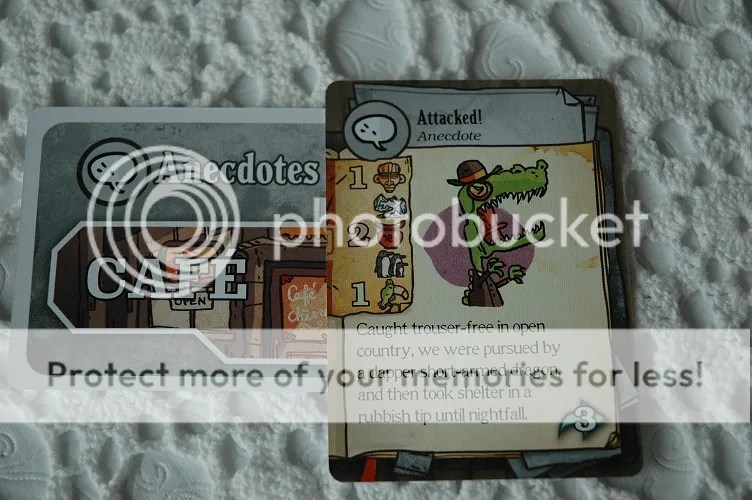
The cards are silly, creatively imagined, and often hilarious, discussing mythical events, explaining weird artifacts, and offering much-needed color to help sell your false tale.

All the while, you must dodge Professor Elemental, who is moving around the board investigating your shenanigans. If you end up in the same spot as him, you face a penalty (either losing a card or having every card in your hand drop one point each in value.)

[The game comes with these colored tokens (top), but you can opt for the slightly more expensive (& delightful) Meeples of the Professor & various faux adventurers (bottom).]

What makes this game such a puzzly treat is the mix of strategy and opportunity. You can take whatever cards you get and hit the Adventurer’s Club frequently to rack up smaller amounts of points more frequently, or you can bide your time and then hit the club less often for higher point values.

But either way, there’s always the looming threat of crossing paths with the Professor at a bad time and losing a key card or crucial points.

Plus, the map is different every game based on how you lay it out, so there’s a lot of replay value here.

Stuff and Nonsense is available from Cheapass Games for $25, and is featured in our Holiday Puzzly Gift Guide! What great fun.

[youtube https://www.youtube.com/watch?v=JuhGMA–r7M]


Thanks for visiting PuzzleNation Blog today! Be sure to sign up for our newsletter to stay up-to-date on everything PuzzleNation!

You can also share your pictures with us on Instagram, friend us on Facebook, check us out on Twitter, Pinterest, and Tumblr, and explore the always-expanding library of PuzzleNation apps and games on our website!

PuzzleNation Product Review: Pentdoku Puzzles

In today’s product review, we explore a clever and intriguing puzzle in the Sudoku vein: the Pentdoku puzzle. As you might’ve deduced from the name, pentdoku puzzles only use the numbers 1 through 5, but the unique design and less traditional solving rules make for a curious and more demanding solve than you’d expect.

Creator Dale Maron provided me with a copy of the first volume of his Pentdoku Puzzles collections. You would think that almost halving the number of options in a regular Sudoku would make this puzzle easier, but these puzzles offer just as much challenge, if not more, than the average Sudoku.

Let’s take a closer look at one of these colorful puzzles.

It’s essentially two puzzles in one, as the outer ring of pentagons is separate from the inner ring. Neighboring numbers in the outer and inner rings can be the same, which is an important distinction when it comes to solving. (As you can see in the upper left, where a 5 in the outer ring neighbors a 5 in the inner ring.)

You must place the numbers 1 through 5 in each of the pentagons in the inner ring. As you can see, each pentagon shares two triangle boxes with its neighbor on the left and two triangle boxes with its neighbor on the right. Standard Sudoku rules apply here, so no two neighboring boxes can have the same number inside.

You must also place the numbers 1 through 5 in each of the pentagons in the outer ring, and again, standard Sudoku rules apply. But unlike the inside ring of pentagons, there are no overlapping sections here. So how do you deduce where to place the other numbers?

That’s where the second rule of the outer ring comes in. Each six-block run like the one highlighted in green — which I think of as Batman symbols — not only contains all five digits 1 through 5, but they begin AND end with the same number.

So, in this particular Batman symbol, we know that it will both begin and end with a 3, and the numbers 1, 2, 4, and 5 will appear in some order between the two 3s.

But what about those shaded triangles scattered throughout the grid? Those are the only interaction between the inner and outer rings. The same number will appear in both yellow triangles, and that goes for the red and green triangles as well. And those little triangles often prove to be a huge solving aid in these puzzles.

With differing designs allowing for more open or more dense pentagon arrangements, there’s enough variety and challenge in this collection to keep solvers happy. And quite honestly, I liked having a brand of Sudoku that pushed me outside of my usual solving comfort zone. Moving away from the standard rows and columns layout had my brain working overtime to adapt to these new grids, and that is a big plus in my book.

My only caveat is that there are a few printing issues with the book. There are two blank pages where puzzles should be, and several blank pages in the back where some of the puzzle solutions should be.

You can check out Pentdoku Puzzles: Volume 1 in our Holiday Puzzly Gift Guide or on the Outskirts Press website, as well as all things Pentdoku at Dale’s website pentdokupuzzles.com. Thank you to Dale and Sonya for the opportunity to try out Pentdoku Puzzles!


Thanks for visiting PuzzleNation Blog today! Be sure to sign up for our newsletter to stay up-to-date on everything PuzzleNation!

You can also share your pictures with us on Instagram, friend us on Facebook, check us out on Twitter, Pinterest, and Tumblr, and explore the always-expanding library of PuzzleNation apps and games on our website!