PuzzleNation Product Review: Tak•tak

When it comes to strategy puzzle games, no matter how complex or how simple the actual game mechanics, the game itself hinges on the two players involved. After all, two extremely tactical puzzlers can make checkers look like chess.

Now, imagine a game that combines the pattern-matching of Uno, the strategy of chess, and the mechanics of Upwords, and adds a scoring element to boot. It might sound complicated, but I promise, it’s as simple as checkers.

Tak•tak is a two-player strategy scoring game designed by the folks at Twizmo Games, and it’s another puzzle game brought to life thanks to a successful crowdfunding campaign. Although Twizmo Games is best known for twisty puzzles (or Rubik’s Cube-style puzzles), they’ve taken a strong step into the traditional board game market with Tak•tak.

Each player starts with 12 tiles, each tile bearing a different score (10, 20, 30, or 40) and a different color (green, blue, or yellow). The two rows nearest the player form that player’s safe zone. The three rows in the middle are the war zone.

Your goal is to get as many points as possible into your opponent’s safe zone by stacking your tiles, crossing the war zone, and either capturing or maneuvering around your opponent’s tiles. You can only move forward (either straight or diagonally), so this is a game about tactics and initiative.

You build your stacks by matching either point values or colors. For instance, you can stack a yellow 20 and a yellow 40, or a yellow 30 and a green 30, and either of those new stacks would represent 60 points. This enables you to move more tiles around the board quickly. (But careful: once you’ve stacked tiles, they stay stacked for the rest of the game.)

But those matching rules also apply to your opponent’s tiles! When you and your opponent cross paths in the war zone, you can stack your tiles onto theirs and steal those points for yourself. (The stacks you make from your own tiles can only go three tiles high, but stacks made from your tiles AND your opponent’s tiles can go as high as you want! Heck, a stack might change owners several times and tower over the game board!)

The game ends when one player has no more available moves. (There are other ways to end the game if you choose to use the advanced game play rules, but we’ll stick with the basic rules for now.) And then it’s time to count your tiles.

You earn points for all of the tiles you’ve moved into your opponent’s safe zone (including any of your opponent’s tiles that are in stacks you control), plus points for any tiles your opponent never moved into the war zone. (Meaning they were never “in play.”) Highest score wins!

Tak•tak builds a lot of versatility and play possibilities into a game with checkers-simple mechanics, and the more you play, the more fun it is to delve deeper into tactics and strategy. It was worth losing 50 points for keeping a few tiles in my safe zone when they prevented a stack of my opponent’s tiles from scoring.

The clever mix of classic game-play elements not only makes Tak•tak so easy to dive into, but also ensures new players can more time actively playing and less time worrying about learning the rules (a common downfall for more complicated strategy games).

The designers claim the game is appropriate for ages 8 through 108, and I think they’re right on the money.


Thanks for visiting PuzzleNation Blog today! You can share your pictures with us on Instagram, friend us on Facebook, check us out on Twitter, Pinterest, and Tumblr, and be sure to check out the growing library of PuzzleNation apps and games!

PuzzleNation Product Reviews: Fluxx Dice and Adventure Time Fluxx

fluxxdice1

The flagship game of the Looney Labs brand, Fluxx, at its core, is a card game that mixes flexibility and strategy in gloriously chaotic fashion. The basic mechanics of Fluxx — collecting keeper cards in order to complete a certain goal — remain the same each time you play, but with constantly shifting rules and goals (as well as obstacles your fellow players employ), every time you play, it’s a brand new game.

And quite honestly, given how often the rules change during a game, I didn’t think Fluxx could get more chaotic.

Enter Fluxx Dice.

fluxxdice2

Fluxx Dice adds five cards to your Fluxx deck, and they all concern using (or not using) the two Fluxx Dice to change how many cards you draw per turn and how many you play per turn.

The addition of dice-rolling randomness to an already hectic game offers a level of unpredictability that even a well-shuffled deck cannot. Especially since a sufficiently tactical Fluxx player can often overcome the game’s inherent instability with the proper strategy. But no one can prepare for a chance roll of the dice!

Although I’ve only tried Fluxx Dice with the standard game, Batman Fluxx, and today’s other review product so far, I can confidently say that you will not believe how big an impact five little cards and two dice will have on your gameplay. What a terrific way to add a touch more luck and consequence to a game that already employs both so deftly.

This brings us to Adventure Time Fluxx.

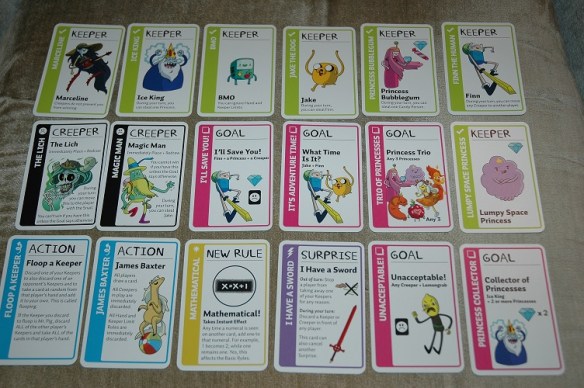
adventuretime1

[A small sampling of cards given the Adventure Time touch.]

Adventure Time is a Dungeons and Dragons-inspired cartoon show about a boy named Finn and his best friend, a shape-shifting dog named Jake, as they have adventures in the Land of Ooo. In a world populated by talking sweets, numerous princesses, and monsters galore, Finn and Jake must deal with the return of magic to the world and the aftermath of the Great Mushroom War.

As you can see, the show’s fingerprints are all over this themed Fluxx deck, and given that the show itself has a very strong “anything can happen” vibe to it, this is clearly a match made in heaven.

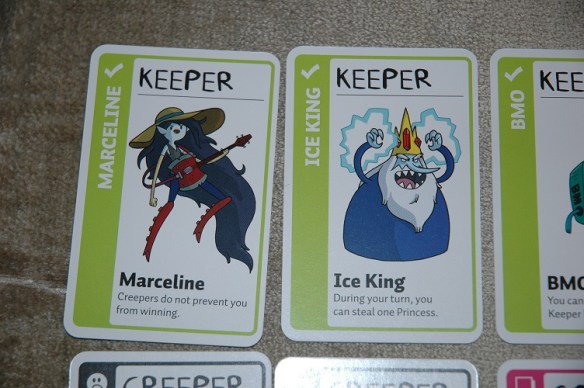
adventuretime2

[Two of my favorite characters become valuable Keeper cards in this edition of Fluxx.]

Although I hoped some of the cards would offer fans of the show gameplay incentives — akin to the Batman Fluxx card that rewarded players wearing something with the Batman symbol on it — my fellow players and I did come up with an appropriate Adventure Time-fueled variant.

Each time a keeper card was played, the person who played it had the opportunity to repeat a quote or popular line from that character. If they did so, they received either an additional card to be played immediately OR a roll of the Fluxx Dice to alter the current rules of the game.

For a show that rewards sharp-eyed attentive viewers with in-jokes and humor, this felt like a suitably Adventure Time-y wrinkle to add to the game.

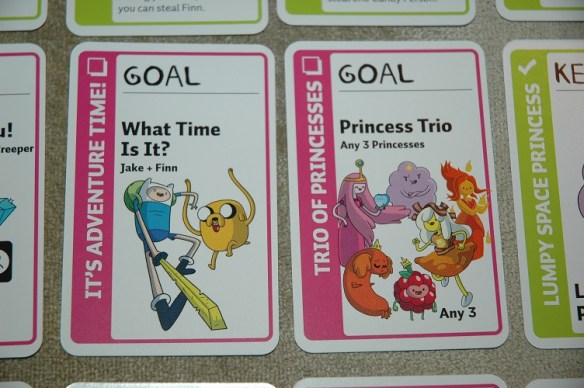
adventuretime3

The family of Fluxx games continues to grow, and although Adventure Time Fluxx didn’t really bring anything new to the table gameplay-wise, the immense charm of its themed cards and references to the show still make it a worthwhile addition to any Fluxx fan’s collection.

And as for Fluxx Dice, it may be a small set, but in terms of sheer gameplay impact, it packs one heck of a punch.


Thanks for visiting PuzzleNation Blog today! You can share your pictures with us on Instagram, friend us on Facebook, check us out on Twitter, Pinterest, and Tumblr, and be sure to check out the growing library of PuzzleNation apps and games!

PuzzleNation Product Review: Compose Yourself

Compose Yourself, ThinkFun’s latest offering, is unlike any product I’ve ever reviewed before, and that’s part of what makes it special. It is a single unending puzzle and a million different smaller puzzles all at once. It is literally as simple or as complex as you choose to make it.

You’re given sixty transparent cards (two copies each of thirty distinct note patterns). Each card features four different codes: one for the notes as they appear, one for the notes rotated 90 degrees, one for the notes backward, and one for the notes backward AND rotated 90 degrees. This allows for a staggering number of choices for a budding composer.

As you play around with placing the transparent cards in various order, you can log into the ThinkFun website and use the code provided to access a digital composing program.

[A picture of my first composition in progress…]

Input the codes from your layout of transparent cards in groups of four — as many as you wish! — and then click play. You can hear your new composition played on marimba, performed by an orchestra, or in both modes simultaneously!

Now, I confess, I am not a musically inclined person, but after fifteen minutes or so playing around with random cards — placing, flipping, reversing, and rotating them — I finally clicked play, and I was surprised by the results. (I’d unintentionally created a tune that felt perfect for the background of a Legend of Zelda game. *laughs*)

It feels like your work comes to life at your fingertips. And all you can think about is how to improve it, how to make the most of it, and how new cards will change it.

Each card represents part of a puzzle, and you may have no idea what the finished product will be, but that doesn’t make the process any less satisfying. This is old-school free-form creativity, like dipping your hands into a bucket of LEGOs, pulling out some pieces, and seeing what you can create.

ThinkFun has challenged us in the past with puzzlers like Houdini and Gravity Maze, and they’ve offered younger solvers the chance to learn coding in Robot Turtles and optics in Laser Maze, all while enjoying an experience that feels like play because it IS play.

But they’ve truly outdone themselves with Compose Yourself; it’s a learning experience, a creative experience, and a puzzly experience all at once. What a treat.

Thanks for visiting PuzzleNation Blog today! You can share your pictures with us on Instagram, friend us on Facebook, check us out on Twitter, Pinterest, and Tumblr, and be sure to check out the growing library of PuzzleNation apps and games!
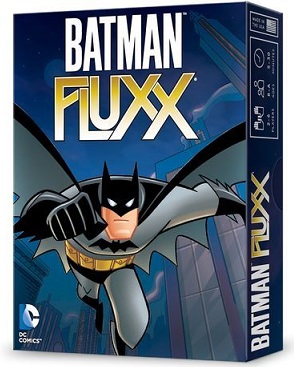
PuzzleNation Product Review: Batman Fluxx

batman-fluxx

The folks at Looney Labs specialize in games with high replay value and dynamic gameplay, and no game epitomizes their gaming spirit more than Fluxx. With its constantly shifting rules, goals, and actions, no two sessions of Fluxx are exactly alike, and with numerous variant games like Star Fluxx, Monty Python Fluxx, Holiday Fluxx and more, there’s no shortage of possible ways to keep the game fresh.

The latest addition to the Fluxx family of games is Batman Fluxx, and between the crafty creators at Looney Labs and Batman’s diabolical Rogue’s Gallery of villains, you AND the Dark Knight will have your hands full.

batfluxx2

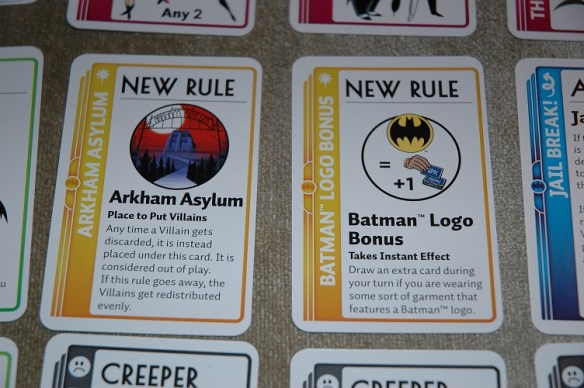
[There’s even a rule card that allows you to take advantage
by wearing something with Batman’s iconic logo!]

Now, anyone who has played Fluxx in the past is familiar with action cards, goal cards, keeper cards, new rule cards, and surprise cards. For those unfamiliar with the game, the basic idea is to collect keeper cards in the hopes of completing a goal and winning the game. But since every player can change rules (like how many cards you draw during your turn, how many you drop, etc.) as well as what the current goal is that will allow you to win the game, you have to be on your toes.

And Batman is the perfect theme for one of Fluxx’s most recent and ingenious innovations: the creeper card.

batfluxx4

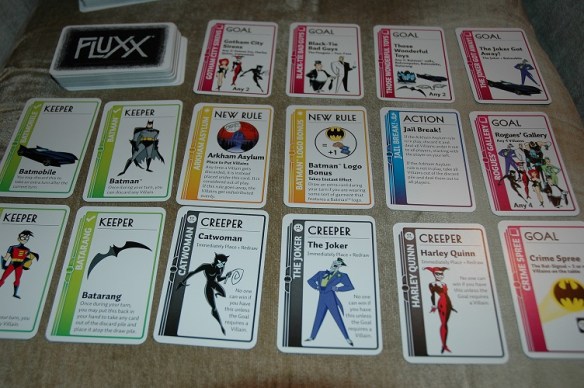
Creeper cards — featuring many of Batman’s most infamous foes, like The Penguin, Mr. Freeze, and Poison Ivy — prevent any player (including the player who plays that card) from winning the game, even if they’ve collected the necessary keeper cards to complete the current goal. So, much like Batman, you need to clean up Gotham City and get rid of all those villains before you can declare victory!

It’s a diabolical way to prevent the other players from winning (that is, unless they’re hiding a goal card that requires a villain!) and it surprised several experienced Fluxx players I know when we playtested the game.

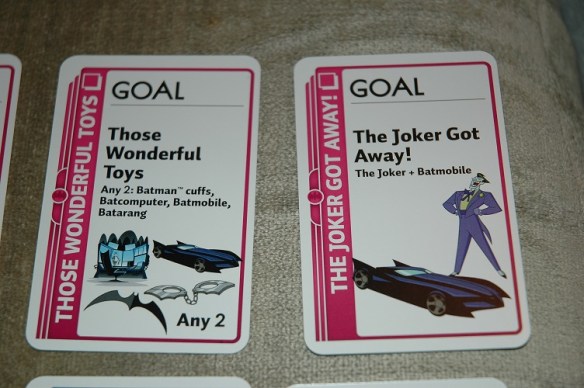
And the Batman-flavored Keepers and Goals are not only great fun, but clearly created with fans of the Caped Crusader in mind.

batfluxx3

[Those Wonderful Toys references Jack Nicholson’s famous line in the first Batman film, and The Joker Got Away! is a sly reference to the Batman-fueled variation of “Jingle Bells” that got many a child in trouble back in the day. Myself included.]

With art straight out of The New Batman Adventures cartoon series from the late ’90s, both the style and the nostalgia factor is here in spades. And yes, both Robin AND Batgirl are along for the ride. (No Nightwing, though, sadly.)

Nonetheless, this has quickly become my favorite version of Fluxx yet, and the Dynamic Duo have converted several other card game enthusiasts I know into Fluxx fans as well.

[To check out more Looney Labs games I’ve reviewed in the past, click here, here, here, and here!]


Thanks for visiting PuzzleNation Blog today! You can share your pictures with us on Instagram, friend us on Facebook, check us out on Twitter, Pinterest, and Tumblr, and be sure to check out the growing library of PuzzleNation apps and games!
PuzzleNation Product Review: Adorable Pandaring

Crowdfunding has significantly changed the world of puzzles and games by offering a new avenue for creators and fans to directly interact and determine whether a game or a puzzle suite becomes a viable product. Many puzzle constructors and game companies are using crowdfunding to both assess the public’s interest in a given game or puzzle AND to raise funds for an initial printing.

And in today’s product review, I’ll be giving the full PuzzleNation treatment to a card game born on Kickstarter and realized through crowdfunding. Let’s talk about Adorable Pandaring, created by Chris Cieslik and Asmadi Games!

In Adorable Pandaring, your goal is to gain bamboo by collecting as many adorable pandas as possible. The trouble is, everyone else is collecting pandas too, and the definition of adorable can change depending on the cards on the table! It’s panda law.

Each panda card has a value and an action. The value lets you know if the panda is adorable or not, depending on the panda law at the time. Sometimes high-numbered pandas are adorable, sometimes low-numbered ones are. Sometimes even-numbered pandas are adorable, sometimes odd-numbered ones are.

The action allows you to affect either an opponent or the game itself. You might gain bamboo, change the panda law, trade cards with an opponent, reveal hidden pandas… there are lots of options, some with exciting consequences.

This is a wonderful mix of poker-style strategy — which card information you share with your opponents and which you conceal — and Fluxx-style rule-shifting chaos. At any time, the panda law can change and your adorable pandas lose their value, or everyone’s hidden cards are revealed and bamboo is awarded.

[A random sampling of the super-cute pandas AND
several ways you can affect the game by playing them.]

And the art is delightful. The pandas are hilarious and, yes, adorable, whether they’re disappointed by dropped ice cream cones or looking sharp in secret agent tuxedo-wear.

Great fun for three to five players, Adorable Pandaring promises adorable pandas and delivers a lot more, making a terrific gateway card game for younger players and a delightful quick-play game for all ages.

(You can pick up a copy from the Asmadi Games store here.)

Thanks for visiting PuzzleNation Blog today! You can share your pictures with us on Instagram, friend us on Facebook, check us out on Twitter, Pinterest, and Tumblr, and be sure to check out the growing library of PuzzleNation apps and games!
It’s Follow-Up Friday: Indie 500 Puzzle edition!

Welcome to Follow-Up Friday!

By this time, you know the drill. Follow-Up Friday is a chance for us to revisit the subjects of previous posts and bring the PuzzleNation audience up to speed on all things puzzly.

May 30 marked the first (hopefully annual!) Indie 500 Crossword Tournament, hosted in Washington, D.C. by constructors Erik Agard, Peter Broda, Neville Fogarty, Andy Kravis, Evan Birnholz, and Finn Vigeland.

While I couldn’t attend the tournament, I did download the tournament puzzles, and after a few weeks, I had the opportunity to sit down and tackle the six puzzles prepared for the event. And today, after a few weeks’ reflection, I thought I’d offer my thoughts on those puzzles, both for the organizers and for any interested PuzzleNationers who might be considering participating in the future.

[Note: I solved the PDF versions of these puzzles, which apparently differed in some ways from the PUZ versions.]


Puzzle 1: Welcome to D.C. by Erik Agard

The opening puzzle offered a solid challenge, utilizing the colors for the various lines of the Washington Metro as clues for the themed entries. (For instance, “Red Line” led you to the answer BASE PATH.)

Agard’s effort set the tone for the rest of the tournament with a some accessible pop culture-fueled clues as well as a fleet of strong, fair clues most puzzlers should have no difficulty cracking. A few more obscure references were made — an Internet meme and a Hunger Games “ship” name among them — but without hindering fair cluing.

Interesting grid entries included GINSU, YOUSE GUYS, and NIQAB, and my favorite clue was probably “Summer’s end?” for TOTAL.

Puzzle 2: Looseness of the Vowels by Peter Broda

Broda’s puzzle incorporated shared boxes — some grid squares were divided in half, allowing two vowels to be placed instead of one — and answering each themed clue required a two-word phrase that shared every consonant.

(For instance, clue 52 Across read “With 52 Across, what David Ortiz practices that annoys his neighbors?” And the grid, once filled, read B[I/A]GP[A/I]P[IE]S, a.k.a. BIG PAPI’S BAGPIPES. This is why the clue cites itself in “With 52 Across,” so that the solver knows the answer word applies twice)

Those neat touches of wordplay weren’t the only tough crossings, however. The crossing of two unusual phrases in BE GENTLE with LAYS STAX actually forced me to abandon the puzzle at one point and return to it later to complete.

Interesting grid entries included TV CHEF, ICE KING, and VISA BILL, and my favorite clue was “Former red giant” for USSR. (Being a science and astronomy geek, I was instantly misled by this one.)

Puzzle 3: Candy Bars by Finn Vigeland

Finn was chosen as the guest constructor to join the five fierce puzzlers who organized the Indie 500, and I was thoroughly impressed with the very clever construction of his grid. In Finn’s puzzle, certain paired black squares were replaced with a graphic of a candy bar, and it was up to the solver to deduce that each entry, either down or across, that touched the candy bar was missing either C, Y, or both.

[The candy bars were in color in the PDF, but I printed them in b and w for solving.]

For instance, in this section of the grid, DIS and ALL (clued as “Checker, for one” and “Word after straight or male, in social justice conversations,” respectively) were actually DISC and ALLY when you added the CY. [Get it? CandY bar?] Similarly, REST and ALTA were actually CREST and YALTA, and the across entry CLING WRAP was actually the theme entry CYCLING WRAP.

This was my favorite of the six puzzles in the tournament, one with a great hook and excellent execution.

Interesting grid entries included SENIOR GALA, DOT GOV, OH BEHAVE!, and PT BOATS, and my favorite clue was easily “Brian who crosswords would have you believe is the only musician worth knowing (other than 97-Across, maybe)” for ENO. (97-Across was, predictably, ONO.)

Puzzle 4: A Cute Puzzle by Andy Kravis

After a pair of heavy-thinking puzzles, Puzzle 4 was an excellent palate cleanser difficulty-wise, complete with solid cluing and some fun entries. Kravis’s puzzle had solvers adding an accented E to the end of themed entries in order to complete them. For instance, “A giant leap for elephant-kind?” was JUMBOJETE.

A well-constructed puzzle (quite possibly designed to lure solvers into a false sense of security before Puzzle 5 walloped them), this was probably the most accessible puzzle of the six, one that casual solvers would quite enjoy.

Interesting grid entries included MINAJ, TEAM USA, KOOPA, and A-MINUS, and my favorite clues were the mildly-risque pair of “Prince Albert’s can?” for both ARSE and LOO.

Puzzle 5: Swap Meet by Neville Fogarty

Apparently, whether it’s the American Crossword Puzzle Tournament or the Indie 500, Puzzle 5 shall forever be a beast of a solve.

Fogarty’s puzzle was by far the toughest of the six, and I admit, it took me forever to uncover the hook: antonyms which crossed at the same starting box were swapped. For instance, 1-Across was “Numbskulled” for THICK and 1-Down was “Dilute” for THIN, but you had to place THICK as 1-Down and THIN as 1-Across.

Beyond that, challenging crossings like IDEA MAN and LAD MAG kept me guessing, and the creative grid entries left few crossword standards for any struggling solvers.

Interesting grid entries included ONE SEC, SHAKY CAM, FAIR GAME, XKCD, and IRISH STEW, and my favorite clue was probably “Number for the troops” for OVER THERE.

[Say, since we’re discussing crosswords, have you checked out the
Penny Dell Crosswords App? This concludes our shameless plug.]

Puzzle 6: The Final Lap by Evan Birnholz

The closing puzzle of the tournament was offered in two difficulty levels: the Inside Track (designated for solvers who finished in the top 25% of the field in a crossword tournament with published standings in the past 5 years) and the Outside Track (designated for everyone else). I opted for the Outside Track, then looked over the cluing for the Inside Track.

This themeless closer was no layup, though; no matter which track you were on, the cluing relied on solid trivia knowledge and classic puzzle-solving skill. (Kudos to Evan for crafting a solid grid with tough AND tougher clues. And for dropping a much-appreciated Army of Darkness reference in the Inside Track clues.)

Interesting grid entries included WHAT ON EARTH?, MOON UNIT, EDIT MENU, and PIE CHART, and my favorite clue (among many I quite liked) was probably “Things a benched player might work on during practice” for ETUDES.


Overall, I thought the Indie 500 was an impressive series of puzzles, rich with cleverness and style. Puzzle 5 easily rivaled ACPT’s Puzzle 5 in terms of difficulty, and the cluing was topnotch. I look forward to its return next year, and hopefully some of you will join me in accepting the Indie 500 challenge!

Thanks for visiting PuzzleNation Blog today! You can share your pictures with us on Instagram, friend us on Facebook, check us out on Twitter, Pinterest, and Tumblr, and be sure to check out the growing library of PuzzleNation apps and games!