PuzzleNation Product Review: Fidelitas

In today’s product review, we delve into a medieval world where courting influence wins the day and the best players can move people like chess pieces. Welcome to Fidelitas, a card game created by Green Couch Games and distributed by the good folks at Game Salute.

In Fidelitas, each player tries to manipulate characters into position around the city in order to accomplish specific tasks and gain valuable allies.

There are two sets of cards in Fidelitas: Missio cards and Virtus cards. Virtus cards allow you to manipulate the cards and maneuver characters into place, while Missio cards detail the tasks you must complete in order to earn points.

Virtus cards can affect how many cards you play that turn, where you can play them, and sometimes, where other players can play their cards. (Regular players of Fluxx or one of its many variations will be familiar with this sort of short-term rule-shifting gameplay.)

Different Missio cards have different point values, reflecting how difficult that card’s given task is. The player with the most points at the end of the game wins, having proven him or herself the master manipulator at the table.

Seven cards make up the City, the setting of the game. There are nine guild alignments (which work almost like the suits in a standard deck of cards), and several of the locations are tied to specific guilds. With many location-specific Missio cards, a strong knowledge of the City is crucial to advantageous gameplay.

Fidelitas is reminiscent of another card game I’ve mentioned in previous blog posts, Guillotine. But in Guillotine, you’re only manipulating the order of characters in a single line, whereas in Fidelitas, you’re dealing with numerous locations and plots in motion. It ratchets up the difficulty level somewhat, but the core mechanic remains simple and accessible, both key components to a great group card game.

It took me a few games to get the strategy of the game under my belt, since between trying to achieve my own Missio tasks and trying to hinder other players in their gambits, it was hard to be sure if the card I was playing would end up helping me or my opponents and their mysterious Missios.

If you’re hunting for a game with some historic flavor, look no further. This one will test your diplomatic skills as you try to sway people to your side, as well as your poker skills by seeing how well you can read your opponents and devise a plan to thwart their Missio cards from being completed.

Fidelitas incorporates a lot of quality gameplay elements in a small package, not only making it a great quick-play game, but one with more replay value than you’d expect.

Thanks for visiting PuzzleNation Blog today! You can share your pictures with us on Instagram, friend us on Facebook, check us out on Twitter, Pinterest, and Tumblr, and be sure to check out the growing library of PuzzleNation apps and games!

PuzzleNation Product Review: Houdini

Whether made of wood, metal, plastic, or rope, mechanical brain teasers can be some of the most challenging and well-crafted puzzles a solver will ever encounter.

Engaging both the solver’s deductive skills and patience, these puzzles often involve removing one key piece from an elaborate interconnected grouping, be it a ball from a seemingly solid maze of wooden posts or a heart from a web of unyielding metal linkages.

The cunning and clever brains at ThinkFun have put their own unique spin on the mechanical brain teaser with their latest product, Houdini, putting you in the legendary escape artist’s shoes and pitting you against numerous scenarios, all intended to keep the magician’s plastic namesake firmly trapped.

Although Houdini’s body and arms are one solid piece — representing his wrists being shackled together — his legs are felt, allowing you to bend and twist them in ways that replicate Houdini’s legendary flexibility. As the ropes are wound around and through both Houdini’s limbs and various obstacles designed to prevent his movement, it’s up to the solver to find the hidden loophole that will allow Houdini to escape scot-free.

With only a lock, a barrel, a solid ring, the three-looped base, and a few easy-clip ropes, ThinkFun has conjured 40 layouts of increasing difficulty, and I admit, some of these seriously taxed my puzzly skills.

The later puzzles involve multiple steps to free Houdini, utilizing tricks you’ve learned solving the earlier puzzles. It’s a brilliant slow-build solving experience, one that ThinkFun has employed with similar success with Laser Maze, Gravity Maze, and other products.

Houdini is not only a wonderful tribute to an entertainment legend, it’s a terrific puzzle toy that introduces a new world of brain teasers to younger solvers.

Thanks for visiting PuzzleNation Blog today! You can share your pictures with us on Instagram, friend us on Facebook, check us out on Twitter, Pinterest, and Tumblr, and be sure to check out the growing library of PuzzleNation apps and games!

PuzzleNation Product Review: Just Desserts

Whether it’s the speedy pattern-matching of Loonacy, the time-traveling strategy of Chrononauts, or the festive rule-shifting chaos of Holiday Fluxx, the folks at Looney Labs are constantly crafting new games that are visually engaging and offer high replay value. They sent us a copy of their newest card game, and we’re happy to give it the full PuzzleNation Blog treatment.

So, without further ado, let’s explore Just Desserts!

pic2453795

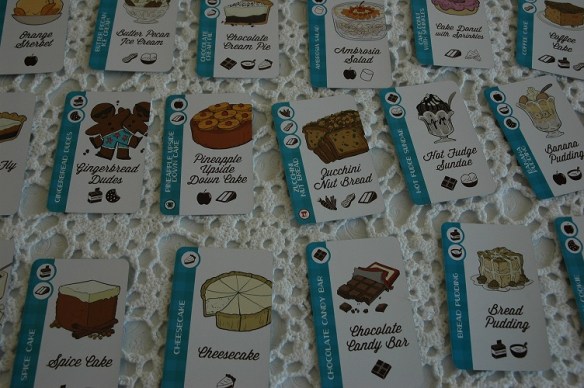
Just Desserts employs a similar game mechanic to Looney Labs’ flagship game, Fluxx: collect Keeper cards and be the first to match a pair of Keeper cards to the current Goal card.

In Just Desserts, you’re collecting Dessert cards and trying to match them to various sweet-toothed guests. You see, each Dessert card represents different ingredients that your guests enjoy or dislike. You want to play desserts that a given guest will enjoy, hoping to match each of their preferred ingredients without including an ingredient they hate.

justdesserts2

So, for instance, The Little Boy likes chocolate, cookies, and marshmallow, so you need Dessert cards representing each of those flavors. But he also has a favorite dessert: S’mores. If you had the S’mores Dessert card, you can cover all of his favorite ingredients with a single card, adding him to the happy guests you’ve collected, and earning yourself a bonus Dessert card.

The guests belong to six different-colored suits, and to win, you must collect three guests of the same suit or five of different suits.

And the relatively few Guest cards available — when compared to the massive number of Dessert cards you can collect — makes each guest a prized commodity.

justdesserts1

The simple game mechanic and wide variety of Dessert cards makes this not only a terrific introductory game for new players or younger players, but also gives the game great replay value, as you try new combinations of sweets to satisfy your picky guests and gather a winning array of cards.

From a puzzle point of view, scanning the various ingredients represented by the Dessert cards in your hand — not to mention figuring out the most economical way to employ them — and secure Guest cards effectively definitely makes for a fun, and constantly evolving, puzzle experience.

The one problem with this game? It makes me hungry.

Nonetheless, Just Desserts is a treat you can indulge in over and over without gaining a pound.


Thanks for visiting PuzzleNation Blog today! You can share your pictures with us on Instagram, friend us on Facebook, check us out on Twitter, Pinterest, and Tumblr, and be sure to check out the growing library of PuzzleNation apps and games!

PuzzleNation Product Review: Rush Hour Shift and All Queens Chess

ThinkFun has always specialized in games that educate as you play, from the optics and angles of Laser Maze and the chain problem-solving of Gravity Maze to the coding-for-kids gameplay of Robot Turtles and the mental agility challenges of their Brain Fitness line of puzzles-for-one.

Two of their newest products bring the best of those puzzles-for-one brain fitness games into the realm of head-to-head competitive solving for two players aged 8 to adult. And while All Queens Chess and Rush Hour Shift focus on two different styles of puzzle-solving, they both highlight the pluses of two-player puzzle games in their own unique ways.

Rush Hour Shift

There have been numerous variations on Rush Hour in the past, all of which center around the same tile-shifting mechanic: moving a series of cars around the board in the proper order to allow your car to escape the traffic jam.

Rush Hour Shift adds a new wrinkle to the puzzle by pitting two players head-to-head in a race to escape the traffic jam. But not only can players shift a personal car (known as the hero car) and the many cars in the way, they can also shift entire sections of the board in order to maximize their efforts to escape or thwart those of their opponent.

[Sometimes, you end up literally head-to-head.]

Your moves are dictated by the cards you draw from a small deck of options. You can either move a certain number of spaces, slide a vehicle as far as it will go before hitting an obstacle, or shift one side of the board or the other in order to create openings for yourself and further obstacles for your opponent. So not only are you solving an ever-evolving maze for your own car, but you’re trying to make your opponent’s maze more challenging.

My one caveat when it comes to Rush Hour Shift is that the game is incredibly dependent on which cards you draw. Between shifting the grid and moving both your hero car and all of the other cars, you have lots of options.

But if your opponent is drawing high-number cards and you’re not, there’s only so much you can do to slow them down or maneuver yourself in the hopes of staying in the game. A few good cards in a row can form a nearly insurmountable advantage.

That being said, Rush Hour Shift is a clever spin on a familiar formula, and a terrific way of introducing kids to the tile-shifting style of puzzle solving.

All Queens Chess

Many of the best games have extremely simple rule sets that still allow for major replayability and inherently complex gameplay, and All Queens Chess absolutely fits that bill.

You’ve got a 5×5 playing field, six queens each, and you’re trying to place four of your queens in a row Connect Four-style while preventing your opponent from doing the same. Each queen moves according to standard chess rules, except there’s no capturing of your opponent’s pieces. This puzzle game is all about placement and strategy.

And when you consider that the game pieces occupy nearly half of the playing area, it’s remarkable that there’s so much maneuverability and tactical potential in such a confined space.

Moreover, my expectation that, after a few games, the inability to capture and remove pieces from the board would prove tedious or frustrating was completely misproven. Six pieces is enough to strike a strong balance of offense (trying to place four in a row) and defense (preventing my opponent from doing so). I never felt locked into a few token moves.

This is a rare open-the-box-and-go puzzle game, and it’s an absolute treat.

Thanks for visiting PuzzleNation Blog today! You can share your pictures with us on Instagram, friend us on Facebook, check us out on Twitter, Pinterest, and Tumblr, and be sure to check out the growing library of PuzzleNation apps and games!

PuzzleNation Product Review: Puzzometry

In the past, I’ve reviewed a few products — Robot Turtles and The Maze of Games, for example — that were crowdfunded before reaching the open market, but today’s product is the first where I’ve completely observed the process from campaign launch to holding the product in my hands.

Today’s product review is Puzzometry, a jigsaw-style piece-placement puzzle with a serious challenge factor.

You’ve got 14 puzzle pieces to place into the frame pictured below, and there’s only one way to place every piece and complete the puzzle. Can you find it?

Created by Jim Fox, Puzzometry had a bit of a rocky road to realization. The initial Kickstarter campaign failed to meet its lofty goals, but Fox, who had remained totally honest and forthright with his backers from day one, reached out to his supporters and presented two possible options: either relaunch on Kickstarter with a lower funding goal or immediately shift all of his efforts to an e-commerce site.

In a close vote, the backers opted for another Kickstarter campaign, which was funded within an hour of launching! In fact, the second campaign was ten times more successful than the original campaign!

Puzzometry comes in three flavors:

  • Puzzometry, which has 14 pieces to fit into the frame
  • Puzzometry Jr., which is smaller and has only 7 pieces to fit into a smaller frame
  • Puzzometry Squares, which also has 14 pieces, but eschews the octagonal shape of many Puzzometry pieces for right angles and more Tetris-like shapes to fit into the frame

[A sampling of Puzzometry’s signature puzzle pieces.]

There’s only one solution that allows you to place every piece in the frame, and the difficulty is a credit to the game’s impressive design. The pieces are all interesting, interlocking in unexpected ways and challenging even savvy jigsaw solvers.

At this point, I’ve only solved Puzzometry Jr. and Puzzometry (I haven’t picked up a copy of Squares yet), and found them both to be great fun. Puzzometry Jr. will be an easy task for older solvers, but it’s a perfect fit for younger puzzlers to introduce them to puzzles beyond the jigsaw format.

Plus, Fox includes instructions for a two-player game called Puzzometry Keepout, which is similar to Blokus. Each player chooses pieces, as if they’re drafting players for a dodgeball team. Then, once all the pieces are allocated, the players take turns placing pieces in the frame. You take turns until someone can’t fit one of their remaining pieces into the frame.

All three versions of Puzzometry are now available on the Puzzometry website, so check them out. They’d make a fine addition to any puzzler’s library.

Thanks for visiting PuzzleNation Blog today! You can share your pictures with us on Instagram, friend us on Facebook, check us out on Twitter, Pinterest, and Tumblr, and be sure to check out the growing library of PuzzleNation apps and games!
PuzzleNation App Review: Hedgehog Gardens

Welcome to the another edition of PuzzleNation App Reviews! Today we continue our quest to explore the world of puzzly games and apps for your tablet or smartphone!

Our resident app player and puzzle fiend Sherri has another intriguing game for us today, so let’s get down to business and dive into her review of Hedgehog Gardens for iPad and iPhone!


Hedgehog Gardens is an iOS game that offers a cute twist on a simple counting game. But in this case, it isn’t so simple at all!

A pretty efficient hedgehog has taken up residence in the Back Garden. His goal, and yours, is to clear out all of the vegetables. To do this, you must number the tiles from 1 to 36, while following specific rules. In much higher puzzles, you must count even higher!

[Where would you place a 3 to continue the
hedgehog’s clockwise path around the garden?]

Each Back Garden puzzle is divided into four different sections, each of which is filled with a different vegetable. There are three rules to follow in order to clear the vegetables and number the tiles: you must move clockwise around the board, you must move in a straight line from section to section, and you can’t revisit a tile.

Now don’t panic about where to start because when you start a puzzle, some of the tiles have already been numbered. Your goal is to complete the puzzle by guessing the remaining numbers and having the hedgehog follow a path from 1 to 2 to 3 and so on.

Once you complete enough Back Garden puzzles, you open up the Orchard, which has its own set of rules. There are other sections you can open once you complete enough puzzles.

If you enjoy counting and Sudoku-type games, this is a great game to play. You get over 1,000 puzzles spread over several sections. However, all of the puzzles are not immediately available. The more you play, the more you open. The sheer volume of puzzles will keep a player busy.

Counting and Sudoku-type games aren’t really my thing, but I find myself playing a puzzle here and there because they are puzzling and almost soothing. They are a pleasant way to work the mind. And I have to admit, the rolling hedgehog is very cute.

Ratings for Hedgehog Gardens:

  • Enjoyability: 3/5 — If you enjoy Sudoku-type numbering games, this one is for you. The sheer number of puzzles, over 1,000, should keep you occupied for a quite a while.
  • How well puzzles are incorporated: 4/5 — The puzzles get progressively harder and bigger the later you go into each section. Since each puzzle has a unique solve, you really need to think and puzzle out how to complete each one, especially with the rule changes in other sections.
  • Graphics: 2/5 — They’re pretty basic, just static pictures related to each particular section. For example, pictures of vegetables in the Back Garden. The rolling hedgehog is rather cute.
  • Gameplay: 2/5 — It’s pretty much the same thing through all of the puzzles. There are different rules for each section, but you’re really just counting. There isn’t much variety.

Thanks for visiting PuzzleNation Blog today! You can share your pictures with us on Instagram, friend us on Facebook, check us out on Twitter, Pinterest, and Tumblr, and be sure to check out the growing library of PuzzleNation apps and games!