A-Ha Moments Stick in the Brain!

It’s one of the best moments in puzzle solving.

When all the pieces click into place brilliantly. When the wordplay is unraveled. When the cryptic crossword clue is deciphered. When the trickery behind the riddle is revealed.

That rush, that satisfaction that coincides with overcoming the clever, devious creation of another keen mind.

The a-ha moment.

And it turns out that the a-ha moment isn’t just significant for puzzly spirits, it’s biochemically significant as well.

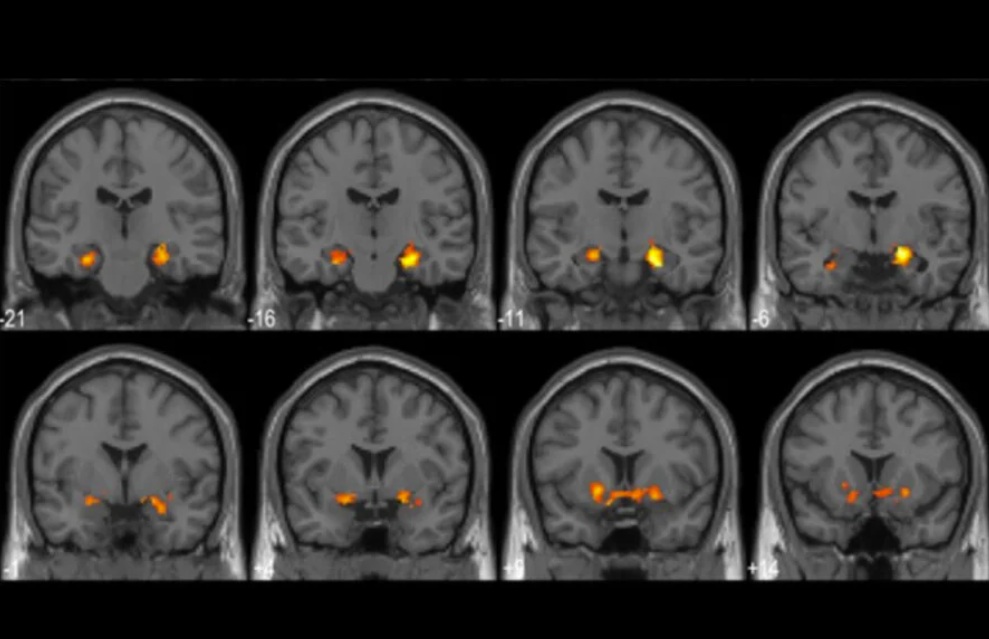
According to a study by Maxi Becker, Tobias Summer, and Roberto Cabeza, the brain remembers a-ha moments better than solutions reached through traditional methodologies.

From a report by Gizmodo:

As study participants solved brain teasers, he [Cabeza] and his colleagues recorded their brain activity with functional magnetic resonance imaging, a technique that measures changes in blood flow associated with brain activity. The brain teasers were visual fill-in-the-blank puzzles that revealed a previously hidden picture once participants completed the image.

And the brain activity resulting from an a-ha moment was comparable to the brain characteristics of important insight events. This means that the solutions derived from a-ha moments were remembered more clearly and with greater detail than those derived from traditional solving or process of elimination-style solving. Some of the solvers still recalled their a-ha moment solution a full five days later!

Researchers are already looking to revamp the ways we teach by utilizing techniques that inspire more a-ha moments, hoping that students will benefit more in the long term from inspiration-focused learning, rather than rote memorization.

Here’s hoping for more a-ha moments for all us! They’re good for the soul and good for the memory banks.

Happy puzzling, everyone!

Product Review: That’s Not a Hat

[Note: I received a free copy of this game in exchange for a fair, unbiased review.]

Most memory games are pretty simple, falling into one of two categories: you either observe a pattern and repeat it, or you look at multiple items and remember where they are when hidden/concealed.

Memory games that include a social mechanic are rarer, and memory games with a social mechanic AND bluffing are rarer still.

Imagine a white elephant or Yankee swap gift exchange, except in reverse. You know what all the gifts are to start, but then they are wrapped one by one and traded around, and you need to remember what’s inside each one.

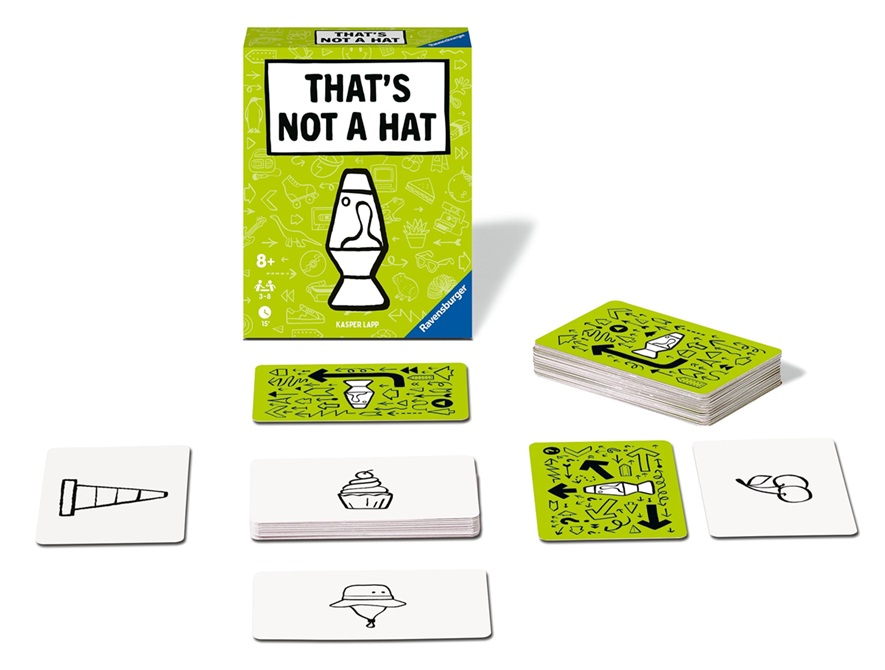
That’s the main idea behind Ravensburger’s social memory game That’s Not a Hat, and it’s brilliantly simple… until it is suddenly not so simple.

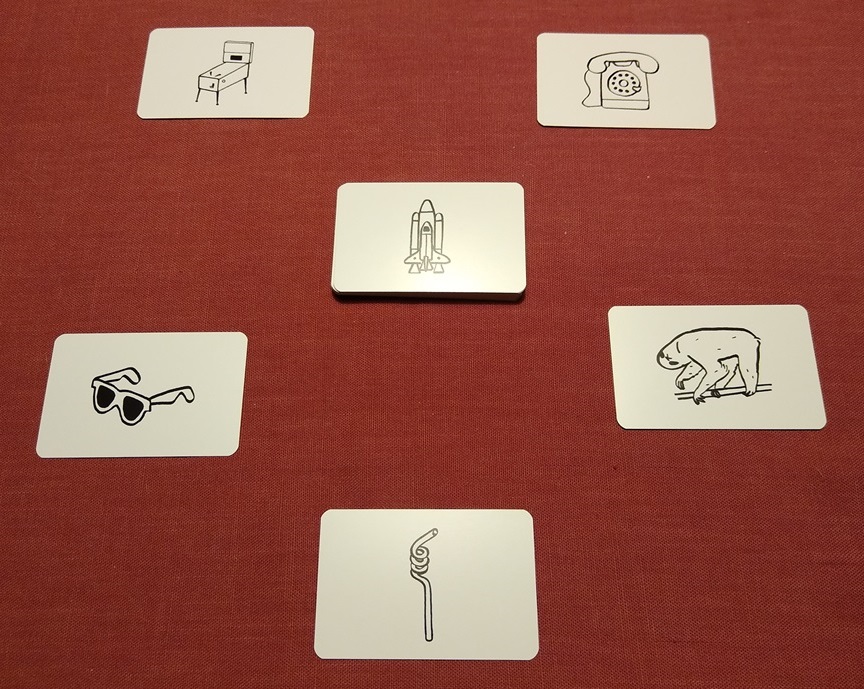
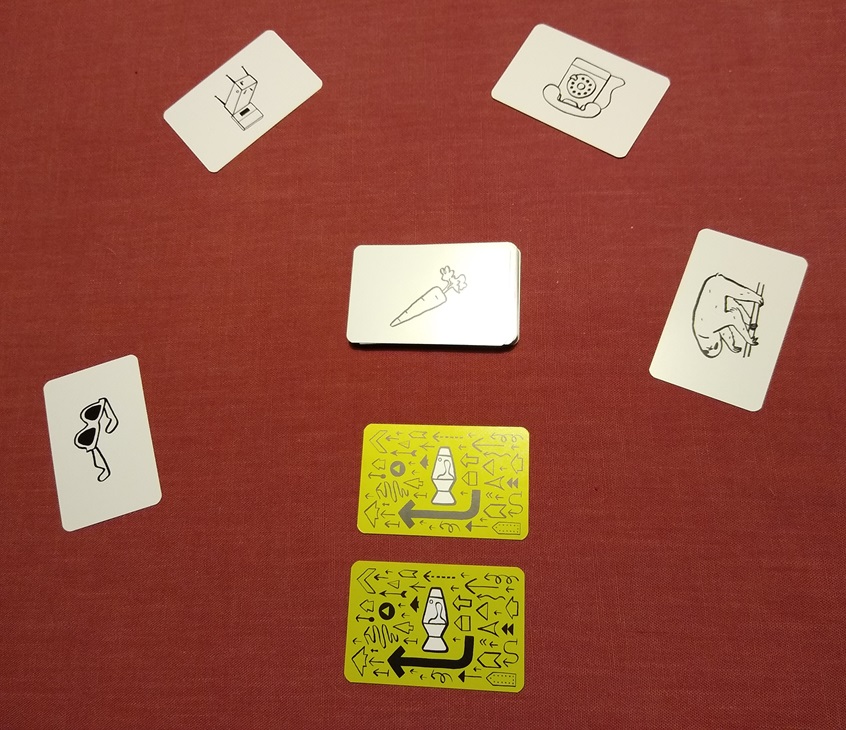
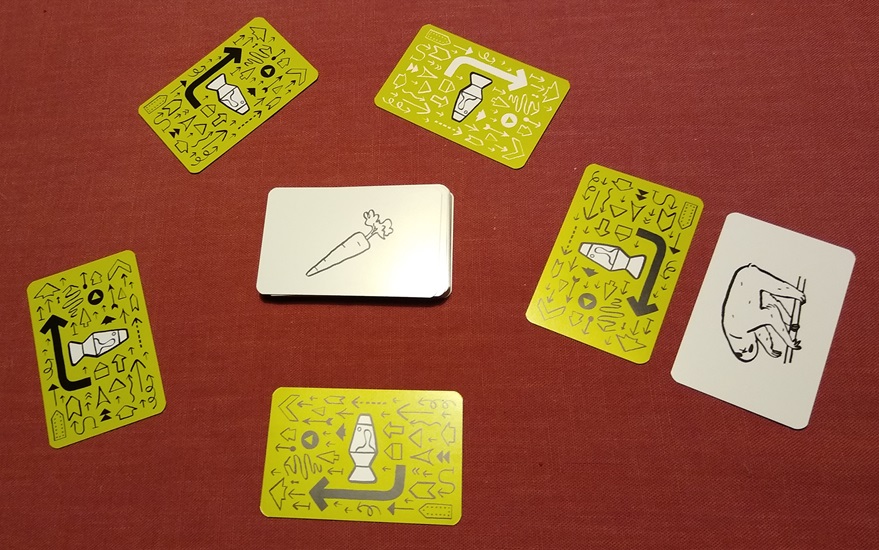
As you can see, everyone starts with a gift. The first player pulls a new gift from the stack in the center of the table, shows it to everyone, then places it facedown.

They then hand that gift to the player indicated by the arrow on the back of the card.

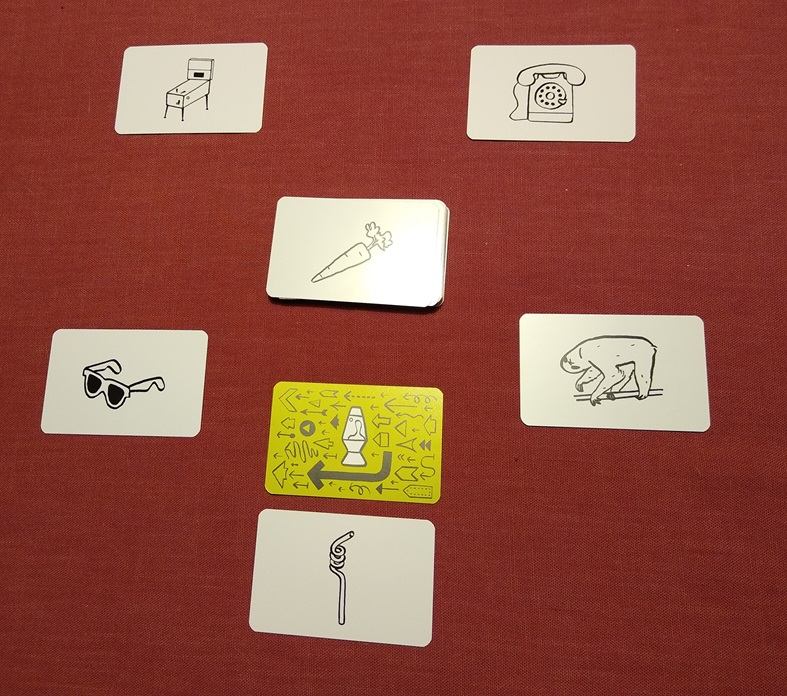
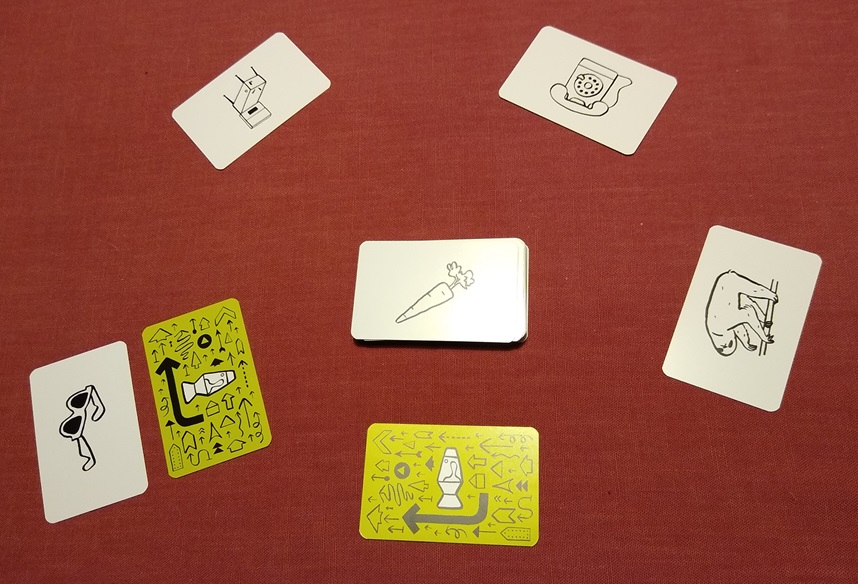
So the player to the right with the sloth card received the space shuttle, flipped it over, and handed it to the swizzle stick player to their left, saying “I have a nice space shuttle for you.”

The player receiving the gift has two options: accept the gift (meaning that they know it’s a space shuttle underneath and agree with the gift giver) or refuse the gift (meaning that they suspect the item underneath is NOT what the gift giver said).

In this case, the game has just started, so our swizzle stick player accepts the gift.

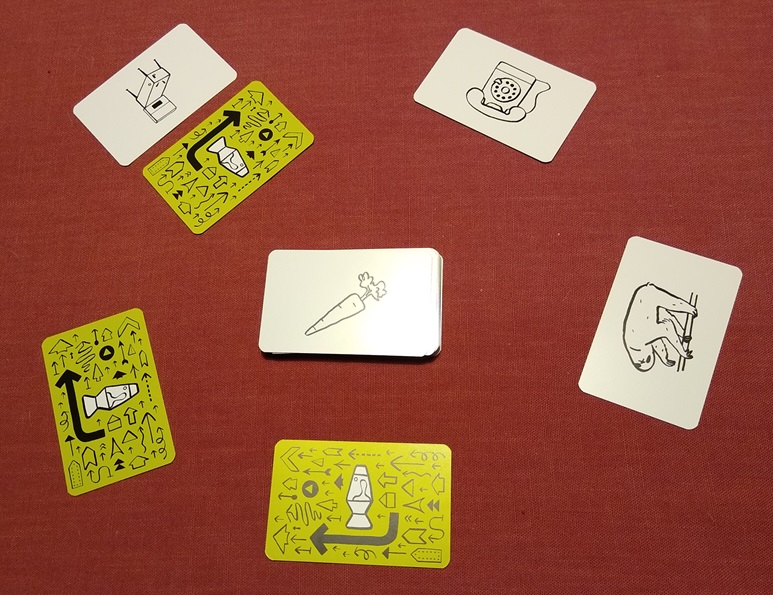
It would be rude to immediately regift what they were just given, so the swizzle stick player turns over their “old gift” and follows the arrow, saying “I have a nice swizzle stick for you” and giving that card to the player to the left (the sunglasses player).

The sunglasses player accepts, turns over their old gift, says their line, and follows the arrow.

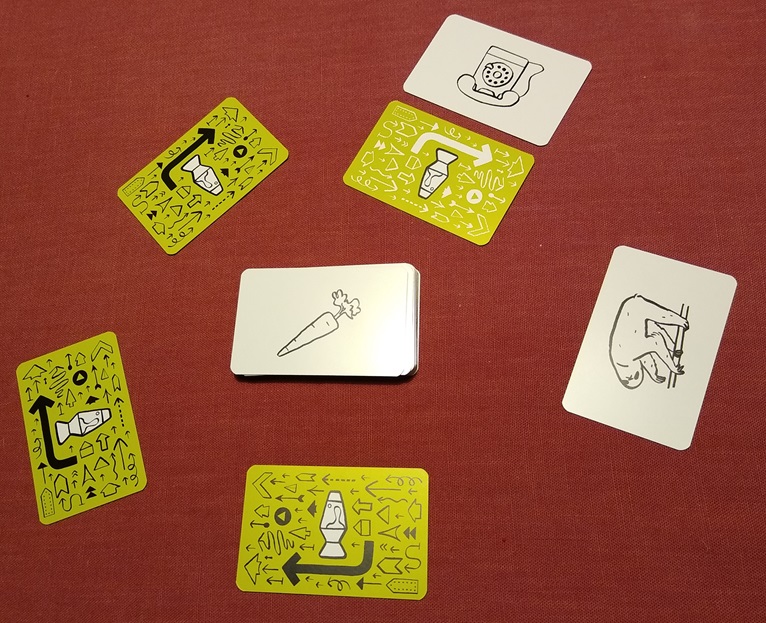
In this simplified version, the arrows only go in one direction, whereas in the regular game, arrows can go left or right (or, in the advanced play style, to any player, depending on the arrows).

Now, as the cards continue moving around from player to player, can you remember what was under all those cards? You’re gonna have to, because it gets harder and harder to remember what each card represents.

Eventually, someone is going to forget, and their “I have a nice __ for you” is going to be met with a refusal. If the refusing player is correct and the gift giver has forgotten what’s under the card, the gift giver takes that card and gets a point. If the refusing player is incorrect and the gift giver correctly remembered what’s under the card, then the refusing player takes the card and gets a point.

The game then resumes with a new present and all the previous cards STILL flipped over. The game ends when one player gets three points.


This combination of memory, interaction, and bluffing (if you forget what’s under your card) makes for a very fun, very mellow play experience, one that only grows tougher and more entertaining the more you play.

On the second game, I had so many images in my head from previous rounds that I immediately forgot what was under my card and earned a point.

With up to eight players at the table, 110 cards to choose from, plus mechanics to make the game easier or harder for the players, That’s Not a Hat is instantly replayable and never feels tired.

Now, you may start to worry about your memory before too long. It’s okay, though, because you’ll quickly be distracted by the laughter (and bad bluffs) to come.

[That’s Not a Hat is for 2 to 8 players, ages 8 and up, and it’s available from Ravensburger and participating websites (in two editions) starting at only $9.99!]

Puzzling and Brain Health Update: Crosswords and Jigsaw Puzzles

brain health

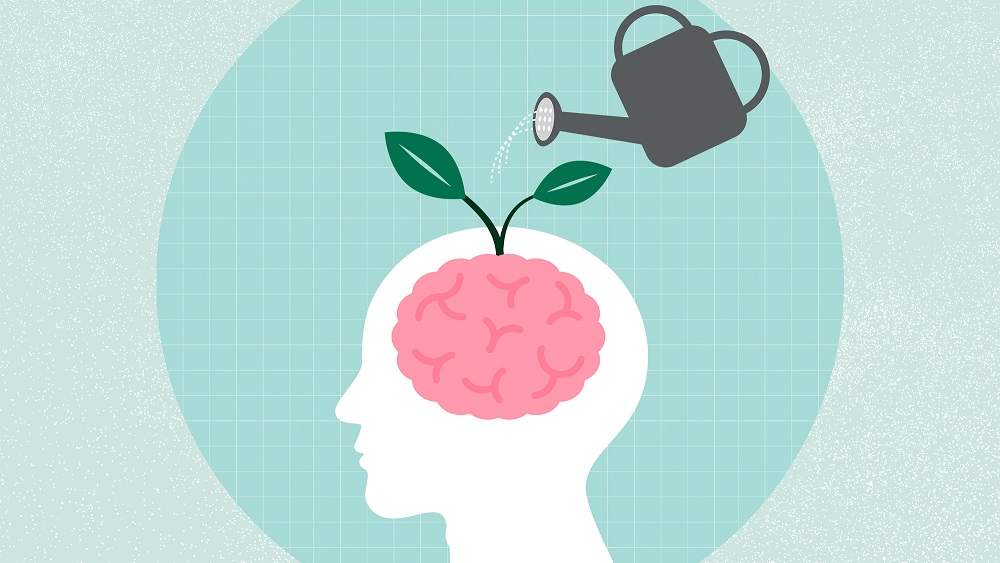
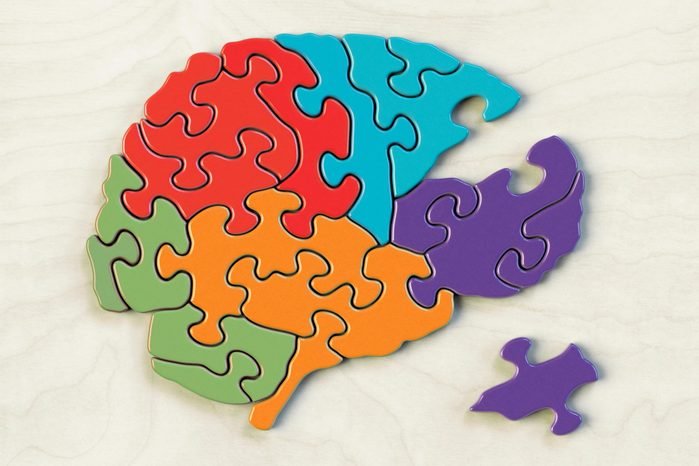
[Loads of images come up when you google “brain health” or “brain fitness,”
but I liked this one much more than all of the ones with brains lifting barbells.]

“Brain health.” “Brain fitness.” “Brain-training.” Ever since I started writing for PuzzleNation Blog, I’ve been chronicling the debate over whether solving puzzles makes a verifiable, detectable impact on brain function, development, and overall health.

There are plenty of puzzle magazines, apps, websites, and services that claim to help with brain fitness. Some make vague assertions related to memory, mental flexibility, and other cognitive functions. Others are insanely specific, promising to reverse the aging process or to help prevent the onset of dementia and other cognitive difficulties later in life.

(Examples of the latter style of advertisement are rarer these days after Lumosity’s two-million-dollar payout for falsely advertising that their puzzle games could “reduce or delay cognitive impairment associated with age and other serious health conditions,” as well as “stave off memory loss, dementia, and even Alzheimer’s disease.”)

cogs-in-the-shape-of-a-human-brain-ryger

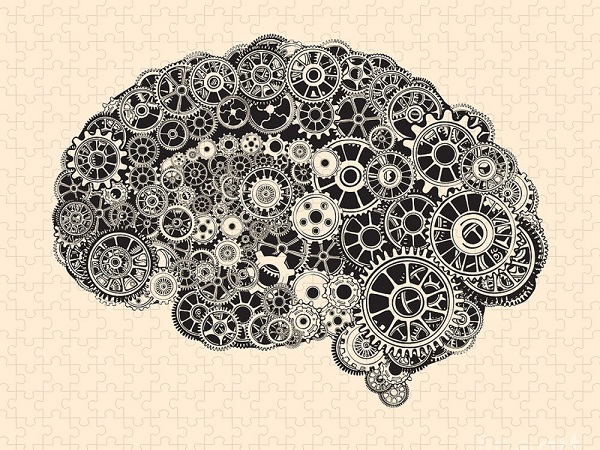
[This puzzle by Ryger can be found here!]

Whether we’re talking short-term or long-term benefits to brain health from puzzling, you’ll find dozens of articles online arguing both sides. Unfortunately, so much of the data out there is inconclusive, or is hindered by test groups too small to be applicable to the general population.

However, the positive, verifiable data we can find is encouraging.

Tetris has been used by researchers to help people suffering from traumatic flashbacks, a type of post-traumatic stress. The University of Exeter conducted a study involving more than 19,000 participants that concluded that adults age 50 and older who regularly solve puzzles like crosswords and Sudoku have better brain function than those who do not.

(While 19,000 is still relatively small when compared to millions upon millions of adults over 50, it’s still one of the largest test groups yet assembled for brain health studies related to puzzles.)

dory

And while people are always discussing short-term memory or long-term memory and how they relate to puzzle solving, it turns out there’s a middle ground between the two that crosswords may have a positive effect on. An article from Scientific American last year discussed how crossword solving engages the episodic buffer, one of the mechanisms related to our working memory, our ability to temporarily hold information while performing cognitive tasks.

Most cognitive activities engage the working memory through either verbal components or visuospatial components. (Visuospatial means how we perceive the relationships between different objects in multiple dimensions). But as it turns out, while playing Scrabble or solving crosswords, both visuospatial and verbal components are utilized by the short-term memory.

Of course, this is preliminary work, and there’s so much more to learn about short-term and long-term memory, but apparently, wordplay like Scrabble and crosswords could have a unique effect on how our working memory functions. That’s pretty cool!

But they’re not the only puzzles that we’ve discovered some fascinating new details about. Jigsaw puzzles can have a positive effect on the brain during the solving process.

BrainGames-scaled

Now, like crosswords and Sudoku puzzles, jigsaw puzzles have been the subject of several articles claiming they can help with brain health (or even decrease the presence of Beta-amyloid protein in the brain, a major component of the plaque that indicates Alzheimer’s disease). But I cannot verify those facts in scientific journals to my satisfaction, so I’m tabling that part of the argument.

What I do want to talk about it is how jigsaw puzzle solving can induce a mental state similar to dreaming, one that helps with stress, relaxation, and mood.

The company Sanesco Health is heralded as an industry leader in neurotransmitter testing, and according to an article on their site, placing those tricky little pieces in the right places can do you a world of good:

The connections made while working on jigsaw puzzles aren’t limited to our brain cells. Exercising both sides of the brain simultaneously also allows the brain to move from a Beta state, the wakeful mind, into an “Alpha” state, the same mental state experienced while dreaming. The Alpha state is where we tap into our subconscious mind.

Jigsaw puzzles naturally induce this state of creative, focused meditation, where connections can be made on deeper levels. And that release of dopamine with every puzzle piece you successfully place is an added bonus! Dopamine causes improved motor skills, an increase in concentration, optimism, confidence, and an enhanced recollection.

[Imagine how restful she felt after this!]

Considering that jigsaw puzzle sales spiked during the pandemic — with some outlets reporting sales increases of up to 500% — it sounds like people were either consciously or subconsciously making the perfect choice to cope with the stresses of lockdown.

As always, we’ll keep our eye out for any additional data on these findings.

But in the meantime, happy puzzling! It might be good for you!


dailypopwsicon

Well, summer’s over, but we still have deals galore for you to check out. You can find them on the Home Screen for Daily POP Crosswords and Daily POP Word Search! Check them out!

Thanks for visiting PuzzleNation Blog today! Be sure to sign up for our newsletter to stay up-to-date on everything PuzzleNation!

PuzzleNation Product Review: 13 Monsters

13monsters0

It’s nearly Halloween, and monsters are a seminal part of the season’s festivities.

Maybe you’re hunting them alongside Buffy, the Winchester brothers, or agents Mulder and Scully. Maybe you’re trying to survive them, like any number of nubile teens at parties, secluded cabins, lakeside retreats, or after hours at the school.

Or maybe, you’re making them.

There’s a grand tradition in pop culture of monster-making, from Dr. Frankenstein and Dr. Moreau to Rita Repulsa and Mr. Sinister.

And who hasn’t wanted to make their own monster at one time or another?

13monsters5

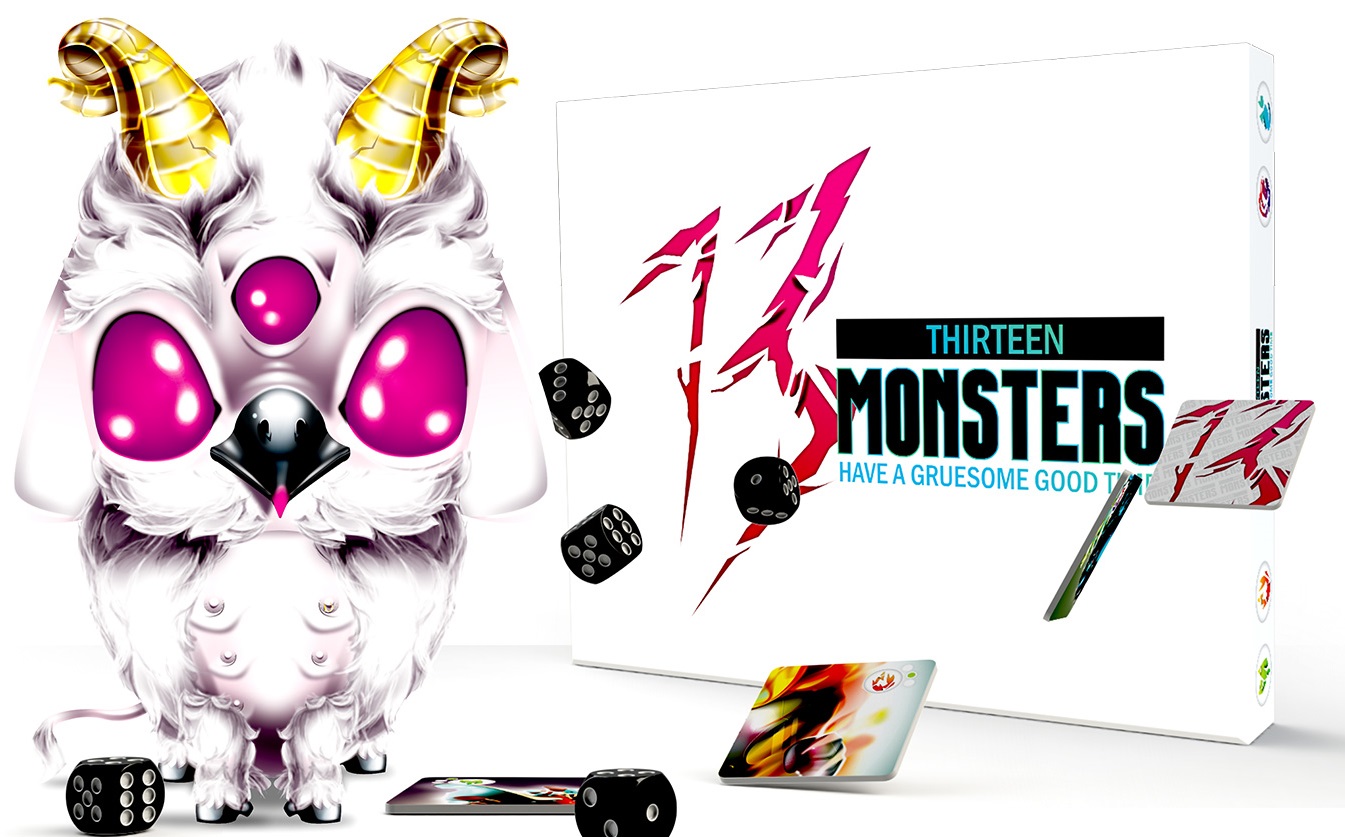
Well, you get your chance in 13 Monsters, a cutesy-spooky build-’em-and-fight-’em game with a load of skill and a little luck required.

13 Monsters combines the attentiveness of Memory, the dice-rolling skills of Yahtzee or Tenzi, and the tactical timing of Bears Vs. Babies or Fluxx to create an enjoyable gameplay experience that’s more fraught with tension than you might expect from a game featuring such heartwarming big-eyed monsters.

13monsters2

And while we’re on the subject, the art for these thirteen monsters is out of this world. The creatures are visually striking, gorgeously rendered onto the tile pieces, and so vivid that they practically pop out into 3-D.

Each has a distinct flavor, adding horns, fangs, wings, and all sorts of tiny details to hint at the deeper, darker worlds they might inhabit. I cannot say enough good things about the art direction behind this game.

13monsters7

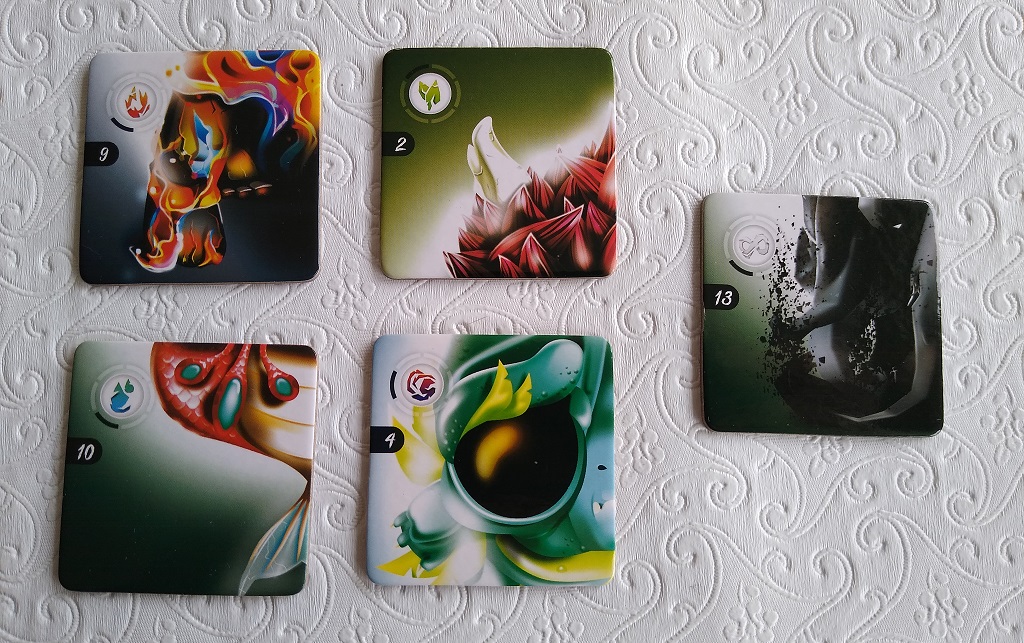
The game starts with a 9×9 grid of tiles, all face down. The pieces of thirteen different monsters are scattered across this grid, and you must find matching pairs of monster pieces to build your gruesomely adorable fighters. If you flip two tiles and they don’t match, your turn is over.

13monsters8

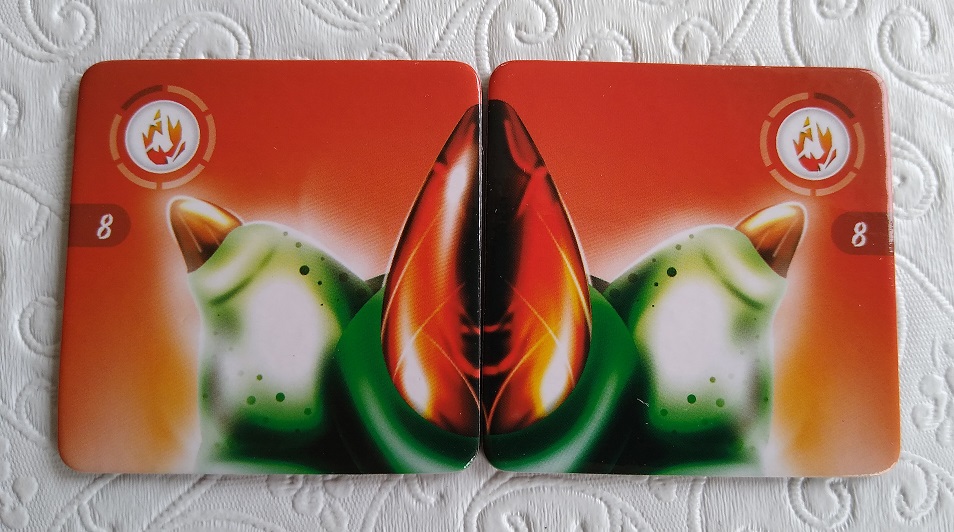
Once you locate a pair — the two tiles making up the top of the head, the two tiles making up the eyes, or the two tiles making up the body — you place it in the play area in front of you, and you may draw again. You can keep drawing until you fail to make a match.

13monsters6

If you have all three sets — no matter if they’re from the same monster or their element symbols match — you combine them to form a full monster.

13monsters1

Once you have a full monster, you can attack your opponents with the goal of taking one of their matched pairs for yourself. (This is one way to assemble a complete, matching monster.)

Different monster combinations have different powers as well, depending on how many of your sets match. This can grant you the power to swap parts between your monsters, freeze tiles on the memory board to prevent other players from taking them, or look at additional tiles on the memory board.

13monsters4

As you can see, there’s a lot going on at once, and the more monsters you assemble, the more options you have available. You need to keep track of what tiles have been revealed, what pairs your opponents have, what pairs you need, how dangerous their monsters are, and how dangerous your monster is. (There’s also the threat of the thirteenth monster out there, which is the most powerful.)

Testing your memory, your ability to assemble the best monster from the pieces you have available, and gauging when to strike for maximum effect, this game will keep board gamers and puzzle fans alike on their toes.

13monsters3

We were impressed by how much gameplay was packed into what seemed like a simple memory/combat mashup game. The wealth of options available, the stunning artwork, and the addictive gameplay quickly made it a hit at the gaming table.

Plus the relative family friendliness of the monsters ensured that younger players could get into the game as well, exposing themselves to several different gameplay styles all at once.

While it may remind you of Dr. Frankenstein’s famous creation, 13 Monsters is no cobbled-together stroke of luck. It’s a well-assembled machine.

[13 Monsters is available from 13-monsters.com and select European outlets.]


Thanks for visiting PuzzleNation Blog today! Be sure to sign up for our newsletter to stay up-to-date on everything PuzzleNation!

You can also share your pictures with us on Instagram, friend us on Facebook, check us out on TwitterPinterest, and Tumblr, and explore the always-expanding library of PuzzleNation apps and games on our website!

PuzzleNation Product Review: Chicken War

chicken war header

[Note: I received a free copy of this game in exchange for a fair, unbiased review. Due diligence, full disclosure, and all that.]

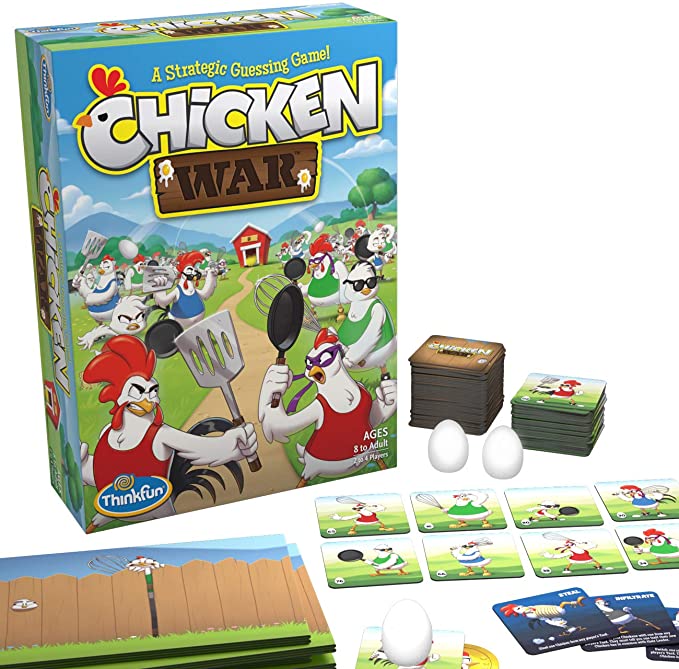
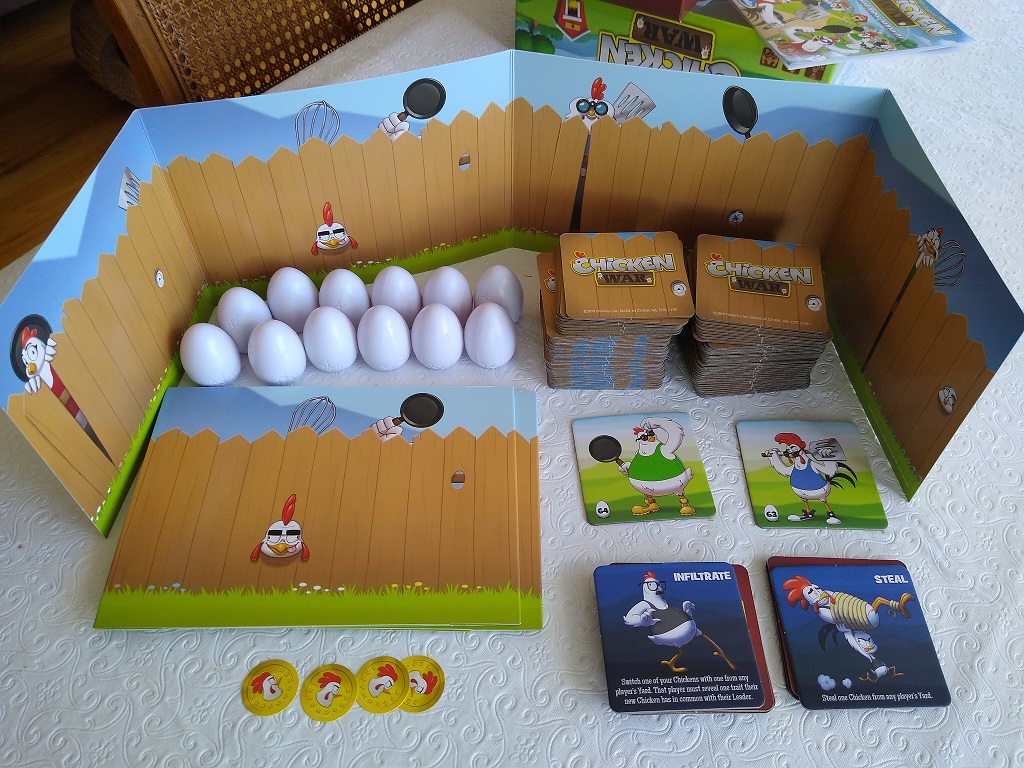
The farm is no longer the quiet, idyllic escape you pictured when learning the sounds barnyard animals make. Instead, it has fallen to factional fury and un-cooped combat between various groups of chickens vying for victory. Such is the setting for ThinkFun‘s latest brain-training game, the colorful and crafty tile game Chicken War.
chickenwar1

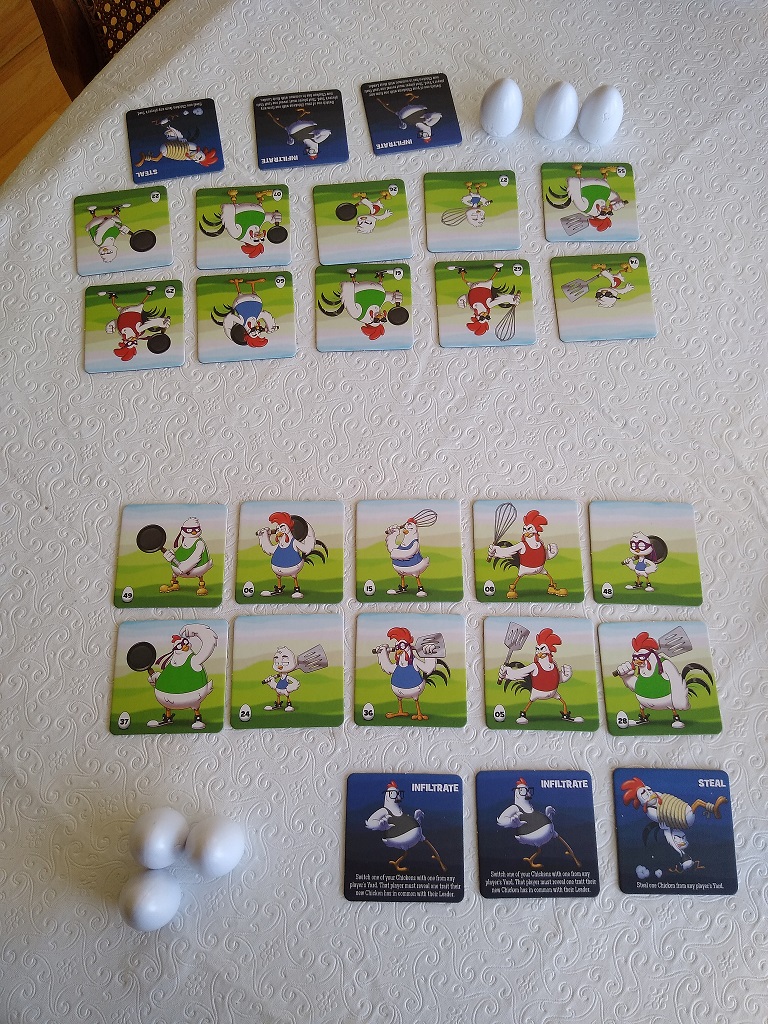
There are two ways to win Chicken War. You can either be the last player standing or the first player to complete their army. To be the last player standing, your opponents’ leaders must be identified. To be the first player to complete your army, you have to have nine other chickens with two traits in common with your leader.

As you can see, Chicken War’s hybrid style of play combines the player observation of a game like Throw Throw Burrito or Scrimish with the deductive reasoning of a game like Clue.
chickenwar2

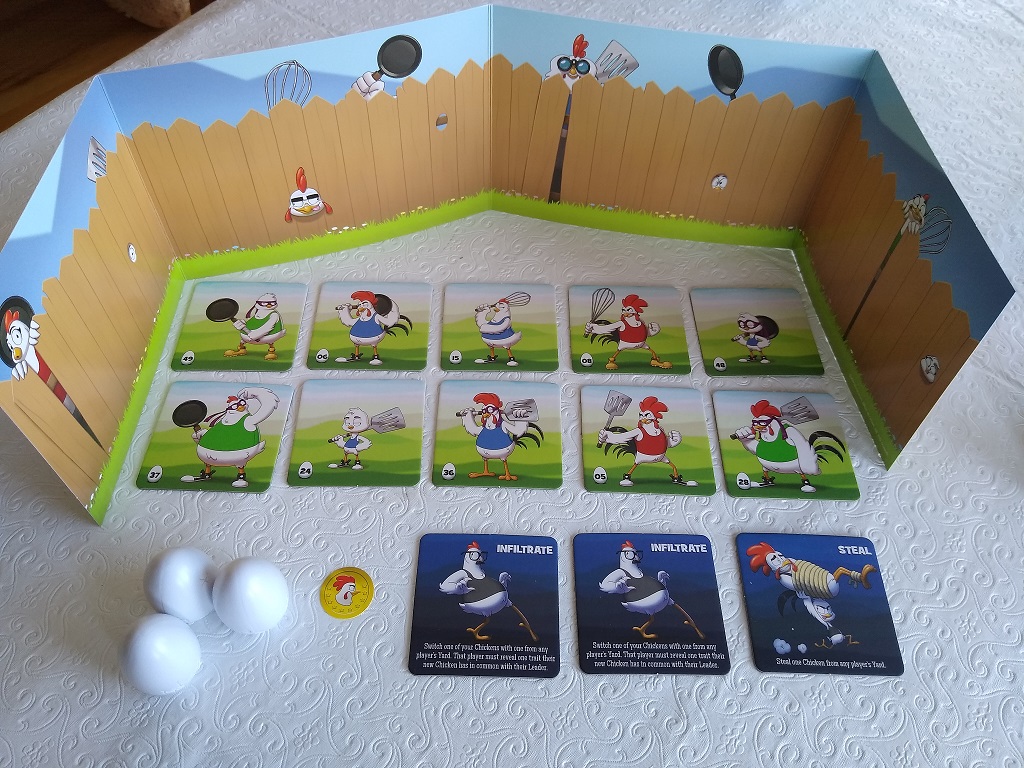
Each player is trying to recruit chickens for their army, and must do so in full view of the other players. This means that you have to strategize not only your recruitment process, but how to do so without revealing too much to your opponents. Plus you have to do all that while keeping an eye on your opponents’ efforts to recruit!

First, you select your leader from the ten starting chickens in your yard. Optimally, you’ll pick a leader where many of the other starting chickens already share two traits, which gives you a leg up in building your army.
chickenwar3

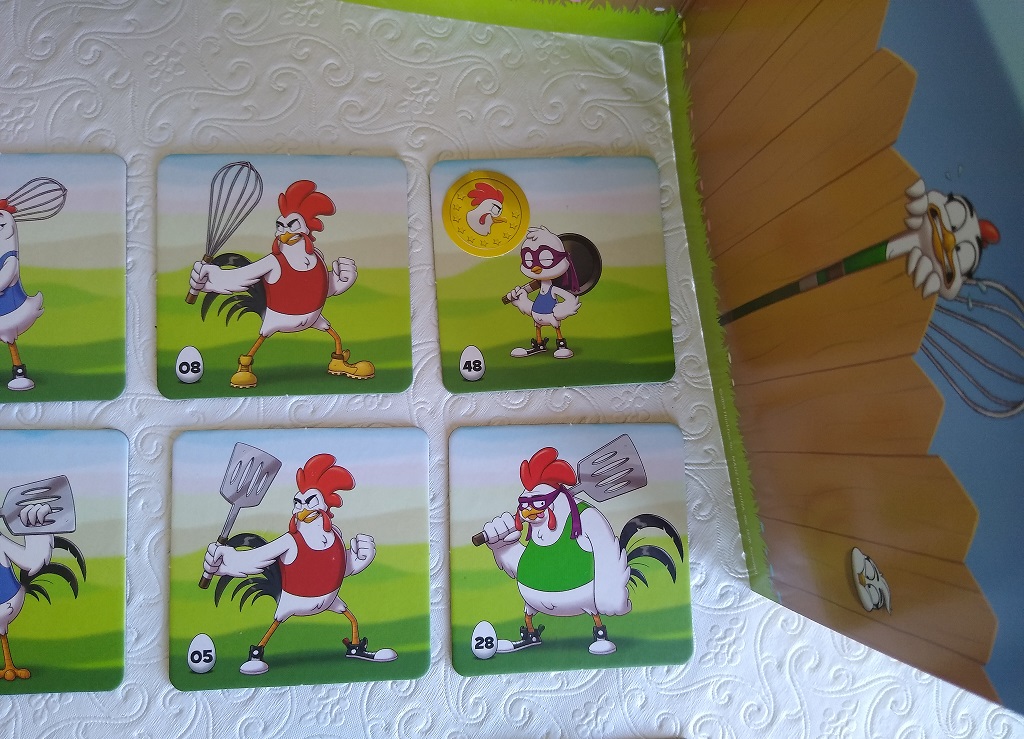
You’ll hide your leader token under that particular chicken to mark it, using your screen to do so away from the prying eyes of other players.

Remember, that’s two traits and only two traits in common.
chicken war trait

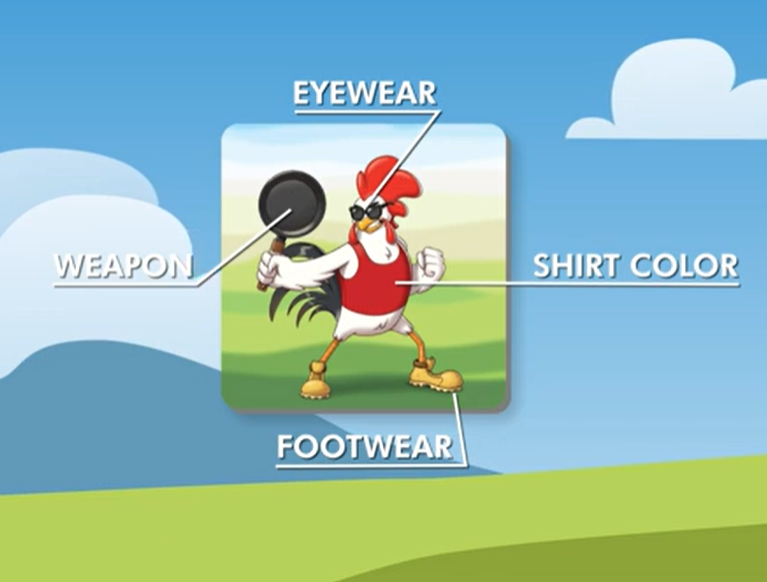
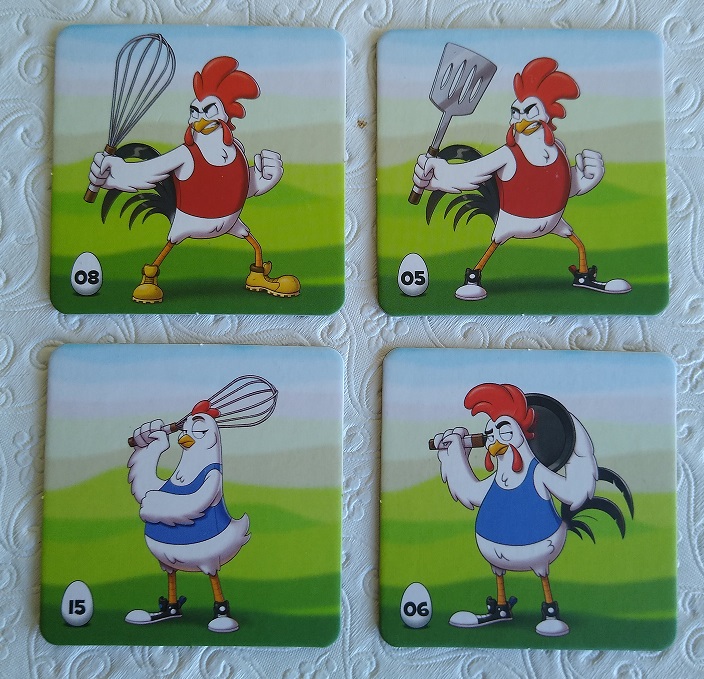
The four possible traits, as shown above, are weapon, shirt color, eyewear, and footwear. Each trait has three variations. For instance, shirt color can be blue, red, or green. Eyewear can be sunglasses, mask, or none.

(Keep those four traits in mind. Body type, pose, and style of tail are all irrelevant, but can be distracting.)
chickenwar9

As you can see here, the top two chickens have two traits in common: shirt color and eyewear. (Footwear and weapon differ.) The two bottom chickens have three traits in common: shirt color, eyewear, and footwear. Therefore, if 05 and 06 are leaders, 05 has a recruit, but 06 does not.

How do you recruit chickens? By drawing from the discard pile. You either keep the new chicken and discard one of the chickens from your yard, or you immediately discard the new chicken.
chickenwar4

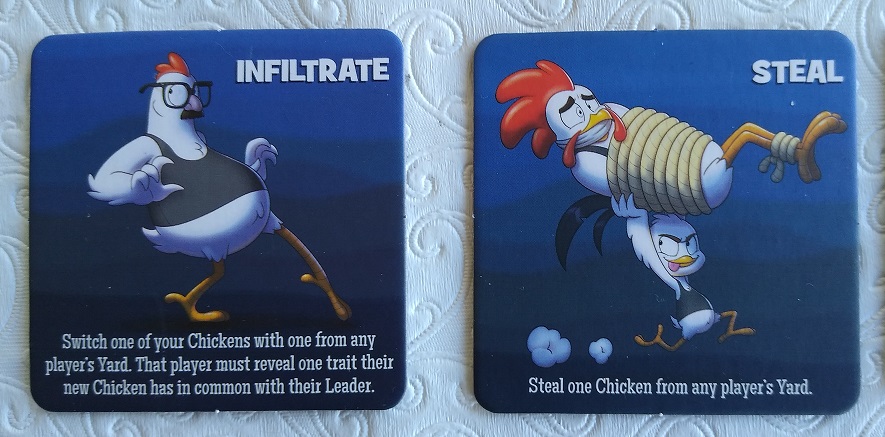
The only other ways to recruit chickens are to use the two special tiles: steal and infiltrate.

Steal lets you take a chicken from another player’s yard and discard one of your unwanted chickens into the discard pile. This not only gives you a new chicken, but leaves your opponent one chicken short. This can be a strategic advantage, because any player with fewer than 10 chickens can’t lob an egg and cannot win the game, even if their remaining chickens all match the leader.
chickenwar8

Infiltrate allows you to swap one of your chickens with one of your opponents’ chickens. That player must then tell you one trait your chicken (the one placed in their yard) has with their leader. If there are no traits in common with the leader, they must tell you that instead. And if you accidentally trade for their leader, they must pick a new leader and start over. So in any case, you gain a new chicken and important knowledge about your opponent’s game.

If multiple players gang up on a single player, the Infiltrate card can prove very dangerous, eventually outing the player’s leader and making them easy pickings for an egg and elimination from the game. (This tactic is more likely to catch new players, as more experienced players would endeavor to repeat the same revealed trait over and over, whenever possible.)

So each turn, you must either draw a chicken from the discard pile or lob an egg.
chickenwar5

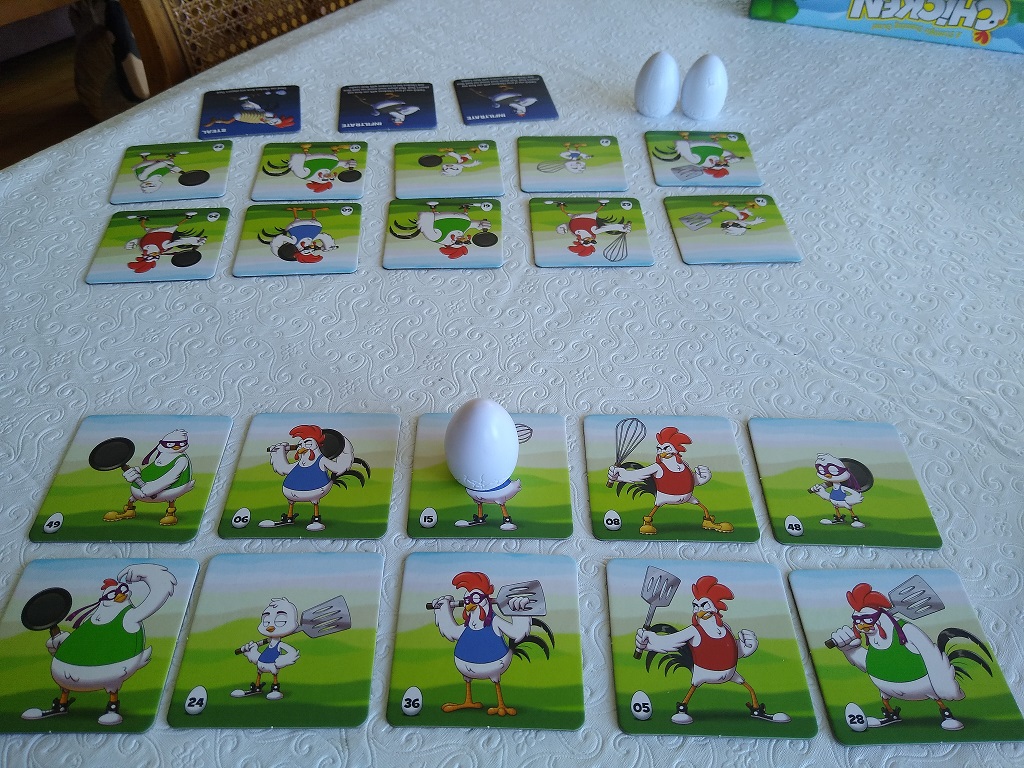
Lobbing one of your three eggs means you place your egg on a chicken in another player’s yard that you suspect is their leader. If you’re correct, that player is out.

But if you’re wrong, you lose an egg and have to discard two chickens from your yard, leaving yourself two chickens short of victory. (Also, as we stated before, you can’t win the game or lob an egg with fewer than 10 chickens in your yard.)
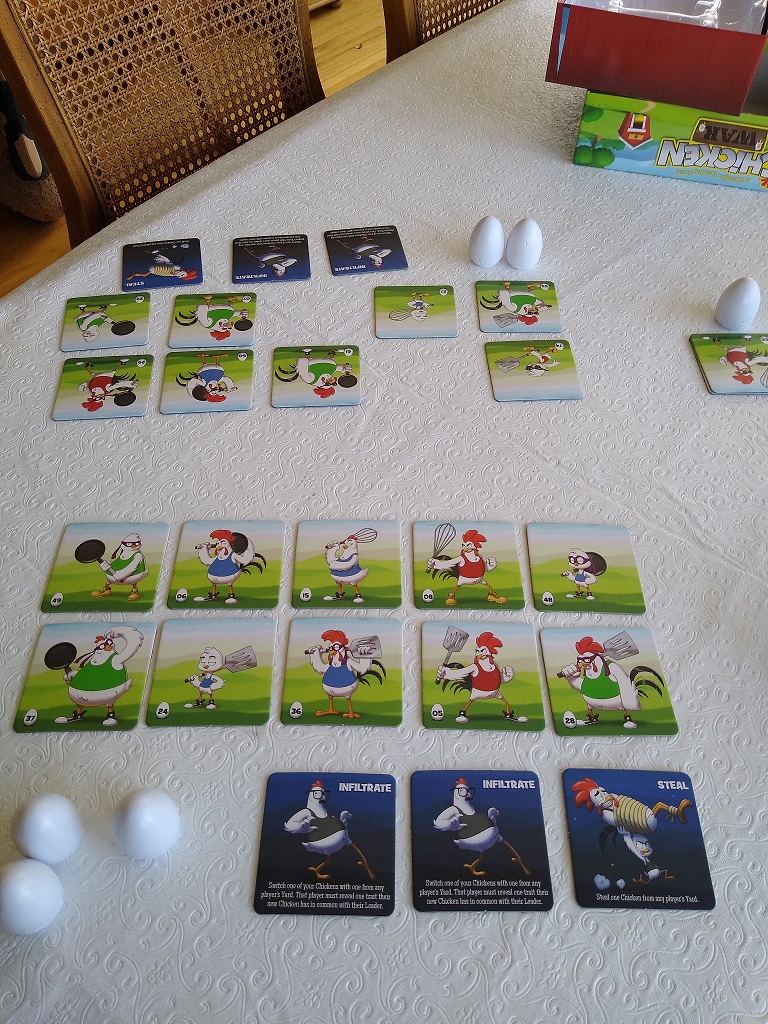
chickenwar6

The two methods of winning can often lead to two different styles of gameplay. Either a player focuses on their recruitment, hoping to be the first to complete their army, or they focus on eliminating another player by sussing out who their leader chicken is.

This adds a lot of variety to the game, particularly when it comes to repeat playthroughs. Figuring out your opponents’ tactics can inform your own, and yet, you don’t want to tip your hand.

Once I had one or two playthroughs behind me, I really started getting invested in the gameplay and trying to get into my opponents’ heads. (Also, there’s something delightfully demented about these chickens all being armed with “weapons” we would use to make breakfast from their eggs. That’s a nice touch.)
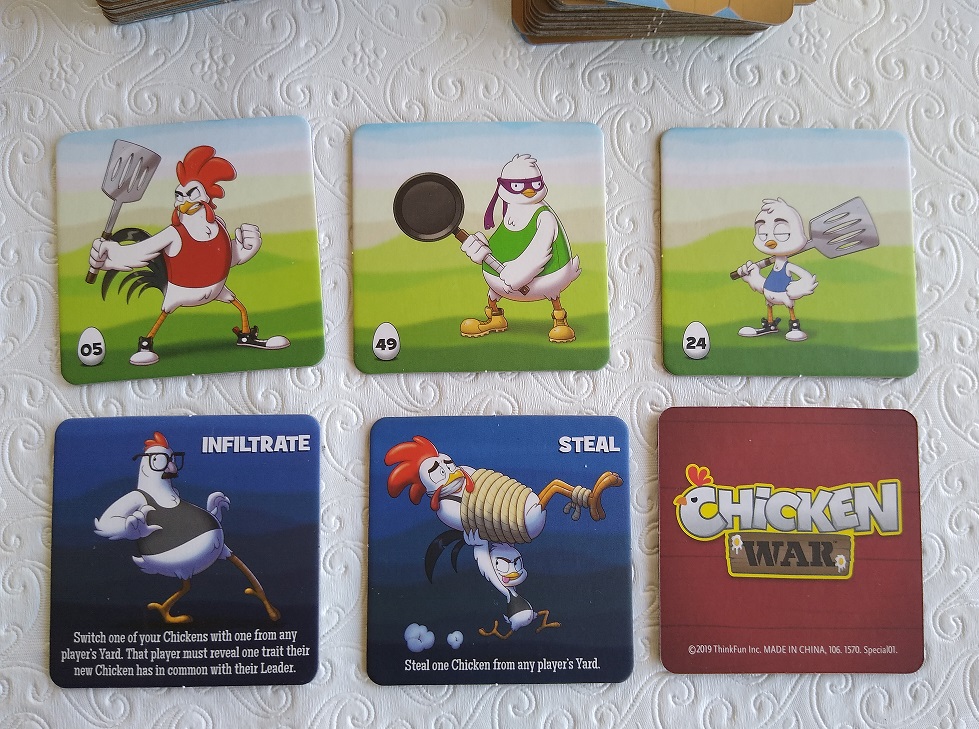
chickenwar7

Although it makes for a tense, enjoyable one-on-one game, the full potential of Chicken War comes alive with all four players involved. It forces to split your attention, retain a lot of information, and constantly adapt your strategy to an ever-shifting landscape.

As you can see, there’s a surprising amount of thought, strategy, and complexity behind this so-called guessing game, and it makes Chicken War a terrific gateway game to other board games in the same style, but with more complex rulesets or player choices. War is hell, but Chicken War is healthy brain-fueled fun.

[Chicken War is available from ThinkFun and other retail outlets.]


Thanks for visiting PuzzleNation Blog today! Be sure to sign up for our newsletter to stay up-to-date on everything PuzzleNation!

You can also share your pictures with us on Instagram, friend us on Facebook, check us out on TwitterPinterest, and Tumblr, and explore the always-expanding library of PuzzleNation apps and games on our website!

Last Kickstarter Roundup for 2019!

Oh yes, it’s that time again.

For years now, crowdfunding platforms like Kickstarter and Indiegogo have been hotbeds of innovative puzzle and game design, and I’m always happy to spread the word about worthy projects that I think will delight and intrigue my fellow PuzzleNationers.

So let’s take a look at some projects that are currently seeking funding and see if any pique your interest!


The first is Peter Gordon’s Fireball Newsflash Crosswords.

Culturally timely clues and entries are a hallmark of this marvelous variation on Gordon’s long-running Fireball Crosswords brand, and you can rest assured that each Fireball Newsflash Crossword grid will be well-constructed and cleverly clued.

With twenty puzzles sent to you by email — one every two to three weeks — you’ll always have some terrific puzzling to look forward to.

Gordon has a knack for melding flowing grid design with sharp, topical entry words, and much of the time, you’ll not only be impressed by how much material makes it into the grid, but by what major and minor events you’ve missed recently! Gordon’s history of topnotch puzzles is all the incentive you need to contribute.

75% funded with 5 days to go, this project is a yearly favorite of mine, and I always look forward to supporting it.

13monsters

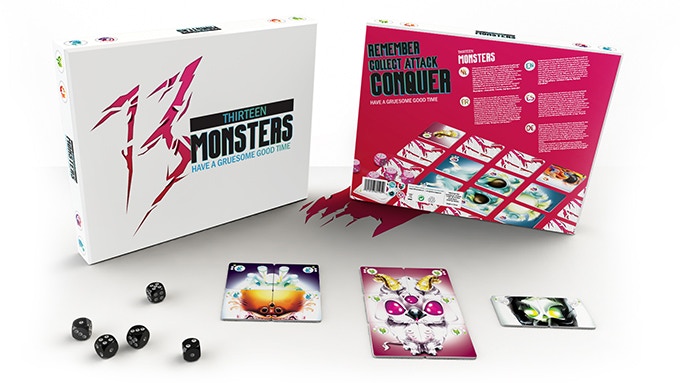
Our second project is a game called 13 Monsters.

A game that takes the strategy of a monster-building game like Bears vs. Babies or Epic Spell Wars of the Battle Wizards and adds a memory component to the gameplay, 13 Monsters requires luck, skill, and tactics in order to assemble monsters and battle your fellow players for dice-rolling, monster-making supremacy.

Because you can only build your monster by finding matching pieces — which you do by flipping tiles and remembering where matching parts are, like in Memory or Concentration — experienced players and newbies have an equal chance at the game’s outset of making moves that seriously impact the game.

With fun mechanics, delightful art, and a clever premise, 13 Monsters looks like a blast.

77% funded with three days to go, 13 Monsters could easily cross the finish line in time, and if more people watched the incredibly charming How to Play video on the Kickstarter page, I think they’d be funded already.

dragondice

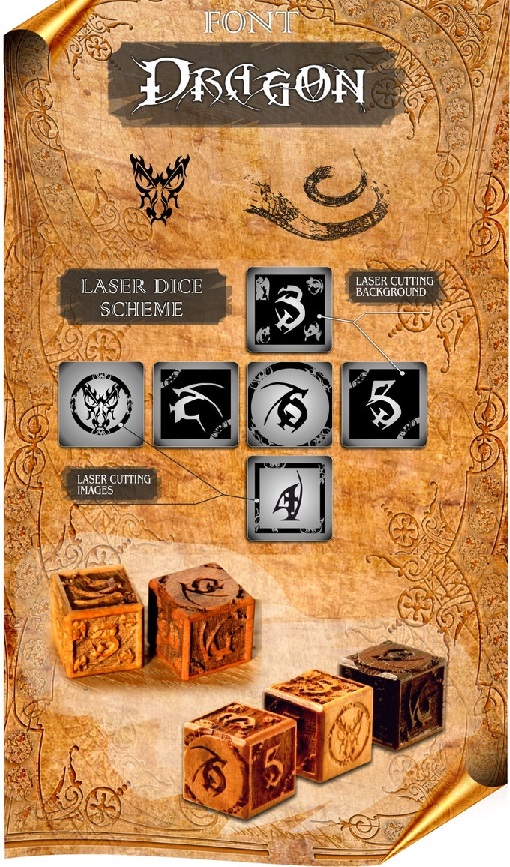
Our third project adds an artistic touch to a classic game tool: dice.

Dragon and Celtic Laser Dice allow you to augment your games — or your game-centric decor — with beautifully designed and intricately realized wooden and metal dice. With laser-cut precision, these dice are eye-catching and could inspire the creation of whole new games just for these dice alone.

Understandably, the project has already reached its funding goals with 24 days to go, but I still think it’s a gorgeous product that will appeal to game fans all over.

gameovercafe

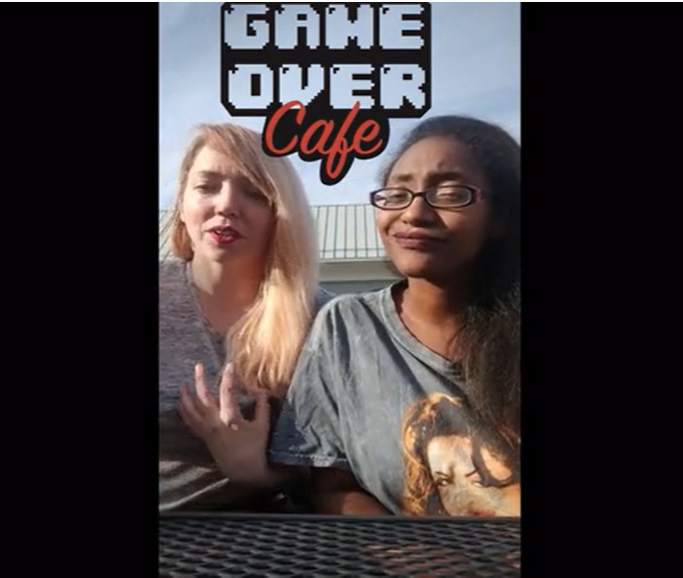
Our fourth and final project today doesn’t focus on game fans all over, instead opting to focus on game fans in one particular area: Chattanooga, Tennessee.

You see, the dynamic duo of Gina and Janay want to open a gamer-friendly coffee shop — The Game Over Cafe — that mixes classic store elements with video game regalia and programming.

Proposing to be a “Gamer-friendly establishment offering quality coffee and beverages, delicious tea, snacks, and sandwiches,” The Game Over Cafe has potential to be a marvelous new business and networking spot for games and gamers.

A quarter of the way to their funding goal with 29 days to go, I think there’s a solid chance this project will find support and fulfill its mission.


Have any of these games or projects hooked you? Let us know which ones you’re supporting in the comments section below! And if there are any campaigns you’re supporting that we missed, let us know!

Thanks for visiting PuzzleNation Blog today! Be sure to sign up for our newsletter to stay up-to-date on everything PuzzleNation!

You can also share your pictures with us on Instagram, friend us on Facebook, check us out on TwitterPinterest, and Tumblr, and explore the always-expanding library of PuzzleNation apps and games on our website!