The Indie 500 Crossword Tournament returns tomorrow!

indie5002017

That’s right! Tomorrow, June 3rd, will mark the third annual edition of the tournament, and although registration is closed (because the event is full!), you can still participate from home for only $10! Click here for details!

Not only that, but once again they’ve whipped up a meta-suite of puzzles to boot, and you name your own price for it!

I expect great things from the immensely talented team of constructors and directors they’ve assembled: Tracy Bennett, Erik Agard, Angela Olson Halsted, Andy Kravis, Paolo Pasco, Allegra Kuney, and Neville Fogarty. With a curious time-centric theme, topnotch constructors, and pie (there’s always pie), you can’t go wrong!

You can click here for the Indie 500 home page, and click here for a rundown of last year’s puzzles!

Will you be competing? Or participating from home? Let us know in the comments below!


Thanks for visiting PuzzleNation Blog today! Be sure to sign up for our newsletter to stay up-to-date on everything PuzzleNation!

You can also share your pictures with us on Instagram, friend us on Facebook, check us out on TwitterPinterest, and Tumblr, and explore the always-expanding library of PuzzleNation apps and games on our website!

Crossword History: Dawe and D-Day

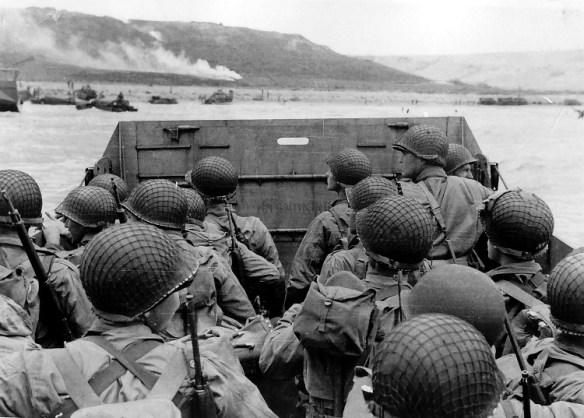
approaching_omaha

[Image courtesy of Wikipedia.]

June 6, 1944 is a date that will continue to resonate for decades to come, and perhaps centuries. On that day, D-Day, the largest amphibious military attack in history was launched as the Allied forces landed at Normandy. This was one of the major offensives that helped bring about the end of World War II.

But a few days before that, a curious confluence of events brought crosswords to the attention to British agents, namely those of MI5.

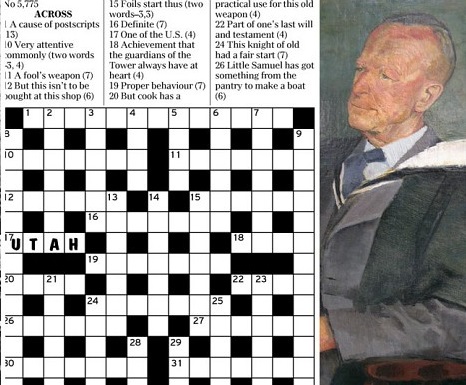
Yes, tomorrow, June 2, 1944, marks the anniversary of the day a physics teacher and crossword constructor named Leonard Dawe was questioned by authorities after several words coinciding with D-Day invasion plans appeared in London’s Daily Telegraph newspaper.

crosswords_2893522b

More specifically, the words Omaha (codename for one of Normandy’s beaches), Utah (another Normandy beach codename), Overlord (the name for the plan to land at Normandy on June 6th), mulberry (nickname for a portable harbor built for D-Day), and Neptune (name for the naval portion of the invasion) all appeared in Daily Telegraph crosswords during the month preceding the D-Day landing.

So, the authorities had to investigate the highly improbable, yet still possible, scenario that Dawe was purposely trying to inform the enemy of Allied plans, and scooped up the constructor to investigate.

In the end, no definitive link could be found, and consensus is that Dawe either overheard these words (possibly mentioned by the loose lips of soldiers stationed nearby) and slipped them into his grids unwittingly, or this is simply an incredible coincidence.

Some crossword fans suspect that there’s more to the story, though.

history_post

According to The Guardian newspaper:

During the celebrations of the 40th anniversary of D-day, one of Dawe’s former pupils approached the Telegraph and insisted that as a lad, he had overheard US and Canadian soldiers discussing the plans, picked up on the codewords, and suggested them to his headmaster as possible entries.

This has been dismissed by most historians as an attempt to rewrite or embellish an already baffling story.

Nonetheless, it’s possible that, somewhere, some document connecting Mr. Dawes and the codewords is waiting to be discovered.

Until then, it simply remains a curious moment in crossword history.


Thanks for visiting PuzzleNation Blog today! Be sure to sign up for our newsletter to stay up-to-date on everything PuzzleNation!

You can also share your pictures with us on Instagram, friend us on Facebook, check us out on TwitterPinterest, and Tumblr, and explore the always-expanding library of PuzzleNation apps and games on our website!

Potent Quotables!

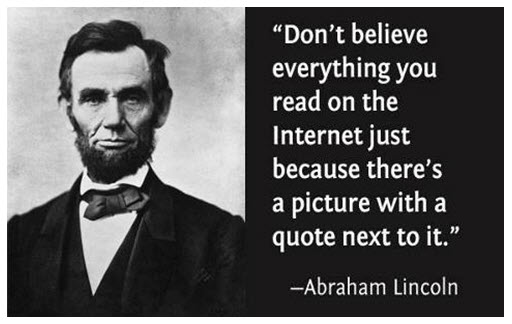
lincoln_internet_quote

Quotations are a major part of the puzzle landscape. From cryptograms and Syllacrostics to crosswords where you end up with unhelpful clues like “Part 1 of quote,” I’d bet that an avid solver rarely goes a day without encountering a quote somewhere in their puzzling.

I was working on a quote puzzle just the other day, and it occurred to me that, despite the hundreds and hundreds of puzzles involving quotes that I’ve created and edited over the years, I couldn’t think of any that were actually about puzzles.

So, naturally, I went looking for quotes about puzzles.

I had to narrow the field to crosswords, because quotes about puzzles were both too numerous and, oddly enough, not actually about puzzles.

“Each person is an enigma. You’re a puzzle not only to yourself but also to everyone else, and the great mystery of our time is how we penetrate this puzzle.” — Theodore Zeldin

Oh sure, they mention puzzles, but only as a metaphor for something else. People are puzzles, or life is a puzzle, or the world is a puzzle, or writing is a puzzle, or acting is a puzzle, or making a movie is a puzzle. Insert topic, blah blah, puzzle metaphor.

You get the idea.

At least some people stick to the subject of puzzles when getting metaphorical.

“There seem to be two main types of people in the world: crosswords and Sudokus.” — Rebecca McKinsey

Betty White has something to say on that subject:

“I love words. Sudoku I don’t get into, I’m not into numbers that much, and there are people who are hooked on that. But crossword puzzles, I just can’t — if I get a puppy and I paper train him and I put the — if all of a sudden I’d open the paper and there’s a crossword puzzle — ‘No, no, you can’t go on that, honey. I’ll take it.'”

See, now we’re getting into actual crossword quotes.

Oh, no, wait. One more metaphor:

“Fighting with him was like trying to solve a crossword and realizing there’s no right answer.” — Taylor Swift

Apparently Taylor Swift doesn’t know how crossword puzzles work. (Then again, she had that song where Romeo and Juliet had a happy ending, so maybe I’m barking up the wrong tree here…)

I shall rebut Miss Swift with a Stephen Sondheim quote: “The nice thing about doing a crossword puzzle is, you know there is a solution.”

Okay, we’re back on track.

This might be the most famous quote about crosswords:

8802-retirement

There’s a definite theme of crosswords being associated with retirement and relaxation.

“But I’m really enjoying my retirement. I get to sleep in every day. I do crossword puzzles and eat cake.” — Derek Landy

“I would prefer to live forever in perfect health, but if I must at some time leave this life, I would like to do so ensconced on a chaise longue, perfumed, wearing a velvet robe and pearl earrings, with a flute of champagne beside me and having just discovered the answer to the last problem in a British cryptic crossword.” — Olivia de Havilland

“I enjoy walking my dog and completing crossword puzzles.” — Brian Jacques

Of course, some folks have regrets…

“Do I rue a life wasted doing crosswords? Yes, but I do know the three-letter-word for regret.” — Robert Breault

Others have complaints…

“Wouldn’t it be wonderful if I won a helicopter in a crossword puzzle competition? There is not much hope though I am afraid, as they never give such practical prizes.” — Leonora Carrington

mp-helicopter-cnc-laser-router-scrollsaw-aircraft-o84_1000

But, to be honest, my two favorite quotes about crosswords didn’t come from celebrities or revered thinkers. (At least, not yet revered.) They came from college students on Tumblr, sharing observations, either their own or those of others.

“Who did Jessica Simpson last divorce?! Like, I don’t know. I could tell you all about Rousseau though.” — Girl doing a crossword puzzle in class

I think I’ll give the final word to another Tumblr user, who summed up crosswords brilliantly.

“A crossword puzzle is an unholy marriage of spelling bee, trivia contest, and a troll that lives under a bridge and asks you riddles.”


Do you have any favorite quotes about puzzles, fellow PuzzleNationers? Let us know in the comments section below!

Thanks for visiting PuzzleNation Blog today! Be sure to sign up for our newsletter to stay up-to-date on everything PuzzleNation!

You can also share your pictures with us on Instagram, friend us on Facebook, check us out on TwitterPinterest, and Tumblr, and explore the always-expanding library of PuzzleNation apps and games on our website!

Visual Video Trickery!

illusion1

Visual trickery plays an important role in puzzles. It can be the clever rebus that challenges you to find the words each image represents, or a visual brain teaser that forces you to think outside the box.

But nowhere in the realm of puzzles is visual trickery more obvious or more disconcerting than in optical illusions. Some are simple, like the famous old woman/young woman image above (or this hilarious video version). But others are not only more complex, they’re absolutely mind-bending.

Few optical illusions are as effective as those done on video. Drawings and photos are all well and good, but incorporating movement and performance into the illusion are something else entirely.

And stop-motion animator Kevin Parry has some doozies in his Instagram feed.

Check out this one involving a mirror and a wooded area. I’ve watched it a half-dozen times and I haven’t figured it out yet:

He’s also a dab hand at forced perspective illusions, as he shows in this video with a can of soda:

With innovators like Kevin at work, we will never run short of visual wonders, that’s for sure.


Thanks for visiting PuzzleNation Blog today! Be sure to sign up for our newsletter to stay up-to-date on everything PuzzleNation!

You can also share your pictures with us on Instagram, friend us on Facebook, check us out on TwitterPinterest, and Tumblr, and explore the always-expanding library of PuzzleNation apps and games on our website!

The Puzzly Art of Carmina Figurata

We don’t discuss poetry all that often in the blog. To be fair, when it comes to poetry and crosswords, all you really need to know are E’ER, O’ER, ODE, E’EN, and ‘NEATH.

But there is one form of poetry that lends itself quite handily to our favorite field of study, sitting at the crossroads of art, poetry, and puzzles. Today, we’re going to talk about carmina figurata.

carminafig1

[A poem shaped like an altar, a work by Publilius Optatianus Porphyrius.
Image courtesy of Some Grey Matter.]

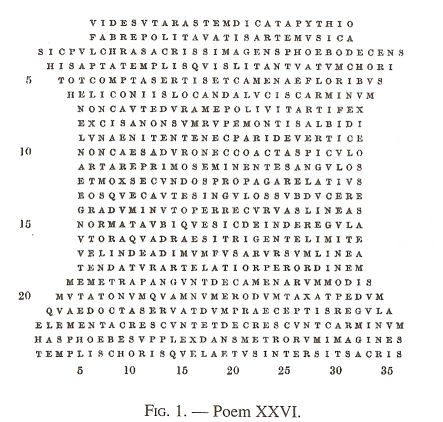
A carmina figuratum is a poem wherein either the entire body of the poem or select parts form a shape or pattern. Often this shape reflects the subject of the poem.

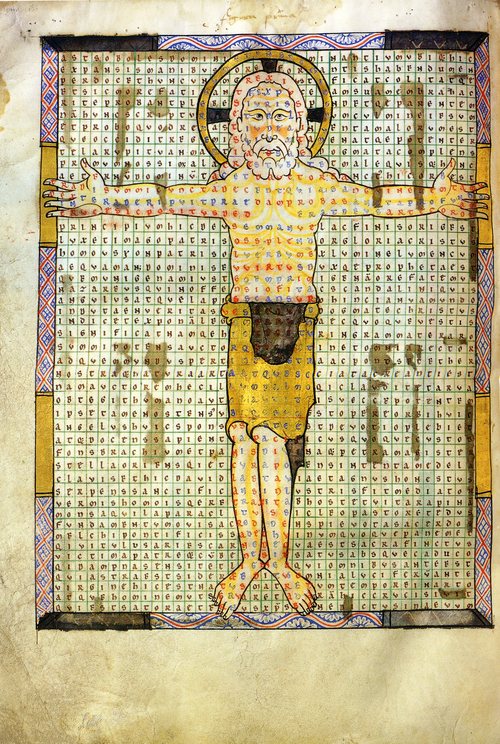
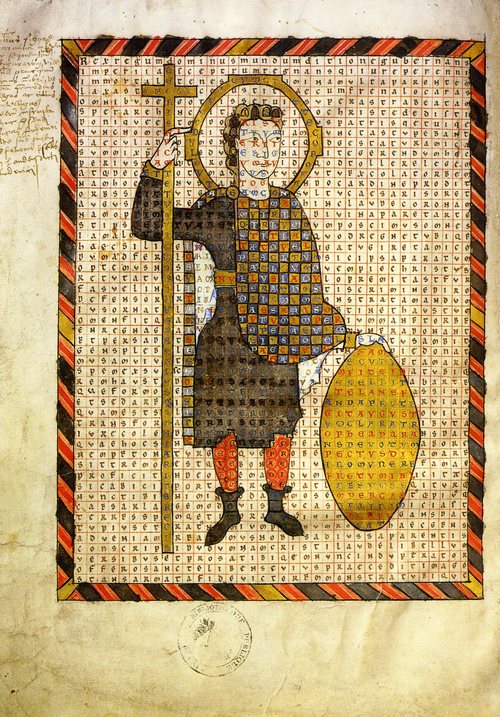
But that’s what the term has come to mean over time, as poetry has evolved and grown. The original carmina figurata were religious-based poems where letters were colored red to stand out from the regular black lettering in order to draw attention to or highlight a certain religious figure.

tumblr_m6a31vnnxo1qggdq1

[“De laudibus sanctae Crucis” by Oliverus.
Image courtesy of WTF Art History.]

For instance, in this image, titled “Praises to the Holy Cross,” you can see “rex,” meaning “king” in red above Christ’s head and “virtu” on his stomach, among other words. Obviously, having the image superimposed over the text helps highlight the words, representing John 1:14, ““And the Word became flesh and made His dwelling among us.”

Quite a bit to unpack in such a small piece.

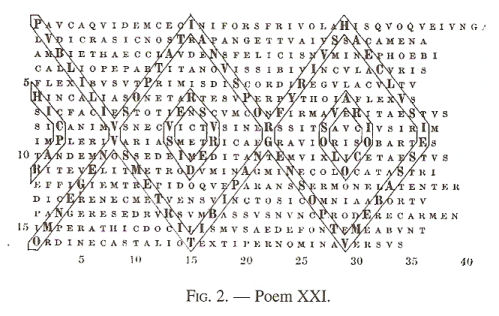
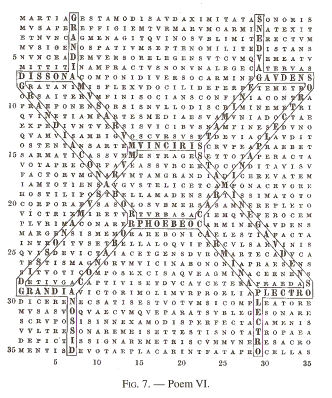
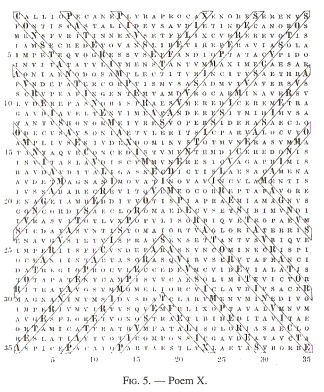
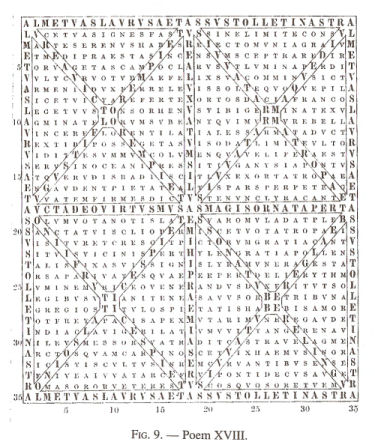
Other carmina figurata have no color or imagery, relying on the cleverness of the reader to uncover the hidden messages within the text. This was particularly true of the poet Publilius Optatianus Porphyrius, who wrote dozens of carmina figurata of increasing complexity.

Some of these hidden messages honored the same rulers the poems were meant to impress. Other messages referenced the date the poem was written or the poet himself. Some even concealed drawings or designs.

carminafig2

carminafig7

carminafig5

carminafig9

[Several of Porphyrius’s most ambitious creations, revealing just how far a reader would have to delve to uncover the hidden messages. Images courtesy of Some Grey Matter.]

From the article on Some Grey Matter:

The poems contain supplementary text ‘hidden’ within the main body of the individual poems and intended to be ‘discovered’ by the reader. These versus intexti poems were apparently intended to dazzle Constantine with their technical virtuosity and thereby inspire the hoped–for recall of their creator…

Now that’s ambition. Imagine you’re constructing a Marching Bands puzzle, with the overlapping lines and loops of text, but all in the hope of courting favor with a major political player. And to do so, you need to hide even more information in the grid. That’s next-level puzzling, to be sure.

Whether you’re moved by the artistry, impressed by the construction, or intrigued by the puzzly challenges they represent, you must admit: carmina figurata are works of puzzle art unlike anything else.

tumblr_m6a3h2cqos1qggdq1


Thanks for visiting PuzzleNation Blog today! Be sure to sign up for our newsletter to stay up-to-date on everything PuzzleNation!

You can also share your pictures with us on Instagram, friend us on Facebook, check us out on TwitterPinterest, and Tumblr, and explore the always-expanding library of PuzzleNation apps and games on our website!
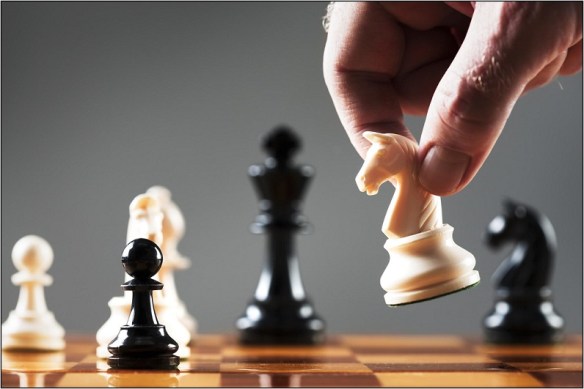
This chess game will cut you to the quick!

chess

When it comes to games, chess is a certified classic, the benchmark against which many tactical games are still measured to this day.

We’ve discussed chess several times in the past here on the blog, whether we’re talking products inspired by chess, like All Queens Chess and Scrimish, or tackling puzzles using chess boards, like knight’s tours or other chess-based brain teasers.

In today’s post, we’ll be looking at a new variation on chess, one meant to dissuade players from careless gameplay by use of a historically appropriate method of enforcing the rule of law: the guillotine.

chess_set_guillotine_custom_card_board_game_analoggames_analog_games_02-1

Fellow puzzlers and PuzzleNationers, say hello to Tour De Force chess.

According to the creators:

Tour De Force chess entices the players to strategize and invest more thought into the game by introducing consequence in the form of a guillotine that beheads captured pieces. Based on early testing with a rough and ready model we confirmed that this game addition makes the prospect of losing a piece unsavory enough to motivate more careful strategy.

You see, in Tour De Force chess, a captured piece isn’t gone immediately. It goes into the stockade until another piece is captured. There are two stockades, which means that once your opponent captures a third piece, that first piece goes to the guillotine, loses its head, and is gone for good.

Not only is this meant to enhance the feeling of loss that comes with having a piece taken, but it introduces an interesting mechanic to the game: saving pieces from a nasty end.

chess_set_guillotine_custom_card_board_game_analoggames_analog_games_04

According to the official rules, “a player can save a captured piece that has not yet been beheaded by taking a higher value piece with a pawn. That pawn is then substituted with the piece closest to beheading.”

Although the higher-value rule means that there’s no saving your captured queen (unless you capture the king, which of course, ends the game anyway), it is an intriguing wrinkle to standard chess that could definitely alter your gameplay. Do you continue to play as you always would, immediately accepting the consequences when a piece is lost? Or do you try to rescue that piece, diverting temporarily from your primary goal of capturing your opponent’s king?

What do you think, PuzzleNationers? Is Tour De Force chess a welcome variation to the game, or an unnecessary twist on a classic? Sound off in the comments below!


Thanks for visiting PuzzleNation Blog today! Be sure to sign up for our newsletter to stay up-to-date on everything PuzzleNation!

You can also share your pictures with us on Instagram, friend us on Facebook, check us out on TwitterPinterest, and Tumblr, and explore the always-expanding library of PuzzleNation apps and games on our website!