Well, that escalated quickly.

I talk a lot in this blog about the role puzzles have played in history, in our culture, and as touchstones for particular individuals. But it’s far more rare for me to talk about one puzzle in particular that changed someone’s life.

Today, I have the privilege of doing precisely that, because a puzzle crafted by our friends at Penny Dell Puzzles has changed two lives for the better.

One day, a gentleman named Bryan reached out to Penny Dell Puzzles with an audacious proposition: his girlfriend is a big fan of their puzzles and he wanted their help in crafting a special puzzly proposal of marriage!

He supplied ideas for clues and entry words, and a topnotch editor accepted the challenge of crafting a page of Escalators puzzles specially tailored for the occasion.

(For the uninitiated, an Escalators puzzle involves clued entries where a 6-letter word loses a letter and anagrams into a 5-letter word, then loses another letter and is anagrammed into a 4-letter word. Those lost letters end up spelling out words and phrases reading down when each grid is complete.)

So this singular puzzle featured his girlfriend’s name, then his name, and then the fateful question: will you marry me?

And to really cap off the presentation, the puzzle was inserted into an actual puzzle magazine (in a special limited run at the printers), so that our hero could deftly guide her toward the puzzle with her being none the wiser.
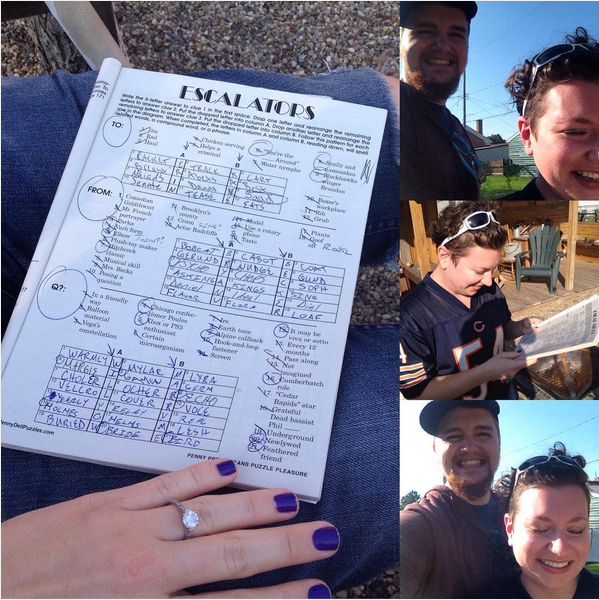
It’s an absolutely awesome idea, a testament to puzzly ingenuity, and honestly, just about the cutest proposal story I’ve ever heard.

I’ll let Bryan take it from here, in an email to his fellow collaborators at Penny Dell Puzzles:

I wanted to let you know that I proposed to Erin today with the puzzle and she said yes! It went perfectly. The puzzle looked great in the book and Erin thought nothing of it, thinking it was just another Escalators puzzle.

Once we got about halfway through the puzzle and she saw my name, it became kind of obvious, and once I knew that she knew, I got down on one knee and popped the question.

She was so surprised and blown away she even forgot to say yes and was just asking how I made it happen! She did eventually say yes after a lot of hugging, kissing, and tears, and then we continued to solve the puzzle before making calls to the rest of our family and friends.

Congratulations to Bryan and Erin! I wish them nothing but the best on their journeys to come.

And kudos to our friends at Penny Dell Puzzles for truly going the extra mile for puzzle fans and romantics alike.


Thanks for visiting PuzzleNation Blog today! Be sure to sign up for our newsletter to stay up-to-date on everything PuzzleNation!

You can also share your pictures with us on Instagram, friend us on Facebook, check us out on TwitterPinterest, and Tumblr, and explore the always-expanding library of PuzzleNation apps and games on our website!

It’s Follow-Up Friday: Puzzlesaurus Kickstarterus edition!

Welcome to Follow-Up Friday!

By this time, you know the drill. Follow-Up Friday is a chance for us to revisit the subjects of previous posts and bring the PuzzleNation audience up to speed on all things puzzly.

And in today’s post, I’m returning to the subject of puzzly crowdfunding campaigns!

I’ve covered various campaigns for board games, card games, and puzzle projects across the Kickstarter and Indiegogo crowdfunding platforms over the years, and today I’d like to share a few more that deserve your attention.

These are some of the cards for Scrimish, a card game so simple and elegant that I cannot believe I haven’t seen this game mechanic before.

Essentially, it’s a chess match with cards. You set up your five piles of cards face down in front of you, hiding a crown card in one of your piles. Then, you play cards against your opponent’s piles in the hopes of revealing his crown card. So strategy, rather than luck, is the name of the game here.

There’s only a day or two left in this campaign, and it’s already blown past its initial goal, so if you donate, at the very least, you’re guaranteed a copy or two of the game. (Sometimes, this is one of the advantages of jumping onto a Kickstarter bandwagon at the eleventh hour.)

Did you know that more dinosaur skeletons were discovered by just two scientists — Cope and Marsh — than by anyone else in history? And did you know that they got so competitive with one another that they actually began damaging dig sites and blowing up fossils in order to sabotage each other?

This ridiculous and amazing period in history is the source material for The Great Dinosaur Rush, a game where you attempt to build a complete dinosaur skeleton while stealthily (and sometimes, not-so-stealthily) combating your opponents’ efforts to do the same.

I’ve been waiting months for this Kickstarter to launch, ever since I first heard about the game, and now it’s well on its way to being funded. Why not take history into your own hands and mess with your friends and fellow scientists while you’re at it?

There are so many more I could cover, all with varying degrees of puzzliness. There’s the card game Master Thief (where you compete with fellow players to rob a museum), the magnetic jigsaw-style Enigma Orbs, a Cards Against Humanity-inspired bounty hunting card game called Skiptrace, and Covalence, a board game where you race to figure out molecular structures!

Heck, there’s even a collection of drinking glasses that link together (called, appropriately enough, Cupzzle)!

I highly recommend taking a little time to surf the puzzle and game pages of Kickstarter and Indiegogo, because you never know what terrific and unexpected products you might help bring to life.


Thanks for visiting PuzzleNation Blog today! Be sure to sign up for our newsletter to stay up-to-date on everything PuzzleNation!

You can also share your pictures with us on Instagram, friend us on Facebook, check us out on TwitterPinterest, and Tumblr, and explore the always-expanding library of PuzzleNation apps and games on our website!

PuzzleNation Product Review: Retro Loonacy

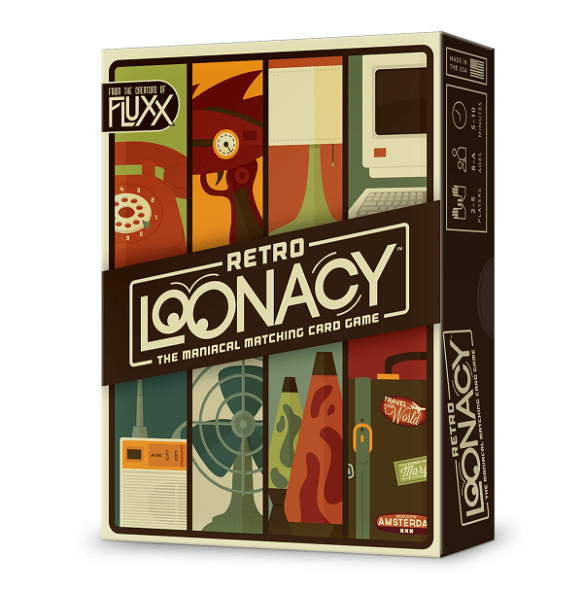
retroloonacy-box-3d

It has been a banner year for the folks at Looney Labs. They’ve already released Just Desserts, Fluxx Dice, Batman Fluxx, and Adventure Time Fluxx, all to excellent reviews, as well as announcing the upcoming Nature Fluxx (a redesign of their environmentally conscious Eco Fluxx) and Firefly Fluxx (for all the Browncoats in the puzzle/game audience).

But, somehow, that’s not all. They’ve also launched a companion game to their pattern-matching game Loonacy, which brings us to the subject of today’s product review. Let’s take a closer look at Retro Loonacy!

retroloon1

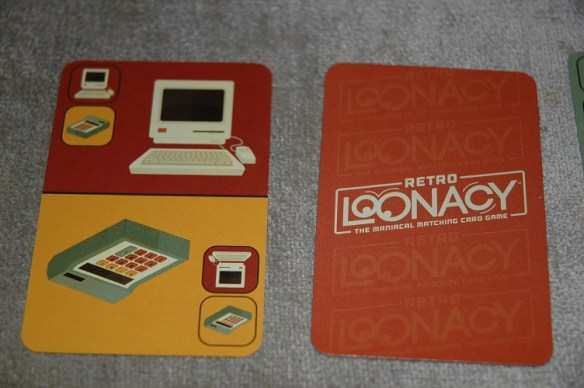
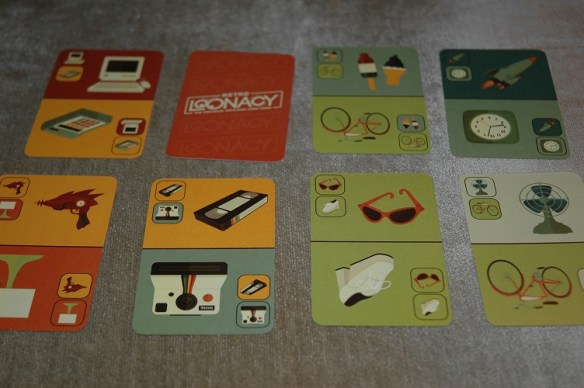
Retro Loonacy replaces the wacky, more cartoonish illustrations of the original with a more subdued assortment of images, evoking sentimental stirrings for trappings and technology of the past (Polaroid cameras, rocketships and rayguns from Golden Age science fiction films, etc.).

It almost feels like looking through one of those old issues of Popular Mechanics that purported to predict the future. Everything is hard angles and earth tones, carefully repackaged nostalgia given form.

Now, I am focusing quite a bit on the art instead of the gameplay, and there’s a reason for that. Unlike each new version of Fluxx, which seems to bring something new to the table — whether it’s a new type of card like the creeper or simply a few clever innovations in the rules tailored to that specific brand — Retro Loonacy is played exactly the same as Loonacy. You’re still trying to empty your hand of cards as quickly as possible by matching one of the two images on your card with one on the board. There are no new wrinkles or variations. This is a repackaging, plain and simple.

retroloon2

[Retro Loonacy side-by-side with the original Loonacy.]

And, quite honestly, it’s for the better. Retro Loonacy‘s artwork is charming in the extreme, and the game feels more suitable for adults than the bright, silly, madcap images you must match in Loonacy. It presents itself as a game for adults, even if the frenetic gameplay might appeal more to younger players.

The style and execution elevate Retro Loonacy above many contemporary card games, placing it in the same aesthetic upper echelon as 12 Days (which features the most beautiful cards I’ve ever seen in a card game) and some of the more ambitious decks of Pairs offered by our friends at Cheapass Games.

retroloon3

In short, Retro Loonacy is a strong pattern-matching game with oodles of style. Another terrific offering by the game masters at Looney Labs.


Thanks for visiting PuzzleNation Blog today! Be sure to sign up for our newsletter to stay up-to-date on everything PuzzleNation!

You can also share your pictures with us on Instagram, friend us on Facebook, check us out on TwitterPinterest, and Tumblr, and explore the always-expanding library of PuzzleNation apps and games on our website!

View a Clue: Common Crossword Words!

Welcome to a brand-new feature on PuzzleNation Blog: the View a Clue game!

I talk about crosswords a lot here, and rightfully so. Crosswords are the most famous pen-and-paper puzzles in the world, and here at PuzzleNation, you can always find terrific, fresh puzzle content for our Penny Dell Crosswords App!

And although I love running our daily Crossword Clue Challenge on Facebook and Twitter, I wanted to try something different today.

I’ve selected ten words that commonly show up in crossword grids — some crosswordese, some not — and I want to see if the PuzzleNation readership can identify them from pictures. It’s a visual puzzle I call View a Clue!

Let’s give it a shot!


#1 (4 letters)

#2 (4 letters)

#3 (4 letters)

#4 (4 letters)

#5 (4 letters)

#6 (4 letters)

#7 (3 letters)

#8 (4 letters)

#9 (4 letters)

#10 (4 letters)


How many did you get? Let me know in the comments below! And if you’d like to see another View a Clue game (maybe about common names in crosswords or crosswordy animals!), tell us below!

Thanks for visiting PuzzleNation Blog today! Be sure to sign up for our newsletter to stay up-to-date on everything PuzzleNation!

You can also share your pictures with us on Instagram, friend us on Facebook, check us out on TwitterPinterest, and Tumblr, and explore the always-expanding library of PuzzleNation apps and games on our website!

PuzzleNation Product Review: ThinkFun’s Laser Maze Jr.

Whether you’re unraveling locks and ropes in Houdini, bending gravity to your will in Gravity Maze, making music note-by-note with Compose Yourself, or mastering the basics of programming in Robot Turtles, playing with the puzzle games by ThinkFun always encourages you to learn while you solve.

Today, we see if Laser Maze Jr. matches the high standard set by those other puzzly products.

Now, for those of you familiar with the original Laser Maze, you might be expecting a simplified version, akin to the Jr. versions of Rush Hour or other puzzle games where the difficulty lessens but the game remains the same. Worry not. Laser Maze Jr. is actually a heavy redesign that keeps the best aspects of the original and tailors itself to players as young as 6, both in gameplay and in safety.

Perhaps the biggest change from the original is the board itself.

Not only is the laser fixed in place, but the board is surrounded by red plastic barriers that both protect young eyes and highlight where the beam is projecting at any given time. You would have to seriously tamper with the game to endanger your eyes with this layout; with the original, there was a greater (though still quite slim) chance that unmonitored gameplay could lead to an accident.

The laser also has a switch instead of a button to press, so if you choose, you can leave the laser on and see the beam’s path change as you add elements to the game board. As a learning tool, this is a super-helpful feature for younger minds. (The original encouraged more of a wait-and-see approach to placing the elements.)

The final change to the board’s layout involves the cards that provide the specifics of each puzzle. Instead of small cards that tell you which elements are fixed and which you add in order to solve the puzzle and light up the targets, the new cards actually slide into place beneath the board, showing you where to place the set pieces. Again, ease of setup and play is a main consideration.

The game pieces also got retooled. Instead of the gateway piece that players had to direct the laser beam through en route to the targets, Laser Maze Jr. has large rocks that block the laser’s path. This is a simple, effective way of providing obstacles for younger solvers to overcome.

The three light-up targets have been replaced with two light-up rockets. While this does eliminate some of the most complex puzzles from the original game, that’s forgivable, given that this is intended for younger solvers.

I was slightly disappointed with the laser, though. It’s less powerful than the previous one (either that or the rockets don’t light up as brightly as the original targets), and to be honest, part of the appeal of the puzzle is seeing your targets light up when you’re done!

[Taken at night with most of the lights off. Unless you’re willing to play in near-darkness — and use the night feature on your camera — the end result won’t be as bright.]

The 40 puzzles (2 on each challenge card) range from easy to super-hard, and solving them in order is a great way to slowly introduce new players to the game. Although “super-hard” is clearly a ranking for kids, not adults, the challenge of placing the beam splitter properly and avoiding the rocks is still a lot of fun for an older solver.

(Be careful when getting started, though; one of the explanatory graphics in the instructions is wrong. ThinkFun is aware of the error, and they’ll be correcting it on their next printing.)

In the end, I was pretty impressed with Laser Maze Jr. and the many changes made to tailor it to younger solvers, both in terms of safety and gameplay. While the laser is a little underwhelming, it doesn’t impact the gameplay too much, and the same solid foundation of logic and experimentation that drove the fun of the original is alive and well here.


Thanks for visiting PuzzleNation Blog today! Be sure to sign up for our newsletter to stay up-to-date on everything PuzzleNation!

You can also share your pictures with us on Instagram, friend us on Facebook, check us out on Twitter, Pinterest, and Tumblr, and explore the always-expanding library of PuzzleNation apps and games on our website!

Touching a Piece of Puzzle History

Friend of the blog Peter Kanter came by the other day and showed me this curious piece of puzzle history that his brother had stumbled upon in a garage sale or a flea market.

Little did I realize I would soon be holding a puzzle that predates the crossword puzzle by over twenty years.

According to the instruction manual — which features rules for ten different spelling and anagramming games, one or two of which bear no small resemblance to Bananagrams in play style and spirit — this game was copyrighted in 1890 by McLoughlin Bros.

According to one of their catalogs, this game “consists of a box full of letters, so selected as to be most useful in a number of exceedingly interesting spelling games. The letters, printed on cardboard, are easily distinguished and handled. The box label is unusually bright and attractive.”

Yes, thanks to the wonders of the Internet, I’ve been able to do a little research on this marvelous find.

McLoughlin Bros. was a publishing firm based in New York that operated from the mid-1800s until the early 1900s. They specialized in children’s books and picture books, but also published linen books, games, paper dolls, puzzles, and toys.

They were among the first publishing houses to employ color printing techniques in products marketed specifically for children. (They also helped popularize the works of Thomas Nast, curiously enough.)

[A sampling of McLoughlin Bros.-style art, a style definitely reflected in the box art of the anagram game above.]

As it turns out, after the death of one of the founders, the company was sold to none other than Milton Bradley — makers of Battleship, Axis & Allies, Candyland, Connect Four, Operation, and Jenga, among many many others — who had continued success with some of the McLoughlin Bros. products, including mechanical paper toys called “Jolly Jump-Ups.” (You might know “mechanical paper toys” better as pop-up books.) Production of those toys was halted, however, during World War II, presumably to save materials for the war effort.

There is now a collector’s market for McLoughlin products — check out this listing for a game board produced by the firm — and if this anagram game is any indication, the color and striking artistic designs from a century ago still hold up today.

And although I can’t definitively say that this exact game predates the crossword, there’s no doubt that this sort of wordplay was delighting kids and adults alike well before Arthur Wynne’s “Word-Cross” puzzle saw the light of day.

How cool is that?


Thanks for visiting PuzzleNation Blog today! Be sure to sign up for our newsletter to stay up-to-date on everything PuzzleNation!

You can also share your pictures with us on Instagram, friend us on Facebook, check us out on TwitterPinterest, and Tumblr, and explore the always-expanding library of PuzzleNation apps and games on our website!