The Diabolical Long Division Brain Teaser!

From time to time, I’ll receive an email with a brain teaser I’ve never seen before. Sometimes they come from friends, or fellow puzzlers. Other times, PuzzleNationers will ask for my assistance in solving a puzzle that has flummoxed them.

That was the case with today’s puzzle, and I’ll admit, this one was a bit of a doozy to unravel.

longdiv1

Yup, an entire long division problem with only a single digit set. No letters or encryption to let us know which digits were repeated, as there are in Word Math puzzles published by our friends at Penny Dell Puzzles.

Just a 7 and a bunch of asterisks. “Is this doable?” the sender asked.

Yes, this is entirely doable, friend. Let’s break it down step by step.

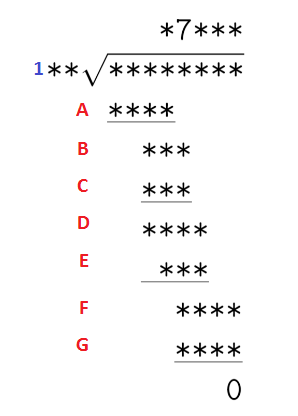
First, we need to know our terminology. The 8-digit number being divided is our dividend. The 3-digit number we’re dividing into it is the divisor. The 5-digit number on top is our quotient.

For the other lines, let’s label them A through G for ease of reference later.

longdiv2

There we go. Now, where do we go from here? We start with what we know.

We know that 7 is the second digit in our quotient.

So our divisor, times 7, equals the number on line C. That’s a 3-digit number, which means the first number in our divisor is 1. Why? Because if it was 2, 2 times 7 would give us 14, which would be a 4-digit number on that line.
longdiv3

That means the quotient is somewhere between 100 and 142. (Why 142? Easy. I divided 1000 by 7, and 142 is the last 3-digit number you can multiply 7 against and still end up with a 3-digit answer for line C. 143 times 7 is 1001, which is too high.)

What else do we know from the puzzle as it stands?

Well, look at lines E and F. We bring both of the last two digits in the dividend down for the final part of the equation. What does that mean?

Remember how long division works. You multiply the divisor by whatever number gets you closest to the given digits of the dividend, subtract the remainder, bring down the next digit from the dividend, and do it all over again until you get your answer.

You multiply the first digit of the quotient times the divisor to get the number on line A. You multiply 7 times the divisor to get the number on line C. You multiply the third digit of the quotient times the divisor to get the number on line E.

Following this route, you would multiply the fourth digit of the quotient against the divisor to get the number on line G. But bringing just one digit down didn’t give us a number high enough to be divided into. Instead of needing more lines (H and I, in this case), we bring the last digit of the dividend down and press onward.

That means the fourth digit of the quotient is 0, because the divisor went into the dividend zero times at that point.

longdiv4

And there’s more we can glean just from the asterisks and what we already know. We know that every one of those 4-digit numbers in the equation begin with the number 1.

How do we know that? Easy. That first number in the divisor. With a 1 there, even if the divisor is 199 and we multiply it times 9, the highest possible answer for any of those 4-digit numbers is 1791.

So let’s fill those numbers in as well:

longdiv5

Now look at lines D, E, and F. There’s nothing below the 1 on line D. The only way that can happen is if the second digit in line D is smaller than the first digit on line E. And on line F, you can see that those first two columns in lines D and E equal zero, since there’s nothing on line F until we hit that third column of digits.

That means the second digit on line D is either a 0 or a 1, and the first digit on line E is a 9. It’s the only way to end up with a blank space there on line F.

longdiv6

I realize there are a lot of asterisks left, but we’re actually very close to knowing our entire quotient by now.

Look at what we know. 7 times the divisor gives us a 3-digit answer on line C. We don’t yet know if that’s the same 3-digit answer on line E, but since it’s being divided into a 4-digit number on line E and only a 3-digit number on line C, that means the third digit in our quotient is either equal to or greater than 7. So, it’s 7 or 8.

Why not 9? Because of the 4-digit answers on lines A and G. Those would have to be higher than the multiplier for lines C and E because they result in 4-digit answers, not 3. So the digit in the first and fifth places in the quotient are higher than the digit in the third. So, if the third digit in the quotient is 7 or 8, the first and fifth are either 8 or 9.

So how do we know whether 7 or 8 is the third digit in the quotient?

Well, if it’s 7, then lines C and E would have the same 3-digit answer, both beginning with 9. But line C cannot have an answer beginning with 9, because line B is also 3 digits. The highest value the first digit in line B could have is 9, and 9 minus 9 is zero. But the number on line D begins with 1, ruling out the idea that the numbers on lines C and E are the same.

That makes the third digit in the quotient 8, and the first and fifth digits in the quotient 9.

longdiv7

We know our quotient now, 97809. What about our divisor?

Well, remember before when we narrowed it down to somewhere between 100 and 142? That’s going to come in handy now.

On line F, we know those first two digits are going to be 141 or below, because whatever our divisor is, it was larger than those three digits. That’s how we ended up with a 0 in our quotient.

So, the number on line D minus the number on line E equals 14 or below. So we need a 900-something number that, when added to a number that’s 14 or below, equals 1000 or more. That gives us a field from 986 to 999.

And that number between 986 and 999 has to be divisible by 8 for our quotient to work. And the only number in that field that fits the bill is 992. 992 divided by 8 gives us 124, which is our divisor.

longdiv8

From that point on, we can fill out the rest of the equation, including our lengthy dividend, 12128316.

longdiv9

And there you have it. With some math skills, some deduction, and some crafty puzzling, we’ve slain yet another brain teaser. Nice work everyone!

[After solving the puzzle, I did a little research, and apparently this one has been making the rounds after being featured in FiveThirtyEight’s recurring Riddler feature, so here’s a link.]


Thanks for visiting PuzzleNation Blog today! Be sure to sign up for our newsletter to stay up-to-date on everything PuzzleNation!

You can also share your pictures with us on Instagram, friend us on Facebook, check us out on TwitterPinterest, and Tumblr, and explore the always-expanding library of PuzzleNation apps and games on our website!

Rise of the Machines!

hqdefault5

I don’t mean to alarm you, fellow puzzlers and PuzzleNationers, but the machines may be taking over.

First, there was Deep Blue, defeating Russian chess grandmaster Garry Kasparov under standard chess tournament time constraints.

Then, there was IBM’s supercomputer Watson, sitting at the buzzer on Jeopardy!, besting previous champions Brad Rutter and Ken Jennings to nab a million-dollar prize.

An AI program called Deep Mind can play several Atari games with superhuman proficiency.

These days, you can design robots with LEGOs that are capable of solving Rubik’s Cubes in seconds flat.

And, of course, crossword fans probably know of Dr. Fill, the crossword-solving computer program that competes at the American Crossword Puzzle Tournament each year. In a matter of five years, it has jumped from 141st place in the 2012 tournament to 11th place in the 2017 tournament.

drfill_400x400

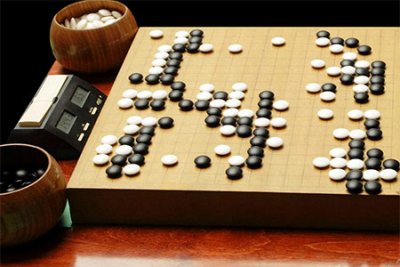
Now, the machines are coming for Go players next. Google has developed an artificial intelligence known as AlphaGo which twice conquered Ke Jie, the 19-year-old Go tournament champion ranked number one in the world.

This strategy board game is played with white and black gamepieces called stones, and the objective is to surround a greater total amount of territory on the game board than your opponent. Along the way, you can surround your opponent’s pieces in order to capture them and remove them from play.

Wikipedia aptly describes the depth and difficulty of the game:

Despite its relatively simple rules, Go is very complex, even more so than chess, and possesses more possibilities than the total number of atoms in the visible universe. Compared to chess, Go has both a larger board with more scope for play and longer games, and, on average, many more alternatives to consider per move.

go-game

People have been playing Go for over 2,500 years, and yet, machines have already surpassed our greatest player.

Science fiction movies have been warning us about this for years. I just never expected them to come after our games and hobbies first.


Thanks for visiting PuzzleNation Blog today! Be sure to sign up for our newsletter to stay up-to-date on everything PuzzleNation!

You can also share your pictures with us on Instagram, friend us on Facebook, check us out on TwitterPinterest, and Tumblr, and explore the always-expanding library of PuzzleNation apps and games on our website!

The Indie 500 Crossword Tournament returns tomorrow!

indie5002017

That’s right! Tomorrow, June 3rd, will mark the third annual edition of the tournament, and although registration is closed (because the event is full!), you can still participate from home for only $10! Click here for details!

Not only that, but once again they’ve whipped up a meta-suite of puzzles to boot, and you name your own price for it!

I expect great things from the immensely talented team of constructors and directors they’ve assembled: Tracy Bennett, Erik Agard, Angela Olson Halsted, Andy Kravis, Paolo Pasco, Allegra Kuney, and Neville Fogarty. With a curious time-centric theme, topnotch constructors, and pie (there’s always pie), you can’t go wrong!

You can click here for the Indie 500 home page, and click here for a rundown of last year’s puzzles!

Will you be competing? Or participating from home? Let us know in the comments below!


Thanks for visiting PuzzleNation Blog today! Be sure to sign up for our newsletter to stay up-to-date on everything PuzzleNation!

You can also share your pictures with us on Instagram, friend us on Facebook, check us out on TwitterPinterest, and Tumblr, and explore the always-expanding library of PuzzleNation apps and games on our website!
Visual Video Trickery!

illusion1

Visual trickery plays an important role in puzzles. It can be the clever rebus that challenges you to find the words each image represents, or a visual brain teaser that forces you to think outside the box.

But nowhere in the realm of puzzles is visual trickery more obvious or more disconcerting than in optical illusions. Some are simple, like the famous old woman/young woman image above (or this hilarious video version). But others are not only more complex, they’re absolutely mind-bending.

Few optical illusions are as effective as those done on video. Drawings and photos are all well and good, but incorporating movement and performance into the illusion are something else entirely.

And stop-motion animator Kevin Parry has some doozies in his Instagram feed.

Check out this one involving a mirror and a wooded area. I’ve watched it a half-dozen times and I haven’t figured it out yet:

He’s also a dab hand at forced perspective illusions, as he shows in this video with a can of soda:

With innovators like Kevin at work, we will never run short of visual wonders, that’s for sure.


Thanks for visiting PuzzleNation Blog today! Be sure to sign up for our newsletter to stay up-to-date on everything PuzzleNation!

You can also share your pictures with us on Instagram, friend us on Facebook, check us out on TwitterPinterest, and Tumblr, and explore the always-expanding library of PuzzleNation apps and games on our website!

This chess game will cut you to the quick!

chess

When it comes to games, chess is a certified classic, the benchmark against which many tactical games are still measured to this day.

We’ve discussed chess several times in the past here on the blog, whether we’re talking products inspired by chess, like All Queens Chess and Scrimish, or tackling puzzles using chess boards, like knight’s tours or other chess-based brain teasers.

In today’s post, we’ll be looking at a new variation on chess, one meant to dissuade players from careless gameplay by use of a historically appropriate method of enforcing the rule of law: the guillotine.

chess_set_guillotine_custom_card_board_game_analoggames_analog_games_02-1

Fellow puzzlers and PuzzleNationers, say hello to Tour De Force chess.

According to the creators:

Tour De Force chess entices the players to strategize and invest more thought into the game by introducing consequence in the form of a guillotine that beheads captured pieces. Based on early testing with a rough and ready model we confirmed that this game addition makes the prospect of losing a piece unsavory enough to motivate more careful strategy.

You see, in Tour De Force chess, a captured piece isn’t gone immediately. It goes into the stockade until another piece is captured. There are two stockades, which means that once your opponent captures a third piece, that first piece goes to the guillotine, loses its head, and is gone for good.

Not only is this meant to enhance the feeling of loss that comes with having a piece taken, but it introduces an interesting mechanic to the game: saving pieces from a nasty end.

chess_set_guillotine_custom_card_board_game_analoggames_analog_games_04

According to the official rules, “a player can save a captured piece that has not yet been beheaded by taking a higher value piece with a pawn. That pawn is then substituted with the piece closest to beheading.”

Although the higher-value rule means that there’s no saving your captured queen (unless you capture the king, which of course, ends the game anyway), it is an intriguing wrinkle to standard chess that could definitely alter your gameplay. Do you continue to play as you always would, immediately accepting the consequences when a piece is lost? Or do you try to rescue that piece, diverting temporarily from your primary goal of capturing your opponent’s king?

What do you think, PuzzleNationers? Is Tour De Force chess a welcome variation to the game, or an unnecessary twist on a classic? Sound off in the comments below!


Thanks for visiting PuzzleNation Blog today! Be sure to sign up for our newsletter to stay up-to-date on everything PuzzleNation!

You can also share your pictures with us on Instagram, friend us on Facebook, check us out on TwitterPinterest, and Tumblr, and explore the always-expanding library of PuzzleNation apps and games on our website!

New Puzzle Sets for the Penny Dell Crosswords App!

Hello puzzlers and PuzzleNationers! Happy Friday!

That’s right, you get a special bonus blog post today because we’ve got some exciting news!

Our latest puzzle set for the Penny Dell Crosswords App just launched for both iOS and Android users, and it’s one of our best yet!

Say hello to Collection 22!

c201

For the prolific puzzlers and savvy solvers among you, we’ve just launched the perfect puzzle bundle, designed for any skill level!

You can grab any of the Collection 22 puzzle sets, which range from easy to medium to hard, each one featuring 30 topnotch puzzles!

c202

Or you can pick up one of the Collection 22 puzzle combos, which offer 60 easy puzzles or 60 medium puzzles for your solving enjoyment!

But that’s not all! You can always opt for the Collection 22 Value Pack, which offers 150 easy, medium, and hard puzzles designed to satisfy and challenge any puzzler!

c203

You can’t go wrong with these awesome deals! PuzzleNation is dedicated to bringing you the best puzzle-solving experience available, with world-class puzzles right in your pocket, ready to go at a moment’s notice! That’s the PuzzleNation guarantee.

Happy solving, everyone!


Thanks for visiting PuzzleNation Blog today! Be sure to sign up for our newsletter to stay up-to-date on everything PuzzleNation!

You can also share your pictures with us on Instagram, friend us on Facebook, check us out on TwitterPinterest, and Tumblr, and explore the always-expanding library of PuzzleNation apps and games on our website!