Puzzle History: Codebreaking and the NSA, part 2

[Image courtesy of NSA’s official Twitter account.]

At the end of part 1 of our look at the history of the NSA and American codebreaking, we left off with the pivotal Black Friday event.

On November 1, 1948, all intel coming from monitored Soviet signals went quiet. All traffic on military, naval, and police radio links was replaced with dummy messages. It was such an unprecedented and alarming event that London and Washington briefly considered that it might’ve been the first indication of preparations for war.

According to Code Warriors author Stephen Budiansky:

The full extent of the disaster only became apparent the following spring when real traffic started reappearing on the radio nets, now employing greatly improved — and completely unbreakable — technical and security procedures. The keying errors or other mistakes that had allowed most of the Soviets’ machine-enciphered military traffic to be routinely read by US and British codebreakers for the last several years had been corrected, and the much more disciplined systems that now replaced them slammed the cryptanalytic door shut.

Even the one-time pads that had offered some hope to attentive American codebreakers were updated, eliminating the ability to sort messages by which organization they originated from.

Codemakers had suddenly outpaced codebreakers.

[The Kryptos sculpture outside CIA Headquarters. The NSA cracked
several of its codes before the CIA did. Image courtesy of Slate.com.]

The Office of Naval Intelligence wanted to take over from Signals Intelligence (SIGINT), demanding to see “everything” so they could do the job. They claimed SIGINT should limit their work to message translation, leaving interpretation to “the real experts.” This sort of territorial gamesmanship would continue to hamper government organizations for decades to come.

And that demand to see everything? That probably sounds familiar, in light of the revelations about government data collection and the PRISM program that were revealed in Edward Snowden’s leaks.

Black Friday was the start of all that, a shift from codecracking to the massive data collection and sifting operation that characterized the NSA for decades to come.

More amazingly, there was SO MUCH information collected during World War II that SIGINT was still poring over it all in 1949, decrypting what they could to reveal Soviet agents in the U.S. and England.

The fact that a high-ranking member of British Intelligence at the time, Kim Philby, was actually a Soviet double agent complicated things. After a decade under suspicion, Philby would flee to the Soviet Union in 1963, stunning many friends and colleagues who had believed in his innocence.

[The spy and defector, honored with a Soviet stamp.
Image courtesy of Britannica.com.]

Although the Russians had flummoxed SIGINT, other countries weren’t so lucky. The East German police continued to use ENIGMA codes as late as 1956. Many of the early successes in the Korean War were tied to important decryption and analysis work by SIGINT. Those successes slowed in July of 1951, when North Korea began mimicking Russia’s radio procedures, making it much harder to gain access to North Korean intel.

Finally, the chaotic scramble for control over signal-based data gathering and codebreaking between the government and the military resulted in the birth of the National Security Agency on November 4, 1952, by order of President Truman.

One of the first things the NSA did? Reclassify all sorts of material involving historical codebreaking, including books and papers dating back to the Civil War and even the American Revolution.

[The actual report that recommended the creation of the NSA.
Image courtesy of NSA’s official Twitter account.]

The creation of the NSA had finally, for a time at least, settled the issue of who was running the codebreaking and signals intelligence operation for the United States. And they were doing fine work refining the art of encryption, thanks to the work of minds like mathematician and cryptographer Claude Shannon.

One of Shannon’s insights was the inherent redundancy that is built into written language. Think of the rules of spelling, of syntax, of logical sentence progression. Those rules define the ways that letters are combined to form words (and those words form sentences, and those sentences form paragraphs, and so on).

The result? Well, if you know the end goal of the encoded string of characters is a functioning sentence in a given language, that helps narrow down the amount of possible information contained in that string. For instance, a pair of characters can’t be ANYTHING, because letter combinations like TD, ED, LY, OU, and ING are common, while combos like XR, QA, and BG are rare or impossible.

By programming codecracking computers to recognize some of these rules, analysts were developing the next generation of codebreakers.

Unfortunately, the Russian line was holding. The NSA’s failure to read much, if any, Soviet encrypted traffic since Black Friday was obviously becoming more than just a temporary setback.

Something fundamental had changed in the nature of the Russian cryptographic systems, and in the eyes of some scientific experts called in to assess the situation, the NSA had failed to keep up with the times.


I hope you’re enjoying this look at the early days of America’s 20th-century codebreaking efforts. Part 3 will continue next week, with the sea change from active codebreaking to data mining, plus Vietnam, the space race, and more!


Thanks for visiting PuzzleNation Blog today! Be sure to sign up for our newsletter to stay up-to-date on everything PuzzleNation!

You can also share your pictures with us on Instagram, friend us on Facebook, check us out on Twitter, Pinterest, and Tumblr, and explore the always-expanding library of PuzzleNation apps and games on our website!

Our Fourth of July Deluxe Puzzle Set is Here!

Hello puzzlers and PuzzleNationers! Happy Independence Day!

And we’re celebrating the Fourth of July the way we know best: by launching a new puzzle set for the Penny Dell Crosswords App!

Our July Deluxe puzzle set just launched for both iOS and Android users, and it’s one of our best yet!

Take a break from the fireworks and barbecue to tackle this patriotic puzzle bundle, designed for any skill level!

Offering 30 easy, medium, and hard puzzles, plus 5 July-themed bonus puzzles to delight solvers of all skill levels, the July Deluxe set is just what the doctor ordered to scratch that puzzly itch!

But that’s not all!

That’s right, double down on puzzle goodness with the July Deluxe Combo! That’s 70 puzzles, including July-themed bonus crosswords for your puzzly pleasure!

But maybe you need more! If you want an explosive deal on PuzzleNation-quality crosswords, we’ve got you covered with the July Deluxe Bundle! That’s 105 puzzles, three times the terrific content and crafty cluing, loaded and ready for you to solve!

You can’t go wrong with these awesome deals! PuzzleNation is dedicated to bringing you the best puzzle-solving experience available, with world-class puzzles right in your pocket, ready to go at a moment’s notice! That’s the PuzzleNation guarantee.

Happy solving, and happy Independence Day everyone!


Thanks for visiting PuzzleNation Blog today! Be sure to sign up for our newsletter to stay up-to-date on everything PuzzleNation!

You can also share your pictures with us on Instagram, friend us on Facebook, check us out on Twitter, Pinterest, and Tumblr, and explore the always-expanding library of PuzzleNation apps and games on our website!

PuzzleNation Product Review: Less

lessgame

There are many games out there that pair nicely with food or drink. Many party games even revolve around this mechanic, like Jason Anarchy’s alcohol-fueled roleplaying game Drinking Quest.

But I think Less is the first game where the playing tiles intentionally double as coasters for your drinks. It feels like a game that could be played in a tavern at a moment’s notice, which lends its minimalist style an old-world gaming charm.

less1

But I’m getting ahead of myself here. Less is a strategy game that combines the tactical planning of chess with the dynamic maneuverability of checkers.

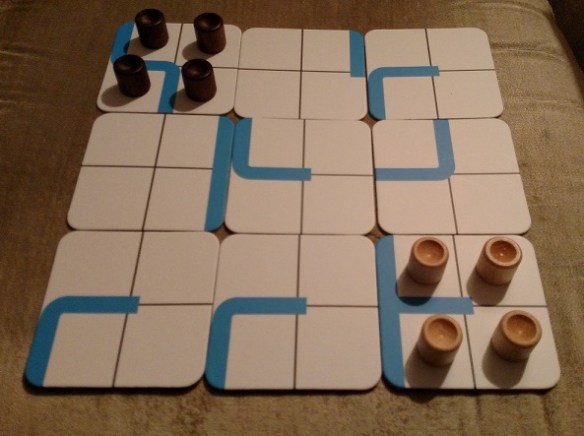
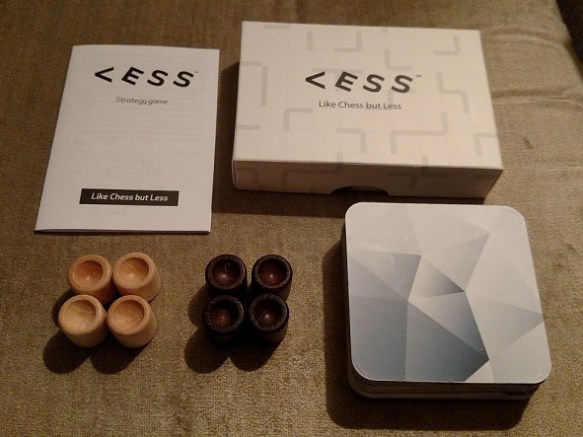
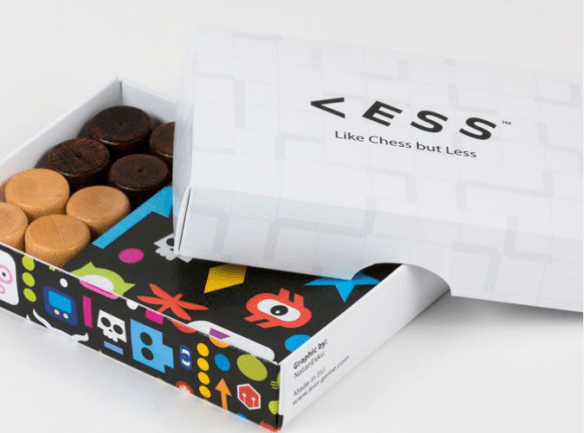
The game consists of 12 tiles and 8 game pieces, 4 white and 4 black. The players randomly select 9 of the 12 tiles and arrange a 3×3 game board. (With 12 tiles and four ways to place each tile, you’re virtually guaranteed a different game board every time you play.)

One player sets up their 4 game pieces in one corner, and the other player sets up their game pieces in the opposite corner. The goal of the game is to move all 4 of your pieces into your opponent’s corner before your opponent can occupy your corner.

less2

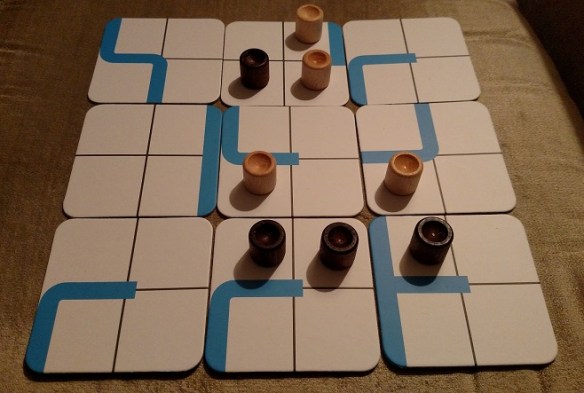
To do so, you are allowed three moves per turn. You can use all three moves for a single game piece, or spread them out over multiple game pieces. Moving a piece from one square to a neighboring square is one move. Jumping over a game piece to the next open square is also one move. (Here’s where checkers-style planning comes in handy.)

By now, you’ve probably noticed those blue walls on some of the tiles. Those walls require an extra move to traverse, so moving a game piece over a wall requires two moves. (And if neighboring squares each have a wall between them, jumping that double wall requires all three moves that turn.)

This three-move system offers players loads of options going forward, but your best bet is to arrange a sequence of leapfrog jumps to move your pieces as efficiently as possible across the board. (Unlike chess or checkers, there is no capturing or removing your opponent’s pieces from the board.)

less3

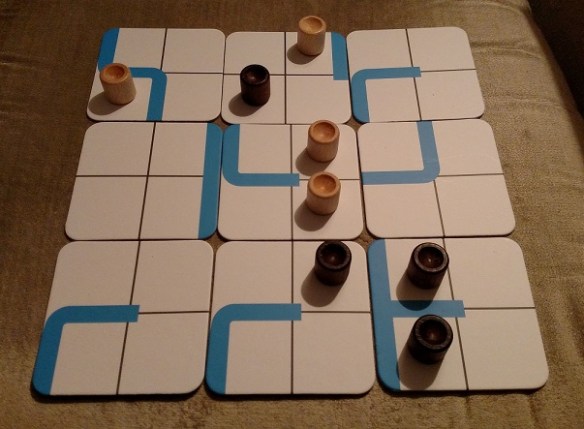
[Here, black has more pieces near the opposing corner, but that blue wall will make it harder to occupy the corner efficiently. Meanwhile, more of white’s pieces are farther away, but there are fewer obstacles to slow those pieces down.]

Mixing a tactical approach with the improvisation that comes with reacting to your opponent’s movements makes Less a very engaging gaming experience, even if a game routinely lasts less than ten minutes. And on the puzzle side of things, figuring out the most efficient way to navigate a path toward your opponent’s corner is great fun, since every game is different, and your opponent has different obstacles to tackle than you do, given the random placement of walls on the board.

Plus, if you’re willing to invest in two copies of the game, you can play with four players, as you and your partner coordinate your efforts across a 4×4 game board in the hopes of occupying your opponents’ corners first.

It’s a game that takes a few minutes to learn and offers near-infinite replayability. It might be called Less, but it feels like a very complete, very satisfying challenge.

less4

Less is published by InventedFor and is available online at less-game.com (with numerous coaster designs for the reverse side of the tiles). Click here for full details.


Thanks for visiting PuzzleNation Blog today! Be sure to sign up for our newsletter to stay up-to-date on everything PuzzleNation!

You can also share your pictures with us on Instagram, friend us on Facebook, check us out on Twitter, Pinterest, and Tumblr, and explore the always-expanding library of PuzzleNation apps and games on our website!

Collection 23: New Puzzle Sets for the Penny Dell Crosswords App!

Hello puzzlers and PuzzleNationers! Happy Friday!

Our latest puzzle set for the Penny Dell Crosswords App just launched for both iOS and Android users, and it’s one of our best yet!

Collection 23 has arrived!

23a

For the prolific puzzlers and savvy solvers among you, we’ve just launched the perfect puzzle bundle, designed for any skill level!

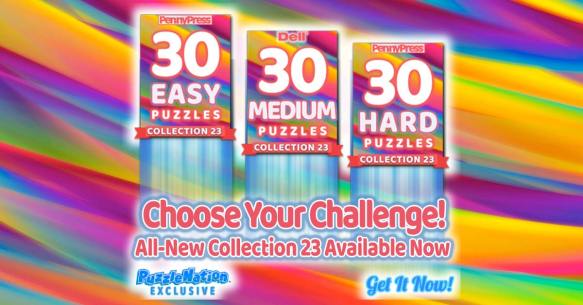
You can grab any of the Collection 23 puzzle sets, which range from easy to medium to hard, each one featuring 30 topnotch puzzles!

23c

Or you can pick up one of the Collection 23 puzzle combos, which offer 60 easy puzzles or 60 medium puzzles for your solving enjoyment!

23d

But that’s not all! You can always opt for the Collection 23 Value Pack, which offers 150 easy, medium, and hard puzzles designed to satisfy and challenge any puzzler!

You can’t go wrong with these awesome deals! PuzzleNation is dedicated to bringing you the best puzzle-solving experience available, with world-class puzzles right in your pocket, ready to go at a moment’s notice! That’s the PuzzleNation guarantee.

Happy solving, everyone!


Thanks for visiting PuzzleNation Blog today! Be sure to sign up for our newsletter to stay up-to-date on everything PuzzleNation!

You can also share your pictures with us on Instagram, friend us on Facebook, check us out on Twitter, Pinterest, and Tumblr, and explore the always-expanding library of PuzzleNation apps and games on our website!

Pun in the Sun! It’s a Summer Wordplay Party!

Oh yes, it’s that time again! It’s to unleash our puzzly and punny imaginations and engage in a bit of sparkling wordplay!

summerpuzzles

You may be familiar with the board game Schmovie, hashtag games on Twitter, or @midnight’s Hashtag Wars segment on Comedy Central.

For years now, we’ve been collaborating on puzzle-themed hashtag games with our pals at Penny Dell Puzzles, and this month’s hook was #PennyDellSummerPuzzles, mashing up Penny Dell puzzles and vacations, the summer months, surf movies, camp, activities… anything and everything you associate with summer!

Examples include Summer Triangles, Beach Blanket Bingo, or Suntan-glewords!

So, without further ado, check out what the puzzlers at PuzzleNation and Penny Dell Puzzles came up with!


Summertime, and the Living is Easy Sudoku

School’s Out of Place for Summer

Camp Tanglewood

Which Way to San Jose Words

Summer lovin’, had me a blips

You’re invited to a neighborhood block party; come at 6’s and 7’s

Cancellations my reservation

Summerdoku

Picknic and Choose

Hopscotch the globe

Middle of the Road Warrior

Sisterhood of the Traveling Spanners

Grand Tourist Trap

The End-of-the-Line-less Summer

Rods & Wheels

Word Maze Runner

Kakuro Vs. the Volcano

A Perfect Hang Ten

Annetagrams Funicello

Fiddler’s Crab Frame

Surfs-Up and Downs

Ups and Dunes

Sun’rays’ burn

Junebox Jumble

Abagust

I Know What You Did First and Last Summer / Insiders Know What You Did Last Summer

Catalina Caperfect Fit

Bit Sand Pieces

Bricks Sand Mortar / Bricks and S’mortar

Surfin’-sert-a-Bird

Take a Letter from Camp

Point the Way Home


There were a few submissions that deserve their own section, as several of our intrepid puzzlers went above and beyond.

-Glossing and Burning in Extreme Sundoku

-Exchange Boardwalks featuring Ice Cream Dots and Dashes

-Have a nice cool “coco nutty crossword” smoothy!

-“Rapid Reader Encounters Bookworms on Word Trails; You Can Take It From There”

And one solver took it to an entirely unexpected rhyming level:

Kellermans we come together, Simon Says as one
We have Shared-a-Letter seasons Takeout, Piggybacks, and fun.
Summer days will soon be Odds & Evens, soonly Autumn starts
And tonight our Mixmaster whispers softly in our Heads & Tails.


Have you come up with any Penny Dell Summer Puzzles entries of your own? Let us know! We’d love to see them!

Thanks for visiting PuzzleNation Blog today! Be sure to sign up for our newsletter to stay up-to-date on everything PuzzleNation!

You can also share your pictures with us on Instagram, friend us on Facebook, check us out on Twitter, Pinterest, and Tumblr, and explore the always-expanding library of PuzzleNation apps and games on our website!
5 Questions for Artist and Game Designer Jennifer Hrabota Lesser

Welcome to 5 Questions, our recurring interview series where we reach out to puzzle constructors, game designers, writers, filmmakers, musicians, artists, and puzzle enthusiasts from all walks of life!

It’s all about exploring the vast and intriguing puzzle community by talking to those who make puzzles and those who enjoy them! (Click here to check out previous editions of 5 Questions!)

And I’m excited to welcome Jennifer Hrabota Lesser as our latest 5 Questions interviewee!

jhl1

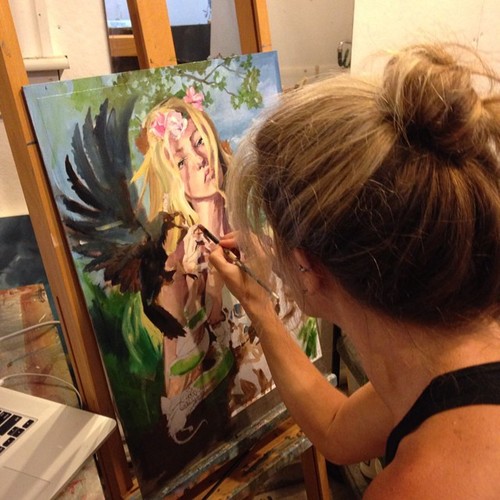
Jennifer Hrabota Lesser is an artist. Whether it’s commissioned artwork, passion projects of her own, or design work for board games and video games, she adds a personal touch to every piece she works on.

Initially getting into the game industry as a way to pay off student loans, she has since gone on to build a small board game company, Wild Power Games, with her husband. She also teaches a summer class on game design at the Rhode Island School of Design.

Jennifer was gracious enough to take some time out to talk to us, so without further ado, let’s get to the interview!


5 Questions for Jennifer Hrabota Lesser

1.) How did you first get into puzzles and games?

I’ve always loved puzzles and games. I think that I’ve always found them to be very calming. As a kid, puzzle books were a great way to get through long car rides. (Back in the days before iPhones!) These days, they are a way to unwind and calm down.

I am definitely a gamer, I adore board games and table top games. I also find Sudoku very soothing and meditative.

2.) I had the pleasure of scrolling through the art on your website, and there’s a really wonderful trend of reaching out that seems to suffuse many of your works. People holding each other, or finding themselves enveloped by things like flowers. Is that an intentional theme, either for your site or for your art in general, or just something I pulled from this sampling of your work?

Connection is an ongoing theme in my work, both connection with other people and connection with nature. I try to portray my subjects in transitional moments, where they may be at a point of finding a deeper connection with someone, or they may feel as if something has just been lost — the moments of feeling untethered. I believe understanding our connection with those around us is important to our health and happiness as individuals and as a society.

jhl2

3.) How does your art inform your work in games, and vice versa?

My work is strongly influenced by mythology and fables, and the games I work on are often character-centered. I really enjoy working on games that have a story, and I think the same applies to my artwork. There is often an implied narrative in the work I’m doing.

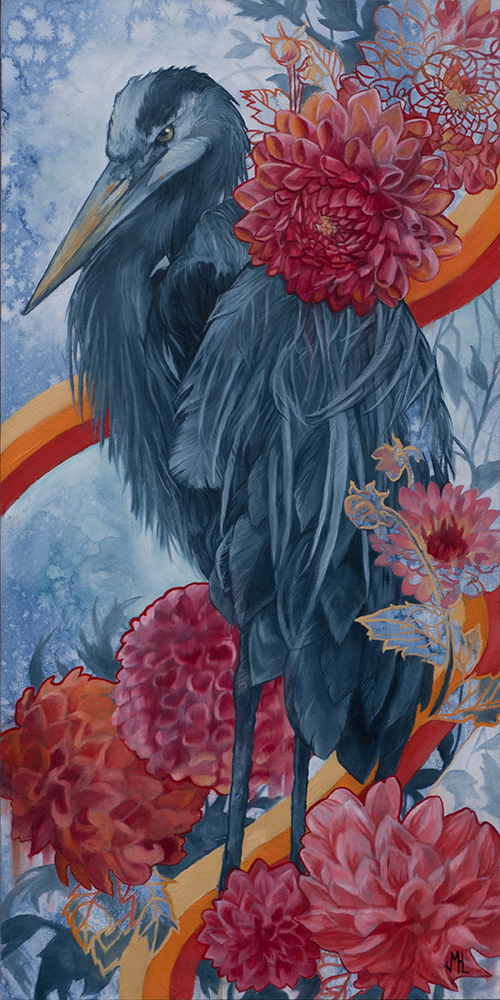
I often like to portray strong female characters, finding their power. Years ago I got to design some great female characters for Guitar Hero 2, which was a blast because I love playing guitar and women tend to be underrepresented in rock. More recently I was able to design some of my favorite goddesses for our tabletop game High Heavens. I particularly loved painting Nut and Isis from the Egyptian pantheon. Illustrating The Mother of Dragons for a recent Game of Thrones expansion was also pretty great.

heron_jennifer_hrabota_lesser_sm

4.) What’s next for Jennifer Hrabota Lesser?

I am working on a poker deck that will be featuring my artwork, which is going to be an intense undertaking, but one that I am excited about!

5.) If you could give the readers, writers, artists, aspiring game designers, and puzzle fans in the audience one piece of advice, what would it be?

Whatever your creative path is, find time to do it every day. Create when you are inspired, but create when you are uninspired, push through the times when you aren’t feeling it, to get into the habit of working. I love the quote by Pablo Picasso: “Inspiration exists, but it has to find you working.”

We work and work, and sometimes when we least expect it, something amazing happens. It won’t happen if you aren’t doing the work in the first place.


A huge thank you to Jennifer for her time. Be sure to check out her website for the latest updates on all her marvelous endeavors!

Thanks for visiting PuzzleNation Blog today! Be sure to sign up for our newsletter to stay up-to-date on everything PuzzleNation!

You can also share your pictures with us on Instagram, friend us on Facebook, check us out on Twitter, Pinterest, and Tumblr, and explore the always-expanding library of PuzzleNation apps and games on our website!