It’s difficult to write about the potential health benefits of puzzles. Believe me, I’ve tried.
But many scientific articles, research studies, and other professional analyses disagree on the short-term or long-term benefits that puzzles have on the brain. There’s a wealth of material out there on brain health and the impact of puzzles, but much of it is inconclusive.
I’ve always tried to be careful to discuss any scientific articles on brain health for that reason, especially after Lumosity’s two-million-dollar payout earlier this year for falsely advertising that their puzzle games could “reduce or delay cognitive impairment associated with age and other serious health conditions,” as well as “stave off memory loss, dementia, and even Alzheimer’s disease.”
That’s less of an issue, thankfully, when writing about other puzzle-solving creatures, though. In the past, we’ve seen crafty cockatoos, clever crows, outwitting octopuses, and deductive dogs. Apparently, we can also add cats to the list of fellow puzzlers!
[A mobile feeder toy. Image courtesy of Purina One.]
A recent article in the Journal of Feline Medicine and Surgery reports that their findings indicate that a healthy dose of puzzle-solving at mealtime is beneficial to a kitty’s welfare.
According to the folks at Gizmodo, by utilizing food puzzles that require cats to roll a toy to release some food or manipulate a game board to reveal food, “these puzzles take advantage of the feline hunting instinct, fulfilling their ingrained desires. By ‘foraging’ for food in this way, cats are more physically active, they experience reduced levels of stress, and they become less demanding of their owners.”
Apparently, it’s all about engaging the cats, giving them something to work against in order to earn the food. The case studies cited by the report include behavioral issues and obesity that were overcome thanks to the use of food puzzles.
I already knew that cats were skilled at treasure and scavenger hunts — based on the absolutely ludicrous places I would find the toys my sister’s cats left behind, often weeks after their visits — but I had no idea they belonged among the elite puzzle-solving animals we’ve previously chronicled here.
Makes sense, though. I solve puzzles for snacks sometimes. *shrugs* It’s a living.
Thanks for visiting PuzzleNation Blog today! Be sure to sign up for our newsletter to stay up-to-date on everything PuzzleNation!
By this time, you know the drill. Follow-Up Friday is a chance for us to revisit the subjects of previous posts and bring the PuzzleNation audience up to speed on all things puzzly.
And today, I’d like to return to the subject of one of the classic deduction games: Clue.
Clue (also known as Cluedo) is a classic in several respects. It is a beloved board game, mentioned alongside Monopoly, Scrabble, Battleship, and Candyland as staples of board game culture, but one that is quite rare: a deduction-based game where you’re playing against both your opponents and the game itself. (The only other game I can think of that captures the same spirit of gameplay is Gameworthy Labs’ Oh My Gods!)
But the film version is also beloved by game devotees and comedy lovers alike. And although I’m dubious about the recently-announced remake of Cluecoming to theaters in the near future, there is one revamp of the mystery property that I can get behind: a playable LEGO version of the game.
As part of the 2014 MOCOlympics — a competition between amateur LEGO designers, where MOC stands for “my own creation” — master builder Ian Spacek created this delightful set, which captures the spirit of each character and each of the game’s signature rooms in impressive miniature fashion.
You see, the challenge was to “build a game that you would choose to play on a rainy afternoon when the power’s out and you don’t have any juice left on your iDevices.” And I think Spacek’s design fits the bill with gusto.
[Spacek even designed a punch card to aid players. Image courtesy of Nerdist.]
I’d much rather see a company put money into releasing this little beauty than an unnecessary retread of one of my favorite films. (Unfortunately, since the MOC Olympics aren’t associated with the LEGO company, this set isn’t available for purchase.)
Somebody just needs to whip up a LEGO version of Murder By Deathand I’ll be set for any rainy day to come.
Thanks for visiting PuzzleNation Blog today! Be sure to sign up for our newsletter to stay up-to-date on everything PuzzleNation!
Welcome to 5 Questions, our recurring interview series where we reach out to puzzle constructors, game designers, writers, filmmakers, musicians, artists, and puzzle enthusiasts from all walks of life!
It’s all about exploring the vast and intriguing puzzle community by talking to those who make puzzles and those who enjoy them! (Click here to check out previous editions of 5 Questions!)
And I’m excited to continue this series with Lily Hevesh (aka Hevesh5) as our latest 5 Questions interviewee!
Lily Hevesh, better known as Hevesh5 on YouTube, is a professional domino artist, a Rube Goldberg machine master, and an advertising whiz who uses skill, patience, and creativity to design wonderfully transfixing works of kinetic art.
She has appeared on The Today Show (auditioning for America’s Got Talent), helped set Guinness World Records — setting up 200,000 dominoes in group displays, as well as 22,000 dominoes on her own for certain projects — and her videos have accumulated over 200 million views on YouTube.
Hevesh5 was gracious enough to take some time out to talk to us, so without further ado, let’s get to the interview!
5 Questions for Hevesh5
1. What is your process when creating one of these ambitious works of kinetic art? How much planning goes into them before the first domino is laid? How do you know if you’re heading in the right direction or if you need to stop, reassess, and try something else?
Planning time varies a lot depending on the type of project. Sometimes I do absolutely zero planning and just start building and see where things go. I think of ideas while building which keeps me going. Other times (especially for live events) I have to plan out the whole setup by digitally drawing out the domino path from start to finish.
[A video thank you posted when Lily reached 2,000,000 views on YouTube.]
First I have to decide what I am going to build — whether that be a logo, an image of something, some sort of text, etc. Then I have to figure out the best way to build this as a domino trick. Dominoes can be built in many ways: lines, domino fields, walls, 3D structures, and other creative tricks, so I have to decide which technique is best for each individual project. Then it’s a matter of connecting every trick with domino lines and figuring out the position on the floor.
If I’m heading in the wrong direction, I’ll usually realize something is wrong — maybe it doesn’t look like what I envisioned, the structure looks risky or is becoming too difficult to build, it looks sloppy, etc. In those cases, I will make the best of the situation and try to correct the mistakes, sometimes even knocking it down and starting over if I feel like it doesn’t live up to what I’m picturing.
[Lily and several other domino artists craft a 30,000 domino masterpiece at the
Brattleboro Museum and Art Center for the 9th annual Domino Toppling Extravaganza!]
2. On your YouTube page, you answer the question “How did I get into dominoes?” with “I searched ‘dominoes’ on YouTube.” Was that the spark of all of your kinetic art (like your Rube Goldberg devices) or were you into mechanical puzzles before that?
The reason I searched dominoes was because I loved to play with the classic dotted dominoes and set them up for fun. I was intrigued by the knock down and wanted to find out if there were others who set up dominoes like I did as a kid. Searching dominoes certainly fueled my love for kinetic art an extraordinary amount though.
3. You have helped set world records and amassed over 200 million views on YouTube. Amongst all those awesome, mind-blowing projects, which are some of your favorites? And what’s the best part of collaborating with fellow domino artists and kinetic sculptors?
Amongst all the projects I’ve been involved with, 2 stand out: “The Incredible Science Machine” (new American domino record with 250,000 dominoes and world record for most dominoes in a circle field) and working on a domino segment for the upcoming feature film Collateral Beauty starring Will Smith.
The best part about collaborating with other domino artists is finally being able to talk to someone who understands your “domino language”. Meeting new people is always exciting, but it’s even more exciting when they share the same passion for such a unique art form. It’s always fun learning from other builders and seeing different styles of building.
[A stick-bomb chain reaction.]
4. What’s next for Hevesh5?
Right now I am just starting my gap year to do dominoes and YouTube full time. I plan to make as many domino videos as possible and create an inventory so that I can post them periodically when I go to college (I won’t have time to make videos in college, so I’m making a lot now to save up for the future).
I plan to post a video on my channel (YouTube.com/hevesh5) every week while also doing side projects for companies, ad agencies, and others who may need domino art.
5. If you could give the readers, writers, puzzle fans, aspiring YouTubers, and kinetic art enthusiasts in the audience one piece of advice, what would it be?
Don’t give up on what you love. Patience and perseverance are key, even in the most challenging times.
A huge thank you to Hevesh5 for her time. Be sure to visit her YouTube page for new videos and updates on her latest projects. I cannot wait to see what she has in store for us next!
Thanks for visiting PuzzleNation Blog today! Be sure to sign up for our newsletter to stay up-to-date on everything PuzzleNation!
I’m always on the lookout for new board games or card games that I think will interest the PuzzleNation readership, and today, I think I’ve got something special.
Many games center around combat, territory acquisition, player elimination, and other aggressive forms of gameplay that can alienate younger players and families alike. But what if there was a game where the toughest decision is what to plant in your garden?
Fellow puzzlers and PuzzleNationers, I give you…Herbaceous.
You have herb cards and container cards, and your goal is to collect the best combination of herbs to pot in your private garden. You do this by drawing herb cards and either planting them in your private garden or placing them in the community garden, where they might be snatched up by other players hoping to bolster their own private gardens.
It’s a simple, accessible game mechanic that makes it perfect for players of all ages, quick to learn but offering enough variety and strategy to give it plenty of replay value.
I reached out to Eduardo Baraf, who is part of the creative team and managing the Kickstarter, to discuss this intriguing family-friendly game.
What separates Herbaceous from other games?
Herbaceous stands out because it has accessible, welcoming gameplay that provides great player moments and dynamics. Certainly the art and subject matter of Herbaceous also grabs people’s attention.
As both a game designer and a game enthusiast, what aspect of the game most appeals to you?
The ease with which I can play it with anyone in my family and extended family. Cousins, Aunts, Grandparents, etc.
Ed backs up his claims of inviting all-ages gameplay by having his mother explain how to play the game:
And best of all, the game is already funded! So if you donate, you’ll be contributing to a game with stretch goals already in mind and plenty of support. Also, given Ed’s successful track record with crowdfunded campaigns, I have great confidence in this game reaching many satisfied supporters and customers.
[Brief Kickstarter explanation for the uninitiated: Although there are no guarantees when it comes to Kickstarter or other crowdfunding platforms, donating to already-funded projects gives you a much-higher chance of receiving the finished product in a timely fashion, since you’ve already crossed one of the major thresholds — securing the minimum funding to make the game — eliminating the chance for disappointment that the project might be cancelled because it didn’t make its minimum funding goal.]
So if you’re looking for a fun, non-combative game to play with family and friends, Herbaceous just might be what you’re looking for.
Click here for all of the details on the game and the Kickstarter campaign!
Thank you to Ed for taking the time out to answer our questions! Best of luck with the game!
Thanks for visiting PuzzleNation Blog today! Be sure to sign up for our newsletter to stay up-to-date on everything PuzzleNation!
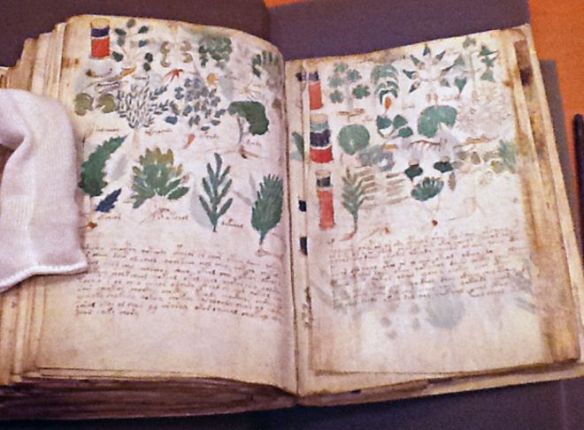
If you scour the Internet for great unsolved mysteries of this or any era, the Voynich Manuscript is always one of the top results, and with good reason.
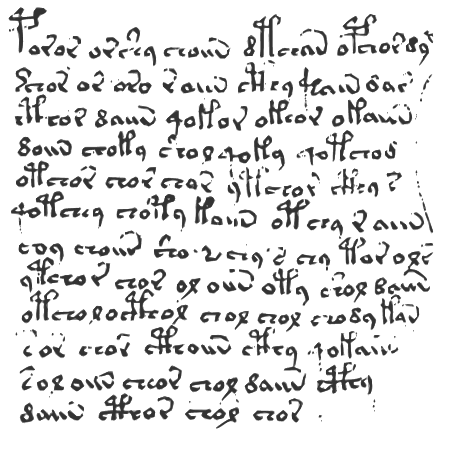
A small hand-written volume, the Voynich Manuscript is believed to have originated in the 15th century (thanks to carbon-dating), and it’s written in an as-yet-undeciphered language.
Both amateur and professional cryptographers have attempted to unravel the mysteries of the unknown language, but all have thus far failed. (Oh sure, some people have claimed in the past that they’ve cracked the code, but none of these efforts have held up to scrutiny.)
Some theorize that instead of an encryption, it’s an invented language or a previously unseen invented written form for an established language.
A few cryptographers have gone so far as to call it unsolvable, while others believe it to be an elaborate hoax or the work of someone afflicted with glossolalia, a written equivalent of speaking in tongues.
And ever since the only known copy was donated to Yale University’s Beinecke Rare Book and Manuscript Library, aspiring solvers have had to rely on online scans of the manuscript in their attempts to crack it.
Until recently, that is.
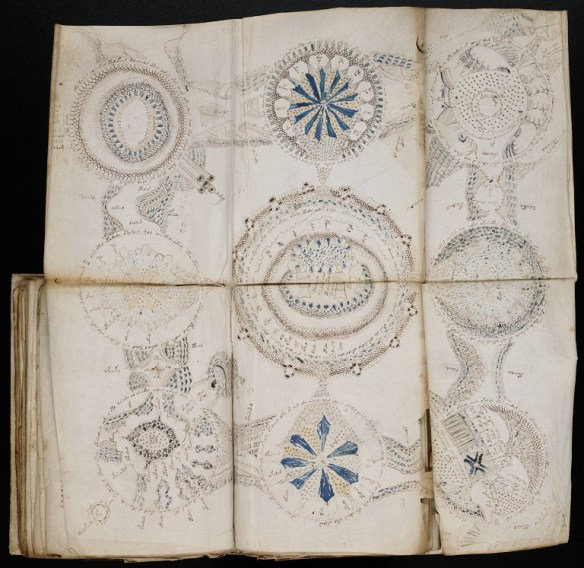
[One of several fold-out pages in the manuscript.
Image courtesy of Wikipedia.org.]
A Spanish publishing house is currently working on a limited run of exacting replicas of the Voynich Manuscript, purportedly including “every stain, hole, [and] sewn-up tear in the parchment.”
Of course, such meticulous work is reflected in the price of each book, which runs roughly $8000 to $9000 a copy. A third of the 898 copies being offered for sale have already been snatched up in pre-orders.
If you’re still hoping for a chance to tackle the mystery but you’re not looking to break the bank, thankfully Yale University Press is offering a $50 trade hardcover edition of the manuscript for sale later this year.
Whether this finally leads to a solution or simply adds new members to the ever-growing list of disappointed or frustrated aspiring solvers, I can’t say. But it’s exciting to see the mystery is alive and well.
Thanks for visiting PuzzleNation Blog today! Be sure to sign up for our newsletter to stay up-to-date on everything PuzzleNation!
By this time, you know the drill. Follow-Up Friday is a chance for us to revisit the subjects of previous posts and bring the PuzzleNation audience up to speed on all things puzzly.
And today, I’d like to return to the subject of portmanteaus.
For the uninitiated, a portmanteau is a word that combines two words and represents aspects of both of them. Smog is a portmanteau of smoke and fog. Spork, avionics, brunch, labradoodle, cyborg, Pinterest, webinar, glitterati, Reaganomics, sharknado…these are all portmanteau words.
It can be a handy way to coin a term for a situation that doesn’t already have a word to describe it. For instance, I like to think of that unpleasant sensation that you’re going to drop your car keys down a storm drain as “sedanxiety.” A disastrous kiss? “Liplockalypse.”
And clearly I’m not the only one who enjoys crafting new portmanteaus.
Utilizing a keen knowledge of French grammar, he coins this project a portmantout, using the French word for “all.”
And not only does he coin a few choice portmanteaus along the way, but he succeeds in creating a single portmanteau that contains every word in the English language:
Granted, that word is 611,000 letters long, but hey, it’s still a pretty impressive bit of coding and wordsmithing.
I look forward to a future video where he says the word out loud.
Thanks for visiting PuzzleNation Blog today! Be sure to sign up for our newsletter to stay up-to-date on everything PuzzleNation!