What crosswords have taught me

I’m a huge proponent of puzzles not just being fun, but being great for the brain as well. There are numerous studies (and PuzzleNation blog posts) touting the ways that certain puzzles can keep you sharp and perhaps even stave off developmental issues later in life.

Whether it’s crosswords helping with retrieval of previously learned information or Sudoku exercising your concentration, attention, and formation of new memories, puzzles are good brain food.

[Please note that I am making no promises about potential health benefits of our puzzles; I’m simply reporting on the results of certain studies regarding puzzles and brain health. The jury is definitely still out on this subject.]

And then there are the curious facts and new words we learn simply by solving crosswords and other puzzles.

In the decade plus that I’ve been constructing and editing puzzles, I’ve encountered all sorts of strange vocabulary and interesting trivia that wouldn’t have crossed my path in other fields.

Through proper crossword cluing and fact-checking, I’ve learned the difference between Inuit and Eskimo (and why they are not interchangeable). I’ve learned which Hawaiian islands the nene calls home.

I now know that cows are fed magnets in order to cope with the random bits of wire and other metals that they unintentionally swallow. A puzzle about rationing during World War II taught me that an ordinary piano contains enough steel, copper wire, and brass to make a dozen bayonets, a corps radio, and sixty-six thirty-caliber cartridges.

My Latin has certainly improved from years of studying word etymologies. Did you know that “ita erat quando hic adveni” is Latin for “it was like that when I got here?” That’s a handy phrase to have in your back pocket.

Heck, I now know how pineapples grow because of crosswords. How cool is that?

And it doesn’t stop there.

Crosswords provoke your curiosity and lead you down unexpected avenues of thought. Crossword clues cause you to ask questions you probably never would otherwise, like “Is ‘L.A. Law’ two words or three?” or “Is ‘bat-signal’ hyphenated?”

(Both of those are actual topics of discussion for puzzles of mine in the past.)

What sorts of interesting facts and weird vocabulary have crosswords introduced you to, fellow puzzlers? Let me know! I’d love to hear about it!

Thanks for visiting PuzzleNation Blog today! You can share your pictures with us on Instagram, friend us on Facebook, check us out on TwitterPinterest, and Tumblr, and be sure to check out the growing library of PuzzleNation apps and games!

A Quantum Leap Forward in Crosswords!

It’s fair to say that the 1996 Election Day crossword, pictured above, is one of the most famous puzzles in crossword history. The puzzle “predicted” the outcome of the election quite cleverly by allowing for either CLINTON ELECTED or BOB DOLE ELECTED to read out, depending on how the solver answered seven down clues.

(You can click the image to see a larger version of the grid and clues.)

Reportedly, Will Shortz called it the most amazing puzzle he’d ever seen.

Well, that puzzle may have been topped.

But first, a bit of backstory.

These rare crosswords are called Quantum puzzles or Schrodinger puzzles. These names reference the famous thought experiment involving a very unlucky cat in a box that could be alive or dead, and an observer wouldn’t know which until he opened the box. Meaning that both answers are correct at the same time; the cat is both alive and dead.

[This great t-shirt melds the Schrodinger’s Cat concept with a classic joke.]

Similarly, these puzzles have more than one answer, and each answer is equally correct.

And on Thursday, December 4, constructors Kacey Walker and David Quarfoot combined some considerable Scrabble skills and a dynamite crossword grid to create the most impressive Schrodinger puzzle to date.

You see, clues 26-Across, 36-Across, and 44-Across all feature seven letters, like a rack in Scrabble. And it’s up to the solver to find the anagram of each rack that fits the grid.

For example, 26-Across reads “Play in 7-Across with the rack DEIORRW”. (The answer to 7-Across is SCRABBLE, giving the solver a strong idea of where to go next.)

Quite amazingly, Walker and Quarfoot have designed the puzzle so that each of those clues has three possible correct answers — for 26-Across: ROWDIER, WORDIER, and WORRIED all fit the down clues — meaning there are a staggering 27 possible correct solutions!

This is just one of those 27 solutions:

[You can check out all of the possible solutions, as well as the clues, on XWordInfo here.]

This is David Quarfoot’s 41st NYT published puzzle and Kacey Walker’s first! Talk about setting the bar as high as you can.

This is also one of the flat-out coolest puzzle constructions I’ve ever seen. My thanks to Deb Amlen for doing such a great write-up on the puzzle and for pointing it my way.

Thanks for visiting PuzzleNation Blog today! You can share your pictures with us on Instagram, friend us on Facebook, check us out on TwitterPinterest, and Tumblr, and be sure to check out the growing library of PuzzleNation apps and games!

Beware the power of crosswords!

Both athletes and sports fans can be superstitious. Some have rituals before game or during game, or certain things they have to do or say after a big play.

Sometimes, it’s a playful thing, a form of passive support for the team, or a fun activity for everyone gathered around the TV on a Sunday afternoon or in the parking lot tailgating.

But other times, it’s taken much more seriously. After all, where you have superstitions, you also have curses.

Well, we might just need to add crosswords to the list of possible ways to jinx a team or player.

You see, sports fan Evans Clinchy knocked one entry off his bucket list by publishing a crossword with the New York Times, a worthy goal to be sure.

But he’s afraid his entry for 58-Across, KEVIN DURANT, may have jinxed a long-time favorite player and idol. You see, news went out the next day that Mr. Durant fractured his foot and will be out from 6 to 8 weeks.

I highly recommend reading the entire article, which is very funny and offers some hilarious insight into the mind of sports fans everywhere.

And his post does raise an interesting question: have any of the constructors or puzzlers out there jinxed an athlete, an actor, or a celebrity with their puzzles, or worried about doing so? I have a hard time believing Mr. Clinchy is the only one, especially since there are plenty of sports fans in the puzzle constructing community.

Let me know! I’d love to hear your stories.

Better luck with your next puzzle, Mr. Clinchy! And heal up soon, Mr. Durant. Your team, and Mr. Clinchy’s conscience, need you.

Thanks for visiting PuzzleNation Blog today! Don’t forget to check out our Facebook Giveaway for the chance to win a free puzzle app download!

It’s Follow-Up Friday: Fond Farewell edition!

Welcome to Follow-Up Friday!

By this time, you know the drill. Follow-Up Friday is a chance for us to revisit the subjects of previous posts and bring the PuzzleNation audience up to speed on all things puzzly.

And today’s update is all about constructor Robin Stears.

You’ve probably seen her puzzles in various Penny Press magazines, not to mention her delightful Team StearsWords mailings and products. She’s a prolific and creative constructor, a longtime friend of the blog, and an all-around good egg whose body of work spans two decades of terrific puzzling.

So I admit, I was a little sad to see her latest blog post a few days ago.

In short, Robin is taking time away from crosswords to embark on a new adventure: returning to college to study mathematics, in the hopes of sharing her love of math with the world.

While I’m overjoyed to see her tackling new and exciting challenges, I must confess that as a fan of her crosswords, I’m a little sad. Robin’s crosswords always feature clever, topical themes and fun entries, and her support, humor, and friendship over the last two years has been wonderful. She has always been unflinchingly kind and generous when it comes to PuzzleNation, granting interviews and contributing her wisdom, drive, and expertise to several blog posts.

Robin, I wish you the very best in starting a new chapter in your life. For many, many reasons, thank you.

Thanks for visiting PuzzleNation Blog today! You can share your pictures with us on Instagram, friend us on Facebook, check us out on TwitterPinterest, and Tumblr, and be sure to check out the growing library of PuzzleNation apps and games!

Crosswords, Cryptics, Constructors, and… Setters?

One of the privileges of writing two or three posts a week for this blog is that it pushes me to expand my own horizons when it comes to puzzles. I reach out to puzzlers, game designers, and pop culture personalities of all sorts; I try out new games and puzzles; I obsessively scour the Internet for new projects, new products, and new stories that involve puzzles.

Oftentimes, that continuous search takes me beyond the borders of the United States, allowing me to explore what puzzles mean to other countries and cultures. And I am forever intrigued by the differences in crossword puzzles between America and the UK.

The world of cryptic crosswords (or British-style crosswords, as some call them) is a bit different from the world of American crosswords. Instead of constructors, they have compilers or setters, and while constructor bylines and attributions were a long time coming on this side of the Atlantic, setters in the UK have been drawing loyal followings for decades, thanks to their unique and evocative pseudonyms.

While Will Shortz, Merl Reagle, Patrick Blindauer, Brendan Emmett QuigleyPatrick Berry, Trip Payne, Matt Gaffney, and Bernice Gordon represent some of the top puzzlers to grace the pages of the New York Times Crossword, names such as Araucaria, Qaos, Arachne, Crucible, Otterden, Tramp, Morph, Gordius, Shed, Enigmatist, and Paul are their word-twisting counterparts featured in The Guardian and other UK outlets.

In fact, beloved setter Araucaria will soon be the subject of a documentary. For more than 50 years, he challenged and delighted cryptic crossword fans, amassing a loyal following. In January of 2013, he even shared his cancer diagnosis with the audience through a puzzle in The Guardian.

While the Wordplay documentary, as well as interviews on PuzzleNation Blog and other sites, have given solvers some insight into the minds and lives of constructors and setters, it’s wonderful to know that the life of a fellow puzzler will be chronicled in so intimate a format.

Thanks for visiting PuzzleNation Blog today! You can share your pictures with us on Instagram, friend us on Facebook, check us out on TwitterPinterest, and Tumblr, and be sure to check out our library of PuzzleNation apps and games!

5 Questions with constructor Patrick Blindauer!

Welcome to another edition of PuzzleNation Blog’s interview feature, 5 Questions!

We’re reaching out to puzzle constructors, video game writers and designers, board game creators, writers, filmmakers, musicians, and puzzle enthusiasts from all walks of life, talking to people who make puzzles and people who enjoy them in the hopes of exploring the puzzle community as a whole. (Click here to check out previous editions of 5 Questions!)

And I’m excited to have Patrick Blindauer as our latest 5 Questions interviewee!

Any list of the top constructors in crosswords today simply has to include Patrick Blindauer. His puzzles have appeared in the New York Times, the Los Angeles Times, the American Values Club Crossword, GAMES Magazine, and numerous other outlets, and Patrick is known for his devilishly clever themes and challenging puzzle grids.

As a regular contributor to the American Crossword Puzzle Tournament and co-host of this year’s Lollapuzzoola, Patrick represents both classic crossword traditions and the enterprising spirit of today’s most innovative constructors, pushing boundaries and continuing to explore just how devious and delightful crosswords can be.

Patrick was gracious enough to take some time out to talk to us, so without further ado, let’s get to the interview!

5 Questions for Patrick Blindauer

1.) How did you get started with puzzles?

My parents instilled my love of puzzles and games from an early age. I remember my mom got me an educational toy called Mr. Light, and my dad had a subscription to GAMES Magazine, which I would flip through when he was done with it. I loved the visual puzzles and the contests, but I didn’t get into crosswords until many years later when I decided to give up cigarettes and take up solving.

It was one of the best decisions I ever made, simultaneously improving my health and leading me to a new hobby and eventually to a new career. After a year of solving I tried constructing, and after a year of constructing something clicked and I made my first sale (a Thursday for the NYT, which ran on 7/21/05).
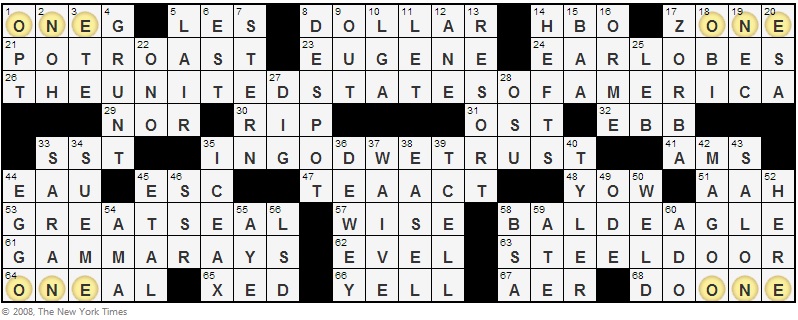
2.) Whether it’s the New York Times or the American Values Club Crossword, you’ve created some truly innovative and diabolical puzzles, like your famous dollar-bill-shaped crossword (featured above) or the New York Times puzzle from last year where multiple movie titles shared boxes. Do you have any favorite puzzles or clues, either your own or constructed by others? And on the flip side, what’s your least favorite example of crosswordese?

Thanks! Those are certainly the 2 New York Times crosswords which have gotten the most attention. Other favorites which spring to mind are my 7/4/07 New York Times puzzle*, the 12/17/09 New York Times puzzle I made with Francis Heaney, and the stuff I wrote for the NY Sun when I started out, which are collected in the book Patricks’ Puzzle Pandemonium: A Cavalcade of Crossword Craziness.

[*Glenn’s note: The 7/4/07 crossword was designed so that the letters “USA” could be found when certain boxes were shaded. It was no doubt a beast to construct. The 12/17/09 crossword was Noah’s Ark-themed, and animal names appeared side-by-side in the grid.]

I’m also the proud poppa of 5 Puzzlefests (interconnected xword suites with a final answer), which I offer through my website, and I’ve written a bunch of puzzle books (“Crossword Word Search” and “Wide-Screen Crosswords” are two of my favorites).

There are lots of other constructors whose work I enjoy, especially those who devise novel gimmicks that really push the envelope.

blindauer beard

My least favorite xwordese is probably LST, though I try to avoid all xwordese when I can. Coming up with a fresh SST clue is tough too, so I just avoid putting it in the grid in the first place.

[Glenn’s note: LST is an abbreviation for an amphibious military craft, short for Landing Ship Tank. SST is an abbreviation for supersonic transport, like the former Concorde.]

3.) You’re also a musician, and both the best puzzles and enjoyable musical performances often have a sense of flow and elegance about them. Do you ever find yourself relying on your more puzzly skills while performing, conducting, or teaching?

Not consciously, no, but maybe I should!

4.) What’s next for Patrick Blindauer?

I actually have something very exciting to announce: I’ve been commissioned to write a 6-puzzle set for the New York Times! It will run Monday-Saturday sometime this fall, and the plan is to make it a contest, as well. I’m thrilled and honored to have the opportunity to do something like this. Wish me luck!

5.) If you could give the readers, writers, and puzzle fans in the audience one piece of advice, what would it be?

Keep your pencil sharp and your mind even sharper.


Many thanks to Patrick for his time. You can check out his PuzzleFests and other puzzly works on his website, and be sure to follow him on Twitter (@pblindauer) to keep up on all things Patrick. (You can also learn more about the Lollapuzzoola tournament at BeMoreSmarter.com.) No doubt, Patrick will have something fiendishly fun for solvers soon.

Thanks for visiting PuzzleNation Blog today! You can share your pictures with us on Instagram, friend us on Facebook, check us out on TwitterPinterest, and Tumblr, and be sure to check out the growing library of PuzzleNation apps and games!