That’s right, fellow puzzlers and PuzzleNationers! It’s that time again when we pit our puzzly minds against a fiendish brain teaser and test our mental mettle!
You might’ve seen this brain teaser making the rounds on social media. It’s known as the hundred dollar puzzle, and unlike most brain teasers, this one is less about the puzzle and more about how we got to the solution.
Intrigued? You’re not the only one. Let’s take a look at the brain teaser:
A young man sees a shirt for $97. He borrows $50 from mom and $50 from dad. He buys the shirt and is left with $3 change.
He gives $1 to mom, $1 to dad, and keeps $1 for himself. Now he owes his mom $49 and his dad $49.
$49 + $49 = $98 + his remaining $1 = $99. Where did the other $1 go?
People love brain teasers like this, because at first glance, and even at second glance, the math SEEMS to hold up.
But the real trick to this one is that it’s asking the wrong question. The other dollar didn’t go anywhere.
The problem here is… as soon as he pays his parents back, it’s no longer about one hundred dollars. It’s about ninety-eight dollars.
Let’s look at total borrowings versus borrowings after paying back his parents. The original specs were:
What he owed: $100
What he had: $3 and a $97 dollar shirt.
But the goalposts changed when he paid his parents back a dollar each. (And if he plans to pay the loan off a dollar at a time, it’s going to take FOREVER for them to get their money back.)
What he now owes: $98
What he has: $1 and a $97 dollar shirt.
The math adds up. Your total borrowings go from $100 to $98 dollars, and you spent $97 dollars and put the extra dollar in your pocket.
So the final equation in the brain teaser is flawed. It’s not $49 + $49 = $98 + his remaining $1 = $99. It’s $49 + $49 = $98 = his remaining $1 and his fancy shirt $97.
Sometimes, brain teasers aren’t about crunching numbers, but finding the logical flaw in the puzzle itself.
We hope you enjoyed unraveling the hundred dollar puzzle, and if you have any brain teasers, riddles, or other puzzly suggestions for mental challenges to conquer, let us know in the comment section below! We’d love to hear from you!
Thanks for visiting PuzzleNation Blog today! Be sure to sign up for our newsletter to stay up-to-date on everything PuzzleNation!
Earlier this year, I wrote a post about puzzle furniture, a small but growing niche of the puzzle world. We explored modular sofa, chair, and desk designs, as well as impressive tables designed by the puzzle wizards at Praktrik.
But what happens when you combine a designer of fiendishly clever puzzle boxes and a furniture designer with an impeccable knack for melding mechanical puzzles and beautiful woodworking?
You get the Wisteria Puzzle Cabinet, an absolute masterpiece that serves as both a stylish cabinet and an incredibly complex puzzle box.
It’s the most beautiful and complicated safe you could ever want, and it would hide in plain sight in your home.
Check out this video detailing some — but I suspect not all — of its secrets, including hidden compartments, an internal elevator, and multi-piece keys that must be uncovered, assembled, and reused:
The puzzly aspects were designed by Robert Yarger (also known as Stickman in the puzzle box world) and the actual cabinet built by Craig Thibodeau, and together, they’ve brought this mind-blowing piece of puzzle art to life.
Granted, the price of an piece like this is pretty steep.
On his website, Thibodeau states that his “latest work exploring mechanical furniture, puzzles and hidden compartments is the most expensive furniture I build due to the highly complex design and fabrication process. These pieces typically start at around $30,000 and go up from there due to the complexity of the internal mechanisms and the variety of hidden details incorporated into the design of these highly unique pieces.”
Although that’s out of my price range, it’s a testament to how much preparation, design, and labor goes into a puzzle as gorgeous and labyrinthine as this cabinet. Even at five figures, it seems well worth the price.
Oh, and if you’re looking for more puzzly furniture, you can also check out the table designs of David Lundell on YouTube, like this magic-themed coffee table:
Now, if you’ll excuse me, I’m going to go check every piece of furniture in my house for secret compartments. You know, just in case.
Thanks for visiting PuzzleNation Blog today! Be sure to sign up for our newsletter to stay up-to-date on everything PuzzleNation!
Yes, we’re celebrating today, fellow puzzlers and PuzzleNationers!
We’re celebrating because it is the sixth anniversary of the very first post here on PuzzleNation Blog! Yes, we’ve been on this puzzly journey together since August of 2012, and in my admittedly biased yet humble opinion, it’s been a brilliant one.
In those six years, we’ve published over a thousand posts! (More than nine hundred of them penned by yours truly.) We’ve delved into puzzle history, cracked diabolical brain teasers, marked milestones like the centenary of the crossword, and even rejoiced at puzzly proposals of marriage!
And to celebrate six years of PuzzleNation Blog, we’ve got a week of activities planned for our marvelous readers and fellow puzzlers!
For starters, we’re loading over a hundred new pins to our Pinterest account for your viewing pleasure!
And we’re launching a promotion across all of our social media platforms to celebrate the anniversary. It’s our PuzzleNation 6th Anniversary Contest!
(These will be separate from the usual Crossword Clue Challenge posts, and we’ll mark them with “PuzzleNation 6th Anniversary Contest” to distinguish them.)
Message us on FB or Twitter with the answer, or message us on Instagram with the answer to a brain teaser, and you’ll go into a drawing for a terrific prize! (And yes, since there are different brain teasers each day and different answers for each of the two daily puzzles, you can enter multiple times to increase your odds of winning!)
Enjoy the contest, fellow puzzlers. It’s a small thank you for being a part of the PuzzleNation community.
Thanks for visiting PuzzleNation Blog today! Be sure to sign up for our newsletter to stay up-to-date on everything PuzzleNation!
[Note: I received a free copy of this game in exchange for a fair, unbiased review. Due diligence, full disclosure, and all that.]
Chess, checkers, backgammon, Go, Othello… all of the classic board games rely upon the idea that both players know how the pieces can and will move from round to round. That way, they can strategize, they can prepare defenses, they can circumnavigate your attempts to flummox them. To outmaneuver someone, you have to know how they can maneuver.
But what if your opponent could potentially move in five different ways? How would that alter your strategy? How would that alter your gameplay?
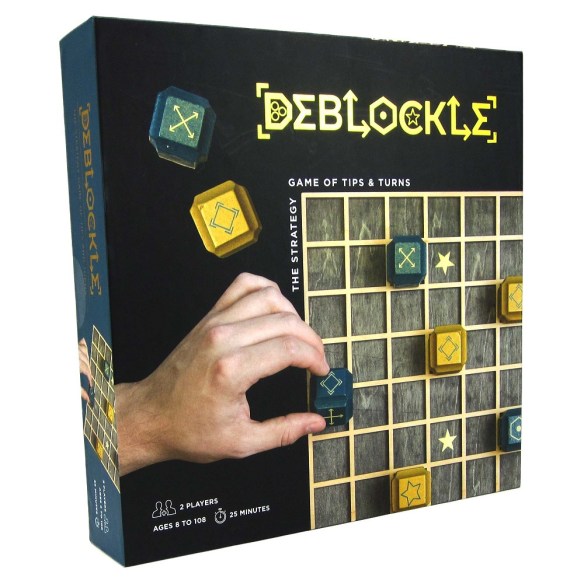
Beware, fellow puzzlers… one-on-one board gaming just got a little more complicated with Deblockle.
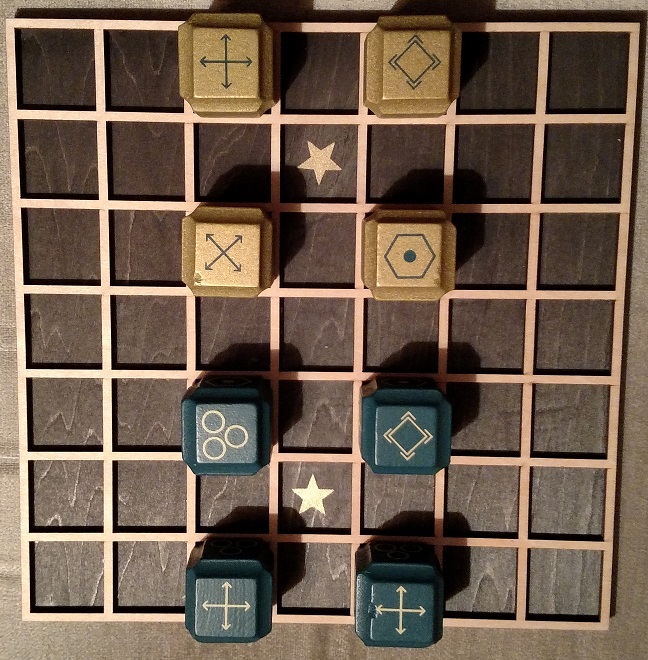
Masterminded by the team at Project Genius, Deblockle pits two players head to head to see who can remove their four blocks from the board first.
That’s right, there aren’t sixteen pieces to keep track of, like in chess, or twelve, like in checkers. There are just four blocks for you, and four blocks for your opponent.
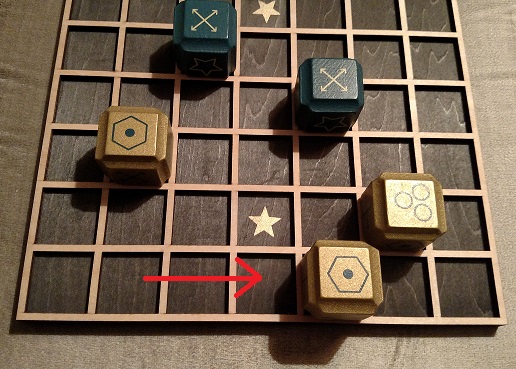
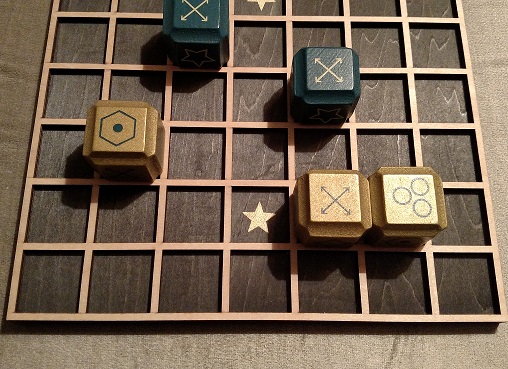
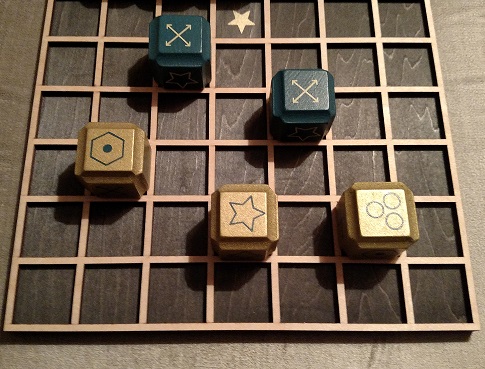
But here’s where things get tricky. Each turn, you have two moves. The first move is to roll one of your blocks into an adjacent space (either vertically or horizontally).
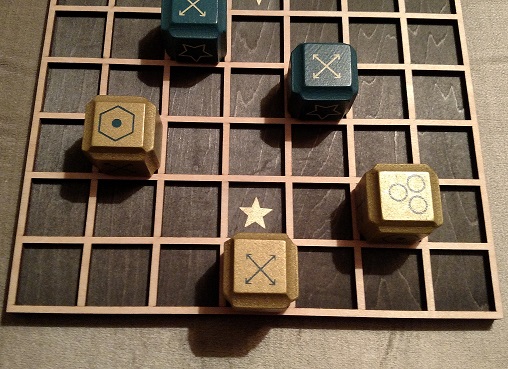
The second move is to place your block according to whichever symbol that landed face-up because of that roll.
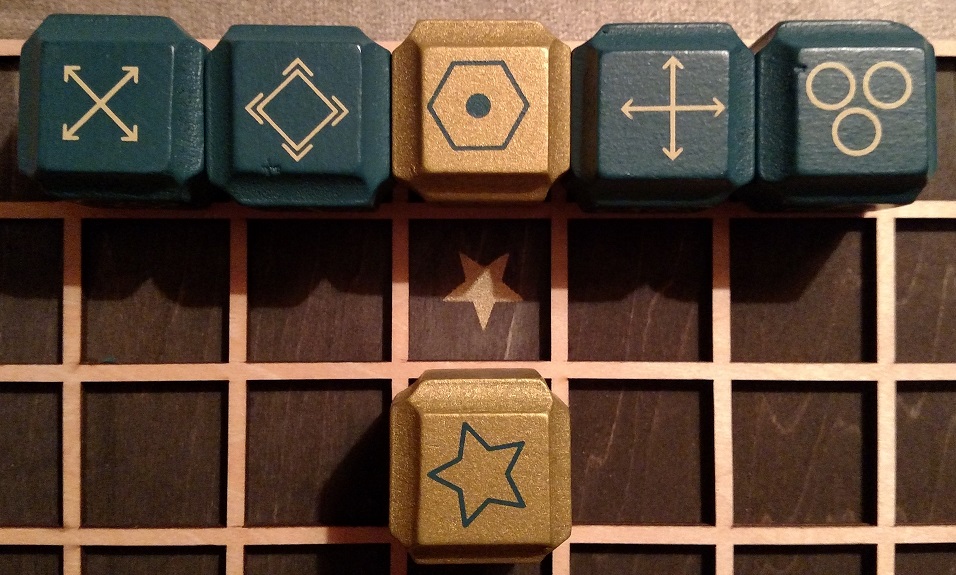
There are six symbols, each with a corresponding action:
Stop: your turn is over, there is no second move
Cross: move your block one space either horizontally or vertically
X: move your block one space diagonally
Hoops: move your block three spaces (vertically or horizontally) in any combination, including backtracking over a space you just occupied
Slider: move your block either vertically or horizontally until you reach the end of the row or column, or until you’re stopped by another block
With each of those second moves, you’re not rolling the block to reveal a new symbol; you’re picking it up and placing it into its new position.
And yes, there are six symbols, and I only listed five above. That’s because the sixth symbol, the star, can only be revealed if you’re rolling onto one of the star spaces on the board. By rolling the block star-side-up onto a star space, you remove the block from play.
That’s the only time you can roll your block star-side-up, and the only time you’re allowed to occupy a star space with your block.
There are only two star spaces on the board, and you can only remove your blocks from the game if you utilize the star space opposite you.
And that’s when things get really tricky. Because it’s entirely likely that your opponent’s blocks will prevent you from rolling onto the symbol you wanted. So you’re puzzling out how exactly to roll and move your blocks so you’ll end up adjacent to the star space with the star symbol waiting to be rolled face-up, and also playing defense to impede your opponent’s efforts to navigate and manipulate the board to their own advantage.
It’s a lot to keep track of, and it makes for an immensely engrossing, engaging puzzle duel for two players. You’ve got the resource management of Risk, the piece placement mechanics of chess, and the defensive gameplay of Stratego and other strategy games.
And since the blocks are placed in their starting positions by your opponent — after rolling them randomly to see which symbol is face-up to start — every game of Deblockle is different. Opening gambits — like those you can learn in chess — are useless, because you won’t know how you can move your blocks initially until your opponent places them.
There is a wonderfully fresh challenge factor to Deblockle that many other head-to-head board games lack. While playing the game over and over will allow you to develop techniques and skills for how to better move your blocks, there are no shortcuts to becoming a better player through sheer repetition, because each opening setup is different.
Project Genius has managed to stuff a massive amount of gameplay, strategy, and style into those four little blocks, and they’ve got a real winner on their hands here.
[Deblockle is available from Project Genius and other participating retailers, for players starting at 8 and up!]
Thanks for visiting PuzzleNation Blog today! Be sure to sign up for our newsletter to stay up-to-date on everything PuzzleNation!
We’ve written about some pretty amazing and elaborate puzzle hunts here in the past. There was the Gravity Falls cipher hunt that led to an actual statue of the show’s villain Bill Cipher in the woods of Reedsport, Oregon. (And a mayoral position for the first person to find him and shake his hand!) There was the puzzle-turned-global-scavenger hunt from Trials Evolution that won’t be completed until 2113 at the base of the Eiffel Tower.
And now, a massive crowdsourcing effort has cracked another masterpiece, a puzzle hidden in an expansion pack for the video game Destiny 2. Destiny 2 is an online first-person-shooter loaded with sci-fi trappings and in-depth storytelling where players explore a shared environment while engaging in their own personal plot and adventures.
The most recent expansion to the game, Warmind, was released last week, and players noticed an elaborate symbol on a wall in the bunker of Rasputin, a sentient robot. The symbol appeared to be a lock surrounded by keys and curious symbols.
This Kotaku post went live on Friday, three days after the Warmind release, revealing the incredible online effort already in motion to unravel the secrets of the Rasputin puzzle. The subreddit r/raidsecrets was ground zero for the puzzle-solving efforts, and players compiled their theories and discoveries there.
Players quickly determined that each of the keys had a symbol that linked back to other imagery from the game, and by following those breadcrumbs, they had a chance to crack the cipher.
The first symbol was found in several places, each time with a set of digits and a bar in a particular position. Solvers theorized that these symbols represented the word “reverse.”
The second symbol appeared beside a Braille grid, leading hunters to crates with Braille lettering on them: OEAARRTFWTH. This anagrams to The Art of War, Sun Tzu’s famous tome. In this case, The Art of War was used as the source material for an Ottendorf Cipher. (That particular cipher was made famous by Nicolas Cage’s National Treasure movies.)
This type of cipher uses numbers in groups of three, and these numbers correspond to positions of letters in a book. Most often the numbers refer to Line, Word, and Letter. Decoding the number-combinations in the image above led to the answer “Destroy all second A and B. Then destroy all third C and R.”
These two clues were assumed to be instructions for what to do with the encoded ciphertext others had discovered in the game:
This encrypted message was the heart of the puzzle. But there was more to uncover first.
As it turns out, the last three keys in the image represented different words to apply to the ciphertext in order to properly decode it.
The fourth symbol was found near a Morse Code sequence that spelled out “NTEHNMLNEEGIT,” an anagram for “Enlightenment.”
The fifth symbol pointed toward a monitor with some peculiar code on it. It turns out the code was actually Jianpu, an ancient form of Chinese notation for writing music. When translated into actual music, a player identified the piece as an excerpt from Tchaikovsky’s Swan Lake.
One intrepid codebreaker then tried to decrypt the ciphertext given the clues everyone had assembled thus far.
He reversed the ciphertext, according to the instruction of the first key. He then removed every other A and every other B from the text, then every third C and every third R, according to the instructions of the second key.
Then, employing a Vigenere cipher, he used the two key words he had — “enlightenment” and “swan lake” — to begin decrypting the text. He managed to decrypt the entire text, but more incredibly, he also reverse engineered the missing third key word — “mechanized” — while doing so.
And what was the final message, after all this?
thank you for taking the time to piece together this message, friend. the time of our final conflict is drawing closer and you and ana have an important role to play in the events to come. so watch over her, guardian. i would have no life without ana or the exoprogram. i regret that we have become strangers, but we each have a path that we must walk. and, ironically, there never seems to be enough time. tell her, rasputin’s first attempt was in the right location, but the wrong moment. look here: 43.549573, -73.544868 – e
As you might suspect, those numbers at the end are GPS coordinates, which correspond to Sleeping Beauty Mountain in upstate New York. (The company that developed Warmind, Vicarious Visions, is based in upstate New York.)
A small treasure trove of prizes awaited the brave soul who trekked out to Sleeping Beauty Mountain on Saturday morning. The centerpiece was a giant spear, a replica of a weapon from the game known as the Valkyrie.
There was also a box of gold coins (along with instructions asking the finder to only take one), a set of notes, and a journal for recording visitors. The note, from Warmind design lead Rob Gallerani, encouraged the finder(s) to share photos of this discovery and told them that there are only three spears like that in existence — one at Vicarious Visions, one at Bungie, and this.
The spear, shown above (alongside the visiting team from Vicarious Visions) now resides at a comic shop called The Freakopolis Geekery.
As for the gold coins and the geocache Vicarious Visions had set up for others who make the trip, unfortunately, park rangers removed it because the designers didn’t get a permit. The coins have been returned to Vicarious Visions, who are currently reaching out to all the folks at r/raidsecrets who contributed to the solution of the puzzle, hoping to get them the coins they so richly deserve.
And, as if all that wasn’t amazing enough, it turns out… this might not be the end of the adventure.
Because a sharp-eyed observer noticed some text embossed on the upper portion of the replica Valkyrie spear:
At the moment, no one knows what the letters mean. But if I had to wager, I’d say the master puzzle solvers at r/raidsecrets should keep digging. Who knows what they’ll find next?
Thanks for visiting PuzzleNation Blog today! Be sure to sign up for our newsletter to stay up-to-date on everything PuzzleNation!
[Note: I received a free copy of this product in exchange for a fair, unbiased review. Due diligence, full disclosure, and all that.]
Clear, or transparent, cards are a rarity in puzzles and games, but they offer a terrific gameplay mechanic: the ability to stack cards without obscuring information.
The clear cards in the storytelling game Gloom allow players to add and subtract points from various characters as the grim and whimsical stories unfold. The quick-play pattern-matching game On the Dot — which was part of last month’s Tabletop Tournament — challenges players to properly arrange four clear cards — each with randomly-placed colored dots — in order to match a given pattern before their opponents do.
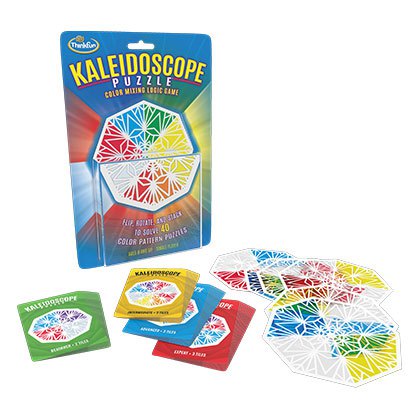
Now, the creative minds at ThinkFun have put a wonderful, vibrant twist on the clear-card genre of puzzles and games with their latest release: Kaleidoscope Puzzle.
[Two of the six kaleidoscope tiles.]
In Kaleidoscope Puzzle, you have six octagonal tiles, each with its own pattern of tinted and clear quadrants. It’s up to the solver to arrange either two or three of the six tiles in order to recreate the patterns on the challenge cards.
First off, I want to say that this might be the most aesthetically pleasing puzzle I’ve ever solved. Just turning the kaleidoscope cards in my hands in front of a light is enjoyable, letting the snowflake-patterning on each card blur and come into focus anew as the cards line up, each time matching and mixing the various colored quadrants to create eye-catching effects. It’s brilliant in its simplicity, and unlike any color-based puzzle I’ve seen on the market today.
It almost feels like putting together a stained-glass window, particularly as the challenge cards progress and the patterns grow more elaborate.
[One possible combination of those two tiles.]
The Beginner challenge cards help to familiarize you with the gameplay. You quickly figure out placement and color combinations. As you transition into the Intermediate challenge cards, the patterns grow more elaborate, and honestly, more beautiful. It’s amazing the combinations you can conjure with just two of the six possible kaleidoscope tiles!
Halfway through the Intermediate challenge cards, they ratchet up both the possibilities and the difficulty, as you now have to create the patterns with three kaleidoscope tiles. Now you’re trying to cover all four quadrants with color patterns, and it becomes about maximizing what each tile offers.
But it’s in the Advanced challenge cards that the game really separates itself from On the Dot-style solving, because Kaleidoscope puzzle has the color-mixing element as well. Not only are you manipulating the kaleidoscope tiles to place the basic colors where you need them, but you also need to create green, orange, and purple patterns as well.
Toward the end of the Advanced challenge cards, you start to deal with eighths instead of quadrants, divvying up the field into increasingly more complicated designs, reminiscent of pie charts.
Sometimes, you might discover alternate ways to form the patterns, which is very satisfying indeed. It also speaks to how adaptable the six kaleidoscope tiles are, since you can arrange them in seemingly endless combinations.
By the time you reach the Expert challenge cards, you’ll be turning, flipping, and rearranging these tiles like crazy to form the intricate patterns on the cards. It’s an unexpectedly relaxing form of puzzling, a meditative mix of challenge and aesthetics.
[The same pattern coming to life under a desk lamp.]
I cannot say enough good things about this puzzle. Mixing the resource management of how to get the most out of each tile you choose with the striking visuals of the kaleidoscope tiles makes for a unique solving experience.
Puzzles that are as satisfying to look at after the solve as they are to solve in the first place… that’s a true rarity. What a treat.
[Kaleidoscope Puzzle is available from ThinkFun and participating retailers, starting at $9.99!]
Thanks for visiting PuzzleNation Blog today! Be sure to sign up for our newsletter to stay up-to-date on everything PuzzleNation!






 PuzzCulture