The Conundrum of Computers, Crosswords, and AI

Image courtesy of ESLTower.

AI continues to encroach on nearly every aspect of our lives, online or otherwise, and crosswords are not immune to this effect.

Actually, crosswords and computers have walked hand-in-hand for a long time.

Some companies use computer programs to generate their unthemed crosswords, no human intervention necessary. Computer programs like Crossword Compiler aid constructors in puzzle design and grid fill, allowing them to build and cultivate databases of words with which to complete their grids.

And computers are getting better at solving puzzles as well. Years ago, I wrote about a program that taught itself to solve Rubik’s Cubes.

Matt Ginsberg’s ever-evolving crossword-solving program Dr. Fill won the American Crossword Puzzle Tournament in 2021 — although the top prize still went to a flesh-and-blood solver — a first-time occurrence which garnered a lot of media attention:

The first computer to win the event, Dr. Fill completed most puzzles in well under a minute and only made three mistakes, edging out its top human competitor by 15 points.

To be fair, several constructors responded by vowing to make a crossword for the following year’s tournament that would thwart any computer. And I respect such inspired declarations immensely.

(I’ll have to do more research and find out if any of them succeeded!)

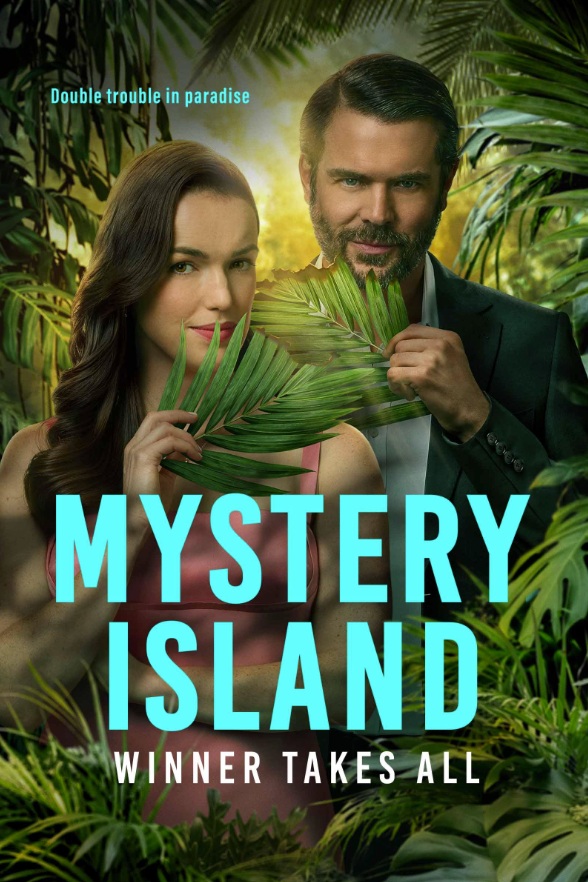
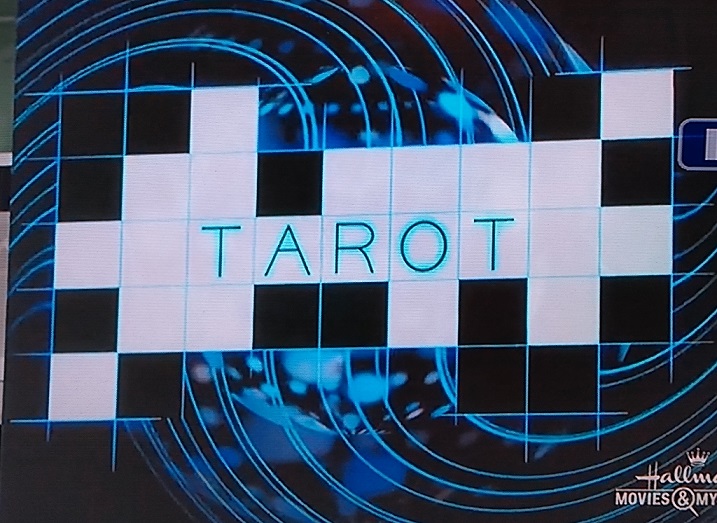
Really, we shouldn’t be surprised. They wrote an entire Crossword Mysteries movie on the Hallmark Channel about a crossword-clue-solving AI (and the people who would kill for the technology).

But I digress.

I have AI on the brain today because I just checked out an AI-fueled competitive mini-crossword arena, and I have mixed feelings about it.

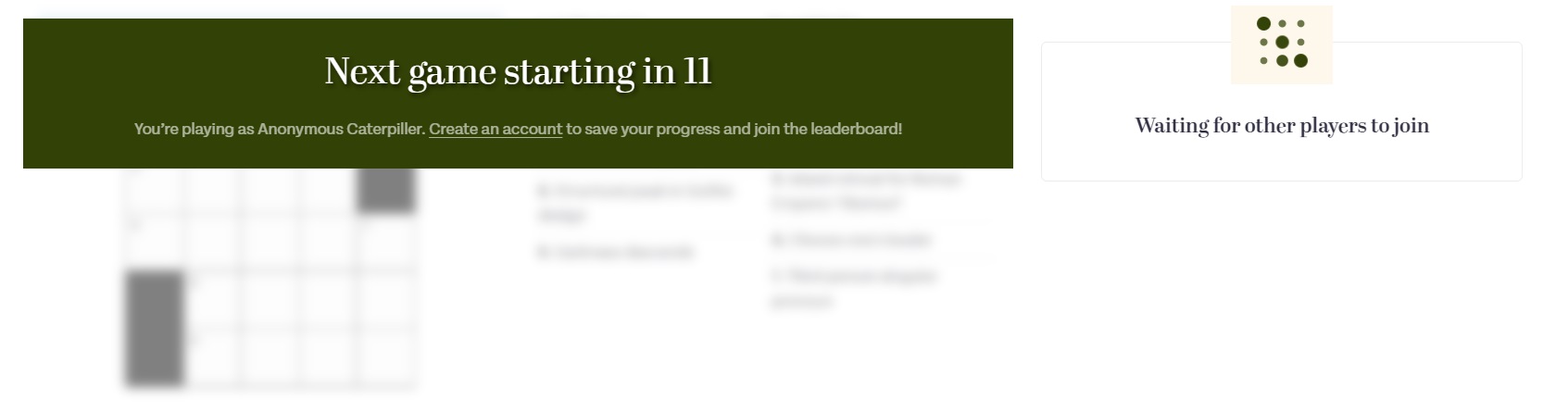
It’s called Crossword Race, and it uses AI to generate 5×5 mini-crosswords, clue them, and load them up for solvers to complete in as fast a time as possible.

Yes, the cluing is very bland and overly technical (feeling more like oddly-worded dictionary definitions), but there seems to be a genuine desire to build and serve a puzzle-solving community.

And I can see the value.

If you’re a puzzler trying to get better at solving — especially if you have friends posting their mini-crossword results on the daily — this is a safe space to practice your solving, your grid navigation, and shake off the nerves that come with any timed competitive endeavor. (You can create a profile to track your stats or play anonymously.)

But I’m also a writer, a puzzler, a content creator, and such push-button “creativity” gives me the ick. Beyond the soullessness that comes with so many AI creations that lack the heart and inspiration of human touch, there are already too many computer-generated crosswords these days with crap clues, poor fill, and frustrating Naticks/crossings that would stump the average solver.

I looked at a puzzle book from one of these companies a few years ago. I mean, it was almost impressive that one computer-generated puzzle managed to cram FIFTEEN abbreviations into a 13×13 grid, often crossing or piled together in corners. It was an abysmal solving experience.

Now, abysmal is not a fair word to use when discussing Crossword Race’s grids. Let me be fair here. I don’t like the cluing, but the grids are reliably filled with beginner-appropriate vocabulary.

And I want PuzzCulture to be a place where we discuss what’s going on in the world of puzzles. That includes AI.

So it’s up to you, fellow puzzlers, if you decide to use Crossword Race or not, or if Crossword Race is a net good for puzzlers worldwide. Time will tell, I suppose.

In the meantime, I wish you happy puzzling, folks! And remember to support your friendly neighborhood cruciverbalist! Sign up for a Patreon, buy a puzzle book, attend a crossword tournament, every little bit helps!

Crossword News Roundup!

In today’s blog post, we’ve got a trio of crossword-related news items for you!


shortzoffice

Welcome back, Will!

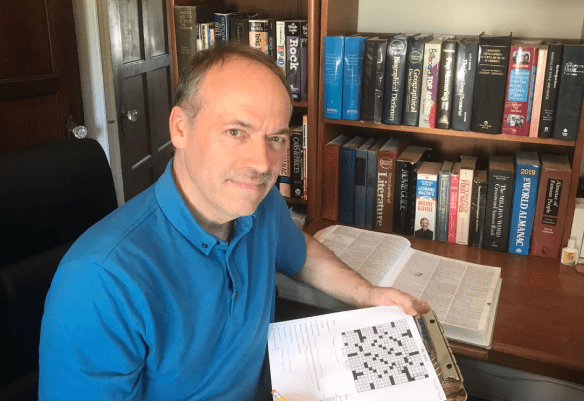
Earlier this week, The New York Times announced that Will Shortz was back at work editing the Times crossword (beginning with the December 30th puzzle).

This is wonderful news, as Will had to step back from his editing work in February to attend to his recovery.

For those who were unaware, Will suffered a stroke that affected his mobility — he offered details on both the stroke and his recovery to Brain & Life magazine — but he is back to editing and playing table tennis.

From the NYT article:

In addition to completing hours of physical therapy and rehab, Will slowly returned to puzzle making and editing throughout the year. He directed the American Crossword Puzzle Tournament, returned as the creator of NPR’s Weekend Edition Sunday Puzzle in April and resumed choosing puzzles for The Times in May.

We wish Will all the best in his continued recovery and return to puzzling. I’ve had the pleasure of interacting with Will a number of times — mostly at the ACPT, though I did interview him for the blog years ago — and I’m very glad to hear that he’s well enough to enjoy both of his favorite pastimes again.


acptlogo

And speaking of Will Shortz news, registration is open for the 47th edition of the American Crossword Puzzle Tournament!

Once again being hosted in Stamford, CT, the ACPT is a weekend-long puzzle extravaganza of solving, puzzle-themed events, fun, and community.

This year’s tournament runs from April 4th through the 6th, and you can click here for more details (and to register for this year’s event, should the spirit move you).

Are you planning on competing this year? Let us know in the comments below! We’d love to hear from you.


Our last bit of crossword news was brought to our attention by friend-of-the-blog DGhandcrafted.

The jewelry crafting supply website Lima Beads has a puzzly promotion going on that might interest the craftier members of the readership.

There is a crisscross grid featured on the site for the entire month of January, and the numbered answers correspond to what’s on sale that particular day!

There’s even a chance to win a bonus prize if you solve the entire puzzle early!

It’s a pretty clever way to bring solvers and crafters back to the site throughout the month, and hopefully it’s a success for both the customers and Lima Beads.

Happy puzzling (and crafting) everyone!

Women of Letters (and Squares and Boxes and Clues and…)

Puzzles bring joy to so many of us. They’re an escape, a challenge, a satisfying little test of our wits, our dedication, our creativity, and our flexibility of thought.

In uncertain times, in times of trouble, people often turn to puzzles. Puzzles were a refuge for many during lockdown when COVID hung over our heads. And now, when so much seems uncertain, if not downright unstable, people will no doubt turn to puzzles again.

That’s not to say that puzzle solving is a mere flight of fancy, a desperate bit of escapism, a Hail Mary avoidance of difficult circumstances, hard questions, and treacherous times to come. Quite the opposite, in fact.

If you turn to puzzles now, you’ll see a road map that proves things can get better.

Because, like it or not, misogyny once dominated the world of puzzles. It was baked into crosswords from the very beginning.

Yes, Arthur Wynne created the template for crosswords. Simon & Schuster are credited with publishing the first crossword puzzle book, as well as all the bestselling puzzle books that followed, serving as the foundation that helped build their brand.

But it was women who made crosswords into something more.

Women like Richard Simon’s aunt Wixie. She insisted Simon look into publishing a limited release crossword book. (UPDATE: I originally wrote that none of the stories mentioned her name, but I later found some that included her nickname, Wixie. I later discovered her actual name is Hedwig Simon.)

Women like Margaret Farrar. While serving as “an unofficial editor of the crossword-puzzle section,” she prevented errors and helped establish some of the baselines that still stand in crosswords today.

Women like Ruth Hale. Ruth was the founding president of the Amateur Cross Word Puzzle League of America, an organization that set crossword standards like limiting black squares and symmetrical grids, building off of Farrar’s work.

Women like Nancy Schuster. Schuster (no relation to the aforementioned publisher) not only ran Dell Crosswords but was the first winner of the American Crossword Puzzle Tournament.

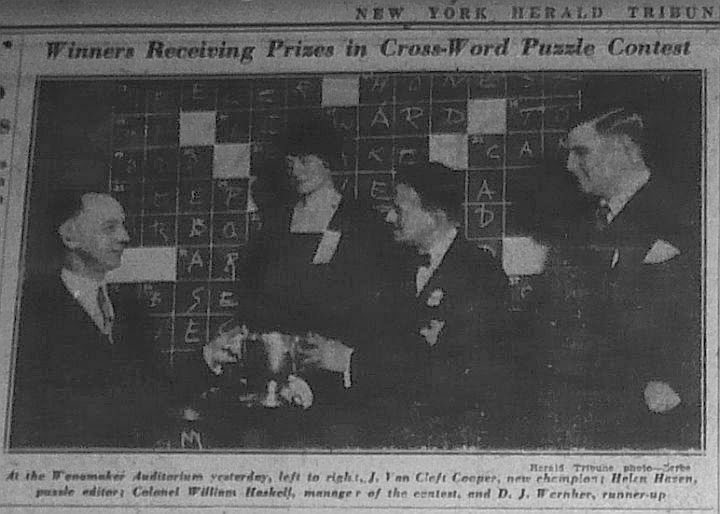
Women like Helen Haven. In the 1920s, Haven was the organizer of the first competitive crossword-solving contest and served as the puzzle editor for The New York Herald-Tribune.

As pointed out by Anna Shechtman in her book The Riddles of the Sphinx: Inheriting the Feminist History of the Crossword Puzzle, between 1913 and the 1960s, most crosswords were created by women.

Puzzles were literally women’s work! With all the connotations that phrase invites.

And crosswords were derided as a frivolous pastime because of it. Not only because women made crosswords, but because crosswords were predominantly solved by women.

The New York Times called the crossword “a primitive form of mental exercise” and female solvers were blamed for neglecting their families and wifely duties because of their “utterly futile finding of words the letters of which will fit into a prearranged pattern, more or less complex.”

Funny how their opinions changed just in time to profit on crosswords in the 1940s.

Much like the Beatles — who were dismissed as nothing more than a glorified boy band when thousands of women cheered at their shows, only for them to be recognized as a once-in-a-generation group of talents when men started paying attention — crosswords became “respectable” only when men took interest and took over.

The percentage of female constructors published in The New York Times went down during the Will Shortz era, as compared to the Will Weng and Eugene Maleska eras.

And like it or not, but “the average solver” concept — a problem I discussed years ago — is still using a white male yardstick for comparisons, to the detrimental of solving and constructing.

In a wonderful blog post on the subject of women in puzzles, the author of the piece opens with the line “I’ve always associated crossword puzzles with men.”

And I realized how lucky I was to NOT have that association. In fact, I don’t think I would be a puzzly guy without the women in my life.

My mother (the first female store manager in A&P history) still solves crosswords and jigsaw puzzles to this day, and encouraged my interest in puzzles in the first place. My oldest sister (a teacher) introduced me to wordplay. My older sister spent hours playing puzzle video games like Dr. Mario with me. My younger sister is not just a master jigsaw puzzle solver, but a fiend at trivia nights and escape rooms, forever challenging me to match her flow.

I was trained in crossword puzzle editing and construction by Penny Press’s crossword guru Eileen Saunders, and still lean on her creativity and wisdom every day (and marvel at her blistering speed and efficiency).

I was shepherded through the world of variety puzzles by Los Angeles Times crossword editor and puzzle badass Patti Varol. (Though it was probably more like dragging my deadweight body through molasses than “shepherding” if I’m being honest.)

And that’s not counting the undeniable and indispensable influence of Amy Roth (a shining light at Penny Press), Chris Begley, and so many other female voices that make Penny Press one of the best outlets for puzzles in the world.

I love puzzles because of those women. I have made a career in puzzles because of those women. I am better at puzzles because of those women.

The puzzle world is better because of women. It will continue to advance and innovate and thrive because of women.

How do I know this? Because women are doing incredible things in puzzles RIGHT NOW.

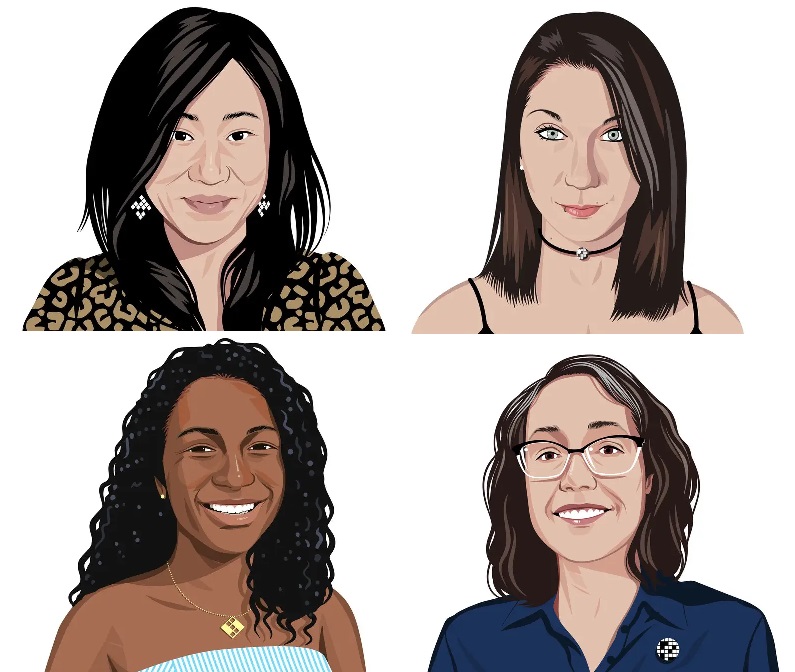
A small sampling of the women making puzzles better. Wyna Liu, Amanda Rafkin, Soleil Saint-Cyr, Tracy Bennett. Illustrations by Ben Kirchner.

Look at The New York Times. Tracy Bennett, Wyna Liu, and Christina Iverson are delivering great daily puzzles like Connections, Strands, and Mini Crosswords not just consistently, but brilliantly.

The aforementioned Patti Varol is absolutely crushing it at The Los Angeles Times crossword. With Katie Hale and Angela Kinsella Olsen on Patti’s team, every month since mid-April 2022 has had a minimum of 50% women constructors and often exceeds that, all while delivering topnotch puzzles.

The New Yorker, USA Today, The Slate Crossword? Liz Maynes-Aminzade, Amanda Rafkin, Quiara Vasquez. Brooke Husic runs PuzzMo (where Rachel Fabi constructed my favorite puzzle of the year!) and Amy Reynaldo co-edits Crosswords With Friends.

Rebecca Goldstein just won the Orca for constructor of the year. Smarter people than me have called Stella Zawistowski a crossword boss in every sense of the word. Ada Nicolle won the 2024 Lollapuzzoola crossword tournament.

The impact of projects like Women of Letters and The Inkubator weren’t just the tip of the iceberg, they were the tip of the spear. A spear aimed directly at the heart of outdated notions of who makes crosswords and who solves them, dismantling the idea of some mythical “average solver” that has never truly represented the crossword audience.

As constructors, editors, and solvers, women in the past shaped puzzles as we know them. And women in the present are redefining puzzles. Not just in terms of representation (both as grid answers and creators behind the scenes), but in terms of acknowledgment, respect, and appreciation.

As for women of the future? I, for one, can’t wait to see what they have in store for us.

(And thank you to several of the women mentioned above for making this post far, far better than it started.)

Two Crossword Anniversaries This Week!

exercise-brain-crossword-670x335

Crossword history isn’t exactly a field of study that dates back to ancient times — I mean, we only celebrated the centennial of the crossword back in 2013 — but that doesn’t mean there isn’t a huge amount of historical crossword material out there to be commemorated.

In fact, this week marks two fairly meaningful crossword anniversaries, one to be celebrated today, the other tomorrow.

The first crossword anniversary to observe is the 150th birthday of Arthur Wynne.

[Image courtesy of express.co.uk.]

In 1913, Arthur Wynne created the first modern crossword puzzle — which he called a Word-Cross puzzle — and over a hundred years later, we are still enjoying the ever-increasing variety of puzzles and clues spawned by that “fun”-filled grid.

Wynne was born on June 22, 1871 in Liverpool, England, but moved to the states in the early 1890s, spending time in Pittsburgh and New York City before creating his Word-Cross puzzle for the New York Sunday World.

Of course, the crossword as we know it — with its square grid and the black-and-white square patterning — are due not to Mr. Wynne, but to his former associate, future first New York Times crossword editor Margaret Farrar.

But, speaking of figures who helped elevate crosswords to greater prominence, that brings us to our second anniversary.

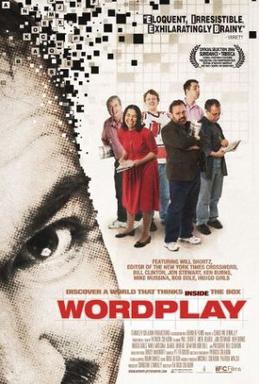
Tomorrow marks the 15th anniversary of the release of the influential crossword documentary Wordplay.

Wordplaymp

Wordplay introduced several famous names in crossword tournament circles, like Ellen Ripstein, Trip Payne, Tyler Hinman, Jon Delfin, and Al Sanders, as well as highlighting many celebrity crossword solvers like Jon Stewart, Ken Burns, Bill Clinton, and more. The documentary also chronicled the 2005 edition of the American Crossword Puzzle Tournament, bringing national attention to the tournament (and inspiring a Simpsons episode about crosswords).

Wordplay sparked a 40% increase in attendance the year after it aired, and the growing interest in the yearly event caused the tournament to actually change locations to a larger venue in New York City for 7 years!

(It has since returned to the Stamford Marriott, its traditional setting, despite actually topping the biggest NYC attendance in 2019, and again virtually in 2021.)

But the impact Wordplay had on the tournament itself, and interest in crosswords in general, cannot be overstated.

And this week, we celebrate both crossword anniversaries, one marking the genesis of crosswords, and the other marking how far crosswords had come, and how much farther they could go in the future.

It’s a pretty cool confluence of dates, to be sure.


dailypopwsicon

Have you checked out our special summer deals yet? You can find them on the Home Screen for Daily POP Crosswords and Daily POP Word Search! Check them out!

Thanks for visiting PuzzleNation Blog today! Be sure to sign up for our newsletter to stay up-to-date on everything PuzzleNation!

The Robots Have Come For Our Crosswords!

robo-machine---puzzler-robot---crossword-p-image-262284-grande

Well, it was bound to happen. We’ve seen it in chess, and Go, and Scrabble. Now, crosswords are the latest pastime to fall to the inevitable machine takeover of civilization.

Okay, I’m being a tad hyperbolic here. Robots aren’t snatching crossword puzzles out of peoples’ hands and solving them, after all.

But we have reached a peculiar milestone in AI and crossword history: a computer program won the American Crossword Puzzle Tournament. Sorta.

Dr. Fill, the crossword-solving creation of Matt Ginsberg, was able to balance the occasional solving mistake with a blistering solving speed in order to overtake any human competitors in its total tournament score.

But not by much. Former ACPT champion Erik Agard was only 15 points behind Dr. Fill on the seven tournament puzzles. Dr. Fill then went on to solve the championship puzzle in 49 seconds (while actual winner Tyler Hinman did so in three minutes).

acptlogo

But, as it turns out, this isn’t the old Dr. Fill that has been competing in the ACPT for years. No, this year’s Dr. Fill is a curious hybrid of the original programming and a neural network known as the Berkeley Crossword Solver.

And this Frankenstein’s monster of puzzle-solving machinery is what toppled the competition in the first-ever virtual edition of the tournament.

According to an article on Slate:

An alliance came naturally. Ginsberg and the Berkeley crew started working together just two weeks before the tournament, plugging the latter system into the former, and the centaur program finally ran with just days to go.

The result, hastily constructed though it was, was a marvel, its pieces working hand in glove to solve crosswords. Ginsberg’s system handled the grid and the colder, mathematical side of things, searching and placing answers, while the Berkeley team’s system unriddled the hazier, “human” side of the language of the clues, crosswords’ music.

You know, it’s kind of reassuring that it took TWO computer programs working in tandem to best the top puzzle solvers.

Also, it’s not like Dr. Fill can actually win a tournament. Not until it can hold a marker and solve in person in front of everybody while Greg Pliska and Ophira Eisenberg crack wise about it, at least.

It does make next year’s tournament more intriguing. Will Dr. Fill perform as well “in person”? Or will the master cruciverbalists retake the title?

And hey, if anyone is building a body for Dr. Fill, please stop. Stop, rewatch every sci-fi movie about AI and robots, and then rethink your life choices.


Thanks for visiting PuzzleNation Blog today! Be sure to sign up for our newsletter to stay up-to-date on everything PuzzleNation!

You can also share your pictures with us on Instagram, friend us on Facebook, check us out on TwitterPinterest, and Tumblr, and explore the always-expanding library of PuzzleNation apps and games on our website!

The American Crossword Puzzle Tournament Returns This Weekend!

acptlogo

Hello fellow puzzlers and PuzzleNationers!

Normally, this reminder post would go up on Friday, but since the deadline to register to participate in this year’s virtual American Crossword Puzzle Tournament is noon tomorrow, we’re posting a day early.

Yes, the 43rd edition of the ACPT — jokingly referred to as the Nerd Olympics — has gone online this year (though some folks are still attending in person). But it’s not just the competition puzzles! Prizes, panels, and more are planned across the weekend.

A full slate of events has been scheduled for Friday through Sunday, including the Merl Reagle Award, puzzle workshops, trivia and games, and the live-solving finals, including commentary from Greg Pliska and Ophira Eisenberg!

But who is constructing this year’s puzzles, you ask? A fine question.

Constructors Sam Ezersky, Emily Carroll, Patrick Berry, Kevin Der, Lynn Lempel, Mike Shenk, Ruth Bloomfield Margolin, and Robyn Weintraub are all contributing puzzles to this year’s tournament.

You can click here to register and visit the ACPT website for full details!

Will you be competing, fellow puzzlers? Let us know in the comments section below! We’d love to hear from you.


Thanks for visiting PuzzleNation Blog today! Be sure to sign up for our newsletter to stay up-to-date on everything PuzzleNation!

You can also share your pictures with us on Instagram, friend us on Facebook, check us out on TwitterPinterest, and Tumblr, and explore the always-expanding library of PuzzleNation apps and games on our website!