Puzzling and Brain Health Update: Crosswords and Jigsaw Puzzles

brain health

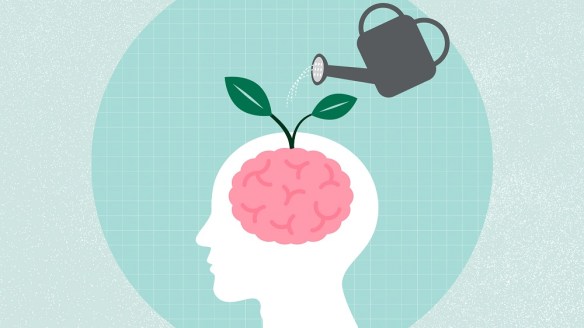
[Loads of images come up when you google “brain health” or “brain fitness,”
but I liked this one much more than all of the ones with brains lifting barbells.]

“Brain health.” “Brain fitness.” “Brain-training.” Ever since I started writing for PuzzleNation Blog, I’ve been chronicling the debate over whether solving puzzles makes a verifiable, detectable impact on brain function, development, and overall health.

There are plenty of puzzle magazines, apps, websites, and services that claim to help with brain fitness. Some make vague assertions related to memory, mental flexibility, and other cognitive functions. Others are insanely specific, promising to reverse the aging process or to help prevent the onset of dementia and other cognitive difficulties later in life.

(Examples of the latter style of advertisement are rarer these days after Lumosity’s two-million-dollar payout for falsely advertising that their puzzle games could “reduce or delay cognitive impairment associated with age and other serious health conditions,” as well as “stave off memory loss, dementia, and even Alzheimer’s disease.”)
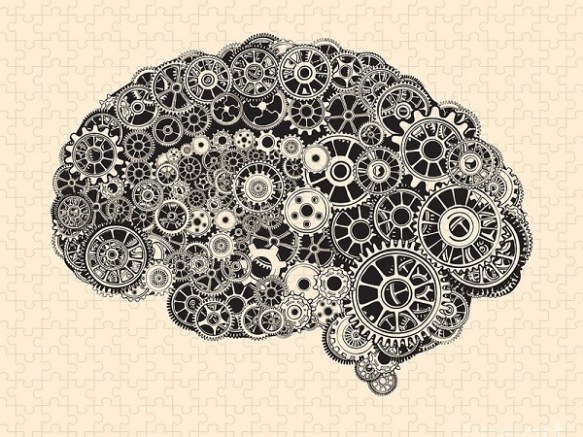
cogs-in-the-shape-of-a-human-brain-ryger

[This puzzle by Ryger can be found here!]

Whether we’re talking short-term or long-term benefits to brain health from puzzling, you’ll find dozens of articles online arguing both sides. Unfortunately, so much of the data out there is inconclusive, or is hindered by test groups too small to be applicable to the general population.

However, the positive, verifiable data we can find is encouraging.

Tetris has been used by researchers to help people suffering from traumatic flashbacks, a type of post-traumatic stress. The University of Exeter conducted a study involving more than 19,000 participants that concluded that adults age 50 and older who regularly solve puzzles like crosswords and Sudoku have better brain function than those who do not.

(While 19,000 is still relatively small when compared to millions upon millions of adults over 50, it’s still one of the largest test groups yet assembled for brain health studies related to puzzles.)
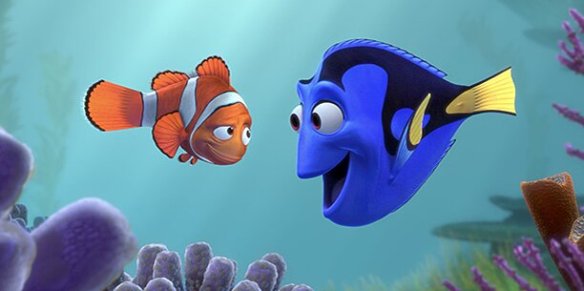
dory

And while people are always discussing short-term memory or long-term memory and how they relate to puzzle solving, it turns out there’s a middle ground between the two that crosswords may have a positive effect on. An article from Scientific American last year discussed how crossword solving engages the episodic buffer, one of the mechanisms related to our working memory, our ability to temporarily hold information while performing cognitive tasks.

Most cognitive activities engage the working memory through either verbal components or visuospatial components. (Visuospatial means how we perceive the relationships between different objects in multiple dimensions). But as it turns out, while playing Scrabble or solving crosswords, both visuospatial and verbal components are utilized by the short-term memory.

Of course, this is preliminary work, and there’s so much more to learn about short-term and long-term memory, but apparently, wordplay like Scrabble and crosswords could have a unique effect on how our working memory functions. That’s pretty cool!

But they’re not the only puzzles that we’ve discovered some fascinating new details about. Jigsaw puzzles can have a positive effect on the brain during the solving process.
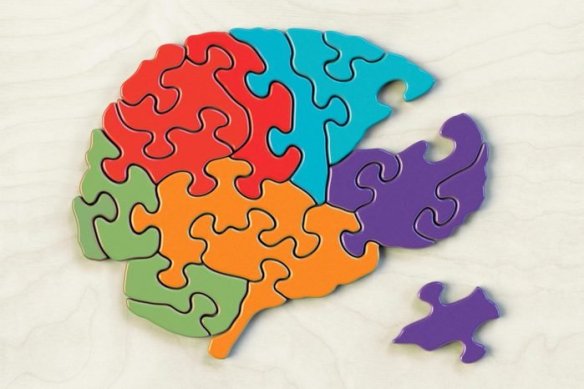
BrainGames-scaled

Now, like crosswords and Sudoku puzzles, jigsaw puzzles have been the subject of several articles claiming they can help with brain health (or even decrease the presence of Beta-amyloid protein in the brain, a major component of the plaque that indicates Alzheimer’s disease). But I cannot verify those facts in scientific journals to my satisfaction, so I’m tabling that part of the argument.

What I do want to talk about it is how jigsaw puzzle solving can induce a mental state similar to dreaming, one that helps with stress, relaxation, and mood.

The company Sanesco Health is heralded as an industry leader in neurotransmitter testing, and according to an article on their site, placing those tricky little pieces in the right places can do you a world of good:

The connections made while working on jigsaw puzzles aren’t limited to our brain cells. Exercising both sides of the brain simultaneously also allows the brain to move from a Beta state, the wakeful mind, into an “Alpha” state, the same mental state experienced while dreaming. The Alpha state is where we tap into our subconscious mind.

Jigsaw puzzles naturally induce this state of creative, focused meditation, where connections can be made on deeper levels. And that release of dopamine with every puzzle piece you successfully place is an added bonus! Dopamine causes improved motor skills, an increase in concentration, optimism, confidence, and an enhanced recollection.

[Imagine how restful she felt after this!]

Considering that jigsaw puzzle sales spiked during the pandemic — with some outlets reporting sales increases of up to 500% — it sounds like people were either consciously or subconsciously making the perfect choice to cope with the stresses of lockdown.

As always, we’ll keep our eye out for any additional data on these findings.

But in the meantime, happy puzzling! It might be good for you!


dailypopwsicon

Well, summer’s over, but we still have deals galore for you to check out. You can find them on the Home Screen for Daily POP Crosswords and Daily POP Word Search! Check them out!

Thanks for visiting PuzzleNation Blog today! Be sure to sign up for our newsletter to stay up-to-date on everything PuzzleNation!

Solution to the Peppermint Patty Brain Teaser!

[Image courtesy of SharpBrains.com.]

A week ago, we shared a brain teaser sent in by a PuzzleNationer named Bethany, who challenged us to solve the following stumper.

Today, we’re going to share not only the solution, but how we got there! Please enjoy this brief solve and tutorial, inspired by one of your fellow PuzzleNationers!


The Peppermint Patty Riddle

You’re facing your friend, Caryn, in a “candy-off,” which works as follows: There’s a pile of one hundred caramels and one peppermint patty. You and Caryn will go back and forth taking at least one and no more than five caramels from the candy pile in each turn. The person who removes the last caramel will also get the peppermint patty. And you love peppermint patties.

Suppose Caryn lets you decide who goes first. Who should you choose in order to make sure you win the peppermint patty?


When I posted this brain teaser, I said that “the question basically demands that you not only achieve victory, but figure out how to do so with your very first move.”

That was meant to be a hint. Because the best way to unravel this riddle is to start at the end.

Look at the last turn. If there are five or fewer caramels left on the board and it’s Caryn’s turn, she wins. For you to guarantee a win, she needs to see six caramels on her last turn. (Seven or more allows her to take just enough to leave YOU with six, which means she wins on her next turn.)

And that six is the magic number. Her previous turn, you need to leave her with 12 caramels. The turn before that, 18 caramels. The turn before that, 24. And so on and so on.

Why? Simple.

caramel

Let’s look at the 12 caramel turn. If she takes any number of caramels (anywhere from 1 to 5), she’ll leave you with between 11 and 7 caramels. You can use your turn to remove whatever number of caramels are necessary (anywhere from 5 to 1) to leave her with six.

The entire game can be broken into six-caramel increments.

And the closest multiple of 6 to 100 (your starting point) is 96 caramels.

Which means you can’t let Caryn go first. You need to remove 4 caramels on your first turn, and then use every subsequent turn to ensure Caryn faces a multiple of six, which eventually gives you the victory and the peppermint patty.

So the answer to the riddle is you should go first.

Diabolical!

Did you solve the brain teaser, fellow PuzzleNationer? Or do you have a brain teaser you’d like us to unravel with you? Let us know in the comments section below! We’d love to hear from you.


dailypopwsicon

Well, summer’s over, but we still have deals galore for you to check out. You can find them on the Home Screen for Daily POP Crosswords and Daily POP Word Search! Check them out!

Thanks for visiting PuzzleNation Blog today! Be sure to sign up for our newsletter to stay up-to-date on everything PuzzleNation!
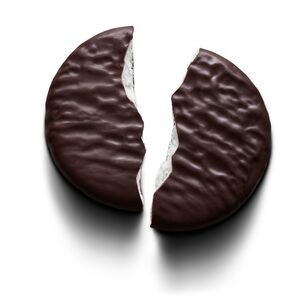
How to Define Success vs. Failure in Roleplaying Games

Roleplaying games are some of my absolute favorite pastimes. The simple act of telling a story with friends is rejuvenating for me. I love sitting at a table — or on a Zoom call — with friends and collectively creating an adventure in our imaginations.

I know that the dice and the rulebooks and all the numbers can be daunting for new players, but honestly, they’re just the laws of physics, fate, and chance given form. In the simplest form, roleplaying games consist of you telling the gamemaster / dungeon master / game runner what you want to do, and the dice determining how it goes.

In many RPGs, there’s a success/failure line. If you roll above a certain number, you succeeded. If you roll below it, you failed.

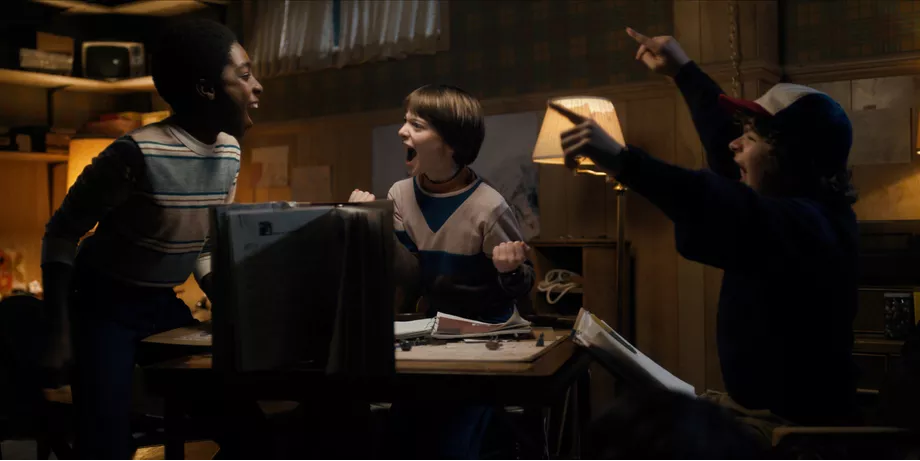
[Image from Stranger Things courtesy of The Verge.]

That’s certainly simple enough. But it can be frustrating for some players, new and old. After all, if you had to beat a 15 and you rolled a 14, why should the result be the same as if you’d rolled a 2? The 14 is much closer, after all.

Some roleplaying games stick to the strict success/failure model. But others have a different approach that players might find more rewarding.

star-wars-edge-empire-rpg-core_1_97bac45707850006a463c742ecc746af

Fantasy Flight Games offers a Star Wars-themed roleplaying game that has one of my favorite dice systems. There are different colored dice that represent different aspects of the game (your character’s ability to do something, the difficulty of the action they’re attempting, advantages and disadvantages to their action at the time, etc.), and the dice don’t have the traditional number values you’d expect.

Instead, they have symbols that represent success, failure, advantage, threat, triumph, and despair.

So, depending on the dice roll, it’s not just a success or a failure. You can have an overwhelming success, or an overwhelming failure, or many things in between. You can fail at the task, but end up with something unexpected and advantageous still happening. Or you can succeed, but with some consequence.

It opens up the narrative floodgates WAY beyond the success/failure binary option, and it has led to some of my absolute favorite moments in roleplaying.

Naturally, this requires a little more creativity from both the player and the game runner, but together, you can tell some fantastic adventures.

81YTNmLLMLL

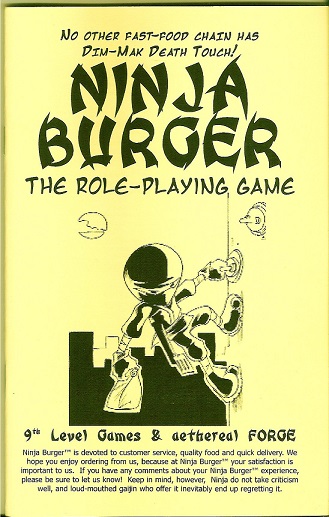
Ninja Burger is a humorous quickplay roleplaying game that uses standard six-sided dice. In the game, you’re a ninja secretly delivering fast food. It’s very silly and great fun.

One rule in the game that can lead to enjoyable chaos AND take the sting out of the traditional success/failure mechanic of roleplaying games is that you are instructed to act as if you never fail. Even if you’re failed a roll.

So, say you’re using wujenitsu (ninja magic) to pretend to be a bag of golf clubs to sneak into a country club. But you failed your roll. The caddy who grabbed you is clearly carrying a ninja on his back, not a bag of golf clubs.

But you must proceed as if you succeeded, no matter how ridiculous things get.

Sure, failure has consequences in any game, even silly ones, but if you’re in on the joke, then failure isn’t so bad. Especially if you can find a way to make your friends laugh along the way.

dreadJenga

Dread is a roleplaying game that doesn’t use dice at all. Instead, you set up a Jenga-style tower of blocks, and to accomplish certain tasks, you have to pull a certain number of blocks from the tower without collapsing it.

It’s a brilliantly simple way to add tension to a game AND put your fate in your own hands. There’s no single unlucky dice roll that can condemn you to defeat. Just gravity and your own steady (or unsteady) hand.

And of course, as the game continues and the tower grows unsteadier — and your options for wood blocks to pull become fewer and fewer — the tension mounts and mounts.

Eventually, the tower — and your character’s chances — collapse in a clatter.

[Image courtesy of Lewis Brown.]

Of course, the rules of every roleplaying game are eventually up to the people running/playing the game. If you decide that the success/failure rules of your game should be more nuanced, you can do something about it immediately.

But for new players and new game runners, sometimes it helps to remind them there are always other options available. Whether you ditch numbers entirely for narrative dice like in FFG Star Wars, pretend failure isn’t failure at all in Ninja Burger, or ignore the dice completely with something like Dread, you can still build tension and tell some wonderfully fun, exciting, and action-filled stories.

Good luck, and happy roleplaying, everyone!


dailypopwsicon

Well, summer’s over, but we still have deals galore for you to check out. You can find them on the Home Screen for Daily POP Crosswords and Daily POP Word Search! Check them out!

Thanks for visiting PuzzleNation Blog today! Be sure to sign up for our newsletter to stay up-to-date on everything PuzzleNation!

Emmy-Winning “Queen’s Gambit” Ignores Actual Grandmaster’s Legacy?

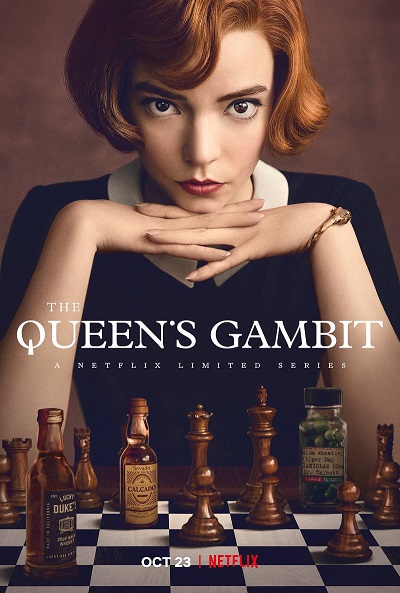
queengambit 1

The popularity of chess goes through ebbs and flows over the decades, but there’s something universal about the game that ensures it will never go away.

Right now, chess is going through something of a pop culture resurgence thanks to the popularity of the Netflix series The Queen’s Gambit, a show that won eleven Emmy Awards just this weekend.

queengambit 2

The show depicts the journey of fictional chess player Beth Harmon. As Beth rises to prominence, she gains the attention of the world through her masterful playing style while dealing with a secret dependence on drugs.

Beth is a fictional character, but she’s often navigating the historical record of the actual chess world, one steeped in pride and impressive accomplishments by men and women alike.

And one of those women takes umbrage at how she has been depicted in the show.

queengambit 3

Meet Nona Gaprindashvili, the fifth women’s world chess champion, and the first woman to be named Grandmaster by the International Chess Federation. This Soviet and Georgian woman played in the Women’s Chess Olympiads across four decades (from the 1960s through the 1990s), winning numerous championships, and having success against both male and female opponents.

Not only did the show misidentify her as Russian, but she was said to have never played against men, unlike the fictional Beth who regularly competes against men.

Gaprindashvili considers the comment grossly sexist, and claims in her lawsuit that by 1968 — the year depicted in the series — she had already defeated many male players, including ten grandmasters. Gaprindashvili herself pointed out in an interview with The New York Times the cruel irony in the show celebrating a fictional trailblazer by disregarding an actual trailblazer.

She is suing Netflix for false light invasion of privacy and defamation, seeking $5 million dollars in damages.

Netflix seems optimistic that the lawsuit has no merit, and they may be right, but it is amazing how easily this could have been avoided. You could have simply not mentioned Gaprindashvili at all, or focused on making Beth’s accomplishment a huge achievement for American women at the time.

Some fans of the show are twisting themselves in knots trying to ignore the contradiction, some saying that since this is a fictionalized story, they have a fictional version of Gaprindashvili in the show who DIDN’T accomplish what she did in real life. This is arguably more insulting than the show’s treatment of the Georgian grandmaster.

It will be interesting to see how things proceed from here. If nothing else, it will hopefully give more attention to the genuine accomplishments of a legendary female chess player who certainly deserves some of the spotlight.


dailypopwsicon

Well, summer’s over, but we still have deals galore for you to check out. You can find them on the Home Screen for Daily POP Crosswords and Daily POP Word Search! Check them out!

Thanks for visiting PuzzleNation Blog today! Be sure to sign up for our newsletter to stay up-to-date on everything PuzzleNation!
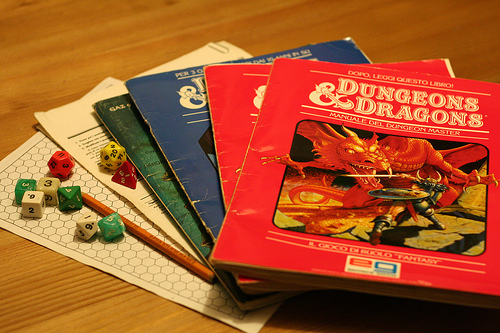
Another Brain Teaser Submitted by Readers For Your Puzzly Pleasure!

[Image courtesy of SharpBrains.com.]

When’s the last time you had your brain properly tied in knots by a riddle?

That’s a pretty common occurrence around here, honestly. In our puzzly explorations of the world, we stumble across all manner of brain teasers, riddles, logic puzzles, math problems, mind ticklers, deduction games, and wordplay-fueled bits of linguistic legerdemain.

Sometimes, we even receive them directly from our fellow PuzzleNationers!

And on those occasions, we happily share them with you, dear reader, so that you can also enjoy the challenge of unraveling whatever fiendish puzzly conundrum has been placed before us.

This time around, a solver named Bethany submitted this riddle she found online. It’s known as the Peppermint Patty Riddle.

Let’s see how we do.


The Peppermint Patty Riddle

You’re facing your friend, Caryn, in a “candy-off,” which works as follows: There’s a pile of one hundred caramels and one peppermint patty. You and Caryn will go back and forth taking at least one and no more than five caramels from the candy pile in each turn. The person who removes the last caramel will also get the peppermint patty. And you love peppermint patties.

Suppose Caryn lets you decide who goes first. Who should you choose in order to make sure you win the peppermint patty?


Now that’s interesting, because it doesn’t ask us specifically HOW to achieve victory. But the question basically demands that you not only achieve victory, but figure out how to do so with your very first move.

Tricky indeed.

Will you be accepting this puzzly challenge from a fellow PuzzleNationer? Let us know in the comments section below. We’d love to hear from you!


dailypopwsicon

Well, summer’s over, but we still have deals galore for you to check out. You can find them on the Home Screen for Daily POP Crosswords and Daily POP Word Search! Check them out!

Thanks for visiting PuzzleNation Blog today! Be sure to sign up for our newsletter to stay up-to-date on everything PuzzleNation!
Spies, Crosswords, and Secret Messages!

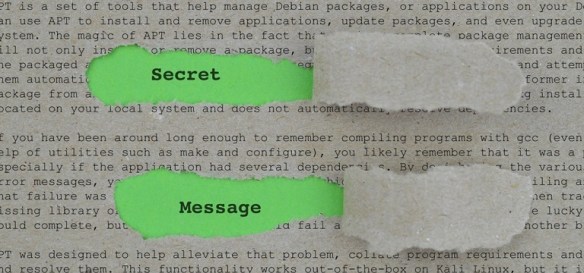
secret message

There are loads of ways to hide secret messages in puzzles. The field of cryptography is built around it. Many meta puzzles have a special secret lurking inside their clever constructions. Heck, our friends at Penny Press even have an entire word seek called Secret Message.

But have you ever noticed that there’s a strange fascination in pop culture with secret messages in crosswords?

No, I don’t mean constructors hiding quotations, poems, or word seeks in their crosswords, though those are impressive feats of cruciverbalism.

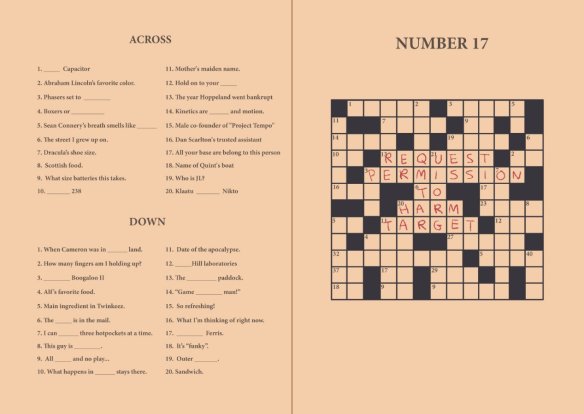
I’m talking about stories about actual secret messages concealed in crossword grids, meant to be hidden from even the most diligent solvers, only a special few possessing the keys to finding the hidden words.

Oh, believe me, it’s definitely a thing.

Look no further than the first Crossword Mysteries movie. The film opens with a murdered art gallery owner with a crossword in his pocket. And it turns out that a devilish criminal mastermind was submitting puzzles to Tess’s daily crossword that contained hidden instructions for robberies to be conducted that day. Diabolical!

You might laugh, but this is hardly the only time we’ve seen crime, secret messages, and crosswords combined. It was a plotline in the radio show The Adventures of Superman, and Lois Lane’s life once depended on Superman’s ability to solve a crossword puzzle.

There are any number of mystery novels, cozy and otherwise, that contain hidden messages in crosswords. Nero Blanc’s Anatomy of a Crossword and Corpus de Crossword come to mind, as do any number of murder mysteries where a strange message scribbled on a crossword grid turn out to be a pivotal clue to catch the killer.

And there’s an even more curious subset of this in pop culture: crosswords and spycraft.

I could give you a simple example, like Bernie Mac’s character in the Ocean’s 11 remake pretending to solve a crossword, but actually writing down key information about the casino for the upcoming heist.

But that’s not really a secret message IN a crossword. No, it’s more of a secret message ON a crossword, though it is a bit of decent spycraft.

CnwtMc9UMAAssmH

[From Spy vs. Guy.]

Let’s talk about spies and their crosswords, then.

In the TV show Burn Notice, former (and occasionally current) spy Michael Weston sometimes received hidden messages from his previous spy organization through the crossword, though we’re not given much info on how this is achieved.

In the James Bond prequel novel Double or Die, it’s actually the young Bond’s teacher who sneaks a secret message into a puzzle. He’s also a cryptic crossword editor, and he convinces his kidnappers to allow him to submit a crossword to the newspaper, because if he didn’t, it would let people know all was not well.

Naturally, the kidnappers didn’t spot the clues to his current location that the teacher had hidden in the puzzle. Bond, even in his youth, manages to do so with ease.

Rubicon-008

In the short-lived TV show Rubicon, crosswords are at the center of a fascinating unsolved mystery. An intelligence agent named Will finds out his mentor committed suicide after seeing a four-leaf clover.

He then finds a pattern across several crosswords that leads him to believe his mentor’s death is somehow connected to the pattern in the crosswords, and he tells his superior about it.

And soon after investigating it himself, Will’s superior is also found dead. Unfortunately, we never get a resolution for this story, but it certainly fits the bill.

So yes, the curious connection between secret messages and crosswords in pop culture is definitely a thing.

But did you know it also extends beyond fiction? Yup, I’ve got some real-world examples for you too.

Back in June of 1944, physics teacher and crossword constructor Leonard Dawe was questioned by authorities after several words coinciding with D-Day invasion plans appeared in London’s Daily Telegraph.

The words Omaha (codename for one of Normandy’s beaches), Utah (another Normandy beach codename), Overlord (the name for the plan to land at Normandy on June 6th), mulberry (nickname for a portable harbor built for D-Day), and Neptune (name for the naval portion of the invasion) all appeared in Daily Telegraph crosswords during the month preceding the D-Day landing.

So it was possible (though highly improbable) that Dawe was purposely trying to inform the enemy of Allied plans, and the powers that be acted accordingly. In the end, no definitive link could be found, and consensus is that Dawe either overheard these words himself or was told them by his students — possibly slipped by soldiers stationed nearby — and placed them into his grids unwittingly.

Yes, this was just a big misunderstanding. But sometimes, accusations like this have real-world consequences.

In Venezuela, a newspaper has been accused multiple times of hiding encrypted messages within their daily crossword puzzles in order to incite revolt against the government.

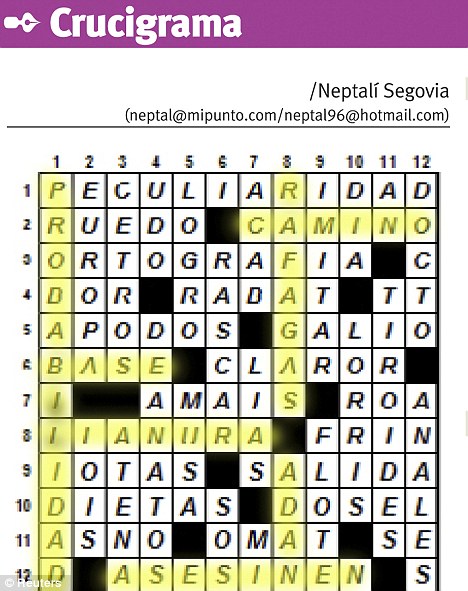
Another Venezuelan newspaper was accused of concealing messages ordering the assassination of a public official named Adan, the brother of President Hugo Chavez!

article-0-130C1EBE000005DC-570_468x591

Some of the answers considered suspicious in the grid included “Adan,” “asesinen” (meaning “kill”), and “rafaga” (which can mean either a burst of gunfire, or a gust of wind).

Apparently this confluence was considered enough to warrant a half-dozen members of the intelligence service visiting the newspaper’s editorial office.

Now, were these cases of genuine secret messages being passed through the crossword, or were these coincidental events that appeared credible because the crossword/secret message concept has been part of pop culture for decades?

I leave that question to you, fellow puzzlers.

Can you think of any examples of crosswords with secret messages in pop culture or intersections of crosswords and spycraft that weren’t mentioned here? Let us know in the comments section below! We’d love to hear from you.


dailypopwsicon

Well, summer’s over, but we still have deals galore for you to check out. You can find them on the Home Screen for Daily POP Crosswords and Daily POP Word Search! Check them out!

Thanks for visiting PuzzleNation Blog today! Be sure to sign up for our newsletter to stay up-to-date on everything PuzzleNation!