PuzzleNation Holiday Puzzly Gift Guide: By Age

Welcome to the PuzzleNation Blog Holiday Gift Guide!

We’re overjoyed to have so many tremendously fun and puzzly projects to share with you this year. We just might be your one-stop shop for all things puzzly!

This guide is broken down by age group, so we’re sure you’ll find the perfect gift for puzzlers of any age on your list!


For Ages 3-5 and Up

Treasure Hunt Game (Hammacher Schlemmer, party game)

All the tools you need to create an engaging treasure hunt for kids can be found in Hammacher Schlemmer’s Award-Winning Treasure Hunt Game! With a map, clues, coins, and everything else you’ll need, it’s an all-in-one kit for scavenger hunt fun! ($64.95)

Kindergarten Learning Fun

The kid-friendly Kindergarten Learning Fun book (part of the Learning Fun series) is a perfect introductory book of puzzles for youngsters! ($3.99)


For Ages 8 and Up

Walk-By Scrabble Board, Lexicographer’s Extended Scrabble, and the World’s Largest Scrabble Game

Hammacher Schlemmer has several Scrabble variants available, including the Lexicographer’s Extended Scrabble for those with multisyllabic ambitions ($39.95) and the mindboggling World’s Largest Scrabble Game ($12,000!), but neither is as clever or as convenient as the Walk-By Scrabble Board! Designed as a family game for people on the go, it’s a perfect way to bring back Board Game Night for busy families! ($29.95)

[Check out our full product review of the Walk-By Scrabble Board here!]

Seven Bridges (app)

Based on the classic Konigsberg Bridge puzzle, Seven Bridges challenges you to navigate different towns and cross each bridge only once! A terrific chain-solving game with more than a few tricks up its sleeve!

Fluxx: The Board Game (Looney Labs, board game)

Take a board game, and make the cards, goals, and board changeable, and you’ve got Fluxx: The Board Game. It’s the ultimate think-on-your-feet experience, and like nothing you’ve played before. ($30)

[Check out our full product review here!]

Word Winder (David L. Hoyt, puzzle game)

Word Winder (also available in app, puzzle book, and GIANT versions!) is a game of finding chains of hidden words in an ever-changeable grid! Put your strategy and spelling skills to the test! ($19.95)


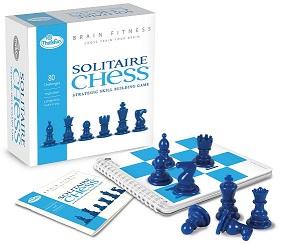
Laser Maze and the Brain Fitness series: Solitaire Chess, Rush Hour, and Chocolate Fix (ThinkFun, puzzle games)

ThinkFun brings us a logic game with an actual laser in Laser Maze ($26.95), as well as three variations on their classic puzzle games in order to keep your mind in fighting trim for puzzling! Put your chess skills in play for Solitaire Chess, your Sudoku skills on high for Chocolate Fix, and your chain-solving on overdrive for Rush Hour ($14.99 each)!

[Check out our full product review of Laser Maze by clicking here and our review of the Brain Fitness line by clicking here!]

Light ‘Em Up (app)

In this app, you control fire and you’re trying to burn all the woodpiles in the area. But fire is trickier than you think! A fun problem-solving game with a great medieval look!

ROFL! (Cryptozoic, party game)

Challenge your friends to decode famous movie lines, catchphrases, and song lyrics in Cryptozoic’s game ROFL!!, created by Dork Tower‘s John Kovalic! Put your texting and abbreviation skills to the test in this laugh-out-loud party treat! ($35)

[Check out our full product review here!]


For Ages 10-12 and Up

Dabble (app)

This word-forming game will put your anagram skills to the test as you try to move letters between tiers in order to spell multiple words of varying lengths! It’s Scrabble taken to the next level!

Penny/Dell Puzzles Crossword App (app)

Test your crossword chops with this impressive app, featuring smart navigation to move you to partially filled-in entries and an alternate-clue option to help you solve!

Castellan (Steve Jackson Games, board game)

Build a castle and then occupy it in Castellan, a game of strategy and opportunity. With great modeled pieces that really add to the aesthetic, Castellan has style and substance. ($34.95)

[Check out our full product review here!]

Chrononauts (Looney Labs, card game)

Time travel can be tough, but when other time travelers are changing history, it can be downright weird. In Chrononauts, you’ll bend the rules of time and space in the hopes of completing your mission and going home. And who hasn’t wanted to make history once or twice? ($20)

[Check out our full product review here!]

PuzzleNation Classic Word Search (iBook)

Enjoy our own puzzler-friendly classic word search iBook (with three volumes of themed puzzles to choose from)! With an adaptable screen and plenty of puzzles to keep you busy, Classic Word Search is a terrific way to pass the time!

The Stars Are Right (Steve Jackson Games, card game)

Build an army of followers and change the stars themselves in The Stars Are Right, a thoroughly enjoyable card game where the goal is summoning an elder god and destroying the world. As you do. ($27.95)

[Check out our full product review here!]


For Ages 14 and Up

Pink Hijinks (Looney Labs, puzzle game)

Part of Looney Labs’ multi-colored Pyramids series, Pink Hijinks is a quick-to-play strategy game for two players! Roll the dice, make your move, and try to race your opponent to the finish in this easily transported game of tactics! ($12)

[Check out our full product review here!]

Veritas (Cheapass Games, board game)

In Veritas, it’s the Dark Ages, and you’re trying to protect your brand of the truth. As monasteries burn and other versions of the truth are spread, can you become the predominant truth in France? This strategy game has a wicked sense of humor and some fun twists on the Risk model. ($15, plus chips)

[Check out our full product review here!]


For Ages 18 and Up

Most puzzle books would probably fall in the Age 9-10 and Up range, but oftentimes, the cluing is geared toward an older audience, so to avoid confusion, I’ve bundled the majority of the puzzle books here.


Our friends at Penny/Dell Puzzles have put together some outstanding holiday collections with puzzles galore to be solved!

Whether it’s their 100 Years of Crosswords commemorative book, their holidaytastic Sugar & Spice Pocket Sudoku Pack, or one of their many value packs featuring puzzles of all sorts, Penny/Dell has you covered. (And be sure to click here for their ongoing 12 Days of Holiday Savings promotion for even better deals!)

And for more specialized puzzle books, some high-level constructors have books of their own for your perusal! With New York Times and Los Angeles Times crosswords to their credit, you’re sure to find some puzzlers within these pages!

Rich Norris’s A-to-Z Crosswords

Doug Peterson’s Easy ABC Crosswords

Jeff Chen’s puzzles for Bridge enthusiasts

Brendan Emmett Quigley’s puzzles (the only one I’d firmly classify as 18 and up)

–Patrick Blindauer’s Quick-As-A-Wink Crosswords and WideScreen Crosswords

And many top constructors have started marketing their puzzles directly to solvers, so in addition to free puzzles available on their websites, they have downloadable puzzle bundles and collections!

Patrick Blindauer PuzzleFests (puzzle bundles)

David Steinberg’s Chromatics (color-themed puzzles)

Robin Stears’ StearsWords (themed puzzles)

The American Values Crossword (subscription and daily puzzles)

Of course, if you’d like to have a crossword specially created for someone, both Brendan Emmett Quigley and Robin Stears create puzzles to order on their sites! Two prolific, topnotch constructors are at your service!


Thank you to all of the constructors, designers, and companies taking part in our holiday gift guide!

Thanks for visiting the PuzzleNation blog today! You can like us on Facebook, follow us on Twitter, cruise our boards on Pinterest, play our games at PuzzleNation.com, or contact us here at the blog!

Let’s Make a Deal!

It’s a scenario every game show fan knows well. You’ve got three doors to choose from, and one of those doors will open to reveal a fabulous prize.

After you’ve made your choice (let’s say Door #2), our affable host Monty Hall plays Devil’s Advocate by opening one of the doors you didn’t choose (let’s say Door #1), revealing a goat or other lackluster result.

And then, Monty offers you a chance to change your mind. Will you stick with the door you initially chose, or will you switch to the other unopened door (Door #3)?

The average player sees two choices, Door #2 and Door #3, which on the surface sounds like a 50/50 shot, a coin flip. So would it surprise you to learn that people who switched from one door to the other doubled their chances to win the fabulous prize?

This is known as the Monty Hall Problem, an example of how statistics aren’t always what they seem, and it has puzzled people for decades.

It’s counterintuitive, isn’t it? I mean, you have two choices, so the odds should be 50/50. But you’re forgetting that third door that Monty eliminated. That third door makes all the difference, statistically speaking.

Let’s break it down. Your initial choice is between 3 doors, meaning you have a 1 in 3 chance of picking the correct door, and a 2 in 3 chance of picking the wrong one.

When Monty opens that other door, the odds haven’t changed. Only the number of options available has changed. Your door is still a 1 in 3 chance of being correct and a 2 in 3 chance of being wrong. But the remaining door now has a 2 in 3 chance of being correct!

So what appeared to be a coin flip between sticking with your choice and switching is now heavily weighted toward switching!

There have been several real-world tests of the Monty Hall Problem, and all of them have consistently shown that the people who switch were twice as likely to open the winning door!

The real puzzle here is how we fool ourselves. We take the numbers at face value — 3 doors become 2 doors, so a 1 in 3 chance becomes a 1 in 2 chance — and actually hurt our chances with those seemingly simple assumptions.

Being able to reconsider your assumptions is a major tool in the puzzler’s solving kit. Plenty of tricky crossword clues depend on you associating the clue with one thing, when the answer is something quite different.

After all, if you saw the clue “Unlocked” for a four-letter entry, you’d probably try OPEN before you tried BALD. Clever constructors are counting on that.

So be sure to remember Monty Hall and his three-door conundrum the next time you’re stumped on a puzzle. Maybe the answer is as simple as trying another door.

Thanks for visiting the PuzzleNation blog today! You can like us on Facebook, follow us on Twitter, cruise our boards on Pinterest, check out our Classic Word Search iBook (recently featured by Apple in the Made for iBooks category!), play our games at PuzzleNation.com, or contact us here at the blog!

PuzzleNation Product Review: The Walk-By Scrabble Board

Hammacher Schlemmer is perhaps best known for its library of high-end products, from massage chairs and high-tech toys to outlandishly marvelous devices like a jetpack that propels you into the air on columns of water.

But they’re also home of some unexpectedly delightful puzzle products, like the latest edition to my cubicle space, the Walk-By Scrabble Board.

Lightweight, durable, and easy to mount around the home or office, the Walk-By Scrabble Board is designed for puzzlers who don’t mind taking some time between moves to accomplish other tasks.

The magnetic letters adhere well to both the board and the player tags that conceal your tiles from others, and the dry-erase board scoreboard doesn’t stain easily. It’s perfect for repeated, regular play.

But the Walk-By Scrabble Board has another terrific facet: the casual nature of its layout infuses your gameplay. There isn’t the tension and gravitas of having several players watch you as you make your move, feeling seconds tick away as you scramble to anagram in your head. 

You can play at your leisure, offering a similar playing experience to electronic versions of the game like Words with Friends and Lexulous, but without sacrificing the more social, familial spirit of playing a game with your family. 

That combination of the best of the electronic and board game versions makes for a much more congenial playing experience overall.

As you can see, it’s a hit here at the PuzzleNation office.

Well-made and affordable, the Walk-By Scrabble Board is a great way to reignite the puzzly spirit of your household in a fun, casual way.

[This product and many others will be featured in our Holiday Puzzly Gift Guide, going live on PuzzleNation Blog next Wednesday!]

Thanks for visiting the PuzzleNation blog today! You can like us on Facebook, follow us on Twitter, cruise our boards on Pinterest, check out our Classic Word Search iBook (recently featured by Apple in the Made for iBooks category!), play our games at PuzzleNation.com, or contact us here at the blog!

5 Questions with Puzzle Creator (and Jumble Master) David L. Hoyt

Welcome to the tenth edition of PuzzleNation Blog’s interview feature, 5 Questions!

We’re reaching out to puzzle constructors, video game writers and designers, writers, filmmakers, and puzzle enthusiasts from all walks of life, talking to people who make puzzles and people who enjoy them in the hopes of exploring the puzzle community as a whole.

And I’m excited to have David L. Hoyt as our latest 5 Questions interviewee!

Even if you don’t know David’s name, you’ve probably solved one of his puzzles. Whether it’s the illustrated Jumble puzzle syndicated in newspapers across America or one of his numerous puzzles and games, David Hoyt is a puzzle-creation dynamo. Seamlessly transitioning from print to electronic media, David also has a number of apps and websites featuring his work, cultivating terrific relationships with Pat Sajak and USA Today among many other brands.

And it’s worth mentioning that in addition to being the most syndicated man in puzzles, he’s also my mother’s favorite puzzler (leaving me a distant second). *laughs*

David was gracious enough to take some time out to talk to us, so without further ado, let’s get to the interview!

5 Questions for David L. Hoyt

1.) You’ve been recognized nationally and internationally as a leading name in puzzles for decades now. What, in your estimation, separates a great puzzle from an average one?

I specialize in very fast-playing daily puzzles so my answer may be a different from other puzzle creators. When it comes to fast-playing daily puzzles, I feel that a great puzzle is one that gives the solver a chance to feel smart and to feel that he or she has just barely beaten me. The puzzle needs to give to player a fair chance to “win.”

It can’t be too easy, nor can it be too hard. It’s a balancing act. You want the solver to come back to play on a daily basis, so a great fast-playing daily puzzle will need to give the solver enough satisfaction and entertainment to get the solver back the next day.

(Here’s a brief video profiling David’s ongoing puzzle projects.)

2.) The internationally syndicated Jumble puzzle is probably the most well-known in your ever-expanding stable of puzzles. How many do you make in a year, and what does the creative process entail?

I create the classic daily Jumble in partnership with cartoonist Jeff Knurek. I took over the reins from Mike Argirion three years ago. It’s in about 650 newspapers. It’s a seven-days-a-week puzzle. I also create Jumble Crosswords, TV Jumble and a few other Jumble-branded puzzles so the answer to how many I make is lots and lots!

I really love making the classic Jumble. Coming up with the “punny” answer is so fun for me. I have found that I come up with the best ones when I’m running so quite often I’ll go for a run in downtown Chicago and just look around and listen for ideas. I love seeing how far I can run and how many Jumble ideas I can come up with during the run. The city of Chicago is my assistant when it comes to new puzzle ideas.

3.) The hundredth anniversary of the crossword is fast approaching. Given your familiarity with puzzles, what does the hundredth anniversary mean to you? Do you think puzzles as we know them will still be around a hundred years from now?

I’m very excited about the 100th anniversary of the crossword puzzle! I feel very confident that puzzles as we know them will be around 100 years from now. I see enough young people playing puzzles on the trains, subways and buses here in Chicago that it makes me think that puzzles will be around for as long as humans are around.

4.) What’s next for David L. Hoyt?

I have two things going on right now that have me super excited and that are laying the groundwork for a very busy 2014. I have a new hit game (app) called Just 2 Words and we are working on a series of new versions of this game for 2014.

Also, I am working with teachers and students to get the Word Winder Giant Game into schools, libraries, etc. I love working with teachers and students. It looks like I’ll be spending a lot of time in schools in 2014 which I’m really looking forward to.

5.) If you could give the readers, writers, and puzzle fans in the audience one piece of advice, what would it be?

I feel that an important key to success is to pay very close attention to the things that don’t work out the way you expect them to. I feel there’s much more to learn from things that don’t work out as expected compared to what you can learn from the things that do work out as expected.

It’s ok to be wrong. It’s ok to have bad ideas. That’s just a part of being human. They key is to not let your human nature mask what really happened. There’s so much that can be learned from the non-successes that can lay a very strong foundation for success over the long-term.

Many thanks to David for his time. You can check out his library of puzzles and games on his website, and keep your eyes peeled for his Word Winder game, as I suspect it’ll be finding its way into school curricula very soon!

Thanks for visiting the PuzzleNation blog today! You can like us on Facebook, follow us on Twitter, cruise our boards on Pinterest, check out our Classic Word Search iBook (recently featured by Apple in the Made for iBooks category!), play our games at PuzzleNation.com, or contact us here at the blog!

PuzzleNation Product Review: ThinkFun’s Brain Fitness line

The folks at ThinkFun are always trying to raise the bar when it comes to puzzly games that keep the mind in fighting trim. (You may remember them from our review of Laser Maze over the summer.)

In that vein, they’ve unleashed the Brain Fitness line of puzzle games, offering all sorts of exercises to challenge you one-on-one and put your puzzly skills to the test.

They sent us copies of three Brain Fitness games to review, each with its own distinct flavor.

solitairechess

Brain Fitness Solitaire Chess

Solitaire Chess presents you with various layouts of pieces on a 4×4 grid, challenging you to clear the board of all but one piece. Every single move must eliminate a piece until only one remains.

Even the beginner puzzles gave me pause at first, because the need to knock out a piece with every move is a very different style of chess than I’m accustomed to. But I very quickly got into the groove of plotting out the chain of moves necessary to clear each board. With two pawns, two knights, two bishops, two rooks, a queen and a king, there are myriad layouts of varying complexity to solve, and some of them were serious brain melters.

Oddly enough, I found some of the expert-level grids easier than the advanced-level puzzles, though you could easily spend five or ten minutes on a single crafty puzzle.

Not only is it a terrific mental exercise, but it just might make you a better chess player in the long run.

Brain Fitness Chocolate Fix

Chocolate Fix is a marvelous variation on the Sudoku model, offering nine sweets of varying shape and color, and tasking you with deducing the intended position of each in a 3×3 baking sheet.

The beginner-level puzzles are child’s play, and would actually be a terrific introduction for younger puzzlers. But as soon as you reach the intermediate-level challenges, the difficulty begins ratcheting skyward. Some clues give you colors only, others shapes only, and the occasional clue is centered around a given piece’s location on the baking sheet.

Midway through the advanced-level challenges, they stop referencing specific sweets at all, leaving you to do some serious deductive work with shapes and colors alone.

By the time you reach the expert puzzles (which abandon any clues providing all nine squares, leaving you to mentally assemble Tetris-like pieces with shape and color symbols), it becomes a serious mental workout that banishes any false confidence and bravado that the easy early rounds might’ve sparked.

Victory may be sweet, but Chocolate Fix’s later challenges will make you earn it.

Brain Fitness Rush Hour

Rush Hour is a variation on the classic sliding-tile game, except instead of tiles, you’re sliding cars and trucks back and forth in order to clear a path for your heroic little red car to escape the traffic jam.

Rush Hour (in various forms) has been a great success for ThinkFun over the years, and the Brain Fitness version is a brilliantly simple adaptation. Self-contained and perfect for puzzling-on-the-go, Rush Hour takes the chain-move thinking of Chess Solitaire to the next level.

The jump from beginner-level to intermediate-level challenges is a sobering one, if only because the playing grid seems absolutely packed with cars! But you quickly realize that a packed grid means fewer possible moves, which helps to point you toward the solution.

The grid thins out again when you reach the advanced-level puzzles, but greater movement only leads to tougher challenges, since so many more moves are available to you, requiring chains of increasing complexity in order to rescue your little red car.

Having thoroughly tested all three games, I found Rush Hour the most difficult of the three (though Solitaire Chess wasn’t far behind), but I must admit, the multilayered colors / shapes / positioning clue style of Chocolate Fix provided the most unexpected challenge.

As an experienced puzzler, I was thoroughly impressed by the scalability of each idea. The easy puzzles were terrific introductions to the game, and the expert puzzles were challenges quite worthy of your time.

ThinkFun recommends 15 minutes of puzzling time a day with any of their Brain Fitness products in order to give your brain a proper workout, but I suspect you’ll have a hard time stopping there. If only physical workouts were as much fun as these mental ones!

Thanks for visiting the PuzzleNation blog today! You can like us on Facebook, follow us on Twitter, cruise our boards on Pinterest, check out our Classic Word Search iBook (recently featured by Apple in the Made for iBooks category!), play our games at PuzzleNation.com, or contact us here at the blog!

PuzzleNation Product Reviews: Veritas

Here at PuzzleNation Blog, we’re constantly on the lookout for any and all things puzzly, happy to spread the word on anything that will appeal to puzzle solvers.

And we think Cheapass Games’ board game Veritas fits the bill nicely.

Veritas is a strategy game in the same vein as Risk and other map-based board games, but with a much quicker pace and a delightfully wicked sense of humor.

The game is set in France during the Dark Ages, and each player represents some version of the Truth, printed in a few books at a random monastery. As you make more copies of the Truth and spread the word to other monasteries and cities, your fellow players are doing the same with their own versions of the Truth, as each of you tries to become the prevailing Truth in the country.

Sounds like a pretty straightforward strategy game, right? But that’s where the element of luck comes in.

Every round, each player pulls from a set of tiles, each tile representing a monastery that will burn down that turn. As monasteries burn, the books they contain are scattered, and the map becomes a little smaller, a little more claustrophobic, and one player’s Truth begins supplanting that of others.

Veritas is a marvelous mix of chance and skill, encouraging both short-term and long-term strategizing (skills that puzzle solvers and puzzle gamers have in spades).

The element of randomness is key in separating Veritas from games with similar territorial stakes. There’s a fun element of the unknown as you pick your tile, and since books are scattered instead of destroyed, there’s significantly less chance of hard feelings when one player burns down another player’s monastery.

(Plus it’s always fun to explain to coworkers in the lunchroom what you’re doing. “Burning down French monasteries” is never the answer they expect. *laughs*)

(Confession: We were so involved in the gameplay that I forgot to take pictures of the board. Please enjoy this dramatic recreation.)

The Cheapass Games rationale is simple, but elegant. They know you’ve got board games at home, so why jack up the price of their games by making you buy another set of dice, another set of chips, another set of tokens and supplemental pieces?

Cheapass Games arrive in a slim white box — as our complimentary review copy did — containing exactly what you need to play the game, and describing precisely what you’ll need from other games to play.

In the case of Veritas, you receive the game board (split into 8 well-rendered cards), the monastery tiles (for randomized burning), and instructions. Simple and elegant. All you need are chips to represent books filled with your truth.

Dime-sized ones will work best, especially since they need to be stackable. Monasteries in key positions can start to resemble miniature games of Jenga, as opposing players keep adding to the stack.

We used Rolco plastic chips in our playtesting, but they didn’t stack particularly well. (The game’s designers highly recommend using smaller poker chips like the ones featured here, since they’re designed to be stacked and won’t take up too much space on the game board.)

The game’s setup is a snap, though you’ll want to give the instructions a thorough read before starting, since the multiple actions available to players on a given turn can take a minute or two to suss out completely. (Any rules we were fuzzy on became instantly clear after a round or two of play.)

Veritas is a terrific strategy game that will appeal to plenty of puzzle solvers and gamers of all ages, continuing the Cheapass Games tradition of clever games with their signature sense of humor.

After all, what’s a little monastery burning between friends? =)

[You can find more information on Veritas (or pick up a copy of your own) by clicking here.]

Thanks for visiting the PuzzleNation blog today! You can like us on Facebook, follow us on Twitter, cruise our boards on Pinterest, check out our Classic Word Search iBook (recently featured by Apple in the Made for iBooks category!), play our games at PuzzleNation.com, or contact us here at the blog!