The Penny Dell Crosswords App! Free Daily Puzzle!
Image
Reply

Welcome to Follow-Up Friday!
By this time, you know the drill. Follow-Up Friday is a chance for us to revisit the subjects of previous posts and bring the PuzzleNation audience up to speed on all things puzzly.
And today, I’d like to return to the subject of twisty puzzles and the Rubik’s Cube!

You know, every time I think I’ve seen it all when it comes to Rubik’s Cube, some enterprising solver proves me wrong yet again. I mean, in writing three blog posts a week here for years, I’ve seen a LOT of cool things done with Rubik’s Cubes.
I’ve seen the world’s largest Rubik’s-style cube being solved, a building turned into a solvable Rubik’s Cube, a new speed-solving world record of 5.25 seconds, and a Rubik’s Cube solved one move at a time by strangers across the globe.
But I didn’t expect this one. Please join me in awe as this breath-defying solver tackles 2×2-style, 3×3-style, AND 4×4-style Rubik’s cubes in a little over a minute:
I’ll give $20 to the first person to solve a crossword in the same fashion.
Thanks for visiting PuzzleNation Blog today! You can share your pictures with us on Instagram, friend us on Facebook, check us out on Twitter, Pinterest, and Tumblr, and be sure to check out the growing library of PuzzleNation apps and games!

Compose Yourself, ThinkFun’s latest offering, is unlike any product I’ve ever reviewed before, and that’s part of what makes it special. It is a single unending puzzle and a million different smaller puzzles all at once. It is literally as simple or as complex as you choose to make it.
You’re given sixty transparent cards (two copies each of thirty distinct note patterns). Each card features four different codes: one for the notes as they appear, one for the notes rotated 90 degrees, one for the notes backward, and one for the notes backward AND rotated 90 degrees. This allows for a staggering number of choices for a budding composer.
As you play around with placing the transparent cards in various order, you can log into the ThinkFun website and use the code provided to access a digital composing program.

[A picture of my first composition in progress…]
Input the codes from your layout of transparent cards in groups of four — as many as you wish! — and then click play. You can hear your new composition played on marimba, performed by an orchestra, or in both modes simultaneously!
Now, I confess, I am not a musically inclined person, but after fifteen minutes or so playing around with random cards — placing, flipping, reversing, and rotating them — I finally clicked play, and I was surprised by the results. (I’d unintentionally created a tune that felt perfect for the background of a Legend of Zelda game. *laughs*)
It feels like your work comes to life at your fingertips. And all you can think about is how to improve it, how to make the most of it, and how new cards will change it.

Each card represents part of a puzzle, and you may have no idea what the finished product will be, but that doesn’t make the process any less satisfying. This is old-school free-form creativity, like dipping your hands into a bucket of LEGOs, pulling out some pieces, and seeing what you can create.
ThinkFun has challenged us in the past with puzzlers like Houdini and Gravity Maze, and they’ve offered younger solvers the chance to learn coding in Robot Turtles and optics in Laser Maze, all while enjoying an experience that feels like play because it IS play.
But they’ve truly outdone themselves with Compose Yourself; it’s a learning experience, a creative experience, and a puzzly experience all at once. What a treat.
Thanks for visiting PuzzleNation Blog today! You can share your pictures with us on Instagram, friend us on Facebook, check us out on Twitter, Pinterest, and Tumblr, and be sure to check out the growing library of PuzzleNation apps and games!

[Picture courtesy of crosswordfiend.com.]
The puzzle world was stunned this weekend by the sudden passing of a true crossword legend: Merl Reagle.
Merl has been one of the biggest names in puzzles for a long time now, one of the few crossword constructors who was successful and prolific enough to work on puzzles full-time.
Between his appearance in the Wordplay documentary and a cameo on The Simpsons alongside New York Times crossword editor Will Shortz, he proudly represented both the love of puzzles so many solvers share AND stood as a standard-bearer for crossword construction and quality puzzling.
Merl sold his first crossword to the New York Times at age 16 — ten years after he started constructing puzzles, amazingly enough! In a career spanning five decades, his contributions to the world of puzzles were myriad. Nearly every year, one of his puzzles appears at the American Crossword Puzzle Tournament. The crossword he constructed for the 100th Anniversary of the Crossword was turned into a Google Doodle, and, based on my research, is the most solved crossword puzzle in history.
A craftsman with humor and heart (and no small amount of anagram skill), Merl was truly one of a kind.

[Picture courtesy of tucson.com.]
I had the privilege of meeting him at the American Crossword Puzzle Tournament this year. It was only for a few minutes while the tournament participants were tackling one of the early puzzles and the vendor’s floor was pretty empty. (Otherwise, there were always puzzlers crowded around Merl’s table between tournament puzzles. He was the center of gravity around which many fellow puzzle fans orbited, a master of ceremonies wherever he went.)
He was friendly and gracious, one of those people who can strike an instant rapport with virtually anyone. He put me at ease immediately as I checked out his latest puzzly offerings and we briefly chatted about the tournament itself. (I didn’t get the chance to challenge his legendary anagramming talents, sadly.)
Fellow puzzler and friend of the blog Keith Yarbrough was kind enough to share one of this experiences with Merl:
Merl gave me his philosophy of puzzle construction at the ACPT one year. His goal, he said, was to make the solver smile. Coming up with a funny theme was the main thing. His test when he came up with an idea was to run it past his wife, who is not a puzzler. If it made her smile, it was a keeper.
He wasn’t out to frustrate the solver with obscurities or unnecessary crosswordese, so he used common entries as much as possible. His mantra was that the fill should not be overly difficult.

[Picture courtesy of cltampa.com.]
The dozens of tributes I’ve seen online are a testament to how many friends and admirers Merl earned over the years. There are too many to link to here, but I want to highlight a few from fellow puzzlers Brendan Emmett Quigley, Deb Amlen, and David Steinberg.
Merl, you will be missed. Thank you, for the laughs, for the tough crossings, the trickiest-of-tricky clues, and the many unexpected delights you managed to spring on so many solvers.
You can check out Merl’s work on his Sunday Crosswords website as well as some of his collections on Amazon. Click the links. You won’t regret it.
Thanks for visiting PuzzleNation Blog today! You can share your pictures with us on Instagram, friend us on Facebook, check us out on Twitter, Pinterest, and Tumblr, and be sure to check out the growing library of PuzzleNation apps and games!
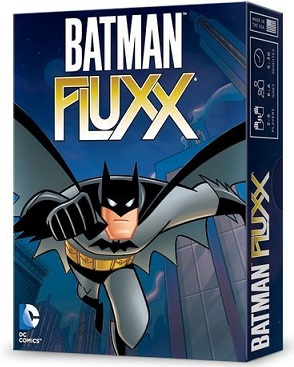
The folks at Looney Labs specialize in games with high replay value and dynamic gameplay, and no game epitomizes their gaming spirit more than Fluxx. With its constantly shifting rules, goals, and actions, no two sessions of Fluxx are exactly alike, and with numerous variant games like Star Fluxx, Monty Python Fluxx, Holiday Fluxx and more, there’s no shortage of possible ways to keep the game fresh.
The latest addition to the Fluxx family of games is Batman Fluxx, and between the crafty creators at Looney Labs and Batman’s diabolical Rogue’s Gallery of villains, you AND the Dark Knight will have your hands full.
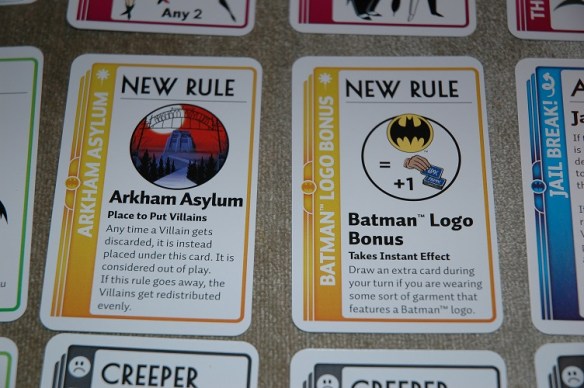
[There’s even a rule card that allows you to take advantage
by wearing something with Batman’s iconic logo!]
Now, anyone who has played Fluxx in the past is familiar with action cards, goal cards, keeper cards, new rule cards, and surprise cards. For those unfamiliar with the game, the basic idea is to collect keeper cards in the hopes of completing a goal and winning the game. But since every player can change rules (like how many cards you draw during your turn, how many you drop, etc.) as well as what the current goal is that will allow you to win the game, you have to be on your toes.
And Batman is the perfect theme for one of Fluxx’s most recent and ingenious innovations: the creeper card.
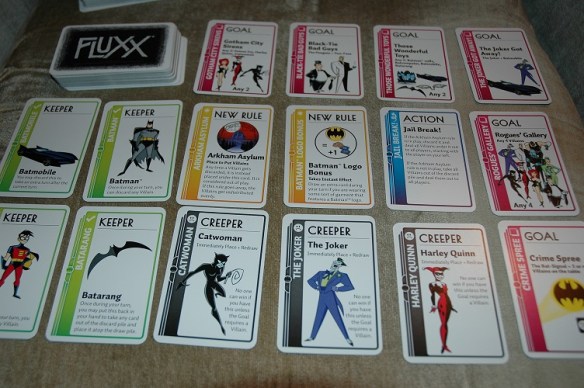
Creeper cards — featuring many of Batman’s most infamous foes, like The Penguin, Mr. Freeze, and Poison Ivy — prevent any player (including the player who plays that card) from winning the game, even if they’ve collected the necessary keeper cards to complete the current goal. So, much like Batman, you need to clean up Gotham City and get rid of all those villains before you can declare victory!
It’s a diabolical way to prevent the other players from winning (that is, unless they’re hiding a goal card that requires a villain!) and it surprised several experienced Fluxx players I know when we playtested the game.
And the Batman-flavored Keepers and Goals are not only great fun, but clearly created with fans of the Caped Crusader in mind.
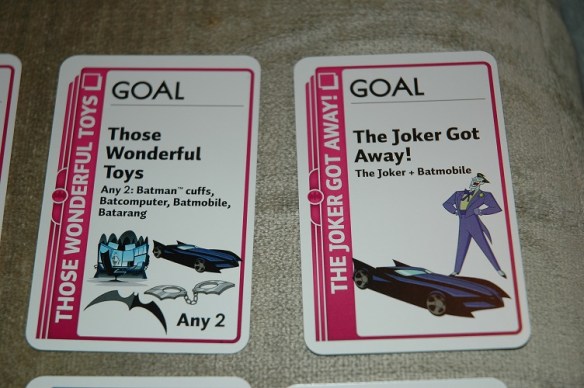
[Those Wonderful Toys references Jack Nicholson’s famous line in the first Batman film, and The Joker Got Away! is a sly reference to the Batman-fueled variation of “Jingle Bells” that got many a child in trouble back in the day. Myself included.]
With art straight out of The New Batman Adventures cartoon series from the late ’90s, both the style and the nostalgia factor is here in spades. And yes, both Robin AND Batgirl are along for the ride. (No Nightwing, though, sadly.)
Nonetheless, this has quickly become my favorite version of Fluxx yet, and the Dynamic Duo have converted several other card game enthusiasts I know into Fluxx fans as well.
[To check out more Looney Labs games I’ve reviewed in the past, click here, here, here, and here!]
Thanks for visiting PuzzleNation Blog today! You can share your pictures with us on Instagram, friend us on Facebook, check us out on Twitter, Pinterest, and Tumblr, and be sure to check out the growing library of PuzzleNation apps and games!

I’ve started to develop a reputation as something of a brain-teaser pro, given some of the beastly brain teasers we’ve featured on the blog over the last few months.
And, as such, I’ve started to receive brain teasers from friends and fellow puzzlers, challenging me to unravel them AND explain my methods to the PuzzleNation audience.
I’ve never been one to shirk a challenge, so here we go! This puzzle is entitled Mystery Number, and a little googling after solving it reveals it most likely came from this Business Insider link. (Although their solution is slightly flawed.)
Enjoy!
There is a ten-digit mystery number (not starting with zero) represented by ABCDEFGHIJ, where each numeral, 0 through 9, is used once. Given the following clues, what is the number?
1. A + B + C + D + E = a multiple of 6.
2. F + G + H + I + J = a multiple of 5.
3. A + C + E + G + I = a multiple of 9.
4. B + D + F + H + J = a multiple of 2.
5. AB = a multiple of 3.
6. CD = a multiple of 4.
7. EF = a multiple of 7.
8. GH = a multiple of 8.
9. IJ = a multiple of 10.
10. FE, HC, and JA are all prime numbers.
(And to clarify here for clues 5 through 9, AB is a two-digit number reading out, NOT A times B.)

[Image courtesy of Wikipedia.]
Now, anyone who has solved Kakuro or Cross Sums puzzles will have a leg up on other solvers, because they’re accustomed to dealing with multiple digits adding up to certain sums without repeating numbers. If they see three boxes (which would essentially be A + B + C) and a total of 24, they know that A, B, and C will be 7, 8, and 9 in some order.
[For those unfamiliar with Cross Sums or Kakuro solving, feel free to refer to this solving aid from our friends at Penny/Dell Puzzles, which includes a terrific listing of possible number-combinations that will definitely prove useful with this brain teaser.]
And since the digits 0 through 9 add up to 45, that provides a valuable starting hint for clues 1 and 2 (in which all 10 digits appear exactly once). A multiple of 6 (6, 12, 18, 24, 30, 36, 42) plus a multiple of 5 (5, 10, 15, 20, 25, 30, 35, 40, 45) will equal 45. And there’s only one combination that works.
So A + B + C + D + E must equal 30, and F + G + H + I + J must equal 15.
The same logic applies to clues 3 and 4 (in which all 10 digits appear exactly once). A multiple of 9 (9, 18, 27, 36, 45) plus a multiple of 2 (2, 4, 6, 8, 10, etc.) will equal 45. And there’s only one combination that works.
So A + C + E + G + I must equal 27, and B + D + F + H + J must equal 18.
And now, we jump to clue 9. Since IJ is a multiple of 10, and all multiples of 10 end in 0, we know J = 0.

This tells us something about JA in clue 10. J is 0, which means A can only be 2, 3, 5, or 7.
There may a quicker, more deductive manner of solving this puzzle, but I couldn’t come up with it. I went for a brute force, attrition-style solve.
So I wrote out all of the possibilities for clues 5 through 9, and began crossing them off according to what I already knew. Here’s what we start with:
AB = 12, 15, 18, 21, 24, 27, 30, 33, 36, 39, 42, 45, 48, 51, 54, 57, 60, 63, 66, 69, 72, 75, 78, 81, 84, 87, 90, 93, 96, 99
CD = 12, 16, 20, 24, 28, 32, 36, 40, 44, 48, 52, 56, 60, 64, 68, 72, 76, 80, 84, 88, 92, 96
EF = 14, 21, 28, 35, 42, 49, 56, 63, 70, 77, 84, 91, 98
GH = 16, 24, 32, 40, 48, 56, 64, 72, 80, 88, 96
IJ = 10, 20, 30, 40, 50, 60, 70, 80, 90
Now, we can remove any double numbers like 33 because we know each letter represents a different number.
AB = 12, 15, 18, 21, 24, 27, 30, 36, 39, 42, 45, 48, 51, 54, 57, 60, 63, 69, 72, 75, 78, 81, 84, 87, 90, 93, 96
CD = 12, 16, 20, 24, 28, 32, 36, 40, 48, 52, 56, 60, 64, 68, 72, 76, 80, 84, 92, 96
EF = 14, 21, 28, 35, 42, 49, 56, 63, 70, 84, 91, 98
GH = 16, 24, 32, 40, 48, 56, 64, 72, 80, 96
IJ = 10, 20, 30, 40, 50, 60, 70, 80, 90

[Sorry guys, you’re out.]
And we know that J = 0, so we can remove any numbers that end in zero for AB, CD, EF, and GH.
AB = 12, 15, 18, 21, 24, 27, 36, 39, 42, 45, 48, 51, 54, 57, 63, 69, 72, 75, 78, 81, 84, 87, 93, 96
CD = 12, 16, 24, 28, 32, 36, 48, 52, 56, 64, 68, 72, 76, 84, 92, 96
EF = 14, 21, 28, 35, 42, 49, 56, 63, 84, 91, 98
GH = 16, 24, 32, 48, 56, 64, 72, 96
IJ = 10, 20, 30, 40, 50, 60, 70, 80, 90
And for AB, we know that A can only be 2, 3, 5, or 7, so we can delete any numbers that don’t start with one of those four digits.
AB = 21, 24, 27, 36, 39, 51, 54, 57, 72, 75, 78
CD = 12, 16, 24, 28, 32, 36, 48, 52, 56, 64, 68, 72, 76, 84, 92, 96
EF = 14, 21, 28, 35, 42, 49, 56, 63, 84, 91, 98
GH = 16, 24, 32, 48, 56, 64, 72, 96
IJ = 10, 20, 30, 40, 50, 60, 70, 80, 90
Hmmm, that’s still a LOT of options. What else do we know?

Well, we know from clue 10 that FE and HC are prime numbers. So they can’t be even numbers OR end in a 5. So we can eliminate any options from CD and EF that begin with an even number or a 5.
AB = 21, 24, 27, 36, 39, 51, 54, 57, 72, 75, 78
CD = 12, 16, 32, 36, 72, 76, 92, 96
EF = 14, 35, 91, 98
GH = 16, 24, 32, 48, 56, 64, 72, 96
IJ = 10, 20, 30, 40, 50, 60, 70, 80, 90
Alright, now we need to look at those big addition formulas again. Specifically, we need to look at B + D + F + H + J = 18.
We know J = 0, so the formula becomes B + D + F + H = 18. Now, take a look at our lists of multiples for AB, CD, EF, and GH. Look at the second digit for each. There’s a little nugget of information hiding inside there.
Every D and H digit is an even number. Which means that B and F must either both also be even, or both be odd in order to make an even number and add up to 18.
But, wait, if they were both even, then they would use all of our even numbers, and some combination of B, D, F and H would be 2 + 4 + 6 + 8, which equals 20. That can’t be right!
So let’s delete any even numbered options from AB and EF.
AB = 21, 27, 39, 51, 57, 75
CD = 12, 16, 32, 36, 72, 76, 92, 96
EF = 35, 91
GH = 16, 24, 32, 48, 56, 64, 72, 96
IJ = 10, 20, 30, 40, 50, 60, 70, 80, 90
Okay, we’ve whittled down EF to 2 possibilities: 35 and 91. [Here is where the Business Insider solution goes awry, because they never eliminate one of these two options.]
Clue 10 tells us that FE is a prime number, but that doesn’t help, because both 53 and 19 are prime. So now what?
Let’s return to those starting formulas.

We know that A + B + C + D + E = 30, and our handy-dandy number-combination listing tells us there are six possible ways that five digits can add up to 30: 1-5-7-8-9; 2-4-7-8-9; 2-5-6-8-9; 3-4-6-8-9; 3-5-6-7-9; and 4-5-6-7-8.
Look at the possibilities for A, B, C, D, and E according to our work thus far:
AB = 21, 27, 39, 51, 57, 75
CD = 12, 16, 32, 36, 72, 76, 92, 96
EF = 35, 91
There’s not a single 8 in any of those pairings! And five of our six possible answers for A + B + C + D + E = 30 include an 8 as one of the five digits.
Therefore, 3-5-6-7-9 and A-B-C-D-E match up in some order.
EF is either 35 or 91, but with both 3 and 5 counted among the letters in A-B-C-D-E, EF cannot be 35, so EF is 91. Let’s eliminate any option for AB, CD, GH, or IJ that include 9 or 1.
AB = 27, 57, 75
CD = 32, 36, 72, 76
EF = 91
GH = 24, 32, 48, 56, 64, 72
IJ = 20, 30, 40, 50, 60, 70, 80
Because E = 9, that leaves 3, 5, 6, and 7 as the only possible digits available for A, B, C, and D. So let’s eliminate any combinations that use numbers other than those four.
AB = 57, 75
CD = 36, 76
EF = 91
GH = 24, 32, 48, 56, 64, 72
IJ = 20, 30, 40, 50, 60, 70, 80
We can also eliminate any combinations for GH and IJ that include those four numbers.
AB = 57, 75
CD = 36, 76
EF = 91
GH = 24, 48
IJ = 20, 40, 80
Since our only possibilities for AB use 5 and 7 in some order, CD cannot be 76, so it must be 36.
AB = 57, 75
CD = 36
EF = 91
GH = 24, 48
IJ = 20, 40, 80

So, here are our options at this point:
AB = 57, 75
CD = 36
EF = 91
GH = 24, 48
IJ = 20, 40, 80
All possible solutions for GH include the number 4, so we can delete 40 as a possibility for IJ.
AB = 57, 75
CD = 36
EF = 91
GH = 24, 48
IJ = 20, 80
Let’s look at those formulas one more time. We know A + C + E + G + I = 27.
We also know C = 3 and E = 9, so A + G + I = 15. And the only combination of available digits that allows for that is 5, 2, and 8, meaning AB = 57, GH = 24, and IJ = 80.
So ABCDEFGHIJ = 5736912480.
I don’t think I’ve tackled a puzzle this tough since the seesaw brain teaser!
Thanks for visiting PuzzleNation Blog today! You can share your pictures with us on Instagram, friend us on Facebook, check us out on Twitter, Pinterest, and Tumblr, and be sure to check out the growing library of PuzzleNation apps and games!
 PuzzCulture