ACPT Wrap-up!

The 38th annual American Crossword Puzzle Tournament was this weekend, and puzzlers descended on the Stamford Marriott Hotel in the hopes of putting their puzzly chops to the test in what has been dubbed “the Nerd Olympics.”

The tournament takes place over two days — with six puzzles to solve on Saturday, followed by one on Sunday — and then the championship puzzle, which the top 3 solve on white boards in front of the audience. On Friday and Saturday night, there are often puzzle events, demonstrations, and panels by top puzzlers and figures in the puzzle world as well.

I ventured down to Stamford myself Saturday morning amidst some unexpected snow flurries and sat in with my friends from Penny/Dell Puzzles at their booth.

They were armed to the teeth with tote bags, magazines, pencils, and freebie copies of The Crosswords Club, The Uptown Puzzle Club, Will Shortz’s Sudoku, and some of the tougher Penny Press and Dell Magazines titles. It was a sumptuous buffet of puzzly goodness, to be sure.

Joining me behind the tables were Penny Press proofreader and puzzler Debra Yurschak Rich and PuzzleNation‘s very own Director of Game Development, Fred Galpern, who was on hand to show off the Penny Dell Crosswords App.

We had a few hours before Puzzle #1 would kick off the tournament, so I wandered around, checked out the ballroom where the competition would take place, surveyed the other booths, and chatted with many tournament competitors and puzzlers.

Not only did I get to see friends of the blog like Uptown Crossword Club editor Patti Varol, author and puzzler Eric Berlin, constructor Ian Livengood and Penny Press variety editor Keith Yarbrough, but it was a great opportunity to match names and faces, since I’d had the chance to tweet, email, and otherwise interact with many of them online over the last few years, but never actually met them in person.

Among the folks I got to meet were crossword gentleman Doug Peterson, New York Times Wordplay blogger Deb Amlen, constructor and Pre-Shortzian Puzzle Project curator David Steinberg, constructor Joon Pahk, top solver and former champion Ellen Ripstein, Los Angeles Times crossword editor Rich Norris, constructor Alan Olschwang, Evan Birnholz of Devil Cross, top competitor and former champion Tyler Hinman, and New York Times puzzle editor Will Shortz.

[Will stops in at the Penny/Dell Puzzles booth, and poses with his namesake titles.]

One of my favorite things about the tournament is the absolute and unabashed puzzle love shown by so many competitors. I saw crossword-patterned sweaters, ties, shirts, and earrings, as well as punny t-shirts of all kinds. One guy even dressed up in full papal regalia, but with a crossword theme!

[Fred poses with the eye-catching Puzzle Pope. In nomine puzzle…]

Finally, it was time for the tournament to begin, so the competitors filed into the ballroom where Will Shortz introduced Puzzle #1, created by Tracy Bennett, which would be a Monday difficulty puzzle.

It’s an excellent warm-up puzzle for competitors, and rarely one that poses a significant challenge. Dan Feyer, reigning five-time champion, set a new tournament record by completing Puzzle #1 in under two minutes. WOW.

But, as it turns out, there was a bit of a kerfuffle surrounding the first puzzle. From the Puzzle Brothers blog:

A weird scoring anomaly took place when the Puzzle 1 results were announced, when a solver named William Hall appeared to have solved Puzzle 1 a full four minutes before Dan Feyer did. Since Dan solved the puzzle in less than two minutes – believed to be an ACPT first – that meant that Hall would have had to do some serious messing with the time-space continuum to finish the puzzle TWO MINUTES BEFORE HE EVEN STARTED.

[I believe I met a third of the names on this list over the course of the day.]

The glitch was soon resolved and Dan Feyer returned to his proper spot at the top of the leaderboard.

Puzzles #2 and #3 (constructed by Joel Fagliano and Merl Reagle, respectively) proceeded without any scoring scandals, and throughout the day, I was getting great insight into the puzzles themselves and the energy of the room with post-puzzle updates from Keith, Patti, Doug, and some of the other competitors.

After a break for lunch, the ballroom filled once more for Puzzle #4, Paula Gamache’s contribution to the tournament. And then, it was time for Puzzle #5.

If you recall my report from last year’s tournament, Puzzle #5 is routinely the toughest puzzle in the tournament. While Brendan Emmett Quigley’s puzzle last year was widely regarded to be a brutally challenging one, Will Shortz said this year’s entry (constructed by Jeff Chen) was “easy for Puzzle #5.” Which is akin to calling something “the friendliest volcano” or “the warmest Eskimo.”

I happened to bump into Dan Feyer outside the ballroom after he completed Puzzle #5, and he jokingly inquired, “Where is everyone?” I looked at him point-blank and replied, “You know exactly where everyone is, Dan!”

Not long after, I received the following text, from another competitor: Puzzle 5. *sad trombone*

The day’s puzzle wrapped up with Puzzle #6, a Lynn Lempel creation that helped set the stage for Sunday’s remaining two crosswords: Patrick Berry’s Puzzle #7 and Byron Walden’s championship closer.

And although I wasn’t present for Sunday’s tournament finale, I continued to get updates from friends and fellow puzzlers throughout the day. When it came time for the top three to solve on their white boards in front of their fellow competitors, a familiar trio of names were listed: Dan Feyer, Tyler Hinman, and Howard Barkin.

Due to his performance over the previous seven puzzles, Dan began with a 5-second head start over Tyler. And that made all the difference.

Watch as Dan and Tyler race to the finish:

Only a half-second separated Dan and Tyler’s times, a nail-biter in ANY competition, but Dan Feyer locked up his sixth straight ACPT championship!

Not only did he top Tyler’s streak of 5 straight wins, but he’s put himself in contention to match Jon Delfin’s record of seven tournament victories next year! Names like Anne Erdmann, Francis Heaney, Joon Pahk, and Al Sanders were not far behind.

And out of more than 560 competitors, friends of the blog had a strong showing themselves! David Steinberg ranked 36th overall, and was named the Division C champion, the youngest ever!

Patti Varol placed 109th, and only a few steps behind her was Eric Berlin at 112th! Keith Yarbrough placed 177th, and Doug Peterson was the top performer in our little cabal of puzzlers, delivering some outstanding solves and placing 14th overall!

(In case anyone was curious, the Puzzle Pope placed 463rd.)

I’ve never experienced anything quite like the ACPT, but I’m definitely going back next year. Congratulations to all the competitors!

Thanks for visiting PuzzleNation Blog today! You can share your pictures with us on Instagram, friend us on Facebook, check us out on TwitterPinterest, and Tumblr, and be sure to check out the growing library of PuzzleNation apps and games!

It’s Follow-Up Friday: ACPT Eve edition!

Welcome to Follow-Up Friday!

By this time, you know the drill. Follow-Up Friday is a chance for us to revisit the subjects of previous posts and bring the PuzzleNation audience up to speed on all things puzzly.

And in today’s post, I’m returning to the subject of the American Crossword Puzzle Tournament!

The 38th annual tournament kicks off tomorrow, and I’m definitely excited to be attending for the very first time! I’ll be sitting in with my pals at the Penny Press/Dell Magazines booth, offering some great puzzles and meeting topnotch competitors and constructors alike.

How many PuzzleNationers and fellow puzzle fiends are attending? Come by, I’d love to meet you!

Not only that, but Fred, our Director of Game Development, will be on hand to show off the Penny Dell Crosswords App!

This week, the names of the constructors contributing puzzles to the tournament this year were revealed, and it’s a terrific mix of first-class constructors. Some you may know, some you may not!

Merl Reagle (who masterminded Google’s 100th Anniversary of the Crossword puzzle) is contributing, along with prolific puzzlers Lynn Lempel, Joel Fagliano (currently Will Shortz’s assistant at The New York Times), and Jeff Chen (XWordInfo‘s webmaster)!

They’re joined by constructors Tracy Bennett, Paula Gamache, Patrick Berry, and Byron Walden (a Saturday NYT regular known for some seriously tough puzzles)! It’s entirely possible that the diabolical Puzzle #5 at this year’s tournament will be a Walden original.

Not only that, but several friends of the blog will be in attendance, like Penny Press variety editor Keith Yarbrough, constructor Ian Livengood, puzzler and author Eric Berlin, crossword gentleman Doug Peterson, and Uptown Puzzle Club editor Patti Varol!

Tuesday’s blog post will be a recap of the tournament, complete with pictures, but stay tuned to Twitter and Facebook this weekend for bonus posts and previews!

Thanks for visiting PuzzleNation Blog today! You can share your pictures with us on Instagram, friend us on Facebook, check us out on TwitterPinterest, and Tumblr, and be sure to check out the growing library of PuzzleNation apps and games!
PuzzleNation Product Review: Rush Hour Shift and All Queens Chess

ThinkFun has always specialized in games that educate as you play, from the optics and angles of Laser Maze and the chain problem-solving of Gravity Maze to the coding-for-kids gameplay of Robot Turtles and the mental agility challenges of their Brain Fitness line of puzzles-for-one.

Two of their newest products bring the best of those puzzles-for-one brain fitness games into the realm of head-to-head competitive solving for two players aged 8 to adult. And while All Queens Chess and Rush Hour Shift focus on two different styles of puzzle-solving, they both highlight the pluses of two-player puzzle games in their own unique ways.

Rush Hour Shift

There have been numerous variations on Rush Hour in the past, all of which center around the same tile-shifting mechanic: moving a series of cars around the board in the proper order to allow your car to escape the traffic jam.

Rush Hour Shift adds a new wrinkle to the puzzle by pitting two players head-to-head in a race to escape the traffic jam. But not only can players shift a personal car (known as the hero car) and the many cars in the way, they can also shift entire sections of the board in order to maximize their efforts to escape or thwart those of their opponent.

[Sometimes, you end up literally head-to-head.]

Your moves are dictated by the cards you draw from a small deck of options. You can either move a certain number of spaces, slide a vehicle as far as it will go before hitting an obstacle, or shift one side of the board or the other in order to create openings for yourself and further obstacles for your opponent. So not only are you solving an ever-evolving maze for your own car, but you’re trying to make your opponent’s maze more challenging.

My one caveat when it comes to Rush Hour Shift is that the game is incredibly dependent on which cards you draw. Between shifting the grid and moving both your hero car and all of the other cars, you have lots of options.

But if your opponent is drawing high-number cards and you’re not, there’s only so much you can do to slow them down or maneuver yourself in the hopes of staying in the game. A few good cards in a row can form a nearly insurmountable advantage.

That being said, Rush Hour Shift is a clever spin on a familiar formula, and a terrific way of introducing kids to the tile-shifting style of puzzle solving.

All Queens Chess

Many of the best games have extremely simple rule sets that still allow for major replayability and inherently complex gameplay, and All Queens Chess absolutely fits that bill.

You’ve got a 5×5 playing field, six queens each, and you’re trying to place four of your queens in a row Connect Four-style while preventing your opponent from doing the same. Each queen moves according to standard chess rules, except there’s no capturing of your opponent’s pieces. This puzzle game is all about placement and strategy.

And when you consider that the game pieces occupy nearly half of the playing area, it’s remarkable that there’s so much maneuverability and tactical potential in such a confined space.

Moreover, my expectation that, after a few games, the inability to capture and remove pieces from the board would prove tedious or frustrating was completely misproven. Six pieces is enough to strike a strong balance of offense (trying to place four in a row) and defense (preventing my opponent from doing so). I never felt locked into a few token moves.

This is a rare open-the-box-and-go puzzle game, and it’s an absolute treat.

Thanks for visiting PuzzleNation Blog today! You can share your pictures with us on Instagram, friend us on Facebook, check us out on TwitterPinterest, and Tumblr, and be sure to check out the growing library of PuzzleNation apps and games!

Puzzles in Pop Culture: Brooklyn Nine-Nine

brooklyn-nine-nine-season-2-episode-16-captain-holt-jake-peralta-terry-jeffords

In previous editions of Puzzles in Pop Culture, we’ve explored opinions about crosswords, embarked on scavenger hunts with sitcom characters, and even saved New York with brain teasers alongside John McClane in Die Hard with a Vengeance. But it’s rare when a movie or TV show poses a puzzler and leaves it to the audience to solve it.

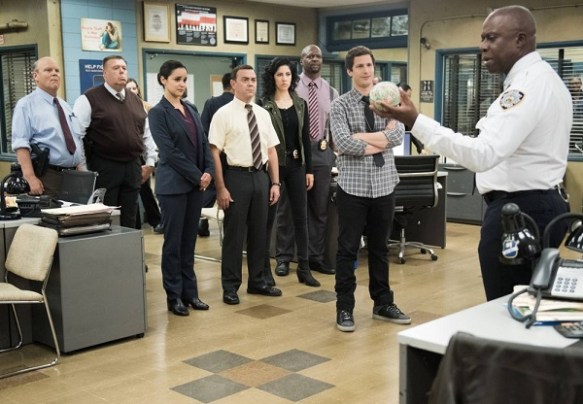
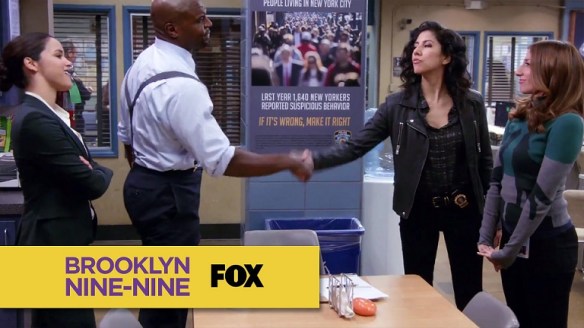
In “Captain Peralta,” a recent episode of the Fox police sitcom Brooklyn Nine-Nine, a subplot featured Captain Holt posing a brain teaser to his fellow officers.

There are 12 men on an island. 11 weigh exactly the same amount, but one of them is slightly lighter or heavier. You must figure out which.

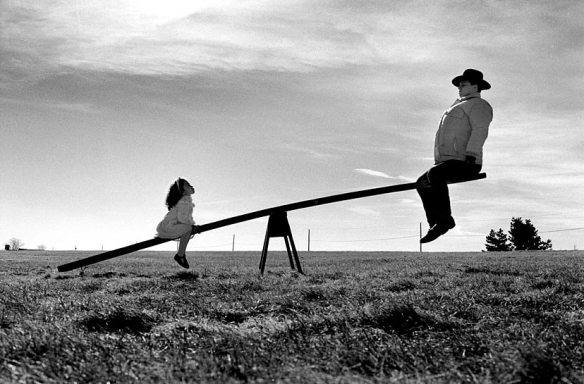
The island has no scales, but there is a seesaw. You can only use it three times.

maxresdefault4

With Beyonce tickets going to the person who solved the puzzle, the competition was fierce. Rosa suggested using the seesaw to threaten the men into confessing. Amy and Terry suggested that the first seesaw ride involve putting six men on one side and six on the other, which Captain Holt quickly said wouldn’t work.

As it turns out, Holt was hoping one of his officers would solve the puzzle for him, since he’s been unable to crack it for years. The episode ended without providing the audience with a solution.

Thankfully, your friends here at PuzzleNation Blog would never leave you high and dry like that. Let’s get puzzling!

bizarroshipwrecked07-02-95

Now, this WOULD be a simple logic problem if you knew you were looking for someone lighter or you knew you were looking for someone heavier. In that case, a 3×3 ride, 4×4 ride, or even the 6×6 ride Amy and Terry suggested, would eliminate part of the field immediately, and the remaining two uses could determine the heavy person or the light person.

Unfortunately, in Captain Holt’s puzzle, you don’t know if the person is heavier or lighter, which makes this more difficult. For instance, if you knew you were looking for someone heavier, you could immediately eliminate anyone on the side of the seesaw higher in the air. But if you don’t know if the subject in question is lighter or heavier, then you could have a heavier person on one side or a lighter person on the other.

Diabolical.

But, with some careful deduction, you CAN solve this puzzle.

First, let’s identify our 12 castaways with the letters A through L. Now let’s divide them into three groups of four: ABCD, EFGH, and IJKL.

seesaw

For the first seesaw ride, let’s weigh ABCD vs. EFGH.

There are three possible outcomes:

  • They balance, meaning we can eliminate all eight of them and our mystery person is in IJKL.
  • ABCD sinks while EFGH rises, meaning there’s a heavier person in ABCD or a lighter person in EFGH, so we can eliminate IJKL.
  • EFGH sinks while ABCD rises, meaning there’s a heavier person in EFGH or a lighter person in ABCD, so we can eliminate IJKL.

OUTCOME 1: They balance

For the second seesaw ride, we’ll take IJK and weigh them against any three of the eliminated people — let’s say ABC — because we know they weigh the same.

OUTCOME 1-1: if IJK balances against ABC, we know that L is our guy. For the third seesaw ride, weigh L against A to determine if L is lighter or heavier.

OUTCOME 1-2: if IJK sinks, one of them is heavier than ABC. For the third seesaw ride, weigh I against J. If they balance, K is the heavy one. If I or J sinks, he’s the heavy one.

OUTCOME 1-3: if IJK rises, one of them is lighter than ABC. For the third seesaw ride, weigh I against J. If they balance, K is the light one. If I or J rises, he’s the light one.


article-2401231-1b6471bd000005dc-74_634x452

OUTCOME 2: ABCD sinks while EFGH rises

For the second seesaw ride, we have eight possible suspects — four heavy, four light — so we mix up the two previous groupings in order to eliminate some suspects. We’ll take E, F, and A and weigh them against G, B, and L. That’s two from the lighter side and one from the heavier vs. one from the lighter, one from the heavier, and one we know is standard.

Again, there will be three possible outcomes:

OUTCOME 2-1: If EFA balances with GBL, they’re all eliminated, leaving either H as a lighter person or either C or D as a heavier person. For the third seesaw ride, weigh C against D. If they balance, H is lighter. If they don’t, whichever is heavier is our guy.

OUTCOME 2-2: If EFA sinks, either A is heavy (because E and F were on the lighter side before) or G is light (because B was on the heavier side and L has already been eliminated), and we can eliminate C, D, and H. For the third seesaw ride, weigh G against L. If they balance, A is heavy. If they don’t, then G is light.

OUTCOME 2-3: If EFA rises, either B is heavy (because G was on the lighter side and L has already been eliminated) or either E or F is light (because A was on the heavier side), and we can eliminate C, D, and H. For the third seesaw ride, weigh E against F. If they balance, then B is heavy. If they don’t, whichever is lighter is our guy.


giant-see-saw

OUTCOME 3: EFGH sinks while ABCD rises

For the second seesaw ride, we have eight possible suspects — four heavy, four light — so we mix up the two previous groupings in order to eliminate some suspects. We’ll take A, B, and E and weigh them against C, F, and L. That’s two from the lighter side and one from the heavier vs. one from the lighter, one from the heavier, and one we know is standard.

Again, there will be three possible outcomes:

OUTCOME 3-1: If ABE balances with CFL, they’re all eliminated, leaving either D as a lighter person or either G or H as a heavier person. For the third seesaw ride, weigh G against H. If they balance, D is lighter. If they don’t, whichever is heavier is our guy.

OUTCOME 3-2: If ABE sinks, either E is heavy (because A and B were on the lighter side) or C is light (because F was on the heavier side and L has already been eliminated), and we can eliminate D, G, and H. For the third seesaw ride, weigh C against L. If they balance, E is heavy. If they don’t, then C is light.

OUTCOME 3-3: If ABE rises, either F is heavy (because B was on the lighter side and L has already been eliminated) or either A or B is light (because E was on the heavier side), and we can eliminate D, G, and H. For the third seesaw ride, weigh A against B. If they balance, then F is heavy. If they don’t, whichever is lighter is our guy.


This was one whopper of a brain teaser, to be sure, and I’m not surprised it stumped even the likes of the impressive Captain Holt. But, as a special treat, if you’d like to see the Captain himself explain the solution, go here and check out the embedded video. Enjoy.

Of course, it doesn’t answer the real question: who cares about weight? Why aren’t they building a boat to escape the island?

Thanks for visiting PuzzleNation Blog today! You can share your pictures with us on Instagram, friend us on Facebook, check us out on TwitterPinterest, and Tumblr, and be sure to check out the growing library of PuzzleNation apps and games!

It’s Follow-Up Friday: Monopoly’s Birthday edition!

Welcome to Follow-Up Friday!

By this time, you know the drill. Follow-Up Friday is a chance for us to revisit the subjects of previous posts and bring the PuzzleNation audience up to speed on all things puzzly.

And today, I’d like to revisit the subject of Monopoly.

I recently posted about the 80th anniversary of the game and their real-money promotion in France.

And whether you’re a fan of the game or not, you can’t deny its staggering success or the genuine historical impact it has made.

Yesterday was the official 80th anniversary of the game. March 19, 1935 was the day Parker Brothers acquired the rights from the game from Charles Darrow, who claimed to have invented Monopoly, although the game was actually invented by a woman named Elizabeth J. Magie. (Parker Brothers now owns the rights from both parties.)

And over the course of 80 years, a lot of trivia has accumulated regarding the game. Here are a few of my favorite little nuggets:

  • The character locked behind the bars is called Jake the Jailbird. Officer Edgar Mallory sent him to jail.
  • Escape maps, compasses, and documents were inserted into Monopoly game boards smuggled into POW camps inside Germany during World War II. Real money for escapees was slipped into the packs of Monopoly money.
  • Tokens from the United States Monopoly: Here & Now Edition were flown into space aboard Space Shuttle Atlantis in 2007.

You can check out Hasbro’s full listing of Monopoly history and trivia here!

And now, a few questions: when you play Monopoly, what token do you use? And what’s your favorite variation of the game? Let me know! I’d love to hear from you!

Thanks for visiting PuzzleNation Blog today! You can share your pictures with us on Instagram, friend us on Facebook, check us out on TwitterPinterest, and Tumblr, and be sure to check out the growing library of PuzzleNation apps and games!

“Do nine men interpret?” “Nine men,” I nod.

I’ve written about Bletchley Park and the efforts to crack the German ENIGMA code several times now, both from a historical standpoint and a cinematic one with the recent release and Oscar success of The Imitation Game.

Bletchley Park was the home of world-class codebreakers, chess players, and crossword solvers, but as it turns out, there was one more type of puzzle that the Bletchley Park crew mastered: palindromes.

In their spare time, they had competitions to create new sentences that could be read both backward and forward — like the title of today’s post, one of my all-time favorites — and mathematician Peter Hilton was far and ahead the most gifted when it came to crafting these palindromes. (His penchant for the puzzle was even mentioned in his obituary in the British online magazine The Independent.)

Perhaps you’ve seen his most famous creation, one of the world’s longest palindromes, composed during one sleepless night at Bletchley Park:

Doc note: I dissent. A fast never prevents a fatness. I diet on cod.

From an article on Vocabulary.com:

Incredibly, the young codebreaker did not use paper or pencil while composing his epic palindrome. He simply lay on his bed, eyes closed, and assembled it in his mind over one long night. It took him five hours.

It all started, apparently, with a contest to best a well-known palindrome: Step on no pets.

Two days later, Hilton responded with the cheeky “Sex at noon taxes.”

And they were off to the races, competing to create longer and more elaborate palindromes. It’s not known how many of the Bletchley Park alums were involved — whether Alan Turing played remains a big question mark — but it’s been said that the competition, instigated by mathematician John Henry Whitehead (nephew of philosopher Alfred North Whitehead), helped spawn the golden age of palindromes.

Some estimate that more palindromes were written in the ten years after Bletchley Park’s competition started than were published across the world in the more than three hundred years that preceded them.

That’s one heck of a legacy.

Thanks for visiting PuzzleNation Blog today! You can share your pictures with us on Instagram, friend us on Facebook, check us out on TwitterPinterest, and Tumblr, and be sure to check out the growing library of PuzzleNation apps and games!