Delving into the 2026 Westwords Tournament Puzzles!

It’s time, once again, for me to sit down and try my hand at some tournament-style puzzles. This week, it was the puzzles from this past weekend’s Westwords Crossword Tournament.

Given the talent involved amongst the organizers and constructors, as well as the previous year’s banger crop of puzzles, I had high expectations, and I was not disappointed.

So let’s put those puzzles under the microscope and see what’s what!


Puzzle #1: Western Expansion by Andrea Carla Michaels & Mark Axel

The tournament began with this 15x grid where the word WEST appeared in each theme entry, but the letters were spread further apart with each subsequent answer, offering solvers the Western Expansion promised in the title.

This was a great opener with a fun, accessible theme and a very smooth solve. The vocabulary was playful and the puzzle had great Monday energy. My only quibble was the repetition of YOU in the crossing entries I GOT YOU and WE STILL LOVE YOU, but that’s more of a personal preference than any fault with the construction.

Interesting grid entries included BAD LUCK, HIS LOSS, E-CLASS, and SOBFEST, and my favorite clues were “Duct tape has dozens of these” for USES and “Beatles song about an age that Paul is nearly 20 years past” for WHEN I’M SIXTY-FOUR.
Puzzle #2: Make It Rain by Sophia Maymudes

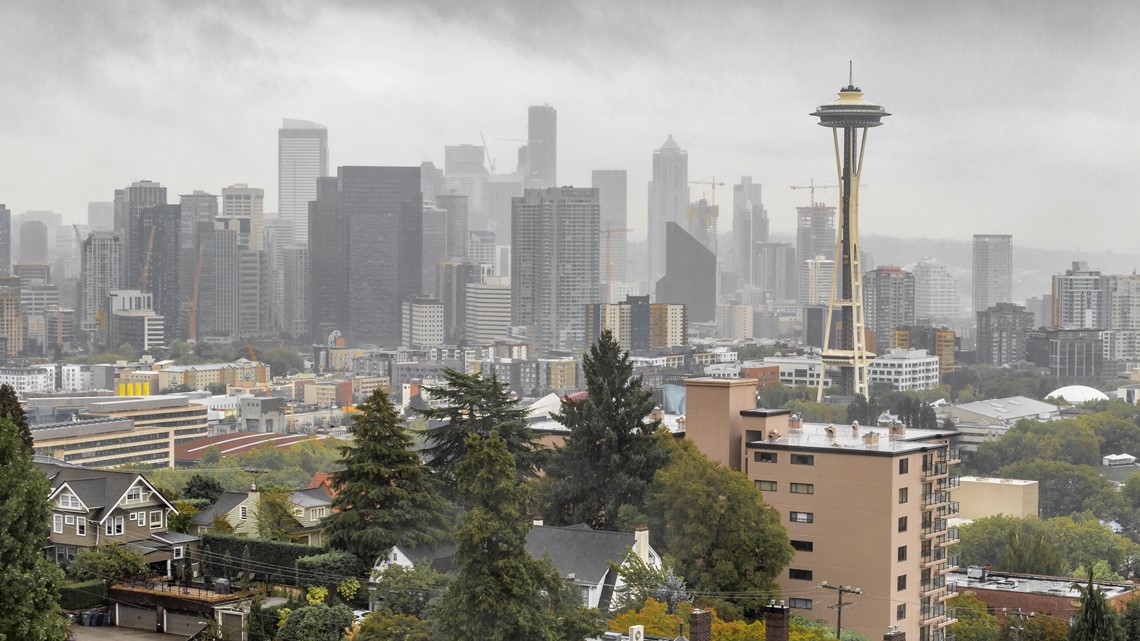
The second tournament puzzle was a freestyle 15x absolutely loaded with trivia about the West Coast and western cities, as well as two grid-spanning entries about the Pacific Northwest in particular (BIGFOOT SIGHTING and SEATTLE SOUNDERS).

I found the difficulty to be pretty much on par with the first puzzle of the tournament, and I was impressed with Sophia’s clean layout, construction, and delightful grid fill. (The across pairing of MADE PROUD and IMMODESTY was a fun little visual Easter Egg as well.)

Interesting grid entries included LA GEAR, ARMAGEDDON, DIOGENES, and KATNISS, and my favorite clues were ‘Word preceding “dash” or “bracelet”‘ for SLAP and “Quality that’s neither very demure nor very mindful” for IMMODESTY.

Puzzle #3: Pride of Place by Zhou Zhang and Mallory Montgomery

This 18×17 grid was the largest of the tournament (though Puzzle #5 came close), and the theme centered around common phrases where a W was replaced with a B, as explained by the revealer WESTCOASTBESTCOAST (which is a nice nod to both the tournament’s setting and the fantastic URL for the Westwords website, westwordsbestwords.com).

The puckish wordplay (particularly with READ ‘EM AND BEEP) made this midpoint puzzle of the tournament a treat. I also liked the synchronicity of HASTA LA VISTA and LEAVE NO TRACE reading down, continuing the unofficial theme of related fill entries in grids.

Interesting grid entries included DOG DAD, ODAWA, JOIN US, MALORT, and TREBEK, and my favorite clues were “Fairy tale girl who gets a witch baked?” for GRETEL, “Super-duper promise” for VOW, “Lawless heroine?” for XENA, “Hue grant?” for DYE JOB, and “They were celebrated 35 days ago” for MOMS. So many great clues in this one!
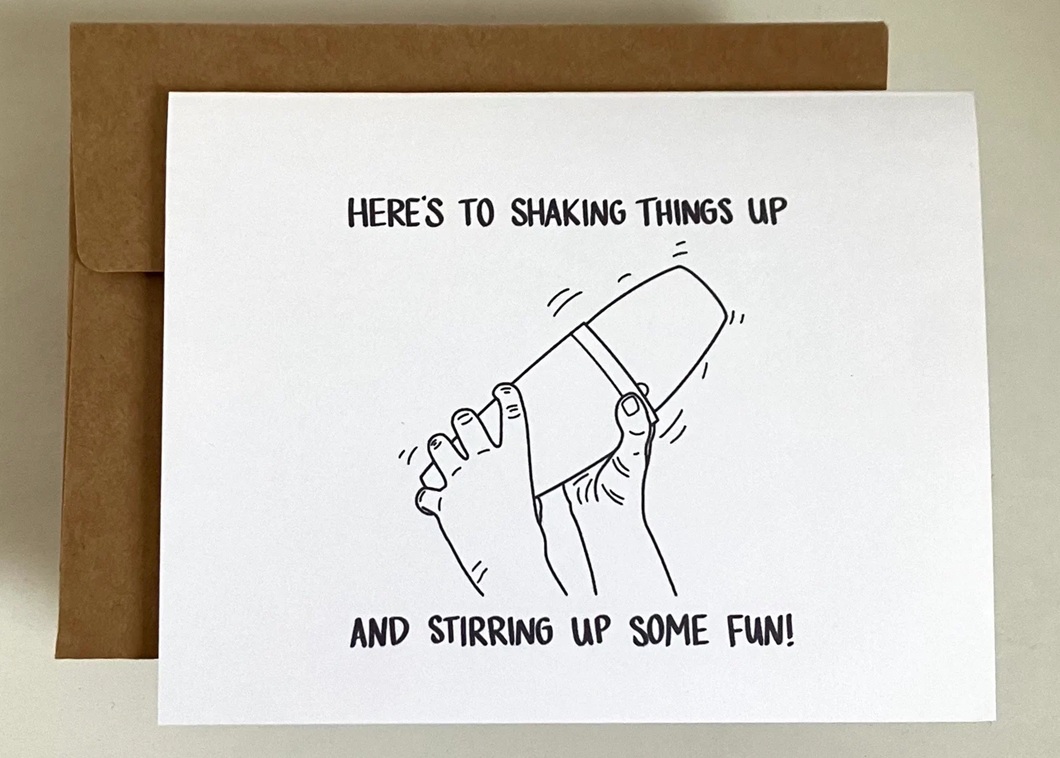
Image courtesy of Etsy.

Puzzle #4: Catch My Drift? by Rebecca Goldstein

I predicted last year that Puzzle #4 in Westwords could build a similar reputation to the dreaded Puzzle #5 at the American Crossword Puzzle Tournament, and this year’s Puzzle #4 understood its instructions perfectly.

This 16×15 grid was the toughest of the tournament. Fault lines ran throughout the grid, causing letters to drop out of many of the down entries. These SHAKEUPS related to the shifting of TECTONIC PLATES — our two revealers in the grid! — not only caused PLATE to be removed from those aforementioned down entries, but they also made the across entry ABOVE each fault line scramble/anagram itself into another word!

There was so much going on with this grid, and despite the fault lines, it all fit together seamlessly. (The down words that lost letters STILL spelled actual words.) It was a diabolical bit of crossword construction, to be sure!

Between the down entries with letters from PLATE removed and the scrambled entries across, there was a lot of “I KNOW this is the right answer, but it doesn’t fit” brain scramble as I was solving, heh. But it was an immensely fun challenge to puzzle out.

Interesting grid entries included PIXIE CUT, ANOMALIES, and DRIP PAN, and my favorite clues were “Not exactly a long look” for PIXIE CUT and “Some docs” for IDS.

Puzzle #5: Play Grounds by Sarah Sinclair

After the deviousness of Puzzle #4, and with the freestyle final puzzle looming, Puzzle #5 was a lighter, breezier solve, but one that still managed to pack this 18×15 grid with five punnily-clued entries tied to West Coast landmarks.

And that “play”-ful aspect continued throughout the cluing. We had pop culture trivia, tongue-in-cheek jabs at pop culture and crosswordese, and more facts and details germane to the tournament’s setting. Sinclair went all out with the cluing in this one.

Interesting grid entries included OH HELL NO, KOOPA, SO LONG, and ADORBS, and my favorite clues were “Concave decagon, more familiarly” for STAR, “Knd f lttr mssng frm ths cl” for VOWEL, and “Something read by a cleric… that becomes something read by a clairvoyant when a letter is removed” for PSALM.
Puzzle #6: Final by Byron Walden

The final puzzle for the tournament boasts a different set of clues for each of the divisions — Beach and Mountain — and Byron constructed a 15x puzzle with smooth fill, cunning cluing, and great variety in vocabulary. This was a Byron Walden special, for sure.

Both the Beach and Mountain versions of the puzzle had kickass clues (including a Reginald VelJohnson reference), and either version would made for a suitable challenge for the tournament’s finalists. I’m glad I didn’t have to try to puzzle this one out in front of a crowd!

Interesting grid entries included BUDDY SYSTEM, STANDING O, HOG WILD, and DAIKONS.

As for favorite clues, here’s a list:

BEACH: “Company with a Breakout hit?” for ATARI
BEACH: “Unruly way to go” for HOG WILD
BEACH: “Poly relative” for MULTI
BEACH: The Galatea pairing of “Water-dwelling divinity such as Galatea” for SEA NYMPH and “Solar system body such as Galatea” for MOON
MOUNTAIN: “They’re not sold on the Sabbath” for AGNOSTICS
MOUNTAIN: “Alaska is 120 times its size: abbr.” for CONN
MOUNTAIN: “Set of safety matches” for BUDDY SYSTEM
MOUNTAIN: “Past perfect mood?” for NOSTAGIA
MOUNTAIN: “Avon calling?” for BARD

There were genuinely too many to list. Between this one, Puzzle #3, and Puzzle #5, solvers were absolutely spoiled with great cluing this year.
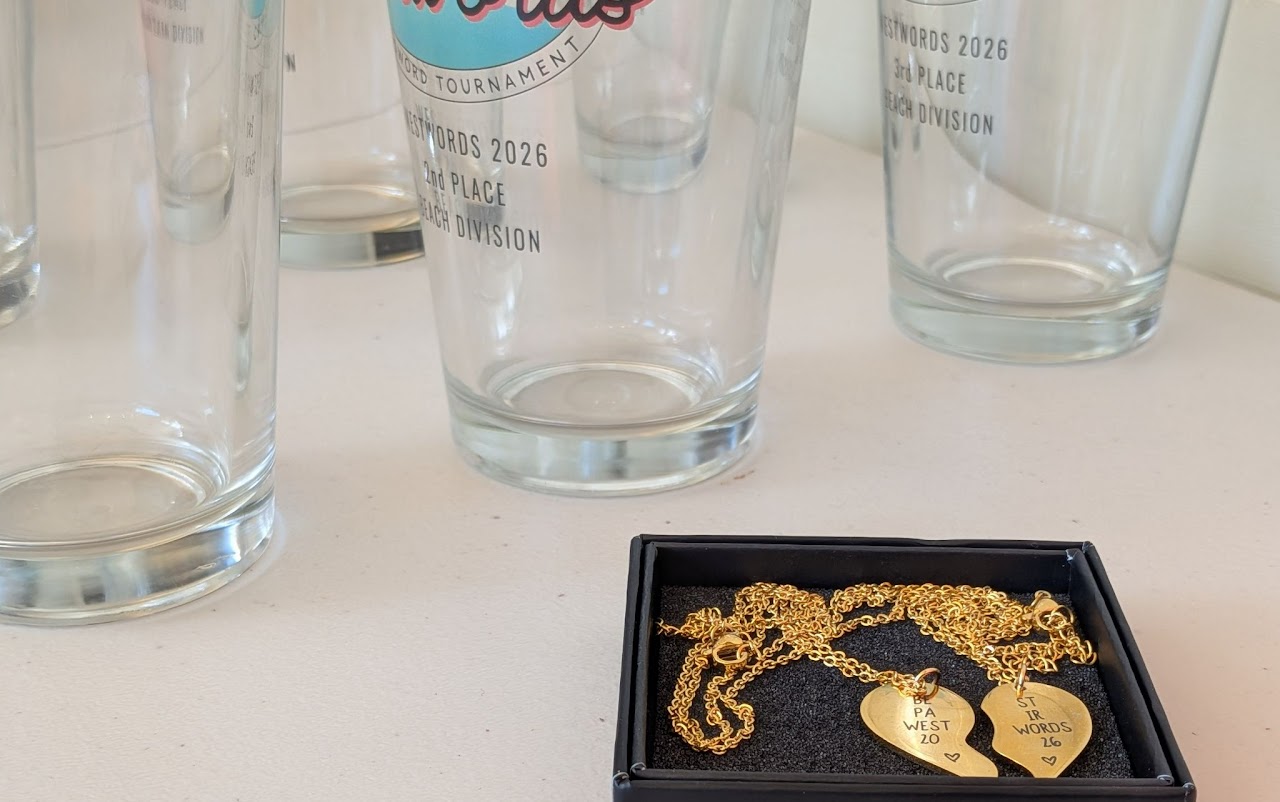

Westwords goes from strength to strength with another standout year of puzzles. The bar is SO HIGH for tournament puzzles these days, and the 2026 Westwords constructors stepped up big time. The creativity was there, the trivia was flowing, and the cluing was fantastic.

We got several different puzzles playing on the Westwords / West Coast branding, and every puzzle felt like it had its own identity and voice, which is not always the case with tournament puzzles as a whole.

If you’ve never tackled tournament-style puzzling before, I would highly recommend giving Westwords a try. It gets you into the flow of solving with the first few puzzles, punches you in the face with a proper challenge, then eases you back into it before the final. It’s a great time.

I can’t wait to see what they cook up for us next year!


Did you attempt this year’s Westwords tournament puzzles, fellow solver? Let me know in the comments section below! I’d love to hear from you.

The 2021 Boswords Fall Themeless League: Looking Back

boswords new

After two months of challenging, engaging, and thoroughly enjoyable weekly solving, the Boswords 2021 Fall Themeless League came to a close last week.

If you’re unfamiliar, the Boswords 2021 Fall Themeless League spreads out a tournament-style solving experience over nine weeks, one themeless crossword per week. Each puzzle is scored based on your answer accuracy (incorrect letters, empty squares, etc.) and how quickly you complete the grid.

While each week’s puzzle only had one solution, there were three sets of clues, each representing a different difficulty level for solvers. Smooth was the least challenging, Choppy was the middle ground, and Stormy was the most challenging. (When solvers registered to participate, they chose the difficulty level that suited them best.)

Hundreds of solvers signed up for the challenge of two months of themeless puzzle solving and a bit of friendly competition, and now that it’s over, I’d like to share a few thoughts about my experience in the League.

With the previous two Themeless League events under my belt, I had a good sense of what to expect both from the puzzles and from myself.

Although I rarely solve online — and I solve themed crosswords far more often than themeless crosswords — I now have a good base to build on.

Unfortunately, I accidentally signed up for the wrong difficulty level this time around. The previous two seasons, I’d opted for the middle ground, Choppy. I signed up for Stormy by mistake, and didn’t realize my error until I logged in and prepared to solve the season’s first puzzle.

120718_crossword_L

As you might expect, being freed from the shackles of themed puzzle building allows constructors to really flex their creative muscle, indulging all sorts of curious and unexpected vocabulary as they cross long entries and employ fewer black squares in these impressive grids.

And since I’d mistakenly opted for the toughest level of cluing, I also saw the decidedly clever and devious side of each constructor as I navigated tricky wordplay and more challenging clue content.

The first puzzle of the season immediately showed me what I’d gotten myself into. I didn’t know the number of operas Beethoven had written, or who spoke what ended up being a Madonna quote, or what Mohsin Hamid’s “Exit West” was about.

I hit nearly half an hour with my solving time, which I think was a ten-minute increase from my performance in the previous League’s debut puzzle.

Although I would have better performances later in the season — my time averaged out to 24:48 across eight puzzles — that was definitely a shot right across the bow of my confidence.

tumblr_nnl5c43Ov61qd4fqho1_500

I could have contacted the organizers and asked to be moved over to Choppy. I’m sure they would have accommodated me; the Boswords team is terrific.

But instead, I decided to throw myself into the deep end and stick with Stormy and see how it went.

As I expected, it was quite a challenge. But I trusted my instincts more — filling in more guesses at the start, rather than letting them sit empty until crossing words offered confirmation — and overall, I enjoyed the experience. Sure, I was a little disheartened at how my season started, but knowing that I was competing — however slowly — at the steepest level available pushed me to keep going.

I’ve never been the fastest solver to begin with — doesn’t matter if it’s pencil and paper or on a computer — and I rarely time myself when I solve in my free time. But I kept setting different goals each week. If I had half the grid filled by a certain time, I’d set a time to beat based on that. I didn’t always succeed, but more often than not, I kept my time below whatever goals I’d set.

(Still, I dare not look at the times of the top performers, lest I despair once more. Heh.)

In the end, my individual rank was 220 (out of 303 Stormy solvers), and my overall rank was 251 (out of the 871 individual solvers). Not too shabby. A staggering 1253 people participated in this season’s event,

As for the puzzles themselves, they were solid. The vocabulary — particularly the longer entries — was incredibly creative and unexpected. And the constructors were fantastic.

Each brought their own style and flavor to the competition, and it was great to see well-established names like Byron Walden, Evan Birnholz, Kameron Austin Collins, and the dynamite duo of Doug Peterson and Angela Olson Halsted mixed with newer names to the field like Mollie Cowger and Quiara Vasquez.

All in all, I enjoyed the Fall Themeless League. (Although I was more comfortable with the solving interface and I had a better handle on themeless solving, given that this was my third go-around, I still felt like a rookie tackling the Stormy-level clues.)

I think when the Spring Themeless League rolls around, I’ll try Stormy again. Now that I have a baseline to compare it to, I’d like to see how I can improve.

And with the promise of future Boswords-hosted events in 2022 like the Winter Wondersolve event on February 6th and the Spring Themeless League, it’s nice to have exciting puzzle events to look forward to in the near future.

They’ve already announced the teams for each! The Winter Wondersolve will be constructed by Kate Chin Park, Christina Iverson, Adesina Koiki, and Matthew Stock.

The Spring Themeless League will be handled by Adam Aaronson, Wendy L. Brandes, Katja Brinck, Julian Lim, Frank Longo, the team of Sophia Maymudes & Kyra Wilson, Ada Nicolle, Robyn Weintraub, and one constructor to be named later.

(Yup, a mystery constructor. They’re actually selecting them based on an open submission process, the details of which will be announced tomorrow, Wednesday 12/8! How cool is that?)

Kudos to everyone who helped bring this marvelous project together, and kudos to everyone who participated. It was tough, but also a great deal of fun.


   dailypopwsicon

Treat yourself to some delightful deals on puzzles. You can find them on the Home Screen for Daily POP Crosswords and Daily POP Word Search! Check them out!

Thanks for visiting PuzzleNation Blog today! Be sure to sign up for our newsletter to stay up-to-date on everything PuzzleNation!

The Boswords Themeless League Returns Soon (Plus Some Puzzle Activism!)

boswords new

The Boswords summer crossword tournament has been a highlight of the puzzly calendar for years now, but during the pandemic, they also made a splash with their Fall and Spring Themeless Leagues.

And registration is now open for the Boswords 2021 Fall Themeless League!

If you’re unfamiliar, the Fall Themeless League is a clever weekly spin on traditional crossword tournament-style solving. Instead of cracking through a number of puzzles in a single day (or two), the Fall Themeless League consists of one themeless crossword each week, scored based on your accuracy and how fast you complete the grid.

120718_crossword_L

Each week’s puzzle only has one grid, but there are three sets of clues, each representing a different difficulty level for solvers. Smooth is the least challenging, Choppy is the middle ground, and Stormy is the most challenging. (When solvers register to participate, they’ll choose the difficulty level that suits them best.)

Sign up, and you get two months of puzzly fun running through October and November!

Plus, they’ve already announced a dynamite lineup of constructors for this season’s puzzles. Here’s the full list: Evan Birnholz, Kameron Austin Collins, Mollie Cowger, Debbie Ellerin, Leslie Rogers, Quiara Vasquez, Byron Walden, Nam Jin Yoon, and the team of Angela Olson Halsted and Doug Peterson.

There’s a terrific mix of established names and up-and-coming constructors there, and I expect the season to be a terrific exploration of the best of themeless crosswords.

tumblr_nnl5c43Ov61qd4fqho1_500

The project is once again being spearheaded by the dynamic duo of John Lieb and Andrew Kingsley, and Brad Wilber will be the puzzle editor.

It’s only $30 to enter as an individual participant ($40 for Pairs), but there’s also a student/discount level for participants who may find the $30 price tag too steep. (There are also puzzle packets from the previous Themeless Leagues available for $10 apiece.)

The Boswords Seasonal Themeless League events have not only opened my eyes to the creativity and skill required for themeless crosswords, but they’ve become some of my favorite parts of the puzzly calendar.

Be sure to click this link for more information, sample puzzles, instructional videos, and more.

And you can check out our thoughts on both the 2020 Fall Themeless League and the 2021 Spring Themeless League for more info as well!


Puzzling and charitable acts often intersect. This is true of the Boswords team with their wonderful discounted option for participants, as well as their donation to Boston-based charities from the proceeds of their summer tournament

And while we’re discussing the intersection of puzzling and doing good, it’s worth mentioning that there are numerous examples of crossword projects working hand-in-hand with social activism for the greater good.

Queer Qrosswords and Women of Letters are just a few examples. All of them provide puzzle bundles for you to enjoy if you show them that you’ve donated to worthwhile charities and other helpful groups and causes.

But there’s another one you might not have heard about: These Puzzles Fund Abortion.

This puzzle packet, originally created to raise funds for the Baltimore Abortion Fund, contains the work of over a dozen constructors, and serves as a marvelous incentive to donate to abortion funds all over the country.

Please click this link hosted by Just Gridding for more information. It’s a terrific way to do some good.


dailypopwsicon

Have you checked out our special summer deals yet? You can find them on the Home Screen for Daily POP Crosswords and Daily POP Word Search! Check them out!

Thanks for visiting PuzzleNation Blog today! Be sure to sign up for our newsletter to stay up-to-date on everything PuzzleNation!

Sometimes, You Can’t Trust the “Rules” of Crosswords

There are a lot of things you learn as you solve more and more crosswords.

You learn vocabulary, both words that are simply new to you AND words that are common to crosswords. You learn cluing tropes, like question marks indicating wordplay or quotation marks indicating informal speech or exclamations.

You also start to learn some of the constructors’ tricks.

Now, there are all sorts of ways that constructors can play with solvers, but all told, they seem to fit into three overall categories: clue trickery, theme gimmickry, and grid manipulation.

We’ve spoken about clue trickery loads of times in the past, and no doubt will again. And theme gimmickry will be the subject of a future post.

But today, we’d like to focus on grid manipulation.

tumblr_nltrvaQWZN1qafoq6o1_400

So, what do we mean by that? Well, essentially, grid manipulation is our catchall term for the most devious arrow in the constructor’s quiver. It’s when the standard accepted rules of crosswords no longer apply.

No matter what sort of symmetry is involved or how the grid is constructed, there are generally three accepted rules of crosswords:

  • Across words read across.
  • Down words read down.
  • One letter per square.

These are the fundamental rules, Newton’s three laws of crosswords. They’re the rules every solver expects to be in play when they sit down to solve a crosswords.

But that’s not always true.

gopher

Over the years, crafty constructors have found ways to push the boundaries of what you can do with those iconic grids of black and white squares.

Some constructors have literally gone outside the box, creating puzzles where letters of answers are placed beyond the grid itself, as in Sid Sivakumar’s American Values Club crossword “Bursting With Pride” a year or two ago (with the letters LGBTQIA+ appearing in sequence).

Byron Walden’s Fasten Your Seatbelts puzzle from the AVC crossword in 2019 also extended beyond the grid. Extra letters served not only as “bumps” along the otherwise smooth sides of the grid, but spelled out various bumps, like RAZOR, SPEED, and GOOSE.

Other constructors find fresh ways to pack more into a grid than expected.

The most common form is the rebus puzzle, whether multiple letters can be placed in a single grid square. Sometimes, it’s only a single square in a themed entry where multiple letters fit. Other times, you can get whole strings of them. The exact puzzle escapes me, but I can remember a crossword where two down entries all had rebus squares, so instead of one film title in that down entry, two would fit in each.

One impressive example that comes to mind is Andy Kravis’s “Currency Exchange” puzzle from the 2019 Indie 500 puzzle tournament.

The puzzle actually had little ATM graphics in various grid boxes, and they represented different currencies concealed in the theme entries. Plus, the across and down entries that shared an ATM had different currencies in their entries. For instance, one ATM represented WON in SMALL WONDER and DINAR in ORDINARY.

Other puzzles, known as quantum puzzles, feature multiple possible answers in the same space.

1996 election puzzle gif

The most famous example is the 1996 Election Day crossword. The puzzle “predicted” the outcome of the election quite cleverly by allowing for either CLINTON ELECTED or BOB DOLE ELECTED to read out, depending on how the solver answered seven down clues.

Arguably the most impressive one I’ve ever seen was published in 2014. Constructors Kacey Walker and David Quarfoot combined some considerable Scrabble skills and a dynamite crossword grid to create an amazing puzzle.

You see, clues 26-Across, 36-Across, and 44-Across all featured seven letters, like a rack in Scrabble. It was up to the solver to find the anagram of each rack that fit the grid. Walker and Quarfoot designed the puzzle so that each of those clues had three possible correct answers — for 26-Across: ROWDIER, WORDIER, and WORRIED all fit the down clues — meaning there were a staggering 27 possible correct solutions!

Still, those puzzles followed the standard across and down rules. But other puzzles don’t.

In those puzzles, entries don’t go the way you’d think, bending or taking unexpected twists in the grid. One example was Patrick Berry’s brain-melting Puzzle 5 from the 2016 American Crossword Puzzle Tournament, “Changing Lanes,” where answers zigzagged across the grid.

A less complex puzzle with a similar gimmick appeared in the 2019 Boswords tournament. “Spill the Tea” by John Lieb and David Quarfoot featured longer entries than would fit in the given spaces. The trick was to shorten in by removing a brand of tea from the answer, and letting it read down off that across entry, rather than inside it. So, for instance, HOTEL CHAIN read HOTELCN across, because CHAI was reading down from the C instead.

thatsnoneofmy

Lieb and Quarfoot incorporated five such “spills” in the grid, and clued each tea reading down simply with “Oops.” It was an immensely clever way to utilize the across and down entries in a unique, unexpected way.

As you can see, puzzle innovation can come in virtually any form, and often, the very foundational rules of crosswords can be bent or broken to create an ambitious, brain-twisting, and (ultimately) satisfying solve.

So be on the lookout, fellow puzzlers. You truly never know how constructors will challenge you next.


Thanks for visiting PuzzleNation Blog today! Be sure to sign up for our newsletter to stay up-to-date on everything PuzzleNation!

You can also share your pictures with us on Instagram, friend us on Facebook, check us out on TwitterPinterest, and Tumblr, and explore the always-expanding library of PuzzleNation apps and games on our website!

A Cornucopia of Clever Clues

Problem-solving-crossword

Last month, in the afterglow of the Crossword Tournament From Your Couch event, I waxed nostalgic about some of the clever and tricky cluing that the constructors employed to keep the solvers on their toes.

I had so much fun poring over those puzzles and highlighting the clues that caught my eye that I’ve decided to do it again.

You see, I keep track of favorite clues from constructors as I solve various crosswords. Not only are they often witty, hilarious, and/or impressive, but they inspire me as a puzzler to always try to find entertaining, engaging new angles for clues.

So here are some favorites from my personal clue vault.

(And I’m crediting the constructor listed on the byline for each clue. These clues may have been created elsewhere and reused, created by the constructor, or changed by an editor, I have no way of knowing. So I’m just doing my best to give credit where credit is due.)


I’m a sucker for delicious wordplay, and thanks to a plethora of ingenious constructors, modern crosswords are rarely lacking in linguistic legerdemain.

One of my favorite cluing tropes is the old word-form switcheroo, when a constructor makes you think the clue is one word form (a verb, for instance) when it’s really a noun, or vice versa.

Erik Agard’s clue “Leaves from a club” certainly sounds like a verb, so it’s a fun surprise when you realize the answer is LETTUCE.

Similarly, the ability to utilize the multiple meanings of words can make for some seriously elusive clues. Mike Shenk’s “Volume setting?” has you thinking music or audio, but the answer SHELF also fits neatly.

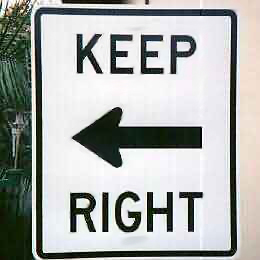
Byron Walden is a master at this sort of cluing, as evidenced by his clue “Uruguayan uncle?” for the phrase NO MAS. Given how often TIO, TIA, MADRE, and other Spanish familial terms are used in crosswords, it’s a keen example of misdirection.

keep-right-misdirection

And playing with the tropes of crossword cluing creates opportunities for more wordplay.

“Trick or treat,” a clue from Aimee Lucido, masquerades as the common Halloween phrase when it’s really two examples cluing the answer VERB.

Similarly, “Jets or chargers starter” sounds like a sports reference, but the lowercase “chargers” reveals something else is afoot. The answer to this clue (which appeared in a puzzle constructed by Craig Mazan and Jeff Chen) is TURBO.

Erin Rhode’s “Drum, for some” sounds like a simple example-style clue, but the answer RHYME reveals how she hid her wordplay in plain sight.

Yes, these clues have a lot in common with wordplay clues, but they also play with the conventions of crossword cluing.

owl

Oh, and speaking of clues that hide their trickery in plain sight, I’ve got a few examples of that as well.

Kathy Weinberg once clued ROWS as “15 things in this puzzle,” which is the sort of clue that’s simultaneously so vague and so on-the-nose that it drives me insane.

Similarly, Steve Faiella uses modern slang to hide an answer in plain sight with the clue “Has beef with somebody, say.” That sure sounds like a vernacular use of “has beef with,” so you’re less likely to read the clue as a simple description of EATS, the actual answer. Very sly.

I’m going to close out today’s post with a clue that’s not only clever, it’s economical as well. Robyn Weintraub clued HOLE with two simple words — “Darn it!” — and it’s as hilarious as it is effective.

What are some of your favorite crossword clues, fellow puzzlers and PuzzleNationers? Let us know in the comments section below! We’d love to hear from you.

Thanks for visiting PuzzleNation Blog today! Be sure to sign up for our newsletter to stay up-to-date on everything PuzzleNation!

You can also share your pictures with us on Instagram, friend us on Facebook, check us out on TwitterPinterest, and Tumblr, and explore the always-expanding library of PuzzleNation apps and games on our website!

Crossword Tournament From Your Couch Recap!

ctfccouch

This past weekend was supposed to be the 43rd year of the American Crossword Puzzle Tournament, but that event was postponed due to the ongoing public health crisis.

But something amazing arose from the ashes of those plans. A small, intrepid group of puzzlers worked night and day for more than a week, bringing an at-home crossword tournament to life: Crossword Tournament From Your Couch. (AKA #CouchWord on Twitter.)

And in doing so, they hosted the biggest crossword tournament in history. According to the Google scoresheet, more than 1,800 solvers took part in the event (with at least 1,300 tackling ALL of the puzzles).

Over the course of a few hours, and thanks to the Herculean efforts of a hard-working few, the puzzle community came together for an afternoon of fun, frivolity, and frantic puzzle-solving.

Oh, and in this recap, I will be discussing the tournament puzzles somewhat, so if you want to remain completely unspoiled, stop reading here. (Or better yet, click here to solve the puzzles for yourselves!)


Before I get into the event itself, I want to highlight the folks who made it all possible.

The initial idea belongs to Kevin Der, who put out the rallying cry to fellow puzzlers. He ran the tech side of the event alongside Finn Vigeland, coordinating each puzzle’s release, the overlapping livestreams, and the live-solving finals.

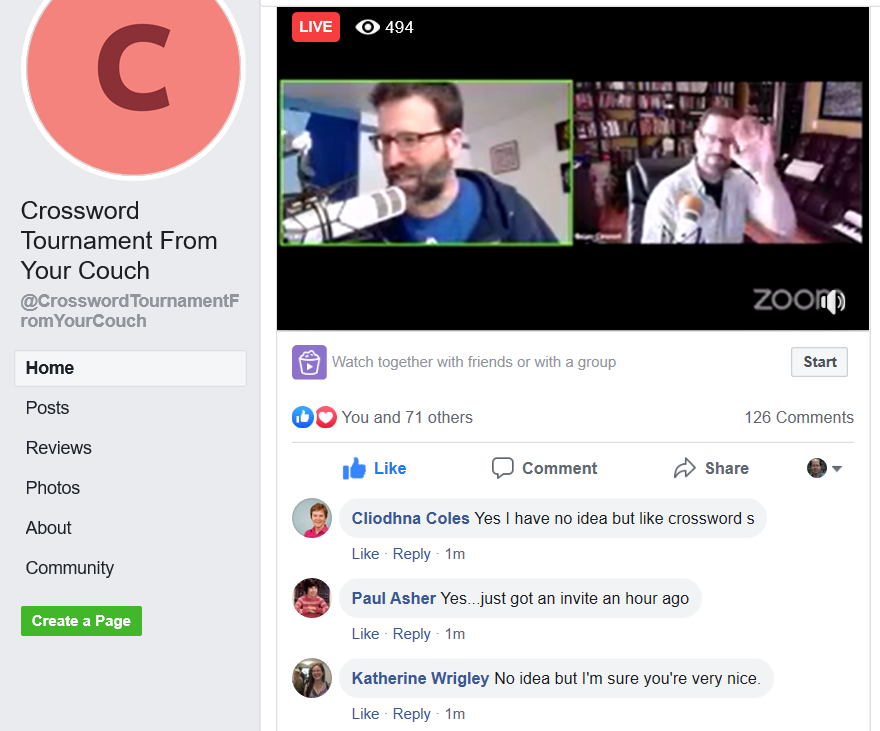
livestreampic2

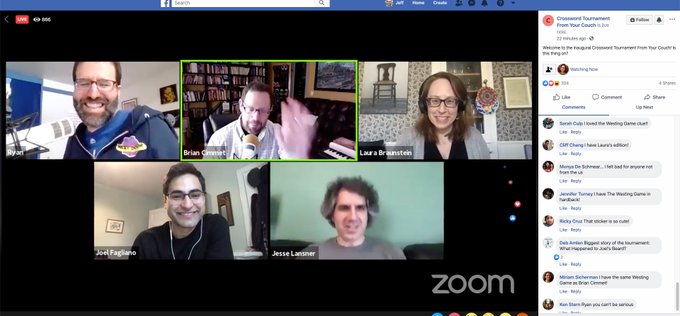
Hosting duties were ably carried out by Ryan Hecht and Brian Cimmet, who kept the energy light, made sure the participants were well-informed, and even interviewed fellow constructors and event organizers in the downtime between tournament puzzles.

The tournament puzzles — 4 tournament puzzles, 1 championship playoff puzzle, and 2 warm-up puzzles — were constructed by Byron Walden, Rachel Fabi, Joel Fagliano, Robyn Weintraub, Patrick Blindauer, Finn Vigeland, Laura Braunstein, and Jesse Lansner.

Jeremy Horwitz, Natan Last, and Ellen Ripstein were credited as test-solvers, and Jeff Davidson, Stephanie Yeung, and Vincent Siao were credited as tech support/magic gurus.

The Inkubator was credited as tournament sponsor.

Assembling and running this event was a monumental, complex undertaking, and my sincerest appreciation and utmost respect (and AWE) goes out to everyone involved in making CTFYC possible.


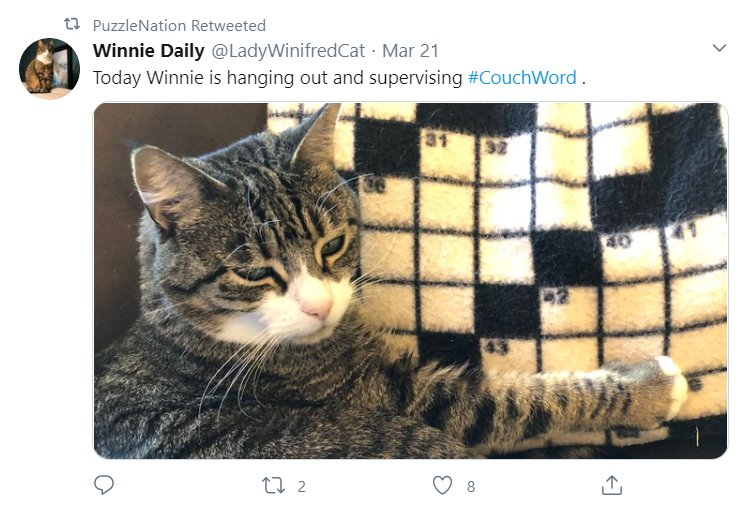
catpuzzle

[Image courtesy of @ladywinifredcat.]

So, how did the tournament itself go?

Well, participants logged into the website and selected one of three divisions in which to compete:

  • The Chesterfield Division (for individuals who in the past few years have finished in the top 20% of a major crossword tournament)
  • The Futon Division (for all other individual participants)
  • The Love Seat Division (for two participants who want to solve together)

Upon logging in, a warm-up puzzle created by Robyn Weintraub awaited solvers. “Get the Pillows Ready” allowed solvers to get familiar with the online solving interface and start getting in a tournament mindset.

tournamentpuzzlepage

The tournament itself was set to begin at approximately 1 PM with the livestream of Ryan and Brian, our amiable emcees who covered the rules, other tournament info, and so on.

The livestream was warm and welcoming, and the accompanying chat area was packed with new faces as well as familiar puzzlers. The usual suspects from ACPT were all there, alongside constructors, puzzle enthusiasts, and top-notch solvers. It was genuinely heartwarming to see so many names I recognized from the puzzle world participating.

livestreampic

Soon, a second warm-up puzzle became available — Rachel Fabi’s “Put Your Feet Up” — a small, Saturday mini-sized puzzle that still managed to be tricky. (And I personally loved the Fleabag reference.) It was a great way for solvers to get their pre-tournament juices flowing AND served to ensure that all of the tech was working for the organizers.


From the livechat:

“Changed my system font to Papyrus so that I could win Worst Handwriting.” — Neville Fogarty


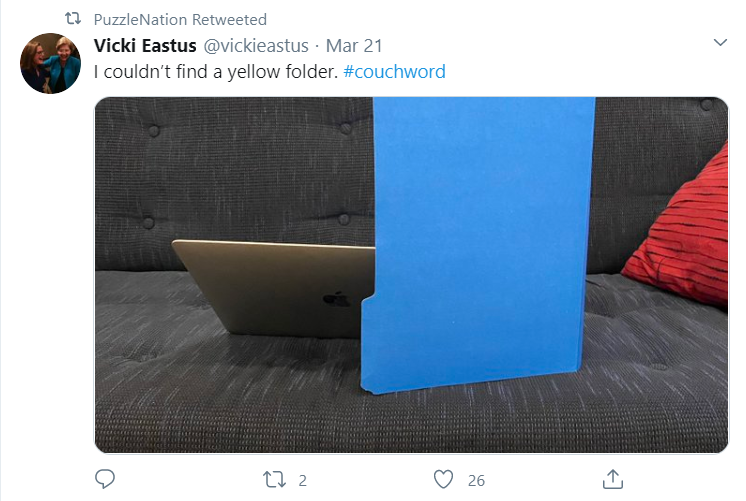
yellowfolder

[Image courtesy of @vickieastus.]

The first tournament puzzle was scheduled for 1:30ish, and to the credit of the organizers, we only started a few minutes late.

Puzzle #1, “Hollywood Ending” by Joel Fagliano, was a 15x puzzle with a 15-minute time limit.

In all, it was a really fun starter with a good hook — entries that end with items found on a Hollywood set, a la JAVASCRIPT. I got stuck in the upper right corner for about two minutes, because I didn’t want to make a mistake, but doing so slowed me down considerably.

With the online solving, results were tabulated much faster than you’d expect from past tournaments, so you could view the leaderboard and see who was on top quite quickly.

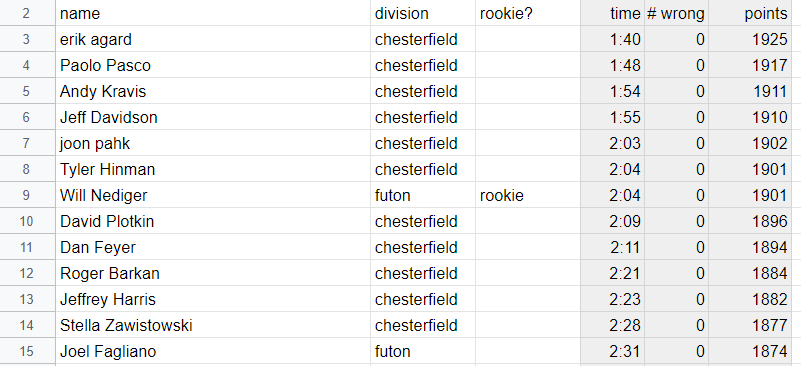
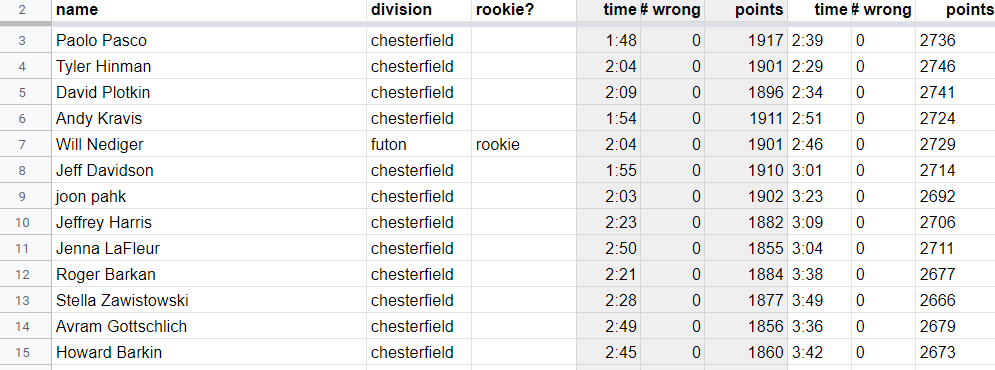
At the end of puzzle 1, many of the usual suspects were on top, along with rookie (and bewilderingly constructor) Will Nediger:

leaderboardafterpuzzle1

After solving, competitors were welcome to return to the livestream chat and treat the chatroom like the lobby at the ACPT, sharing thoughts and commiserating on their solves.

Puzzle #2, “Raise the Roof” by Laura Braunstein and Jesse Lansner, was a 17x puzzle with a 25-minute time limit.

This puzzle had a solid punny hook, phrases where the letter T became P, so you had PICKLE ME ELMO instead of TICKLE ME ELMO. This was accompanied by great fill, although some were tougher entries (like SEZ WHO and NEOPET). I made one dumb mistake, leading to my only error of the tournament, but otherwise, I enjoyed the puzzle.

(I also enjoyed the conversation about The Westing Game in the livestream chat kicked off by the entry RASKIN.)

leaderboardafterpuzzle2

Errors by Dan Feyer and Erik Agard opened up a few spots in the top 15, so at least I was in good company with my own error.

At this point, players were invited to take a break before the next two puzzles. The tentative time for that was around 3 PM.

As I surfed the livechat during the break, the feedback for the tournament was overwhelmingly positive. Everyone was enjoying the communal puzzling, and compliments for both the constructors and organizers were plentiful.


From the livechat:

“Yeah, the bad news for the organizers is that this is working so well we’re all going to come to expect it now. :)” — Steve Thurman


Before Puzzle #3, Brian and Ryan had video interviews with Joel, Laura, and Jesse about their puzzles. It was a very cool touch to hear the constructors talk about the origins of each puzzle and how they ended up in the tournament. More of this in the future, please!

joellaurajesse

[Image courtesy of @tinmanic.]

Soon, we were back, and it was time for the second half of the tournament.

Puzzle #3, “Look Up” by Patrick Blindauer, was a 15x puzzle with a 30-minute time limit. So everyone was expecting some trickery afoot.

Blindauer didn’t disappoint, naturally, offering up a clever hook that took entries in a different direction, mixed with lots of long crossings which made getting into the puzzle difficult. All in all, it was a worthy tournament puzzle.

leaderboardafterpuzzle3

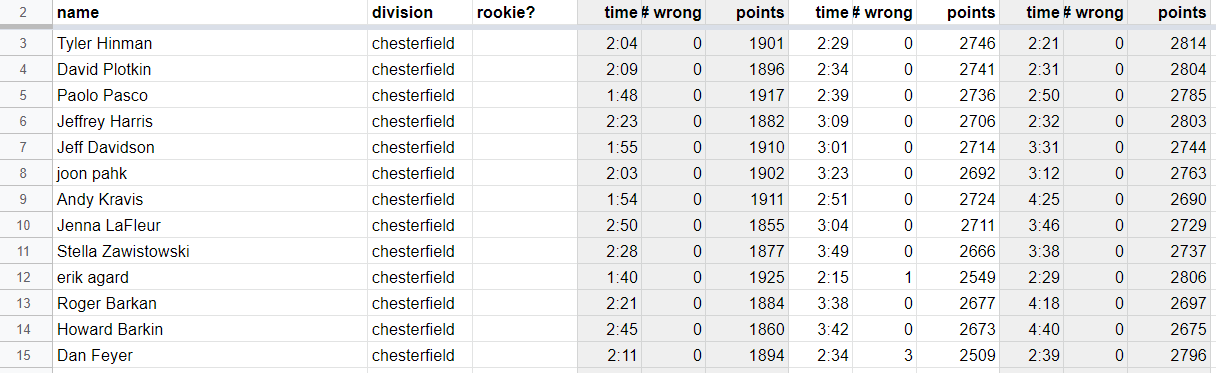
I managed to capture this screengrab of the top 15 after Puzzle 3 before the leaderboard went down. As you can see, the blistering speed of Erik Agard and Dan Feyer had them back in the top 15.

Yes, we managed to break the leaderboard on Google Sheets at this point. (This just made the design for the solving interface even MORE impressive, because it never broke down, even with more than a thousand solvers using it at the same time.)

I was ranked 292 after Puzzle 3, which I felt pretty good about.


From the livechat:

“Hmm, I can play the ‘where would I be if not for the silly error’ game.” — GP Ryan


After a short break, the final puzzle of regular tournament play was upon us.

Puzzle #4, “Naysayers Only” by Finn Vigeland, was a 19x puzzle with a 40-minute time limit.

This was a strong finisher for the tournament, combining clever cluing with a tough theme where the clues referred not to the answers you filled in, but to what the answers became if you followed the rule in the revealer GET OUT THE VOTE. (For instance, you filled in the answer VAMPIRE SLAYER, but the clue “Camera for a photo shoot with Dracula, in brief?” referred to VAMPIRE SLR, since you would remove “AYE” when you get out the vote.)

Yeah, I completed the grid first and had to go back and reread the grid and clues to actually understand the theme.

leaderboard2bafter2bpuzzle2b4fixed

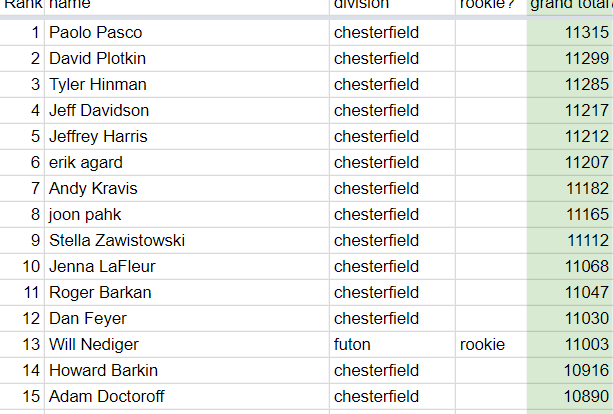
Going into the live playoff final, the top 15 reshuffled a bit. (The board was constantly updating. At one point, I was ranked 283, then 312, then 314. I stopped checking there, because I’m a nerd for Pi.)


From the livechat:

“Shout out to the 11 Davids who are ahead of me in the rankings. Watch your backs.” — David Whyte


After Puzzle #4, Brian and Ryan attempted to interview Patrick, but that didn’t go so well, because the audience couldn’t hear Patrick. The interview with Finn went much better.

Then they announced the finalists for each division who would be participating in the live playoffs.

In the Chesterfield Division, it would be Paolo Pasco, David Plotkin, and Tyler Hinman.

In the Futon Division, it would be Will Nediger, Jason Juang, and Ricky Liu, the top three rookies.

As the top 3 competitors in each division were “sequestered” during the prep for the live playoffs, the playoff puzzle was released for non-finalists to enjoy.

The playoff puzzle, “Couch Your Words” by Byron Walden, was a themeless 15x puzzle with a 15-minute time limit. It also had two sets of clues: the difficult Chesterfield set, aka the A level clues, and the somewhat easier Futon set.

I looked at the Chesterfield clues, but I quickly bailed to try the Futon set. And honestly, even with the Futon Division clues, I found the puzzle pretty tough with ALL the long crossings. As you’d expect from Byron, it was a terrific, well-constructed grid, a very worthy choice to close out the day’s events.


From the livechat:

“Puzzle 5 in this tournament is so hard it doesn’t exist.” — Natan Last


The Futon Division solvers went first, and the three rookie solvers acquitted themselves well.

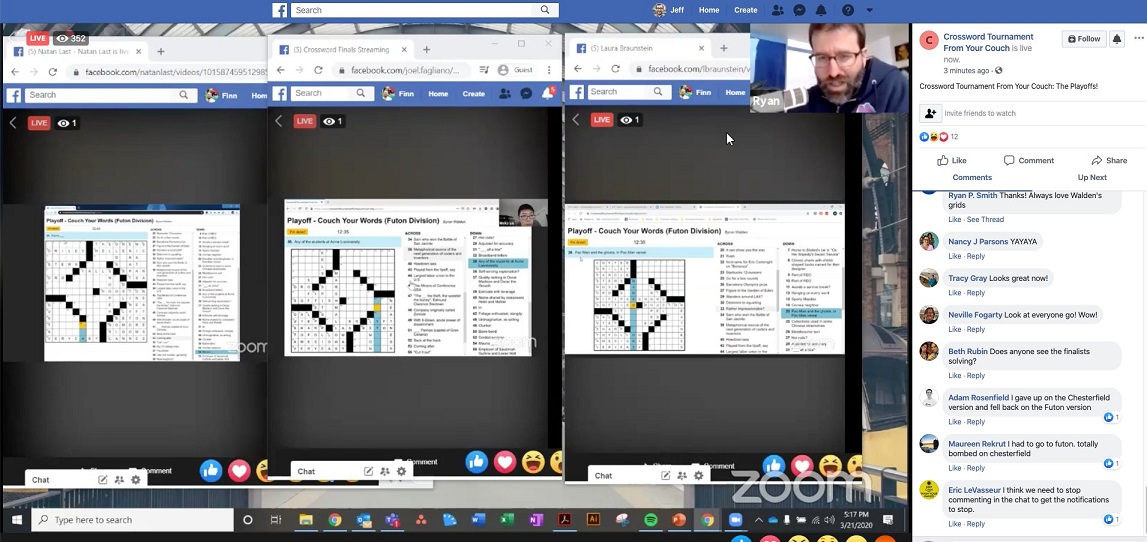
futonlivescreamfinalsbetter

[Image courtesy of @tinmanic.]

Each solver’s time was linked to when they clicked “Start” and when they clicked “I’m done”, so you couldn’t immediately tell who won based on who finished first, because with the livestream lag, it was hard to tell who started first.

In the end, Will completed the puzzle in 4 minutes flat, Jason wasn’t far behind with 4:48, and Ricky closed out the trio with 6:20. Impressive efforts all around!

There were a few more technical issues before the Chesterfield Division playoffs could begin but eventually the tech team got things sorted and the main event started.

During both the prep and the solving, Brian and Ryan interviewed Byron about the finale puzzle and about constructing and cluing in general. It was a terrific bonus mini-seminar on puzzling!

Finally, all was ready and the top three solvers took center stage.

chesterfieldlivestreamfinals

The final was over in less than six minutes.

Tyler, as you might expect from the five-time champ, blasted through the grid, completing it in 4:07. Paolo wasn’t far behind with 4:41, and David, a perennial top finisher, closed out the trio with 5:57.

Again, we had to wait for the official times due to lag, but it was worth the wait.


Here are your Crossword Tournament From Your Couch results:

  • Chesterfield Division: Tyler Hinman, Paolo Pasco, David Plotkin
  • Futon Division: Will Nediger, Jason Juang, Ricky Liu
  • Love Seat Division: Sam Ezersky and Madison Clague, Justin Werfel and Marta Herschkopf, Mike Berman and unnamed partner

After announcing the winners and finalists — and giving another well-deserved shout-out to all of the organizers and folks who made the marvelous event possible — the livestream chat was left running so that participants could talk and enjoy a virtual happy-hour mixer.


From the livechat:

“Anyone else never been to ACPT or Lollapuzzoola, but getting an itch to go after today??” — Josh Beu Forsythe


Even if it hadn’t been the biggest crossword tournament in history, Crossword Tournament From Your Couch would still have been a fantastic success.

More than just a tremendous stand-in for ACPT, CTFYC brought together established puzzlers and newbies for an afternoon of much-needed distraction. (According to the organizers, it was the first tournament for more than 1200 of the participants!)

Thank you once again to everyone involved in this brilliant endeavor. What a treat it was.

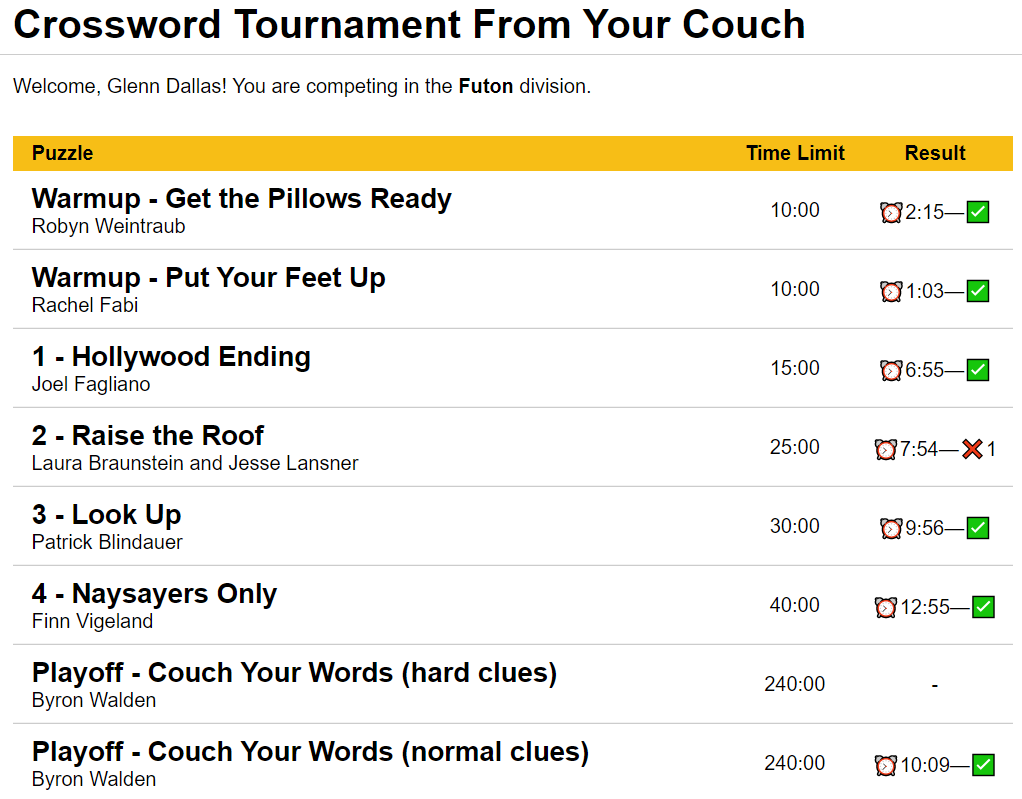
myresults


Thanks for visiting PuzzleNation Blog today! Be sure to sign up for our newsletter to stay up-to-date on everything PuzzleNation!

You can also share your pictures with us on Instagram, friend us on Facebook, check us out on TwitterPinterest, and Tumblr, and explore the always-expanding library of PuzzleNation apps and games on our website!