The Puzzly Legacy of Edgar Allan Poe

[Image courtesy of the Poetry Foundation.]

Edgar Allan Poe is one of the most influential writers in all of American literature. Not only did he come to epitomize all things ghastly and unnerving in Gothic horror with chillers like “The Tell-Tale Heart” and “The Cask of Amontillado,” but he also trailblazed the detective fiction genre with his character C. Auguste Dupin.

He also made an impact on the world of puzzles.

[Image courtesy of the National Cryptologic Museum Foundation.]

Those familiar with Poe’s works of fiction probably think I’m referring to his story “The Gold-Bug,” one of, if not the first, stories to not only mention cryptography, but to include a substitution cipher (a cipher where each letter in the alphabet is represented by a different letter, number, or symbol).

In “The Gold-Bug,” an unnamed narrator meets the unusual William Legrand, a man obsessed with restoring his family’s lost fortune. Legrand shows off a large scarab-like insect, the titular gold bug. A month later, the narrator and Legrand are reunited when the obsessed Legrand (along with his servant Jupiter) goes off on a expedition to discover the location of the buried treasure of the legendary Captain Kidd.

As it turns out, a piece of paper Jupiter used to collect the gold bug had traces of invisible ink on it, revealing a cipher containing instructions for how to find Kidd’s gold.

[Image courtesy of Bookriot.]

But this was far from Poe’s only dalliance with codebreaking. In fact, he helped popularize the art and science of cryptography with a series of articles in a Philadelphia publication called Alexander’s Weekly Messenger.

In December of 1839, he laid out a challenge to his readers, boasting that he could crack any substitution cipher that readers submitted:

It would be by no means a labor lost to show how great a degree of rigid method enters into enigma-guessing. This may sound oddly; but it is not more strange than the well know fact that rules really exist, by means of which it is easy to decipher any species of hieroglyphical writing — that is to say writing where, in place of alphabetical letters, any kind of marks are made use of at random. For example, in place of A put % or any other arbitrary character –in place of B, a *, etc., etc.

Let an entire alphabet be made in this manner, and then let this alphabet be used in any piece of writing. This writing can be read by means of a proper method. Let this be put to the test. Let any one address us a letter in this way, and we pledge ourselves to read it forthwith–however unusual or arbitrary may be the characters employed.

For the next six months, Poe tackled every cipher sent to Alexander’s. According to Poe, he received around a hundred ciphers, though historians have stated that only 36 distinct ciphers appeared in Alexander’s Weekly Messenger, 15 of which had solutions or partial solutions printed.

Nonetheless, it’s believed that Poe solved each of those 36 ciphers.

[Image courtesy of Awesome Stories.]

He followed up this impressive feat with an essay about cryptography in July of 1841 for Graham’s Magazine, “A Few Words on Secret Writing,” in which he discussed ancient methods of encryption and decryption, name-dropping codebreaking icons like Trithemius, Vigenere, and others.

He also published two cryptograms for the readers to solve, both submitted by a man named W.B. Tyler, “a gentleman whose abilities we highly respect.” Poe claimed he didn’t have time to solve either cryptogram, leaving them to the readers to crack. (Naturally, some scholars theorize that W.B. Tyler was none other than Poe himself.)

It would be over a century before the first verifiable solution to a W.B. Tyler cryptogram appeared. Professor Terence Whalen published his solution to the first Tyler cryptogram in 1992, and even offered a $2500 prize to whomever could solve the remaining Tyler cryptogram.

[Image courtesy of Cryptiana.web.]

That prize was claimed 8 years later by a Canadian software expert named Gil Broza, who cracked what turned out to be a polyalphabetic cipher, one in which several substitution alphabets are used.

Naturally, Poe’s interest in secret messages and codebreaking has led some to suspect that secret messages are lurking in his poetry and works of fiction. (Similar conspiracy theories abound regarding the works of Shakespeare.)

To be fair, there is something to this theory.

In a manner similar to Lewis Carroll hiding Alice Liddell’s name in an acrostic poem at the end of Through the Looking-Glass, Poe dedicated a poem to friend and poet Sarah Anna Lewis by hiding her name, one letter per line, in the poem itself.

[Image courtesy of The Baltimore Post Examiner.]

Of course, Poe’s method was more intricate than Carroll’s. The S in Sarah was the first letter on the first line, the A was the second letter on the second line, the R was the third letter on the third line, and so on. (Hiding coded messages in plain sight in this manner is known as steganography.)

And to this day, the hunt is on for secret messages in Poe’s works, particularly his more esoteric and oddly worded pieces. For instance, his prose poem “Eureka” — a musing on the nature of the universe itself, which actually proposed a Big Bang-like theory for the birth of the universe well before scientists offered the same theory — is believed to contain some sort of secret message or code.

Poe stated on more than one occasion that “human ingenuity cannot concoct a cipher which human ingenuity cannot resolve.” So if there is a code lurking in his works, someone will surely find it.

And in the meantime, we can still enjoy the chills, the grand ideas, and the mysteries he left behind. That’s quite a puzzly legacy.


Thanks for visiting PuzzleNation Blog today! Be sure to sign up for our newsletter to stay up-to-date on everything PuzzleNation!

You can also share your pictures with us on Instagram, friend us on Facebook, check us out on TwitterPinterest, and Tumblr, and explore the always-expanding library of PuzzleNation apps and games on our website!
Congratulations to Elm City Games!

I talk a lot about the puzzle/game community, my fellow puzzlers and PuzzleNationers, and so on, and that’s because, deep down, the community is one of my favorite things about being a puzzler and game enthusiast.

There are many cool, inspiring, and brilliant people that contribute so much to the world of puzzles and games, making it ridiculously fun to be a part of, and today, I’d like to give a shout-out to one particular member of that community.

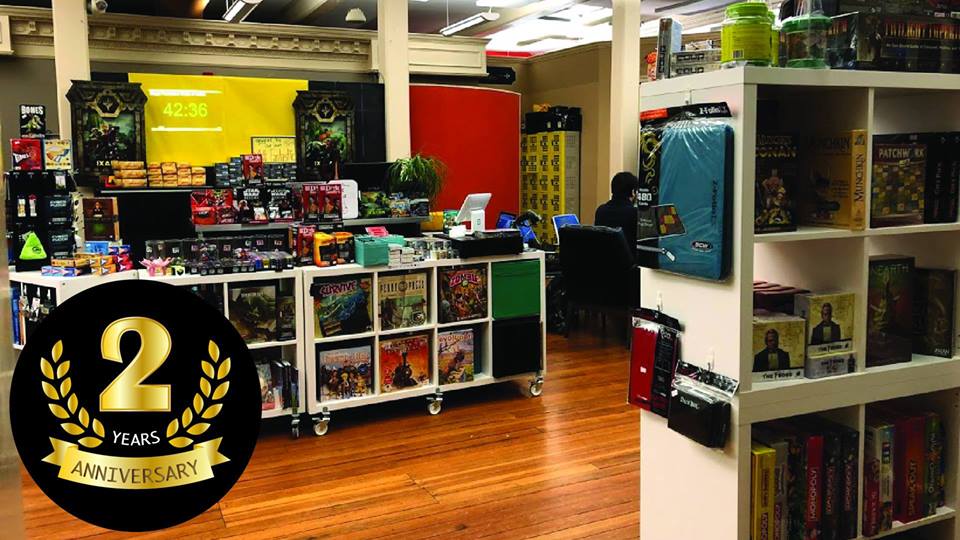
Elm City Games is celebrating its second anniversary this Saturday with a party and potluck event, and I’m overjoyed for them. They truly put the “Friendly” in Friendly Local Game Shop, representing the best aspects of the puzzle/game world.

I got to explore Elm City Games when they hosted the first Connecticut Festival of Indie Games back in May of 2016. They threw open their doors to dozens of aspiring and established game designers and a slew of game fans, and to this day, it remains one of the best puzzly events I’ve ever had the privilege of attending.

One of the coolest and most inclusive spots in Connecticut for game lovers, they even host board game mixers on Fridays so you can meet fellow players and try out any number of games from their incredible in-house library. (They’ve also cultivated a choice selection of games for purchase in the store, including rarities and lesser-known titles.)

To celebrate the occasion, they’re hosting events all day (starting at noon) like learn-to-play sessions of Dungeons & Dragons, game tournaments, and more!

What more can I say? It’s a great spot run by rad people. So if you’re anywhere near New Haven, CT, on Saturday, swing by to wish Matt and Trish well, enjoy some games, and support a terrific local hub for all things great about gaming.

[Elm City Games is located on the 2nd floor at 760 Chapel Street, New Haven.]


Thanks for visiting PuzzleNation Blog today! Be sure to sign up for our newsletter to stay up-to-date on everything PuzzleNation!

You can also share your pictures with us on Instagram, friend us on Facebook, check us out on TwitterPinterest, and Tumblr, and explore the always-expanding library of PuzzleNation apps and games on our website!
The Voynich Manuscript: Finally Cracked?

[Image courtesy of BBC.com.]

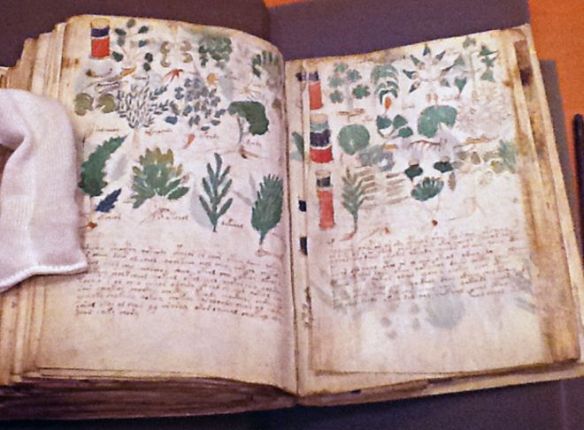
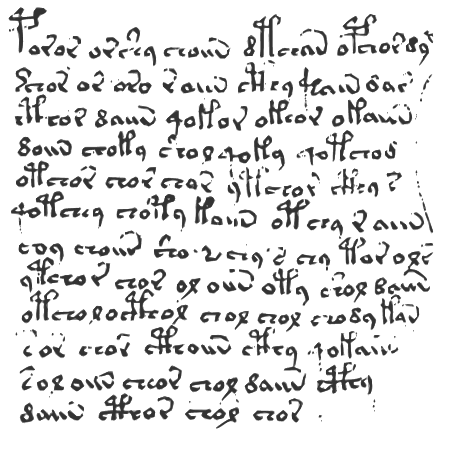
A year and a half ago, I introduced my fellow puzzlers and PuzzleNationers to the Voynich Manuscript, a cryptologic curiosity unlike anything else we’ve seen before. Discovered over a hundred years ago but believed to date back to the fifteenth century, the Voynich Manuscript is a hand-written book that has baffled linguists and puzzlers for decades.

The writing, which reads from right to left, has yet to be identified. It’s unclear if this is some sort of sophisticated code, an unknown or lost language which was then encoded, an invented language, an example of glossolalia (a written equivalent of speaking in tongues), or simply an elaborate hoax.

The only known copy of the text resides in Yale University’s Beinecke Rare Book and Manuscript Library, although Yale has printed replica texts.

From the Yale University website:

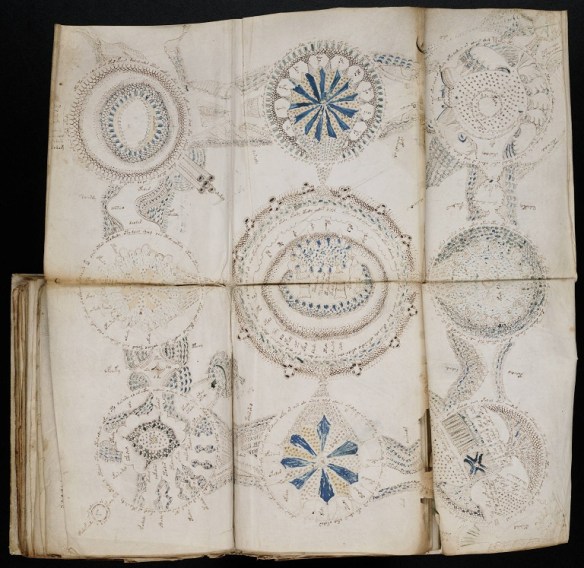
Many call the fifteenth-century codex, commonly known as the “Voynich Manuscript,” the world’s most mysterious book. Written in an unknown script by an unknown author, the manuscript has no clearer purpose now than when it was rediscovered in 1912 by rare books dealer Wilfrid Voynich. The manuscript appears and disappears throughout history, from the library of the Holy Roman Emperor Rudolf II to a secret sale of books in 1903 by the Society of Jesus in Rome. The book’s language has eluded decipherment, and its elaborate illustrations remain as baffling as they are beautiful.

[One of several fold-out pages in the manuscript.
Image courtesy of Wikipedia.org.]

But computer scientists at the University of Alberta believe they’ve finally unraveled some of the mysteries behind the Voynich Manuscript.

They designed an artificial intelligence program with the intent of figuring out the language in the manuscript. The AI analyzed versions of the UN’s Universal Declaration of Human Rights in 400 different languages in order to establish different linguistic patterns to compare against the text of the Voynich Manuscript.

And according to the AI, the text was most likely written in Hebrew.

Now that they had a language to work with, they needed to begin deciphering precisely how that language was encrypted.

[Image courtesy of Wikipedia.org.]

There have been many theories regarding what form of encryption was employed in the Voynich Manuscript. Some investigators theorized that vowels had been removed from the words in the text in order to obscure their meaning further, while others have suggested writing that has been mirrored or otherwise written backwards. Anagrams and other forms of word manipulation are a common theory, and the University of Alberta team went with a variation on the anagram idea.

They theorized that the encoded words were alphagrams, anagrams where the letters in a word are placed in alphabetical order. (For instance, if VOYNICH was encoded this way, it would read CHINOVY.)

Turning loose the AI once again under these parameters, they found that 80% of the words in the Voynich text could be anagrammed into Hebrew words. They managed to cobble together a possible opening sentence for the text:

“She made recommendations to the priest, man of the house and me and people.”

Is it clunky? Sure. But it’s also a partial translation that has held up to some scrutiny, which is better than most amateur AND professional attempts to crack the Voynich Manuscript have done.

The team is currently hoping to team up with experts in ancient Hebrew and continue the process, but until then, they’re excited to apply their AI to other ancient manuscripts to see what it uncovers.

Although we are a long way from calling the Voynich mystery solved, this is a very intriguing step forward for cryptographers and codebreaking enthusiasts everywhere.


Thanks for visiting PuzzleNation Blog today! Be sure to sign up for our newsletter to stay up-to-date on everything PuzzleNation!

You can also share your pictures with us on Instagram, friend us on Facebook, check us out on TwitterPinterest, and Tumblr, and explore the always-expanding library of PuzzleNation apps and games on our website!
It’s Called a CrossWORD, Not a Crossnumber!

When it comes to crosswords, every solver and constructor has their own ideas about what’s appropriate and what’s inappropriate.

And I don’t just mean the age-old debate of pen vs. pencil. Whether we’re talking about answer words, abbreviations, cluing styles, gimmicks like shared letters in one box, or even the number of black squares in a grid, the sheer variation and customization possible is bound to lead to differing opinions.

A recent New York Times Tuesday Mini puzzle was the source of some consternation for solvers when it turned out that the first three boxes across were intended to be filled with numbers, not letters.

The clue? “Easy as ____,” which many solvers mistook, understandably, for PIE. When you factor in that many Times puzzle solvers value their solving speeds as well as their solving experience, the extra seconds (or minutes) “wasted” on a clue that feels misleading can be frustrating.

Some of those solvers took their concerns (and complaints) to Twitter, prompting a response from the official Wordplay Twitter account, which offered up the Easter egg that “123” referred to not only the answer to 1 Across, but also the date the puzzle appeared, 1/23.

That is a nice little bonus, but it wasn’t referenced at all in the clue, so it did little to appease those who were upset with what they consider a breach in crossword etiquette.

[Image courtesy of Shutterstock.]

Although I absolutely sympathize with being unexpectedly flummoxed by a clue — it happens to me all the time as a solver — I must admit that this sort of thing doesn’t bother me. I don’t mind when multiple letters share a grid square, or if there’s a number there instead of a letter.

In fact, Alex Eaton-Salners employed the same thing in his “Read the Fine Print” Fireball Crosswords puzzle, and it made my favorite puzzles of 2017 list.

Clearly something like this is going to bother some solvers more than others. What do you think, fellow puzzlers? Does using numbers instead of letters in crosswords bother you or violate your idea of what a good crossword should be?

What about having multiple letters inside one grid square? Do you think that’s a cheat — a way to get around constructing something that actually fits the space — or a clever conceit allowing for more grid and theme flexibility? We’d love to hear your thoughts on the subject!


Thanks for visiting PuzzleNation Blog today! Be sure to sign up for our newsletter to stay up-to-date on everything PuzzleNation!

You can also share your pictures with us on Instagram, friend us on Facebook, check us out on TwitterPinterest, and Tumblr, and explore the always-expanding library of PuzzleNation apps and games on our website!
A Brand New Puzzle Bundle for the Penny Dell Crosswords App!

That’s right, fellow puzzlers and PuzzleNationers! It’s a special Wednesday bonus post to deliver an unexpected treat for fans of the Penny Dell Crosswords App!

We’ve just released a terrific puzzle collection to brighten up your dreary February days!

Value Pack 1 is loaded with 150 topnotch puzzles — that’s more than you’d get with one of our deluxe sets! — and it’s available for in-app purchase for both Android and iOS users right now!

With razor-sharp clues and the world-class construction you’ve come to expect from PuzzleNation, you can’t go wrong with this fantastic deal!

We’re dedicated to bringing you the best puzzle-solving experience available, right in your pocket, ready to go at a moment’s notice! That’s the PuzzleNation guarantee.

Happy solving everyone!


Thanks for visiting PuzzleNation Blog today! Be sure to sign up for our newsletter to stay up-to-date on everything PuzzleNation!

You can also share your pictures with us on Instagram, friend us on Facebook, check us out on TwitterPinterest, and Tumblr, and explore the always-expanding library of PuzzleNation apps and games on our website!
Last-Minute Puzzly Valentine’s Day Ideas!

Valentine’s Day looms large, and sometimes it’s hard to find that perfect way to express your love for that certain someone… particularly if that certain someone is the puzzly type.

But have no fear! We’re here with some terrific last-minute puzzly ideas for Valentine’s Day!

[Image courtesy of YouTube.]

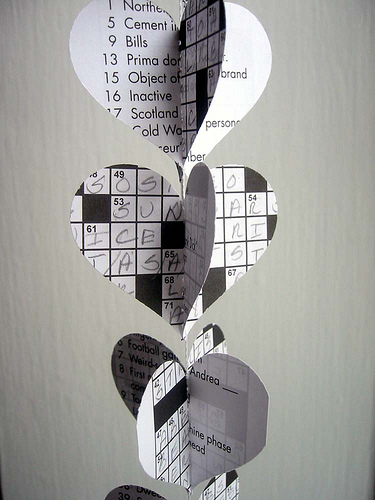
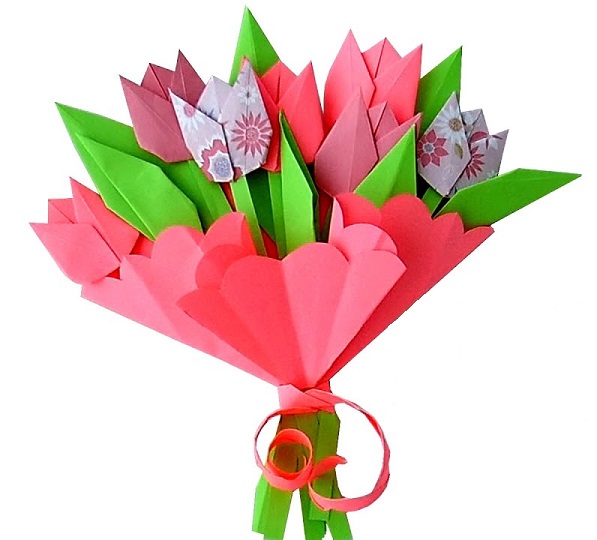
Have you considered a puzzle bouquet? You could grab some newspaper crosswords and origami them into flower shapes for a fun puzzle-fueled spin on a holiday classic.

Or maybe they like coded puzzles? You could write the object of your affection a coded love letter!

All throughout history, people have employed different tricks and techniques to keep their private messages away from prying eyes, and you could do the same! Whether it’s a simple letter-shifting cipher or something more complex, just make sure your message is worth reading. =)

[Image courtesy of Shutterstock.]

Or maybe you’d like to show off how much you know about him or her. Then you could whip up a little scavenger hunt! You could leave clues around leading to a gift, or a romantic dinner, or some other grand finale. Maybe a rose with each clue.

(You could make each clue or destination about your relationship or about your partner, allowing you to show off how well you know them… where you first met, favorite meals, favorite movie… )

If you don’t want to leave things around where anyone could nab them, keep a few small tokens on you, giving one for each destination reached or clue solved. Heck, you could enlist a friend to text clues to your special someone once they’ve reached a particular destination!

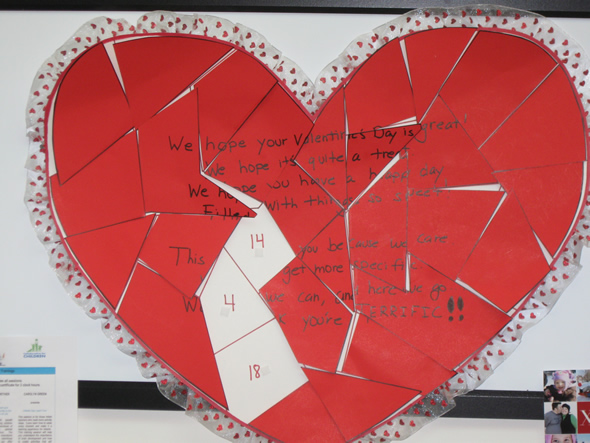
For a family-friendly version of the same idea, have the kids help you cut out and hide jigsaw pieces around the house that, when put together, spell out a Valentine’s message, a picture of the family, or a picture of some gift or event to come!

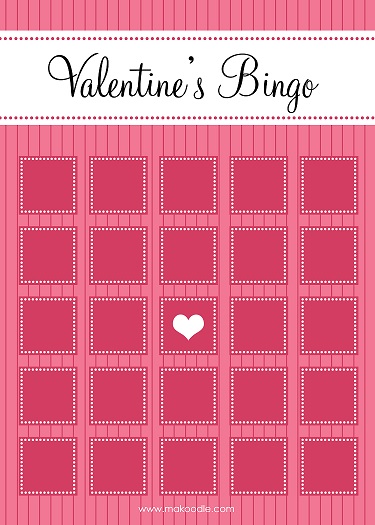
You could even walk around and play Valentine’s Day Bingo.

Go for a walk or take your loved one out to dinner, and see if one of you can get bingo by observing different things. A couple holding hands as they walk, a Valentine’s Day proposal, outrageously priced flowers…

Even on short notice, the possibilities are endless when you put your mind to it. Happy Valentine’s Day, fellow puzzlers!


Thanks for visiting PuzzleNation Blog today! Be sure to sign up for our newsletter to stay up-to-date on everything PuzzleNation!

You can also share your pictures with us on Instagram, friend us on Facebook, check us out on TwitterPinterest, and Tumblr, and explore the always-expanding library of PuzzleNation apps and games on our website!