The Board Game Legacy of Kurt Vonnegut

Mystery novelist Agatha Christie was an avid surfing enthusiast. Abraham Lincoln is in the National Wrestling Hall of Fame and only suffered a single defeat in 12 years. We wouldn’t have Wi-Fi or Bluetooth without the scientific prowess of actress Hedy Lamarr.

It’s fascinating to learn unexpected facts about iconic figures from history that don’t necessarily jive with their most famous accolades.

For instance, did you know that celebrated writer Kurt Vonnegut made a board game?
Yes, nearly seventy years ago, after the less than stellar commercial performance of his novel Player Piano, Vonnegut attempted to create a third game to utilize the 8×8 checkerboard as effectively as chess and checkers did.

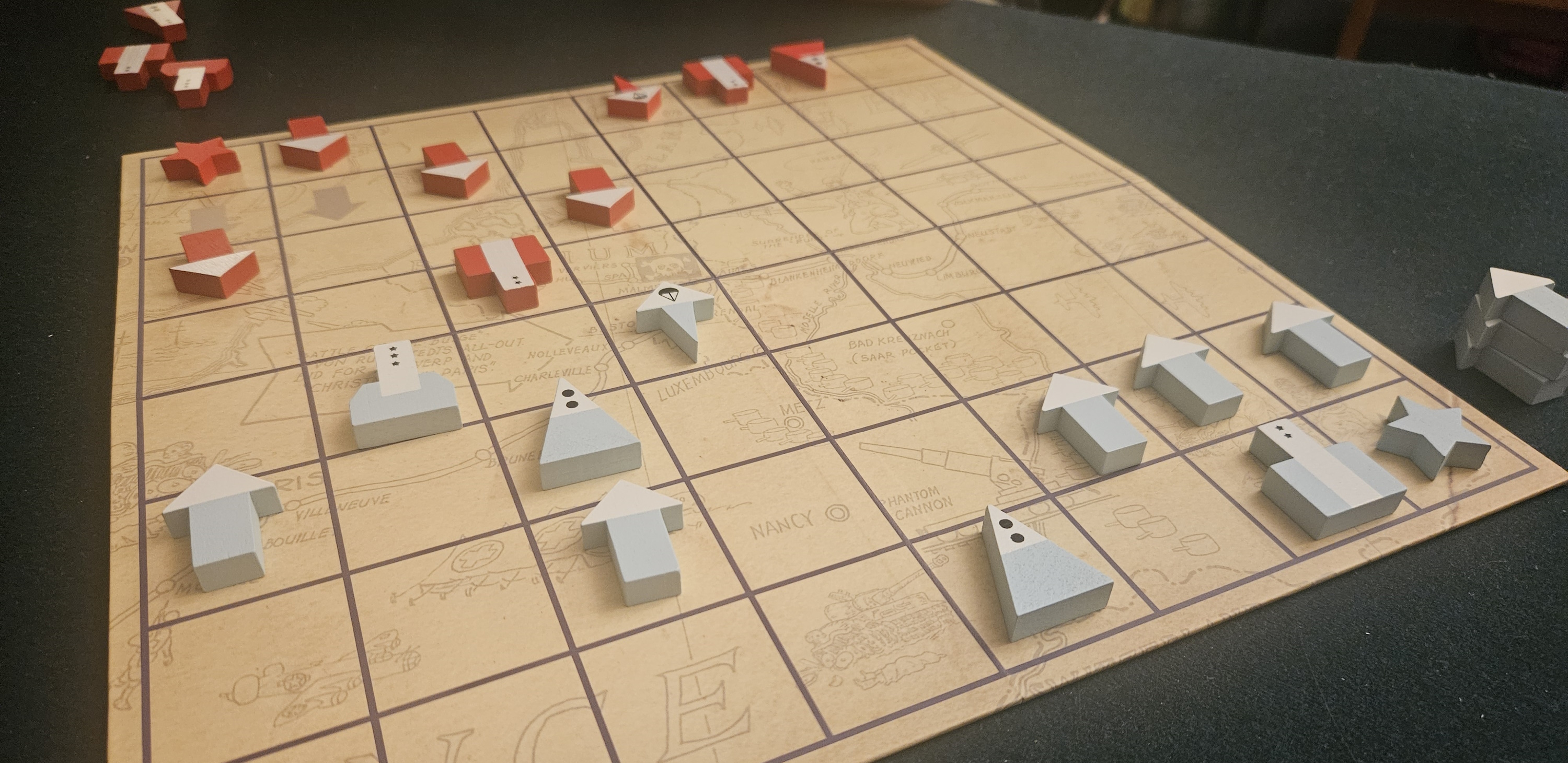
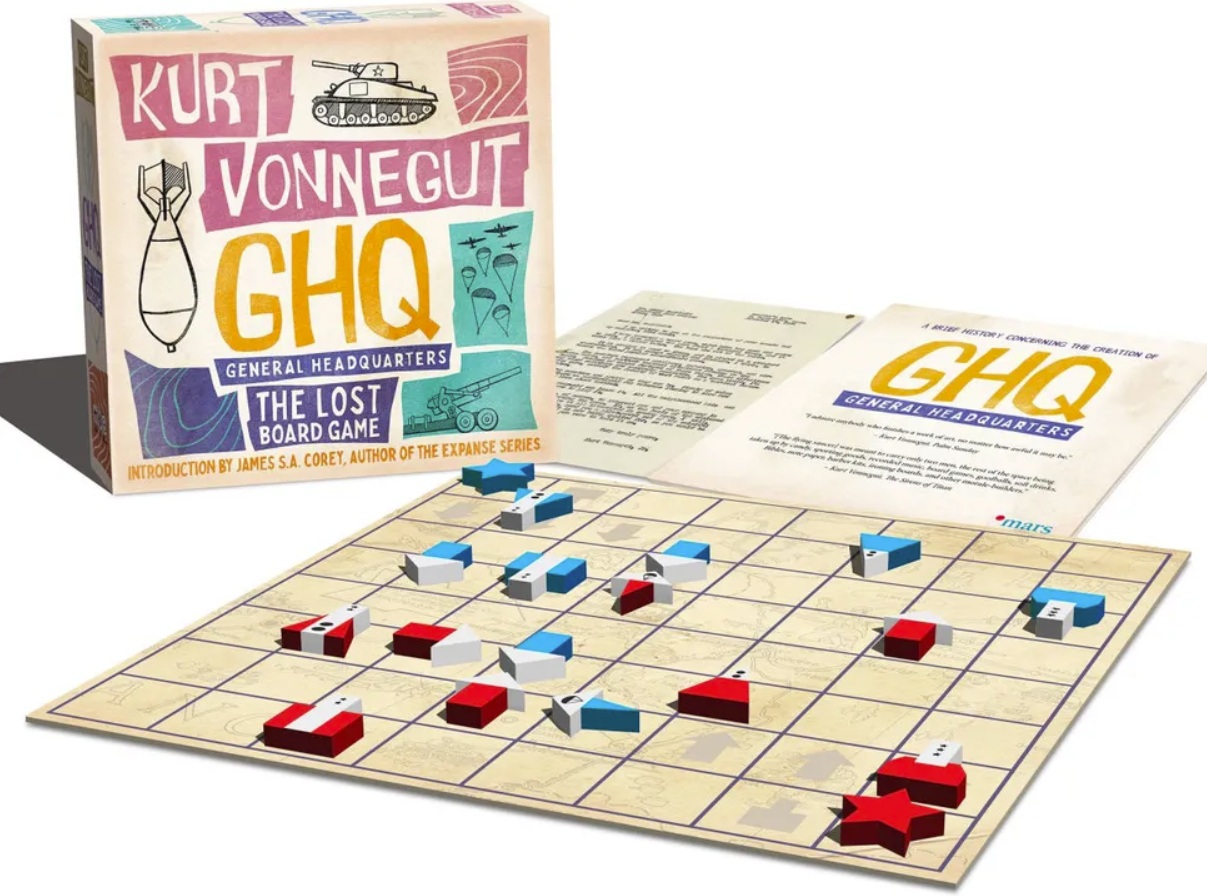
It was called GHQ, short for General Headquarters, and it was a tactical strategy game involving balancing your ground infantry and artillery forces with your airborne forces to capture your enemy’s headquarters.

In 1956, it was downright innovative, mixing wargame mechanics and multiple actions in a single turn. (This is commonplace today, but was quite revolutionary in games for the 1950s.) In today’s board game market, the initial run sold out, and now the game is carried by Barnes & Noble, and I have no doubt it’s performing well.
This would come as a shock to Vonnegut, as the game was rejected by publisher Henry Saalfield of the Saalfield Game Company. Vonnegut put the game away, and as far as his family knows, he never went back to it at all.

That historical context makes the game (and its companion booklet) a wonderful glimpse into Vonnegut as a creative mind.

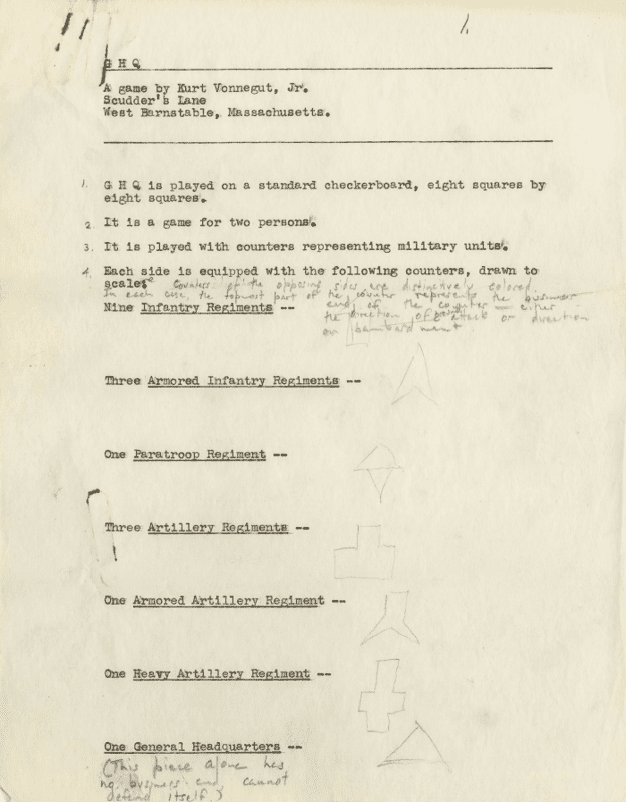
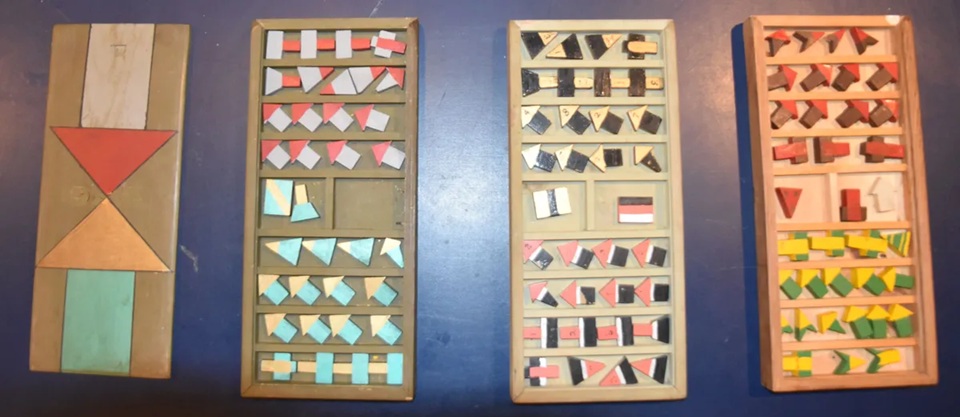
We get his original notes — including rules for the game — as well as photos of the original game pieces from his prototype.
GHQ exists as a fascinating conundrum. How do you reconcile encountering a combat-focused game designed by someone famous for his antiwar sentiments?

A review of the game on Spacebiff had something interesting to say about this:

It’s also so very Vonnegut. Years before Billy Pilgrim manifested as his coping mechanism for the horrors he witnessed in the Ardennes and during the firebombing of Dresden, here he was designing a game that drew on his experience as a spotter for the 106th Infantry Division. It’s a game rooted in a particular military doctrine, one where most casualties were not inflicted by tanks or planes, but by distant cannons. While the game’s airborne units are flashy and threatening, it’s the roving fields of fire that shape this battlefield.

That, too, strikes me as the proper way to consider GHQ. Vonnegut’s antiwar stance crystallized as U.S. involvement deepened in Vietnam, and it’s natural to wonder if the older Vonnegut set aside GHQ not only out of disappointment with Saalfield’s lack of interest but also because its maneuvers and bombardments cut too close to the bone.
It’s impossible to separate the man from the art in this case. I can’t help but view this game as not only part of Vonnegut’s journey toward his rejection of warfare and wartime thinking, but also as a way for him to turn his knowledge and experience from wartime into something productive (and profitable) for his family.

It’s pragmatic, transformative, and a little bit sad in a way that feels so keenly Vonnegut.

I haven’t had a chance to play it yet, but I do have a Barnes & Noble gift card burning a hole in my pocket, so perhaps you’ll see a more thorough writeup on GHQ in the future.


In the meantime, what do you think of this curious discovery, fellow puzzlers? Does GHQ intrigue either the reader or the tactical gamer in you? Let us know in the comments section below. We’d love to hear from you!

PuzzleNation Looks Back at 2016!

The year is quickly coming to a close, and as I look back on an eventful year in the world of puzzles and games, I’m unbelievably proud of the contributions both PuzzleNation Blog and PuzzleNation made to the puzzle community as a whole.

Over the last year, we explored board games and card games, strategy games and trivia games, dice games and tile games, do-it-yourself puzzlers and pen-and-paper classics. We met designers, constructors, authors, artists who work in LEGOs and dominos, and creative types of all kinds.

We unraveled math puzzles and used statistics to play Hangman and Guess Who smarter. We accepted the challenge of diabolical puzzles, optical illusions, Internet memes, and more.

We delved into puzzle history with posts about Bletchley Park, puzzle graffiti from ancient Greece, Viking board games, and modern mysteries like the Kryptos Sculpture and the Voynich Manuscript. We separated fact from fiction when it comes to puzzles and brain health, avoiding highfalutin promises and sticking to solid science.

We spread the word about numerous worthwhile Kickstarters and Indiegogo campaigns, watching as the puzzle/game renaissance continued to amaze and surprise us with innovative new ways to play and solve. We shared amazing projects and worthy causes like Humble Bundles and puzzle/game donation programs for schools that allowed puzzle lovers to help others.

We celebrated International TableTop Day, built a puzzle fort in honor of International Puzzle Day, attended the American Crossword Puzzle Tournament and the Connecticut Festival of Indie Games, and dove deep into puzzle events like the Indie 500, the UK Sudoku Championship, the 2016 UK Puzzle Championship, and Lollapuzzoola. We even celebrated a puzzly wedding proposal, and we were happy to share so many remarkable puzzly landmark moments with you.

It’s been both a pleasure and a privilege to explore the world of puzzles and games with you, my fellow puzzle lovers and PuzzleNationers. We marked four years of PuzzleNation Blog this year, I’m approaching my 650th blog post, and I’m more excited to write for you now than I was when I started.

And honestly, that’s just the blog. PuzzleNation’s good fortune, hard work, and accomplishments in 2016 went well beyond that.

In April, we launched Penny Dell Crosswords Jumbo 3 for iOS users, and in May, we followed that with Penny Dell Crosswords Jumbo for Android. In November, we launched our new Penny Dell Sudoku app on both Android and iOS.

But the standout showpiece of our puzzle app library remains the Penny Dell Crossword App. Every month, we release puzzle sets like our Dell Collection sets or the themed Deluxe sets for both Android and iOS users, and I’m proud to say that every single puzzle represents our high standards of quality puzzle content for solvers and PuzzleNationers.

We even revamped our ongoing Crossword Clue Challenge to feature a clue from each day’s Free Daily Puzzle in the Crossword app, all to ensure that more puzzle lovers than ever have access to the best mobile crossword app on the market today.

And your response has been fantastic! The blog is closing in on 2000 followers, and with our audience on Facebook, Twitter, Instagram, and other platforms continuing to grow, the enthusiasm of the PuzzleNation readership is both humbling and very encouraging.

2016 was our most ambitious, most exciting, and most creatively fulfilling year to date, and the coming year promises to be even brighter.

Thank you for your support, your interest, and your feedback, PuzzleNationers. Have a marvelous New Year. We’ll see you in 2017!


Thanks for visiting PuzzleNation Blog today! Be sure to sign up for our newsletter to stay up-to-date on everything PuzzleNation!

You can also share your pictures with us on Instagram, friend us on Facebook, check us out on TwitterPinterest, and Tumblr, and explore the always-expanding library of PuzzleNation apps and games on our website!