Follow-Up Friday: ACPT View a Clue edition!

Welcome to Follow-Up Friday!

Follow-Up Friday is an opportunity to look back on past posts and puzzly topics. Whether we’re updating you with new developments, providing answers to a previously posted brain teaser or puzzle, or simply revisiting a subject with a fresh perspective, Follow-Up Friday lets us look back and look forward.

In today’s post, we’ve got another edition of the View a Clue game!

In fact, the PuzzleNation audience is getting the first look at the View a Clue game I’ve put together for the American Crossword Puzzle Tournament this weekend!

We’ve got ten animals that commonly show up in crossword grids — some have become crosswordese at this point — and I want to see if the PuzzleNation audience can identify them from pictures. It’s a visual puzzle I call View a Clue!

And, as an extra treat, people who submit their answers will have a chance to win a copy of Scrimish, provided by the creative team behind that terrific card game!

So, without further ado, let’s get to it!


#1 (3 letters)

#2 (4 letters)

#3 (6 letters)

#4 (4 letters)

#5 (6 letters)

#6 (9 letters)

#7 (4 letters)

#8 (5 letters)

#9 (4 letters)

#10 (5 letters)


Submit your answers in the comments below (or reach out to us across all of our social media platforms) for a chance to win! Good luck, and enjoy!

Thanks for visiting PuzzleNation Blog today! Be sure to sign up for our newsletter to stay up-to-date on everything PuzzleNation!

You can also share your pictures with us on Instagram, friend us on Facebook, check us out on TwitterPinterest, and Tumblr, and explore the always-expanding library of PuzzleNation apps and games on our website!

A puzzle in your pocket

Brain teasers come in all shapes and sizes, but there’s one particular brand of brain teaser that fits in your pocket. Today we’re talking about matchstick puzzles (or toothpick puzzles).

Matches as we know them (relying on friction to ignite, rather than dipping or crushing) were invented in 1826 by English chemist John Walker, and in the decades that followed, numerous improvements were made, especially in terms of safety and ease of use. Matchsticks soon grew ubiquitous and match companies started putting little puzzles on their boxes.

And the matchstick puzzle was born.

(I have no historical documentation to back me up on this, but I suspect that bar bets also played a role in the rise of matchstick puzzles, because the sort of cleverness and trickery that goes into solving some of these puzzles would be perfectly at home in the repertoire of someone looking to con a few free drinks out of fellow tipplers.)

So, for the uninitiated, what are matchstick puzzles?

These are rearrangement or transformation puzzles, where you’re given a certain shape (laid out in matchsticks, toothpicks, straws, pencils, or anything else of equal length), and you have to move the items into another shape or configuration. Sometimes, it’s simply about placing the matchsticks economically, but other times, you have to get crafty and think outside the box to complete your task.

For instance, here’s the first matchstick puzzle I ever remember seeing:

[This image, and the one below, courtesy of Matchstick Puzzles on Blogspot.]

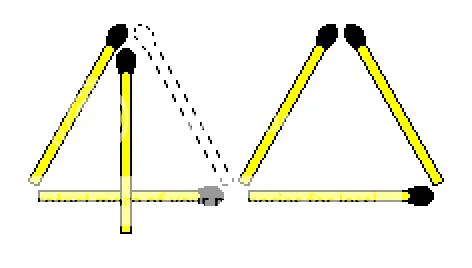
You have two triangles formed from six matchsticks. Move one matchstick to make four triangles.

Now, you could easily use all of these matchsticks to make four triangles, but that would involve moving more than one of them. So clearly there’s something else at work here if you only need to move one to solve the puzzle.

That something, in this case, is a little visual trickery.

As you can see, you turn one triangle into a numeral four, making the matchsticks literally read out “4 triangle.” Sneaky sneaky.

There are literally hundreds of these puzzles if you go hunting for them. (I found a treasure trove of them here.)

A curious variation, though, applies the same rules to mathematical formulas laid out in matchstick form.

Here’s one that’s been making the rounds on Facebook recently:

Now, the big difference between these mathematical ones and the shape ones mentioned above, as far as I’ve found, is that the math ones are far more alternate prone.

For instance, this equation puzzle has at least four solutions that I’ve found:

  • You can move one match to make the 6 a 0, so that 0+4=4.
  • You can move one match from the 6 to the second 4 to make the 6 a 5 and the 4 a 9, so that 5+4=9.
  • You can move one match from the plus sign to the 6 to make the plus sign a minus sign and the 6 an 8, so that 8-4=4.
  • You can move one match from the plus sign to the equal sign to make the plus sign a minus sign and the equal sign a doesn’t-equal sign, so that 6-4 does not equal 4.

As you can see, with matchstick puzzles,  the possibilities are endless and the building blocks — whether matches, toothpicks, Q-Tips, or straws — are easily accessible.

I’ll leave you one more to ponder, this time provided by the folks at IO9:

Using six matchsticks of equal length, create four identical, equilateral triangles. There’s no need for snapping, burning, or otherwise altering the matchsticks.

Good luck!


Thanks for visiting PuzzleNation Blog today! Be sure to sign up for our newsletter to stay up-to-date on everything PuzzleNation!

You can also share your pictures with us on Instagram, friend us on Facebook, check us out on TwitterPinterest, and Tumblr, and explore the always-expanding library of PuzzleNation apps and games on our website!

Follow-Up Friday: Other puzzles you might not know! (Volume 2)

Welcome to Follow-Up Friday!

Follow-Up Friday is an opportunity to look back on past posts and puzzly topics. Whether we’re updating you with new developments, providing answers to a previously-posted brain teaser or puzzle, or simply revisiting a subject with a fresh perspective, Follow-Up Friday lets us look back and look forward.

In today’s edition, now that we’ve presented some new puzzles for crossword devotees to try out, let’s turn our attention to Fill-In puzzle fans.

Fill-Ins feature the same grid-filling solving as crosswords, but instead of coming up with the answers to clues, you’re given all of the words in advance, organized by length, and it’s up to you to deduce which words fit the across boxes and which fit the down boxes.

Fill-Ins don’t demand the same level of recall and vocabulary as crosswords, but the deduction aspect more than makes up for it. And if you’re a Fill-In fan, but looking for something different, there are plenty of options out there for you.

Like Frameworks, for instance.

[Click here or on the grid for a larger version.]

A Framework puzzle is like a Fill-In, but without the rigid crossword-style grid. Instead, the grid is looser, allowing for longer words and interesting themes to be incorporated into the puzzle. The trade-off here is that, with fewer letters crossing, you have fewer hints for placing words in the grid. You’ll have to rely on knowing word lengths and counting boxes to complete these grids.

But for something a little less familiar, how about Places, Please?

[Click here or on the grid for a larger version.]

Places, Please gives you all of the words to place in the grid, just as Fill-Ins do, but there are no black squares to help guide you. Instead, you’re told where the first letter of each word will be placed, and you have to figure out in which direction each word will read.

You’ll want to start with the longest words first, seeing which directions will allow them to be placed. As you place each word, those letters offer clues for placing other words. Eventually, you’ll fill the entire grid! (It’s like a word seek in reverse!)

And if that’s a bit too open-ended for you, let’s talk Stretch Letters.

[You get the idea.]

Stretch Letters puzzles offer the same word-list format as Fill-Ins (organized by word length), but you’ll only enter them reading across. The wrinkle here is that some of the words above and below each row will share those letters, stretching the boxes (and the letters themselves).

It’s a visually striking take on word-placement puzzles, and the stretched letters make for a fun and interactive grid. One S could provide S’s for a half-dozen words or more!

Of course, if you enjoy the deductive side of Fill-Ins — figuring out word placement in the grid — you should also consider trying traditional Logic Puzzles.

[Yup.]

Now, I know these grids can seem a little daunting to new solvers, but they’re simply a way of organizing information. As you work your way through the different clues in the Logic Puzzle, you exclude possibilities in the grid by putting an X in the box where those two options cross.

For instance, in the above Logic Problem, based on clue 7, you’d place an X in the box where Esther (listed under First Name) crosses Tyson (listed under Last Name), eliminating it as a possibility.

The more boxes you fill with X’s, the greater the amount of information you garner from the grid, and eventually, you’ll know their full names, ages, and instrument of choice based on those seven clues. Pretty impressive deduction there.


Next week, we’ll take a break from these puzzle recommendations posts, but if you’ve got puzzle recs for your fellow puzzlers in the meantime, please let us know in the comments!

Thanks for visiting PuzzleNation Blog today! Be sure to sign up for our newsletter to stay up-to-date on everything PuzzleNation!

You can also share your pictures with us on Instagram, friend us on Facebook, check us out on TwitterPinterest, and Tumblr, and explore the always-expanding library of PuzzleNation apps and games on our website!

Other puzzles you might not know! (Volume 1)

We’re all puzzle fans here, right? And sometimes we need something new, something fresh and engaging to rejuvenate our love of puzzles. We know all the classics — crosswords, fill-ins, logic puzzles, word seeks, Sudoku, cryptograms, and anagram puzzles — but there’s a whole wide world of puzzles out there to explore that you might not even know about!

So, in today’s post, I’m going suggest some puzzles to check out, based on each of those classic solving experiences.


Let’s start with crosswords.

From the New York Times and LA Times crossword puzzles to the Penny Dell Crossword App, there’s no shortage of terrific crosswords of all difficulty ranges awaiting solvers.

But there are also some terrific variant crosswords for you to try out, like Double Trouble.

[Click here or on the grid for a larger version, complete with clues.]

In a Double Trouble crossword, you can put one, two, or three letters into a box, making for a more difficult solve that the standard one-letter one-box crossword.

But if you want to go a little farther afield, you can try something like Marching Bands.

[Image courtesy of Brendan Emmett Quigley’s website.]

A Marching Bands puzzle has two sets of clues. The first set clues the rows reading across, with two clues per line. But the second set is where things get interesting. See those alternating rings of light and dark shading? The second set clues words reading clockwise along those rings, or bands.

So instead of words meshing across and down, as in a standard crossword, you have across clues and band clues interacting to help you fill the grid. It’s a wonderful variation on familiar crossword rules, but one challenging enough to keep you interested. (For a more in-depth look, click here!)

But maybe you like crossword cluing but you’d like an answer more interesting than just a grid filled with words. Fair enough, have you ever tried Crostics?

[Click here or on the grid for a larger version.]

Crostics, also known as Anacrostics (from our friends at Dell Magazines) or Acrostics (as made by friend of the blog Cynthia Morris), feature a series of clues and letter blanks to be filled.

Those letter blanks each have coordinates assigned, so that when you fill the correct letters into those blanks, you’re also filling blanks in a grid below to spell out a bonus message, quotation, or anecdote. (It’s a one-to-one ratio, so each letter blank corresponds to a letter blank in the grid. If there’s one J in the message, you’ll find a J in the answer words.)

Although you don’t have the overlapping entries to help you puzzle out answers like crosswords or Marching Bands do, you can use the grid below as a solving aid. As each word in the message emerges, you can fill in those letters in the blanks above (using those same coordinates).

And for something along the same vein, you’ve got Word Games Puzzles.

[Click here or on the grid for a larger version.]

You still get the message reading out in a grid and the letter blank coordinates like in Crostics, but instead of a bunch of crossword-style clues, you instead get four mini-games to solve. One might be trivia or encryption, another might involve some wordplay, another might offer themed clues, and the fourth might be an anagram game.

Each will challenge you in different ways, and the use of repeated letters — a change from Crostics with their one-to-one letter blank to grid letter ratio — gives you more than one chance to fill in the final message.

Hopefully, one or more of these puzzles will pique your interests and offer a welcome new solving experience!


Next week, I’ll have recommendations for fans of Fill-In puzzles, and in future installments, we’ll tackle word seeks, logic puzzles, Sudoku, and more! If you’ve got recommendations for your fellow puzzlers, please let us know in the comments!

Thanks for visiting PuzzleNation Blog today! Be sure to sign up for our newsletter to stay up-to-date on everything PuzzleNation!

You can also share your pictures with us on Instagram, friend us on Facebook, check us out on TwitterPinterest, and Tumblr, and explore the always-expanding library of PuzzleNation apps and games on our website!

Neil Patrick Harris: Actor, Magician, Puzzler?

I’m a puzzle guy, so naturally I’m always on the lookout for new puzzles, whether it’s in the newspaper, the bookstore, the Internet, or anywhere else I happen to be browsing.

But sometimes, you stumble upon a puzzle in the unlikeliest of places. Like a celebrity’s autobiography.

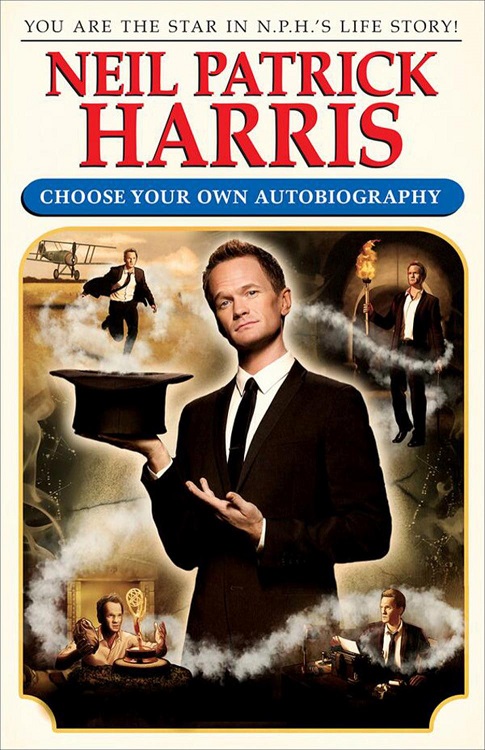
neil-patrick-harris

I recently got around to reading the autobiography of comedian, actor, magician, award-show host extraordinaire, and all-around champion of entertainment Neil Patrick Harris, and, as you’d expect from someone as creative as him, it was no ordinary affair. It’s written in the style of a Choose Your Own Adventure book, where you can make life decisions (as he did) and see where they lead!

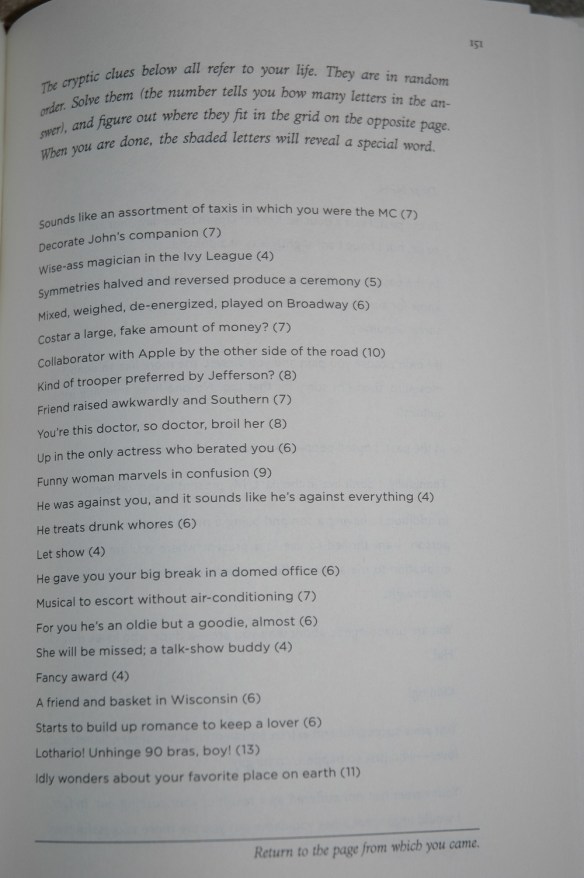
Some lead to hilarious fake deaths, while others lead to genuine poignant moments from his life. We learn about his career, his discovery of magic, the peaks and valleys of his acting career, and his search for love, and it’s a great story. But he also includes messages from friends, drink recipes, and other hidden gems in the book, one of which was an unexpected cryptic crossword puzzle!

nphcryptic1

nphcryptic2

Now, I’ve made no secret of the fact that I’m hardly the strongest cryptic solver around, but I couldn’t resist tackling a surprise Neil Patrick Harris-themed puzzle. (Thankfully, I was able to call in a friend who’s really good with cryptics for the clues that stumped me.)

To Neil’s credit, there are some very clever clues here, in addition to more traditional cryptic clues like “Let show (4)” for RENT and “Symmetries halved and reversed produce a ceremony (5)” for EMMYS. And, as you’d expect, most or all of them apply to events in his life, so you have to read the book to have any chance of solving this one.

Let’s look at a few of my favorites:

  • Sounds like an assortment of taxis in which you were the MC (7): An assortment of taxis is a CAB ARRAY, which sounds like CABARET, a show in which he played an emcee.
  • Costar a large, fake amount of money? (7): Actor Nathan FILLION costarred in Dr. Horrible’s Sing-Along Blog with Neil, and FILLION certainly sounds like a large, fake amount of money.
  • He was against you, and it sounds like he’s against everything (4): There’s a terrific story in the book where Neil is accosted by actor Scott CAAN, whose name sounds like CON.
  • Lothario! Unhinge 90 bras, boy!: This one takes a little work. “Unhinge” indicates this is an anagram clue, so if you anagram “ninety bras,” you get BARNEY STIN. Add “SON” as a synonym of “boy,” and you get BARNEY STINSON, the lothario he played in How I Met Your Mother.

Once you have your 24 answer words, it’s time to fill in the words Framework-style. Quite helpfully, there are several places in the grid where only one word fits, due to word length, which offers the solver several points of access.

However, only 23 of those words will fit in the grid, allowing for an alternate solve for the answers RENT and PENN. But there’s only one way to place the other answers so that the shaded squares spell out a ten-letter word that has a special meaning for clever and attentive readers, a code word Neil suggests as a sign of kinship with the reader.

I debated whether to share the word here, but I don’t want to deprive others of the joy of solving a surprisingly tough and enjoyable puzzle lurking inside an already fun read.


Thanks for visiting PuzzleNation Blog today! Be sure to sign up for our newsletter to stay up-to-date on everything PuzzleNation!

You can also share your pictures with us on Instagram, friend us on Facebook, check us out on TwitterPinterest, and Tumblr, and explore the always-expanding library of PuzzleNation apps and games on our website!

Cracking the GCHQ Christmas Card!

As you may recall, my fellow puzzlers and PuzzleNationers, a few months ago, a government organization in England called the GCHQ — Government Communications Headquarters — released a puzzly Christmas card designed to tax even the savviest puzzle solvers.

They’ve finally released the answers to this mind-blowing series of puzzles, and I’d like to go over some of them with you. Partly to marvel at the puzzle wizardry necessary to solve this challenging holiday gift, and partly to gloat about the parts I managed to solve.

So let’s get to it!


Part 1 was a logic art puzzle where you have to deduce where to place black squares on an open grid in order to form a picture.

Each column and row has a series of numbers in it. These numbers represent runs of black squares in a row, so a 1 means there’s one black square followed by a blank square on either side and a 7 means 7 black squares together with a blank square on either side.

This is mostly a deduction puzzle — figuring out how to place all the strings of black squares with white spaces between them within the space allotted — but no image immediately emerged, which was frustrating. Once the three corner squares started to form though, I realized the answer was a QR code, and the puzzle started to come together nicely.


Part 2 was a series of six multiple-choice brain teasers. I’ll give you the first three questions, along with answers.

Q1. Which of these is not the odd one out?

A. STARLET
B. SONNET
C. SAFFRON
D. SHALLOT
E. TORRENT
F. SUGGEST

Now, if you stare at a list of words long enough, you can form your own patterns easily. Here’s the rationale the GCHQ used to eliminate the odd ones out:

STARLET is an odd one out because it does not contain a double letter.
SONNET is an odd one out because it has 6 letters rather than 7.
SAFFRON is an odd one out because it ends in N rather than T.
TORRENT is an odd one out because it starts with T rather than S.
SUGGEST is an odd one out because it is a verb rather than a noun.

SHALLOT is our answer.

Q2. What comes after GREEN, RED, BROWN, RED, BLUE, -, YELLOW, PINK?
A. RED
B. YELLOW
C. GREEN
D. BROWN
E. BLUE
F. PINK

After playing around with some associative patterns for a while, I realized that somehow these colors must equate to numbers. First I tried word lengths, but 5-3-5-3-4-___-6-4 didn’t make any sense to me. But then, it hit me: another time where colors and numbers mix.

Pool balls. Of course, the colors and numbers didn’t match, because this is a British puzzle, and they don’t play pool, they play snooker.

So the colored balls in snooker become the numbers 3, 1, 4, 1, 5, -, 2, 6. The numbers of Pi. And now the blank makes sense, because Pi reads 3.1415926, and there’s no 9 ball in snooker.

So the next number in the chain is 5, and 5 is the color BLUE.

Q3. Which is the odd one out?
A. MATURE
B. LOVE
C. WILDE
D. BUCKET
E. BECKHAM
F. SHAKA

This one came pretty quickly to me, as the names Oscar Wilde and Charlie Bucket leapt out. And if you follow the phonetic alphabet, you also get Victor Mature, Romeo Beckham, and Shaka Zulu. (I didn’t get Mike Love, however.)

Since Shaka Zulu was the only one where the phonetic alphabet word was the surname, not the first name, SHAKA is the odd one out.

(The other three questions included an encryption puzzle, a number pattern (or progressions puzzle), and a single-letter puzzle.)

Granted, since you could retake this part as many times as you wanted, you could luck your way through or brute force the game by trying every permutation. But managing to solve most of them made this part go much faster.


Part 3 consisted of word puzzles, and was easily my favorite section, because it played to some strengths of mine.

A. Complete the sequence:

Buck, Cod, Dahlia, Rook, Cuckoo, Rail, Haddock, ?

This sequence is a palindrome, so the missing word is CUB.

B. Sum:

pest + √(unfixed – riots) = ?

This one is a little more involved. To complete the formula, you need to figure out what numbers the words represent. And each word is an anagram of a French number. Which gives you:

sept + √(dix-neuf – trois) = ?

Dix-neuf is nineteen and trois is three, so that’s sixteen beneath a square root sign, which equals four. And sept (seven) plus four is eleven.

The French word for eleven is onze, and ZONE is the only anagram word that fits.

C. Samuel says: if agony is the opposite of denial, and witty is the opposite of tepid, then what is the opposite of smart?

This is a terrific brain teaser, because at first blush, it reads like nonsense, until suddenly it clicks. Samuel is Samuel Morse, so you need to use Morse Code to solve this one. I translated “agony” and tried reversing the pattern of dots and dashes, but that didn’t work.

As it turns out, you need to swap the dots and dashes, and that’s what makes “denial” read out. This also worked with “witty” and “tepid,” so when I tried it with “smart,” the opposite was OFTEN.

D. The answers to the following cryptic crossword clues are all words of the same length. We have provided the first four clues only. What is the seventh and last answer?

1. Withdraw as sailors hold festive sing-song
2. It receives a worker and returns a queen
3. Try and sing medley of violin parts
4. Fit for capture
5.
6.
7. ?

Now, I’m not a strong cryptic crossword solver, so this part took FOREVER. Let’s work through it one clue at a time.

1. Withdraw as sailors hold festive sing-song

The word WASSAIL both reads out in “withdraw as sailors hold” and means “festive sing-song.”

2. It receives a worker and returns a queen

The word ANTENNA both “receives” and is formed by “a worker” (ANT) and “returns a queen” (ANNE, reading backward).

3. Try and sing medley of violin parts

The word STRINGY is both an anagram of “try” and “sing” and a violin part (STRING).

4. Fit for capture

The word SEIZURE means both “fit” and “capture.”

Those four answers read out like this:

WASSAIL
ANTENNA
STRINGY
SEIZURE

And with three more answers to go, it seemed only natural that three more seven-letter answers were forthcoming. Plus, when you read the words spelling out downward, you notice that the first four letters of WASSAIL, ANTENNA, STRINGY, and SEIZURE were spelling out.

If you follow that thought, you end up with the start of a 7×7 word square:

 WASSAIL
ANTENNA
STRINGY
SEIZURE
ANNU___
INGR___
LAYE___

And the only seven-letter word starting with INGR that I could think of was INGRATE.

WASSAIL
ANTENNA
STRINGY
SEIZURE
ANNU_A_
INGRATE
LAYE_E_

And if the last word is LAYERED…

WASSAIL
ANTENNA
STRINGY
SEIZURE
ANNU_AR
INGRATE
LAYERED

Then the missing word must be ANNULAR. The original question asked for the last word though, so our answer is LAYERED.


This brings us to Part 4, Number Puzzles, where I must confess that I finally tapped out, because I could only figure out the first of the three progressions involved.

Fill in the missing numbers.

A. 2, 4, 8, 1, 3, 6, 18, 26, ?, 12, 24, 49, 89, 134, 378, 656, 117, 224, 548, 1456, 2912, 4934, 8868, 1771, 3543, …

B. -101250000, -1728000, -4900, 360, 675, 200, ?, …

C. 321, 444, 675, 680, 370, 268, 949, 206, 851, ?, …

In the first one, you’re simply multiplying by 2 as you go.

2, 4, 8, 16, 32, 64, 128, 256, 512, 1024, 2048, 4096, 8192, 16384, 32768, 65536, 131072, 262144, and so on.

But you begin to exclude every other number as you move into double-digits, triple-digits, quadruple-digits, and beyond.

2, 4, 8, 16, 32, 64, 128, 256, 512, 1024, 2048, 4096, 8192, 16384, 32768, 65536, 131072, 262144, and so on.

So the answer, 512, becomes the real answer, 52.

But, as I said, I couldn’t crack the other two, and I’m already exhausted just running through these four sections!

And, based on the answers they released recently, Part 5 only got more mindbending from there.

As a matter of fact, not a single entrant managed to get every answer in Part 5 correct. Prizes were awarded to the three people who came closest however, and it turns out a staggering 30,000+ people made it to Part 5. Color me impressed!

This was, without a doubt, the most challenging puzzle suite I have ever seen, and I offer heartfelt kudos to anyone in the PuzzleNation Blog readership who even attempted it!

You’re welcome to try it out for yourself, though. I highly recommend using this link from The Telegraph, which allows you to skip to the next part if you get stumped.


Thanks for visiting PuzzleNation Blog today! Be sure to sign up for our newsletter to stay up-to-date on everything PuzzleNation!

You can also share your pictures with us on Instagram, friend us on Facebook, check us out on TwitterPinterest, and Tumblr, and explore the always-expanding library of PuzzleNation apps and games on our website!