PuzzleNation Product Review: Are You a Robot?

ayar0

[Note: I received a free copy of this game in exchange for a fair, unbiased review. Due diligence, full disclosure, and all that.]

Whether you’re playing a board game like Clue or a card game like Werewolf or Mafia, you and your fellow players have accepted the challenge of a very different form of puzzle gaming: the social deduction game.

Social deduction games operate under a simple premise — the cards determine the role you play — and from that point forward, you’re trying to determine who is secretly a danger to you and others in the game.

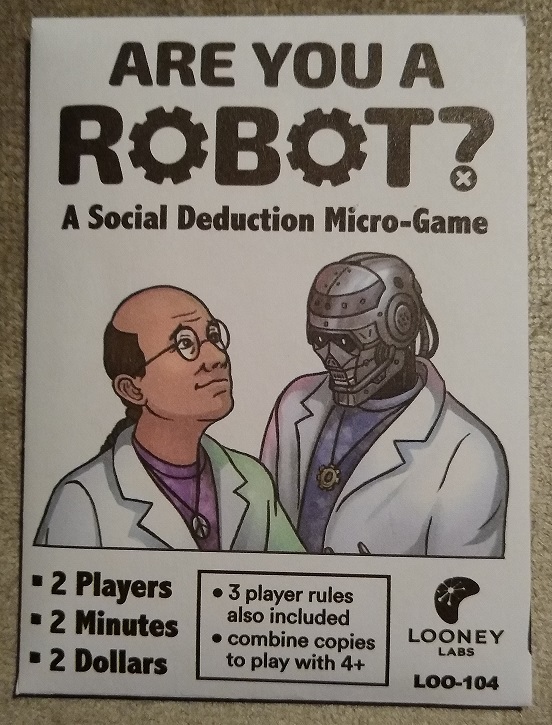
In this particular case, there might a robot lurking among the humans aboard your space station.

You see, in Are You a Robot?, all of the players randomly select a card. There’s always a human card for every person playing the game, plus one robot card. (So, for instance, if five people are playing, you have five human cards and one robot card in the deck.) You shuffle the cards, deal out one to each player, and put the last one aside. Everyone looks at their card (but doesn’t show anyone else) and discovers their role for the game.

Now, at this point, there’s between zero and one robots in the game, and the rest of the players are human. The humans want to suss out if there are any robots disguised as humans, and the robot wants to get the humans to accuse each other and whittle down their numbers so the robots can take over.

ayar1

[A whole lot packed into a little envelope.]

This is the social aspect of the game. There are three things players can do in order to figure out who is who: shake hands, shoot a laser gun at another player, or talk. If the players all agree that there are no robots in play, two players can agree to shake hands. If there are no robots in the game after all, the humans win. If a robot is present after all, the humans lose.

Humans can shoot other players, but robots cannot. If a robot is shot, it’s gone from the game and the humans rejoice. If a human is shot, three things happen: the shooter is immediately removed from the game, the human who was shot comes back to life and returns to the game, and there’s a chance another robot slips into the game.

This element of chance involves all of the players closing their eyes, any robots secretly revealing themselves, and all of the remaining players turning in their cards. Those cards are shuffled randomly, a robot card is introduced, and the cards are redistributed to the surviving human players.

It’s possible everyone remains human, and it’s possible one of the humans is now a robot in disguise.

The game now resumes, and the players must once again figure out if there are any robots in their midst. (And your mind immediately begins spiraling out with possibilities. “Did so-and-so not shoot me because he believes that I’m human? Or because he’s a robot and can’t shoot me?”)
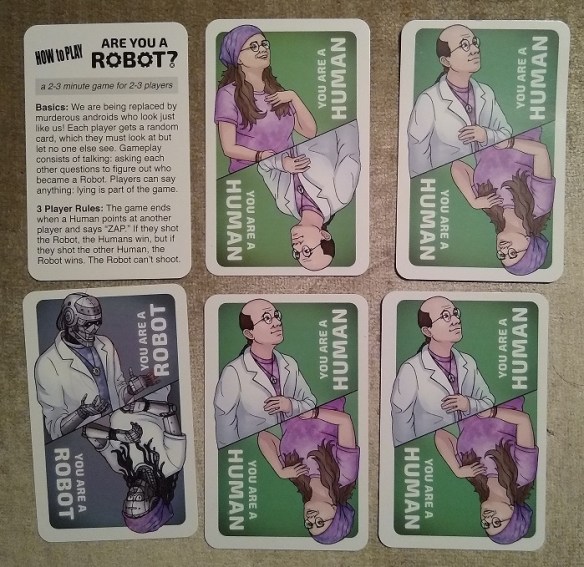
ayar2

[The set up for a four-person game: instructions, four human cards, and one robot card.]

Play continues until either the humans have eliminated any possible robots (and have shaken hands to confirm this) or the robots have overwhelmed the game and the humans have been whittled down to a single player.

In my estimation, Extended Mode, designed for 5 or more players, is the most interesting version of the game. The core game is for two or three players, consisting of two human cards and one robot card. Adding a second game allows for up to four players, a third game allows for up to six, and so on.

Our Extended Mode testing involved eight players (and four copies of the game), which allowed for multiple rounds of play, the introduction of several possible additional robots, and so on, making for a deeper, more engrossing (and nerve-wracking!) play experience.

And that’s the beauty of Are You a Robot? when compared to similar social detection card games like Mafia and Werewolf. Not only can you have satisfying play experiences with fewer people but the element of randomness that comes into play with more players adds tension to the game. (In Mafia and Werewolf, the number of antagonists is set at the start of the game. In Are You a Robot?, the number might increase, or it might not. It’s a simple change that adds so much.)

An elegant balance of silliness and suspenseful, consequence-loaded gameplay, Are You a Robot? is a winner with any number of players. Bring your laser gun, bring your skepticism, and bring along a couple of sets so everyone can play.

[Are You a Robot? is available (for $2!) from Looney Labs and other participating retailers.]


Thanks for visiting PuzzleNation Blog today! Be sure to sign up for our newsletter to stay up-to-date on everything PuzzleNation!

You can also share your pictures with us on Instagram, friend us on Facebook, check us out on TwitterPinterest, and Tumblr, and explore the always-expanding library of PuzzleNation apps and games on our website!
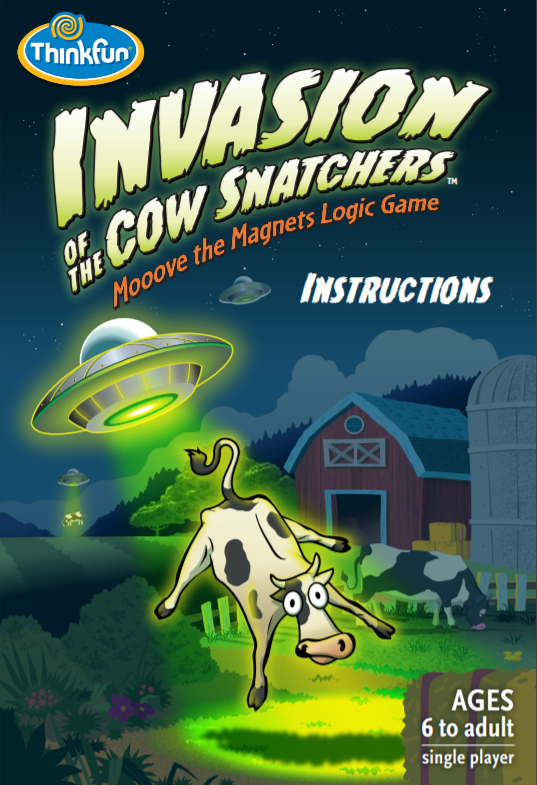
PuzzleNation Product Review: Invasion of the Cow Snatchers

invasion0

[Note: I received a free copy of this game in exchange for a fair, unbiased review. Due diligence, full disclosure, and all that.]

Nobody does deduction and logic puzzle games quite like the folks at ThinkFun. We’ve wielded lasers, electrical circuits, robots, and even putty in order to conquer some of their most recent and diabolical puzzles. But they always have some new tricks up their sleeves, and their latest offering is positively magnetic.

So join us as we give the full PuzzleNation Blog review treatment to Invasion of the Cow Snatchers, a puzzle game all about bringing species together… with magnets.

invasion1

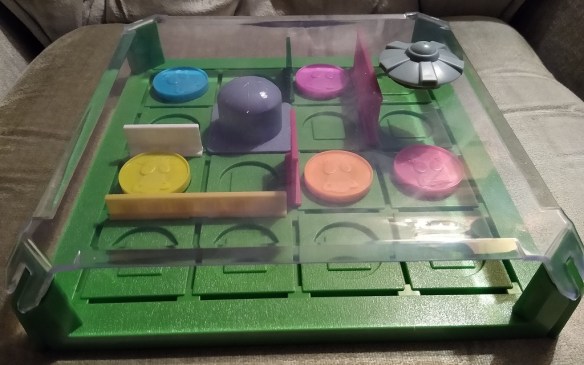
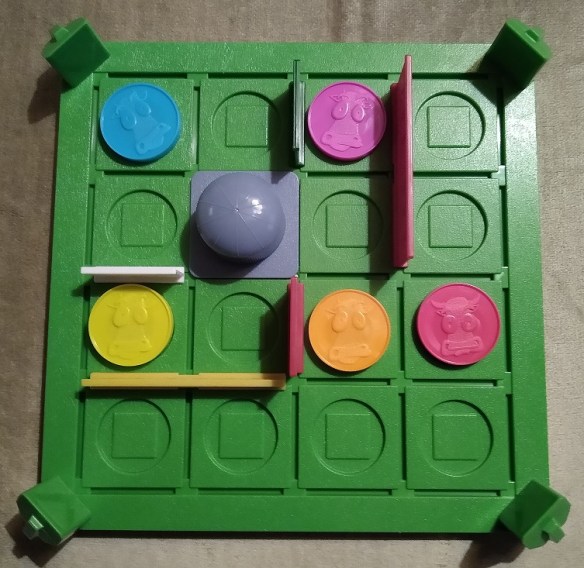
The challenge is deceptively simple: you’re an alien, and your job is to maneuver your UFO around the farm and pick up all of the cows, then finally the bull, before leaving the area.

Sounds easy, right? You’re a member of an advanced alien species, you can travel the galaxy. Picking up a few curious Earth creatures should be a cakewalk.

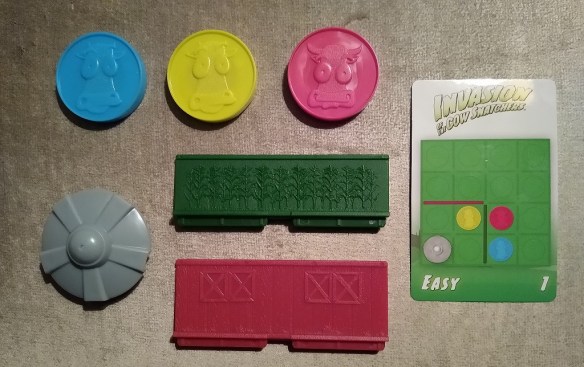
Well, obviously, the crew at ThinkFun already thought of that. And you’ll have plenty of obstacles to navigate and overcome before you can complete your task. Not only is there a silo you can never pass over, but there are barriers of varying heights that can impede your path.

invasion3

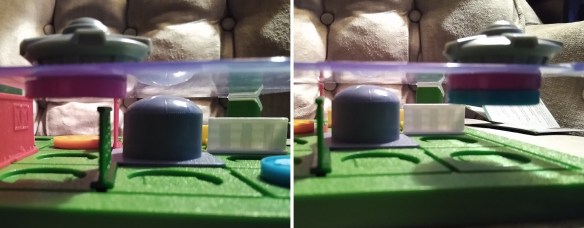
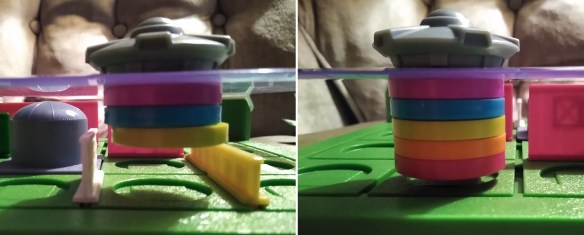
[Here, we’ve captured one cow, so we can pass over the green row of crops. In the second pic, we’ve captured our second cow. In the background, you can see the silo (which we can’t pass at all) and the white fence, which we can pass over with up to 2 cows.]

For instance, if you’ve already captured one cow, you can’t carry it over a barn wall, but you can carry it over the row of crops. (The walls allow between 0 and 3 cows to be carried over them, depending on their height.)

Note: Be aware that you need a completely flat surface for this game. The magnets are powerful, and they’re liable to shift and move when the UFO comes near. The bull is especially prone to this.

invasion7

Each Challenge Card requires you to navigate the grid in a specific way in order to capture all of the cows and be successful. After all, once a cow is captured, you can’t drop it. Demanding that the bull be collected last adds another wrinkle to the gameplay, since you cannot pass over the bull until all of the cows are collected, which requires creative thinking and good planning.

Honestly, I can’t think of another ThinkFun puzzle to date that requires this much movement or utilizes the full space of the board as effectively as Invasion of the Cow Snatchers.

invasion5

[Continuing the challenge card from above, we pass over the white fence, pick up our third cow, and pass over the hay bales, before rounding the corner, capturing the bull last, and making our escape.]

Finally, you have to escape the board, and there are no walls that allow you to pass with more than three captured cow tokens, so your escape route also has to be considered.

The Challenge Cards increase in difficulty as you work your way through the deck. Easy and Medium Challenges give way later to Hard and Super Hard puzzles that will have you wracking your brain to stealthily maneuver your UFO around the farm setting.

This is probably my favorite design I’ve seen from ThinkFun. The clever use of magnets, the plastic casing that separates the UFO from the rest of the board, and the impressive variety of challenges they’ve conjured with relatively few obstacles makes for a game with tons of replay value and puzzles that are always engaging, never frustrating. You KNOW there’s a path to victory. You just have to be cagey enough to find it.

invasion2

Oh, and remember how I said you can’t drop any of the cows? Well, you can if you accept the challenge of the twenty Genius level Challenge Cards that are also included. These cards utilize everything you’ve learned up to this point, but add crop circles where you can drop off cows (but not the bull) temporarily.

Why? Because it’s not just about capturing all of the cows, then the bull, then escaping. Now you must capture the cows in a very specific order. (Suddenly, the color coding of the cow tokens becomes more than a fun design choice. It becomes an integral part of the puzzle.)

This new gameplay option completely reinvents the concept. Before, it didn’t matter what in order you captured the cows, only that you got them all. It almost feels like you’re starting over from scratch, because the walls aren’t the primary obstacle anymore (though they can still offer some intriguing challenges to this new gameplay model).

The crop circles are another delightfully tongue-in-cheek addition to the already fun design of the game, playing nicely on the alien abduction gimmick.


All in all, I was thoroughly impressed by ThinkFun’s latest logic puzzle game. The concept is hilarious, the colorful and clever pieces make for fun reactive gameplay, and the puzzles are harder than you’d expect. Watching the cows fly up and snap! against the plastic as the UFO captures them never gets old!

It’s simple enough for the youngest puzzlers to get into, but there’s plenty here for parents and older puzzlers as well. (Some of the Genius level Challenge Cards really tax your brainpower!)

[Invasion of the Cow Snatchers is for ages 6 and up, available from ThinkFun and other participating retailers.]


Thanks for visiting PuzzleNation Blog today! Be sure to sign up for our newsletter to stay up-to-date on everything PuzzleNation!

You can also share your pictures with us on Instagram, friend us on Facebook, check us out on TwitterPinterest, and Tumblr, and explore the always-expanding library of PuzzleNation apps and games on our website!
PuzzleNation Product Review: Codenames

codenames0

There are all kinds of games where communication is crucial.

In You’ve Got Crabs, you must employ a secret non-verbal signal to inform your partner that you’ve completed a task, but without the other team spotting your signal and intercepting. In Taboo, you have to get a teammate to state a particular word, but without using several words closely associated with the answer.

But other games ratchet up both the creativity necessary to win and the difficulty involved in doing so. Imagine having to communicate volumes with a single word.

In today’s product review, we delve into the world of spycraft and put our communication skills to the test as we try out the card game Codenames.

codenames4

In Codenames, two teams (the red team and the blue team) are tasked with identifying all of their secret agents before their opponents can locate their own agents from the same list. But in order to do so, they must pick those agents out of a field of 25 possible individuals.

In each group, there are red agents, blue agents, innocent bystanders, and an assassin. Each possible individual is marked with a codename that is viewable by all of the players.

So, where does the wordplay and communication come in?

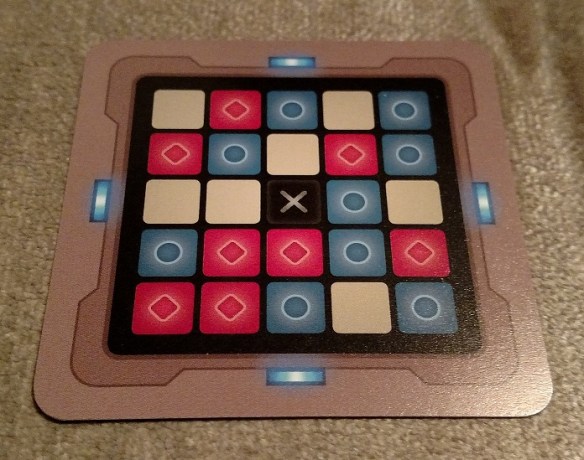
Each team selects one player apiece to serve as the spymaster. The spymaster for each team looks at one of the secret patterns determining which cards/codenames represent blue agents and which red agents.

codenames3

So it’s up to the spymaster to point the players in the right direction, but it’s up to the players to actually choose a given person in the field of 25 and label them an agent.

Each round, the spymaster comes up with a one-word clue for the other players on their team that points to their secret agents (as well as a number representing the number of agents in the field that the clue applies to). The word must be specific enough to point them in the right direction, but that can be difficult depending on the words in your play area.

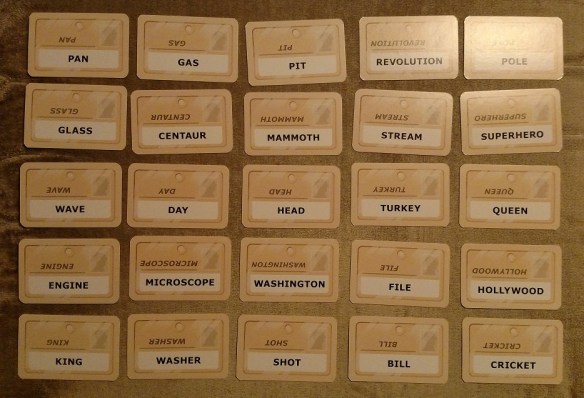
For instance, in our example grid, the clue “royalty: 1” could point toward KING, or QUEEN, or HEAD, or even REVOLUTION, depending on what the other players associate with the word “royalty.” But suppose that you want your players to choose KING and not QUEEN. Then “royalty” is no good, because it’s too vague.

The number aspect of the clue is also important, because it offers the opportunity to gain an advantage over your opponents. For instance, if you wanted both KING and QUEEN to be labeled as your agents, the clue “royalty: 2” would be good, because those would probably be the two most likely choices based on that clue.

codenames2

In our example grid, the red team went first, and the spymaster said “dishes: 2.” The other player on the red team chose GLASS and WASHER from the grid, and both were correct and marked with red agent cards. This was a smart play, but also a risky one, as PAN could also be associated with “dishes.”

The blue team responded with the clue “rasp: 1,” choosing specificity and a single possible answer for the sake of certainty, rather than risk trying for more than one agent in this turn. The blue player correctly selected FILE, and that card was marked with a blue agent card.

The next turn for the red team didn’t go nearly as well. The spymaster used the clue “big: 1” and instead of choosing SHOT (the intended answer), the player opted for MAMMOTH. The card was revealed to be an innocent bystander, and the red team’s turn was immediately over for failing to ID an agent that turn.

And that is one of the big strategic challenges of Codenames. Do you stick to 1 agent per turn with a greater chance of success, or do you try to get more creative and bold by going for less certain clues that could lead to multiple agent IDs in one fell swoop? Do you risk uncovering the assassin (and immediately losing the game) with a clue that could suggest him as well as a secret agent for your team?

codenames1

The field of codenames in the play area can also lead to unexpected challenges. In one game, I was playing the spymaster for my team. The words JUPITER and SATURN were both in the grid, but only JUPITER was one of our agents. So a clue like “planet” was out. Unfortunately, other clues (like “biggest” or “god”) were excluded because they also applied to other codenames in the play area, including the dreaded assassin.

A mix of tactics, efficiency, association, vocabulary, and luck, Codenames is a terrific game that will test your wits, your communication skills, and your ability to make every word count.

The sheer volume of possible codenames (as well as the increased variety offered by each card being double-sided) ensues a huge amount of replay value is built into the game. And not only is it great as a group game, but the two-player version is just as fun!

Codenames, playable for 4 to 8 players (with variant rules for 2 or 3 players) is available at Target, Barnes & Noble, and many online retailers.


Thanks for visiting PuzzleNation Blog today! Be sure to sign up for our newsletter to stay up-to-date on everything PuzzleNation!

You can also share your pictures with us on Instagram, friend us on Facebook, check us out on TwitterPinterest, and Tumblr, and explore the always-expanding library of PuzzleNation apps and games on our website!
PuzzleNation Product Review: The Abandons

What is it about exploring a maze that is so satisfying? We’ve covered labyrinths before — in book form, in wood form, even in LEGO form — but we’ve never sampled something quite like The Abandons.

The Abandons is a one-player labyrinth-building game that is different every time you play. And unlike most labyrinths that are predetermined for you (and are observed from above), you have to explore it room by room, dealing with the surprises and consequences revealed by your choices.

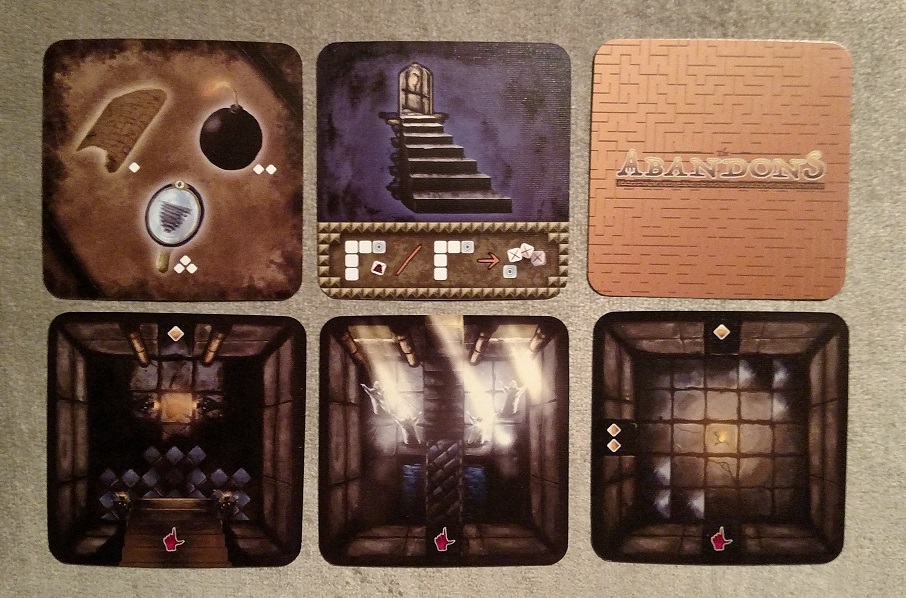
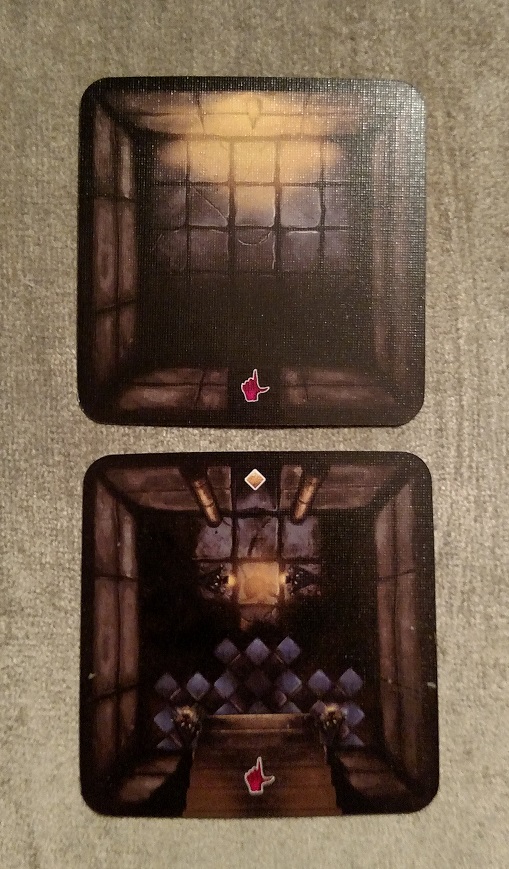
[A sampling of the cards you’ll see; clockwise from upper left: an item card, a stairs card, the card backing, a corridor card with choices, the end card, the beginning card.]

This quick-play game is simple to learn, simple to set up, and difficult to conquer. Locate the beginning and end cards, remove them from the deck, then shuffle the remaining 48 cards. Once they’re shuffled, place the end card at the bottom of the deck. This is now your draw pile.

Place your beginning card down on the table. You’ll notice it has a diamond at the door. The diamonds represent how many cards you draw in order to move forward. With one diamond, you simply draw the next card and play it. With two, you discard one card and play the next. With three, you discard two cards and play the third. And so on.

[Sometimes you reach a quick dead end.]

As you pull cards from the draw pile and add them to the labyrinth, you’ll come to intersections that allow for multiple paths. You’ll pick one direction and follow it. If you come to a dead end, you can retrace your steps back to the nearest intersection with an unexplored path and continue your journey.

But if you encounter enough dead ends, you’ll find yourself without any unexplored paths, and you lose, having trapped yourself in the labyrinth forever. Bummer.

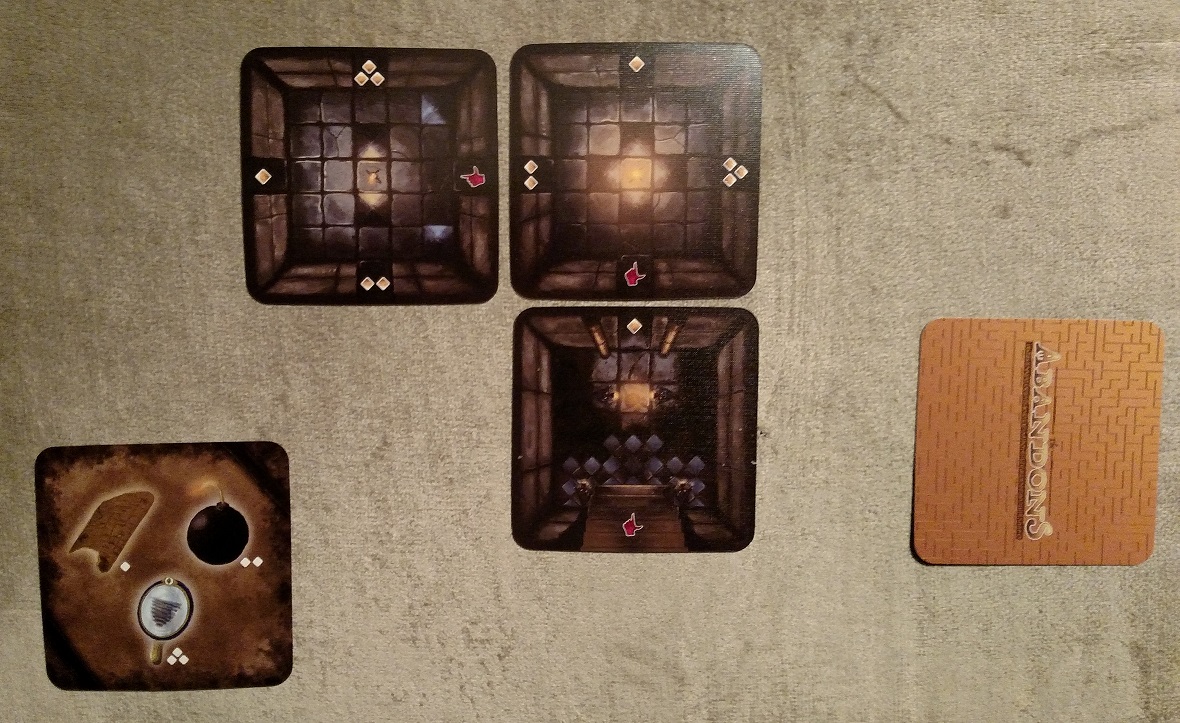
You can see in this playthrough, we were lucky with our first cards, as we drew an item card immediately (and set it aside for later), followed by an intersection card with three paths to choose from. We went left, drew another intersection card, and then had a choice to make.

If one of those paths leads to a dead end, we’re still in good shape since there are currently four unexplored paths to fall back on. Options are life in this game.

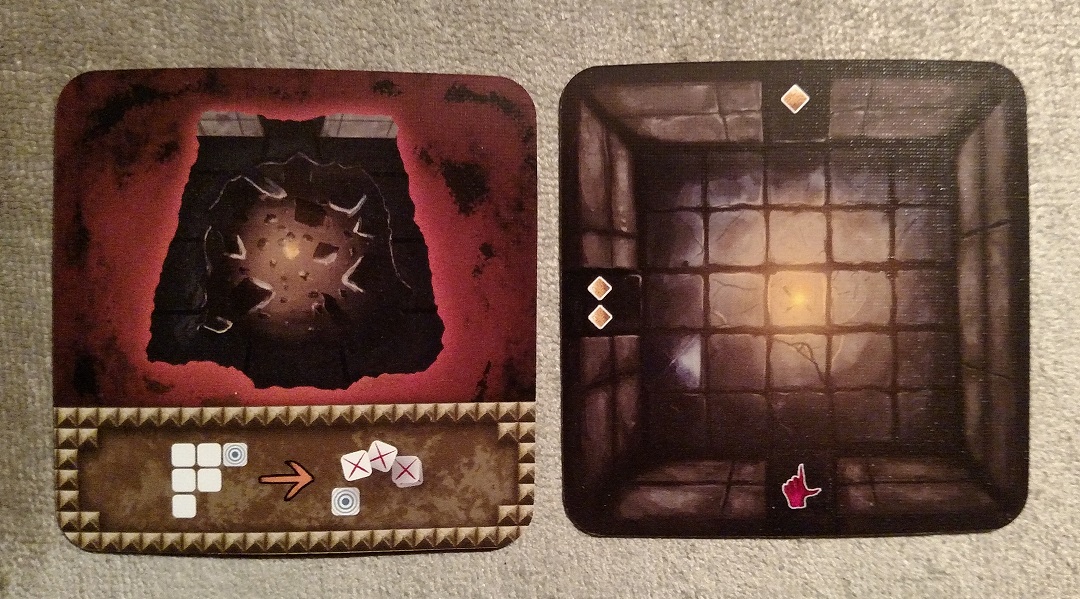
Unfortunately, we went right, drew another intersection card, and then went left, drawing the collapse card.

If you draw this card, you wipe all of your progress from the play area and go back to the start, as if you’ve fallen into a lower level of the labyrinth and must start your search anew for an exit. (This is one of two cards that can cause this game reset. The other, the stairs card, gives you the choice of continuing with your current path or going back to the start. It’s slightly more pleasant than the collapse card.)

So you don’t just have dead end cards to worry about. Sometimes you’ll be pretty deep into your explorations, and suddenly, you’re back at the start. It’s a kick in the teeth, to be sure.

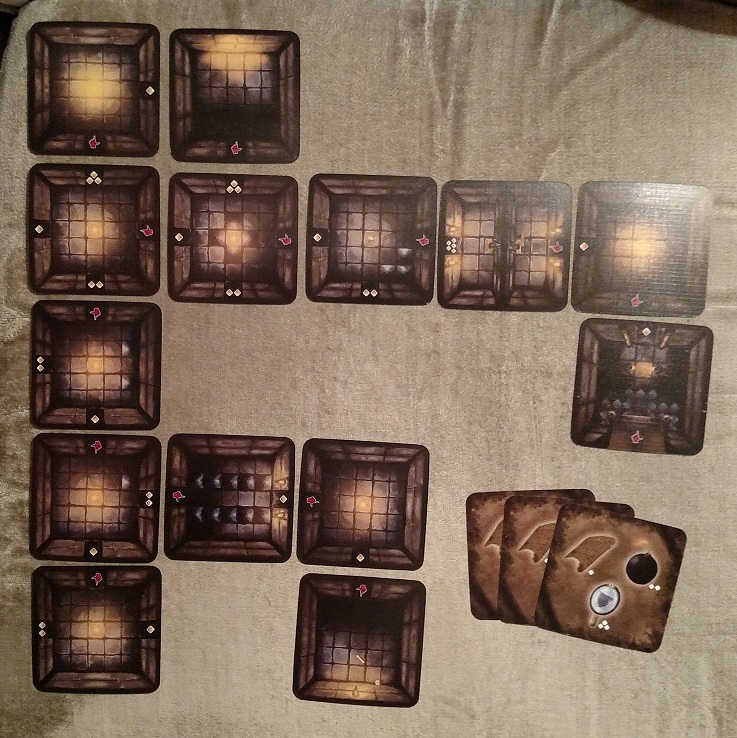
Now here’s a game where we’ve gotten pretty far. You can see in the top left and the bottom center areas of your screen, a few dead end cards have appeared. But we have several unexplored paths to fall back on, as well as three item cards.

The item cards offer different options depending on how many you have. If you have one, you can spend it to look at the top three cards of the draw pile (as if you’ve found part of a map of the labyrinth). If you have two, you can spend them on a bomb to blast your way through a dead end or another wall, giving yourself another unexplored path (and another chance for escape). And if you have three, you can spent them on a magic mirror that allows you to return to the start and take a new path.

Overall, I really enjoyed playing this game. Many explore-a-world games require lots of setup, whereas this one gets going in seconds and plays out in about ten minutes or so. The mix of strategy and luck makes each game unpredictable — even if it’s a bit frustrating to draw a dead end card early on that squashes the whole game. The item cards allow for some solid tactical planning — I’m a huge fan of bombing my way through walls — which offsets the randomness of the draw pile.

Yes, it’s true that this isn’t really a game that you can master, since randomness will always be a big part of the gameplay, but it’s certainly a game you can get better at playing. After just a few tries, you start to get the hang of how to choose your paths and try to make the draw pile work for you, not against you. (In that way, it becomes a puzzly version of poker where you’re playing against the deck itself.)

It’s a terrific solo solving experience, a great intro game for younger players (I certainly think you can go younger than the 14+ recommended by the designers), and small enough to fit in your pocket. This is one quick-play game that won’t sit on the shelf for very long.

The Abandons is available from Puzzling Pixel Games and select online retailers.


Thanks for visiting PuzzleNation Blog today! Be sure to sign up for our newsletter to stay up-to-date on everything PuzzleNation!

You can also share your pictures with us on Instagram, friend us on Facebook, check us out on TwitterPinterest, and Tumblr, and explore the always-expanding library of PuzzleNation apps and games on our website!
Kickstarter Roundup!

Oh yes, it’s that time again.

For years now, crowdfunding platforms like Kickstarter and Indiegogo have been hotbeds of innovative puzzle and game design, and I’m always happy to spread the word about worthy projects that I think will delight and intrigue my fellow PuzzleNationers.

So let’s take a look at some projects that are currently seeking funding and see if any pique your interest!


The first (and puzzliest!) entry in today’s list is a reinvention of something PuzzleNation Blog readers already know: Eric Berlin’s Puzzle Your Kids subscription service.

Eric realized that the clever puzzles he was creating worked for both younger AND older solvers, and has reimagined the subscription service to provide all sorts of quality variety puzzles to solvers.

Now known as Puzzlesnacks, it’s the perfect way to keep the puzzler in your life busy with fun, unique variety puzzles, no matter what their skill level.

With 23 days to go, the project is already funded, so any further funding just means more puzzles and even greater quality going forward!

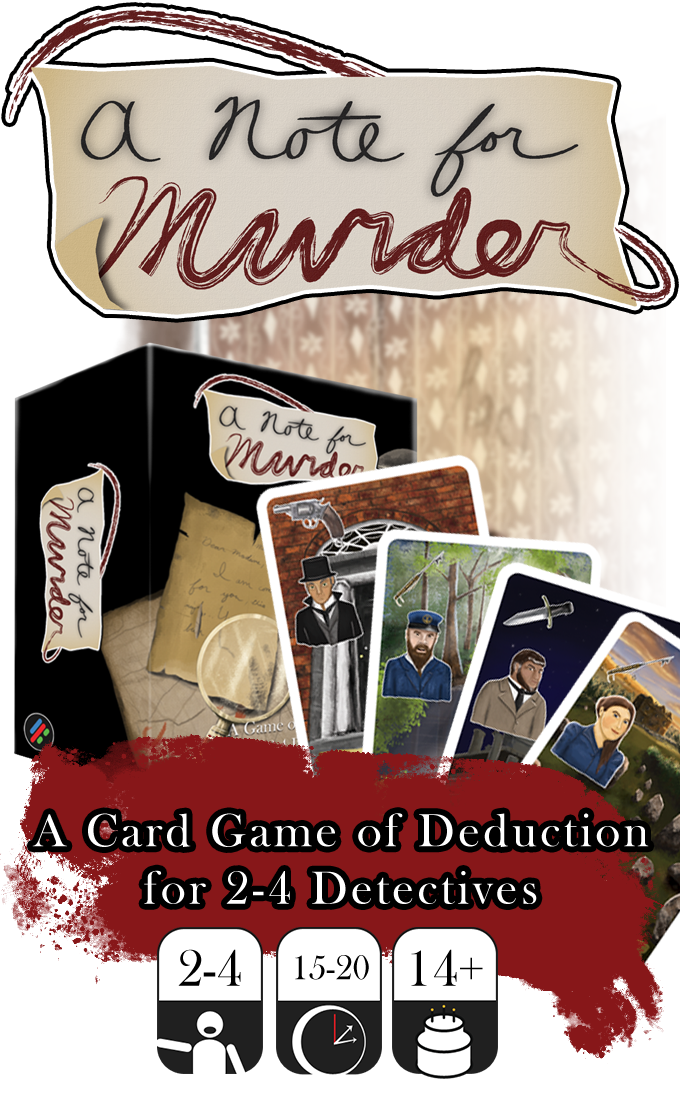
Our second project is something for the murder mystery fans in the audience: A Note for Murder.

This game plays on classic murder mystery tropes, as players piece together the crime —  identifying the suspect, the murder weapon, and the scene of the murder. The twist? The crime hasn’t happened yet!

Plus you’re competing with your fellow players. Although it takes working together to solve the crime, only one person can get the credit for preventing the crime. Will it be you?

With 23 days to go, the project is one-third funded, but I suspect this intriguing spin on traditional murder mystery board games like Clue will meet its funding goal.

Our third campaign celebrates the history of one of the most unique game companies in the market today: Cheapass Games.

The company originally marketed its games by selling only what you need to play the game, allowing you to save money by scrounging up your own dice, tokens, and more from the games you already have. It was a genius approach that led to dozens of fantastic, unusual gaming experiences.

And now, they’re bringing that history to life with Cheapass Games in Black and White, a book collecting the rules and histories of every game offered by the company during the Black and White era.

The book is already funded, but with 21 days left, this project is still worth your time.

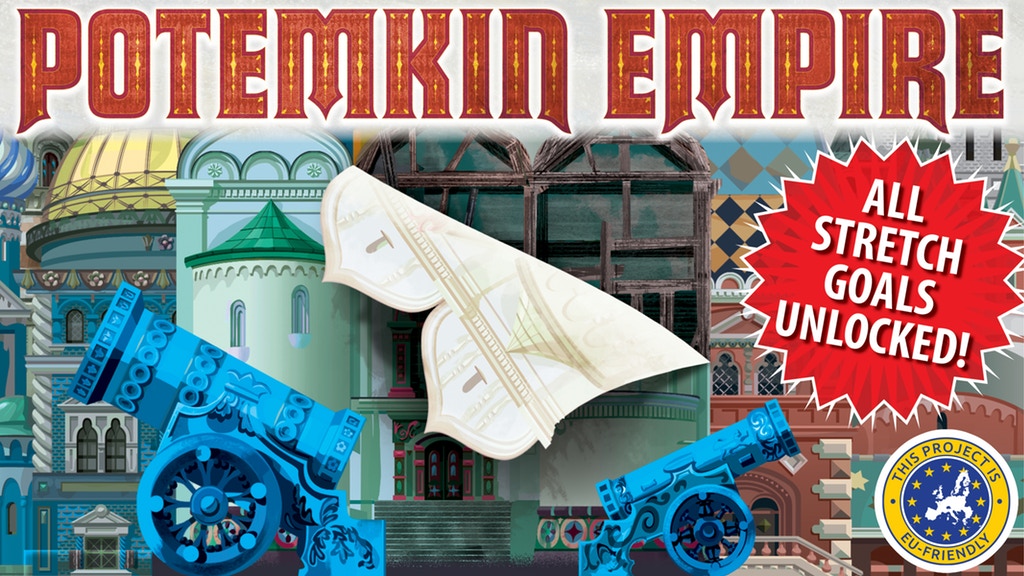
We delve into a peculiar true story from history with our fourth entry: Potemkin Empire.

As Empress Catherine tours the towns and villages in her domain, each player competes to convince her that they have the most prosperous and worthy village. And a bit of chicanery is needed, as everyone is setting up empty building facades to enhance the look of their individual towns.

The game quickly becomes a battle of cons, ruses, bluffs, and betrayal, as players try to expose the fake buildings of others while concealing their own false fronts. This looks like a terrific strategy game with some devious poker elements, built in the same vein as Sheriff of Nottingham and other social games.

There’s less than 36 hours left in the campaign, so contribute now. The game is fully funded and pushing towards some worthwhile stretch goals in the home stretch!

Our fifth and final entry today adds a macabre sense of humor to an iconic storytelling world.

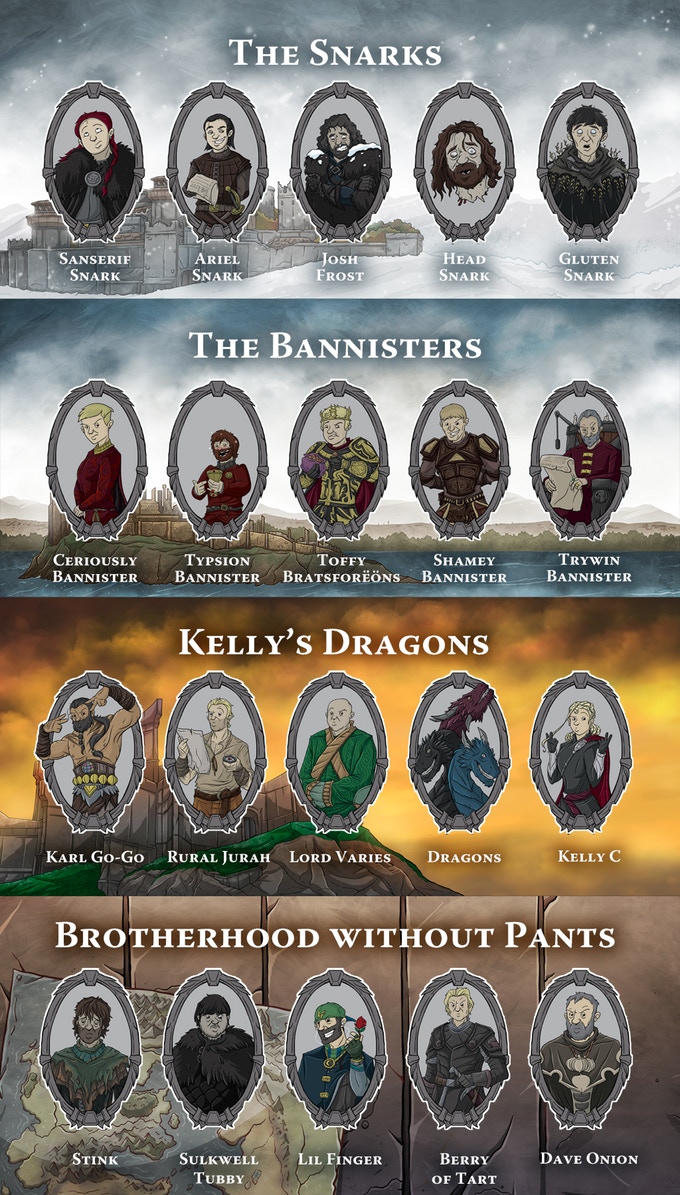
Gloom of Thrones combines the mystique and grandeur of Game of Thrones with the namesake card game’s twisted humor and clever gameplay. As each player takes control of a noble family, they endeavor to make them as miserable as possible to score points, and then kill them off when the time is right.

The transparent cards allow for all sorts of playing combinations as you torment and mistreat the parody characters. And naturally, you can derail the other players by causing nice things to happen to their characters. There’s really nothing quite like playing Gloom.

With 20 days to go, the game is fully funded and pushing onward toward stretch goals, so don’t miss out on this hilariously brutal spin-off.


Have any of these projects hooked you? Let us know which ones you’re supporting in the comments section below! And if there are any campaigns you’re supporting that we missed, let us know!

Thanks for visiting PuzzleNation Blog today! Be sure to sign up for our newsletter to stay up-to-date on everything PuzzleNation!

You can also share your pictures with us on Instagram, friend us on Facebook, check us out on TwitterPinterest, and Tumblr, and explore the always-expanding library of PuzzleNation apps and games on our website!
Solve Puzzles in Paradise with PUZZLE FEST!

If you want to be on the cutting edge in puzzles, you have to keep innovating.
Pushing boundaries. Offering something new and unexpected.

PUZZLE FEST.

Forget ACPT. Forget Lollapuzzoola. Forget escape rooms and scavenger hunts and puzzle cruises and D&D in a castle. Our newest offering leaves all of them in the dust.

PUZZLE FEST.

We’re talking about an an immersive solving experience on a remote, private island.

PUZZLE FEST.

The best in crosswords, word search, Sudoku, and
more in the most stunning of locales.

PUZZLE FEST.

Once owned by an international puzzle magnate too scandalous to name,
PuzzleNation goes PuzzleInternational like never before.

PUZZLE FEST.

A destination AND an experience.
Exclusively for the most discerning solver.
Linguistic legerdemain meets luxury living.

Solve all day, party all night.

PUZZLE FEST.

Puzzles and paradise in one.

PUZZLE FEST.

Sign up today! Click here to find out more!


Thanks for visiting PuzzleNation Blog today! Be sure to sign up for our newsletter to stay up-to-date on everything PuzzleNation!

You can also share your pictures with us on Instagram, friend us on Facebook, check us out on TwitterPinterest, and Tumblr, and explore the always-expanding library of PuzzleNation apps and games on our website!