PuzzleNation Product Review: ThinkFun’s Cat Crimes

[Note: I received a free copy of this product in exchange for a fair, unbiased review. Due diligence, full disclosure, and all that.]

ThinkFun is a company that excels at creating logical deduction puzzles for solvers of all ages. Whether it’s moving robots toward a rocket ship in Lunar Landing, completing electrical circuits in Circuit Maze, or placing mirrors to reflect a laser’s beam in Laser Maze Jr., these clever puzzly challenges introduce classic puzzle concepts to younger solvers in engaging, unique ways.

But with their latest release, they’ve taken a step back from more high-concept, high-tech puzzles and embraced a more traditional logic puzzle format.

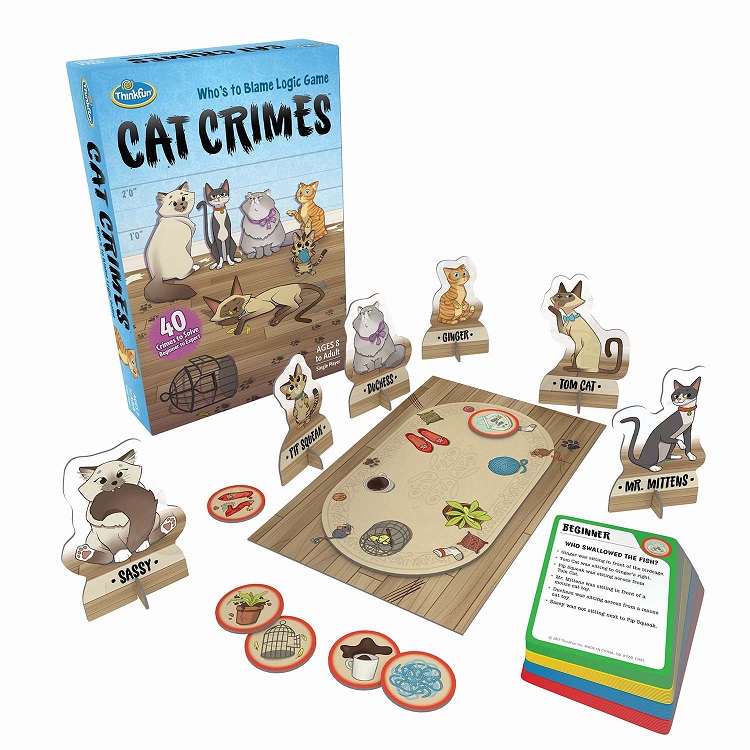
In Cat Crimes, you’re given a series of clues, and it’s up to you to place the six cat characters around the living room in order to determine which one has been up to some destructive mischief.

For instance, a given challenge card will list the crime in the upper right corner — a flowerpot that’s been knocked over, for instance — and the clues listed beneath will tell you which cats are your suspects, along with hints for where to place them in the living room.

The living room is covered with little bits of visual evidence — scratches on the floor, paw prints, mouse toys, etc. — that can be used to help you figure out where each of the cats were sitting when the crime was committed.
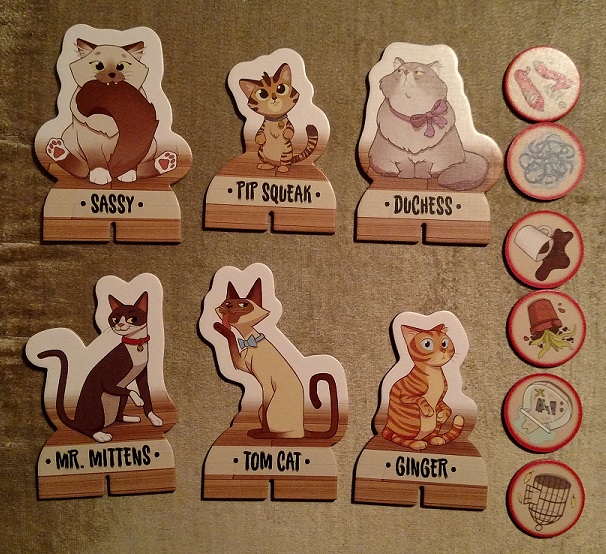
The beginner-level mysteries start out simple, with the clues mostly focused on the placement of the cats (across from a sock or next to some catnip, for instance). As the mysteries cards grow more complex — moving from beginner and intermediate levels of difficulty to advanced and, finally, expert — more options emerge. A cat could be in one of two places, or is only referenced with regards to another cat it’s sitting next to or across from.

Higher-level challenge cards will also refer to qualities of the cat suspects themselves. Some wear bows or have bells on their collars, while others are referenced by eye color. Solvers need to keep increasingly greater amounts of information in their head in order to place all of the cats in their proper positions and solve the crime.

I repeatedly found myself discussing possibilities out loud as I solved. “Well, if Sassy is between two of these cats, it can only be Mr. Mittens and Ginger, and Ginger can’t be in front of a scratch mark, so…”

With only six possible crimes and six possible suspects, you’d think that repeated play would lead to player burnout or quickly exhausting the possible permutations, but that’s not the case here at all. As you ascend through the deck of challenge cards, the ThinkFun team throw new twists and cluing styles at you, keeping you on your toes. A lot of creativity and hard work went into the cluing here, and it shows.

[Image courtesy of Logic Puzzles.org.]

It’s not only an absolutely adorable way to bring logic puzzle solving to a new audience, it’s also a refreshing change of pace for solvers accustomed to traditional logic puzzles (complete with those tables where all of the possible permutations are listed, and you can simply cross off the incorrect ones as you go). Cat Crimes requires you to keep more of that information in mind as you determine where each cat goes.

With up to six feline suspects to place per crime and 40 different crimes to solve, Cat Crimes will keep your deductive skills sharp, even as the easier challenge cards introduce younger solvers and logic newbies alike to a different style of puzzle-solving. Cat Crimes is not just one of the cutest puzzle games I’ve played in a long time, it’s the perfect gateway puzzle to strip away some of the intimidation factor of logic problems.

[Cat Crimes is available from ThinkFun and other select retailers for $12.99!]


Thanks for visiting PuzzleNation Blog today! Be sure to sign up for our newsletter to stay up-to-date on everything PuzzleNation!

You can also share your pictures with us on Instagram, friend us on Facebook, check us out on TwitterPinterest, and Tumblr, and explore the always-expanding library of PuzzleNation apps and games on our website!

PuzzleNation Product Review: Chessplus

Chess is one of the all-time classic games. Alongside Checkers, Go, Tic-Tac-Toe, and mah-jongg, chess is one of the cornerstones of the genre, one of the first games we’re introduced to, and one of the formative games upon which we build concepts of strategy, timing, and opportunity.

Over the centuries, there have been numerous attempts to reinvent chess or find new ways to play. We’ve talked about puzzly variations on chess in the past, all of which can be played with a standard chess set. (Except for that guillotine set we featured last year.) But if you’re looking for a truly unique chess experience, the team at Chessplus have a simple, elegant game for you.

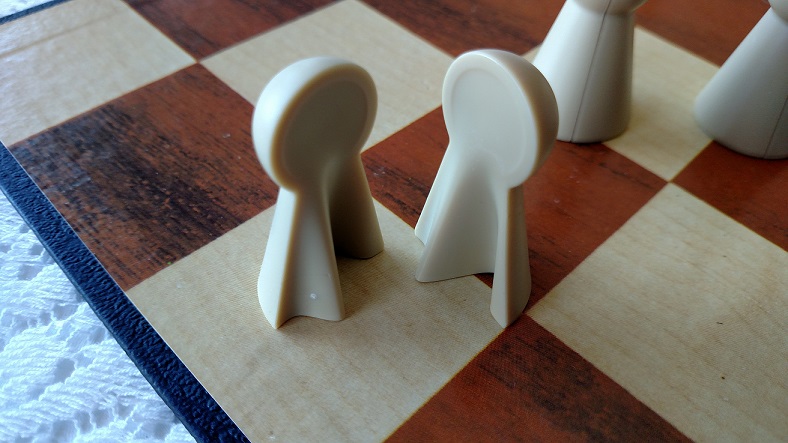
Chessplus is played under standard chess rules, but with one crucial difference: you can combine your pieces into more powerful ones.

Do you want a pawn that can make less-expected moves, or a knight that can play conservatively? Combine a knight and pawn into a single piece with the abilities of both. Do you need to keep your queen where it is, but still want a versatile piece that can command the board? Easy. Combine a rook and a bishop, and you’ve got a new piece that works just like a queen.

[Only the king is a solid piece. Every other piece can be combined with others.]

Merging pieces not only allows you to take advantage of each component’s abilities, but it can also allow you to more swiftly transport pieces across the board. Instead of a pawn crawling across the board one square at a time, combine it with a rook who can send it straight across the board, where it is then promoted to a queen! Or combine two pawns so you only have to escort one piece across the board safely, then split them again and voila! Two pawns promoted into new queens.

Oh yes, merging the pieces doesn’t link them forever. You can split them at any time. That feature adds another layer to your gameplay, since putting one merged piece into play deep in your opponent’s territory can suddenly become two separated pieces again.

Now, this piece-combining mechanic is a double-edged sword. Yes, you have a more powerful, mobile game piece. (I was very excited to try out combining a knight and a queen, just to make the queen even more dangerous.) But if someone takes a merged piece, you lose BOTH halves, making them as vulnerable as they are valuable. Imagine an opponent capturing my merged knight/queen, so I lose a knight AND a queen in one turn. That could be a devastating loss.

As you’d expect, it took a little while to grow accustomed to these new variant pieces. With so much to keep track of during a normal chess game, pieces with greater mobility make strategy — both offensive and defense — a bit more complicated.

But it was also great fun. Early Chessplus games tend to be faster, more aggressive, because of the greater mobility allowed by some of the merged piece combinations. But once you’ve played a few games, your more traditional chess mindset settles in, and gameplay tends to become more measured and tactical.

Just imagine. A single change that offers a world of new possibilities and challenges. That’s brilliant, in my estimation. Chessplus is a wonderful way to reinvigorate chess if the game has lost its luster for you. And if you are a dedicated player, I think Chessplus will prove to be a welcome change of piece from the traditional game.

[Chessplus sets start at $35.95 (for just the pieces) and are available from the shop on Chessplus.com.]


Thanks for visiting PuzzleNation Blog today! Be sure to sign up for our newsletter to stay up-to-date on everything PuzzleNation!

You can also share your pictures with us on Instagram, friend us on Facebook, check us out on TwitterPinterest, and Tumblr, and explore the always-expanding library of PuzzleNation apps and games on our website!

PuzzleNation Review: Topple Magazine

One of the best things about being a puzzle constructor these days is the level of access solvers have to you and your puzzles. Many constructors create and maintain their own puzzle subscription services, funding them through tips, crowdfunding, subscription fees, or direct-to-solver sales. When puzzly skills and a knack for self-promotion meet, you have the opportunity for real success in building a reputation and an audience.

So when constructor Gregory Gray reached out to me regarding his puzzle e-magazine, Topple, I was all ears. Whether it’s print books, downloadable puzzle packets, or Kickstarter campaigns, I’m always happy to spread the word about puzzle projects that I think the PuzzleNation audience will enjoy.

Gregory sent me the latest edition of Topple (issue VII) to review, so let’s dive right in.

Issue 7 offers a variety of different puzzles to try out. Anagramming and word-forming challenges, trivia, a rebus, some deduction, find-the-path games, and more can be found across these 12 pages of puzzles (plus solution pages, obviously).

I was immediately impressed with all of the different solving styles on display. Shying away from classics like crosswords, word seeks, and fill-ins, Topple opts for puzzles that offer greater opportunities to incorporate art and interesting layouts.

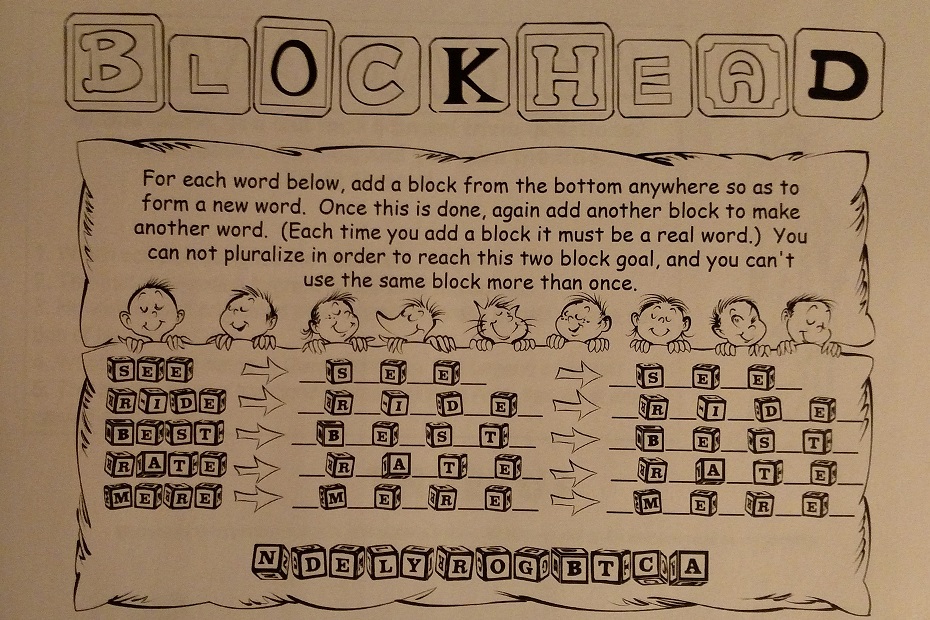
From the anagram rings of ‘Gram Crackers to the alphabet blocks of Blockhead, a great deal of work has clearly gone into not only the puzzles, but the presentation of them, which makes for a very eye-catching solving experience.

The mix of art and puzzles also presents a more welcoming tone for new solvers, who might find a denser arrangement of puzzle grids to be more off-putting or daunting. Each puzzle is given plenty of space to establish itself, so even unfamiliar puzzle types seem more inviting.

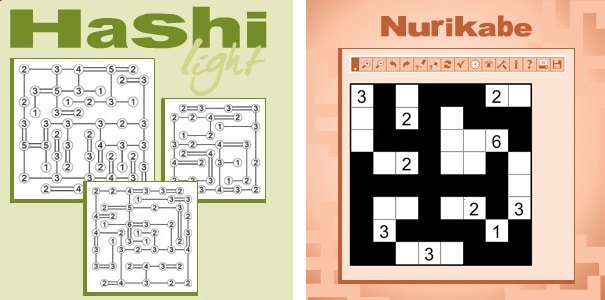
But solvers who prefer a bit more challenge will also find something worth their time in this issue of Topple, as a two-page spread of Japanese-style deduction puzzles awaits you in the middle of the book. Whether you’re connecting the dots in Masyu and Hashi or deducing the placement of numbers in Kakuro or black square in Nurikabe, these were easily the most challenging puzzles in the entire magazine, a pleasant change of pace for a more experienced solver.

[Examples of Hashi and Nurikabe puzzles.
Images courtesy of Conceptis Puzzles.]

To be fair, the book isn’t perfect. Some of the blurbs explaining the rules of each puzzle are a bit clunky, which can lead to moments of solver confusion. For instance, it’s not immediately clear in Blockhead if you can anagram the letters in each given word, or if those letters stay in place while you add a letter from the options below.

But those hiccups are few and far between, and for the most part, I found solving issue 7 of Topple to be a very enjoyable solving experience. I breezed through some puzzles, while others put my puzzly skills to the test.

And with Topple, you get quite a bang for your buck. Literally: Each issue of Topple is only $1, and when you consider both the variety of puzzles and the production quality of the book, it’s a steal.

So if you’re looking to try something new without breaking the bank, Topple is an excellent place to start.

The complete Topple collection, along with a free downloadable sampler pack of puzzles, can be found here. You can also subscribe to Topple through Patreon, and be sure to keep up with all things Topple-related on their Facebook page.


Thanks for visiting PuzzleNation Blog today! Be sure to sign up for our newsletter to stay up-to-date on everything PuzzleNation!

You can also share your pictures with us on Instagram, friend us on Facebook, check us out on TwitterPinterest, and Tumblr, and explore the always-expanding library of PuzzleNation apps and games on our website!

PuzzleNation Product Review: Zendo

[Note: I received a free copy of this game in exchange for a fair, unbiased review. Due diligence, full disclosure, and all that.]

Experienced puzzlers are familiar with deduction as a puzzle-solving method. They may know it from solving logic puzzles, determining who brought what to Thanksgiving dinner. They may know it from asking questions in Clue in order to eliminate possibilities and figure out who killed Mr. Boddy, where, and how. They may know it from brain teasers, riddles, puzzles, or card games.

But they’ve probably never tried their hand at a deduction puzzle game quite like Zendo.

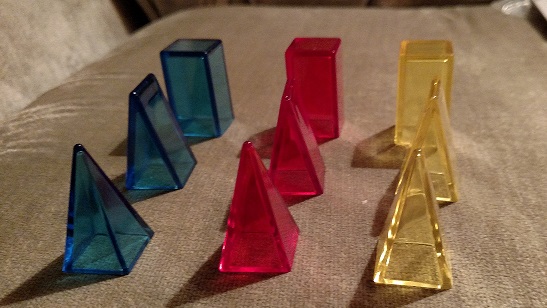
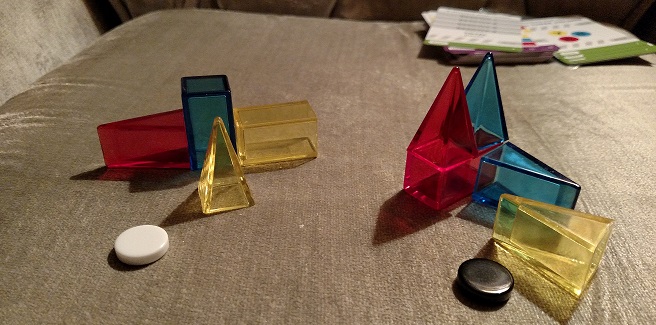
In Zendo, the players pull pieces from a communal pile in order to build different structures, using pyramids, wedges, and blocks. One player, the moderator, chooses a secret rule for the players to uncover, and builds two structures. One of these structures follows the secret rule, and one does not, and both are marked as such.

Secret rules can be as simple as “must contain all three shapes” or “must contain exactly four pieces.” They can be as complex as “must contain more blue pieces than blocks” or “must contain at least one yellow piece pointing at a blue piece.” Some rules involve how pieces touch, or how they’re stacked, while others demand no touching or stacking whatsoever. The field is wide open at the start of the game.

Players then try to deduce the secret rule by building structures themselves, arranging pieces from the communal pile into various patterns and asking the moderator for more information.

[Can you tell what the rule is by looking at these two structures?]

They can do so in one of two ways. The first is by saying “Tell,” wherein the moderator marks the player’s structure with either a white token or black token, depending on whether the structure fits the secret rule.

The second is by saying “Quiz,” wherein every player guesses whether the given player’s structure fits the rule. Every player who guesses right gets a guessing token.

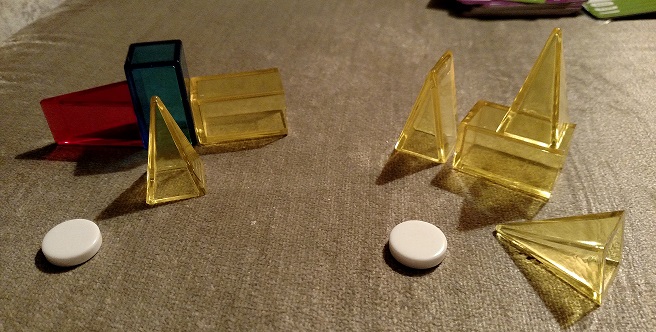
Guessing tokens, as you might suspect, are spent to guess the secret rule. But the moderator doesn’t answer with a simple yes or no. The moderator instead must build a new structure, which will either fit the secret rule (but not the player’s guess, and get marked with a white token) or fits the player’s guess (but not the secret rule, and gets marked with a black token).

This back-and-forth between players can be frustrating or informative, depending on how specifically you frame your guesses. It also tests the creative mettle of your moderator, which adds a curious wrinkle to the game. Not only are you competing with your fellow players to figure out the secret rule, but you have to deal with the often crafty skills of the moderator.

[Does this second sculpture give you any hints?]

It’s an ever-evolving puzzle that can change in an instant with a new bit of information. You might confirm you’re on the right track, or realize you’ve been looking at the structures incorrectly all along, and you’re back to square one (or, you know, pyramid one or wedge one).

But thankfully, Zendo is easily scalable for solvers of any age or solving skill level. You can keep the secret rule simple or make it complex, depending on who is playing. And if you’re the moderator, you have a free hand in determining how much information your structures reveal.

Like Fluxx and other games under the Looney Labs umbrella, Zendo has tons of replay value, and it’s a puzzle-game that ages well, since solvers with more experience are not only better players, but more devious moderators as well. This is some seriously puzzly fun.

Zendo is available from the crafty crew at Looney Labs, and it’s also featured in this year’s Holiday Puzzly Gift Guide!


Thanks for visiting PuzzleNation Blog today! Be sure to sign up for our newsletter to stay up-to-date on everything PuzzleNation!

You can also share your pictures with us on Instagram, friend us on Facebook, check us out on TwitterPinterest, and Tumblr, and explore the always-expanding library of PuzzleNation apps and games on our website!
PuzzleNation Product Review: Doctor Lucky’s Mansion That Is Haunted

[Note: I received a free copy of this game in exchange for a fair, unbiased review. Due diligence, full disclosure, and all that.]

Some board games are known for their iconic characters. You know the Monopoly guy, all the folks from Candyland, the mouse from Mouse Trap, the cast of suspects from Clue, and more. But one of the flagship characters from Cheapass Games might be new to you. His name is Doctor J. Robert Lucky, and players have been trying to kill him for twenty years now.

The game Kill Doctor Lucky has taken many forms over the decades — including several versions where players tried to save the infamous doctor instead — but the newest variation takes things in a spookier direction.

In today’s review, we look at Doctor Lucky’s Mansion That Is Haunted.

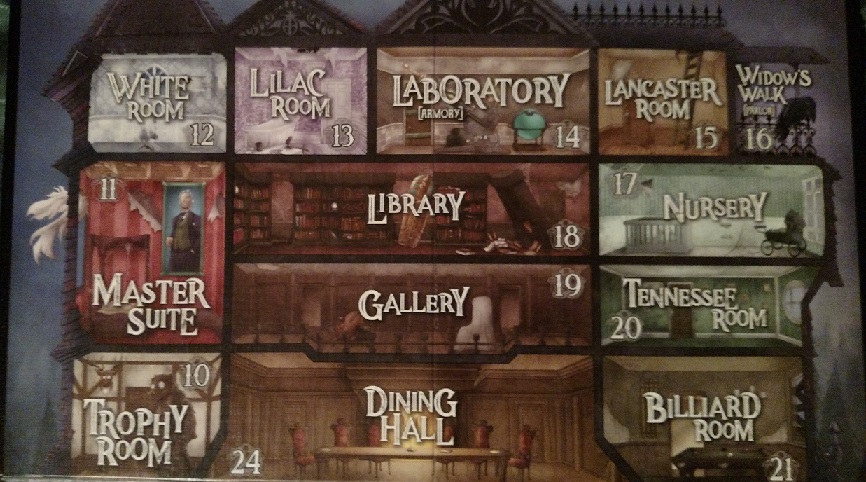
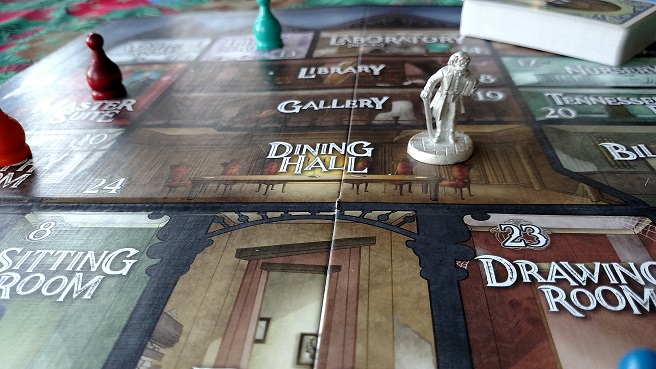
[Just half of the new game board.]

This expansion includes a new game board and new instructions, but that’s all; everything else you need to play is contained in the Deluxe 19.5th Anniversary Edition of Kill Doctor Lucky, including cards and tokens.

The endgame is also the same: kill Doctor Lucky before another player does. And while the same rules apply — you have to be alone in the room with Doctor Lucky and out of sight of every competitor — this expansion adds one curious wrinkle: all of the players are ghosts.

You see, in Doctor Lucky’s Mansion That Is Haunted, Doctor Lucky is trying to sell off his famous mansion, but the ghosts who also reside there wish for Doctor Lucky to stay, and they’ll go to any lengths to keep him around.

And you might not think that one curious wrinkle could radically change a game, but you’d be wrong. The fact that you’re a ghost means you can pass through walls, ceilings, and floors. That is a huge alteration in both strategy and game mechanics.

You can more quickly maneuver into a room with the Doctor, but you can also thwart your opponents by sneaking into a neighboring room and spoiling their murder attempt by observing the proceedings through an open door.

After all, it saves a lot of time to pass through a wall instead of leaving a room, moving down the hall, and entering the next. (Passing between floors is an even bigger time saver! Slipping through the ceiling and dropping in on someone is a marvelous feeling.)

Factor in the secret portals connecting several of the rooms, and suddenly the mansion is much more accessible.

This expansion harkens back to the early days of Cheapass Games — when they would send you the necessary pieces for their game and encourage you to harvest the extra bits (like dice and tokens) from games you already owned, thereby saving money all around — while adding new touches and revitalizing a game you already know quite well.

Plus, if Kill Doctor Lucky seems less family-friendly than you’d prefer, you can always call this Spook Doctor Lucky and give it a Scooby-Doo-esque twist.

Doctor Lucky’s Mansion That Is Haunted (and the Deluxe 19.5th Anniversary edition of Kill Doctor Lucky) are available from Cheapass Games. And the expansion is also featured in this year’s Holiday Puzzly Gift Guide!


Thanks for visiting PuzzleNation Blog today! Be sure to sign up for our newsletter to stay up-to-date on everything PuzzleNation!

You can also share your pictures with us on Instagram, friend us on Facebook, check us out on TwitterPinterest, and Tumblr, and explore the always-expanding library of PuzzleNation apps and games on our website!

PuzzleNation Product Review: Deluxe Pairs and BRAWL

[Note: I received free copies of these games in exchange for fair, unbiased reviews. Due diligence, full disclosure, and all that.]

Today, we’re looking at two card games that demand very different approaches to player strategy. The first requires you to patiently and craftily outlast your fellow players, while the other focuses on outmaneuvering your opponent as quickly as possible.

Today, we’re reviewing Deluxe Pairs by Hip Pocket Games and BRAWL by Cheapass Games.

The goal of Pairs is to avoid getting points, and you get points when you draw matching pairs of cards throughout the game.

It’s a bit like Blackjack, except the deck is designed to favor some cards over others. You see, a Pairs deck has one 1 card, two 2 cards, three 3 cards, and so on, all the way up to ten 10 cards. So not only is drawing a 10 dangerous because of its high point value, but it carries the additional risk of being more likely to come up in a deck than, say, a 2 or a 3.

As the dealer works his way around the table, you have the option to either fold or take a card. If you fold, you accept the lowest value card in play, and add those points to your total. If you take a card and end up with a pair, you end up with the value of that paired hand in your total.

The total score to avoid depends on the number of players, but the first person to reach or exceed that score loses, ending the game. So, essentially, this is less a game about winning and more a game about lasting longer than everyone else.

Deluxe Pairs expands on this idea by including a Companion Book with over 30 additional rulesets and variations. Originally, some of these variations were tied to Pairs decks of a specific theme (Deadfall was originally created for a wild west-themed deck, for instance).

But the revamped version of the Fruit Deck — the original Pairs deck — allows you to play all sorts of variations without needing those specialty decks.

BRAWL is about playing out combat in real time between two characters, each with their own strengths and weaknesses.

Each character’s deck is made up of hits, clears, blocks, bases, presses, and freezes. Your goal is to score as many hits as possible on your opponent by the time the match is over.

A match starts with each player placing one base card on the table. These represent combat encounters, so you need to play your hits, blocks, and other cards on the base cards for them to work. If you can’t play them, you must place them in your discard pile instead.

Hits and blocks are color-coded, so you have three different kinds: blue, green, and red. Once you’ve played one color on a base, you can only play further hits and blocks of the same color on that base. For instance, if there are only two bases up, and you’ve played a red hit on one and a blue hit on the other, then any green hit cards must be discarded until a third base is played.

Since your deck is shuffled, you won’t know what card you have to play until you draw it, making for a hectic game that mixes strategy with luck and speed. The faster you can react and take advantage of the cards as they come up, the more likely you are to outmaneuver your opponent and score hits.

Once the freeze cards at the bottom of the deck come up, the match is over, and you count up the number of hits on each base. Whoever has more hits wins the base, and whoever wins the most bases wins the game.

Similar to Slapjack and other quick-reaction card games, but with greater options and depth of play, BRAWL is frenetic, but fun. And with six player decks to choose from, experimenting to see which decks work against other decks makes for some serious replay value.

For starting players, I highly recommend using the Bennett and Chris decks in training mode, since they’re more balanced and forgiving for newer players, and the turn-based nature of training mode helps build confidence and experience in spotting opportunities for using your cards.

As you grow more familiar with the game’s mechanics, you can experiment with the nuances of the other characters, as well as introducing additional speed AND additional players in tournament mode.


I thoroughly enjoyed both of these games. They were very different play experiences, obviously, but both forced me to think tactically while remaining quick on my feet. Both games would be welcome additions to any puzzler’s social game collection.

Deluxe Pairs is available here from Hip Pocket Games and the six BRAWL character decks are available here from Cheapass Games. And both of these games are featured in this year’s Holiday Puzzly Gift Guide!

Next week, we’ll be reviewing another game from the Cheapass Games library: Dr. Lucky’s Mansion That Is Haunted.


Thanks for visiting PuzzleNation Blog today! Be sure to sign up for our newsletter to stay up-to-date on everything PuzzleNation!

You can also share your pictures with us on Instagram, friend us on Facebook, check us out on TwitterPinterest, and Tumblr, and explore the always-expanding library of PuzzleNation apps and games on our website!