5 Questions with PuzzleNation Director of Digital Games Fred Galpern

Welcome to 5 Questions, our recurring interview series where we reach out to puzzle constructors, game designers, writers, filmmakers, musicians, artists, and puzzle enthusiasts from all walks of life!

It’s all about exploring the vast and intriguing puzzle community by talking to those who make puzzles and those who enjoy them! (Click here to check out previous editions of 5 Questions!)

For the entire month of August, I’ll be introducing the PuzzleNation readership to many of the members of the PuzzleNation team! So every Thursday this month, you’ll meet a new name and voice responsible for bringing you the best puzzle apps on the market today!

And I’m excited to continue this series with Fred Galpern as our latest 5 Questions interviewee!

Fred is our Director of Digital Games, and he’s been the driving force behind our mobile app brand since Day One. With previous video-game experience working on iconic games like System Shock 2 and Thief, Fred brings illustration, digital art, and graphic-design knowhow to the table, bringing pen-and-paper puzzle concepts to new formats like mobile gaming and solving.

(He’s also a pretty sharp guitar and ukulele player, but as far as I know, that hasn’t factored into our app-development efforts yet.)

Fred was gracious enough to take some time out to talk to us, so without further ado, let’s get to the interview!


5 Questions with Fred Galpern

1. As Director of Digital Games, you’re the head honcho around these parts when it comes to app development. What does that job entail? What role do you play in bringing new features and apps to market?

PuzzleNation is a small team, which means we all wear multiple hats. For me, the most important, and coincidentally the most fun, hat is product management. In this role I set the direction for each of our apps, including sorting out what new features to add, which existing features to improve, what new content to offer to users and how to improve the look and feel of our apps.

Our approach always starts with what will be best for the app user; we then figure out how to make that good user experience work for us as business. Finally, we do our best to listen to user feedback so we can improve a feature after it’s released, so that our apps get better and better over time.

2. You had a background in game development and design before you began developing puzzle apps. How has your work in traditional video games informed your work with puzzles, and has working with puzzles changed how you view game design as a whole?

Prior to joining PuzzleNation I was fortunate to have had experiences all around the game industry, from intense hardcore game development projects to family-oriented games and even some gaming hardware. All of these experiences have been valuable, especially my experience at Blue Fang Games, where I was an Art Director and Producer for the Zoo Tycoon series. Working on that series showed me how fulfilling it can be to create games that appeal to people outside the stereotypical gamer audience of males aged 13 to 35.

PuzzleNation strives to provide users of all ages with great puzzle-solving experiences. The lessons I learned at Blue Fang are useful every day at PuzzleNation. Whether we’re planning new apps or improvements to our current apps, I often find myself recalling a previous project that suggests a solution for today’s projects.

3. The PuzzleNation audience first got to know you in our post announcing the free daily puzzle feature for the Penny Dell Crosswords app, where you mentioned you and your family are big board game players. Are there any new games that have become favorites in your house?

Oh yes, our passion for board games has not slowed down! Our current favorites include a mix of old and new games: X-Wing Star Wars miniatures game, Star Realms, Ascension, Marvel VS and 7 Wonders.

Of those, 7 Wonders has gotten the most play. It’s a wonderfully fun game that has a small learning curve followed by hours of enjoyable, strategic gameplay that works for all different play styles. I usually try aggressive strategies which are countered by more thoughtful approaches by my wife and kids. Board games are still in the midst of an amazing renaissance. I encourage readers to learn more on sites like Board Game Geek and The Dice Tower and Watch-It-Played YouTube channels.

[Fred, alongside the Puzzle Pope at last year’s American Crossword Puzzle Tournament.]

4. What’s next for Fred Galpern and PuzzleNation?

For me, next up is lunch! I know that sounds like a joke, but it’s true. Since I work from home, getting out of the house at lunchtime is a ritual that adds a bit of adventure to my day. I’m lucky to live in Providence, RI, a small city with an abundance of excellent restaurants. Today, I’m thinking of heading to historic Federal Hill, well known for several of the top Italian restaurants in the country. I’ll most likely indulge with a delicious Italian grinder sandwich or maybe a chicken parmigiana.

As for PuzzleNation, our what’s next may not be as literally delicious, but you can be sure it will be equally enjoyable. We’re deep into development of two great new apps, and at the same time rolling out performance improvements for our current Crosswords apps. I can’t go into specifics but can say that puzzle lovers who enjoy the puzzles found in Penny Press and Dell Magazines will be pleasantly surprised. Stay tuned to the PuzzleNation blog and Newsletter for more details soon!

5. If you could give the readers, writers, programmers, aspiring game/app designers, and puzzle fans in the audience one piece of advice, what would it be?

One piece of advice for all of those different folks? Wow, that’s a puzzle in itself!

I learned something many years ago about achieving goals. The only way to reach a goal is to never give up. On the surface this can seem like rah-rah, sports minded, “stay strong” type of advice. For me, the thinking behind it goes a bit deeper. “Never give up” doesn’t speak to just tenacity and willingness to keep trying, but also to the need to think differently about the path to a goal.

Sure, sticking doggedly to the path you’re on may get you to your goal; however, creative exploration and finding alternate paths is often a more enriching, fulfilling journey. I know that may sound a bit mystical, but I assure you it’s not. It’s as simple as settling on a goal to strive for, then waking up every day and checking in that you’re still on a path towards that goal. The path may change every day, every few days or not at all. As long as you’re still on a path that can logically lead to the goal, you are making progress towards that goal.


A huge thank you to Fred for his time! I can’t wait to see some of those new apps hit the market and watch the PuzzleNation brand expand and flourish!

Thanks for visiting PuzzleNation Blog today! Be sure to sign up for our newsletter to stay up-to-date on everything PuzzleNation!

You can also share your pictures with us on Instagram, friend us on Facebook, check us out on Twitter, Pinterest, and Tumblr, and explore the always-expanding library of PuzzleNation apps and games on our website!

It’s Follow-Up Friday: Murder Mystery edition!

Welcome to Follow-Up Friday!

By this time, you know the drill. Follow-Up Friday is a chance for us to revisit the subjects of previous posts and bring the PuzzleNation audience up to speed on all things puzzly.

And in today’s post, I’d like to follow up on last week’s murder mystery post.

In the previous post, I gave you some of the backstory and logistics of our in-office murder-mystery event, and today, I wanted to discuss the event itself.

Our murder happened Monday night — the fictional J. Augustus Milverton Puzzlenationo would breathe his last breath near the photocopier — so Tuesday morning marked the official start of the game.

And since we’re an office full of puzzlers, the morning began with something of a logic puzzle, as the players were given a list of passcodes used to enter the building, but they needed to figure out who had used them and at what time.

You see, someone’s passcode being used at a certain time didn’t necessary mean that person was actually entering the building at that time. Someone could’ve used another player’s code. (Information involving times and identities was scattered throughout emails to all 10 participants, so it would take a fair amount of cooperation to unravel this.)

But since all of the players were suspicious of each other — which was wise, given that several “solvers” were actually following my orders throughout the event to fulfill certain tasks — the first day didn’t involve as much cooperative solving as I’d hoped. (That would come the next day out of necessity, as alliances began to form and more information was shared.)

As I fielded questions from players asking for further details — and several clues were discovered and analyzed — the first of several complications for the players was revealed: a fellow player was “killed.”

This not only upped the stakes for the players, but led to one of my favorite moments in the game. You see, when a fellow player stumbled upon the body, he wasn’t sad that his coworker was dead…he was sad because he couldn’t ask him any questions. (Though, intrepid solver that he was, he asked if a Ouija board was out of the question.)

For the rest of the day, I was fielding all sorts of instant messages and emails from players, asking for information, cashing in Holmes Tickets, clarifying things, and trying to fit the pieces of the puzzle into place. Early theories emerged. Some were wild guesses, and some were surprisingly close to the truth.

Our event played out in real time, so the players were aware that things could happen outside the workday that would impact the game. People seemed reluctant to leave, just in case they missed a clue.

Day Two opened with another red herring — punny threats sent to three of the players, delivered in envelopes that pointed to another player (a gambit by the killer to put the spotlight on someone else) — and a few secrets had already come out.

Players openly offered information to each other in a group email, which helped resolve some red herrings and put other pieces into place. More clues were uncovered, but the murder weapon remained elusive.

Lunchtime was orchestrated to be a tipping point. Not only would another murder occur, but other plans and clues would come together. I gave one of my collaborators two missions to accomplish while the players were away from their desks. Hopefully, she’d be able to accomplish both, but at the very least, she had to accomplish one of the tasks.

There were a few of these open-ended narrative moments written into the story where the players had the chance to surprise me with what happened and what didn’t. Not only did those moments make the game more fun for me to run, but it gave other players chances to really inhabit their characters and get into the performance side of the gameplay.

Lunchtime allowed for more group theorizing — something that the workday hampered, as you might expect — but the real fireworks awaited players upon their return.

A trap was sprung, and another player died unexpectedly. Although some chaos did ensue, most of the players realized this latest death was the work of another party, and several of the players solved it quickly before returning their attention to the first two murders.

In the midst of all this, two real-world complications arose on Day Two.

The first involved a player dropping out due to a mix of time constraints (she felt the game was distracting her too much from work) and general frustration with the format of the game (which, for someone unfamiliar with immersive storytelling like this, is totally understandable). I was sad to see her go, and adjusted the story accordingly, recovering a clue from her and redistributing it to an active player.

The second involved the pace of the game itself. I’d hoped to run it over the course of Tuesday and Wednesday and have it wrapped up that second day. But between the elaborate unfolding plot and the difficulty in balancing gameplay with, you know, actually getting our work done, things were progressing more slowly than expected.

That darn workday. Such a nuisance.

So the game rolled into Day Three, and players could sense the end was near. Most of the puzzle pieces were there for the taking, and several compelling theories emerged. (Honestly, one of them was better than the story I’d actually written, which was both funny and a little humbling.)

To add a bit of drama, I set a deadline of mid-afternoon. If the murders hadn’t been solved by then, the killer would escape scot-free.

Things finally steamrolled to their conclusion when the murder weapon was revealed — in the hands of a thief who had been woven into the plot — and one of the players came close enough to cracking all three murders that I declared the mystery solved. (And our ace detective did so before the deadline, so no escape for our dastardly murderer.)

It was different from any murder-mystery event I’d run before, and everyone seemed to enjoy it. There were certainly flaws in execution, as there are in any first attempt, but I learned some valuable lessons in this play-through that will make other such events in the future smoother, more satisfying, and more engaging.

Although…I hadn’t considered the potential consequences of the event on workdays going forward; everyone seems a bit more wary of each other. (And there are a few vengeful “spirits” lurking about, hoping to avenge themselves in future games.)


Thanks for visiting PuzzleNation Blog today! Be sure to sign up for our newsletter to stay up-to-date on everything PuzzleNation!

You can also share your pictures with us on Instagram, friend us on Facebook, check us out on Twitter, Pinterest, and Tumblr, and explore the always-expanding library of PuzzleNation apps and games on our website!

5 Questions with PuzzleNation Programmer Mike O’Neil

Welcome to 5 Questions, our recurring interview series where we reach out to puzzle constructors, game designers, writers, filmmakers, musicians, artists, and puzzle enthusiasts from all walks of life!

It’s all about exploring the vast and intriguing puzzle community by talking to those who make puzzles and those who enjoy them! (Click here to check out previous editions of 5 Questions!)

For the entire month of August, I’ll be introducing the PuzzleNation readership to many of the members of the PuzzleNation team! So every Thursday this month, you’ll meet a new name and voice responsible for bringing you the best puzzle apps on the market today!

And I’m excited to kick things off with Mike O’Neil as our latest 5 Questions interviewee!

Mike is part of our dynamite programming team, maintaining the high level of quality we know PuzzleNationers expect of us and helping push us into new puzzly arenas. A musician and long-time video-game fan as well, Mike is enthusiastic, sharp, and immensely capable, part of the well-oiled machine that makes PuzzleNation a brand to watch!

Mike was gracious enough to take some time out to talk to us, so without further ado, let’s get to the interview!


5 Questions with Mike O’Neil

1. How did you get started with puzzles and games?

I’ve been a video-game addict my whole life, so when I got to college I eventually decided to make them for a living. Puzzles and puzzle solving have always been a part of being a big-time gamer, so I’ve been puzzle solving since I got the gamer bug as a kid, though my favorite magazine-type puzzles are word searches.

2. Programming, puzzles, and music all demand a strong sense of balance and flow to create an immersive and productive experience. As a musician, does that ever influence your work in unexpected or insightful ways?

I would say that it’s more of the opposite, where programming has influenced my musicianship. The biggest common feature of all three is patience, so growing up solving puzzles was good training for practicing guitar.

Also, working on a piece of music can actually be like solving a puzzle because every person is different, so I often need to “solve the puzzle” to figure out exactly how I’m going to be able to pull off a particular riff/lick/lead/etc, which could be radically different from how the next person would do it.

3. What do you do in your off-time? What helps you relax or mentally recharge after a long week of puzzling?

My biggest off-time activities are video games and music, though those can all be a bit mentally challenging and not often the greatest unwinding activity. If things get really heavy I often do some urban hiking around NYC. It’s very stimulating and can last for hours (I once walked all 33 miles around the perimeter of Manhattan. My feet hated me for a week.)

4. What’s next for Mike O’Neil?

What’s next is working with the PN team to get more and more types of puzzle apps out there. Crosswords are great, but we have so much potential with our tools and team that the sky’s the limit. I’m looking forward to seeing what we come up with.

[Crosswords ARE great! Have you checked out the Penny Dell
Crosswords App for both iOS and Android devices? /shameless plug.]

5. If you could give the readers, writers, programmers, aspiring game designers, and puzzle fans in the audience one piece of advice, what would it be?

One piece of advice is to make sure that the solution you come up with for your current problem is the best one, not necessarily the fastest or most slick. When I was mentoring students back at the Electronic Arts Academy, my main goal was to make sure that they don’t start implementing solutions for simple tasks with the super fancy, super complicated-type things you do in school. A good general rule is to imagine someone has to take over your work the next day, so make sure it’s easily understandable.


A huge thank you to Mike for his time. I can’t imagine a better way to introduce a month of PuzzleNation-fueled interviews and content!

Thanks for visiting PuzzleNation Blog today! Be sure to sign up for our newsletter to stay up-to-date on everything PuzzleNation!

You can also share your pictures with us on Instagram, friend us on Facebook, check us out on Twitter, Pinterest, and Tumblr, and explore the always-expanding library of PuzzleNation apps and games on our website!

Interactive Puzzling is Murder on a Work Day!

[Image courtesy of Carriageway.com.]

It all started with a board game at lunchtime.

TableTop Day is a popular annual event here at PuzzleNation, and several of my fellow puzzlers enjoyed it so much that they wanted it every week. Well, we couldn’t swing that — deadlines and all — so we play games every Wednesday during lunch.

During a particularly spirited round of 10 Minutes to Kill — a game where every player controls a hitman trying to take out three targets without being identified by the other players or the police — the subject of murder mysteries came up, and I let slip that I’d helped write and run several murder mystery dinners in the past.

[Image courtesy of Vancouver Presents.com.]

So, naturally, the idea of running a murder mystery at work became a recurring topic of discussion.

As a huge fan of interactive storytelling — be it tabletop role-playing games like Dungeons & Dragons, improv theater, LARPing, or other group activities — the idea appealed to me.

Of course, I had one huge hurdle to overcome: the work day.

You see, murder mystery dinners thrive on the theatricality of the event. Attendees can overhear arguments, catch snippets of banter and exposition as they walk around, and engage characters in conversation to learn more. The more you interact with the story, the better chance you have of solving the mystery, but even passive players will get the big picture.

But in a normal workday, I can’t stage big elaborate sequences, like a failed marriage proposal or someone tossing wine in another’s face. I’d have to find another way to deliver information, mysteries, and drama.

Thankfully, as a puzzler, I’m accustomed to writing clues. Cluing is simply delivering information in unexpected ways. Whether it’s through deceptive wordplay, puns, or connections with other entries, crosswords and logic problems are excellent training for being creative and stealthy while presenting important information.

So, I mapped out the murder and the characters I’d need to pull it off, and cast those characters from a group of fellow puzzlers. At the same time, I gauged interest from other coworkers to see who’d be interested in trying to crack the case, and began devising ways to weave them into the narrative. (This was more intimate than writing your usual murder mystery dinner for random attendees, since the latter is more about creating scenes than tailoring it to specific people and circumstances.)

[Can’t have a murder mystery without an animal for someone to pet fiendishly.
In this case, my trusty armadillo in a cowboy hat, Armando.]

My goal was to get everyone prepped to play on Monday, and then actually run the mystery on Tuesday and Wednesday, with the murder having occurred overnight.

Which led to another big hurdle. I couldn’t exactly stage an elaborate murder scene in a way that was unobtrusive to the workday, so I’d have to describe the scene to the players and let them ask questions about it.

But how do I leave clues for the players that are readily identifiable as clues and not just the ephemera of a working office? After all, any good murder investigation needs some convenient clues to uncover that will help unravel the mystery.

I opted to mark any clue (which were most often color pictures of actual items, like a stashed wallet or a threatening letter) with the symbol below, to remove any doubt that this item was involved someway in the murder mystery:

Okay, that takes care of the clues. But what about the actual interaction, where players ask questions of characters and gain the valuable knowledge needed to solve the crime?

Sure, a lot of that can be done through group emails and instant messenger programs, encouraging the investigators to share what they’ve learned, so there wouldn’t be random gaggles of investigators creating a distraction as they ponder the latest clue found or deduction made.

As a storyteller, whether you’re running an RPG or a murder mystery, you not only need to know the details of your story backwards and forwards, but you need to anticipate what questions the audience will ask.

And no matter how prepared you are, I assure you, the players will ALWAYS find a way to monkey-wrench your plans, whether they approach the problem from an unexpected direction or they ask for information you hadn’t prepared in advance. There had to be a simple way to reflect this in the actual gameplay.

To deal with this, I borrowed an idea from Lollapuzzoola and created Holmes Tickets, which were catch-all requests for deeper insight or information than had been provided. Basically, anything that would require outside intervention or skills beyond that of the casual investigator could be revealed by spending a Holmes Ticket.

Dusting for fingerprints, getting ahold of a coroner’s report, uncovering information on a missing check…all of these and more were results of investigators cashing in their Holmes Tickets at various points in the investigation.

So, how did the actual murder mystery go? Well, I’d love to tell you, but it’s not finished yet! The work day proved more intrusive than expected — damn those pesky deadlines and responsibilities! — so we’re rolling into a third day of passive gameplay.

By hook or by crook, the story will be wrapped up today, and I’ll be able to fill you in more on the actual story, clues, and progression of each investigation. For now, I’ll just let you know that there are currently three bodies to account for (our killer has been busy since Monday night), and a host of theories, but no firm accusations yet.

We shall see if justice is served or if our crafty killer gets away.


Thanks for visiting PuzzleNation Blog today! Be sure to sign up for our newsletter to stay up-to-date on everything PuzzleNation!

You can also share your pictures with us on Instagram, friend us on Facebook, check us out on Twitter, Pinterest, and Tumblr, and explore the always-expanding library of PuzzleNation apps and games on our website!

A proposal most puzzly!

Tuesday’s post was all about the chaos and unpleasantness ensuing from a puzzly misunderstanding, so let’s make today’s post about puzzles bringing people together.

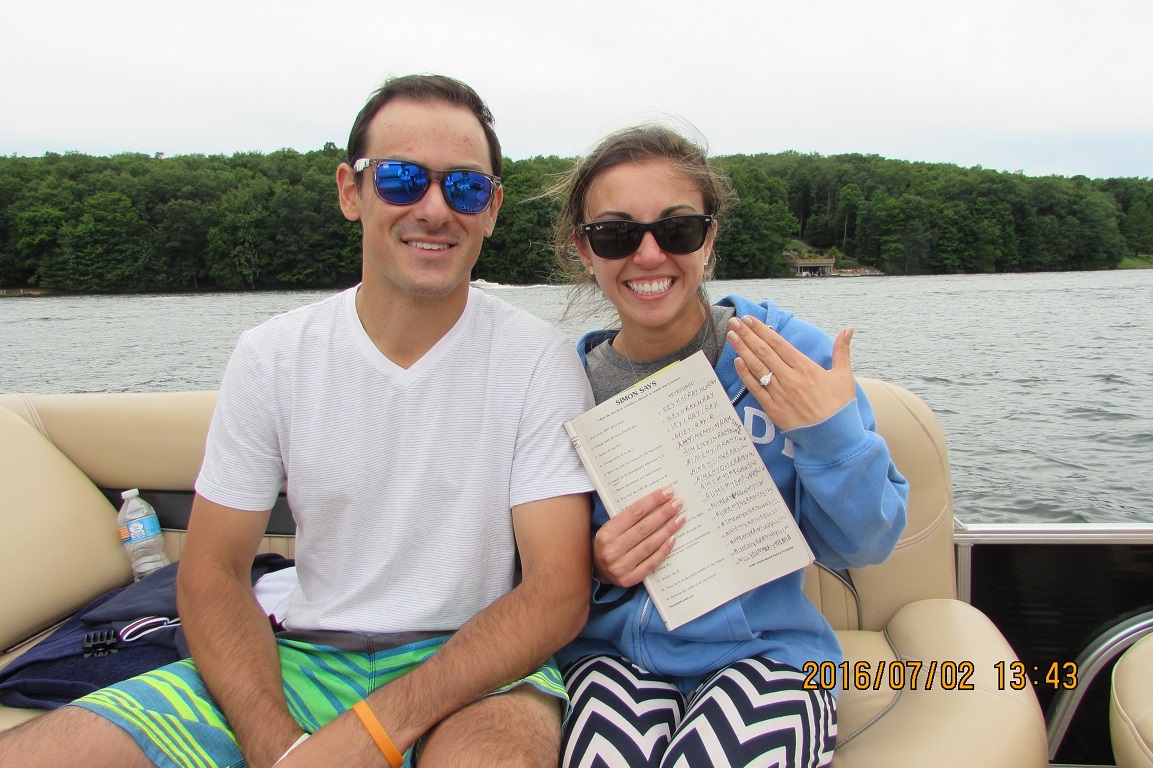
Oh yes, my fellow puzzlers and PuzzleNationers, we’ve got a puzzle-fueled engagement on our hands!

Our friends at Penny Dell Puzzles were contacted by a fellow named Bryan who wanted their assistance in crafting a puzzly proposal for his girlfriend.

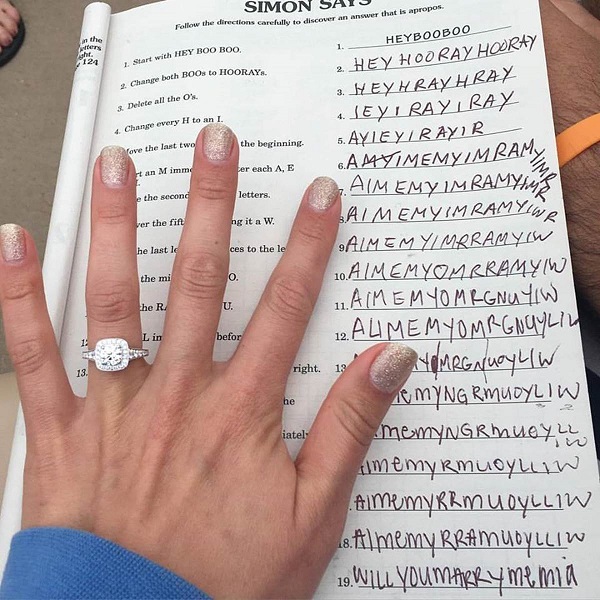
Bryan provided information and ideas for the folks at Penny to utilize, and a special Simon Says puzzle was constructed for the proposal and slipped into a short run of magazines during production. That way, the proposal would be concealed amidst many other puzzles, and his girlfriend wouldn’t suspect a thing! Diabolical!

(For the uninitiated, Simon Says is an instruction puzzle where you start with a phrase, follow various instructions on how to manipulate and change the letters in the phrase, and you end up with a completely new phrase, usually a pun or a play on the starting phrase.)

In this case, the puzzle started with an affectionate HEY BOO BOO, and 19 steps later, you end up with the fateful question WILL YOU MARRY ME MIA?

So… how did it go, you ask?

Success!

Bryan later told his puzzly cohorts:

The day couldn’t have turned out any better and the fact that she said yes definitely helped. We actually completed around half the book prior to the engagement and she had no clue that page was special. She was completely surprised as well as her parents and it took her until Line 17 to finally figure out what it said. Kudos to you guys for being able to draw it on for that long!

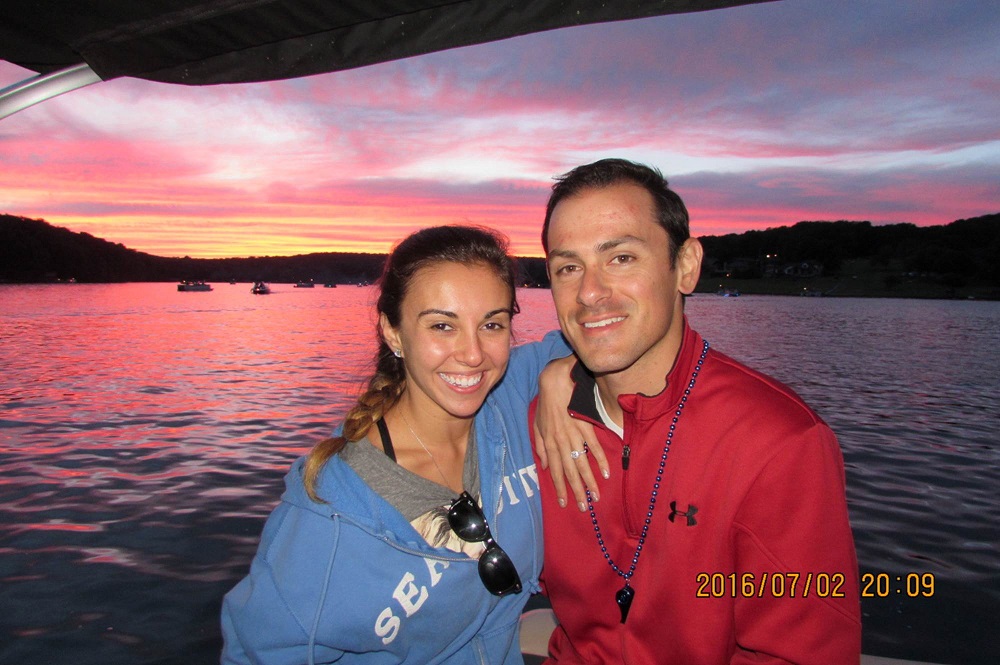
Congratulations to Bryan and Mia! I wish them nothing but the absolute best, and I hope they have many many happy years of love and puzzling ahead of them.

Our pals at Penny Dell Puzzles really outdid themselves on this one. Kudos indeed.

[For the story on the proposal the PDP crew assisted on last year, for another fellow named Bryan, click here!]


Thanks for visiting PuzzleNation Blog today! Be sure to sign up for our newsletter to stay up-to-date on everything PuzzleNation!

You can also share your pictures with us on Instagram, friend us on Facebook, check us out on Twitter, Pinterest, and Tumblr, and explore the always-expanding library of PuzzleNation apps and games on our website!

5 Questions with Constructor and Editor Patti Varol!

Welcome to 5 Questions, our recurring interview series where we reach out to puzzle constructors, game designers, writers, filmmakers, musicians, artists, and puzzle enthusiasts from all walks of life!

It’s all about exploring the vast and intriguing puzzle community by talking to those who make puzzles and those who enjoy them! (Click here to check out previous editions of 5 Questions!)

And I’m excited to welcome Patti Varol as our latest 5 Questions interviewee!

profilepic

If you’ve solved crosswords anywhere other than the New York Times for the last few years, you’re bound to have encountered Patti Varol’s clever constructing and crafty cluing. A regular of The Washington Post and other outlets, Patti is a topnotch constructor and a crossword pro.

She’s also no stranger to PuzzleNation Blog, as she has previously contributed advice for constructing your own crosswords and shared her victory at Lollapuzzoola two years ago with the PuzzleNation audience.

Patti was gracious enough to take some time out to talk to us, so without further ado, let’s get to the interview!


5 Questions for Patti Varol

1. How did you get started with puzzles?

I solved all kinds of puzzles with my grandparents when I was a kid, and games were a big part of family time when I was growing up. A few years after I finished college, I answered an ad for an editorial job with the crossword/variety department at Penny Press — the puzzle test and the interviews for that position, and then taking that job, well, that changed my life. Suddenly, puzzles and games were something to study from the inside out, to take apart and put back together better, to make from scratch. And that was just as much fun as solving them…and I was getting paid to do it.

puzzlebooks_zpstzpevapx

2. You keep awfully busy when it comes to puzzles. Can you fill the PuzzleNation audience in on your various puzzle jobs and how they differ from each other?

I do! I’m Rich Norris’s assistant at the L.A. Times Crossword, which means that I write some of his correspondence (I let constructors know what Rich likes or doesn’t like about the puzzles they’ve sent him), and I pre-edit some of the daily puzzles. I also send out the monthly constructor schedule notices and do some of our testing and fact checking.

I’m also the editor of The Crosswords Club, which is a monthly publication with six Sunday-sized crosswords. The puzzles are made by some of the best constructors in the business, so they are as fun as they are challenging. Each monthly envelope also has an extra word game, and all of the puzzles have explanatory blurbs with some trivia and etymology. It’s a really neat product – there’s really nothing else like it on the market.

And I also do puzzle testing/proofreading for a few other venues, including some crossword tournaments and puzzle magazines. And I’m a puzzle constructor for the CrosSynergy puzzle syndicate; my crosswords appear in The Washington Post roughly once a month. I also construct puzzles for the LA Times and Crosswords Club occasionally, and I mentor new constructors who seek out my help.

Every venue I work for has a different style guide and different target audience, so it’s a job in itself to keep them all straight. All of these different puzzle jobs have made me a strong, confident editor and constructor. I love what I do, and I love being good at what I do. And I’m only good at what I do because I’ve had the privilege to work with and learn from the best.

aid1316594-728px-make-crossword-puzzles-step-10

[Image courtesy of Wikihow.com.]

3. What, in your estimation, makes for a great puzzle? What do you most enjoy — or most commonly avoid — when constructing your own? What do you think is the most common pitfall of constructors just starting out?

A great puzzle has a spark to it — you know right away that it’s something original, fresh, and special. You learn something new, or you see something familiar from a new angle. It’s that aha! moment, that pop. I’m being maddeningly vague here, I realize, but the elements of a great puzzle are elusive and subjective.

That same pop comes when constructing a puzzle, too. Getting a tough grid to come together cleanly, realizing that the right pieces are finally all there in the right order — that can be even more satisfying than solving someone else’s puzzle.

New constructors always seem to start off with more than they can handle: they try to make a Sunday puzzle (21x) before they’ve mastered the smaller daily format, or they try to do a low-word-count themeless before they’re fully comfortable with the 15x themed format. Or they try to cram too much theme in a grid.

Start small, aim big, and you’ll get better with every grid.

4. Between the Timothy Parker plagiarism scandal and the recent Slate article about insensitivity and tone-deafness in cluing in the New York Times crossword, accountability has been a major topic this year in the world of puzzles. As a gatekeeper to getting published yourself, what changes would you like to see made in order to bring crosswords into the 21st century?

Change is already underway, and it’s exciting, because crosswords just keep getting better and better. Just as language evolves — words and their meanings can be as fluid as they can be subjective — so, too, do the media and art forms that rely on language.

crossword1

[Image courtesy of HomeSchoolSuccess.com.]

The conversations about crosswords, online and offline, illustrate clearly that the crossword community is made up of some of the smartest, most language-sensitive, funniest people you’ll ever meet. We’re in love with our craft, and sometimes we take ourselves and our work too seriously, which is what happens when you’re passionate about what you do. But it’s so important to remember that puzzles are entertainment, a happy diversion, and if we use language incorrectly or insensitively, we’re not providing that diversion. We have to take our fun very seriously!

When we’re polishing a puzzle, crossword editors have a very specific audience in mind — we know our solvers because we listen to them and because we’re solvers ourselves. Because of this larger, ongoing conversation, we know that our solving audience is bigger and more diverse than ever.

This presents an interesting challenge: how do you make every crossword accessible and fun for every solver, regardless of race, gender, or age? Maybe not every clue and every entry will resonate with every single solver, but as long as I’m not actively alienating a solver, and as long as I’m stretching, testing, and entertaining most of my solvers, I’m doing my job.

And there are so many crosswords available now! In addition to the newspaper dailies, there are paper subscription services like The Crosswords Club, plus email/blog subscriptions by so many talented constructors, and more puzzle books and magazines available on newsstands than ever before.

We’ll always have good, old-fashioned puzzles, but now we also have lively, fresh puzzles with more current pop-culture references. This, too, is what happens when you’re passionate about what you do: your art naturally reflects and includes the community it is a part of.

5. If you could give the readers, writers, aspiring constructors, and puzzle fans in the audience one piece of advice, what would it be?

Solve all the puzzles. All of them. Even the puzzles that, at first glance, look like the kind you don’t like, solve them. And if you don’t know the answers, look them up. There’s no such thing as cheating at a puzzle — it’s all simply research that makes you better at puzzles.

The more you look up, the more you will learn and remember for the next puzzle you solve. And if you want to learn how to make puzzles, or to get better at making puzzles, nothing will teach you more about how a puzzle works than getting stuck — and then unstuck — while solving one.


A huge thank you to Patti for her time. Be sure to check out The Crosswords Club, and follow her on Twitter for baseball tweets and updates on her latest projects! (Her website is currently under construction.) I cannot wait to see what she has in store for us next!

Thanks for visiting PuzzleNation Blog today! Be sure to sign up for our newsletter to stay up-to-date on everything PuzzleNation!

You can also share your pictures with us on Instagram, friend us on Facebook, check us out on Twitter, Pinterest, and Tumblr, and explore the always-expanding library of PuzzleNation apps and games on our website!