ACPT 2016 Wrap-Up!

ACPT LOGO

The 39th annual American Crossword Puzzle Tournament was this weekend, and puzzlers descended on the Stamford Marriott Hotel to put their puzzly chops to the test in what is lovingly called “the Nerd Olympics.”

The tournament takes place over two days, with six puzzles to solve on Saturday, followed by one on Sunday. Then the top three finishers solve the championship puzzle on white boards in front of the audience.

On Friday and Saturday night, there are often puzzle events, demonstrations, and panels by top puzzlers and figures in the puzzle world as well.

(This year, Friday night featured author and puzzler Eric Berlin hosting an Escape the Room-themed puzzle hunt that received rave reviews from participants, and Saturday night saw the first Merl Reagle Memorial Lifetime Achievement Award in crossword construction presented to constructor Maura Jacobson. Her husband accepted on her behalf from Merl’s widow, and there wasn’t a dry eye in the house.)

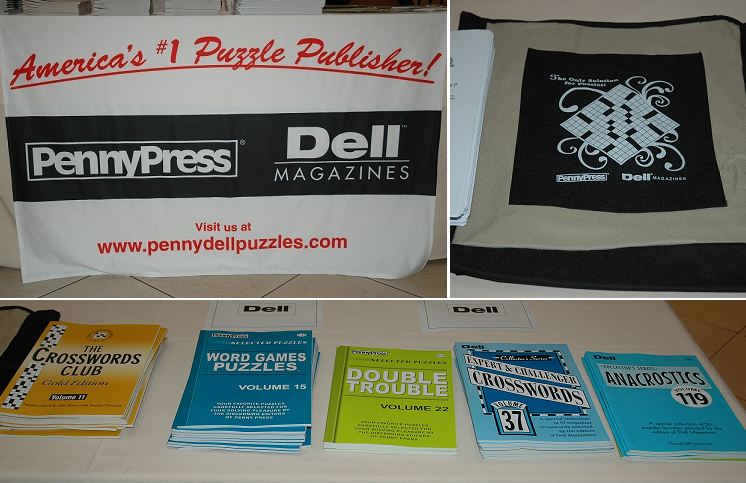
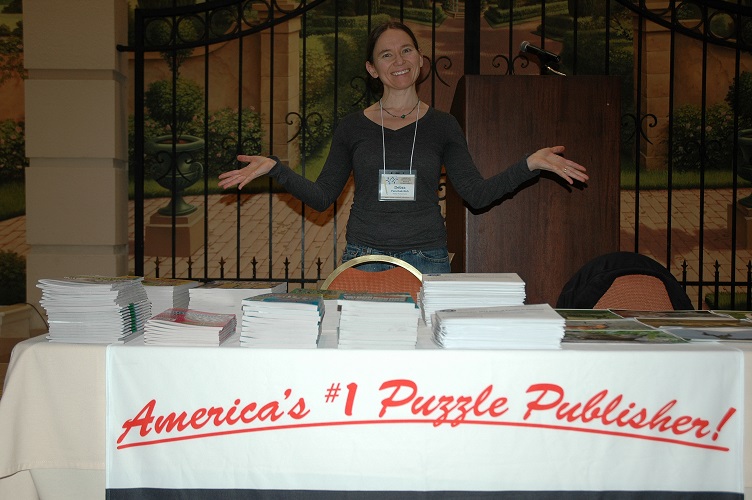
I made the journey down to Stamford myself Saturday morning and sat in with my friend, proofreader and puzzler Debra Yurschak Rich, at the Penny Dell Puzzles booth.

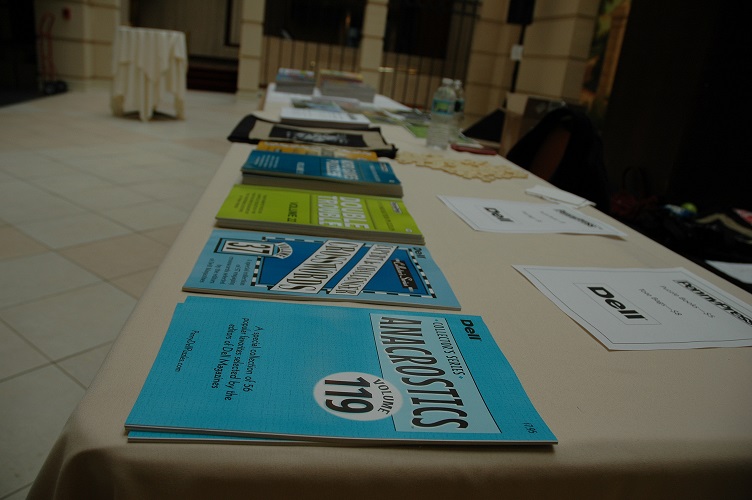
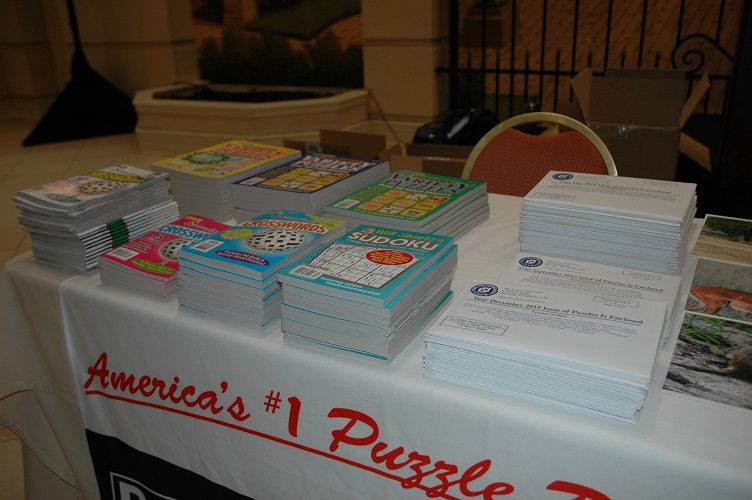
Our pals at Penny Dell Puzzles had a terrific setup as always, with great books and tote bags for purchase and a metric buttload of magazines to give away, including copies of The Crosswords Club, Will Shortz’s Sudoku, and several flavors of Tournament Variety, Master’s Variety, and Dell Sunday Crosswords!

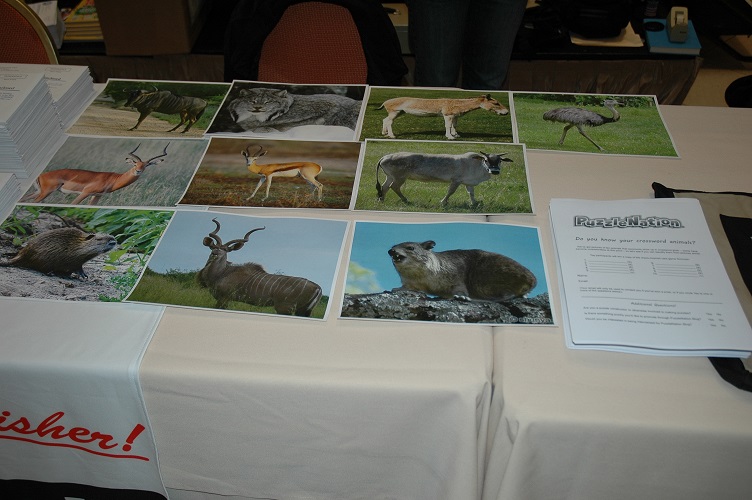
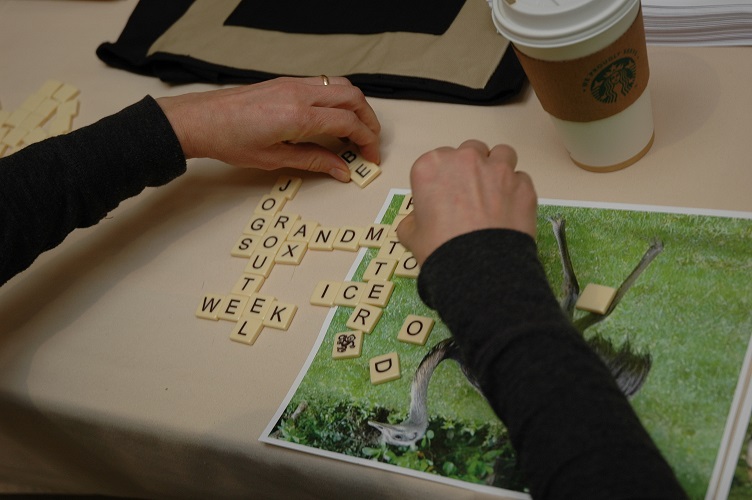
And they didn’t mind at all when I conquered and annexed the middle of the table for PuzzleNation’s in-person version of Friday’s View a Clue crossword animals puzzle. Many competitors stopped by the table to try their luck, allowing some to thoroughly impress their fellow puzzlers with their knowledge of African antelopes, while others were flummoxed trying to match names they’d written into grids dozens of times with images of the actual animal!

(One woman told me she’d seen many of these animals during a trip to South Africa, and even EATEN some of them, but she couldn’t identify them by name. I imagine it’s quite rare to know what an animal tastes like but not what it LOOKS like.)

At 9 AM, the tournament was two hours away, but the marketplace was up and running. In addition to the usual ACPT swag, the marketplace included Hayley Gold and her Across & Down comics, the aforementioned Eric Berlin (repping his Winston Breen books and Puzzle Your Kids subscription puzzles), a collection of Merl Reagle’s puzzle books, and an impressive selection of puzzly titles from the marvelous crew at The Village Bookstore in Pleasantville, New York!

Plus I got to see friends of the blog like Crosswords Club editor Patti Varol, constructor Ian Livengood, crossword gentleman Doug Peterson, and Penny Press variety editor Keith Yarbrough!

Another treat of the tournament is getting to chat with numerous puzzle luminaries I’ve gotten to know through PuzzleNation Blog, like New York Times Wordplay blogger Deb Amlen, constructor and Pre-Shortzian Puzzle Project curator David Steinberg, constructor Joon Pahk, top solver and former champion Ellen Ripstein, constructor George Barany, Evan Birnholz of Devil Cross, top competitor Tyler Hinman, and, of course, New York Times puzzle editor Will Shortz.

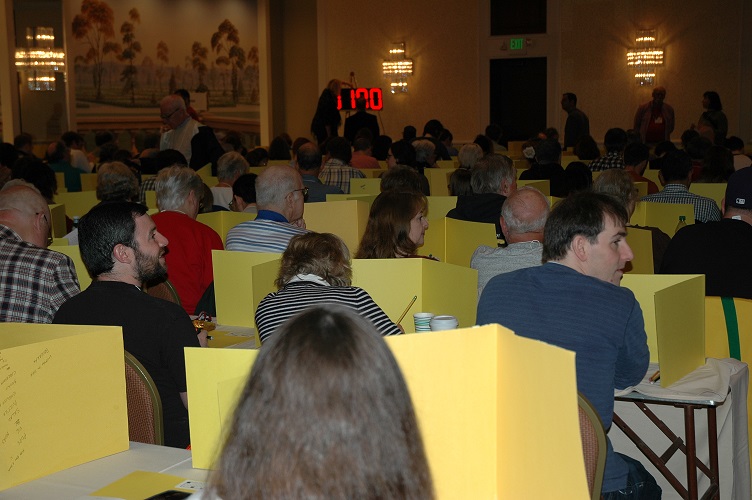
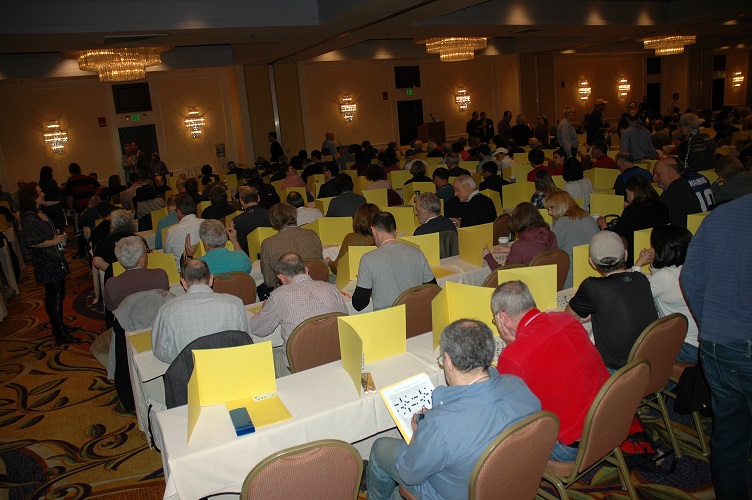
The two hours before showtime passed quickly, and soon, the marketplace emptied and the ballroom filled as competitors took their seats for Puzzle 1.

Puzzle 1 didn’t stagger any of the participants, although there was no repeat of Dan Feyer’s blisteringly fast under-two-minute solve like last year. Three minutes seemed to be the benchmark for the top performers this year.

But Puzzle 2 had a crossing that flummoxed several solvers: CORTANA crossing CONTE. Constructor Patrick Blindauer, not in attendance, was no doubt on the receiving end of some Puzzle 5-level heat for that one. But when Doug reached out to Blindauer, it turns out that THAT wasn’t Blindauer’s corner! It had been edited, with MONTANA becoming CORTANA.

I had no idea puzzles accepted for the tournament were edited that much!

Puzzles 3 and 4 passed without incident, and people seemed to enjoy both the camaraderie of the event and the opportunity to compete against their own best times from previous years.

[In our downtime, Debra and I indulged in a round or two of Bananagrams, because it was a day for wordplay of all sorts.]

Then Patrick Berry’s Puzzle 5 arrived, complete with zigzagging entries and a thoroughly impressive fill. (“Wow” was uttered several times by competitors describing their impression of the always-dreaded fifth puzzle of the day.)

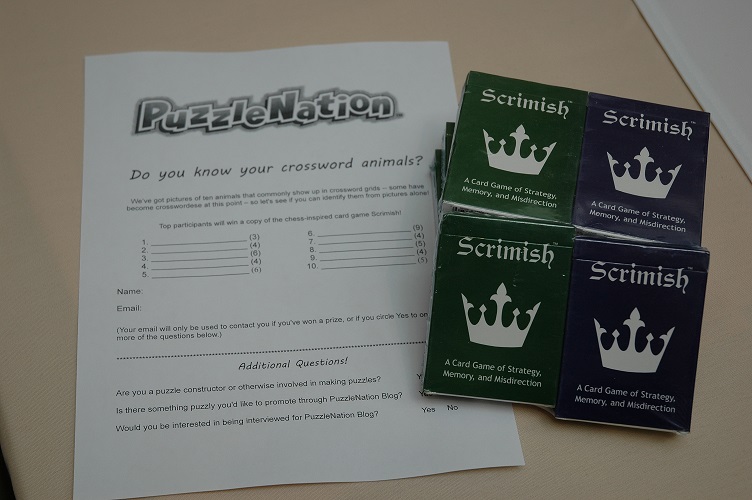
Between puzzles 5 and 6, I handed out prizes for our View a Clue crossword animals game: copies of Scrimish, donated by that game’s terrific design team!

Two copies went to our top performers — one got ALL TEN and another got nine out of ten — and two copies went in a drawing from all of the players who gave it their best shot. So congratulations to Robert Moy (who pitched a shut-out), Robert Kern, Abbie Brown, and the man known only as Dan (who got all but one)!

After the diabolical inventiveness of Puzzle 5, Puzzle 6 was tackled by the solvers, who declared it a fun and fair end to the day’s competition. The solvers dispersed to rest their brains; we packed up the table, and headed for home.

And although I wasn’t present for Sunday’s tournament finale, I continued to get updates from friends and fellow puzzlers.

The day started off with Lynn Lempel’s Puzzle 7, which received strong reviews, but did little to alter the standings of the top competitors.

Soon, it was time for the finalists to be announced. When it came time for the top three to solve on their whiteboards in front of their fellow competitors, two of the names were quite familiar to attendees: Dan Feyer, defending six-time champion, and Howard Barkin, four-time champion and perennial participant in the finals.

Conspicuous by his absence was another familiar name and former champion, the performer who made last year’s finals such a nail-biting showdown: Tyler Hinman. An unfortunate error in Puzzle 2 took him out of the running, so the final member of the live-solving trio would be David Plotkin. (Joon Pahk, Francis Heaney, Al Sanders, Jon Delfin and other regular key performers were also near the top.)

He and Howard prepared for a thoroughly wordy and daunting battle with Mr. Feyer, whose excellent performance in the seven previous puzzles had him leading his competitors by three minutes.

You can watch the final puzzle being solved below:

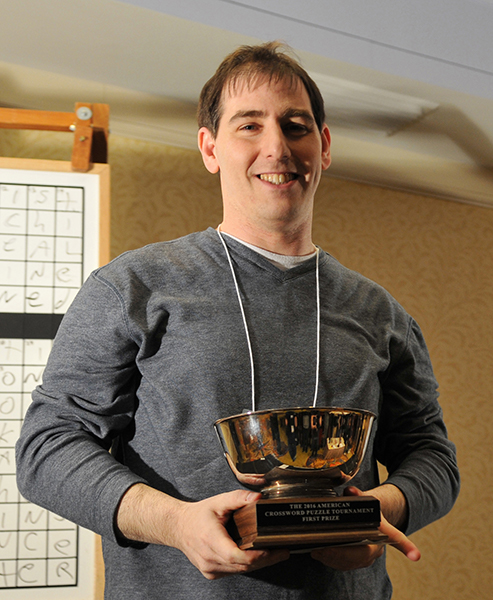
In a stunning upset, Howard Barkin did the seemingly impossible, besting Dan Feyer and claiming the top spot! The room erupted for him as others sat by, stunned that the expected seventh straight win for Dan was not to be.

[Howard poses with his well-earned trophy.]

But that’s not all! Friend of the blog and crossword gentleman Doug Peterson placed 13th overall AND won the finals for Division B! Congratulations to Doug!

And it was a strong showing for many other familiar names! Patti Varol placed 97 (up from last year’s 109 showing), David Steinberg 113th, Kathy Matheson 237th, and Keith Yarbrough 266th out of a field of nearly 600 participants.

It was certainly a day for surprises, strong emotions, and puzzly camaraderie. It’s always great fun to spend time with fellow puzzlers and wordplay enthusiasts, immersing myself in the puzzle community and enjoying all the charm and weirdness that comes part and parcel with it.

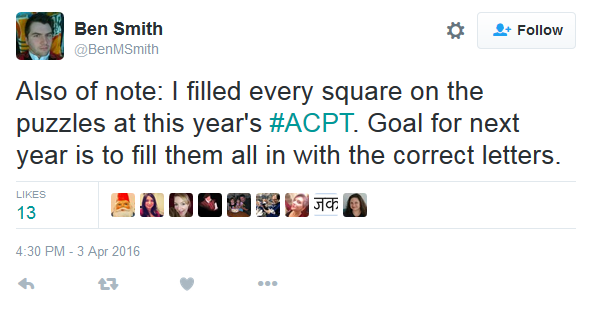
That would’ve been my closing statement, but I think the final word belongs to competitor Ben Smith:


Thanks for visiting PuzzleNation Blog today! Be sure to sign up for our newsletter to stay up-to-date on everything PuzzleNation!

You can also share your pictures with us on Instagram, friend us on Facebook, check us out on TwitterPinterest, and Tumblr, and explore the always-expanding library of PuzzleNation apps and games on our website!


Other puzzles you might not know! (Volume 1)

We’re all puzzle fans here, right? And sometimes we need something new, something fresh and engaging to rejuvenate our love of puzzles. We know all the classics — crosswords, fill-ins, logic puzzles, word seeks, Sudoku, cryptograms, and anagram puzzles — but there’s a whole wide world of puzzles out there to explore that you might not even know about!

So, in today’s post, I’m going suggest some puzzles to check out, based on each of those classic solving experiences.


Let’s start with crosswords.

From the New York Times and LA Times crossword puzzles to the Penny Dell Crossword App, there’s no shortage of terrific crosswords of all difficulty ranges awaiting solvers.

But there are also some terrific variant crosswords for you to try out, like Double Trouble.

[Click here or on the grid for a larger version, complete with clues.]

In a Double Trouble crossword, you can put one, two, or three letters into a box, making for a more difficult solve that the standard one-letter one-box crossword.

But if you want to go a little farther afield, you can try something like Marching Bands.

[Image courtesy of Brendan Emmett Quigley’s website.]

A Marching Bands puzzle has two sets of clues. The first set clues the rows reading across, with two clues per line. But the second set is where things get interesting. See those alternating rings of light and dark shading? The second set clues words reading clockwise along those rings, or bands.

So instead of words meshing across and down, as in a standard crossword, you have across clues and band clues interacting to help you fill the grid. It’s a wonderful variation on familiar crossword rules, but one challenging enough to keep you interested. (For a more in-depth look, click here!)

But maybe you like crossword cluing but you’d like an answer more interesting than just a grid filled with words. Fair enough, have you ever tried Crostics?

[Click here or on the grid for a larger version.]

Crostics, also known as Anacrostics (from our friends at Dell Magazines) or Acrostics (as made by friend of the blog Cynthia Morris), feature a series of clues and letter blanks to be filled.

Those letter blanks each have coordinates assigned, so that when you fill the correct letters into those blanks, you’re also filling blanks in a grid below to spell out a bonus message, quotation, or anecdote. (It’s a one-to-one ratio, so each letter blank corresponds to a letter blank in the grid. If there’s one J in the message, you’ll find a J in the answer words.)

Although you don’t have the overlapping entries to help you puzzle out answers like crosswords or Marching Bands do, you can use the grid below as a solving aid. As each word in the message emerges, you can fill in those letters in the blanks above (using those same coordinates).

And for something along the same vein, you’ve got Word Games Puzzles.

[Click here or on the grid for a larger version.]

You still get the message reading out in a grid and the letter blank coordinates like in Crostics, but instead of a bunch of crossword-style clues, you instead get four mini-games to solve. One might be trivia or encryption, another might involve some wordplay, another might offer themed clues, and the fourth might be an anagram game.

Each will challenge you in different ways, and the use of repeated letters — a change from Crostics with their one-to-one letter blank to grid letter ratio — gives you more than one chance to fill in the final message.

Hopefully, one or more of these puzzles will pique your interests and offer a welcome new solving experience!


Next week, I’ll have recommendations for fans of Fill-In puzzles, and in future installments, we’ll tackle word seeks, logic puzzles, Sudoku, and more! If you’ve got recommendations for your fellow puzzlers, please let us know in the comments!

Thanks for visiting PuzzleNation Blog today! Be sure to sign up for our newsletter to stay up-to-date on everything PuzzleNation!

You can also share your pictures with us on Instagram, friend us on Facebook, check us out on TwitterPinterest, and Tumblr, and explore the always-expanding library of PuzzleNation apps and games on our website!

Puzzle Plagiarism?

[Image courtesy of PlagiarismToday.com.]

Today’s post isn’t the usual Follow-Up Friday fare. Instead of returning to a previous subject, I’d like to discuss a topic that I expect I’ll be returning to in Follow-Up Friday form in the near future.

There is a certain pride and sense of accomplishment you experience as a puzzler when you come up with an exciting, innovative, unexpected theme idea for a puzzle, or when you pen a terrific clue for a word. Whether the wordplay is spot on or you’ve simply found a way to reinvigorate a tired bit of crosswordese, you feel like you’re adding something to the ever-expanding crossword lexicon, leaving a mark on the world of puzzles.

Unfortunately, there’s also the flip side of that coin, and those who would pilfer the hard work of others for their own gain. And in a story broken by the team at FiveThirtyEight, there may be something equally unsavory going on behind the scenes of the USA Today crossword and the Universal syndicated crossword.

You can check out the full story, but in short, an enterprising programmer named Saul Pwanson created a searchable database of crossword puzzles that identified similarities in published crosswords, and it uncovered an irregularly high number of repeated entries, grids, and clues in the USA Today and Universal crosswords, both of which are edited by Timothy Parker.

More than 60 puzzles feature suspicious instances of repetition — the word “plagiarism” comes to mind, certainly — and it has sparked an investigation. In fact, only a day after the story first broke, Universal Uclick (which owns both the USA Today crossword and the Universal syndicated crossword) stated that the subject of the investigation, Parker himself, “has agreed to temporarily step back from any editorial role for both USA Today and Universal Crosswords.”

I’ve heard that oversight of the USA Today crossword has already passed to another editor of note in the crossword world, constructor Fred Piscop (author of last Wednesday’s New York Times crossword), but I wonder if more examples of crossword duplication are lurking out there.

With resources like XWord Info and the Pre-Shortzian Puzzle Project out there, the history of crosswords is becoming more and more accessible and searchable. I can’t help but wonder if more scandals are lurking down the pike.


Thanks for visiting PuzzleNation Blog today! Be sure to sign up for our newsletter to stay up-to-date on everything PuzzleNation!

You can also share your pictures with us on Instagram, friend us on Facebook, check us out on TwitterPinterest, and Tumblr, and explore the always-expanding library of PuzzleNation apps and games on our website!

It’s Follow-Up Friday: Crossword Contest Conclusion edition!

Welcome to Follow-Up Friday!

Follow-Up Friday is a chance for us to revisit the subjects of previous posts and bring the PuzzleNation audience up to speed on all things puzzly.

And today, I’m returning to the subject of crossword contests!

Last month, I announced the latest crossword contest from the topnotch puzzlers at Barany and Friends. The contest, titled Eliminating the Competition, wrapped up on February 8, but the answer to the meta puzzle concealed within each grid was only revealed this week!

As it turns out, the crafty cruciverbalists paid tribute to the American Crossword Puzzle Tournament by dropping the letters A, C, P, and T from the theme entries in the grid! Not only that, but there were no As, Cs, Ps, or Ts to be found anywhere else in the puzzle grid! Diabolical!

Open division puzzle theme answers:

  • They are left over after division: REMINDERS (“Remainders” with the A eliminated)
  • Lack of affection, say: HILLINESS (“Chilliness” with the C eliminated)
  • A cylindrical utensil used to flatten dough: ROLLING IN (“Rolling pin” with the P eliminated)
  • They’re often found in churches or on campuses: BELL OWERS (“Bell towers” with the T eliminated)

They also hid the reveal, MHU, in the lower right corner. (Fiendishly, MHU is MATCHUP with A, C, P, and T eliminated!)

You can check out the full details of the meta puzzle here, including the theme answers for both the Open Division puzzle and the Master Division puzzle, which was a doozy!

But there’s more! They’ve also announced the prizes for the winners, which include paid registrations to the ACPT, puzzle e-books, crossword subscriptions, autographed puzzle books, and specialized crossword puzzles with the winner’s name built into the grid!

They’ve truly gone all out this year to make the Eliminating the Competition contest something special. Kudos to George Barany, Ralph Bunker, John Child, Michael Hanko, and Roy Leban for creating a terrific challenge and a puzzly feast for solvers.

Did you accept the Barany and Friends challenge this year, fellow puzzlers and PuzzleNationers? Let us know if you did! We’d love to hear from you!


Thanks for visiting PuzzleNation Blog today! Be sure to sign up for our newsletter to stay up-to-date on everything PuzzleNation!

You can also share your pictures with us on Instagram, friend us on Facebook, check us out on TwitterPinterest, and Tumblr, and explore the always-expanding library of PuzzleNation apps and games on our website!
What Crosswords (May) Tell Us About Language

Several friends of the blog linked me to a post in The New York Times about the ever-evolving use of language in crosswords.

Essentially, the authors analyzed the frequency of foreign word use in NYT crosswords, and then extrapolated what that means about our language and our cultural evolution and development over the course of the crossword century.

And the authors unearthed some interesting patterns when it comes to the use of foreign language entries and clues: they’ve gone down. “Foreign-language clues and answers peaked in the 1960s and now make up less than 4 percent.”

The authors point out that this contrasts with the growing globalization of communication and pop culture, perhaps making a statement about crosswords as a linguistic bulwark against dastardly foreign words — the wordy equivalent of keeping the metric system at bay with feet and miles and other Imperial units.

But to me, that simply reflects the ongoing refinement and evolution of puzzles away from obscurities — both foreign and domestic — in favor of better, more accessible crossings. To be honest, a lot of these foreign references qualify as crosswordese, because you’d rarely, if ever, encounter them in casual conversation, even in this increasingly globalized society.

I often joke that crosswords have improved my knowledge of African animals, European rivers, and Asian mountain ranges, none of which really affect my life in any other way. I can file them away with all the high school science I learned, like the definition of osmosis.

Some of their assertions did make me laugh, though. In their closing paragraph, they state:

But we are more likely to encounter Uma as an actress (117 answers since 1990), and not as a Hindu goddess (five answers, none since 1953).

[Pictured: a Hindu goddess enjoying a milkshake.]

And at no point do they mention that Uma as an actress would likely have been used — quite gratefully — by constructors in the ’40s and ’50s, had there been a prominent (or even remotely famous) Uma in films at the time. Heck, I’ve been begging for someone to discover the next megastar Una or Ona or Oona or Ana to help revitalize my cluing.

There will always be a drive to innovate new entries and keep up with the latest in popular culture. That’s part of what maintains the quality and interest in crosswords: they evolve with us.

Admittedly, it’s fun to imagine someone hundreds or thousands of years from now, trying to reconstruct our society and general knowledge based on crossword entries and cluing. They’d no doubt wonder why poetic terminology and female sheep were so important to us.


Thanks for visiting PuzzleNation Blog today! Be sure to sign up for our newsletter to stay up-to-date on everything PuzzleNation!

You can also share your pictures with us on Instagram, friend us on Facebook, check us out on TwitterPinterest, and Tumblr, and explore the always-expanding library of PuzzleNation apps and games on our website!
It’s Follow-Up Friday: International Puzzle Day edition!

Welcome to Follow-Up Friday!

By this time, you know the drill. Follow-Up Friday is a chance for us to revisit the subjects of previous posts and bring the PuzzleNation audience up to speed on all things puzzly.

And today, I’d like to return to the subject of puzzly holidays!

[Let’s celebrate with some crossword cake!]

Today is International Puzzle Day (or National Puzzle Day, depending on who you ask), and we here at PuzzleNation couldn’t resist getting involved in the puzzly celebrations!

In fact, we went all out this year, building a puzzle fort from various puzzle magazines! Check it out!

puzzle fort

And that’s just for starters. We’ve also assembled a new rundown of all the terrific puzzle apps and games PuzzleNation has to offer!

From the iOS and Android versions of the Penny Dell Crossword App (including new puzzle collections for both!) to our Classic Sudoku, Classic Word Search, and Bible Word Search apps, you can get all the details on our library of apps right here!

And to cap off the day’s festivities, we’ve collaborated with our pal Darcy over at Penny Dell Puzzles to concoct a little puzzly quiz for you!

Click here to find out What Kind of Puzzle Am I?, complete with links to share your results across social media!


So how are you celebrating International Puzzle Day? Are you kicking back with your favorite app or puzzle book? Meeting with friends to do a bit of tabletop gaming? Or maybe tackling an Escape the Room event and testing your puzzle mettle! Let us know in the comments!

Thanks for visiting PuzzleNation Blog today! Be sure to sign up for our newsletter to stay up-to-date on everything PuzzleNation!

You can also share your pictures with us on Instagram, friend us on Facebook, check us out on TwitterPinterest, and Tumblr, and explore everything PuzzleNation on our website!