
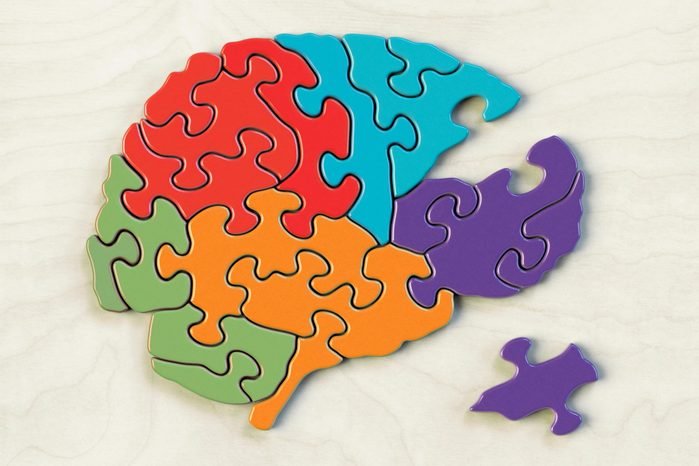
I was going through a collection of brain teasers a fellow puzzler gave me, and it occurs to me that “brain teaser” is one of the least specific puzzle terms around.
Riddles, logic and deduction, math puzzles, and wordplay games all fall under the brain teaser umbrella. So you never know what you’re gonna get. Are your math skills required? Your outside-the-box thinking? Your ability to pay attention to the specifics of the question itself?
In this collection alone, I found examples of each of these types of puzzles:
Riddle: Sometimes I’m green, sometimes I’m black. When I’m yellow, I’m a very nice fellow. That’s when I’m feeling mighty a-peeling. What am I?
Logic / deduction: 3 guys go into a hardware store, all looking for the same thing. William buys 1 for $1. Billy buys 99 for $2. Finally, Willie buys 757 for $3. What were they buying?
Math puzzle: The sum is 12 and the same digit is used 3 times to create the sum. Since the digit is not 4, what is the digit?
Wordplay: Which state capitals would you visit to find a ram, cord, bus, and dove?
So, if someone challenged you to a brain teaser, these would all be fair game. Would you be able to solve all four of them?

It’s possible you wouldn’t, because good and bad brain teasers alike employ tricks to keep you on your toes.
Some hide the answer in plain sight:
Homer’s mother has 4 children. 3 of them are named Spring, Summer, and Autumn. What is the 4th named?
Some use misdirection, purposely phrasing the question to get you thinking one way and steering you away from the real solution:
The big man in the butcher shop is exactly 6’4″ tall. What does he weigh?
In fact, both of these examples use plain sight (Homer, butcher shop) and misdirection (implying a pattern with seasons, specifying his height) to distract you.
I suspect you weren’t fooled by either of them, though.
Others try to overwhelm you with information so you bog yourself down in the details instead of clearly analyzing the problem at hand:
Nina and Lydia start from their home and each runs 2 miles. Nina can run a mile in 8 minutes 30 seconds and Lydia can run a mile in 9 minutes 10 seconds. When they finish running, what is the furthest apart they can be?
A lot of numbers get thrown at you, but they’re irrelevant, since the question only asks about the distance, not the time. So if they each run 2 miles, the furthest apart they can be is 4 miles. The rest is just smoke.
These are all effective techniques for teasing a solver’s brain. You’re given all the information you need to solve the puzzle, plus a little extra to distract, mislead, or overwhelm you.

Unfortunately, some brain teasers use unfair techniques to try to stump you:
Jacob and Seth were camping in June. Before going to sleep they decided to read a book. They both agreed to stop reading when it got dark. They were not fast readers, but they finished the entire encyclopedia. How?
Ignoring the fact that these two boys somehow brought an entire encyclopedia with them on a camping trip, we’re not actually given a lot of information here.
So that makes the intended answer seem like more of an insane leap than a logical jump to the conclusion: They were in Lapland, land of the midnight sun, and the sun didn’t set until September.
WHAT?
There’s no reasonable way for someone to reach this conclusion based on the information given. In fact, it makes less sense the more you read it. Presumably Jacob and Seth know where they are camping, and that it wouldn’t get dark for months. So why would Jacob and Seth agree to stop reading when it got dark IF THAT MEANT THEY’D BE READING UNTIL SEPTEMBER!?
This is gibberish, and you’d be surprised how often something like this gets passed off as acceptable in a collection of brain teasers. (I discussed a similar issue with detective riddles in a previous blog post.)
Let’s close out today’s discussion of the ins and outs of brain teasers with a few fun, fair examples, shall we?
- In what northern hemisphere city can you find indigenous tigers and lions?
- Scientists have found that cats are furrier on one side than the other. The side with the most fur is the side that cats most often lie on. Which side of a cat has more fur?
- A woman married over 50 men without ever getting divorced. None of the men died and no one thought she acted improperly. Why?
Did you solve them all? Let us know! Also, please share your favorite brain teasers (or your tales of treacherous and unfair brain teasers) in the comments below!
Happy puzzling, everyone!















 PuzzCulture