May the Fourth Be With You!

Hello fellow puzzlers and PuzzleNationers! It’s Star Wars Day, and what better way to celebrate than with a puzzly Star Wars brain teaser!

Yes, we’ve created a Jedi-themed logic puzzle for you to unravel! Can you crack this Star Wars-inspired mystery?


On a small planet in the Mid Rim, a group of Jedi dispatched several squads of battle droids. Reporters had a hard time piecing together descriptions of the five Jedi who saved the day, even after interviewing many witnesses.

The only thing the reporters were sure of? The names of the five Jedi:

  • Drosco Wrs
  • Ko Duus
  • Pramyt Gorc
  • Wendo Grars
  • Seredwok

Each of the Jedi wielded a different color lightsaber (green, yellow, blue, orange, or purple). Each held a different title within the Jedi Order (Padawan, Knight, Master, Instructor, or Council Member). And each of them was a different species (Barabel, Bith, Nautolan, Twi’lek, or Wookiee).

Based on the information gathered below, can you figure out which lightsaber color, title, and species belongs with which Jedi?

1. Drosco Wrs (whose lightsaber is either orange or green) is neither the padawan nor the knight.

2. Either Ko Duus or the Bith is the council member, and the other has the yellow lightsaber.

3. The Jedi has the blue lightsaber (who isn’t on the council) is either the Twi’lek or the Wookiee; if Twi’lek, then Drosco Wrs is the instructor, but if Wookiee, then Seredwok is the instructor.

4. The padawan (who has neither the blue lightsaber nor the green lightsaber) is not Seredwok.

5. Wendo Grars (who isn’t the knight) doesn’t have the yellow lightsaber or the blue lightsaber.

6. The Barabel (who is either Pramyt or Seredwok) isn’t the Jedi with the purple lightsaber.

7. The master has either the purple lightsaber or the yellow lightsaber. Neither the purple lightsaber nor the yellow lightsaber are wielded by the Nautolan.

Good luck, fellow puzzlers! This puzzle requires NO actual knowledge of Star Wars to solve. All you need are your puzzly wits!

Let us know if you solved it in the comments below! And May the Fourth Be With You!


Thanks for visiting PuzzleNation Blog today! Be sure to sign up for our newsletter to stay up-to-date on everything PuzzleNation!

You can also share your pictures with us on Instagram, friend us on Facebook, check us out on TwitterPinterest, and Tumblr, and explore the always-expanding library of PuzzleNation apps and games on our website!

Solutions to Last Week’s Detective Riddles!

cluedupp1

Last week, we delved into a curious cousin of brain teaser family — detective riddles. These crime-fueled and investigation-filled little logic problems often cast you as the detective, the accused, or simply someone putting on their deerstalker hat and endeavoring to suss out the actual truth.

And we couldn’t resist putting your puzzle skills to the test with a few detective riddles. Did you unravel them easily or find yourself stumped?

Let’s find out, shall we?


#1

A Japanese ship was leaving the port and on its way to open sea. The captain went to oil some parts of the ship and took his ring off so it wouldn’t get damaged. He left it on the table next to his bunk. When he returned, it was missing. He suspected three crew members could be guilty and asked them what they had been doing for the ten minutes that he had been gone.

The cook said, “I was in the kitchen preparing tonight’s dinner.”

The engineer said, “I was working in the engine room making sure everything was running smoothly.”

The seaman said, “I was on the mast correcting the flag because someone had attached it upside down by mistake.”

The captain immediately knew who it was. How?

Answer: The seaman was to blame.

The key to this one is paying attention to the ship and the flag. A Japanese ship would be flying the Japanese flag, and it’s hard to believe a white field with a red circle in the center could be hung “upside down.”

302568

#2

A chemist was murdered in his own lab. The only evidence was a piece of paper that had the names of chemical substances written on it. The substances were nickel, carbon, oxygen, lanthanum, and sulfur. The chemist only had four people come by his lab on the day of the murder: fellow scientist Claire, his nephew Nicolas, his wife, and his friend Marc.

The police arrested the murderer right away. How did they know who it was?

Answer: Nephew Nicolas was to blame.

If you know your elemental abbreviations, you probably noticed the correlation between what the chemist wrote down and one of the suspects. Ni + C + O + La + S spells the criminal’s name and points the finger at the criminal from beyond the grave.

#3

A man was found on the floor dead with a cassette recorder in one hand and a gun in the other. When the police arrived at the scene they pressed play on the recorder. It was the man’s voice. He said, “I have nothing else to live for. I can’t go on,” followed by the sound of a gunshot.

After listening, the police knew that this was a murder, not a suicide. How?

Answer: Dead men don’t rewind.

The cassette recorder was all prepped for someone to press play, which means someone stopped the tape and rewound it after the gunshot was recorded. If it had been a suicide, the tape recorder would have just kept running after the gunshot, since there wasn’t anyone alive to stop it.


How did you do, fellow puzzlers and PuzzleNationers? Did you solve all three? Let us know in the comments section below! We’d love to hear from you.

Thanks for visiting PuzzleNation Blog today! Be sure to sign up for our newsletter to stay up-to-date on everything PuzzleNation!

You can also share your pictures with us on Instagram, friend us on Facebook, check us out on TwitterPinterest, and Tumblr, and explore the always-expanding library of PuzzleNation apps and games on our website!

Be a Sleuth with Detective Riddles!

cluedupp1

Brain teasers come in many forms. Riddles, logic problems, math puzzles, and deduction games all fall under the umbrella of brain teasers.

One variety of brain teasers that has always appealed to me is the detective riddle. It’s probably because, deep down, who wouldn’t want to glance at a crime scene and deduce what happened, a la Sherlock Holmes?

While brain teasers can consist of all sorts of scenarios, detective riddles usually center around a crime committed or a police investigation to be completed.

crossword mysteries td 0

Here’s an example of a detective riddle:

A dead female body lies at the bottom of a multistory building. It looks as though she committed suicide by jumping from one of the floors.

When the detective arrives, he goes to the first floor of the building, opens the closed window, and flips a coin towards the floor. He goes to the second floor and does the exact same thing. He continues to do this until he gets to the top floor of the building.

When he comes back down, he states that it was a murder and not a suicide. How does he know that?

This is a good example of the detective riddle, because you’re given all of the information you need in the writeup. Some detective riddles involve making strange, unlikely assumptions, which are a sign of a poorly constructed brain teaser. This one is fair, but not ideal.

The solution, of course, is that the window was closed on every floor, meaning that someone shut the window after the person’s body went out the window. (We ARE told that the body fell from “one of the floors,” but doesn’t that necessarily preclude the roof? That little question mark keeps this riddle from being an ideal example of the form.)

bestpuzsherlock

Now, here’s an example of a bad detective riddle:

Nicole went to the police to report that someone had stolen her vintage ring. When the police got to her house they notice that the window was broken, there was a total mess inside, and there were dirty footprints on the carpet. But, there were no other signs of a break-in.

The next day, the police arrested Nicole for fraud. Why?

The solution? Well, according to the source I found: As soon as the police got to the “crime scene,” they knew that Nicole has most likely staged the break-in. The glass from the broken window was all outside of the house, meaning that it had been broken from the inside.

But the riddle doesn’t mention any glass. In fact, it says there were “no other signs of a break-in,” which would include the glass on the OUTSIDE.

See? This one is full of holes.

Now that you have a sense of how detective riddles work, let’s test your puzzly skills with a few!


#1

A Japanese ship was leaving the port and on its way to open sea. The captain went to oil some parts of the ship and took his ring off so it wouldn’t get damaged. He left it on the table next to his bunk. When he returned, it was missing. He suspected three crew members could be guilty and asked them what they had been doing for the ten minutes that he had been gone.

The cook said, “I was in the kitchen preparing tonight’s dinner.”

The engineer said, “I was working in the engine room making sure everything was running smoothly.”

The seaman said, “I was on the mast correcting the flag because someone had attached it upside down by mistake.”

The captain immediately knew who it was. How?


chemistryfluxx

#2

A chemist was murdered in his own lab. The only evidence was a piece of paper that had the names of chemical substances written on it. The substances were nickel, carbon, oxygen, lanthanum, and sulfur. The chemist only had four people come by his lab on the day of the murder: fellow scientist Claire, his nephew Nicolas, his wife, and his friend Marc.

The police arrested the murderer right away. How did they know who it was?


#3

A man was found on the floor dead with a cassette recorder in one hand and a gun in the other. When the police arrived at the scene they pressed play on the recorder. It was the man’s voice. He said, “I have nothing else to live for. I can’t go on,” followed by the sound of a gunshot.

After listening, the police knew that this was a murder, not a suicide. How?


Did you unravel these detective riddles? Let us know in the comment section below! We’d love to hear from you.

Thanks for visiting PuzzleNation Blog today! Be sure to sign up for our newsletter to stay up-to-date on everything PuzzleNation!

You can also share your pictures with us on Instagram, friend us on Facebook, check us out on TwitterPinterest, and Tumblr, and explore the always-expanding library of PuzzleNation apps and games on our website!

A Puzzle for Thanksgiving!

Happy Thanksgiving, PuzzleNationers!

Today is a day for celebrating with family and friends (although that’s harder this year), and giving thanks for all the good things in our lives.

We here at PuzzleNation want to thank you, our fellow puzzlers and PuzzleNationers, because you help make PuzzleNation one of the greatest puzzle communities in the world.

And when it comes to saying thanks, a Thanksgiving puzzle seems like the perfect offering. So we’ve cooked up a little Thanksgiving logic puzzle for you to enjoy!

Can you unravel this holiday puzzler?


On a curious Thanksgiving in 2020, five housemates were social distancing, each engaged in different activities throughout the day. (One was streaming Hulu.)

Each housemate (including Brian) wore a different outfit — one was wearing a tank top and shorts — and was doing their activity at a different time that day (1 PM, 2 PM, 2:30 PM, 3 PM, or 3:30 PM).

From the information provided, can you determine what time each housemate did which activity, as well as what outfit they were wearing?

1. The person doing Zoom trivia did so earlier than Alex but later than the one who wore a t-shirt and jeans.

2. Luke’s activity was earlier in the day than Denise’s, but later than that of the person who wore a Christmas sweater and pants.

3. Alex (who was wearing a Pokemon onesie) had her activity earlier than the person texting Grandma but later than Denise.

4. The person playing Among Us did so later than the person Facetiming their Mom, but earlier than the one wearing pajamas (who did their activity earlier than Adam).


Did you unravel this holiday puzzler? Let us know in the comments section below! We’d love to hear from you!

Thanks for visiting PuzzleNation Blog today! Be sure to sign up for our newsletter to stay up-to-date on everything PuzzleNation!

You can also share your pictures with us on Instagram, friend us on Facebook, check us out on TwitterPinterest, and Tumblr, and explore the always-expanding library of PuzzleNation apps and games on our website!

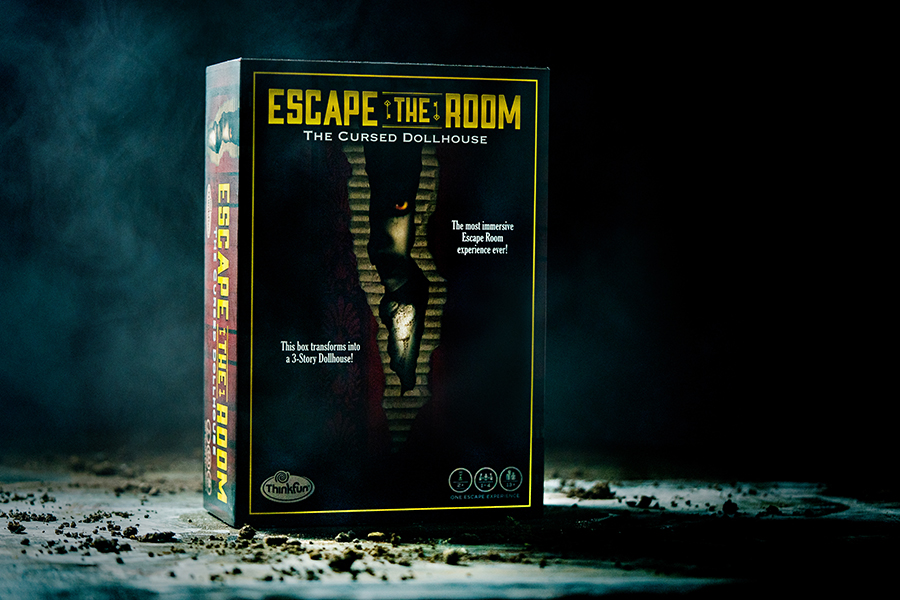
PuzzleNation Product Review: Escape the Room: The Cursed Dollhouse

[Note: I received a free copy of this game in exchange for a fair, unbiased review. Due diligence, full disclosure, and all that.]

All this week, we’ve been discussing different ways to enjoy escape room-style solving from home. We’ve measured each style against the various elements present in most escape rooms — searching the space, finding clues, interacting with the environment, solving puzzles, and experiencing the narrative — to see which ones help scratch this particular puzzly itch from the comfort of your own house.

Today, we continue that journey as we look at ThinkFun’s most elaborate and engaging escape room puzzle game yet. Join us as we accept the challenge of Escape the Room: The Cursed Dollhouse.

Now, unlike our typical reviews which are absolutely loaded with pictures showing you the art, the puzzle layout, different solving styles, and so on, this review may feel a little sparse on the details. But unfortunately, when you’re talking about an escape room puzzle game that’s this involved, this elaborate, and this labor-intensive to bring it to fruition, I wouldn’t want to ruin a single moment of puzzle-solving fun for one of our readers.

So instead, let’s get into the spirit with a nice, spooky little intro.


Every neighborhood has that one house, the one kids whisper about. The one that inspires spooky stories and dares to see how far you can progress into the yard before you panic and run back to your friends.

Your neighborhood is no different. Mr. Garrity’s house has become that mysterious house, ever since his young daughter went missing. Now there are strange lights coming from the shed in his backyard, and other children have been reported missing.

What is going on in that mysterious shed? You decide to find out.

You sneak in, and you’re baffled to find nothing suspicious at all. Just a dollhouse sitting on the work table.

Except it’s glowing…

Drawing you closer…

Until you take one step too many…

Suddenly, the real game begins. And your puzzly skills are the only thing standing between you and a monstrous curse!
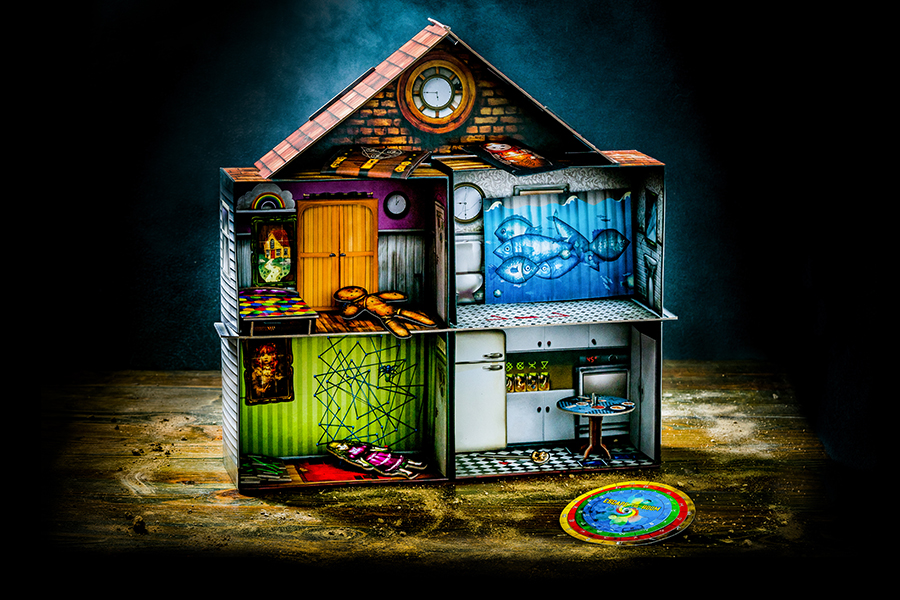

A three-dimensional interactive puzzle-solving experience, Escape the Room: The Cursed Dollhouse is one of the most impressive puzzle games I’ve ever seen from ThinkFun. (And when you consider their previous efforts involving magnets, lasers, and other fantastic elements, that’s really saying something.)

Designed for solvers 13 and older, The Cursed Dollhouse is expected to take upwards of two hours to solve, and between the setup, exploring the various rooms, and tackling the numerous different puzzles inside, that feels like a very fair assessment.

After sliding the box from its protective (spoiler-preventing) sleeve, both the top and bottom of the box itself open up to form the frame of the dollhouse. Thick punch-out boards provide the floor, roof, and various pieces of furniture for the house, and an envelope full of different materials await eager solvers to challenge their minds with mechanical puzzles, riddles, deduction, and outside-the-box thinking.

Furniture, walls, ceiling, floor… every inch of the playspace is utilized in some form or fashion, creating one of the most immersive escape room game experiences I’ve ever played. Heck, some puzzle apps aren’t this engaging, and that’s with no physical barriers or restrictions when it comes to the puzzles.

One of the hardest things to replicate from the escape room experience is the tactile sensation of puzzle solving. The sheer joy and satisfaction of physically manipulating pieces, moving objects, finding secrets, fitting pieces together, and completing tasks is very difficult to simulate in miniature.
But this game has that solving fun in SPADES. Virtually every piece has to be handled or used in some way, and getting to play around with these pieces puts all sorts of solving skills to the test, whether it’s jigsaw-style puzzling, pattern recognition, brain teasers, or logical deduction.

And anyone who experienced their fair share of escape rooms knows the feeling of dealing with puzzles in stages. Some of the game pieces and items you find are relevant to the puzzles at hand, while others must be tucked aside or saved to be carried forward into different areas. The Cursed Dollhouse is no different, offering puzzles for each room in the house as well as information and game pieces to keep with you that will prove vital later.

It can be a bit overwhelming to have so much at hand at once, but it’s immensely satisfying to slowly assign different pieces to their particular puzzles and eliminate them one by one. It’s like whittling down the puzzliest to-do list of all time, and it’s great fun.

They’ve even added a new spin to a classic puzzler’s tool.

Anyone who has bent their brain with one of ThinkFun’s earlier Escape the Room games, as well as readers of yesterday’s post, will be familiar with one of the key solving elements: the decoder ring.
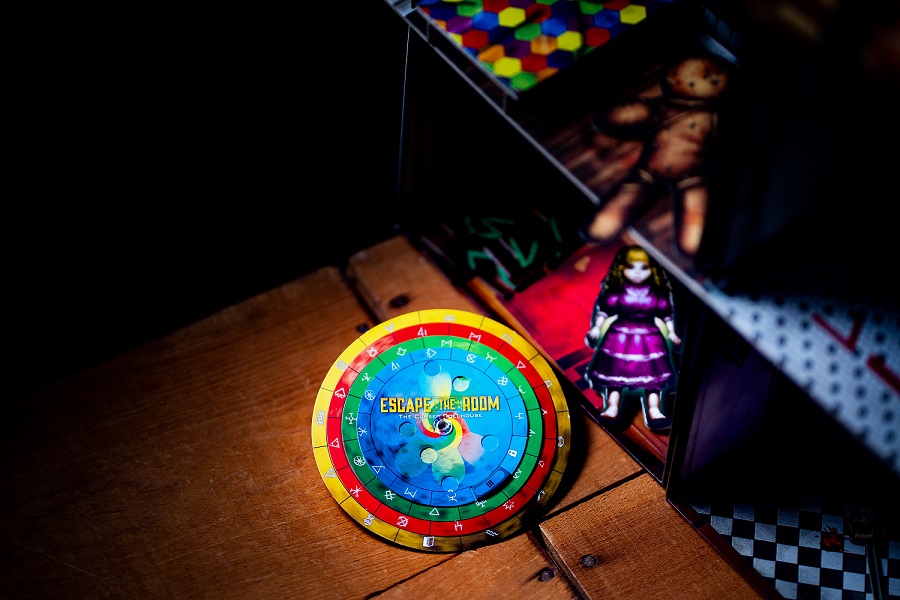
Utilizing a system of symbols for every puzzle, the decoder ring even has a locking feature to add a touch more suspense to the proceedings. Once you’ve turned each wheel and lined up your symbols, you slide the locking lever to the side, and several small windows open in the center of the disc. If the symbols revealed match the puzzle symbol, you’ve got the correct solution!

It’s a nice little touch that adds a lot to an age-old solving trope, and seeing the faces of younger solvers light up when the ring confirms their solve is a terrific moment of puzzling to treasure.

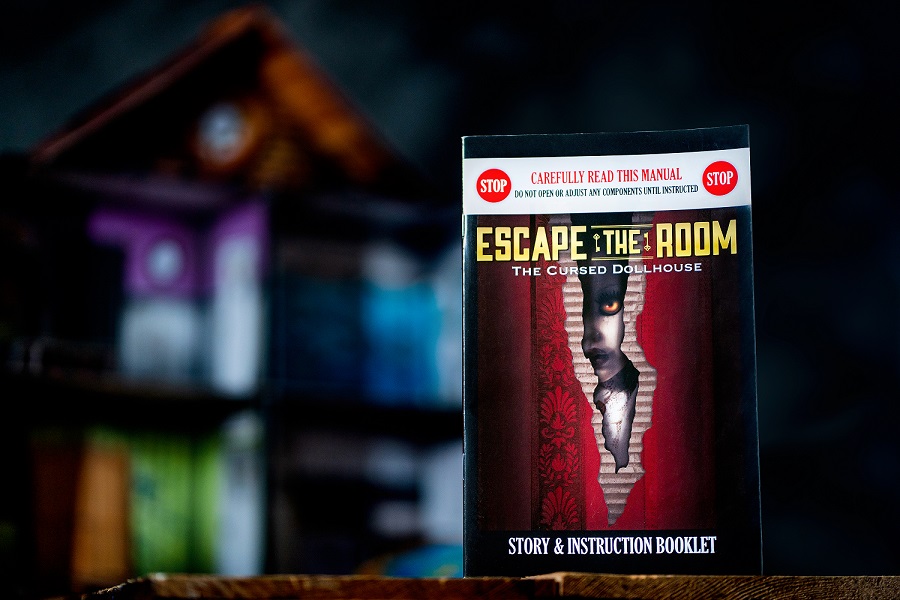
Similar to the Exit: The Game products, The Cursed Dollhouse also has a guidebook. It offers descriptions of the narrative as you progress and instructions on when you can proceed. For younger solvers, it’s a solid framework for the sometimes chaotic and undirected energy of escape room-style solving.

The Cursed Dollhouse offers fewer moments of frantic running around, but you won’t miss it; you’ll be too busy poring over every inch of the house and the gameplay pieces to miss all the skittering about you’re used to.

Be careful, though; younger solvers and older alike should be wary of the tape and sticky substances holding many of the various gameplay elements in the house in place. I worried on more than one occasion that I might damage one of the gamepieces just trying to free it. They’ve traded a bit of user-friendliness in service to keeping the puzzle elements in their places.
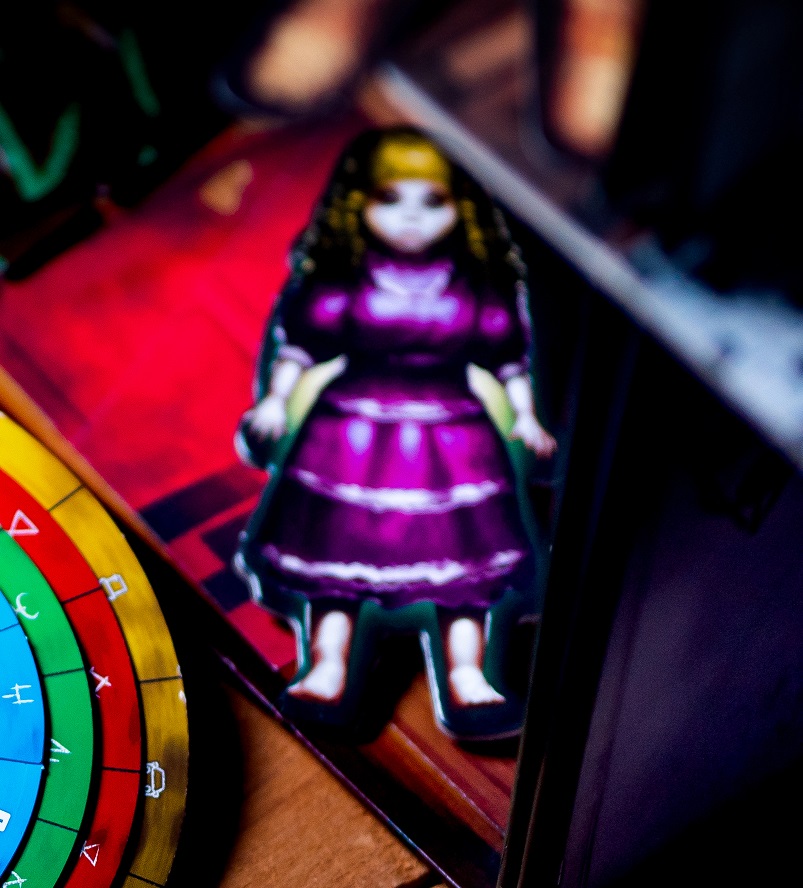
The game also offers an online resource to print and recreate any puzzle elements you manipulate or destroy in the course of your solve, so that you can reset the game for other players. It’s a nice touch that ensures more players get a chance to tackle this devious series of puzzles, and also helps mitigate a price point that’s a little higher than the average at-home escape room set.

The webpage also offers solving hints and solutions for any puzzles that flummox you, complete with visuals and videos, so you can not only progress forward, but learn precisely how the puzzle works (so if you encounter a similar puzzle in the future, you’ll know what to do).

I really can’t say anymore with giving something away, so I can only hope this review has managed to convey just how impressed I am by this puzzle game. The amount of thought, detail, and care that has gone into it is staggering, only matched by the ingenuity and deviousness of the puzzle designers. It brings the escape room experience home like never before, and young solvers and older alike will find plenty to enjoy in this meticulously crafted package.

Plus it’s gloriously spooky, which makes it perfect for fall and Halloween solving.

Escape the Room: The Cursed Dollhouse will be available on October 1st from Amazon for $42.99, and it’s worth every penny.


Thanks for visiting PuzzleNation Blog today! Be sure to sign up for our newsletter to stay up-to-date on everything PuzzleNation!

You can also share your pictures with us on Instagram, friend us on Facebook, check us out on TwitterPinterest, and Tumblr, and explore the always-expanding library of PuzzleNation apps and games on our website!

A PuzzleNation First Look: Setka

Making a new puzzle is challenging. You have to strike a balance between established solving styles (those that are familiar and effective) and innovative twists, mechanics, and variations, all without making the puzzle too convoluted, too tedious, too easy, or too hard.

In the world of crosswords, some variant success stories include Double Trouble, cryptic crosswords, Brick by Brick, and diagramless. With Sudoku, there are variants like Extreme Sudoku (aka X-Sudoku or Diagonal Sudoku), Samurai Sudoku, and Word Sudoku.

I’m always on the lookout for new puzzles and variations to try out, so when the folks behind Setka contacted me, I was more than happy to try out their puzzle brand and explore their signature attempt to combine Sudoku and clued-puzzle elements.

setka1

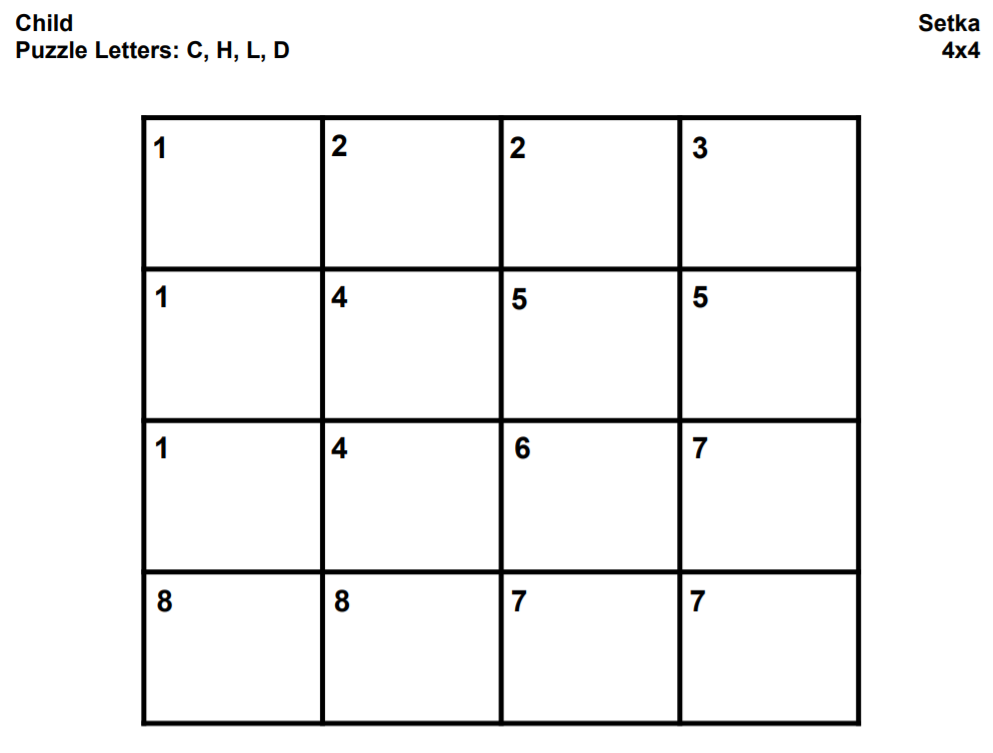
In short, Setka puzzles start with a single word. The consonants of that word not only form the answers to the clues, but also provide the letters to place in the accompanying grid.

For example, if the starting word was INFORM, the key letters would be N, F, R, and M. Every clue answer would feature one or more of those letters. The answer words, like the starting word, ignore the vowels. So you could have answers like NeaR, MoRoN, or MaiNFRaMe. (In the case of duplicate letters, like ReRaN, any duplicates are dropped, so the key letters here would be RN.)

And since there are four letters, there would be an accompanying 4×4 grid for you to fill in, where no letter is repeated in any row or column, Sudoku-style.

To place the letters, the clues are numbered, and the relevant cells in the grid are numbered to match. So, for NeaR (let’s say it’s clue 2), there would be two neighboring cells in the grid with a number 2 in them, and you could place the letters as RN or NR. Words that are three letters or above can read backward, forward, or in an L-shape in the grid.

This mechanic separates Setka from other clued or letter-placement puzzles, because you need both the clue answer AND the Sudoku no-repeats rule in order to complete a grid. Without the clue answers, there can be alternate solves where grid letters swap. And without the Sudoku-style placement, it would be virtually impossible to actually place the answer letters into the grid, because there’s more than one way to do so.

setka2-1

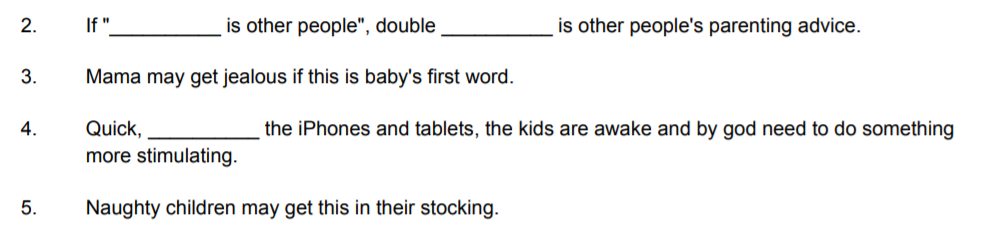
The cluing style alternates between standard crossword-style clues (but usually longer and a little more conversational or trivia-based) and fill-in-the-blank clues. The clues also fit the theme established by the starting word. For instance, the clues above all have to do with kids, which fits the puzzle’s theme word, CHILD.

It takes time to get used to seeking out answer words from the given consonants (since you have to supply any vowels or duplicate consonants missing in order to come up with the correct answer word), but once you’re a few puzzles in, it becomes second nature and a fun component to the solving experience.

Setka puzzles range in size from 4×4 to 7×7, with its signature size being 5×5. Honestly, 5×5 is really where it becomes a proper puzzle. With a 4×4 grid, once you have a few letters placed, it becomes an elementary logic puzzle and you don’t really need the clues.

setka3

[A selection of Setka sizes and themes.]

The puzzle itself is reminiscent of another puzzle we tried late last year — Cluedoku — but Setka’s letter-based theme and smaller grids make for a far more sustainable puzzle going forward, and the mechanic of placing the words in the grid (rather than just individual letters/numbers) adds an intriguing wrinkle to the solve.

All in all, I enjoyed trying out Setka — I solved a half-dozen or so puzzles to get a feel for different sizes and difficulties — and I think they’ve forged an engaging and clever combination of crossword-style cluing and Sudoku-style solving.

You can try Setka for yourself on their website, either playing interactive versions of Setka on the site or printing and solving PDF copies of Setka puzzles. They also offer a subscription where you can receive a Setka puzzle each week along with news and updates.

What do you think of Setka, fellow puzzlers and PuzzleNationers? Let us know in the comments below! We’d love to hear from you.


Thanks for visiting PuzzleNation Blog today! Be sure to sign up for our newsletter to stay up-to-date on everything PuzzleNation!

You can also share your pictures with us on Instagram, friend us on Facebook, check us out on TwitterPinterest, and Tumblr, and explore the always-expanding library of PuzzleNation apps and games on our website!