PN Product Review: Godzilla: Tokyo Clash

Today’s board game review was selected by the PuzzleNation readership through polls on social media!

Would you like more polls to determine reviews, pop culture recaps, and other blog content? Let us know in the comments section below. We’d love to hear from you!

The-original-Godzilla-rel-001

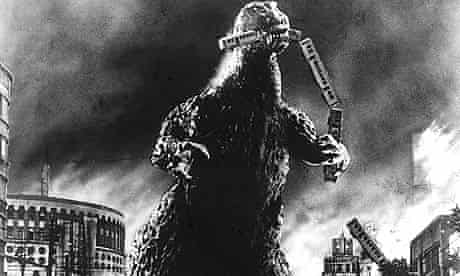
Godzilla returned to theaters this year for the umpteenth time with Godzilla vs. Kong, and after 67 years of cinematic dominance, the King of the Monsters is still an incredibly popular figure in pop culture.

That being said, Godzilla’s board game resume isn’t nearly as impressive. In fact, it’s mostly the pits. Surprisingly, making a good board game about monsters fighting each other is harder than you’d think. (Only two come to mind — King of Tokyo and Smash City — and sadly, neither features cinema’s most iconic city-smashing monster.)

Perhaps even more surprising is the fact that this dilemma might’ve just been solved by a very unlikely source, a company more famous for their collectible figurines than their games: Funko.

In today’s blog post, we’re reviewing a Godzilla game that finally got it right, as we explore Godzilla: Tokyo Clash.
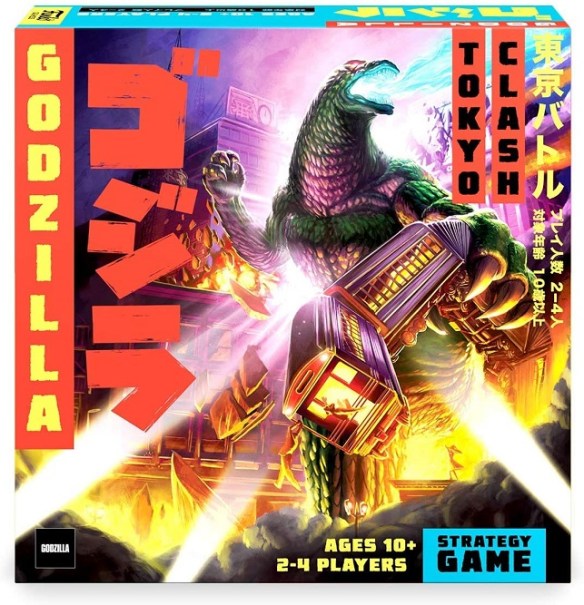
714M7tnjGTL._AC_SL1300_

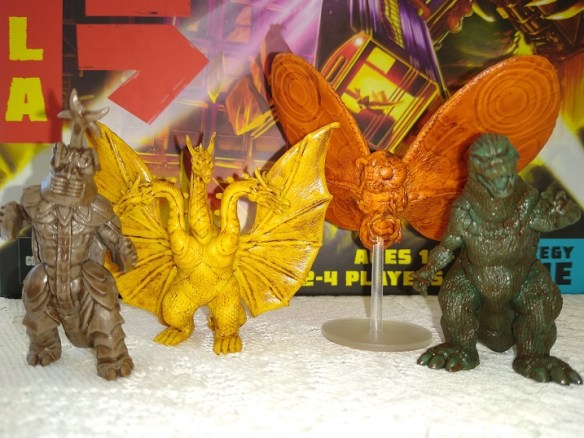
Not only do you have four famous film kaiju (aka monsters) to choose from — Godzilla, Mothra, King Ghidorah, and Megalon — but the game board is different every time you play, thanks to the tile design that allows for numerous different arrangements.

Each of the monsters has a special ability unique to that monster, as well as a deck of action cards that are specifically designed for your monster. Whoever is playing as Godzilla will have different moves, tactics, and attacks than the person playing as Mothra, King Ghidorah, or Megalon, and this adds further replay value to the game.
Plus you randomly choose two ways that the city tries to fight back against the monsters, adding further variety to the wrinkles that color the game play on multiple playthroughs.

You have an energy bar, which is used to control how much you attack the vehicles, buildings, and other kaiju around you. So, in addition to planning for the moves other players make — as well as the moving vehicles on the game board — you also have to manage your attacks based on your available energy.
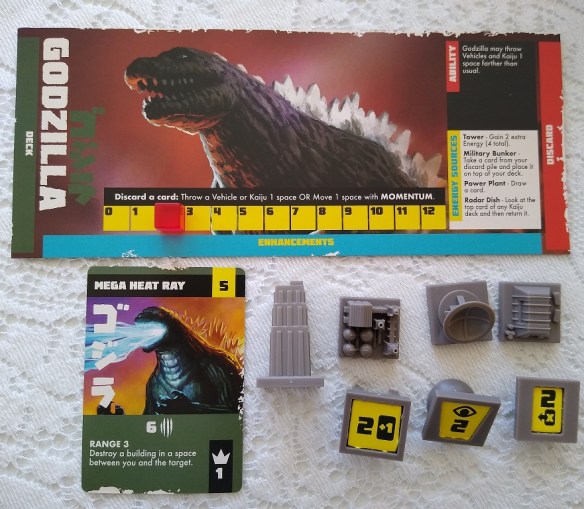
Smashing buildings and vehicles gives you energy, which you can use to attack the other monsters on the board. Successful attacks give you trophies, which count toward your overall Dominance point total. Whoever has the most points at the end of the game wins.

That’s right! Every player stays active for the whole game — unlike many other monster-fighting games, where players can be eliminated and then you just sit around and watch the rest of the game.
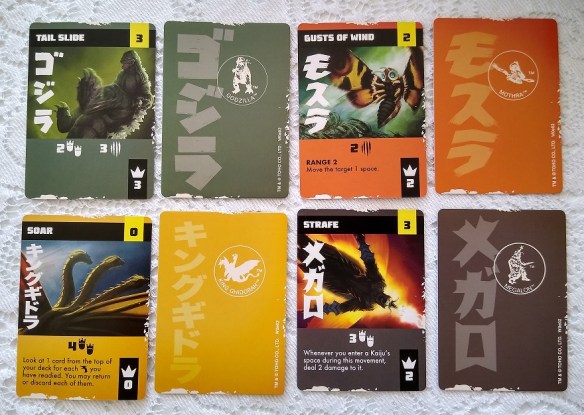
The art is gorgeous, evoking a vibrant style inspired by classic Godzilla movie posters (and don’t worry, the instructions are in English). The miniatures are marvelously detailed, and the game is loaded in references to the films. You don’t have to know them to play the game, but for diehard Godzilla fans like myself, it’s vindication after years of mediocre kaiju-themed games.

And the game is very reasonably priced, considering the quality of the miniatures, the game board tiles, and the overall art. This ticks a lot of boxes for both board game fans and Godzilla enthusiasts.

That being said, the game does have some downsides. The two-player version is far less engaging than the three- or four-player versions, because your tactics are so limited by just throwing vehicles back and forth at each other and smashing buildings. The strategic moves and planning are deeper and far more enjoyable with more targets, threats, and things to consider.

81vjLbMWEwL._AC_SL1500_

It might sound silly, but in this game about monsters smashing things, it’s simply more fun when there are other people smashing stuff too.

Also, I’m not a huge fan of the Dominance system, since it’s a little distracting  to have two sets of numbers to keep track of — the energy and the victory points — but I confess I can’t think of another mechanic that would still allow all of the players to keep playing.

All in all, I was very impressed by this game. It’s easy to pick up, fun to master, and offers a ton of variety for new and experienced players. Plus there’s a surprising amount of tactical puzzling involved, which elevates the game beyond a simple you-go-then-I-go mentality.

This game is a win.

[Godzilla: Tokyo Clash is available from Funko Games and other participating retailers.]


dailypopwsicon

Have you checked out our special summer deals yet? You can find them on the Home Screen for Daily POP Crosswords and Daily POP Word Search! Check them out!

Thanks for visiting PuzzleNation Blog today! Be sure to sign up for our newsletter to stay up-to-date on everything PuzzleNation!

Crossword Competitions: Cancelled!

fingerlakes

Originally, today’s post was going to be about the Eighth Annual Finger Lakes Crossword Competition happening this weekend.

I was going to wish the participants good luck and talk about crossword tournament protocol and advice.

But that’s all been rendered moot, as the Eighth Annual Finger Lakes Crossword Competition has been cancelled due to concerns surrounding gatherings of people during the ongoing Coronavirus situation.

And unfortunately, it’s not the only upcoming puzzly event that has been scuppered by preventative health measures.

acptlogo

Alas, the 43rd edition of the American Crossword Puzzle Tournament has also been cancelled for health-related reasons.

Although Will Shortz is in discussion with the hotel and event organizers regarding potentially moving the tournament to later in the year, for now, ACPT won’t be happening.

I’m disappointed, of course, but I’m not at all surprised. With schools and libraries closing their doors for the time being, not to mention sporting events potentially being held in empty arenas, all sorts of gatherings are being cancelled or rethought in order to keep folks safe.

We here at PuzzleNation hope you and your loved ones are happy, healthy, and taking steps to stay that way.

Be well, fellow puzzlers and PuzzleNationers. (And in the meantime, now you’ve got more time to practice your puzzly skills for the tournament’s talent show.)


Thanks for visiting PuzzleNation Blog today! Be sure to sign up for our newsletter to stay up-to-date on everything PuzzleNation!
You can also share your pictures with us on Instagram, friend us on Facebook, check us out on TwitterPinterest, and Tumblr, and explore the always-expanding library of PuzzleNation apps and games on our website!

Final Jeopardy for James Holzhauer

Alas, all great runs must come to an end, and so it is with a heavy heart that I report that James Holzhauer — sports gambler, trivia whiz, and Jeopardy! champion — has been defeated, relinquishing his title as champion after 32 days.

He amassed an impressive total of $2,464,216, the second highest in game history during regular-season play. And his impressive daily totals have yielded some impressive stats. He now holds 21 of the top 25 spots on the show’s list of the highest single-day winnings.

Only $58,484 separated him from Ken Jennings’ long-standing total of $2,520,700, which was amassed in 74 games back in 2004.

holzhauertweet

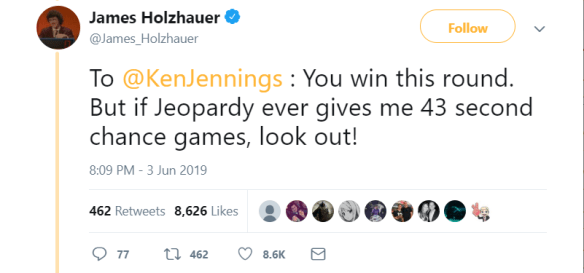
Holzhauer was complimentary toward both Jennings and his Jeopardy! opponent Emma Boettcher on social media, stating, “CONGRATULATIONS to Emma on a world-beating performance. There’s no greater honor than knowing an opponent had to play a perfect game to defeat me.”

He then cited one of the predictions as to how his reign would end, quoting, “James will eventually beat himself by flubbing one of his big bets,” before responding, “Nope, James got his ass kicked straight up by an elite player who nailed her own big bets.”

Naturally, the buzz around social media regarding this unexpected turn of events is mixed. Some viewers are glad to see a new champion crowned, while others are sad to see Holzhauer go.

There are also a few conspiracy theories brewing. Some viewers believe that James intentionally threw this match, citing slower reaction times, gimme questions being missed, and a general lack of energy from the normally bullish champion. He went into Final Jeopardy in second place.

The capper for many was his performance in Final Jeopardy where he made an uncharacteristically low wager (only $1300 or so, when he was at $23k), meaning that despite his correct answer, he wouldn’t defeat his rival for this game. (Emma Boettcher, on the other hand, bet $20k on Final Jeopardy, perhaps anticipating a similarly aggressive bet from Holzhauer.)

But Holzhauer has already explained his unexpected move, telling The Atlantic that, “By the time Final Jeopardy rolled around I knew my goose was cooked if Emma answered correctly. It’s a little like needing a team to miss a last-second field goal ― nothing you can really do but watch. I made peace with my fate before the clue for Final was even revealed.”

Holzhauer seems pleased with his Jeopardy! performance despite not dethroning Jennings. “My only real goals were: Win $110,914 on an episode to honor my daughter’s birthday, and play my absolute best every game. I achieved both, and I’m very proud of myself for that.”

Congratulations to James Holzhauer for a very notable run as champion, and congratulations to Emma Boettcher for proving to be a more than worthy champion in her own right.

And now, there’s really only one way to conclude a saga like this, and that’s with a song. Take it, “Weird Al”…


Thanks for visiting PuzzleNation Blog today! Be sure to sign up for our newsletter to stay up-to-date on everything PuzzleNation!

You can also share your pictures with us on Instagram, friend us on Facebook, check us out on TwitterPinterest, and Tumblr, and explore the always-expanding library of PuzzleNation apps and games on our website!

Daily Double Trouble for a Long-Standing Jeopardy! Record?

It’s been a few weeks, so it’s time for a Jeopardy! update.

Unless you’ve been living under a rock (specifically a rock with no wi-fi, morning news coverage, or game show fans nearby), you’re probably aware of James Holzhauer, the Jeopardy! contestant who has been dominating the scene for more than a month.

After a two-week hiatus where Jeopardy! aired episodes centered around teachers as contestants, sports gambler and trivia master Holzhauer has returned to continue his reign of terror over Alex Trebek’s domain. His undefeated streak now stands at 29 consecutive victories.

Holzhauer is only the second person in history to pass the million-dollar mark on the show, and his success has fans anxiously eyeballing the money-winning record set by Ken Jennings more than a decade ago. That sense of anticipation is only growing stronger.

Holzhauer’s total thus far is $2,254,938.

As of last night’s performance, Holzhauer is a mere $265,762 away from Ken Jennings’ total for highest winnings in regular season play. (Jennings has won additional money in tournament play that isn’t counted in this total.)

Now, granted, that’s a lot of money. But it’s worth noting that $265,762 is only $4613 higher than Holzhauer has won on his two highest-scoring games combined. So, essentially, if he performs to the absolute best of his ability, he’s three wins away from overtaking Jennings. (Even if he’s not performing at his best, his average money won per game ($77,756) means that he’s only four average wins away from overtaking Jennings.)

Oh, and that average money per game statistic? It’s worth noting that the previous single-game record for the show was BELOW that, clocking in at $77,000 dollars.

Have you been keeping up on all the trivia excitement? If so, what do you think, folks? Is Holzhauer going to make history by surpassing Ken Jennings in less than half the time? Is Jennings’ 74-day winning streak also within reach for the bold betting master?

Let us know your thoughts in the comment section below! We’d love to hear from you!


Thanks for visiting PuzzleNation Blog today! Be sure to sign up for our newsletter to stay up-to-date on everything PuzzleNation!
You can also share your pictures with us on Instagram, friend us on Facebook, check us out on TwitterPinterest, and Tumblr, and explore the always-expanding library of PuzzleNation apps and games on our website!

Puzzles and Brain Health: Finally Some Definitive Data?

For years now, brain health and puzzle-solving have been intertwined topics.

There have been many, MANY published studies touting all sorts of effects, both positive and negative, of solving puzzles. Alongside those studies, there have been numerous products of a puzzly nature that claim to do everything from improving memory to staving off Alzheimer’s, dementia, and other debilitating conditions.

I’ve been reading articles on the subject for more than six years now, and the results, for the most part, have been inconclusive. This is often due to small sample sizes for the experimental data, or evidence that leads to likelihoods rather than verifiable, repeatable, reliable data.

Across all of these articles, there are essentially three suppositions:

  • A. Solving puzzles helps maintain or improve brain function
  • B. Specific “brain-training” exercises, programs, or products help maintain or improve brain function more so than traditional/unfocused puzzle solving
  • C. Solving puzzles (whether traditional or “brain-training”) helps stave off conditions like dementia, Alzheimer’s, and memory loss later in life

When it comes to Supposition B, I’ve yet to see anything that proves a “brain-training” or “brain-boosting” puzzle regimen actually helps in a meaningful way. In fact, at one point, one of these “brain-training” companies had to pay a two-million-dollar fine for making promises that their program couldn’t verifiably deliver on.

[Image courtesy of SharpBrains.com.]

But let’s leave that nonsense aside for a moment and focus on Supposition A, the idea that solving puzzles is good for the brain.

For the first time, we have a study performed by a reputable organization with a sample size large enough that it may finally allow us to draw some decent conclusions. Two articles published this month in the International Journal of Geriatric Psychiatry have concluded that adults age 50 and older who regularly solve puzzles like crosswords and Sudoku have better brain function than those who do not.

The study, conducted by researchers from the University of Exeter, involved a test group of more than 19,000 participants.

From an article on Science Daily discussing the study:

Researchers asked participants in the PROTECT study . . . to report how frequently they engage in word and number puzzles and undertake a series of cognitive tests sensitive to measuring changes in brain function. They found that the more regularly participants engaged with the puzzles, the better they performed on tasks assessing attention, reasoning and memory.

From their results, researchers calculate that people who engage in word puzzles have brain function equivalent to ten years younger than their age, on tests assessing grammatical reasoning, and eight years younger than their age on tests measuring short term memory.

Yes, this is only one study, and yes, obviously more testing and sampling is needed to apply this to the millions upon millions of folks age 50 and older who might benefit from this. But it’s worth giving this topic deep consideration. A sample size of 19,000 is impressive, and there’s no profit or “brain-training” scam behind the study.

And, regarding Supposition C, while this study didn’t offer anything definitive, it remains a possibility. Dr. Anne Corbett of the University of Exeter Medical School said, “We can’t say that playing these puzzles necessarily reduces the risk of dementia in later life but this research supports previous findings that indicate regular use of word and number puzzles helps keep our brains working better for longer.”

How much longer, who can say? But, when it comes to better brain health, it seems we can finally say that puzzles are good for you. (I always suspected.)


Thanks for visiting PuzzleNation Blog today! Be sure to sign up for our newsletter to stay up-to-date on everything PuzzleNation!

You can also share your pictures with us on Instagram, friend us on Facebook, check us out on TwitterPinterest, and Tumblr, and explore the always-expanding library of PuzzleNation apps and games on our website!

A Coin Puzzle: My Two Cents (Plus 97 More)

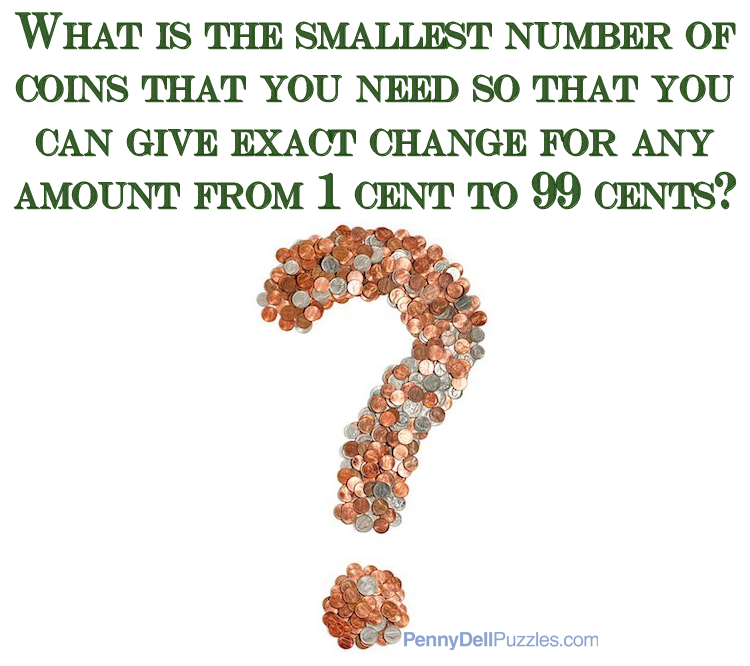
Our friends at Penny Dell Puzzles recently shared the following brain teaser on their social media:

Naturally, we accepted the challenge.

Now, before we get started with this one, we have to add one detail: which coins we’re allowed to use. It’s safe to assume that pennies, nickels, dimes, and quarters are available, but the question doesn’t say anything about half-dollar coins.

So we’re going to figure out the correct answer without half-dollar coins available, and then with half-dollar coins available.

Let’s begin.


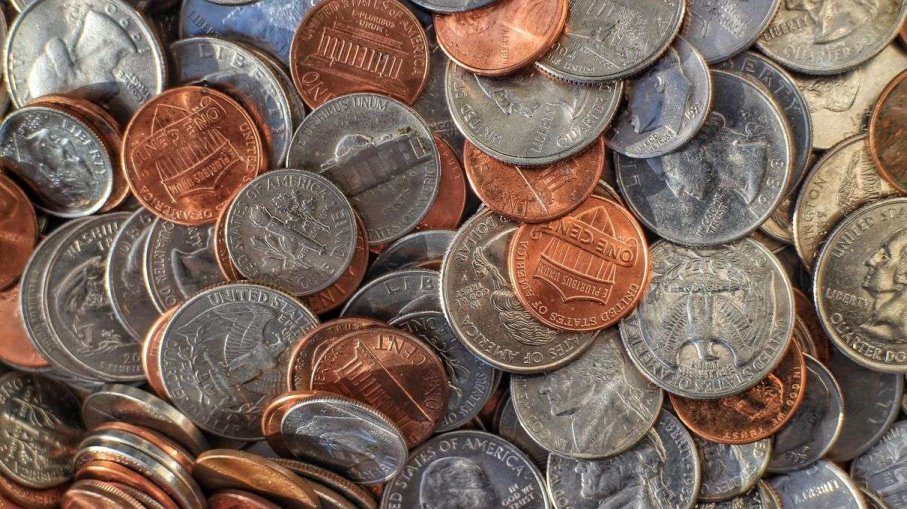
[Image courtesy of How Stuff Works.]

The easiest way to get started is to figure out the smallest number of coins we need to make 99 cents, since that’s the highest number we need to be able to form. Once we have that info, we can work backwards and make sure all the other numbers are covered.

For 99 cents, you need 3 quarters, 2 dimes, and 4 pennies. That’s 25 + 25 + 25 + 10 + 10 + 1 + 1 + 1 + 1 = 99.

Right away, we know we’re close with these 9 coins.

You don’t need more than 3 quarters, for instance, because your possible totals are all below $1.

Now, let’s make sure we can form the numbers 1 through 24 with our chosen coins. (If we can, we’re done, because once we’ve covered 1 through 24, we can simply add one quarter or two quarters to cover 25 through 99.)

Our four pennies cover us for 1 through 4. But wait, there’s 5. And we can’t make 5 cents change with 4 pennies or 2 dimes. In fact, we can’t make 5, 6, 7, 8, or 9 cents change without a nickel.

So let’s add a nickel to our current coin count. That makes 3 quarters, 2 dimes, 1 nickel, and 4 pennies. (Why just 1 nickel? Well, we don’t need two, because that’s covered by a single dime.)

Our four pennies cover 1 through 4. Our nickel and four pennies cover 5 through 9. Our dime, nickel, and four pennies cover 1 through 19. And our two dimes, one nickel, and four pennies cover 1 through 29. (But, again, we only need them to cover 1 through 24, because at that point, our quarters become useful.)

That’s all 99 possibilities — 1 through 99 — covered by just ten coins.

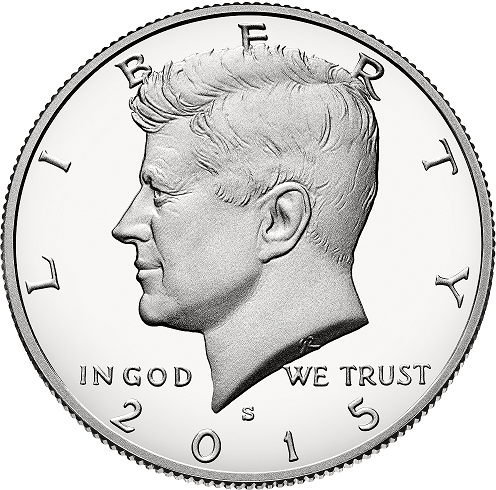
[Image courtesy of Wikipedia.]

But what about that half-dollar?

Well, we can apply the same thinking to a coin count with a half-dollar. For 99 cents, you need 1 half-dollar, 1 quarter, 2 dimes, and 4 pennies. That’s 50 + 25 + 10 + 10 + 1 + 1 + 1 + 1 = 99.

Now, we make sure we can form the numbers 1 through 49 with our chosen coins. (Once we can, we can simply add the half-dollar to cover 50 through 99.)

Once again, we quickly discover we need that single nickel to fill in the gaps.

Our four pennies cover 1 through 4. Our nickel and four pennies cover 5 through 9. Our dime, nickel, and four pennies cover 1 through 19. Our two dimes, one nickel, and four pennies cover 1 through 29. And our one quarter, two dimes, one nickel, and four pennies cover 1 through 54. (But, again, we only need them to cover 1 through 49, because at that point, our half-dollar becomes useful.)

That’s all 99 possibilities — 1 through 99 — covered by just nine coins.


Thanks for visiting PuzzleNation Blog today! Be sure to sign up for our newsletter to stay up-to-date on everything PuzzleNation!

You can also share your pictures with us on Instagram, friend us on Facebook, check us out on TwitterPinterest, and Tumblr, and explore the always-expanding library of PuzzleNation apps and games on our website!