A puzzle in your pocket

Brain teasers come in all shapes and sizes, but there’s one particular brand of brain teaser that fits in your pocket. Today we’re talking about matchstick puzzles (or toothpick puzzles).

Matches as we know them (relying on friction to ignite, rather than dipping or crushing) were invented in 1826 by English chemist John Walker, and in the decades that followed, numerous improvements were made, especially in terms of safety and ease of use. Matchsticks soon grew ubiquitous and match companies started putting little puzzles on their boxes.

And the matchstick puzzle was born.

(I have no historical documentation to back me up on this, but I suspect that bar bets also played a role in the rise of matchstick puzzles, because the sort of cleverness and trickery that goes into solving some of these puzzles would be perfectly at home in the repertoire of someone looking to con a few free drinks out of fellow tipplers.)

So, for the uninitiated, what are matchstick puzzles?

These are rearrangement or transformation puzzles, where you’re given a certain shape (laid out in matchsticks, toothpicks, straws, pencils, or anything else of equal length), and you have to move the items into another shape or configuration. Sometimes, it’s simply about placing the matchsticks economically, but other times, you have to get crafty and think outside the box to complete your task.

For instance, here’s the first matchstick puzzle I ever remember seeing:

[This image, and the one below, courtesy of Matchstick Puzzles on Blogspot.]

You have two triangles formed from six matchsticks. Move one matchstick to make four triangles.

Now, you could easily use all of these matchsticks to make four triangles, but that would involve moving more than one of them. So clearly there’s something else at work here if you only need to move one to solve the puzzle.

That something, in this case, is a little visual trickery.
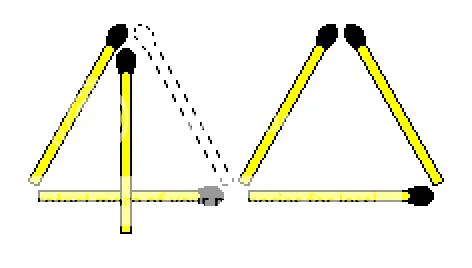
As you can see, you turn one triangle into a numeral four, making the matchsticks literally read out “4 triangle.” Sneaky sneaky.

There are literally hundreds of these puzzles if you go hunting for them. (I found a treasure trove of them here.)

A curious variation, though, applies the same rules to mathematical formulas laid out in matchstick form.

Here’s one that’s been making the rounds on Facebook recently:

Now, the big difference between these mathematical ones and the shape ones mentioned above, as far as I’ve found, is that the math ones are far more alternate prone.

For instance, this equation puzzle has at least four solutions that I’ve found:

  • You can move one match to make the 6 a 0, so that 0+4=4.
  • You can move one match from the 6 to the second 4 to make the 6 a 5 and the 4 a 9, so that 5+4=9.
  • You can move one match from the plus sign to the 6 to make the plus sign a minus sign and the 6 an 8, so that 8-4=4.
  • You can move one match from the plus sign to the equal sign to make the plus sign a minus sign and the equal sign a doesn’t-equal sign, so that 6-4 does not equal 4.

As you can see, with matchstick puzzles,  the possibilities are endless and the building blocks — whether matches, toothpicks, Q-Tips, or straws — are easily accessible.

I’ll leave you one more to ponder, this time provided by the folks at IO9:

Using six matchsticks of equal length, create four identical, equilateral triangles. There’s no need for snapping, burning, or otherwise altering the matchsticks.

Good luck!


Thanks for visiting PuzzleNation Blog today! Be sure to sign up for our newsletter to stay up-to-date on everything PuzzleNation!

You can also share your pictures with us on Instagram, friend us on Facebook, check us out on TwitterPinterest, and Tumblr, and explore the always-expanding library of PuzzleNation apps and games on our website!

Other puzzles you might not know! (Volume 1)

We’re all puzzle fans here, right? And sometimes we need something new, something fresh and engaging to rejuvenate our love of puzzles. We know all the classics — crosswords, fill-ins, logic puzzles, word seeks, Sudoku, cryptograms, and anagram puzzles — but there’s a whole wide world of puzzles out there to explore that you might not even know about!

So, in today’s post, I’m going suggest some puzzles to check out, based on each of those classic solving experiences.


Let’s start with crosswords.

From the New York Times and LA Times crossword puzzles to the Penny Dell Crossword App, there’s no shortage of terrific crosswords of all difficulty ranges awaiting solvers.

But there are also some terrific variant crosswords for you to try out, like Double Trouble.

[Click here or on the grid for a larger version, complete with clues.]

In a Double Trouble crossword, you can put one, two, or three letters into a box, making for a more difficult solve that the standard one-letter one-box crossword.

But if you want to go a little farther afield, you can try something like Marching Bands.

[Image courtesy of Brendan Emmett Quigley’s website.]

A Marching Bands puzzle has two sets of clues. The first set clues the rows reading across, with two clues per line. But the second set is where things get interesting. See those alternating rings of light and dark shading? The second set clues words reading clockwise along those rings, or bands.

So instead of words meshing across and down, as in a standard crossword, you have across clues and band clues interacting to help you fill the grid. It’s a wonderful variation on familiar crossword rules, but one challenging enough to keep you interested. (For a more in-depth look, click here!)

But maybe you like crossword cluing but you’d like an answer more interesting than just a grid filled with words. Fair enough, have you ever tried Crostics?

[Click here or on the grid for a larger version.]

Crostics, also known as Anacrostics (from our friends at Dell Magazines) or Acrostics (as made by friend of the blog Cynthia Morris), feature a series of clues and letter blanks to be filled.

Those letter blanks each have coordinates assigned, so that when you fill the correct letters into those blanks, you’re also filling blanks in a grid below to spell out a bonus message, quotation, or anecdote. (It’s a one-to-one ratio, so each letter blank corresponds to a letter blank in the grid. If there’s one J in the message, you’ll find a J in the answer words.)

Although you don’t have the overlapping entries to help you puzzle out answers like crosswords or Marching Bands do, you can use the grid below as a solving aid. As each word in the message emerges, you can fill in those letters in the blanks above (using those same coordinates).

And for something along the same vein, you’ve got Word Games Puzzles.

[Click here or on the grid for a larger version.]

You still get the message reading out in a grid and the letter blank coordinates like in Crostics, but instead of a bunch of crossword-style clues, you instead get four mini-games to solve. One might be trivia or encryption, another might involve some wordplay, another might offer themed clues, and the fourth might be an anagram game.

Each will challenge you in different ways, and the use of repeated letters — a change from Crostics with their one-to-one letter blank to grid letter ratio — gives you more than one chance to fill in the final message.

Hopefully, one or more of these puzzles will pique your interests and offer a welcome new solving experience!


Next week, I’ll have recommendations for fans of Fill-In puzzles, and in future installments, we’ll tackle word seeks, logic puzzles, Sudoku, and more! If you’ve got recommendations for your fellow puzzlers, please let us know in the comments!

Thanks for visiting PuzzleNation Blog today! Be sure to sign up for our newsletter to stay up-to-date on everything PuzzleNation!

You can also share your pictures with us on Instagram, friend us on Facebook, check us out on TwitterPinterest, and Tumblr, and explore the always-expanding library of PuzzleNation apps and games on our website!

500 Blog Posts!

[Image courtesy of gailperry.com.]

I wrote my first post for PuzzleNation Blog in August of 2012, over three and a half years ago. And I recently posted my five-hundredth blog post on this site.

You might think after three posts a week for years, I’d be burned out. But it’s quite the opposite. I enjoy exploring the world of puzzles, delving into history, cracking the memes and riddles that go viral, interviewing all sorts of puzzle creators and fans, trying out new games and puzzles…and sharing all of that with the PuzzleNation audience.

It’s a privilege, it really is. In many ways, I’ve become the voice of PuzzleNation, and I take that responsibility seriously. I try to both inform and entertain, and I’m constantly hunting for something new and unexpected to offer you.

And speaking of you, the PuzzleNation readership, it kind of blows my mind how many different ways I get to interact with you.

[Image courtesy of Forbes.com.]

I mean, first and foremost, there’s PuzzleNation Blog. Three times a week (and sometimes more), I meander up and down the seemingly endless avenues of the puzzle world and discuss them with you. What a treat.

And then there’s Facebook and Twitter, where I not only discuss all of our projects, but I can play games like the Crossword Clue Challenge every weekday and try to outwit you. (Spoiler alert: I rarely rarely do.) I also have opportunities to answer questions, share posts and information from fellow puzzlers, and really engage people one-on-one, something that feels increasingly elusive these days.

We’ve got the PuzzleNation newsletter! We recently sent out our second edition of the newsletter to subscribers, so keep your eyes peeled. (And if you haven’t signed up yet, you can click this link to get started.)

[Image courtesy of…these guys.]

We also have our monthly hashtag games with our compatriots over at Penny Dell Puzzles, like #PennyDellPresidentPuzzles and our newest one this week, #PennyDellPuzzleDisney. Reading the hilarious and clever puns and bits of wordplay conjured up by friends and fellow PuzzleNationers alike is one of the highlights of the month for me.

And honestly, I want more of that. We have platforms on Tumblr, Pinterest, and Instagram, and I’d love to have some sort of weekly interactive game on each one. (In fact, next week, I’ll be trying out a puzzle game twice a week on Instagram. You heard it here first!)

Plus, I’m hoping to organize some kind of giveaway in the next month or so. I’m not sure of the specifics just yet, so stay tuned for that. (I do have some terrific prizes lined up already, though.)

It’s a little daunting to be celebrating five hundred blog posts with you. I know some of you have been with us since the very beginning, and I’m grateful. I know some of you have only recently started following us, and I’m happy to welcome you. Some of you I know by name, and many of you, I don’t know at all, but I’m hoping to change that in the future.

In any case, thank you for your support, your enthusiasm, your ideas, your comments, your feedback, your shares and likes and clicks and hearts and thumbs up and everything else we’ve shared. I look forward to many many more.

Puzzle Plagiarism?

[Image courtesy of PlagiarismToday.com.]

Today’s post isn’t the usual Follow-Up Friday fare. Instead of returning to a previous subject, I’d like to discuss a topic that I expect I’ll be returning to in Follow-Up Friday form in the near future.

There is a certain pride and sense of accomplishment you experience as a puzzler when you come up with an exciting, innovative, unexpected theme idea for a puzzle, or when you pen a terrific clue for a word. Whether the wordplay is spot on or you’ve simply found a way to reinvigorate a tired bit of crosswordese, you feel like you’re adding something to the ever-expanding crossword lexicon, leaving a mark on the world of puzzles.

Unfortunately, there’s also the flip side of that coin, and those who would pilfer the hard work of others for their own gain. And in a story broken by the team at FiveThirtyEight, there may be something equally unsavory going on behind the scenes of the USA Today crossword and the Universal syndicated crossword.

You can check out the full story, but in short, an enterprising programmer named Saul Pwanson created a searchable database of crossword puzzles that identified similarities in published crosswords, and it uncovered an irregularly high number of repeated entries, grids, and clues in the USA Today and Universal crosswords, both of which are edited by Timothy Parker.

More than 60 puzzles feature suspicious instances of repetition — the word “plagiarism” comes to mind, certainly — and it has sparked an investigation. In fact, only a day after the story first broke, Universal Uclick (which owns both the USA Today crossword and the Universal syndicated crossword) stated that the subject of the investigation, Parker himself, “has agreed to temporarily step back from any editorial role for both USA Today and Universal Crosswords.”

I’ve heard that oversight of the USA Today crossword has already passed to another editor of note in the crossword world, constructor Fred Piscop (author of last Wednesday’s New York Times crossword), but I wonder if more examples of crossword duplication are lurking out there.

With resources like XWord Info and the Pre-Shortzian Puzzle Project out there, the history of crosswords is becoming more and more accessible and searchable. I can’t help but wonder if more scandals are lurking down the pike.


Thanks for visiting PuzzleNation Blog today! Be sure to sign up for our newsletter to stay up-to-date on everything PuzzleNation!

You can also share your pictures with us on Instagram, friend us on Facebook, check us out on TwitterPinterest, and Tumblr, and explore the always-expanding library of PuzzleNation apps and games on our website!

PuzzleNation Product Review: Strata Sphere

In today’s product review, we look at a puzzle game with a simple premise: get your spheres from the top level of the grid to the bottom before your opponent does. All that stands between you and victory? Four levels of sliding walls and a wily opponent.

Today, we tackle the multi-layered challenge of Strata Sphere.

Strata Sphere is a puzzle game for two players that challenges you to outthink and outmaneuver your opponent in order to get your four spheres through the grid first. Imagine the gravity-fueled fun of Ker-Plunk with the chain-reaction planning of chess, and you’ve got something approximating Strata Sphere.

This game is all about tactics and adaptation. First, you and your opponent take turns placing the twelve sliders into the grid. There are four levels to the grid, each level accommodating three sliders.

As you can see, some of the sliders have holes in different places, and others have no holes at all. Placement of these sliders is only part one of the game, but it’s a crucial one.

Once all twelve sliders are in place, the players choose their color spheres (red or black), and take turns placing them into the columns atop the grid, one sphere per column.

[As you can see, some of the spheres have already dropped to level 2,
thanks to the placement of holes in several of the sliders in level 1.]

Now the real strategy begins, because with each turn, a player may select any slider and pull it out of the grid one notch. (Each slider has three notches, allowing it to interact with three different columns.) As the game progresses, players can also push sliders in one notch.

Whether the slider moves out of the way of a sphere or moves a hole into place so a sphere may drop through, each move has the potential to drop a sphere a level (or two!) closer to freedom.

After one or two games, we actually ended up putting the game on a lazy susan, so we could rotate it, observe the grid more easily, and gain better access to all the sliders.

This form of three-dimensional puzzle-solving is a real challenge, because you’re not just dealing with your opponent’s next move, you’re dealing with all the setup (slider placement, sphere placement) that preceded it. Here’s where your ability to adapt comes into play, because all that strategy can go completely out the window at a moment’s notice.

Tension ratchets up quickly as you and your opponent maneuver back and forth, manipulating the sliders and helping gravity guide your spheres through the grid and toward the open tray below. The first player to free all four of their spheres wins.

Strata Sphere is a puzzle game that’s easily explained to younger players, but one that offers a great deal of complexity for older players as well, taxing your tactical abilities, spatial awareness, and your ability to seize unexpected opportunities when they arise.

Being forced to take turns makes long-term planning more difficult, and the four levels of gameplay will push your visualization skills to the max. (Planning out moves on a chess board is one thing, the multi-tiered slider system of Strata Sphere is quite another.)

The gameplay is engaging, the design is simple and elegant, and I daresay there’s no more satisfying sound than the click of a well-earned sphere hitting the tray, freed. What a treat.

Strata Sphere is for ages 8 and up, available now from Family Games America.


Thanks for visiting PuzzleNation Blog today! Be sure to sign up for our newsletter to stay up-to-date on everything PuzzleNation!

You can also share your pictures with us on Instagram, friend us on Facebook, check us out on TwitterPinterest, and Tumblr, and explore the always-expanding library of PuzzleNation apps and games on our website!

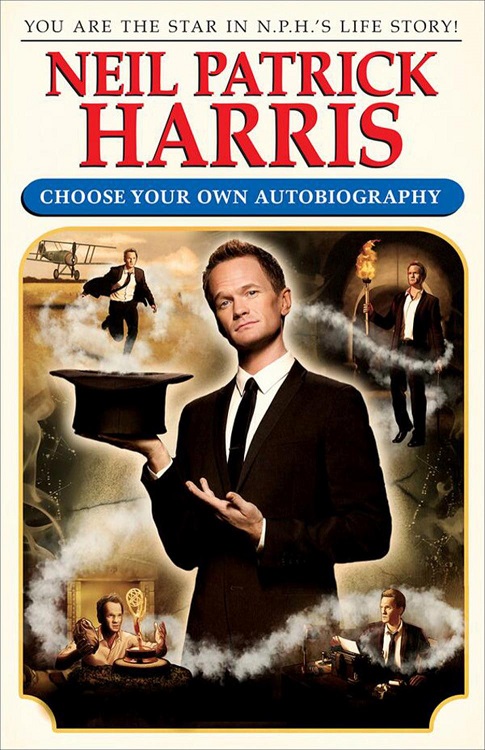
Neil Patrick Harris: Actor, Magician, Puzzler?

I’m a puzzle guy, so naturally I’m always on the lookout for new puzzles, whether it’s in the newspaper, the bookstore, the Internet, or anywhere else I happen to be browsing.

But sometimes, you stumble upon a puzzle in the unlikeliest of places. Like a celebrity’s autobiography.

neil-patrick-harris

I recently got around to reading the autobiography of comedian, actor, magician, award-show host extraordinaire, and all-around champion of entertainment Neil Patrick Harris, and, as you’d expect from someone as creative as him, it was no ordinary affair. It’s written in the style of a Choose Your Own Adventure book, where you can make life decisions (as he did) and see where they lead!

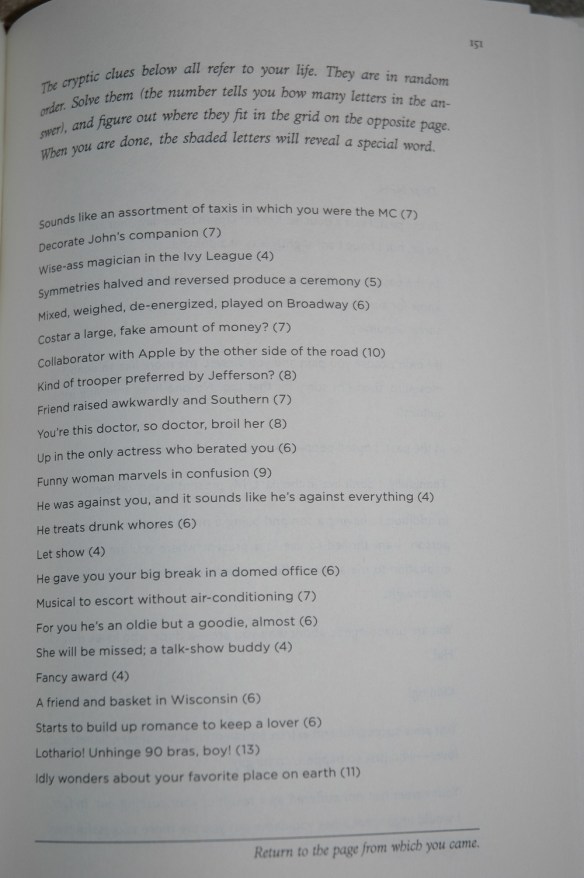
Some lead to hilarious fake deaths, while others lead to genuine poignant moments from his life. We learn about his career, his discovery of magic, the peaks and valleys of his acting career, and his search for love, and it’s a great story. But he also includes messages from friends, drink recipes, and other hidden gems in the book, one of which was an unexpected cryptic crossword puzzle!

nphcryptic1

nphcryptic2

Now, I’ve made no secret of the fact that I’m hardly the strongest cryptic solver around, but I couldn’t resist tackling a surprise Neil Patrick Harris-themed puzzle. (Thankfully, I was able to call in a friend who’s really good with cryptics for the clues that stumped me.)

To Neil’s credit, there are some very clever clues here, in addition to more traditional cryptic clues like “Let show (4)” for RENT and “Symmetries halved and reversed produce a ceremony (5)” for EMMYS. And, as you’d expect, most or all of them apply to events in his life, so you have to read the book to have any chance of solving this one.

Let’s look at a few of my favorites:

  • Sounds like an assortment of taxis in which you were the MC (7): An assortment of taxis is a CAB ARRAY, which sounds like CABARET, a show in which he played an emcee.
  • Costar a large, fake amount of money? (7): Actor Nathan FILLION costarred in Dr. Horrible’s Sing-Along Blog with Neil, and FILLION certainly sounds like a large, fake amount of money.
  • He was against you, and it sounds like he’s against everything (4): There’s a terrific story in the book where Neil is accosted by actor Scott CAAN, whose name sounds like CON.
  • Lothario! Unhinge 90 bras, boy!: This one takes a little work. “Unhinge” indicates this is an anagram clue, so if you anagram “ninety bras,” you get BARNEY STIN. Add “SON” as a synonym of “boy,” and you get BARNEY STINSON, the lothario he played in How I Met Your Mother.

Once you have your 24 answer words, it’s time to fill in the words Framework-style. Quite helpfully, there are several places in the grid where only one word fits, due to word length, which offers the solver several points of access.

However, only 23 of those words will fit in the grid, allowing for an alternate solve for the answers RENT and PENN. But there’s only one way to place the other answers so that the shaded squares spell out a ten-letter word that has a special meaning for clever and attentive readers, a code word Neil suggests as a sign of kinship with the reader.

I debated whether to share the word here, but I don’t want to deprive others of the joy of solving a surprisingly tough and enjoyable puzzle lurking inside an already fun read.


Thanks for visiting PuzzleNation Blog today! Be sure to sign up for our newsletter to stay up-to-date on everything PuzzleNation!

You can also share your pictures with us on Instagram, friend us on Facebook, check us out on TwitterPinterest, and Tumblr, and explore the always-expanding library of PuzzleNation apps and games on our website!