Two years ago, we launched an April Fools Day prank involving a virtual reality version of our puzzles: PNVR.
It was great fun to both imagine how our puzzles would be reinvented by VR and to lampoon the idea of VR puzzling by creating pictures of solvers riding their bikes while wearing VR headsets, puzzling alongside interactive robotic companions, and more.
And more than a few people fell for the prank, given the explosion in VR technology when it comes to gaming and interactive entertainment experiences over the last few years.
Not only can you buy full VR rigs like the Oculus Rift system, but there are plenty of programs and peripherals available that allow you to turn your smartphone into a VR screen, immersing yourself in unusual situations and gaming scenarios.
Some video games have already embraced the technology, and more are sure to do so in the future. But it’s not just video game companies that are getting in on the VR trend.
Escape rooms are as well.
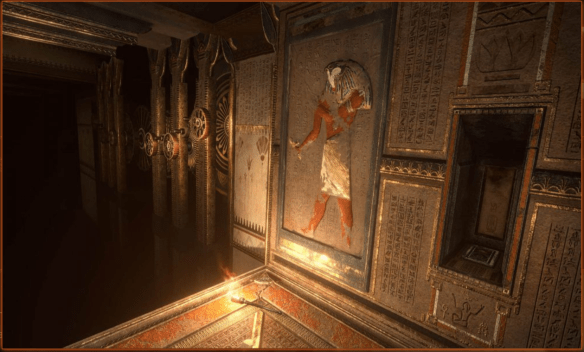
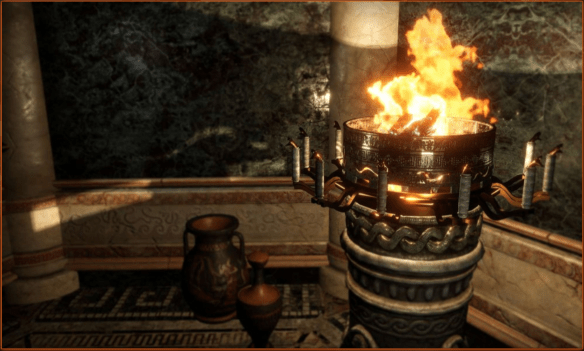
Ubisoft (the company responsible for the Assassin’s Creed video game series) offers a series of game-inspired VR escape rooms in locations around the world.
Two or four players team up and have 60 minutes to find a way out of a vast Aegean coastal cave where the legendary ship of the Argonauts is anchored. To successfully escape, players must use cooperative teamwork, problem-solving skills and precise timing to solve riddles and find their way out of this room-scale experience. Players start the adventure by choosing their avatar from among six diverse characters, and can customize them with Ancient Greek accessories.
Although the VR environment means that the focus is more on VR action than puzzle-solving, there are several mechanical puzzles to unravel and virtual rooms to escape, either on your own or with the help of another player. From descriptions, it appears to feel more like playing a video game than conquering an escape room, but it’s still an impressive step forward in VR technology.
I wonder how far we are from being able to experience an escape room from home. Whether it’s fully immersive and you can manipulate objects or you’re simply piloting a person or robot remotely through the VR interface, I suspect we’ll see a puzzly experience like that sooner rather than later.
Thanks for visiting PuzzleNation Blog today! Be sure to sign up for our newsletter to stay up-to-date on everything PuzzleNation!
I’ll start us off with one of our most recently reviewed games. The Abandons is a one-player maze game where you’re exploring a labyrinth that’s different every time you play. You’re at the mercy of the draw pile for the most part, but the more you play, the better you get at managing your meager resources and exploring the seemingly endless corridors. Can you find your way out?
[If you’re looking for a similar gaming experience, you can also try One Deck Dungeon or Brad Hough’s The Maze.]
For a more traditional solving experience, Puzzometry presents classic puzzle-solving with a modern twist. This next-level jigsaw-style solving will push your Tetris skills as you twist, turn, and maneuver the pieces into seemingly endless combinations, trying to find the one solution that completes the grid.
There are several different Puzzometry puzzles — the standard one, an easier junior one, and a squares-based one — but each offers its own challenges.
Can you twist, turn, and spin these dice to complete beautiful, elaborate patterns inspired by Celtic knots? That’s the name of the game with Knot Dice, a dice game as challenging as it is gorgeous.
This is one of those games I find tremendously relaxing as I trace the various patterns and try to form different designs.
Deduction puzzles have never been so colorful! Each challenge card offers a different layout of set cubes, along with clues to unravel in order to place all twelve cubes. The clues grow trickier with every card, ensuring that you’ll constantly find new challenges as you solve.
Our friends at ThinkFun are masters at putting together single-player puzzle-game experiences, and Thinking Putty Puzzle is just one example. It sounds simple at first: connect two colored dots with a length of stretchable putty. But when you have multiple colors on the board and you can’t overlap your paths, suddenly it’s a much more challenging deductive endeavor.
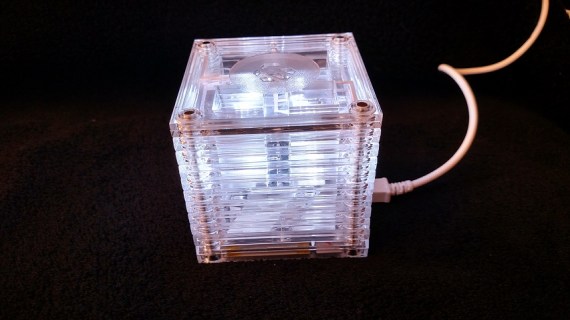
A puzzle box unlike anything you’ve ever seen, Lightbox creates different patterns of shadow and light as you shift and arrange the various plastic plates that make up the box. As you twist and reset them, different electrical connections are made, and different plates light up.
This is another puzzle game that I find quite soothing, even if I can be frustrated by the seemingly endless combinations available.
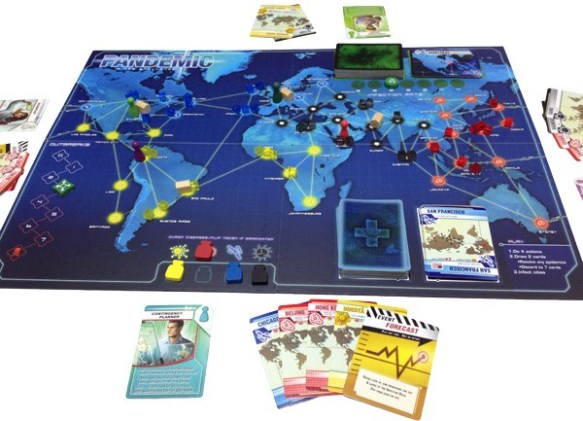
Although co-op games are designed to bring together several players as they work to defeat the game itself, many co-op games also offer satisfying single-player campaigns. Pandemic allows you the chance to singlehandedly save the world from four deadly outbreaks, if you’re quick and clever enough!
[Forbidden Island, Castle Panic!, and other co-op games are also worth your time if you enjoy this kind of gameplay.]
Do you have any suggestions for good single-player puzzles and games, fellow puzzlers? Let us know in the comments section below! We’d love to hear from you!
Thanks for visiting PuzzleNation Blog today! Be sure to sign up for our newsletter to stay up-to-date on everything PuzzleNation!
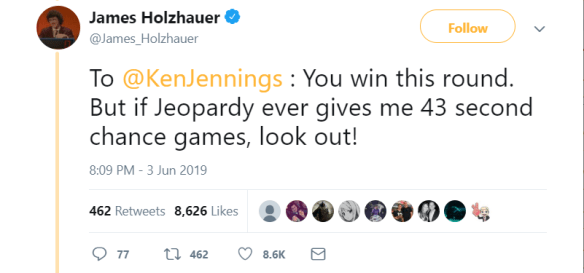
Alas, all great runs must come to an end, and so it is with a heavy heart that I report that James Holzhauer — sports gambler, trivia whiz, and Jeopardy! champion — has been defeated, relinquishing his title as champion after 32 days.
He amassed an impressive total of $2,464,216, the second highest in game history during regular-season play. And his impressive daily totals have yielded some impressive stats. He now holds 21 of the top 25 spots on the show’s list of the highest single-day winnings.
Holzhauer was complimentary toward both Jennings and his Jeopardy! opponent Emma Boettcher on social media, stating, “CONGRATULATIONS to Emma on a world-beating performance. There’s no greater honor than knowing an opponent had to play a perfect game to defeat me.”
He then cited one of the predictions as to how his reign would end, quoting, “James will eventually beat himself by flubbing one of his big bets,” before responding, “Nope, James got his ass kicked straight up by an elite player who nailed her own big bets.”
Naturally, the buzz around social media regarding this unexpected turn of events is mixed. Some viewers are glad to see a new champion crowned, while others are sad to see Holzhauer go.
There are also a few conspiracy theories brewing. Some viewers believe that James intentionally threw this match, citing slower reaction times, gimme questions being missed, and a general lack of energy from the normally bullish champion. He went into Final Jeopardy in second place.
The capper for many was his performance in Final Jeopardy where he made an uncharacteristically low wager (only $1300 or so, when he was at $23k), meaning that despite his correct answer, he wouldn’t defeat his rival for this game. (Emma Boettcher, on the other hand, bet $20k on Final Jeopardy, perhaps anticipating a similarly aggressive bet from Holzhauer.)
But Holzhauer has already explained his unexpected move, telling The Atlantic that, “By the time Final Jeopardy rolled around I knew my goose was cooked if Emma answered correctly. It’s a little like needing a team to miss a last-second field goal ― nothing you can really do but watch. I made peace with my fate before the clue for Final was even revealed.”
Holzhauer seems pleased with his Jeopardy! performance despite not dethroning Jennings. “My only real goals were: Win $110,914 on an episode to honor my daughter’s birthday, and play my absolute best every game. I achieved both, and I’m very proud of myself for that.”
Congratulations to James Holzhauer for a very notable run as champion, and congratulations to Emma Boettcher for proving to be a more than worthy champion in her own right.
And now, there’s really only one way to conclude a saga like this, and that’s with a song. Take it, “Weird Al”…
Thanks for visiting PuzzleNation Blog today! Be sure to sign up for our newsletter to stay up-to-date on everything PuzzleNation!
It’s been a few weeks, so it’s time for a Jeopardy! update.
Unless you’ve been living under a rock (specifically a rock with no wi-fi, morning news coverage, or game show fans nearby), you’re probably aware of James Holzhauer, the Jeopardy! contestant who has been dominating the scene for more than a month.
After a two-week hiatus where Jeopardy! aired episodes centered around teachers as contestants, sports gambler and trivia master Holzhauer has returned to continue his reign of terror over Alex Trebek’s domain. His undefeated streak now stands at 29 consecutive victories.
Holzhauer is only the second person in history to pass the million-dollar mark on the show, and his success has fans anxiously eyeballing the money-winning record set by Ken Jennings more than a decade ago. That sense of anticipation is only growing stronger.
Holzhauer’s total thus far is $2,254,938.
As of last night’s performance, Holzhauer is a mere $265,762 away from Ken Jennings’ total for highest winnings in regular season play. (Jennings has won additional money in tournament play that isn’t counted in this total.)
Now, granted, that’s a lot of money. But it’s worth noting that $265,762 is only $4613 higher than Holzhauer has won on his two highest-scoring games combined. So, essentially, if he performs to the absolute best of his ability, he’s three wins away from overtaking Jennings. (Even if he’s not performing at his best, his average money won per game ($77,756) means that he’s only four average wins away from overtaking Jennings.)
Oh, and that average money per game statistic? It’s worth noting that the previous single-game record for the show was BELOW that, clocking in at $77,000 dollars.
Have you been keeping up on all the trivia excitement? If so, what do you think, folks? Is Holzhauer going to make history by surpassing Ken Jennings in less than half the time? Is Jennings’ 74-day winning streak also within reach for the bold betting master?
Let us know your thoughts in the comment section below! We’d love to hear from you!
Thanks for visiting PuzzleNation Blog today! Be sure to sign up for our newsletter to stay up-to-date on everything PuzzleNation!
Puzzles come in all shapes and sizes. There are wooden boxes, plastic mazes, and metallic brain teasers. Shapes to be reassembled and combinations of wood, rope, and metal to untangle. There are wine bottles to free, locks to open, and secret compartments to uncover.
These rings are made of overlapping metal bands that weave together to create elaborate designs, knots, and patterns. Puzzle rings can consist of as few as three bands or as many as seventeen, though between four and eight are the most common. When properly arranged, the bands align to form a particular design, and the pressure of your finger helps hold the bands in place.
When you take it off, the ring falls apart into its component bands. (Often, the rings are interconnected, which ensures they won’t be misplaced, but can also make solving them harder.)
And, as you might expect, the more bands that constitute the ring, the more difficult and elaborate the movements necessary to arrange the ring into its correct configuration.
Rings with Celtic knot or claddagh designs — inspired by Irish tradition — symbolize the thought and effort that keep the bonds of friendships or marriages strong. Faithfulness and loyalty, a bond forged by separate elements coming together as one.
Now, that’s a lovely thought, but some origin stories paint the puzzle ring as a symbol of mistrust. You see, according to legend, a Turkish king (or a soldier in the Middle East heading off to war, depending on the story), didn’t trust his beloved, so he had a puzzle ring forged for her. This way, if she was unfaithful — for instance, removing the ring so her new lover wouldn’t know she was married — the ring would fall apart, providing sure evidence that the ring had been removed and some sort of shenaniganry was afoot.
Those stories may very well have some fact behind them, but it’s more likely that puzzle rings evolved from the Elizabethan tradition of gimmal rings (or gimmel rings).
Gimmal rings are rings consisting of two or three hoops or pieces that form a single ring. Popular as engagement gifts, the rings would be worn separately until the wedding, when they would be reunited and used as the wedding ring. (The third piece was often worn by a witness to the wedding before it would be reunited with the others.)
Also known as joint rings, gimmal rings found enthusiastic audiences in Germany, England, and elsewhere in Europe, which is also where claddagh designs, dragon designs, and other imagery was added.
Some sites online claim that military veterans in Sweden sometimes receive puzzle rings representing the number of tours they’ve served (four bands representing one tour, five bands representing two tours, etc.), but I’ve been unable to independently verify that.
But no matter the origins or the common uses, there’s no denying that puzzle rings are some of the most beautiful, elegant, and clever puzzles on the market today. (We’ve even added a board full of them to our Pinterest account!)
A cursory Google search turns up dozens of sites selling them, and the prices range from quite reasonable to thousands upon thousands of dollars for diamond-inlaid, golden puzzle rings sure to dazzle the eye and baffle the mind.
I think that, for now, I’ll stick with the 3D-printed puzzle ring I got for Christmas a few years ago.
Thanks for visiting PuzzleNation Blog today! Be sure to sign up for our newsletter to stay up-to-date on everything PuzzleNation!
The local carnival has already come and gone in my town, but there are many more county fairs, state fairs, and amusement park visits in the immediate future. After all, summer is almost here.
With carnivals and fairs, there are certain universal attractions. The Ferris wheel. The burlap sack slide. And, of course, those devious midway games.
Games of strength, games of dexterity, games of skill and chance… carnival games are tailor-made to separate you from your hard-earned dough. But we’re not any run-of-the-mill rube or mark for the carnival crews to exploit; we’re puzzlers!
So is there anything we can do to improve our odds?
You betcha.
Let’s look at a few classic carnival games and how we can increase our chances for stuffed animal prize success.
One of my personal favorites is the basketball shot. It seems simple, since all you have to do is make what looks like a regulation three-pointer.
But looks are deceiving. The hoop is usually higher than normal, as well as farther away. In addition, the ball is overinflated to increase unfriendly bounces, and the rim of the hoop is often bent in an oblong shape to discourage successful tosses. (At one carnival, the hoop was so warped that my friend’s toss actually landed ON the hoop, proving there was no way to successfully make a basket.)
Assuming the hoop actually allows for a ball to pass through, your best chance is to avoid the backboard entirely and go for a clean swish.
What about the rope ladder? The rope ladder seems like the fairest carnival game, since there’s little visual trickery involved. It’s all about balance after all.
But, as expected, it’s harder than it appears. Since the rope’s peak is anchored at only one point — not the two points of contact at the bottom — it’s far easier to tip over. You have to keep your center of balance as close to the center line of the ladder as possible. But it’s virtually impossible to stay in the center of the rungs as you climb, because lifting yourself up and away from the ladder — as you would in normal climbing — makes tipping over likely.
Many websites recommend using your left arm and right foot in tandem, then alternating to your right arm and left foot. If you have a strong center of gravity, that will definitely help. Be sure to stay low and flat, which will allow you greater control of the ladder. Ignore the rungs and focus on using the outside ropes to pull yourself.
And, of course, keep an eye on the operator. Some will hold the ladder steady for you at first, and then let go at an inconvenient moment for you.
Water guns and pellet guns also make appearances in carnival games, with the “shoot the star” game being among the most infamous. The goal in this game is to shoot away any traces of the star from the paper.
It goes without saying that the BB gun will not shoot true, so take a few practice shots to get used to adjusting for the gun’s idiosyncrasies.
Your instinct will be to aim at the center of the star and work your way out, but that’s guaranteed failure. Doing so creates little flaps of paper as the center is eaten away, and those flaps will fold and bend as they’re hit, rather than tearing away.
The recommended tactic is to shoot a circle around the star, which prevents those little energy-absorbing flaps from forming. Granted, if you are successful with this tactic, the star itself will become a flap near the end of the game. It’s best to leave the top part of the circle connected last, since gravity at the very least will be on your side. (If, for instance, you shot away the top part of the circle first, the circle could easily fold or tip down, making it much harder to hit.)
This is definitely one of the tougher midway games. The FBI actually studied how the size of the star affects players’ chances for success, and it turns out the smaller the star, the better your odds. (Specifically, an inch or smaller in diameter is your best bet. If the star is wider than 1.5 inches, you’re outta luck.)
This video features a terrific statistical breakdown of the odds of various carnival games and some techniques for beating them. (It also confirms what we’ve all long suspected… that no matter how quickly you win a prize, you’ve already overpaid for it.)
And before we go, let’s conclude the post with a few more tips for not getting scammed. After all, for the most part, we’ve treated these games as difficult, but ultimately winnable. That’s not always the case.
So make sure to watch a game for a while before you play. Some unscrupulous operators will use different balls or equipment in demonstration than you get to use when your money’s on the line. Be aware.
Also, when trying out a game, always try to stand where the operator was standing. Most carnival games involve showing you “how easy it is to win” in order to sucker you in. But if the operator won’t let you try to recreate exactly how they did it — including which ball and where they’re standing — you might be playing an unfairly rigged game.
Got any other advice for carnival game enthusiasts? Let us know in the comments section below! We’d love to hear from you.
Thanks for visiting PuzzleNation Blog today! Be sure to sign up for our newsletter to stay up-to-date on everything PuzzleNation!