It’s Follow-Up Friday: Hall of Fame edition!

Welcome to Follow-Up Friday!

Follow-Up Friday is a chance for us to revisit the subjects of previous posts and bring the PuzzleNation audience up to speed on all things puzzly.

And today, I’d like to return to the subject of Dungeons & Dragons!

I’ve written about Dungeons & Dragons and other roleplaying games in the past, because I think they are a wonderful, underappreciated part of the world of puzzles and games. Some of the best and most satisfying riddles and puzzles I’ve ever solved were an integral part of a game of D&D.

So I’m excited to announce that Dungeons & Dragons has been inducted into the National Toy Hall of Fame!

Housed at The Strong National Museum of Play, the National Toy Hall of Fame recognizes those products and improvised toys that have played a crucial role in the development of children and teens.

Whether they assist in hand-eye coordination, storytelling, deduction, athletics, or creativity, they are all classic examples of toys tied to fond memories of childhood. Previous inductees include the Rubik’s Cube (2014), Hot Wheels (2011), the Radio Flyer Wagon (1999), Jacks (2000), and Play-Doh (1998).

And I for one think Dungeons & Dragons is a very worthy addition to this club.

From the induction notice:

Dungeons & Dragons and its imitators actually changed the nature of play.

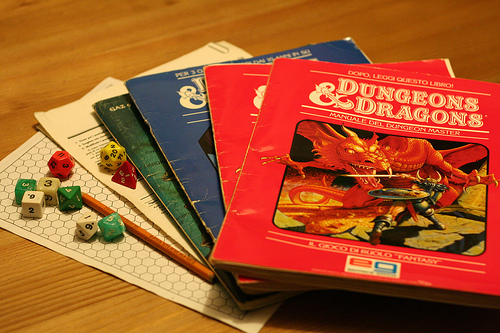
In Dungeons & Dragons players assume the roles of characters who inhabit a world moderated and narrated by a Dungeon Master, a player who explains the action to others and solicits their reactions to the unfolding story. The Dungeon Master’s storytelling skills and the players’ abilities to imagine add enjoyment to the game. Some aspects of the play are familiar, such as dice. But the special dice for Dungeons & Dragons hold up to 20 sides. Rolling them determines each character’s individual strengths, plots their complex interactions, and decides the outcome of their encounters.

More than any other game, Dungeons & Dragons paved the way for older children and adults to experience imaginative play. It was groundbreaking. And it opened the door for other kinds of table games that borrow many of its unique mechanics.

For over forty years, Dungeons & Dragons has been synonymous with roleplaying, collaborative storytelling, and good old-fashioned sword-swinging derring-do. And I think it’s fantastic that it’s getting some long-overdue recognition for the positive role it has played in so many people’s lives.

Congratulations to you, Dave Arneson and Gary Gygax. Thank you for hours and hours of brilliant, engaging fun.


Thanks for visiting PuzzleNation Blog today! Be sure to sign up for our newsletter to stay up-to-date on everything PuzzleNation!

You can also share your pictures with us on Instagram, friend us on Facebook, check us out on TwitterPinterest, and Tumblr, and explore the always-expanding library of PuzzleNation apps and games on our website!

5 Questions with PuzzleNation Social Media Manager Glenn Dallas

Welcome to 5 Questions, our recurring interview series where we reach out to puzzle constructors, game designers, writers, filmmakers, musicians, artists, and puzzle enthusiasts from all walks of life!

It’s all about exploring the vast and intriguing puzzle community by talking to those who make puzzles and those who enjoy them! (Click here to check out previous editions of 5 Questions!)

For the entire month of August, I’ll be introducing the PuzzleNation readership to many of the members of the PuzzleNation team! So every Thursday this month, you’ll meet a new name and voice responsible for bringing you the best puzzle apps on the market today!

And we’re continuing this series with me, your friendly neighborhood PuzzleNation blogger, as our latest 5 Questions interviewee!

My name is Glenn Dallas, and I’m not only lead blogger for PuzzleNation Blog, but also Social Media Manager for PuzzleNation, maintaining and providing content for all of our social media platforms. A lifelong puzzler and board game enthusiast, I try to infuse every blog post with that same level of dedication and passion. Hopefully, I succeed.

I consider it a privilege for me to take some time out to talk to the PuzzleNation audience, so without further ado, let’s get to the interview!


5 Questions with Glenn Dallas

1. How did you get started with puzzles and games?

Looking back, it seems like puzzles and games were always around. My mother has always been a dedicated crossword solver. I can remember my older sister playing “School” with me and my younger siblings, using brain teasers and puzzles from old issues of GAMES Magazine as “lessons.” The classic board games were played often — Monopoly, Sorry, Mouse Trap, Battleship, even Trivial Pursuit, which I was probably too young for. But I’ve always been a trivia nerd.

Although formal puzzling fell by the wayside as I got older, wordplay and riddles and the like remained a recurring interest. I would often create puzzle content for friends’ websites or my own blog that involved Say That Again?-style rewording, palindromes, puns, anagrams, portmanteaus, brain teasers, and other forms of wordplay. (And, for a bit of context for long-time internet users, I’m talking about Geocities and Angelfire websites, as well as a blog that pre-dated LiveJournal.)

I got back into puzzles more directly in college when I began playing Dungeons & Dragons and other role-playing games, because I enjoyed challenging my players with tests beyond the usual monster hunts. So mechanical puzzles, sliding-block puzzles, and more Myst-style puzzle-solving became an interest (along with riddles and such).

After college (and a stint as a TV cameraman), I had an interview at Penny Press and was hired as a puzzle editor, bringing my amateur puzzly skills into a professional setting working on traditional (and non-traditional!) pen-and-paper puzzles like word seeks, crosswords, cryptograms, fill-ins, etc. And more than a decade later, I’m still at it.

2. You’re one of the senior members of the PuzzleNation team, dating back to its earliest days. How has your work for PuzzleNation changed over time and what can you tell us about PuzzleNation as it evolves and moves forward?

That’s true! Originally, I was just pitching in occasionally as a product tester — helping look for bugs or problems with early versions of apps — and I started providing ideas for content to our social media person for Facebook posts. I was a big proponent early on of expanding our efforts to include a blog; it’s a great centerpiece to a social media platform (and one that allows for more control than your average Facebook post).
But I also wanted PuzzleNation Blog to be a hub for all things puzzles and puzzle games, because there’s not really anywhere like that on the Internet. If you like movies, there’s IMDb. If you like books, there’s Goodreads. You’ve got Gizmodo for tech, science, and sci-fi, and Board Game Geek for board games. And although there are plenty of terrific crossword blogs out there, there’s not one central place to go to talk about puzzles in general. I always envisioned PuzzleNation Blog as that place.

When our previous social media person left the company, I was already writing blog posts once or twice a week (alongside Eric Berlin, who was our top contributor to the blog in its early days), and I inherited his position, along with the Facebook, Twitter, and Pinterest accounts that went with them. (I have since added Tumblr and Instagram to our bevy of social media platforms.)

So, as you can see, I’ve gotten a bit busier as time passed, expanding my duties and becoming the lead blogger on the site, writing three (and sometimes more) blog posts a week.

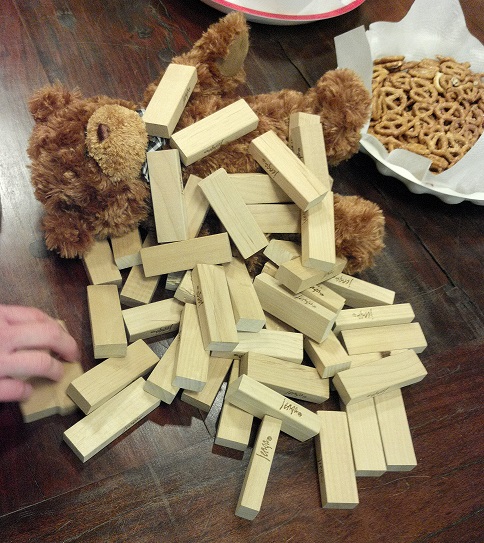
[Here I am, hard at work trying to beat a stuffed teddy bear in Jenga… and failing.]

I feel like the blog has grown and matured into what I originally envisioned — though there’s always room for expansion and improvement! — and my goal right now is continue maintaining that level of interest and quality.

As for our Facebook, Twitter, and other social media outlets, I’m always looking to encourage more interaction with the PuzzleNation audience. I’m hoping at some point to have recurring puzzle features on every platform. (For now, we’ve got the Insta-Anagram game every Monday on Instagram, and the Crossword Clue Challenge every weekday on Facebook and Twitter.)

3. The crossword has been around for over a hundred years, and many puzzles (whether pen-and-paper or mechanical) have roots that can be traced back even farther. What, in your estimation, gives puzzles such lasting appeal?

I think it’s the Eureka! moments that keep people coming back. They’re certainly what I find the most enjoyable and the most motivating factor. And puzzles provide those in spades.

[Image courtesy of tnooz.com.]

When you approach a particularly fiendish brain teaser, or a crossword clue that keeps eluding you, or a mechanical puzzle that has you stymied, and then suddenly, that light bulb appears over your head. You’ve cracked the code, found the hidden latch, connected the missing pieces, made a deductive leap that would make Sherlock Holmes proud…those Eureka! moments never fail to make it all worthwhile.

And when you work with puzzles, you get to see those moments more often than most people.

4. What’s next for Glenn Dallas and PuzzleNation Blog?

For me, quite a bit. My writing partner and I just launched a new promotional blitz for the novel we published last year, Sugar Skulls (my first novel!), and I’m deep into several ongoing writing projects, one of which is on track to wrap up before the end of the year.

On the side, I’m a freelance book reviewer, and I recently posted my 1,200th book review. I’ve also started work on another in-office murder mystery that I’m hoping to run at our summer picnic event next month. (And I’ll be sure to share pictures here and on Instagram of that!)

As for PuzzleNation Blog, I’m proud to announce that, after the recent success of our PuzzleNation team series of interviews, 5 Questions will be returning as a regular, recurring feature on the blog!

It will be at least once a month (but hopefully twice a month), and I’ve already lined up our first guest for September, with more terrific puzzlers, constructors, and personalities to follow!

5. If you could give the readers, writers, puzzlers, and puzzle fans in the audience one piece of advice, what would it be?

Make time for yourself every day to do something that fuels you. If you want to write, write something every day, whether it’s just a haiku or a journal entry or a limerick or whatever. If you like games, play a round at lunch with friends or coworkers. There are plenty of quick-play games and puzzles that fit that bill. (Oooh, that gives me an idea for a blog post…)

But I digress.

We spend so much time worrying about, well, everything, it’s easy to let the good stuff, the stuff that reinvigorates you and keeps your spirits up, fall by the wayside. So make a little time for you every day. It does wonders.


Thanks for visiting PuzzleNation Blog today! Be sure to sign up for our newsletter to stay up-to-date on everything PuzzleNation!

You can also share your pictures with us on Instagram, friend us on Facebook, check us out on TwitterPinterest, and Tumblr, and explore the always-expanding library of PuzzleNation apps and games on our website!

Interactive Puzzling is Murder on a Work Day!

[Image courtesy of Carriageway.com.]

It all started with a board game at lunchtime.

TableTop Day is a popular annual event here at PuzzleNation, and several of my fellow puzzlers enjoyed it so much that they wanted it every week. Well, we couldn’t swing that — deadlines and all — so we play games every Wednesday during lunch.

During a particularly spirited round of 10 Minutes to Kill — a game where every player controls a hitman trying to take out three targets without being identified by the other players or the police — the subject of murder mysteries came up, and I let slip that I’d helped write and run several murder mystery dinners in the past.

[Image courtesy of Vancouver Presents.com.]

So, naturally, the idea of running a murder mystery at work became a recurring topic of discussion.

As a huge fan of interactive storytelling — be it tabletop role-playing games like Dungeons & Dragons, improv theater, LARPing, or other group activities — the idea appealed to me.

Of course, I had one huge hurdle to overcome: the work day.

You see, murder mystery dinners thrive on the theatricality of the event. Attendees can overhear arguments, catch snippets of banter and exposition as they walk around, and engage characters in conversation to learn more. The more you interact with the story, the better chance you have of solving the mystery, but even passive players will get the big picture.

But in a normal workday, I can’t stage big elaborate sequences, like a failed marriage proposal or someone tossing wine in another’s face. I’d have to find another way to deliver information, mysteries, and drama.

Thankfully, as a puzzler, I’m accustomed to writing clues. Cluing is simply delivering information in unexpected ways. Whether it’s through deceptive wordplay, puns, or connections with other entries, crosswords and logic problems are excellent training for being creative and stealthy while presenting important information.

So, I mapped out the murder and the characters I’d need to pull it off, and cast those characters from a group of fellow puzzlers. At the same time, I gauged interest from other coworkers to see who’d be interested in trying to crack the case, and began devising ways to weave them into the narrative. (This was more intimate than writing your usual murder mystery dinner for random attendees, since the latter is more about creating scenes than tailoring it to specific people and circumstances.)

[Can’t have a murder mystery without an animal for someone to pet fiendishly.
In this case, my trusty armadillo in a cowboy hat, Armando.]

My goal was to get everyone prepped to play on Monday, and then actually run the mystery on Tuesday and Wednesday, with the murder having occurred overnight.

Which led to another big hurdle. I couldn’t exactly stage an elaborate murder scene in a way that was unobtrusive to the workday, so I’d have to describe the scene to the players and let them ask questions about it.

But how do I leave clues for the players that are readily identifiable as clues and not just the ephemera of a working office? After all, any good murder investigation needs some convenient clues to uncover that will help unravel the mystery.

I opted to mark any clue (which were most often color pictures of actual items, like a stashed wallet or a threatening letter) with the symbol below, to remove any doubt that this item was involved someway in the murder mystery:

Okay, that takes care of the clues. But what about the actual interaction, where players ask questions of characters and gain the valuable knowledge needed to solve the crime?

Sure, a lot of that can be done through group emails and instant messenger programs, encouraging the investigators to share what they’ve learned, so there wouldn’t be random gaggles of investigators creating a distraction as they ponder the latest clue found or deduction made.

As a storyteller, whether you’re running an RPG or a murder mystery, you not only need to know the details of your story backwards and forwards, but you need to anticipate what questions the audience will ask.

And no matter how prepared you are, I assure you, the players will ALWAYS find a way to monkey-wrench your plans, whether they approach the problem from an unexpected direction or they ask for information you hadn’t prepared in advance. There had to be a simple way to reflect this in the actual gameplay.

To deal with this, I borrowed an idea from Lollapuzzoola and created Holmes Tickets, which were catch-all requests for deeper insight or information than had been provided. Basically, anything that would require outside intervention or skills beyond that of the casual investigator could be revealed by spending a Holmes Ticket.

Dusting for fingerprints, getting ahold of a coroner’s report, uncovering information on a missing check…all of these and more were results of investigators cashing in their Holmes Tickets at various points in the investigation.

So, how did the actual murder mystery go? Well, I’d love to tell you, but it’s not finished yet! The work day proved more intrusive than expected — damn those pesky deadlines and responsibilities! — so we’re rolling into a third day of passive gameplay.

By hook or by crook, the story will be wrapped up today, and I’ll be able to fill you in more on the actual story, clues, and progression of each investigation. For now, I’ll just let you know that there are currently three bodies to account for (our killer has been busy since Monday night), and a host of theories, but no firm accusations yet.

We shall see if justice is served or if our crafty killer gets away.


Thanks for visiting PuzzleNation Blog today! Be sure to sign up for our newsletter to stay up-to-date on everything PuzzleNation!

You can also share your pictures with us on Instagram, friend us on Facebook, check us out on TwitterPinterest, and Tumblr, and explore the always-expanding library of PuzzleNation apps and games on our website!

Demystifying Role-Playing Games

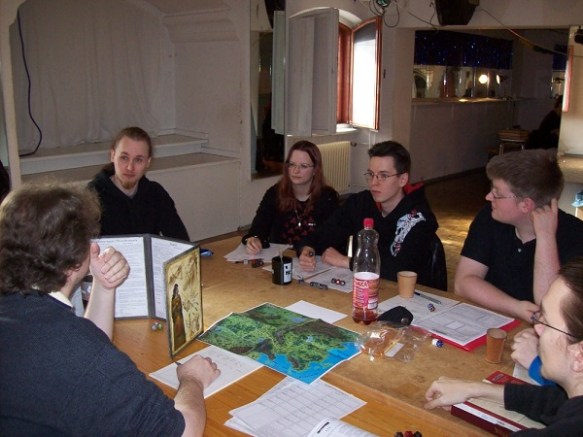
When you hear the words “role-playing game,” what comes to mind? A bunch of nerds in a basement, hunched around a table debating weird and esoteric rules? Practitioners of the black arts, thumbing their noses at God and all that is natural? Or nothing at all?

rpg-2009-berlin-2

Some TV shows, like Community and Freaks & Geeks, have displayed role-playing games in a positive light, but for the most part, role-playing games in general, and Dungeons & Dragons in particular, have gotten a bad rap over the last few decades, maligned as (at best) a game for lonely friendless types and (at worst) a tool to corrupt children.

(This might sound ridiculous to many of you, but folks like Pat Robertson continue to talk about role-playing games as if they’re synonymous with demon worship.)

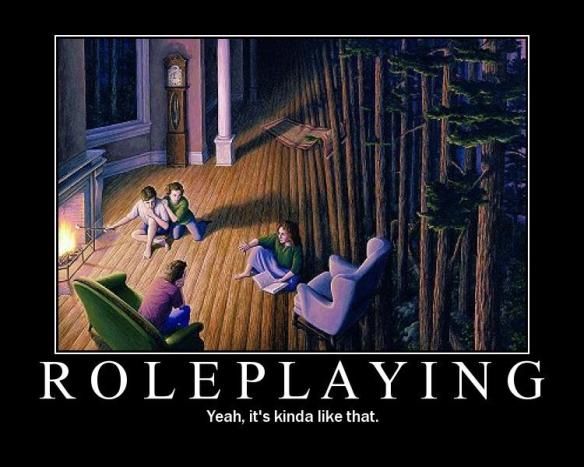
But in reality, role-playing games are simply a way for a group to tell one collaborative story.

roleplaying-kinda-like-that

There are two major elements to this storytelling. The first is managed by a single person who oversees that particular game or gaming session. In Dungeons & Dragons, this person is called the Dungeon Master, or DM; in other games, this person is the Game Master, the Storyteller, or bears some other title tied to the game or setting. For the sake of simplicity, from this point on, I’ll refer to this person as the DM.

So, the DM manages the setting and sets up the adventure. In this role, the DM will describe what the player characters (or PCs) see and explain the results of their actions. The DM also plays any characters the players interact with. (These are known as NPCs, or non-player characters.) Essentially, the DM creates the sandbox in which the other players play.

1951073350_7e357dbdec_3

Which brings us to the second element in role-playing storytelling: the players. Each player assumes a role, a character, and plays that character for the length of the session, or the game, if there are multiple sessions. (Some games last months or years, so these characters evolve and grow; players often become quite attached to their characters.)

The PCs navigate the world created by the DM, but their actions and decisions shape the narrative. No matter how prepared a DM is or how carefully he or she has plotted out a given scene or adventure, the PCs determine much of what happens. They might follow the breadcrumbs exactly as the DM laid them out, or they might head off in an unexpected direction, forcing the DM to think on the fly in order to continue the adventure.

dd2

That’s what makes role-playing games so amazing: you never quite know what you’re going to get. The PCs usually don’t know what the DM has in store, and no DM can predict with perfect clarity what the PCs will do. You’re all crafting a story together and none of you knows what exactly will happen or how it all ends.

For instance, I run a role-playing game for several friends that is set in the universe of Buffy the Vampire Slayer, and my PCs routinely come up with solutions to problems and puzzles that I didn’t expect, but that nonetheless would work. They constantly keep me on my toes as a DM, and it’s one of my favorite aspects of the game.

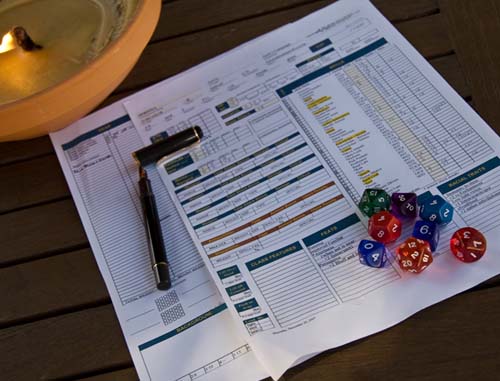
Oftentimes, major events and key moments are determined by dice rolls, adding an element of chance to the story. (In some games, players have replaced dice rolls with a Jenga-style block tower, and they must remove pieces from it to achieve certain goals. That adds a marvelous sense of real-world tension to the narrative tension already present!)

tabletop6

And while I’ve talked quite a bit about the game aspect, some of you might be wondering where the puzzly aspect comes in.

Some of the best, most satisfying puzzle-solving experiences of my life have come from role-playing games.

These puzzles can be as simple as figuring out how to open a locked door or as complicated as unraveling a villain’s dastardly plot for world domination. It can be a poem to be parsed and understood or a trap to be escaped.

There are riddles of goblins and sphinxes, or the three questions of trolls, or even the brain teasers and logic problems concocted by devious fey hoping to snare me with clever wordplay. I’ve encountered all sorts of puzzles in role-playing games, and some of them were fiendish indeed.

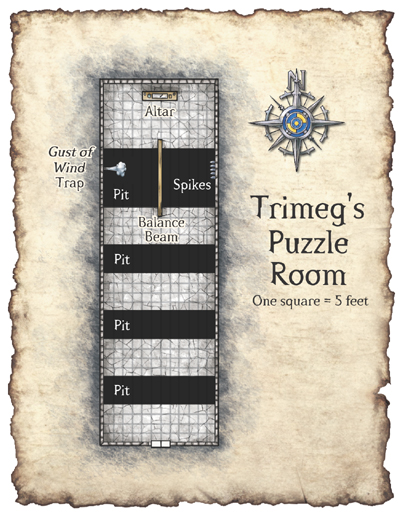
trimegspuzzleroom

One time, during a LARP session (Live-Action Role-Playing, meaning you actually act out the adventure and storytelling), I thought I’d unraveled the meaning of a certain bit of scripture (regarding a key that would allow me to escape the room) and acquired a sword as my prize, only to realize much much later that the key I’d spent the entire session searching for was the sword itself, which unlocked the door and released me.

And designing puzzles for my players to unravel is often as much fun as solving the puzzles myself. Especially when they’re tailored to specific storytelling universes or particular player characters.

(Trust me, it doesn’t matter if you’re dealing with a Jedi or a paladin; riddles stop pretty much everybody in their tracks.)

b7052aee1c93bff98f4c513e4470fbb6

Whether it’s Dungeons & Dragons or Pathfinder, Legend of the Five Rings or Star Wars, GURPS or Ninja Burger, there’s a role-playing game out there for everyone, if you’re just willing to look.


This post was meant as a brief overview of role-playing games as a whole. If you’d like me to get more in depth on the subject, or if you have specific questions about role-playing games, please let me know! I’d be happy to revisit this topic in the future.

Thanks for visiting PuzzleNation Blog today! Be sure to sign up for our newsletter to stay up-to-date on everything PuzzleNation!

You can also share your pictures with us on Instagram, friend us on Facebook, check us out on TwitterPinterest, and Tumblr, and explore the always-expanding library of PuzzleNation apps and games on our website!

Roll with it!

When it comes to games, there’s probably no component more common or familiar than the six-sided die. From craps to Yahtzee, backgammon to Monopoly, everyone has played a game where the dice controlled your destiny.

And there are several games where the dice are integral to the puzzly gameplay.

The most obvious example is Boggle and its numerous variants. Boggle is played with a 4×4 grid of dice with letters on them, shaken up in order to randomize the letters shown. Players have a limited amount of time to spell out as many words as possible, moving from one letter to an adjacent one.

Testing both your vocabulary and anagramming skills, Boggle is great fun and a terrific challenge, depending on the letters you get. (It can also depend on which edition of the game you purchase, since some have different available letters in order to facilitate gameplay.)

Along that line, I actually received a great puzzly dice game as my Secret Santa gift in the office this year. (How did they know I like puzzles and games!?)

It’s called Campbell’s Alphabet Dice Game, and it’s a marvelous mix of Boggle, Yahtzee, and anagramming games, challenging the players to conjure words from the letters they roll.

The packaging is clever, and the game is designed with all sorts of puzzly references to cooking. With higher-valued letters and a low-stress game mechanic — if you’re stumped, everyone rerolls their letters instead of making one player suffer with crummy letters — it’s a nice addition to my puzzle game treasure chest.

And when it comes to letter-dice games, we have to talk about one of my all-time favorites, Scattergories.

In Scattergories, you roll a giant 20-sided die with numerous letters on it, determining what letter everyone will be using that round. Then players are required to come up with one word for each category that starts with that letter.

The puzzly aspect comes not only from coming up with appropriate words to fit each category, but trying to figure out which words your fellow players WOULDN’T come up with themselves, since answers duplicated by one or more players are worth zero points.

It can be a real challenge to not only come up with ten answers on the fly, but to then try to get into the heads of your opponents and guess what words THEY’D write. More than once, I’ve psyched myself out by assuming one answer was too easy and changing it, only to discover a friend had done the exact same thing. *laughs*

Of course, I would be be remiss if I didn’t mention Dungeons & Dragons, a dice game that goes far beyond the average board game-playing experience.

When it comes to conquering puzzles, some of the best puzzle-solving experiences of my life have been in sessions of Dungeons & Dragons with friends.

Whether it was unraveling a curious mechanical puzzle in order to unlock a door, solving a devious riddle to avert some horrible outcome, or devising a clever way to combine the tools at hand to overcome an unexpected obstacle, my puzzle skills often served me well, allowing me to match wits with dark wizards and perilous foes.

This weekend marked the 40th Anniversary of the birth of the world’s most famous roleplaying game, and it’s hard to deny the incredible legacy sparked by those curiously-shaped dice.

Dice games come in all shapes and sizes — as do the dice themselves! — but they add a marvelous wrinkle of randomness and challenge to the puzzle-game community.

What are your favorite puzzly dice games? Did I miss any major ones? Let me know in the comments!

Thanks for visiting the PuzzleNation blog today! You can like us on Facebookfollow us on Twitter, cruise our boards on Pinterest, check out our Tumblr, download our puzzle iBooks and apps, play our games at PuzzleNation.com, or contact us here at the blog!