The Ultimate Jigsaw Puzzle Table?

puzzle tables

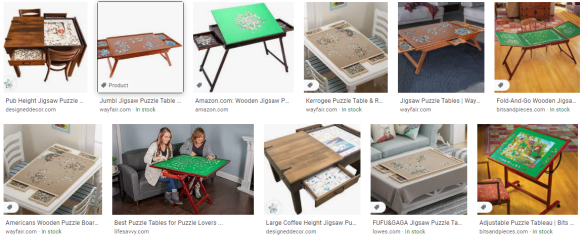
Whether you’re a jigsaw puzzle solver or a tabletop game enthusiast, you’ve probably seen puzzle and game tables. A relatively new addition to the furniture options available for puzzlers and game fans, these tables generally come in one of two forms.

Either they have a removable top with a recessed area underneath to keep your puzzles mid-solve or games mid-play, or they have a central solving surface and side drawers to contain separated pieces. Sometimes this solving surface tilts up / tilts toward you to make it easier to work on.

But those are generally what you’ll see when it comes to puzzle / gaming tables.

il_794xN.1390654132_bmcv

[This table is available on Etsy.]

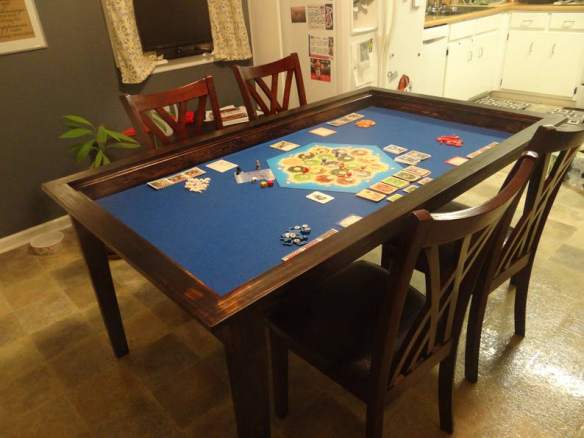
Each has its pluses and minuses. With the removable top version, you have to put the top somewhere, and then you have the deeper solving space, which some solvers find uncomfortable.

With the center table and drawers, you’re still dedicating most of a table to puzzles, and many of them struggle to keep your work in place when folded up or moved around. (Some of these have a removable tray, which can slide into the body of the table, but this can also be unwieldy.)

simone table 3

As they say in the infomercials, there’s gotta be a better way. And YouTuber/inventor/DIY guru Simone Giertz came up with her own solution.

Simone is known for her wacky, inventive, hilarious, and creative construction projects, many of which involve robotics or moving parts. So let’s see what she came up with.

Puzzle-Table-feature-image-10012021

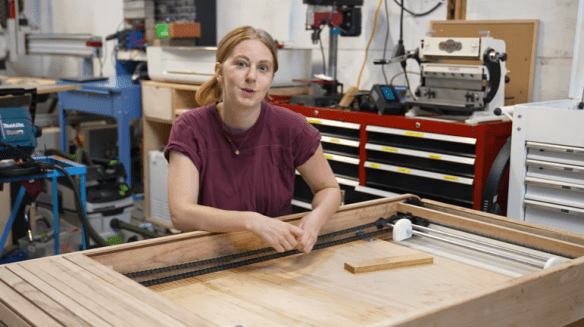
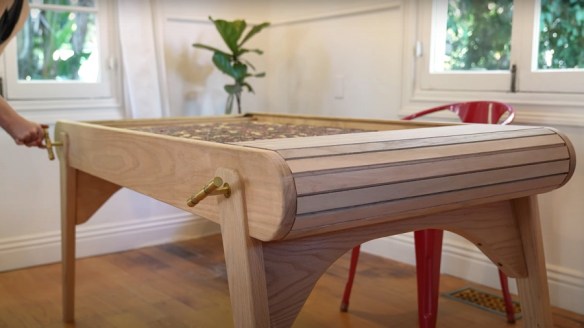
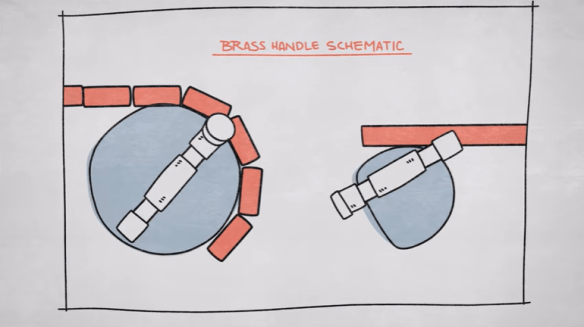
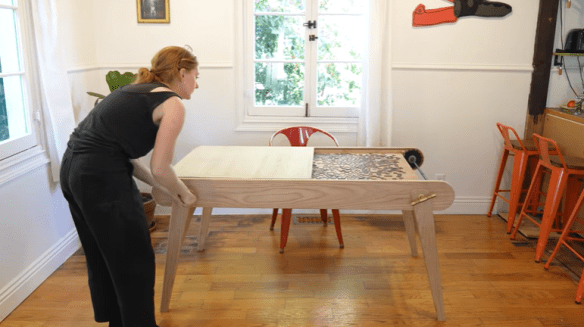
Her table features two hand cranks, each of which solves one of the problems with the removable top version of a puzzle/gaming table.

The first crank turns gears which roll the table top underneath and out of the way, revealing the hidden puzzle-solving space inside. This prevents you from having to worry about storing or handling a heavy or cumbersome tabletop while you solve.

simone table 2

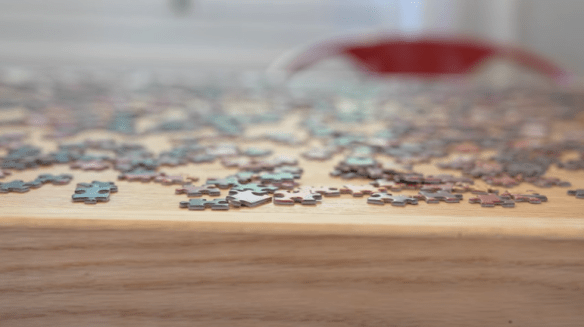
The second crank raises the solving space until it’s flush with the sides of the table. This removes any need to lean down into a recessed play area or solving space to enjoy your puzzles and games. The puzzle literally comes to you!

simone table 4

Plus, this solves some of the issues with other solving tables. There’s no removable tray to navigate, or sliding drawers or flaps that could cause what you’ve already built to shift or fall apart. It simply lowers into the body of the table itself, otherwise resting just as you left it.

simone table

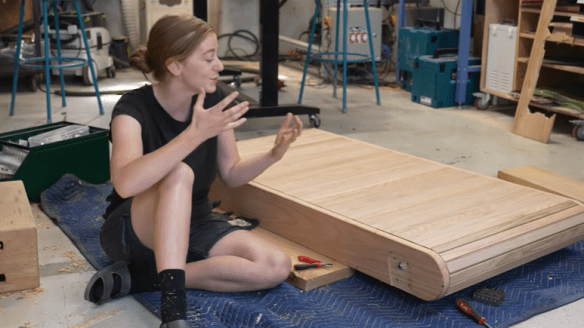
This video shares the entire construction process, including missteps, problems, new solutions, and the eventual successful reveal. (Fair warning: the video is mostly safe for work, but there are two random f-bombs in it, so be aware.)

As you can see, the final product is absolutely beautiful, and unlike virtually every other puzzle or game table you see on the market today.

Pretty much every jigsaw solver I know — and a fair few board game players — would love a piece like this in their house, myself included.

simone table 5

What do you think, fellow puzzlers and PuzzleNationers? Would you like to have this lovely table in your house? Or is there another piece of puzzly furniture that’s caught your eye? Let us know in the comments section below! We’d love to hear from you.


dailypopwsicon

Well, summer’s over, but we still have deals galore for you to check out. You can find them on the Home Screen for Daily POP Crosswords and Daily POP Word Search! Check them out!

Thanks for visiting PuzzleNation Blog today! Be sure to sign up for our newsletter to stay up-to-date on everything PuzzleNation!

Another Brain Teaser Submitted by Readers For Your Puzzly Pleasure!

[Image courtesy of SharpBrains.com.]

When’s the last time you had your brain properly tied in knots by a riddle?

That’s a pretty common occurrence around here, honestly. In our puzzly explorations of the world, we stumble across all manner of brain teasers, riddles, logic puzzles, math problems, mind ticklers, deduction games, and wordplay-fueled bits of linguistic legerdemain.

Sometimes, we even receive them directly from our fellow PuzzleNationers!

And on those occasions, we happily share them with you, dear reader, so that you can also enjoy the challenge of unraveling whatever fiendish puzzly conundrum has been placed before us.

This time around, a solver named Bethany submitted this riddle she found online. It’s known as the Peppermint Patty Riddle.

Let’s see how we do.


The Peppermint Patty Riddle

You’re facing your friend, Caryn, in a “candy-off,” which works as follows: There’s a pile of one hundred caramels and one peppermint patty. You and Caryn will go back and forth taking at least one and no more than five caramels from the candy pile in each turn. The person who removes the last caramel will also get the peppermint patty. And you love peppermint patties.

Suppose Caryn lets you decide who goes first. Who should you choose in order to make sure you win the peppermint patty?


Now that’s interesting, because it doesn’t ask us specifically HOW to achieve victory. But the question basically demands that you not only achieve victory, but figure out how to do so with your very first move.

Tricky indeed.

Will you be accepting this puzzly challenge from a fellow PuzzleNationer? Let us know in the comments section below. We’d love to hear from you!


dailypopwsicon

Well, summer’s over, but we still have deals galore for you to check out. You can find them on the Home Screen for Daily POP Crosswords and Daily POP Word Search! Check them out!

Thanks for visiting PuzzleNation Blog today! Be sure to sign up for our newsletter to stay up-to-date on everything PuzzleNation!
The D’Agapeyeff Cipher, Unsolved for 80 Years!

[Image courtesy of Derek Bruff.org.]

One of my all-time favorite cryptography stories comes from the book The Spy That Couldn’t Spell, a true-life espionage story about a dyslexic man who hid, then encrypted the locations of, thousands of pages of sensitive documents he had stolen from the U.S government.

Why is it one of my favorite stories? Well, because the man in question FORGOT one of the cipher words he used to encrypt the location of his caches.

And it sort of unravels your master plan when you can’t remember a key element of it.

Amazingly enough, this isn’t the only example of a self-trained cryptographer who forgot how to solve his own creation. In fact, one example of this very dilemma remains one of the most famous unsolved codes and ciphers in the world:

The D’Agapeyeff Cipher.

daga

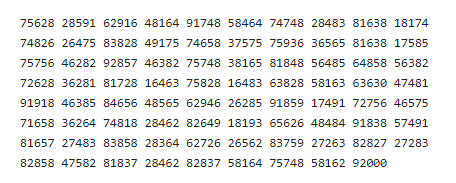
This is the D’Agapeyeff Cipher. This seemingly simple list of numbers contains a secret message. The only problem is… the creator, Alexander D’Agapeyeff, can’t remember how to decrypt it.

When he published a starter book on cryptography — Codes and Ciphers, first edition — D’Agapeyeff included this chain of 5-digit number bundles as a final challenge for the readers to unravel.

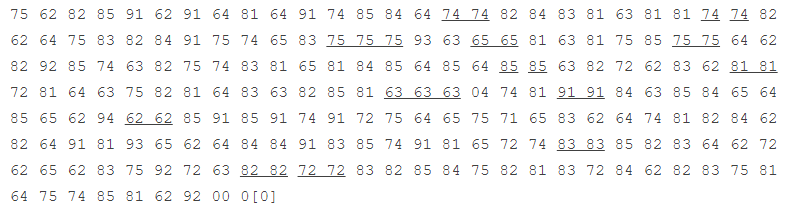
One of the first steps many aspiring cryptographers take is to break the numbers down into pairs instead of groups of five:

daga 2

One result of this is the pattern that every pair has 6, 7, 8, 9, or 0 in the tens column and 1, 2, 3, 4, or 5 in the ones column, which doesn’t seem like a coincidence.

And see those sequences where the same number appears three times in a row? Some cryptographers believe that is also not a coincidence.

Then, they cut off the two double-zero pairings at the end — because they believe they were nulls, empty space-filling characters simply designed to fit the 5-letter groupings pattern of the original code as a way to throw off codecrackers. (And, to be fair, D’Agapeyeff himself wrote about null entries in the book Codes and Ciphers.)

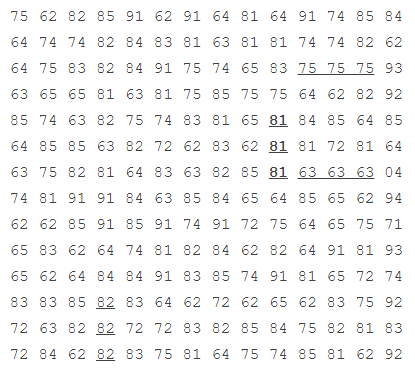
If you remove those double-zero pairings, you can arrange the numbers into a 14×14 pairing grid, like so:

daga 3

See those sequences where the same number appears three times in a row? More of them now.

Many cryptographers consider this to be the true starting point of cracking the D’Agapeyeff Cipher.

But then what?

Some believe that the key to solving the grid lies in the Polybius Square, another encryption device mentioned by D’Agapeyeff.

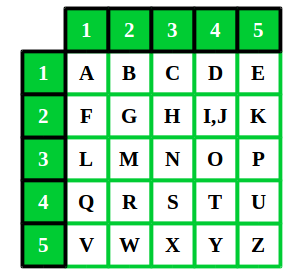
Essentially, you place the alphabet into a 5×5 grid, and use those numbers to encrypt the letters. Here’s a straightforward example:

daga 4

In this case, the word PUZZLE would be 35 45 55 55 31 15.

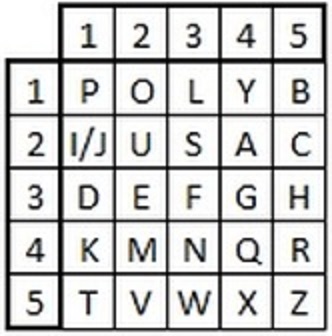
Another way to use the cipher is to pick a keyword to start it. For instance, if you chose POLYBIUS as the key word, then you go across, then down, writing POLYBIUS and then the rest of the unused letters of the alphabet in order, like so:

daga 5

Instead of 1-5 both across and down, you could do 1-5 across the top and 6-0 across the side, reflecting the pairings in the D’Agapeyeff Cipher.

Or, as someone pointed out, perhaps we’re thinking in the wrong language. Triple-letters are uncommon in English words, but more common in Russian words, and D’Agapeyeff was Russian born.

Overlooking simple things like that can make you miss crucial ways into an encrypted message.

So, do you have any thoughts on how to solve this 80-year-old encrypted challenge, fellow puzzlers? Let us know in the comments section below! We’d love to hear from you.


dailypopwsicon

Have you checked out our special summer deals yet? You can find them on the Home Screen for Daily POP Crosswords and Daily POP Word Search! Check them out!

Thanks for visiting PuzzleNation Blog today! Be sure to sign up for our newsletter to stay up-to-date on everything PuzzleNation!

Younger Solvers and Constructors Building Online Crossword Communities!

It’s a dynamic, fluid time for crosswords. It feels like we’re on the cusp of a sea change.

Women, people of color, and members of the LGBTQIA+ community are featured more often, although we still have a LONG way to go on all of those fronts where representation is concerned, both for constructors and editorial staff.

Younger voices are rising up the ranks, and helping to influence the direction of crossword language through projects like the Expanded Crossword Name Database. Online resources like more inclusive word lists, free or discounted editing software (often constructed by younger solvers!), and words of guidance from online crossword collaboration groups are more available than ever.

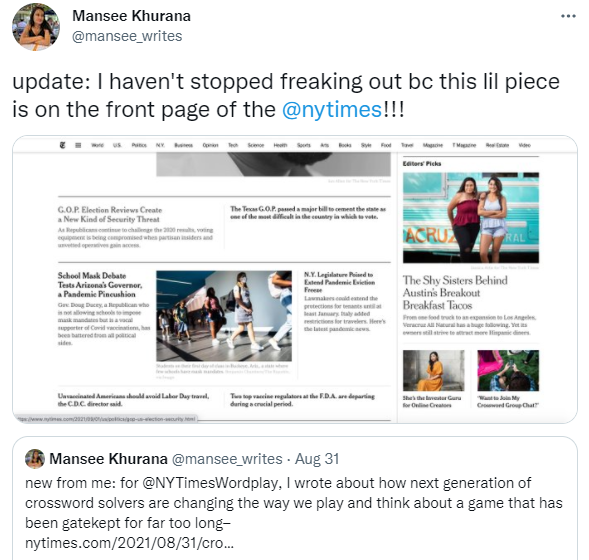
Recently, these topics were tackled in The New York Times itself in an article about younger crossword enthusiasts penned by freelance writer and reporter Mansee Khurana.

mansee

Her article is a terrific snapshot of the modern crossword world.

It discusses the divide between older solvers and younger, and how the content of crosswords doesn’t always serve both sides. It tackles the concept of “evergreen puzzles” — crosswords edited for timeless reprint value, eschewing up-to-date and provocative references that would appeal to younger solvers and underrepresented groups for the sake of republication later.

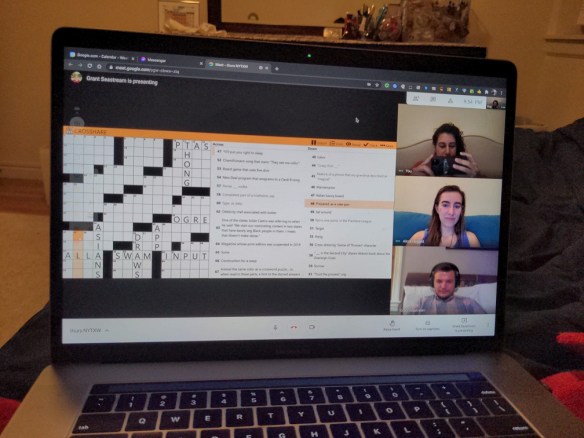
The article mentions the many virtual and online spaces that are now comfortable haunts for younger crossword fans. Facebook forums, Discord chats, Zoom solving parties, Crossword Twitter, r/crossword on Reddit, and even Tiktok accounts dedicated to crosswords got some time in the sun, and it’s really cool to see how these new spaces have emerged and grown more influential.

[A solve-along video from YouTube, Twitch, and Crossword Tiktok user
Coffee and Crosswords. Actual solving starts around 10 minutes in.]

Several names familiar to crossword solvers were cited as well. Constructors like Sid Sivakumar (mentioned just yesterday in our Lollapuzzoola wrap-up), Nate Cardin, and Malaika Handa were all quoted in the piece, reflecting many of the same concerns we’ve heard from new and upcoming solvers in some of our recent 5 Questions interviews.

I actually remember the author’s post reaching out to the contributors and readers of r/crossword a few months ago, and I was glad to see the subreddit getting some mainstream attention. Yes, like any internet forum, it can be combative and argumentative at times, but that’s a rarity.

Most of the time, it’s a supportive community for crossword fans and aspiring constructors, a place where they share questions, bravely offer up their first attempts for input and criticism, and discuss all things puzzly. It’s genuinely inspiring to see new solvers on a near-weekly basis reaching out and being embraced by fellow solvers and cruciverbalists-in-progress.

I highly recommend you take the time out to read Mansee’s piece. She captures a true sense of not just where crosswords are now, but where they’re headed. And if these young people have anything to say about it, it’s headed somewhere very bright indeed.


dailypopwsicon

Have you checked out our special summer deals yet? You can find them on the Home Screen for Daily POP Crosswords and Daily POP Word Search! Check them out!

Thanks for visiting PuzzleNation Blog today! Be sure to sign up for our newsletter to stay up-to-date on everything PuzzleNation!

The Newest Twist on Twisty Puzzles!

history

[Picture courtesy of Rubiks.com.]

Rubik’s Cubes and other twisty puzzles come in all shapes and sizes. With the advent of 3-D printing and innovative home designs that can be shared with a few clicks, the field is constantly evolving. This is a huge plus for puzzle fans.

Naturally, there are puzzle designers who aspire to make the largest twisty puzzle possible. In previous blog posts, we’ve chronicled some of these ambitious endeavors.

One of the first to draw the attention of online solvers was Oskar van Deventer’s 17x17x17 cube known as the “Over the Top” Rubik’s Cube.

Here’s a video of someone solving this diabolical design:

This was later topped by a design by corenpuzzle, who created a 22x22x22 cube. The build was so complex that the cube actually exploded (twice!) during construction.

But it’s not only cube-style twisty puzzles that are drawing the attention of designers. There’s also the minx series of twisty puzzles.

These are dodecahedrons rather than cubes. A dodecahedron is a 12-sided shape formed from pentagons. The smallest of this form is known as a kilominx.

71+IOUAhXQL._AC_SL1487_

The megaminx version (pictured above) was the first to attract greater attention in the puzzle world. It had 50 moving parts, as opposed to the 20 movable pieces of a standard Rubik’s Cube. You can find all sorts of solving videos on YouTube featuring megaminx puzzles.

The quest to build the largest minx-style twisty puzzle has taken puzzling to strange new places. Gigaminx, Petaminx, and more followed as the puzzles grew increasingly complex.

For a while, the champion of these puzzles was Matt Bahner, who created the Yottaminx. It’s a basketball-sized twisty puzzle that took four months to build. With 2,943 parts, it’s the twisty equivalent of a 15x15x15 cube.

Here you can see Bahner showing off his creation:

No record stands forever, though, and corenpuzzle recently returned to the top of the leaderboards with Atlasminx, the new record holder.

This 19-layer dodecahedron weighs in at over 17 pounds, and was assembled from 4,863 moving parts.

Skip to 1:53 to see the finished version of the puzzle and see it in action.

You could literally spend a lifestyle twisting and turning that puzzle and never reach the end.

These mindbending designs continue to wow solvers everywhere while pushing the creative envelope in clever new ways, and I’m definitely not alone in saying we cannot wait to see what comes next.


dailypopwsicon

Have you checked out our special summer deals yet? You can find them on the Home Screen for Daily POP Crosswords and Daily POP Word Search! Check them out!

Thanks for visiting PuzzleNation Blog today! Be sure to sign up for our newsletter to stay up-to-date on everything PuzzleNation!

How People Used Puzzles and Games to Endure the Pandemic

Puzzles and games have been there for many people during the pandemic.

Many puzzle and game companies offered (and continue to offer) “COVID discounts” and giveaways to help people financially impacted by the crisis. Companies released free online or zoom-compatible versions of their products to help people get by.

There are all sorts of articles out there about how Dungeons & Dragons and other roleplaying games have served as critical socializing tools in virtual hangouts. Bar-style trivia, zoom games, Jackbox, Board Game Arena, Fall Guys, Among Us… lots of communal activities went virtual as puzzles and games filled a rapidly growing niche.

Whether solved alone or with other members of the household, jigsaw puzzles sales increased 500% or more. Online sites to coordinate trades sprang up, allowing people to swap puzzles they’d solved before for ones new to them.

At a terrible time for many people, puzzles and games helped us cope.

And honestly, if you know the history of games and puzzles, it makes sense. Many of them have been born out of unpleasant circumstances.

Monopoly was a hit during the Great Depression, offering an escape and the illusory feeling of being rich. The game itself only cost two dollars, so it was a solid investment with a ton of replay value.

Candy Land was created to entertain children with polio (although that fact wasn’t commonly known for 50 years). Clue was designed during air raid drills as a way to pass the time. The Checkered Game of Life (later The Game of Life) was inspired by Milton Bradley’s own wild swing of business misfortune.

Risk and other conflict-heavy games weren’t popular in postwar Germany, so an entire genre of games that avoided direct conflict was born: Eurogames.

It’s just as true in the modern day. What game was flying off the shelves during COVID-19 lockdowns? Pandemic.

That combination of escapism and social interaction is so powerful. Games are low-stakes. They offer both randomness (a break from monotony) and a degree of control (something sorely missing during lockdown).

Puzzles too assisted folks in maintaining their mental health. And isn’t it interesting that crossword solving, something viewed by many as a solitary endeavor — I guess they never needed to ask someone else 5-Down — helped fill a crucial social role for people?

Constructors stepped up in interesting, inventive ways. The sense of community fostered by online crossword events like Crossword Tournament From Your Couch (which filled the void of ACPT in 2020) and the Boswords Themeless League was absolutely invaluable to puzzlers who couldn’t attend some of the highlights of the puzzle calendar year.

As I said before, there are numerous articles out there celebrating the benefits of roleplaying games like Dungeons & Dragons, Pathfinder, and more.

Roleplaying games certainly helped keep me sane during lockdown. It might sound ridiculous, but dealing with world-threatening threats, fiercely dangerous monsters, and sinister plots that I could DO something about was medicinal. It was escape in its truest form. It recharged me, allowing me to lose myself in storytelling with friends.

The last 18 months were hard. There may be hard months ahead. But I’m grateful for the puzzle/game community — and the many marvelous pastimes they’ve created — for helping me and many others get by. To smile. To cope. To socialize. And to enjoy.

What games and puzzles have helped you deal with unpleasant circumstances, fellow puzzlers? Let us know in the comments section below. We’d love to hear from you.


dailypopwsicon

Have you checked out our special summer deals yet? You can find them on the Home Screen for Daily POP Crosswords and Daily POP Word Search! Check them out!

Thanks for visiting PuzzleNation Blog today! Be sure to sign up for our newsletter to stay up-to-date on everything PuzzleNation!