Making a new puzzle is challenging. You have to strike a balance between established solving styles (those that are familiar and effective) and innovative twists, mechanics, and variations, all without making the puzzle too convoluted, too tedious, too easy, or too hard.
In the world of crosswords, some variant success stories include Double Trouble, cryptic crosswords, Brick by Brick, and diagramless. With Sudoku, there are variants like Extreme Sudoku (aka X-Sudoku or Diagonal Sudoku), Samurai Sudoku, and Word Sudoku.
In short, Setka puzzles start with a single word. The consonants of that word not only form the answers to the clues, but also provide the letters to place in the accompanying grid.
For example, if the starting word was INFORM, the key letters would be N, F, R, and M. Every clue answer would feature one or more of those letters. The answer words, like the starting word, ignore the vowels. So you could have answers like NeaR, MoRoN, or MaiNFRaMe. (In the case of duplicate letters, like ReRaN, any duplicates are dropped, so the key letters here would be RN.)
And since there are four letters, there would be an accompanying 4×4 grid for you to fill in, where no letter is repeated in any row or column, Sudoku-style.
To place the letters, the clues are numbered, and the relevant cells in the grid are numbered to match. So, for NeaR (let’s say it’s clue 2), there would be two neighboring cells in the grid with a number 2 in them, and you could place the letters as RN or NR. Words that are three letters or above can read backward, forward, or in an L-shape in the grid.
This mechanic separates Setka from other clued or letter-placement puzzles, because you need both the clue answer AND the Sudoku no-repeats rule in order to complete a grid. Without the clue answers, there can be alternate solves where grid letters swap. And without the Sudoku-style placement, it would be virtually impossible to actually place the answer letters into the grid, because there’s more than one way to do so.
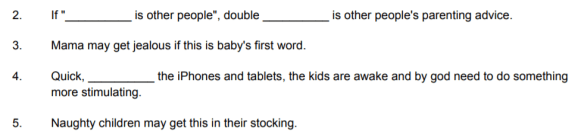
The cluing style alternates between standard crossword-style clues (but usually longer and a little more conversational or trivia-based) and fill-in-the-blank clues. The clues also fit the theme established by the starting word. For instance, the clues above all have to do with kids, which fits the puzzle’s theme word, CHILD.
It takes time to get used to seeking out answer words from the given consonants (since you have to supply any vowels or duplicate consonants missing in order to come up with the correct answer word), but once you’re a few puzzles in, it becomes second nature and a fun component to the solving experience.
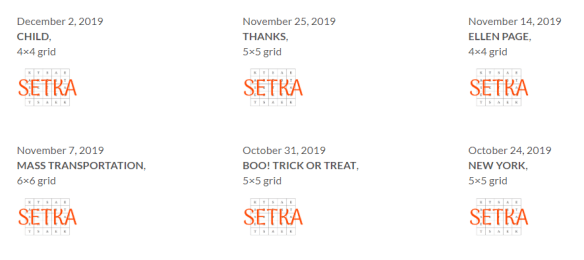
Setka puzzles range in size from 4×4 to 7×7, with its signature size being 5×5. Honestly, 5×5 is really where it becomes a proper puzzle. With a 4×4 grid, once you have a few letters placed, it becomes an elementary logic puzzle and you don’t really need the clues.
[A selection of Setka sizes and themes.]
The puzzle itself is reminiscent of another puzzle we tried late last year — Cluedoku — but Setka’s letter-based theme and smaller grids make for a far more sustainable puzzle going forward, and the mechanic of placing the words in the grid (rather than just individual letters/numbers) adds an intriguing wrinkle to the solve.
All in all, I enjoyed trying out Setka — I solved a half-dozen or so puzzles to get a feel for different sizes and difficulties — and I think they’ve forged an engaging and clever combination of crossword-style cluing and Sudoku-style solving.
You can try Setka for yourself on their website, either playing interactive versions of Setka on the site or printing and solving PDF copies of Setka puzzles. They also offer a subscription where you can receive a Setka puzzle each week along with news and updates.
What do you think of Setka, fellow puzzlers and PuzzleNationers? Let us know in the comments below! We’d love to hear from you.
Thanks for visiting PuzzleNation Blog today! Be sure to sign up for our newsletter to stay up-to-date on everything PuzzleNation!
The hunt is always on for the next big puzzle idea.
Sometimes, it’s an old idea that gets repackaged and catches fire. That’s what happened with Sudoku, a puzzle that had been around since the late ’70s, but only rose to prominence decades later.
Other times, it’s a combination of different puzzle types that yields something special. Our friends at Penny Dell Puzzles, for instance, have a popular puzzle called Anagram Magic Square, which combines crossword-style cluing, anagrams, and the mathematical element of a magic square to create an engaging puzzle experience you can solve from several angles.
Whether a puzzle is destined for superstardom or not depends on a lot of factors: difficulty, the type of solving it involves, how intuitive the solving is (i.e. needing a lengthy explanation vs. getting the gist of the puzzle from a glance), visual aesthetics, and more.
As a puzzler, it’s always exciting to try out a new puzzle. Wholly original ideas are rare, to be sure, but even a single twist on an old classic can be enjoyable if executed well.
Today, we’re taking a look at a puzzle that combines Sudoku with cryptic crosswords (aka British-style crosswords). It’s called Cluedoku, and it was created by cryptic constructor Charlie Methven, better known in solving circles as Chameleon, a contributor to British puzzle outlets like The Guardian.
[Just a sample of the puzzle. Check out the entire puzzle here.]
Like Sudoku, Cluedoku involves placing the digits 1 through 9 into each row, column, and 3×3 square in the grid. But unlike Sudoku, there are no set letters.
Instead, you have 81 clues, one for every cell in the grid, utilizing cryptic-style cluing to hint toward which of the nine numbers goes in a given cell.
Once you’ve unraveled a clue and placed a number in the grid, standard Sudoku rules apply: that number will only appear once in a row, column, or 3×3 square.
But that’s easier said than done. These clues run the gamut of slyly clever to almost baffling. Even when you consider that there are only nine possible answers for each clue, it’s still a challenge. (Plus, not all of the clues adhere to the standard cryptic cluing mechanic of having both a definition AND a wordplay clue included.)
That being said, you’ll find lots of traditional cryptic cluing tricks at play here.
Now, we’re going to be discussing specific clues and answers from this puzzle, so this is your spoiler warning.
***
***
***
***
***
***
***
Last chance to solve without spoilers!
***
***
***
***
***
***
Okay, here we go.
In terms of traditional cryptic cluing gimmickry, we see hidden words, anagrams, homophones, word reversals, and more.
In clue 6 — Axis revolves without beginning to accelerate — we revolve (aka reverse) axis to spell SIXA, and then drop the A (“without beginning to accelerate”) to spell SIX.
In clue 8 — Prime cut from sloth reeks — the answer hides in plain sight, as a prime number (three) reads out in sloTH REEks (and can be cut out of it).
In clue 22 — Scenes in X-Men Origins reveal how many claws Wolverine has! — the phrase “origins reveal” points towards the first letters of the words that precede it proving the answer, meaning that SIX is the number of claws Wolverine has (three on each hand).
There is a similar game in clue 67 — With only seconds remaining, Officer Columbo outwits crook — which has the second digits of “Officer Columbo outwits crook” spelling out FOUR.
In clue 27 — UFO demolished third of Parliament Square — the letter R (“third of Parliament”) gets mixed up with UFO to make FOUR, a square.
But other clues would be familiar to crossword solvers in America.
Clue 29 — Number of Romans in the New Testament? — is simple wordplay for 6, since Romans is the SIXth book. (Similarly, clue 62 — Number of lines taken by bar staff — is a reference to the FIVE lines that make up a staff in sheet music.)
Clue 34 — Top score in Scrabble — is a bit more devious, requiring you to know that T is worth 1 point, O is worth 1 point, and P is worth 3 points, making the correct answer FIVE.
Clue 48 — Man’s arms’ legs’ digit — feels like a clue you’d see at the Indie 500 or Lollapuzzoola, because it’s initially baffling, but then reveals itself as merely clever and challenging. You see, there are THREE legs on the coat of arms for the Isle of Man. But that’s concealed by the wordplay involving three different words that don’t mean what you’d think.
This mix of American and British-style clues made for a fun solve that mixed and mingled two worlds of cluing nicely.
I think my favorite clue was Clue 39 — 192+284 — because it was built like one of those magazine word puzzles, the ones where “rockcaughthardplace” means “caught between a rock and a hard place.” In this case, you have “2+2” literally in 1984. And for anyone familiar with George Orwell’s famous novel, 2+2 in 1984 equalled FIVE.
Although obviously Cluedoku isn’t really sustainable as a recurring puzzle — you’d burn out your anagrams and homophones pretty quickly, as Chameleon himself stated in an interview — it is an impressive marriage of two different puzzles that rarely interact otherwise.
But he did raise the possibility of another variation in the future:
If I did another Chameleon cluedoku, I think I’d use the seven colours of the rainbow plus black and white, as solvers could then colour in each square as they solved. How’s “Cry over Norwich’s core Canary”?
That sounds like a fun follow-up to an interesting puzzle.
What did you think of Cluedoku, fellow puzzlers and PuzzleNationers? Let us know in the comments below! We’d love to hear from you.
Thanks for visiting PuzzleNation Blog today! Be sure to sign up for our newsletter to stay up-to-date on everything PuzzleNation!
[Image courtesy of Amazon. The Times Cryptic Crossword Book.]
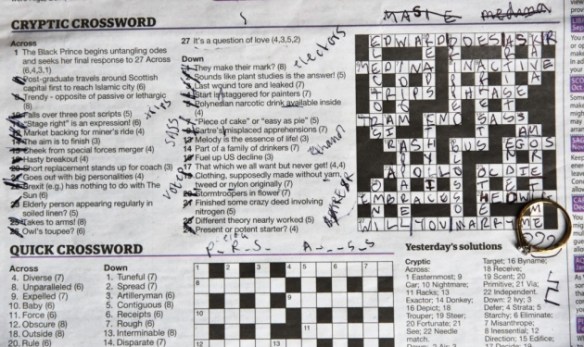
On Twitter yesterday, Oliver Roeder from FiveThirtyEight asked, “If one wanted to learn/practice solving cryptic crosswords, with what puzzles should one begin?”
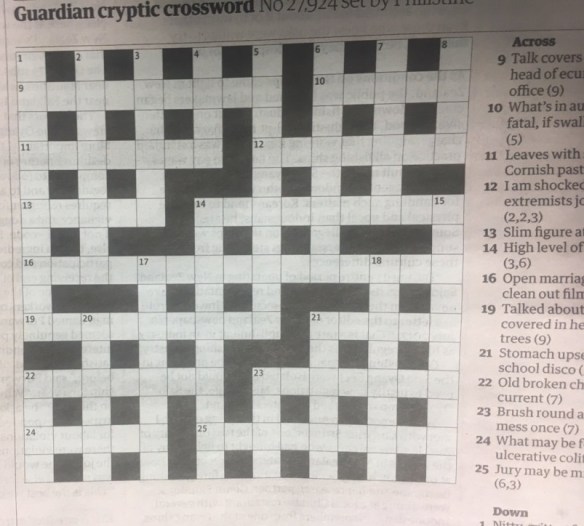
Monthly offerings from constructors like Andrew Ries and Cox & Rathvon were also mentioned, though I would add Patrick Berry’s Son of the Crypt cryptic collection to the list of suggestions. (I would normally also recommend The Guardian because of their great cryptics, but they’re pretty tough, particularly for beginners.)
This, of course, presumes that Roeder meant which cryptic puzzles one should start with.
It occurred to me that he might be asking what OTHER puzzles are good for beefing up your cryptic crossword solving game.
Given the different kinds of clues used in cryptic crosswords, I have a few suggestions.
1. Anagram puzzle
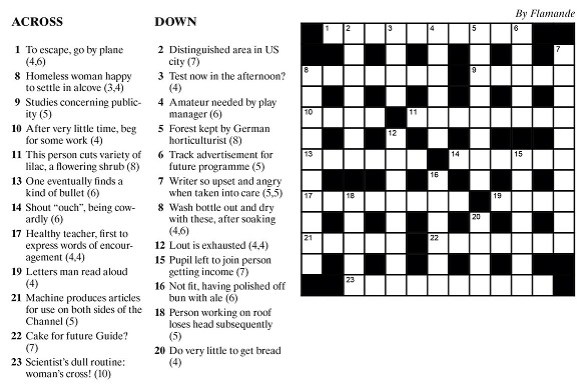
Anagrams are a staple of cryptic cluing, and any puzzler looking to get into cryptics should have some facility with them. There are plenty of ways to practice — the Jumble, Anagram Magic Square and other puzzles from our friends at Penny Dell Puzzles, and even Bananagrams, Words with Friends, or Scrabble will help build your anagram skills.
2. Rebus
Rebus puzzles are all about adding and subtracting letters to form words or phrases, and there’s plenty of that in cryptic cluing. This is a good way to get used to breaking down longer words into abbreviations, anagrams, and so on in order to puzzle out the answer to a cryptic clue.
3. Brain teaser/riddle
Many cryptic clues rely on words with multiple meanings, as well as words that serve as both instructions and hints. Brain teasers and riddles employ similar wordplay, and they can help you develop a proclivity for looking at words from a new point of view.
Of course, if you want help learning to decipher the many variations on cryptic crossword cluing that you’ll encounter, there are some great resources out there.
If you’re looking for deeper dives into all sorts of cryptic cluing, my one-stop shop for insight is The Guardian’s crossword blog. They offer regular features breaking down various kinds of cryptic clues.
It’s a terrific resource for newbie cryptic solvers and established puzzlers alike.
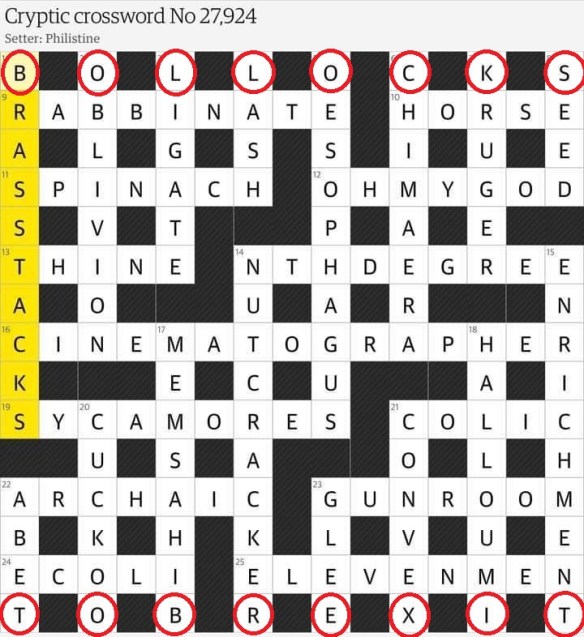
And it’s worth getting into cryptic crosswords, if only for the occasional subversive little Easter egg like this one from yesterday’s The Guardian cryptic:
Did I miss any resources or outlets for great cryptic crosswords? Let me know in the comments section below! I’d love to hear from you!
Thanks for visiting PuzzleNation Blog today! Be sure to sign up for our newsletter to stay up-to-date on everything PuzzleNation!
[The Doctor, of Doctor Who fame. No stranger to nonlinear stories.]
Avid readers and television watchers are probably familiar with the concept of nonlinear storytelling.
Whodunits often bounce forward and backward in time so that readers and detectives alike can reconstruct the events of the crime, and of course science fiction is filled to bursting with time-travel stories that tie the readers’ minds in knots. Bookworms are used to getting their story elements out of order.
But what if the entire novel was out of order? Imagine every single page out of place. Could you reassemble the story and solve the murder?
That was the question posed by Cain’s Jawbone, a 1934 novel by famed cryptic crosswords constructor Edward Powys Mathers, who published under the pseudonym Torquemada.
Readers were tasked with identifying the six victims of the killers, as well as who killed each victim. Not only that, but a successful solve also needed to include the correct order of all 100 pages of the novel.
A prize of 15 pounds was offered to the first reader who could unravel the mystery. That is no small feat, given that the number of possible page combinations is in the millions.
And yet, two solvers did submit solutions and get their prizes, even if the solution was never shared publicly.
85 years later, Cain’s Jawbone is returning to publication, allowing a new generation of puzzlers the chance to solve one of Torquemada’s greatest puzzles.
Subscribers to Cain’s Jawbone will receive its 100 pages unbound in a box. This means that they can be spread out and placed next to each other – so much easier than when pages are bound, as in the original publication.
A space for notes is provided as well as a page to submit with the answer. Only solutions submitted on a page from the box will be eligible.
The competition is returning as well, and a prize of 1,000 pounds is being offered.
With a release date of September of this year, it will be fascinating to see how quickly modern solvers can unravel this classic mystery.
Thanks for visiting PuzzleNation Blog today! Be sure to sign up for our newsletter to stay up-to-date on everything PuzzleNation!
Back in 2013, we created a timeline of events from crossword history as part of our celebration of the hundredth anniversary of the crossword.
Although 105 isn’t as prestigious as 100, and the anniversary is technically tomorrow, we thought we’d honor the day this year by updating our comprehensive look at the long (yet surprisingly short) road it took to get to that marvelous centennial!
So, without further ado or folderol, we proudly present:
A Brief History of the Crossword (Updated)
16th – 11th century BC
Inscriptions from New Kingdom-era Egypt (Eighteenth to Twentieth Dynasties) of horizontal and vertical lines of text divided into equal squares, that can be read both across the rows and down the columns, are made. These inscriptions are later referred to by Egyptologists as “Egyptian crossword puzzles.”
19th century AD
Rudimentary crosswords, similar to word squares, begin appearing in England, and later elsewhere in Europe.
June 22, 1871
Future inventor of the crossword, Arthur Wynne, is born.
March 23, 1897
Future New York Times crossword editor Margaret Farrar is born.
February 25, 1907
Future New York Times crossword editor Will Weng is born.
December 21, 1913
The New York World publishes the first crossword, invented by Liverpool journalist Arthur Wynne. (The puzzle is originally known as a word-cross.)
January 6, 1916
Future New York Times crossword editor Eugene T. Maleska is born.
1920
Margaret Farrar is hired by The New York World as a secretary, but soon finds herself assisting Arthur Wynne with proofreading puzzles. Her puzzles soon exceed Wynne’s in popularity.
Colonel H.W. Hill publishes the first Crossword Dictionary.
1923
Margaret Farrar revises the cluing system for crosswords, sorting them into “Horizontal” and “Vertical” clues by number. (It wouldn’t be until the 1940s that the more familiar “Across” and “Down” terminology became the norm.)
1924
Margaret Farrar publishes the first book of crossword puzzles under contract for Richard L. Simon and Max Schuster, “The Cross-Word Puzzle Book.” It was an instant bestseller, launching Simon & Schuster as a major publisher. (Additional information available below the timeline.)
The Daily Express, founded in 1900, becomes the first newspaper in the United Kingdom to carry crosswords.
Crossword-themed novelty songs hit the airwaves as the puzzle craze intensifies, most notably “Crossword Mama, You Puzzle Me (But Papa’s Gonna Figure You Out).”
The Amateur Crossword Puzzle League of America, a self-appointed group of puzzle enthusiasts, lobbies for rotational symmetry in crosswords, which becomes the standard.
Solver Ruth Franc von Phul becomes a minor celebrity after winning The New York Herald-Tribune’s National All Comers Cross Word Puzzle Tournament at the age of 20. (She would win again 2 years later.)
January 15, 1925
“Felix All Puzzled,” the first animated short to feature a crossword, is released.
Disney releases a crossword-themed animated short, “Alice Solves the Puzzle.”
1926
The cryptic crossword is invented by Edward Powys Mathers, who publishes under the pseudonym Torquemada. He devises them for The Observer newspaper.
First reported instances of Braille crosswords.
1931
Dell Puzzle Magazines begins publishing.
(Dell Publishing itself was founded in 1921.)
1941
Dell Pocket Crossword Puzzles first published.
(The magazine continues to this day.)
February 15, 1942
The New York Times runs its first Sunday edition crossword. (Additional information available below the timeline.)
June 2, 1944
Physics teacher and crossword constructor Leonard Dawe is questioned by authorities after several words coinciding with D-Day invasion plans appear in London’s Daily Telegraph. (Additional information available below the timeline.)
1950
The crossword becomes a daily feature in The New York Times.
August 26, 1952
Future New York Times crossword editor Will Shortz is born.
1968
Lyricist Stephen Sondheim begins creating cryptic crosswords for New York Magazine, helping introduce Americans to British-style crosswords.
1969
Will Weng succeeds Margaret Farrar as the second crossword editor for The New York Times.
1973
Penny Press is founded.
1977
Eugene T. Maleska succeeds Will Weng as the third crossword editor for The New York Times.
1978
First year of the American Crossword Puzzle Tournament, later featured in the documentary Wordplay. 149 contestants compete for the title in the first national crossword tournament since the 1930s.
1979
Howard Garns creates the modern Sudoku puzzle for Dell Magazines (under the name Number Place), the first pen-and-paper puzzle to rival the crossword in popularity (though this spike in popularity would occur decades later under the name Sudoku).
June 11, 1984
Margaret Farrar, while working on the 134th volume in Simon & Schuster’s crossword puzzle book series, passes away.
1993
Will Shortz succeeds Eugene T. Maleska as the fourth crossword editor for The New York Times.
November 5, 1996
One of the most clever and famous crosswords of all time is published, the election-preceding crossword where either BOB DOLE ELECTED or CLINTON ELECTED could read out, depending on the solver’s answers.
1998
The Wall Street Journal adds a crossword to its newspaper, and Mike Shenk is appointed editor.
June 23, 2006
Wordplay documentary hits theaters, featuring celebrity solvers of crosswords as well as the participants and organizers of the 2005 edition of the American Crossword Puzzle Tournament.
February 29 – March 2, 2008
Thanks in part to the Wordplay documentary, the American Crossword Puzzle Tournament outgrows its previous setting and moves to Brooklyn.
The city of Lvov, Ukraine, creates a crossword that spans an entire side of a 100-foot-tall residential building, with clues scattered around the city’s major landmarks and attractions. It’s awesome.
David Steinberg launches the Pre-Shortzian Puzzle Project, designed to compile a complete database of every New York Times crossword.
August 13, 2012
PuzzleNation Blog is launched.
June 14, 2013
Matt Gaffney celebrates five years of MGWCC,
stating that MGWCC will run for 1000 weeks
(which puts the final edition around August 6th, 2027).
December 21, 2013
The Crossword officially turns one hundred years old.
Additional information:
1924: The publishing house Simon & Schuster, agreed to a small (3,600-copy) run of a crossword puzzle book, prompted by founder Richard L. Simon’s aunt, who wanted to give such a book to a friend. It became “a runaway bestseller.”
In no time the publisher had to put the book back on press; through repeated printings, it sold more than 100,000 copies. Soon a second collection followed, and then a third and a fourth. In 1924 and 1925 the crossword books were among the top 10 nonfiction bestsellers for the year, besting, among others, The Autobiography of Mark Twain and George Bernard Shaw’s Saint Joan.
February 15, 1942: The New York Times initially regarded crosswords as frivolous, calling them “a primitive form of mental exercise”; the motivating impulse for the Times to finally run the puzzle (which took over 20 years even though its publisher, Arthur Hays Sulzberger, was a longtime crossword fan) appears to have been the bombing of Pearl Harbor.
In a memo dated December 18, 1941, an editor conceded that the puzzle deserved space in the paper, considering what was happening elsewhere in the world and that readers might need something to occupy themselves during blackouts. The puzzle proved popular, and Sulzberger himself would author a Times puzzle before the year was out.
June 2, 1944: The words Omaha (codename for one of Normandy’s beaches), Utah (another Normandy beach codename), Overlord (the name for the plan to land at Normandy on June 6th), mulberry (nickname for a portable harbor built for D-Day), and Neptune (name for the naval portion of the invasion) all appeared in Daily Telegraph crosswords during the month preceding the D-Day landing.
This has been attributed to either an incredible coincidence or Dawe somehow overhearing these words (possibly slipped by soldiers involved) and incorporating them into puzzles unwittingly.
Do you have any suggestions for additions for our Crossword Timeline? Let us know in the comments section below! We’d love to hear from you!
Thanks for visiting PuzzleNation Blog today! Be sure to sign up for our newsletter to stay up-to-date on everything PuzzleNation!
We spend a lot of time talking about crosswords here on PuzzleNation Blog, and rightfully so.
For more than a century now, crosswords have been the standard-bearer for paper-and-pencil puzzles. From your local paper to The New York Times crossword, from online solving to puzzle apps like our very own Penny Dell Crosswords App, crosswords sit comfortably at the apex of the proverbial puzzle mountain, atop worthy also-rans like word searches, cryptograms, and Sudoku.
[Apparently Puzzle Mountain is actually a place. Who knew?]
But in talking about crosswords, it’s easy to forget that not everyone solves them. In fact, plenty of people find them intimidating, given the mix of trivia, wordplay, and tricky cluing that typify many crosswords these days, particularly in outlets like The New York Times, The LA Times, The Guardian, and more.
So today, I thought I’d offer some helpful resources to solvers just getting started with crosswords.
First off, if you need help filling in troublesome letter patterns, Onelook is an excellent resource. Not only can you search for words that fit various patterns, but you can narrow your searches according to cluing, look up definitions and synonyms, and even hunt down phrases and partial phrases.
Along the same lines, there are websites like Crossword Tracker that offer informal cluing help culled from online databases. For something more formal, there’s XWordInfo, an online database of entries and cluing that also serves as an archive of NYT puzzles you can search for a small fee.
The NYT Wordplay Blog chronicles each day’s puzzle, including insights into the theme, key entries, and more, plus they’ve begun amassing helpful articles about crossword solving. Not only are there sample puzzles to download and solve to get you started, but there are lists of opera terms, rivers, and sports names to know to make you a stronger solver.
And if British-style or cryptic crosswords are your puzzle of choice, look no further than The Guardian‘s Crossword Blog, which frequently posts about various cluing tricks employed by crafting cryptic puzzle setters. Their “Cryptic Crosswords for Beginners” series of posts has discussed all sorts of linguistic trickery, covering everything from the NATO alphabet to elementary chemistry.
Is there a particular puzzle that troubles you, or one you find too intimidating to tackle, fellow puzzlers? If so, let us know! We can either point you toward a solving resource or tackle the puzzle ourselves in a future post to provide helpful solving tips!
Thanks for visiting PuzzleNation Blog today! Be sure to sign up for our newsletter to stay up-to-date on everything PuzzleNation!





 PuzzCulture