The summer is always a marvelous time for puzzly events. We just had the Boswords tournament, and next weekend, there’s another online crossword tournament awaiting solvers!
Lollapuzzoola returns on Saturday, August 21st, and this year, we’re proud to announce that PuzzleNation is one of the tournament’s sponsors!
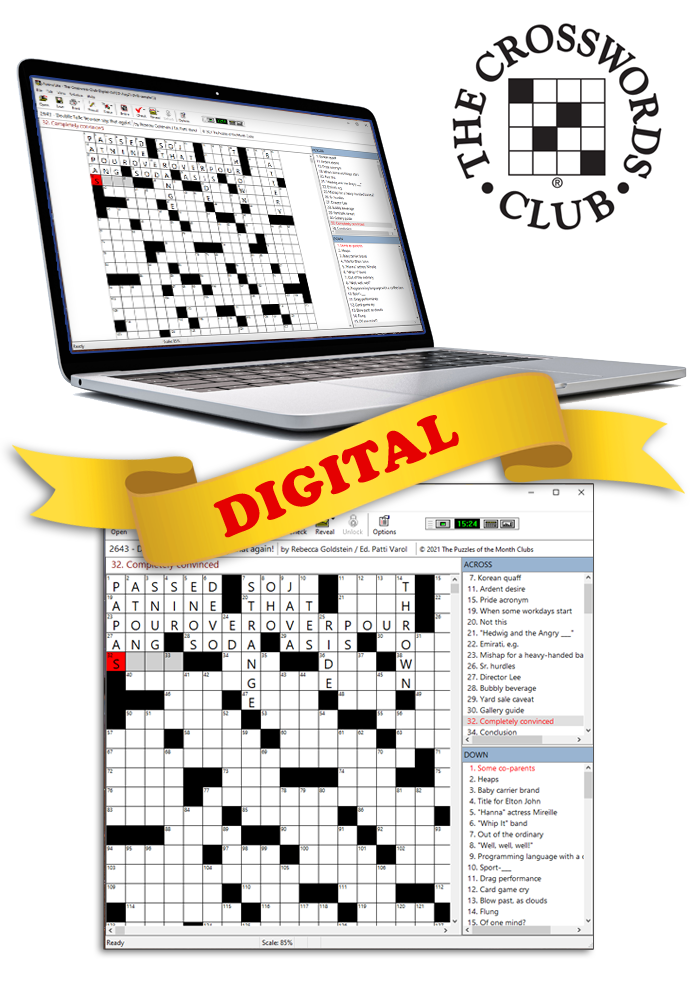
That’s right, we are providing free subscriptions to The Crosswords Club Digital to all twelve of the tournament finalists (12 in all).
Be sure to click the link for more details, or to sign up for this year’s event.
It’s a digital subscription service that provides you with six Sunday-sized crosswords each month, created by some of the sharpest crossword constructors in the business today, and edited by puzzle luminaries Patti Varol and Brad Wilber.
You can solve them on your desktop, on your tablet, or printed out, and each month is guaranteed to provide you with puzzles as fun as they are challenging. Plus each month, you receive a bonus word puzzle!
Click this link to check out a sample of the terrific puzzles you’ll get through The Crosswords Club Digital.
I have been a huge fan of the The Crosswords Club for years, and their Digital service is another fantastic way to get top-notch puzzles with the click of a button.
You can check out the full details for The Crosswords Club Digital here, and don’t forget to give Lollapuzzoola a chance as well.
Will you be virtually attending Lollapuzzoola, fellow puzzlers? Or checking out The Crosswords Club Digital? Let us know in the comments section below! We’d love to hear from you.
We love crosswords here at PuzzleNation. Crosswords are our bread and butter, as well as our pizza, our salad, and our desserts.
We strive to keep our puzzles as accessible as possible for solvers of all ages. And that’s tougher than non-puzzlers might think.
Recently we discussed a never-ending debate in crosswords as we delved into the many, sometimes contradictory, goals of creating a great crossword. You want entries to appeal to older solvers without alienating younger solvers, and vice versa. Some people despise pop culture references and proper nouns, while others embrace them.
Abbreviations, partial phrases, fill-in-the-blank clues, wordplay clues, clues that reference other clues… there’s a vast swathe of crossword qualities that must be balanced, and no matter how good a job you do, you’re probably still going to have a few dissenting voices who believe you should do better.
As a hobby still very much viewed as the purview of older white men — despite the many worthwhile voices of women, people of color, and members of the LGBTQIA+ community that contribute to the world of crosswords in increasing numbers — the language featured in crosswords MATTERS.
It reflects our society, serving as a microcosm of the current day and our culture as a whole. Older solvers might not know new slang or black artists or trans performers or any number of references that are growing more commonplace AND gaining greater visibility. But updating the vocabulary of crosswords is a constant effort, and a worthwhile one.
But I said a lot of this in that previous post, so why am I returning to the topic now?
Well, because I find this continuing democratization of crosswords interesting, because it’s something required of crosswords, but not of many other types of puzzles.
Word seeks (except for some variations) give you the starting list, and then you go hunting for answers. Fill-Ins do the same thing, leaving you the empty grid to fill but requiring no specialized knowledge. Everyone gets the same running start.
Traditional logic puzzles are also presented on an even playing field. You’re presented with information (say, hints about various names, places, times, and activities), as well as an end goal to figure out (the correct schedule of who did what, where, and when).
You don’t have to bring any foreknowledge or previous experience to the table. Given the opportunity, everyone should have an equal chance of solving the puzzle.
Naturally, this equality depends on the assumption that you, the solver, can read the language the puzzle is presented in.
Which brings me to, perhaps, the most democratically fair paper puzzle of all: Sudoku.
The rules are simple, even if the puzzles can be very challenging: place the numbers 1 through 9 in every row, column, and cell.
Even at a glance, without knowing the puzzle, pretty much anyone would have an idea of what’s going on and what needs to be done. Language doesn’t matter, so long as you can identify the nine different symbols to be placed. (This is why word and color variations of Sudoku exist, because the numbers themselves are irrelevent. You just need nine different things.)
Anyone can pick up a pen, a pencil, or a stylus and solve a Sudoku.
And we should strive for the same thing with crosswords.
Sure, all of those other puzzles require practice to get GOOD at them. But at a baseline, everyone who approaches them has a fair shot. Crosswords demand that solvers bring their own knowledge and info and trivia and vocabulary to the table.
But crosswords as a whole should seek that same democratization: Accessibility. Representation. That inviting X factor.
There’s already a touch of that in the medium. Anytime I see someone solving a puzzle on a train, or in an airport, or in some public place, there’s always someone else sneaking a peek or stealing a glance.
Have you ever seen someone complete a crossword for the very first time? I have, and it’s awesome. It’s a magnified version of the delicious a-ha moment when you unravel a tricky clue.
Do you remember the joy in your heart the first time you conquered a New York Times puzzle on a difficult day? The first time you solved a puzzle type you’d never bested before? The first time you cracked the meta lurking in the background of an already devilish design?
Everyone should get that feeling.
No crossword will ever be everything every solver wants it to be. And that’s fine. But I do look forward to the day when everyone looks at a puzzle and at least one of the clues speaks to them, makes them feel seen and heard and represented.
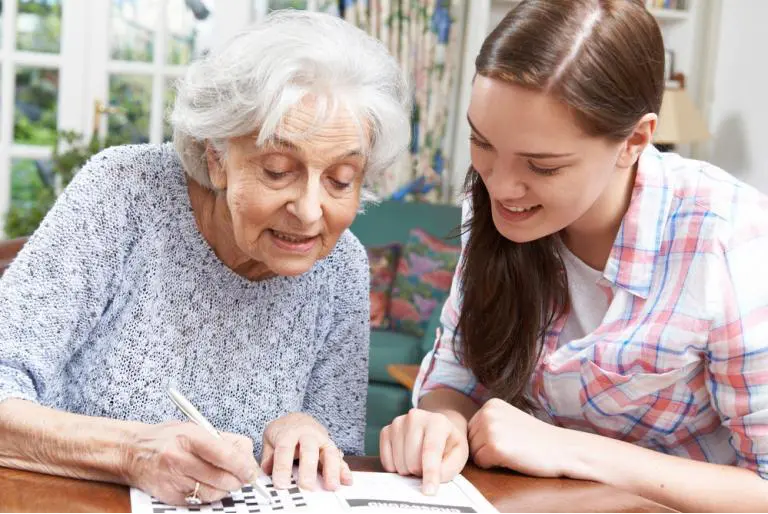
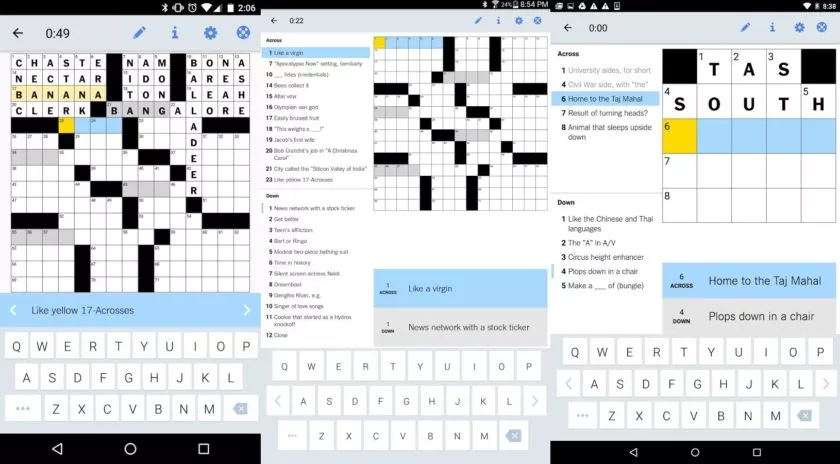
How do you solve crosswords, fellow puzzler? Are you a pencil-and-paper solver, an app solver, an online solver?
There are lots of options for solvers, depending on which outlet you’re talking about.
Unfortunately for some fans of the New York Times crossword, there will soon be fewer ways to access the flagship crossword.
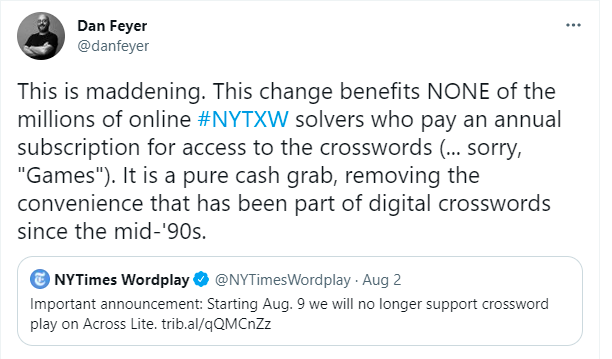
It was announced recently that the NYT will no longer be supporting Across Lite, a third-party file format that some solvers use to import the puzzle into their solving app of choice.
I’m not sure how many solvers use Across Lite — there are millions of daily solvers of the Times crossword — but the online reaction has been fairly negative. Both Crossword Twitter and r/crossword feature numerous posts from disillusioned solvers, including Dan Feyer, multiple-time ACPT winner, who considers this little more than a cash grab by the NYT. (He has gone on to explain his point in greater detail in further tweets.)
I have no doubt that the staff at the Times anticipated some kind of blowback. I mean, we’re puzzle people. Puzzlers, despite an incredible capacity to learn and adapt and suss out all sorts of puzzly solutions, can be set in our ways. We like what we like.
While sitting in with my friends at the Penny Dell Puzzles table at the American Crossword Puzzle Tournament one year, I offered a woman a free pencil. She went on a three-and-a-half-minute diatribe about the inferiority of the pencil and what she views as appropriate qualities for a solving pencil. After she was done, I waited a few seconds and then said, “Miss, you don’t HAVE to take the pencil.”
Like I said, puzzlers like what they like.
Of course, I can see both sides of the argument. The Times is under no obligation to support non-NYT methods of using the puzzle. I mean, knowing how hard our programmers here at PuzzleNation work to make sure our puzzles are accessible across many platforms, I suspect the NYT has the same issues with their own puzzle distribution, let alone worrying about non-brand formats.
But then again, there are reasons third-party platforms exist. Several solvers with visual impairment issues claim that the official app lacks the functionality they need, and they prefer to solve through third-party apps.
That’s a gap that needs to be closed, and if the NYT won’t, someone else will. I know other apps are already being suggested or developed in the wake of this decision.
One big reason is comfort: solvers are hoping to avoid losing the solving style they prefer.
Others begrudge the NYT for being so proprietary and locking away their expansive library of puzzles behind services that they find unwieldly or unreliable.
I’m intrigued to see what happens in the weeks and months to come. Do other apps rise to prominence and fill the gap formerly served through Across Lite, or will the Times respond to the criticism by stepping back or updating their own platforms?
Either way, I’m sure crossword fans will have plenty to say about it.
I finally had a chance to sit down and try my hand at the puzzles from the Boswords Crossword Tournament. Given the talent involved amongst the organizers and constructors — as well as the reliable puzzles featured in the previous three tournaments — I had high expectations, and I was not disappointed.
So let’s put those puzzles under the microscope and see what’s what!
Practice Puzzle #1: One Direction by Ezra Lieb and John Lieb
The first of two unscored opening puzzles, this 16×14 grid was a terrific warm-up solve, designed to get the puzzly brain moving and kick off any solver ring rust that might be lingering about.
It was quick, accessible, and the grid fill flowed nicely. There were four themed entries, each containing the word EAST in some capacity (naturally, as a CT boy, PHINEAS T BARNUM was my favorite of the four). Plus, as the solver worked their way down the grid, EAST slowly migrated further east in each successive themed entry, which was a nice touch.
Interesting grid entries included JASON MOMOA, NAVAJO, DRECK, and THE FED, and my favorite clue was “Stamp with a raised design, like the Oreo’s fleur-de-lis” for EMBOSS. Seeing “Oreo” and “fleur-de-lis” together was a treat.
Practice Puzzle #2: Vowel Language by John Lieb
Boswords’ resident master of warm-up puzzles strikes again with a fun fill and a solid hook in this 16×15 grid. The themed entries were all two-word phrases where the words started with the same vowel (EARLY EDITION, e.g.), running through all five vowels (sorry, Y) as the grid was completed.
In fact, apropos for a letter-based theme, this grid was nearly a pangram (only missing J and V). Creative and interesting fill helped elevate this puzzle nicely.
Interesting grid entries included ZESTY, KENNY G, I QUIT, and MYST, and my favorite clue was “Enjoy a certain 7-Eleven drink, say” for SLURP.
Puzzle #1: Self-Contained by Malaika Handa
The tournament proper launched with this great 18×15 starter, packed with themed entries that both started and ended with the letter I. These entries were helped along by both the title (which I loved) and the revealer GIVES SIDE EYE.
Couple that with some clever cluing — both informative and wordplay clues abound in this puzzle — and you have a very strong opener to this year’s tournament.
Interesting grid entries included HYDRA, OBEY ME, SAY CHEESE, and LATVIA, and my favorite clues were “Org. that might investigate your case” for TSA, “Something popped by toasters?” for CHAMPAGNE, and “Heady challenge for Hercules?” for HYDRA.
Puzzle #2: For Your Amusement by Hoang-Kim Vu
The second tournament puzzle eschewed a wordplay-based book for a very cool visual element. This 15x grid had the word TEACUP six times in the grid, spelled out in circled loops in the grid, and even tied it all together with the word TEACUPS reading down the center of the grid.
This did mean for some difficult grid fill in order to suit the gimmick, but the puzzle remained a solid solving experience and a pleasant shift in style for a tournament that’s often quite wordplay-heavy in its themes.
Interesting grid entries included LUCIDITY, HETERO, I TRY, and ASANTE, and amidst a load of informative and colorful clues, my favorite was “Aging texting acronym that some in Gen Z replace with a skull emoji, as in ‘You kill me'” for LMAO.
Puzzle #3: Rise to the Occasion by Garrett Chalfin and Andrew Kingsley
This 17x grid utilized its themed entries’ crossings in an engaging visual manner, as the double O’s in each phrase were stacked vertically instead of being spelled out — turning DOOM AND GLOOM, for instance, into DOM and GLOM with double O-words crossing the puzzle at the O’s. This gimmick was smartly explained by the corner revealer STANDING O’S.
This was arguably the toughest puzzle of the tournament, mixing the visual element with some interesting grid fill to make Puzzle #3 a step-up in difficulty in vintage Boswords tournament style.
Interesting grid entries included PAR THREE, NO DICE, AGAWAM, and TIME WARPS, and my favorite clue was “Answer that doesn’t belong here among the Downs?” for UPS.
Puzzle #4: Art Heist by Chandi Deitmer
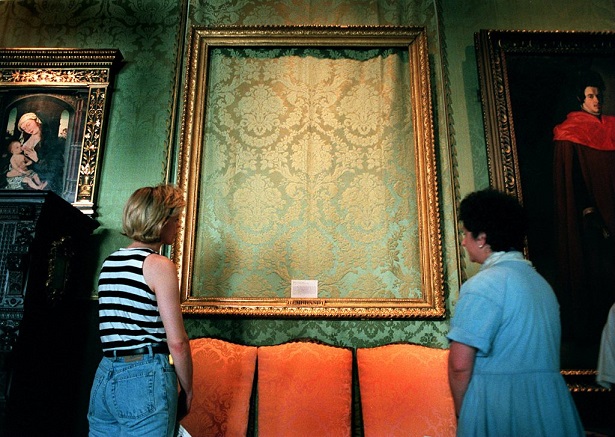
This 18x grid featured the names of artists hidden within larger phrases — KAHLO inside HOOKAH LOUNGE, for instance — but added an additional twist to the solve by ignoring the letters in those artists’ names for the Down entries. So, while KAHLO filled the circled letters reading across, the answers reading down (as clued) would exclude those letters.
But, most importantly, those circled letters STILL formed words reading down, just not the one being clued. So, for example, 4-Down was clued “Comedian whose ‘seven dirty words’ spurred a 1978 Supreme Court ruling on media censorship” gives you the answer CARLIN, but if you include the letters of two artists’ names that the down entry crosses, you get CAROLINA.
It took a little while to get used to using the letters across and ignoring them down (or, at the very least, considering the clued answers down without them while still forming the longer down words), and this made for a fun, yet challenging solve. This was a very cool and well-executed hook for the puzzle that added a lot to the traditional word-hidden-in-phrase crossword theme.
For the third year in a row, Puzzle #4 features my favorite gimmick of the tournament. What a streak!
Interesting grid entries included BEER ME, ANO NUEVO, STUNT DRIVER, and ENGULF, and my favorite clues were “Cliff notes?” for YODEL, “What a designated driver shouldn’t have to pick up?” for TAB, and “Proud papa with a cygnet ring?” for COB.
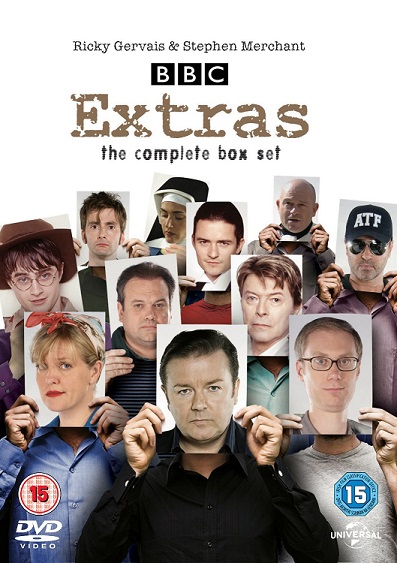
Puzzle #5: Hollywood Extras by Rob Gonsalves and Jennifer Lim
Gonsalves and Lim return to Boswords after a successful debut last year and close out the tournament’s open competition puzzles with a solid 18×17 grid, cooling the solvers down nicely after the one-two punch of puzzles 3 and 4.
This movie-themed puzzle added a letter to film titles — THE BOOK OF ELI becoming THE BOOK OF DELI, for example — and the bonus letters spelled out DRIVE, making the revealer DRIVE-IN MOVIES tie the whole puzzle together nicely.
It’s a really fun, accessible theme that allowed for some fun cluing — I particularly enjoyed MONA LISA SIMILE — and served as a nice capper for the event before the final puzzle.
Interesting grid entries included BOUGIE, GIBRALTAR, CRETAN, and LET’S EAT, and my favorite clue was “Dwarf planet beyond Pluto” for ERIS, because I will forever stand up for Pluto and Eris as planets.
Puzzle 6: Championship Themeless by Wyna Liu
For the third year in a row, a different constructor tackled the challenge of creating the final boss for Boswords, and Liu absolutely smashed it. This was a terrific 15x themeless grid, jam-packed with interesting fill and great crossings.
The strong construction was highlighted by two sets of solid clues — both the MILD and the SIZZLING clue sets had some clever entries for solvers to unravel — and all in all, this was a worthy obstacle for the eventual winners to overcome.
Interesting grid entries included UNO CARD, BLOBJECT, SUSHI CHEFS, ARTIVISTS, and BIKE RIDE (which I KEPT trying to make BICYCLE to my continuing dismay).
As for favorite clues, here’s a list:
MILD: “Academic fire safety?” for TENURE
SIZZLING: “Lift a paddle?” for BID
SIZZLING: “Keeping track?” for TENURE
SIZZLING: “Place to see a metal band?” for RING FINGER
SIZZLING: “Number of syllables in ‘Milano’ or ‘Napoli'” for TRE
Overall, Boswords continues to impress. Between the summer tournament and the seasonal themeless leagues, Boswords has really stepped up their game over the last two years, and as always, I was impressed by the array of puzzles assembled for this year’s tournament.
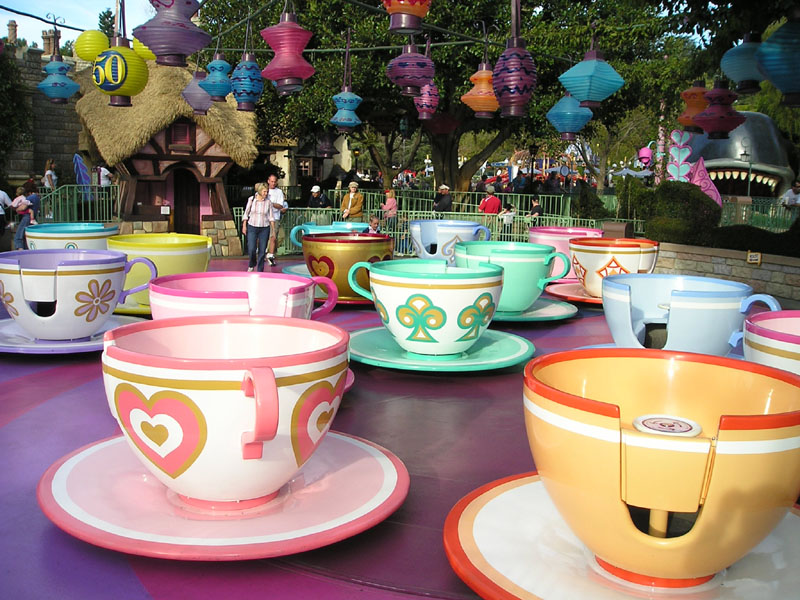
There were tricky themes, visual themes, and even a teacup ride, all of which made great use of both the cluing and the grids themselves. Every puzzle made an impact, and the tournament puzzles as a whole were challenging and creative in their design without being off-putting or getting too esoteric.
While I do think this year’s tournament was a bit harder overall than previous years, Boswords remains the perfect tournament to introduce solvers to tournament-style puzzling, making up for difficulty with accessibility, playfulness, and straight-up solid grid construction.
Once again, I cannot wait to see what they cook up for us next year.
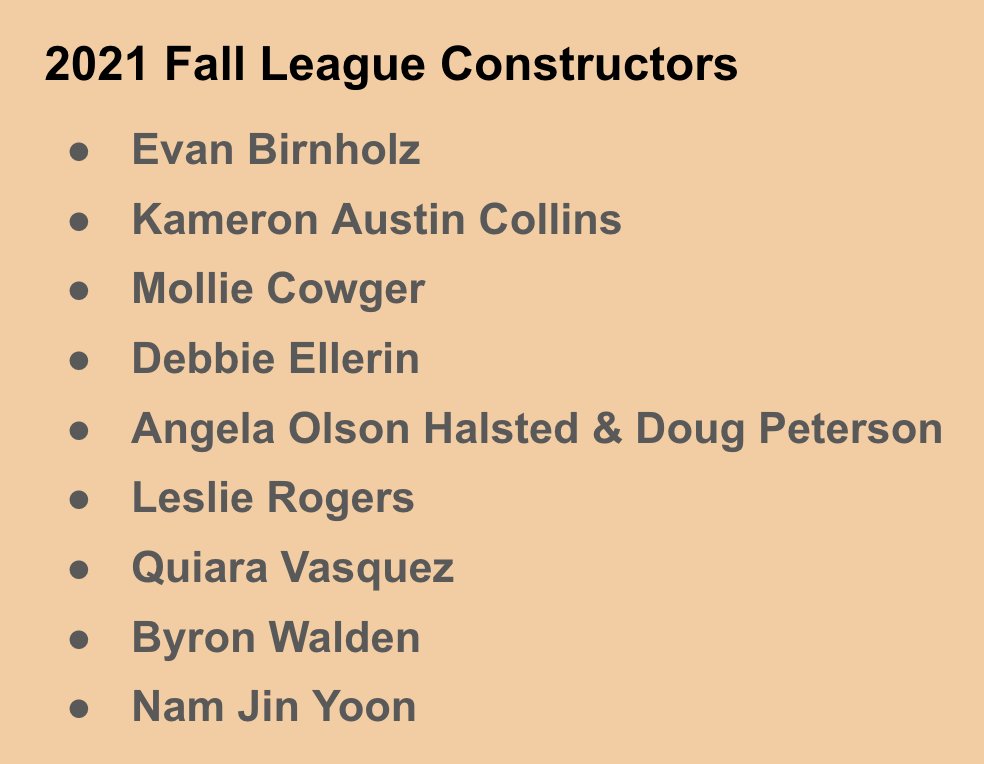
But then again, we don’t have to wait that long for more Boswords fun! At the end of the broadcast for this year’s summer tournament, they announced the roster of constructors that will be contributing to the upcoming Fall Themeless League!
That is one heck of an all-star team to look forward to! See you in October and November for this year’s Fall Themeless League!
Your grid entries need to be interesting, yet accessible. You need to navigate long crossings and tight corners without resorting to too many abbreviations, too much crosswordese, or creating the dreaded Natick, a crossing of two obscure entries. Some solvers don’t like partial phrases, others don’t like proper names or brand names.
Your cluing has to be clever but not impenetrable. How much wordplay is too much? How many fill-in-the-blank clues before your clue section resembles your grid? The cluing must be fresh and vibrant yet timeless and not too of-its-era to make the cut for reprint and collection later.
No matter how you clue it, older solvers may decry newer names, slang, terminology, or pop culture references, while younger solvers will bemoan not just older references they consider passe, but long-established crossword-friendly words they quickly tire of seeing.
And that’s all without considering the difficulty in creating engaging, interesting themes or gimmicks for the puzzle.
That question of fresh entries and cluing vs. older/more familiar fare is a curious one. It raises further questions.
For instance, how much can you talk about what’s going on in the world?
By referring to unpleasant topics, however topical, will you alienate solvers who use the crossword as an escape? Or do you risk the puzzle feeling too sanitized and safe by NOT acknowledging the circumstances of the world at the time of the puzzle’s publication?
There are arguments for both sides. I mean, who wants to see ADOLF in a grid? (But then again, it’s not like IDI AMIN has a hard time finding his way into grid fill.)
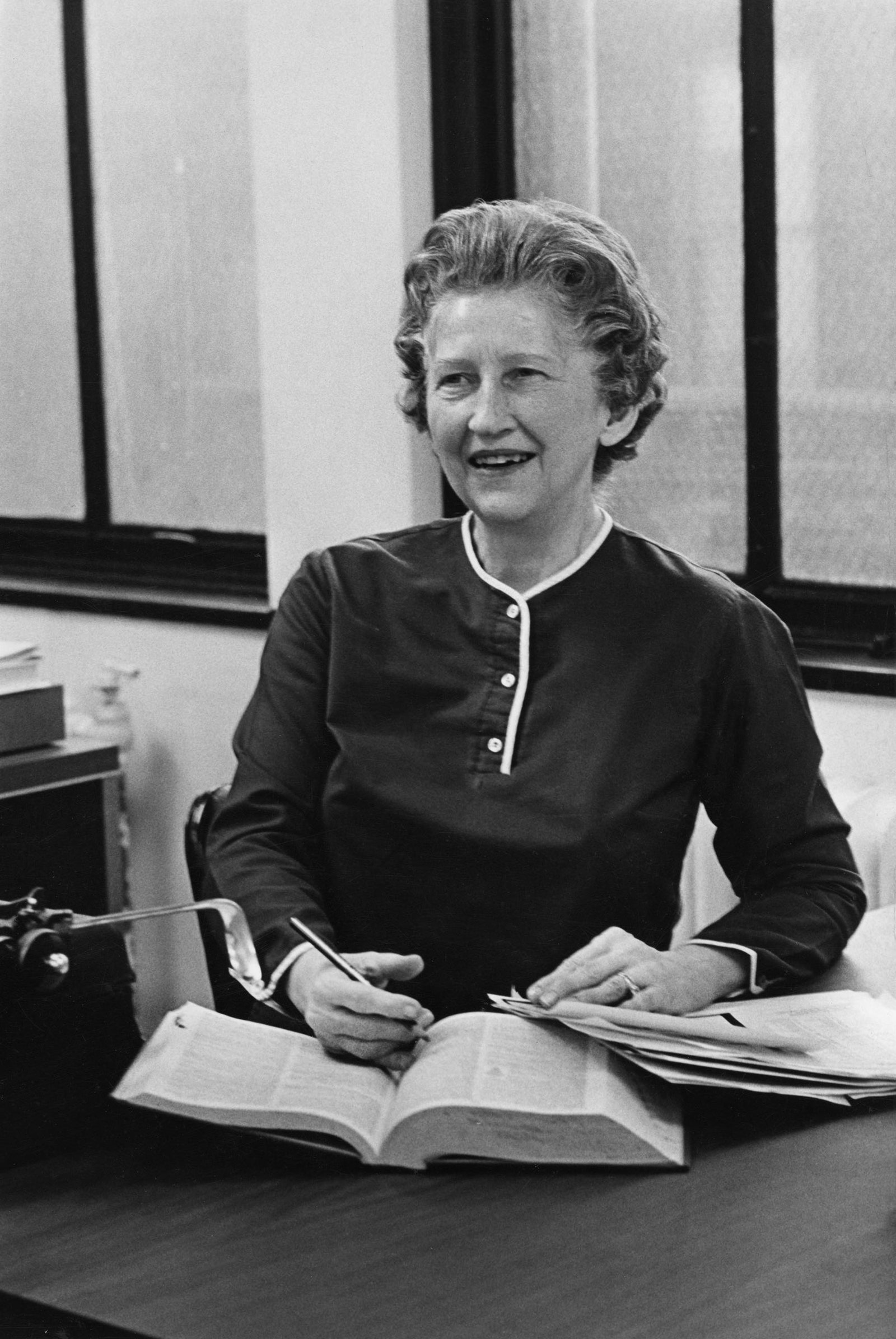
Margaret Farrar believed that crosswords should avoid “death, disease, war and taxes.” Purposely avoiding unpleasant fill and cluing is informally known as the “Sunday Morning Breakfast Test.” (Our friends at Penny Press know plenty about this, as they shy away from unpleasant entries with diligence.)
But on the flip side, to ignore the unpleasantness of the world potentially ignores the people that unpleasantness affects.
As we continue to push for greater representation in crosswords in both editorial staff and constructors, you cannot deny that including the experiences of women, people of color, and members of the LGBTQIA+ community somewhat necessitates facing those unpleasant aspects of our history and our society.
To exclude them is to exclude potentially thought-provoking and important fill and cluing. (One could easily argue that the vast majority of our own Eyes Open crosswords would not pass the Sunday Morning Breakfast Test.)
Not everyone greets adding new cultural fill with open arms, of course. A few years ago, an LA Times crossword solver complained to us (on our holiday gift guide post, of all places) about “ignorant ghetto language” in the crossword. He referred specifically to innocuous entries like “sup,” “did,” and “street cred.”
Thankfully, he is an outlier.
But on the topic of excluding words from crosswords, when Will Shortz was asked about it, he had an interesting response:
If a word or term is used in the columns of The Times, or in cultured society in general, I think it’s probably O.K. for a crossword, even if it’s touchy or slightly unpleasant. I strive to have crosswords reflect real life as much as possible. … I don’t believe in banning words, except for the very worst. And I’d be happy to abolish the term ‘breakfast test’ completely.
I think this is a topic I’m going to ask crossword solvers about more often. I’d be curious to see where they stand on crossword content and topicality.
I suspect opinions will vary, but I also suspect that most solvers welcome new fill, new entries, and new references in clues. Every crossword is an opportunity to learn and expand one’s knowledge, and add to the mental lexicon of crossword knowledge we each build as we solve.
So where do you stand, fellow puzzlers? Do you prefer your crosswords as an escape or as a puzzly reflection of the world around us? Let us know in the comments section below! We’d love to hear from you.
This Sunday, July 25th, from 1 PM to 6 PM Eastern, the Boswords Crossword Tournament returns! The fifth edition of this event will be contested online for the second year in a row, so it’s the perfect opportunity to test your puzzly skills.
If you haven’t signed up yet, registration closes tomorrow at 5 PM Eastern.
With two divisions to choose from — Individual and Pairs — puzzlers of all ages and experience levels are welcome to enjoy some challenging and clever crosswords in a day of puzzly fun and camaraderie.
Tournament organizers Andrew Kingsley and John Lieb (along with talented puzzle editor Brad Wilber) have gathered a diabolical Ocean’s Eleven-style crew of terrific constructors for this year’s puzzles. The five themed puzzles in regular competition (as well as the championship themeless final) will be constructed by Malaika Handa, Andrew Kingsley, Chandi Deitmer, Wyna Liu, Hoang-Kim Vu, Rob Gonsalves, and Jennifer Lim!
Boswords is asking for $25 for adults, $35 for pairs, and $5 for students to (virtually) attend and compete, which is a real bargain! (Also, for anyone with financial difficulties, there is a discounted rate available.)
If you want to solve the puzzles at your leisure and outside of the competitive setting, it’ll only cost you $10 for the puzzle packet, which you’ll receive Monday by email.
To check out the full details of this year’s event, click here! (And for our rundown of last year’s tournament puzzles, click here!)
Will you be attending the Boswords tournament, fellow puzzlers and PuzzleNationers? Let us know! We’d love to hear from you.





 PuzzCulture