A Quantum Leap Forward in Crosswords!

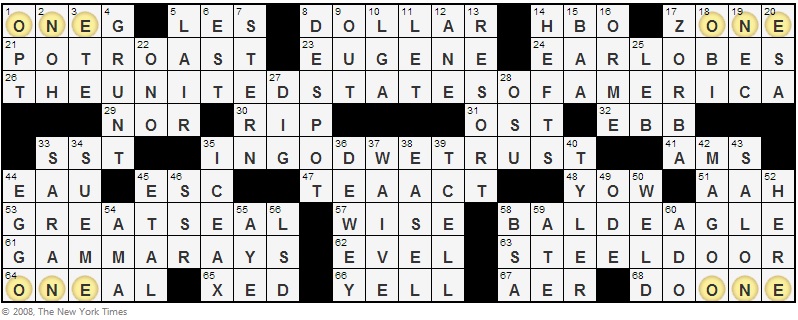
It’s fair to say that the 1996 Election Day crossword, pictured above, is one of the most famous puzzles in crossword history. The puzzle “predicted” the outcome of the election quite cleverly by allowing for either CLINTON ELECTED or BOB DOLE ELECTED to read out, depending on how the solver answered seven down clues.

(You can click the image to see a larger version of the grid and clues.)

Reportedly, Will Shortz called it the most amazing puzzle he’d ever seen.

Well, that puzzle may have been topped.

But first, a bit of backstory.

These rare crosswords are called Quantum puzzles or Schrodinger puzzles. These names reference the famous thought experiment involving a very unlucky cat in a box that could be alive or dead, and an observer wouldn’t know which until he opened the box. Meaning that both answers are correct at the same time; the cat is both alive and dead.

[This great t-shirt melds the Schrodinger’s Cat concept with a classic joke.]

Similarly, these puzzles have more than one answer, and each answer is equally correct.

And on Thursday, December 4, constructors Kacey Walker and David Quarfoot combined some considerable Scrabble skills and a dynamite crossword grid to create the most impressive Schrodinger puzzle to date.

You see, clues 26-Across, 36-Across, and 44-Across all feature seven letters, like a rack in Scrabble. And it’s up to the solver to find the anagram of each rack that fits the grid.

For example, 26-Across reads “Play in 7-Across with the rack DEIORRW”. (The answer to 7-Across is SCRABBLE, giving the solver a strong idea of where to go next.)

Quite amazingly, Walker and Quarfoot have designed the puzzle so that each of those clues has three possible correct answers — for 26-Across: ROWDIER, WORDIER, and WORRIED all fit the down clues — meaning there are a staggering 27 possible correct solutions!

This is just one of those 27 solutions:

[You can check out all of the possible solutions, as well as the clues, on XWordInfo here.]

This is David Quarfoot’s 41st NYT published puzzle and Kacey Walker’s first! Talk about setting the bar as high as you can.

This is also one of the flat-out coolest puzzle constructions I’ve ever seen. My thanks to Deb Amlen for doing such a great write-up on the puzzle and for pointing it my way.

Thanks for visiting PuzzleNation Blog today! You can share your pictures with us on Instagram, friend us on Facebook, check us out on TwitterPinterest, and Tumblr, and be sure to check out the growing library of PuzzleNation apps and games!

The Wide World of Sudoku

hypersudokufromsudokusolverdotnet

[A classic Sudoku grid with a colorful twist, where the 3×3 blue squares also have all 9 numbers inside them. One of many MANY Sudoku variants. Grid from Sudoku-Solver.net]

For more than a century now, crosswords have been the premier pencil-and-paper (or pen-and-paper, if you’re confident) puzzle, but a close second would have to be Sudoku, which has exploded in popularity over the last decade or so.

The simple concept behind Sudoku — a 9×9 grid arranged so that the numbers 1 through 9 only appear once in each row, column, and 3×3 square — is easily modified for any difficulty level, from beginners to topnotch solvers.

The classic form of Sudoku, originally known as Number Place or To the Nines, is instantly recognizable.

screen480x480

[A Sudoku grid from PuzzleNation’s own free Classic Sudoku app for iPad.]

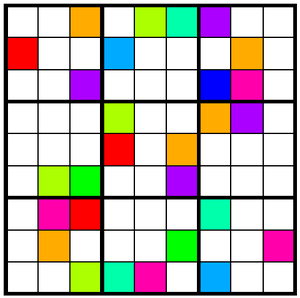
But virtually any set of nine different symbols, characters, numbers, or letters can be used as clues for a Sudoku-style solve. That gives us variations like Picture Sudoku or Color Sudoku, where the same deduction is involved, but the solution is a bit more vibrant.
colorsudokufromalphedotse

[A color Sudoku from Aleph.se.]

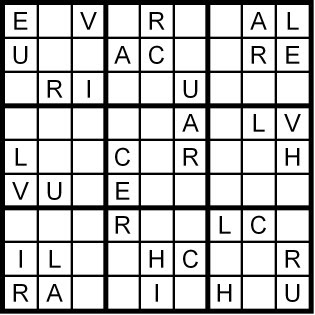
Word Sudoku follows the same concept, replacing the numbers 1 through 9 with letters, allowing for the added bonus of a 9-letter word reading out along one of the rows. I’ve seen Word Sudoku variations in all sorts of languages, which is neat, because you can still solve the puzzle even if you don’t know the language; you’re simply choosing different symbols.
wordsudokufrommagicwordsquareonblogspot

[A Word Sudoku from Magic Word Square on Blogspot.]

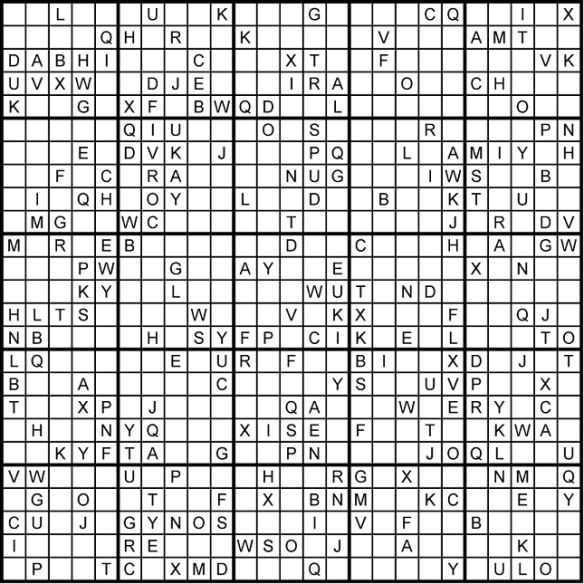
Using letters instead of numbers often factors into larger Sudoku puzzles. While Penny/Dell’s Mega Sudoku is a 16×16 grid using the numbers 1 through 16, other large-scale Sudoku puzzles use letters instead of numbers above 10, while others go so far as to remove the numbers altogether, giving you the option of puzzles that span nearly the entire alphabet!
25gridfromcolinjdotcodotuk

[A 25×25 monster Sudoku grid using letters, courtesy of colinj.co.uk]

And since we’re already discussing bigger Sudoku puzzles, it’s worth mentioning smaller Sudoku puzzles. Often called Mini-Sudoku or Sub-Doku, these puzzles start at 4×4 grids (using only the numbers 1 through 4) and increase in size all the way up to the standard 9×9 grid.

Those are just the puzzles that use standard Sudoku rules. There are numerous types of Sudoku that add new rules or curious wrinkles to the standard solve.

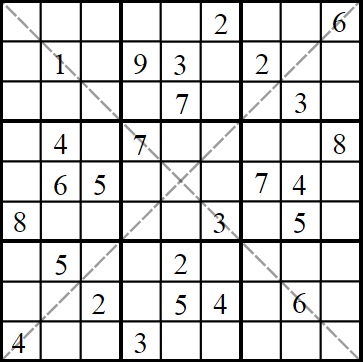
Perhaps the most famous variant is known as Extreme Sudoku, Diagonal Sudoku, or X-Sudoku, and there’s one crucial difference: the numbers 1 through 9 also appear only once along each diagonal. This additional rule helps with solving, but Extreme Sudoku puzzles often have fewer set numbers in order to keep the difficulty level interesting.
extremesudoku

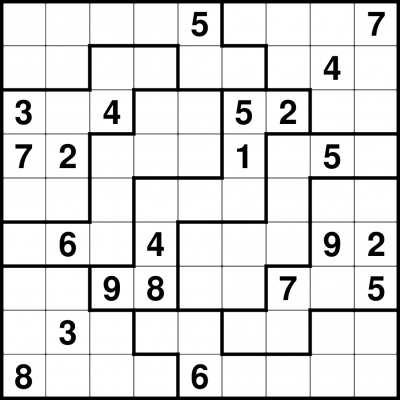
Another popular variation is known as Jigsaw Sudoku or Geometric Sudoku. These puzzles abandon the standard 3×3 boxes, instead using various Tetris-like shapes within the 9×9 grid. Each of these pieces contains each number 1 through 9, and the standard rule of no repeats within a row or a column remains.

These puzzles can either have random shapes or shapes with the same diagonal symmetry that rules both crossword grids and the placement of set numbers in classic Sudoku grids.
jigsawsudokufromanypuzzledotcom

[A Jigsaw Sudoku grid from AnyPuzzle.com]

Some variations involve more deduction as well, like Neighbor Order Sudoku or Greater Than Sudoku. These puzzles feature small arrows that indicate whether the number in a given square is larger or smaller than its neighbor.

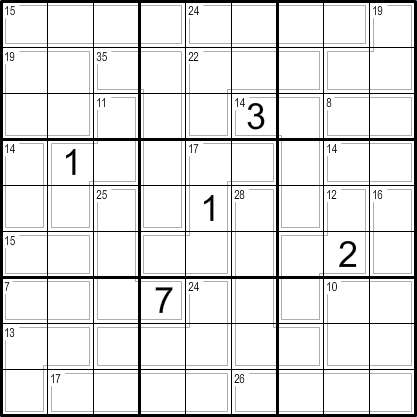
That’s just the start of math-based Sudoku variants that exist. Sum-Doku or Killer Sudoku uses the standard one-per-row, column, and 3×3 box Sudoku rule, but also adds numerous smaller Tetris shapes and boxes, each with a total. The numbers within that smaller box add up to that total.

Those totals are a crucial aid for solving, since Sum-doku puzzles often feature many fewer starting numbers. (The shapes of the smaller boxes often follow the diagonal symmetry of the set numbers.)
sumdokufromcrossworddotnalenchdotcom

[A Sum-Doku grid from Crossword.Nalench.com]

Another popular variant involves overlapping Sudoku grids. You could have two 9×9 grids that share one 3×3 box, or two 9×9 grids sharing four 3×3 boxes, or you could have more grids overlapping in all sorts of ways.
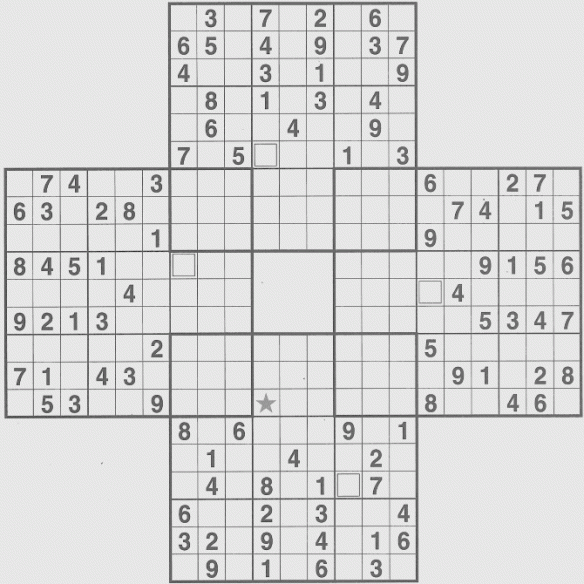
overlappingquadruplesudokufromformsofenjoysudokudotcom

[A quadruple overlapping Sudoku grid, courtesy of the forums of enjoysudoku.com]

The best known overlapping Sudoku puzzle is probably Samurai Sudoku, which features five 9×9 grids, one at the center and one at each corner, so the 4 corner 3×3 boxes of the center grid link the puzzle together.

Check out this masterpiece I discovered on mathpuzzle.com:
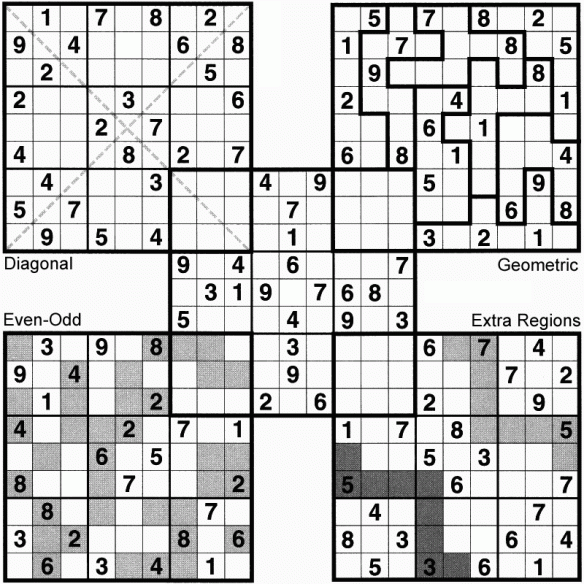
5-way-hybridsudokufrommathpuzzledotcom

Not only is it a Samurai Sudoku with diagonal symmetry for all the set numbers, but each of the four corner grids operates under a different set of variant rules.

The upper left grid uses Extreme Sudoku (or Diagonal Sudoku) rules, the upper right grid is an asymmetric Jigsaw Sudoku (or Geometric Sudoku), the lower left grid has shaded the location of every even-numbered number to aid your solving, and the bottom right has two shaded ribbons weaving throughout the grid, each of which also includes each number from 1 through 9 once.

As you might expect, there are plenty of variations of Samurai Sudoku. My personal favorite is known as Shogun Sudoku; it’s two linked Samurai Sudoku grids — meaning there are ELEVEN linked 9×9 grids — and there are even larger variations out there for the solver who simply can’t get enough of overlapping Sudoku puzzles.
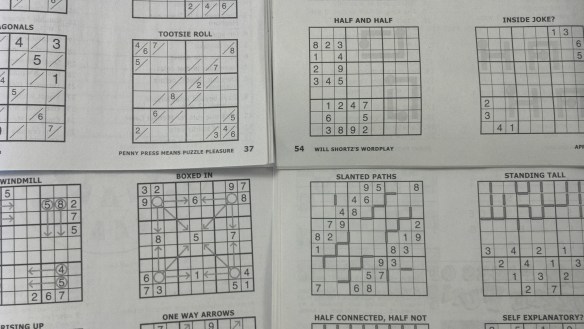
2014-12-04_10-11-41_260

[Upper left: Tight Fit Sudoku, Upper Right: Thermo Sudoku,
Lower Left: Arrow Sudoku, Lower Right: Consecutive Sudoku.]

Our friends at Penny/Dell Puzzles have several titles that offer a variety of different Sudoku puzzles. The four grids above all appear in various issues of Will Shortz’s WordPlay, all courtesy of Sudoku constructor Thomas Snyder.

You should also check out the Sudoku Spectacular title (featured in our Holiday Puzzly Gift Guide!) as well as their upcoming Will Shortz’s Sudoku title.


I would also be remiss if I didn’t mention the mathier cousins of Sudoku.
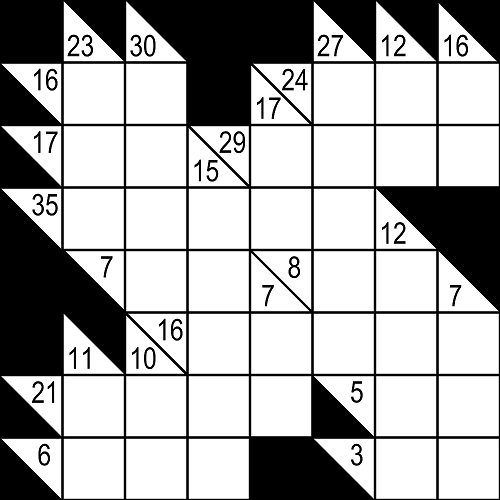
2000px-kakuro_black_box-svg

Kakuro, also known as Cross Sums, follows the same no-repeats rule of classic Sudoku, but the grids are much closer to Crosswords. The numbers along the top and left-side are the total for each row or column, and they are the primary clues for solving the puzzle. Kakuro rarely features set numbers the way Sudoku does, instead opting for a single filled-in row or column to get the solver started.

kenkenfromthemathmagazineonblogspot

[A 6×6 KenKen grid, courtesy of The Math Magazine on Blogspot]

KenKen takes the addition from Sum-Doku and adds subtraction, multiplication, and division to the mix. Each box has a number and a mathematical symbol. The number is the total, and the symbol is how the missing numbers interact to reach that total. For instance, in the upper right corner of the grid, there’s 24X. That means the two missing numbers from that box, when multiplied, equal 24.

And since this is a 6×6 grid, following the same one-per-row and column rules of Sudoku, you know that 4 and 6 are the missing numbers in that box, but you don’t necessarily know where to place them yet.

When it comes to Sudoku, the variations on shapes and layouts are seemingly endless. I’ve seen diamonds and snowflakes, cubes and five-pointed stars, in all sorts of sizes. You can get Samurai Sudoku with 6×6 grids, Jigsaw Sudoku in miniature, and Word Sudoku with Egyptian hieroglyphics.

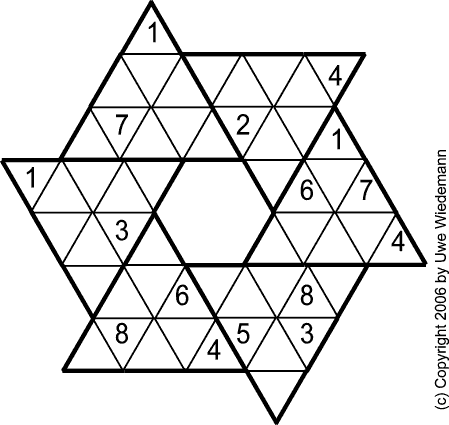
While researching this post, I encountered this marvelous Sudoku variant, which the constructor calls Star Sudoku.
starsudoku1

The numbers 1 through 9 appear once in each triangle, and there are no repeats along any row or slanted column. This puzzle is not only clever, it’s flat-out neat.

So, fellow puzzlers, what’s your favorite variation of Sudoku? Or do you prefer to stick with the classic version? Let me know! I’d love to hear from you!

Thanks for visiting PuzzleNation Blog today! You can share your pictures with us on Instagram, friend us on Facebook, check us out on TwitterPinterest, and Tumblr, and be sure to check out the growing library of PuzzleNation apps and games!

But I have all the koalafications!

Good cluing is one of the cornerstones of quality crossword writing. Not only do the clues have to be interesting, clever, and challenging, but they need to be accurate as well. After all, there’s a big difference between playfully misleading and misleadingly wrong.

Thankfully, this is the Golden Age of cluing assistance, and there are numerous cluing archives and websites loaded up with crossword clues galore. Places like Crossword Nexus, Crossword Tracker, Wordplays, and XwordInfo are searchable, not only allowing constructors to look for new clues, but assisting solvers with troublesome clues.

It also makes researching crossword controversies a whole lot easier, like Hugh Stephenson’s koala-centric kerfuffle in The Guardian’s crossword blog.

You see, fellow puzzlers, a setter named Qaos used the following clue in a cryptic crossword:

Bear a left, then a right, then reverse (5)

This clue was intended to point toward the answer KOALA, both with the word “bear” and the directions “a left, then a right” — meaning A L, A OK — “then reverse” — KOALA. But some solvers took issue with Qaos referring to the koala as a bear, despite the common vernacular term “koala bear.”

Now, if we’re going by strict dictionary definition, those solvers are correct. The koala is a marsupial, not a bear. Of course, dictionaries were recently amended to say that “literally” no longer just means “literally” — it can mean “figuratively” as well. So I’m inclined to go beyond the dictionary definition and plumb the depths of crossword clue archives to see where the crossword community as a whole stands on the question of koala vs. koala bear.

The Crossword Solver lists the clue [Australian “bear”], but mostly avoids the controversy with a litany of clues like [Gum leaf eater], [Australian critter], and [Down Under climber].

If you go to Crossword Tracker, you mostly get clues that hedge their bet, like [Australian “bear”], [Marsupial sometimes called a bear], and [Australian bearlike beast], but there are a few hard-nosed clues like [It isn’t really a bear].

Crossword Giant agrees on this front, while Wordplays wavers wildly, citing both [Cute “bear”] and [Cute bear] in its archives.

I’d hoped for a definitive answer when searching XwordInfo, which is dedicated to clues featured in the New York Times Crossword. The Shortz era comes down firmly on the side of “bear”, not bear, but the pre-Shortz era is less rigid, with clues like [Living Teddy bear], [Bear of Down Under], and [Kangaroo bear].

And while I feel that the koala vs. koala bear issue remains unresolved, Mr. Stephenson is firmly in the koala bear camp, jokingly citing the 1983 Paul McCartney / Michael Jackson collaboration “Ode to a Koala Bear” as evidence.

Of course, if we’re going to start citing songs as evidence, that means “pompatus” is a real word, and that opens a whole new can of worms.

Thanks for visiting PuzzleNation Blog today! You can share your pictures with us on Instagram, friend us on Facebook, check us out on TwitterPinterest, and Tumblr, and be sure to check out the growing library of PuzzleNation apps and games!

5 Questions with constructor Patrick Blindauer!

Welcome to another edition of PuzzleNation Blog’s interview feature, 5 Questions!

We’re reaching out to puzzle constructors, video game writers and designers, board game creators, writers, filmmakers, musicians, and puzzle enthusiasts from all walks of life, talking to people who make puzzles and people who enjoy them in the hopes of exploring the puzzle community as a whole. (Click here to check out previous editions of 5 Questions!)

And I’m excited to have Patrick Blindauer as our latest 5 Questions interviewee!

Any list of the top constructors in crosswords today simply has to include Patrick Blindauer. His puzzles have appeared in the New York Times, the Los Angeles Times, the American Values Club Crossword, GAMES Magazine, and numerous other outlets, and Patrick is known for his devilishly clever themes and challenging puzzle grids.

As a regular contributor to the American Crossword Puzzle Tournament and co-host of this year’s Lollapuzzoola, Patrick represents both classic crossword traditions and the enterprising spirit of today’s most innovative constructors, pushing boundaries and continuing to explore just how devious and delightful crosswords can be.

Patrick was gracious enough to take some time out to talk to us, so without further ado, let’s get to the interview!

5 Questions for Patrick Blindauer

1.) How did you get started with puzzles?

My parents instilled my love of puzzles and games from an early age. I remember my mom got me an educational toy called Mr. Light, and my dad had a subscription to GAMES Magazine, which I would flip through when he was done with it. I loved the visual puzzles and the contests, but I didn’t get into crosswords until many years later when I decided to give up cigarettes and take up solving.

It was one of the best decisions I ever made, simultaneously improving my health and leading me to a new hobby and eventually to a new career. After a year of solving I tried constructing, and after a year of constructing something clicked and I made my first sale (a Thursday for the NYT, which ran on 7/21/05).

2.) Whether it’s the New York Times or the American Values Club Crossword, you’ve created some truly innovative and diabolical puzzles, like your famous dollar-bill-shaped crossword (featured above) or the New York Times puzzle from last year where multiple movie titles shared boxes. Do you have any favorite puzzles or clues, either your own or constructed by others? And on the flip side, what’s your least favorite example of crosswordese?

Thanks! Those are certainly the 2 New York Times crosswords which have gotten the most attention. Other favorites which spring to mind are my 7/4/07 New York Times puzzle*, the 12/17/09 New York Times puzzle I made with Francis Heaney, and the stuff I wrote for the NY Sun when I started out, which are collected in the book Patricks’ Puzzle Pandemonium: A Cavalcade of Crossword Craziness.

[*Glenn’s note: The 7/4/07 crossword was designed so that the letters “USA” could be found when certain boxes were shaded. It was no doubt a beast to construct. The 12/17/09 crossword was Noah’s Ark-themed, and animal names appeared side-by-side in the grid.]

I’m also the proud poppa of 5 Puzzlefests (interconnected xword suites with a final answer), which I offer through my website, and I’ve written a bunch of puzzle books (“Crossword Word Search” and “Wide-Screen Crosswords” are two of my favorites).

There are lots of other constructors whose work I enjoy, especially those who devise novel gimmicks that really push the envelope.

blindauer beard

My least favorite xwordese is probably LST, though I try to avoid all xwordese when I can. Coming up with a fresh SST clue is tough too, so I just avoid putting it in the grid in the first place.

[Glenn’s note: LST is an abbreviation for an amphibious military craft, short for Landing Ship Tank. SST is an abbreviation for supersonic transport, like the former Concorde.]

3.) You’re also a musician, and both the best puzzles and enjoyable musical performances often have a sense of flow and elegance about them. Do you ever find yourself relying on your more puzzly skills while performing, conducting, or teaching?

Not consciously, no, but maybe I should!

4.) What’s next for Patrick Blindauer?

I actually have something very exciting to announce: I’ve been commissioned to write a 6-puzzle set for the New York Times! It will run Monday-Saturday sometime this fall, and the plan is to make it a contest, as well. I’m thrilled and honored to have the opportunity to do something like this. Wish me luck!

5.) If you could give the readers, writers, and puzzle fans in the audience one piece of advice, what would it be?

Keep your pencil sharp and your mind even sharper.


Many thanks to Patrick for his time. You can check out his PuzzleFests and other puzzly works on his website, and be sure to follow him on Twitter (@pblindauer) to keep up on all things Patrick. (You can also learn more about the Lollapuzzoola tournament at BeMoreSmarter.com.) No doubt, Patrick will have something fiendishly fun for solvers soon.

Thanks for visiting PuzzleNation Blog today! You can share your pictures with us on Instagram, friend us on Facebook, check us out on TwitterPinterest, and Tumblr, and be sure to check out the growing library of PuzzleNation apps and games!

It’s Follow-Up Friday: That Has a Name?! edition

Welcome to Follow-Up Friday!

For those new to PuzzleNation Blog, Follow-Up Friday is a chance for us to revisit the subjects of previous posts and update the PuzzleNation audience on how these projects are doing and what these people have been up to in the meantime.

And today, I’d like to revisit crosswords for a moment.

We’ve explored crosswords a lot in this blog. From great cluing to the curse of crosswordese, from advice for constructing quality puzzles to tips for solving them, crosswords have been the centerpiece for many PuzzleNation Blog posts.

But friend of the blog Cathy Quinn recently passed along an article with an interesting bit of crossword trivia attached.

Have you encountered a difficult crossing in a crossword that left you baffled? This happens with proper names, archaic terms, and other more difficult grid entries, and when two of them cross, you might find yourself guessing instead of solving.

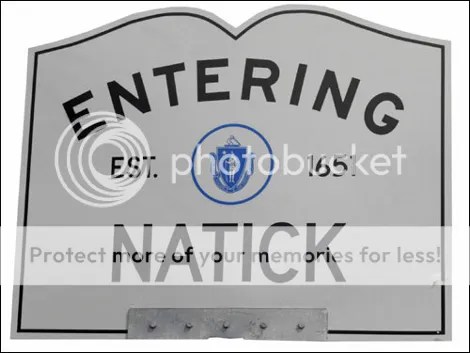
As it turns out, that difficult crossing, that unfillable square, that unsolvable spot, has a name, and it’s “Natick”.

From the article:

Back in 2008, The New York Times crossword puzzle featured a crossing of NATICK (“Town at the eighth mile of the Boston Marathon”) with N.C.WYETH (“Treasure Island” illustrator, 1911). If you weren’t from ’round these parts and were unfamiliar with the less-well-known Wyeth, it was a tough intersection.

Readers were not happy, and the term “a Natick” became shorthand for what is basically an unsolvable part of the crossword grid. (You can check out constructor Brendan Emmett Quigley’s take on the Natick here!)

So, if you’re ever flummoxed by a challenging crossing or an obscure intersection of terms, at least now you know what to call it.

Thanks for visiting PuzzleNation Blog today! You can share your pictures with us on Instagram, friend us on Facebook, check us out on TwitterPinterest, and Tumblr, and be sure to check out our library of PuzzleNation apps and games!

5 Questions: Alumni Edition!

Welcome to a special edition of PuzzleNation Blog’s interview feature, 5 Questions!

Normally, I’d be posting a new interview with a puzzle constructor, game designer, puzzle enthusiast, or a member of any other creative field that enriches the world in a puzzly way.

But instead, today I thought I’d reach out to our 5 Questions alumni and bring you news on what they’ve been up to since their sessions of 5 Questions.

First off, puzzle constructor Trip Payne’s new Puzzle Extravaganza launches tomorrow, August 1! You can still sign up through the end of August, and the extravaganza is only $10 (a little more for bonus puzzles).

Put your puzzly skills to the test against a topnotch constructor who has contributed to dozens of newspapers, outlets, and puzzle books, including Will Shortz’s WordPlay!

[To check out Trip’s session of 5 Questions, click here!]

Next up, the dynamic duo of Aubrey and Angela, better known as The Doubleclicks, are continuing to fulfill all the promises made in the Kickstarter fundraising campaign for their newest album, Dimetrodon!

And they’re currently touring across the Midwest and East Coast! Their ambitious schedule of venues includes Toronto, Boston, Brooklyn, and plenty of other cities, many that will experience the Doubleclicks live for the very first time!

In addition, they’ve just completed their Weekly Song Wednesday project, where they posted a new song and video every Wednesday for ten weeks. You can visit their YouTube page to explore all sorts of delightful content fit for puzzlers and game fans of all ages.

[To check out Angela and Aubrey’s session of 5 Questions, click here!]

And lastly, I have some exciting updates from BaffleDazzle founder Rachel Happen.

After launching a tremendous Kickstarter campaign to fund BaffleDazzle’s first line of jigsaw-inspired puzzles, Rachel recently sent her Kickstarter backers an update on how the production phase is going.

So far, she’s on target to deliver all of her promised puzzles by the end of August!

As a one-woman puzzle-making machine, Rachel is exceeding expectations on all fronts, not only redesigning and improving every aspect of the looming delivery process, but designing brand new bonuses to include.

Just take a gander at these stacks of Codebreakers puzzles, freshly produced and awaiting happy homes and eager puzzlers:

[To check out Rachel’s session of 5 Questions, click here! And for a spoiler-light review of the BaffleDazzle puzzle Cirkusu, click here!]

These are just a few examples of puzzly people doing amazing, entertaining, fascinating things, and I’m glad I’m lucky enough to share their work with you, my fellow puzzlers.

Thanks for visiting PuzzleNation Blog today! You can share your pictures with us on Instagram, friend us on Facebook, check us out on TwitterPinterest, and Tumblr, and be sure to check out our library of PuzzleNation apps and games!