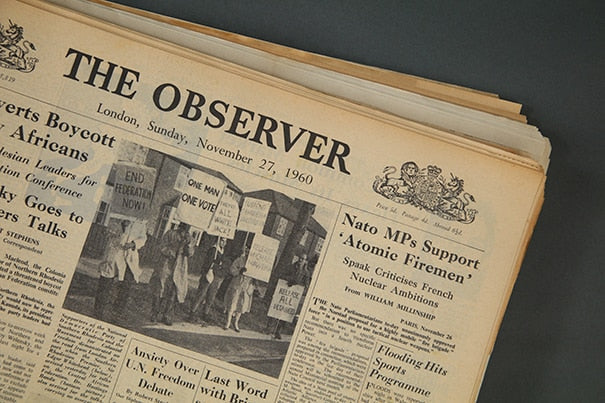
One Hundred Years of The Observer Crosswords!

1913 marked the birth of the crossword as we know it, but cryptic (or British-style) crosswords have been around nearly as long as the American version!

In fact, this past Saturday — Pi Day — marked an important anniversary in the history of cryptic crosswords.

On March 14th, 1926, Edward Powys Mathers, under the pseudonym Torquemada, published the first of 670 cryptic puzzles under the umbrella of The Observer, launching a crossword dynasty that continues to this very day.
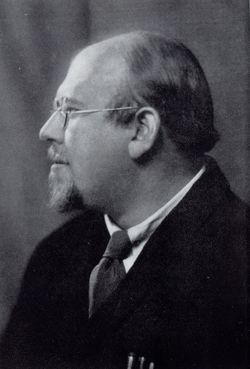
Mathers was a poet and a translator, and quite accomplished in both fields. Two years before his Observer debut as Torquemada, he was actually working for The Observer, but as a reviewer of thriller books. Apparently, he preferred to suggest how each book might be improved, rather than criticizing the book as is.

He noticed the American crossword craze crossing the ocean, but didn’t think much of them. (At the time, crossword cluing was very straightforward, consisting mostly of dictionary definitions. There was no wordplay, no misdirection, no humor. Cluing was VERY dry.)

In 1925, his first cryptic puzzles — a series of 12 crosswords where pairs of clues were rhyming couplets — appeared in The Saturday Westminster Gazette. This was where he first introduced himself to the puzzling public as Torquemada, taking the name of the Spanish Grand Inquisitor.

Well, sort of. The first puzzle was constructed for the entertainment of friends, but one of those friends took it to The Saturday Westminster Gazette against his wishes. The editors of The Gazette then managed to convince Mathers to create more. They were boldly advertised:

I recall how thrilling the green poster looked: “Crosswords for Supermen.” Alas, your tired commuter of today would swallow that first puzzle, verse and all, and correctly disgorge it between Charing Cross and Waterloo. — Torquemada, 1935

(Later those twelve puzzles were collected as “Crosswords for Riper Years.”)

After his run with The Saturday Westminster Gazette was finished, The Observer asked him to contribute puzzles to their outlet. They were called “Feelers,” as Mathers sought to widen the scope and audience of his puzzles, slowly “feeling his way” to better and more satisfying cluing.

It’s unlikely that Torquemada was the first setter to use cryptic-style cluing, but he was the first to ONLY use cryptic clues in his puzzles. But that wasn’t his only cryptic crossword innovation. He abandoned American-style grids as well, including these black bar grids:
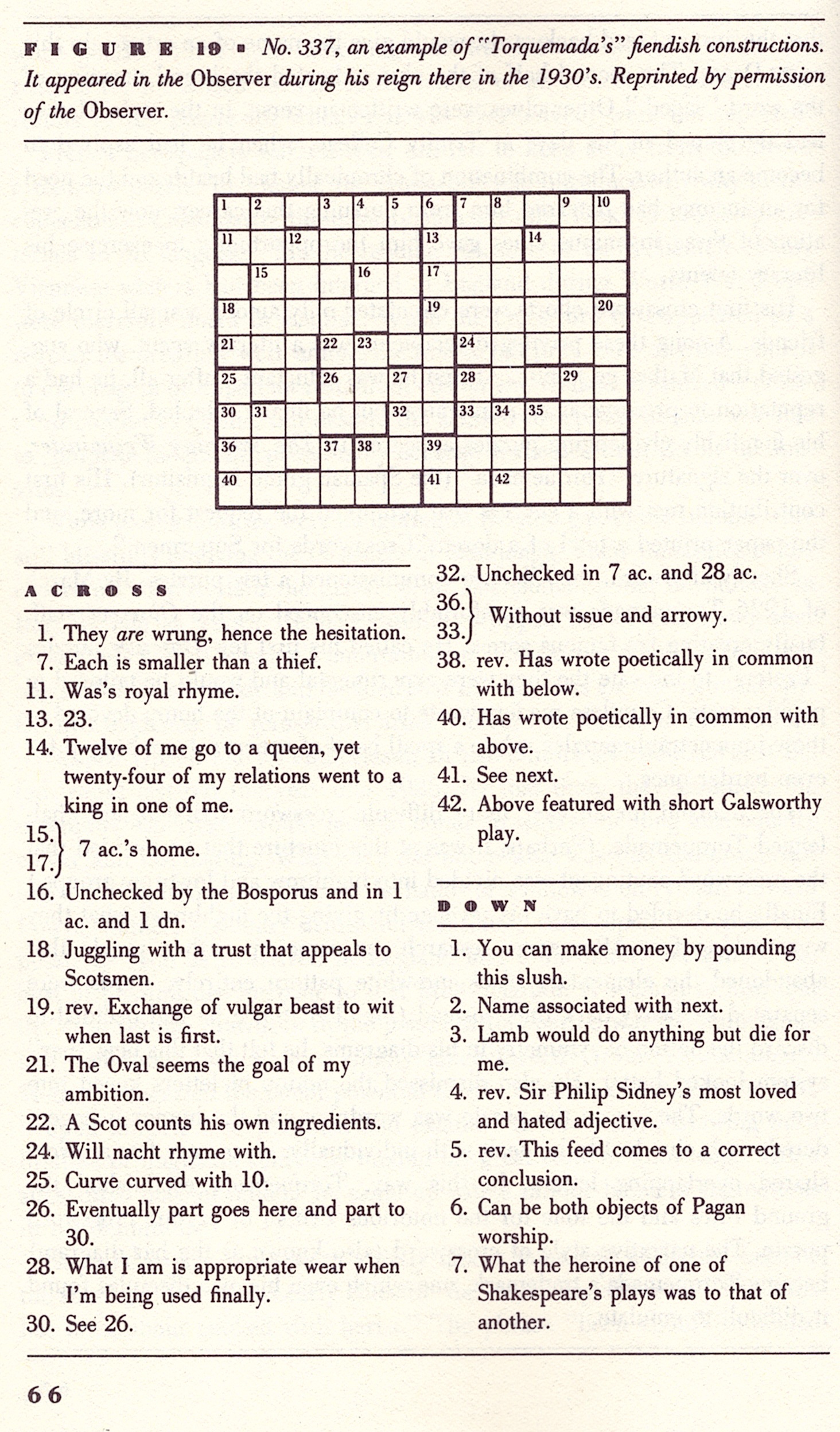
Image courtesy of What’s Gnu? by Michelle Arnot

Apparently he was successful in feeling out his audience; no matter how difficult his puzzles seemed to many, The Observer would receive as many as seven THOUSAND correct solutions from solvers all around the world, hoping to be among the lucky few selected to win a prize. (Prizes went to the first three correct solutions opened each week at The Observer offices.) It’s estimated another twenty thousand solvers out there were regularly completing his puzzles and not sending in their solutions.

Torquemada’s wife Rosamond later recalled that solvers would thank him for helping them “rediscover forgotten beauties in prose and verse to which we might never have returned but for the stimulus of the weekly chase”.

Torquemada’s prolific puzzling and creative cluing led some to suspect that there was actually a team of constructors toiling away under a shared sobriquet, but Torquemada’s only collaborator was Rosamond. He would choose the topic/theme for the grid, providing her with a list of words to include, and she would construct the grid.

Sadly, his time shepherding cryptic crosswords came to end when he passed away on February 3rd, 1939, at the age of 46.

After his passing, Rosamond read through over thirty thousand of his clues. She found the same word used fifty times in his puzzles, and every single time, the clue was different. Fifty different clues for the same word!
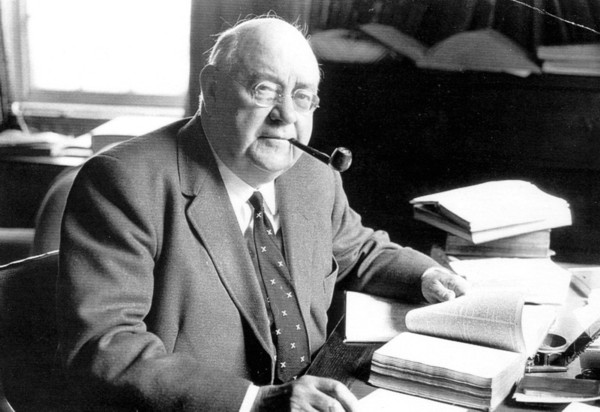

The unenviable task of taking over for Torquemada fell to Derek Somerset Macnutt, who adopted the name Ximenes for his constructing career. (Ximenes, as you might expect, was the name of a Grand Inquisitor in the Spanish Inquisition who succeeded the real Torquemada.)

Taking that particular set a very high bar, a challenge that Macnutt readily accepted. He aspired to increase the vocabulary of his audience, hoping for 30 percent of the answer words in the grid to be new to solvers.

Interestingly, his interest in puzzles was inspired by Torquemada but his singular brand of cluing was more reminiscent of Afrit, aka Alistair Ferguson Ritchie, who constructed cryptics for The Listener.

Ximenes adopted a symmetrical grid — a standard which remains to this day — as well as a maximum and minimum number of unches in the grid. (Unches, for you portmanteau lovers, means unchecked squares.) He also considered some of Torquemada’s puzzles unfair, and sought to standardize cluing, ensuring each had both wordplay and definition included, even while making them more creative and inventive.

In 1966, he published Ximenes on the Art of the Crossword, which pulled back the curtain on his constructing and inspired many constructors and setters in the years to come. (One of the most famous is the setter Eric Chalkley, aka Apex, who literally named himself after Ximenes in his endeavors to “ape X.”)

He also helped kickstart the cryptic crossword movement in America. After solving some of Frank Lewis’s puzzles for The Nation, Stephen Sondheim discovered the work of Ximenes, and started to learn the ins and outs of cryptic crosswords.
He even participated in Ximenes’s weekly clue-writing competitions:

Ximenes would then judge all the clues, conferring a first prize, a second prize, a third prize, and then two levels of honorable mentions: HC (Highly Commended) and VHC (Very Highly Commended). “And you would get in the mail a slip of paper giving the winners’ names and the winning clues.”

The slip was usually four inches wide by twelve inches long. In this way, even though Sondheim was in New York City, he became part of an international community of puzzle solvers matching minds with Ximenes. “I never got past honorable mention,” he lamented, “but I did get honorable mention.”

As it turns out, Sondheim received seventeen honorable mentions, fourteen HCs and three VHCs. One of those VHCs was for the clue “Pop art panel, derived from Dada” for PATERNAL.

Later accepting the challenge of the cryptic crosswords in The Listener (which were, and are, infamous for their difficulty), he introduced them to his collaborator on West Side Story, Leonard Bernstein.

And when Sondheim and Bernstein’s creative differences got the better of each other, they would reunite over a cryptic crossword, and then get back to work.

Sondheim would go on to create cryptic crosswords for New York Magazine, starting in the late 1960s, helping to introduce American audiences to that devious and challenging variety of crosswords. He also cultivated a library of cryptic puzzles and puzzle magazines, passing part of that collection (all of his Listener cryptic crosswords up through 1984) to Will Shortz.
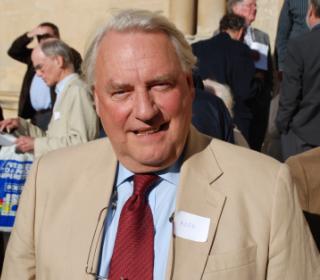

Macnutt passed away in 1971, but the final Ximenes puzzle, number 1200, was published in 1972. In March of that same year, stewardship of The Observer cryptic crossword passed to Jonathan Crowther, who took up the name Azed. Not only does this sound like it covers the alphabet (A to Zed), but it reverses the name of another Grand Inquistor, Diego de Deza.

He had been a solver of Ximenes’s puzzles since 1959, as well as a setter for The Listener. He also continued Ximenes’s clue-writing contest as the Azed Prize.
At this point, Azed has been setting the Observer cryptic crossword for longer than both his predecessors combined.

Also, you can’t help but love that he also sets occasional puzzles under the pseudonym Ozymandias. On his Wikipedia page, it even quotes the poem: “Look on my works, ye Mighty, and despair!”


Cryptic crosswords are alive and well. The Observer, The Guardian, The Independent, The Daily Telegraph, The Spectator, and The Sunday Times, in England, among others. The Ottawa Citizen, Toronto Star and The Globe and Mail in Canada. Harper’s in the US. Nearly every Australian newspaper has cryptic crosswords.

With Parsewords making the scene and hoping to demystify cryptic crossword cluing for new solvers, there’s no telling how many more solvers will discover or rediscover these challenging, playful puzzles.

And the folks at The Observer are marking the puzzle centenary with a special event on Thursday, March 19th!
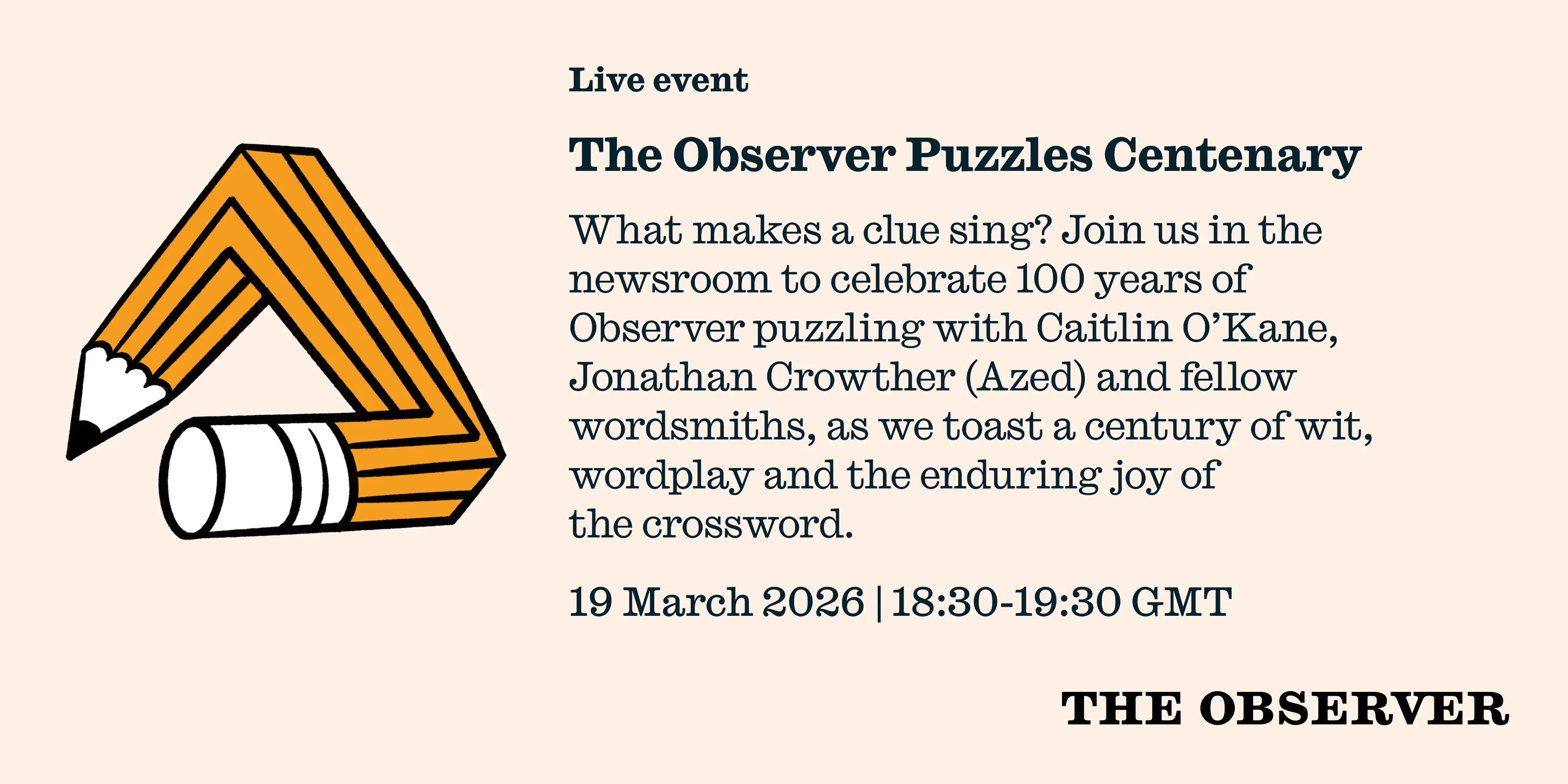
Caitlin O’Kane (their Puzzles Editor) and Azed himself will be in attendance, alongside other crossword setters and cryptic crossword enthusiasts, to enjoy an evening of live-solving and celebration:

From the invention of the cryptic to the rise of the modern brainteaser, they’ll unpack the secrets of their craft – what makes a clue sing, how setters think, and why a good puzzle keeps us hooked. Expect lively chat, unexpected revelations, and at least one enigma that demands to be cracked.

Raise a glass, meet other aficionados, and celebrate a century of wit, wordplay and ingenuity with the people keeping The Observer’s puzzling spirit alive.

So whether you’re attending The Observer‘s Puzzle Centenary, tackling a Parseword puzzle, or trying one of the numerous cryptic crossword outlets across the world, be sure to give a cryptic crossword a chance this week and be a part of one hundred years of puzzly challenge and creativity!

Happy solving, fellow puzzlers (and setters)!


Sources:

  • The Centenary of the Crossword by John Halpurn
  • What’s Gnu: A History of the Crossword Puzzle by Michelle Arnot
  • The Strange World of the Crossword by Roger Millington
  • Matching Minds with Sondheim: The Puzzles and Games of the Broadway Legend by Barry Joseph
  • The Puzzle Edit
  • Derek Harrison’s The Crossword Centre
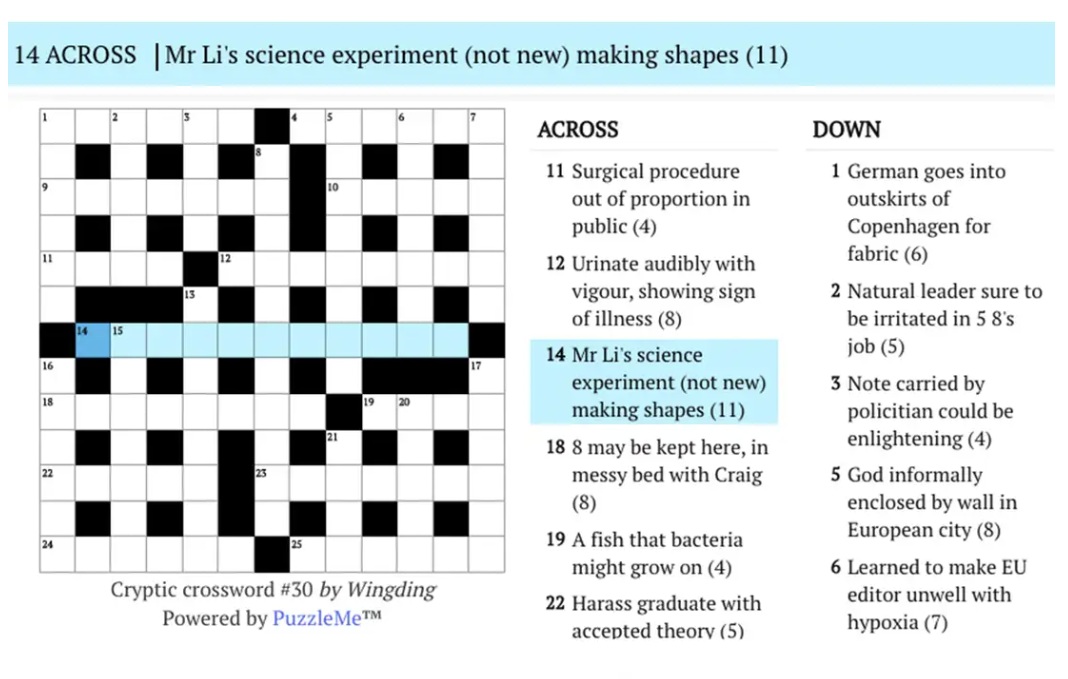
Meet Parseword: Making Cryptic Crosswords Less Cryptic!

You might not know Josh Wardle by name, but you certainly know his viral creation, Wordle, and you’ve no doubt seen friends and family members sharing their solving results daily.

A few days ago, Josh launched a new puzzly endeavor called Parseword.

It’s a definite step up in complexity from Wordle, but you can still see some of Wordle’s foundation in Parseword. After all, Wordle is all about deduction, playing with the pieces in front of you, and slowly (or quickly) applying what you’ve learned to discover the day’s word.

Parseword works in a similar fashion, but instead of using the letters in front of you to uncover the word, you’re using a Cryptic Crossword-style clue to unravel the answer word.

Image courtesy of New Scientist.

The clues in Cryptic Crosswords, also known as British-style crosswords, are longer, incorporating all sorts of wordplay, while concealing the definition within the clue as well. Each clue is a puzzle unto itself.

Here’s an example of cryptic-style cluing: “Quoted from edict wrongly (5)”

The definition part of the clue consists of the first two words, “quoted from.”

“Wrongly” indicates that part of the clue needs to be changed. This hints that the other word, “edict,” is not what it seems. EDICT, when anagrammed, becomes CITED. “Quoted from” defines CITED. Two ways to get the answer, one straightforward, one more challenging.

There you go. And that’s only one trick in the Cryptic Crossword cluing arsenal.

Cryptic clues can hide the answer between words, as in “Scottish snack offered in disco
nearby (5),” where “diSCO NEarby” conceals SCONE, the “Scottish snack.” They can offer two different definitions, as in “Desire for Japanese money (3)” for YEN.

Answer words could read backwards, or hide as initialisms or acronyms in the clue words. There could be soundalike words, or rebus-style assembly of the answer word. There’s loads of trickery and camouflage, especially in the hands of clever setters or constructors.

Parsewords is an interactive way to learn how to unravel Cryptic-style cluing.

Josh recently did an interview with The New Yorker, sharing his inspiration for the new puzzle game:

Wardle had tried cryptic crosswords when he was younger, but found them to be impenetrable. “I didn’t know how to begin,” he told me. The rules could seem arcane, almost impossible to deduce.

By treating the clue like a formula to be simplified, a linguistic version of P-E-M-D-A-S, the formerly impenetrable word salad of a clue starts to transform into something more recognizable. It’s a little bit like Ben Gross’s Bracket City puzzles.

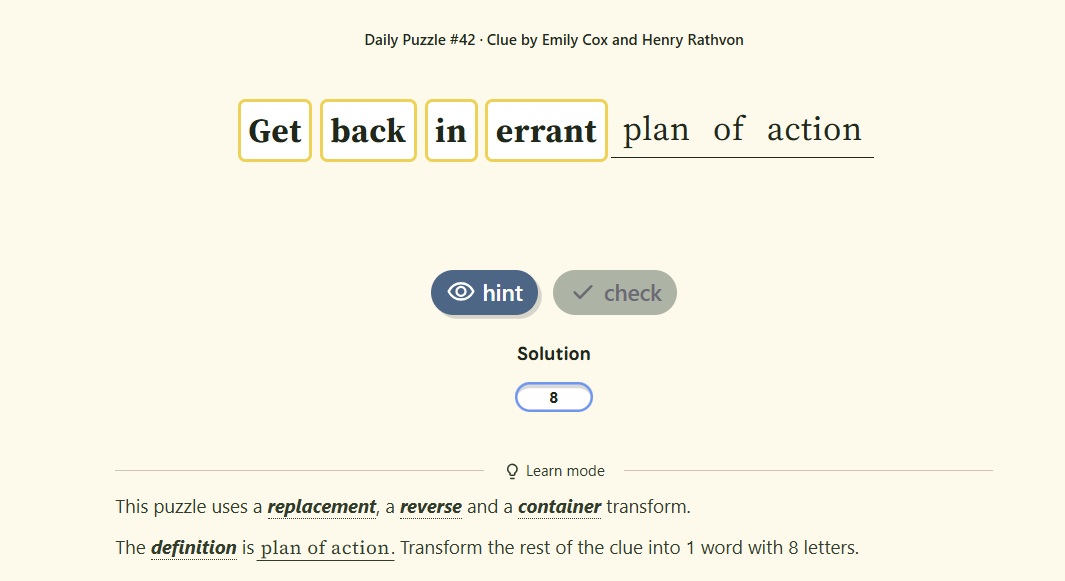
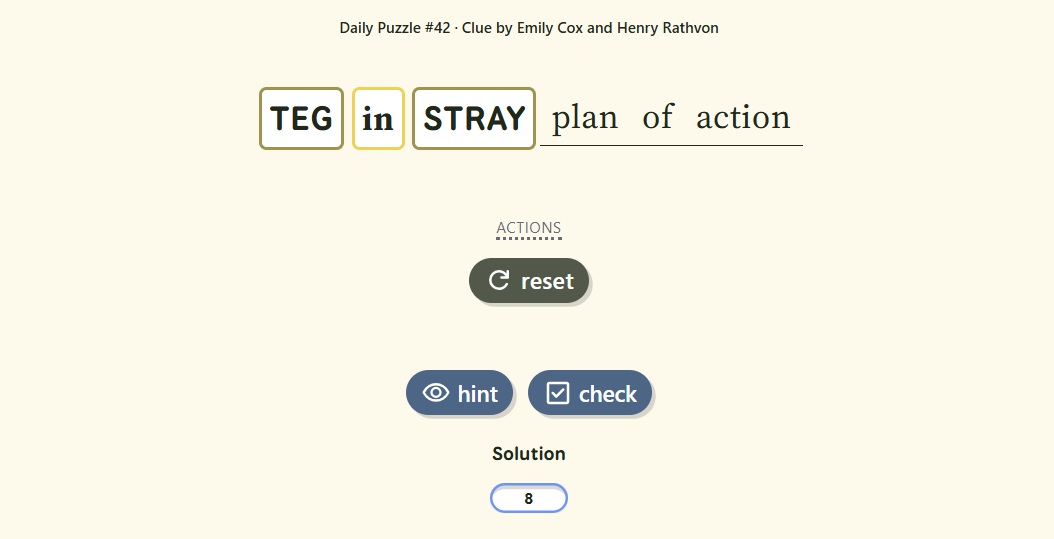
Here, let’s take a look at yesterday’s puzzle and I can show you what I mean.

So the puzzle starts you off by highlighting the definition part of the clue: “Plan of action.”

We must now unravel how we get an 8-letter answer from what remains: “Get back in errant.”

Thankfully, the puzzle also prompts you with which particular forms of cluing manipulation you’ll need to use: a replacement, a reverse, and a container.

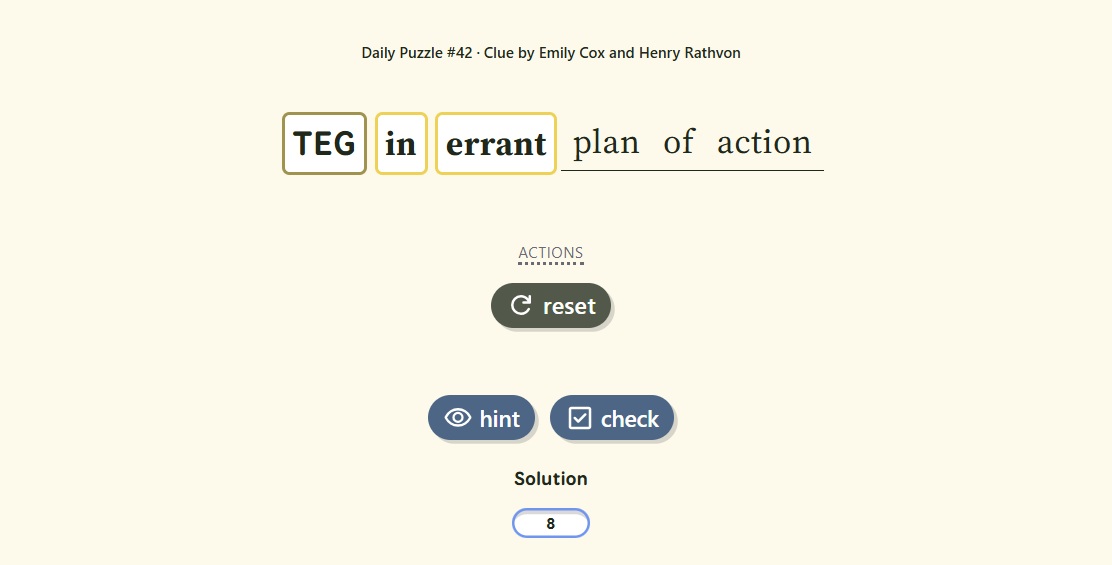
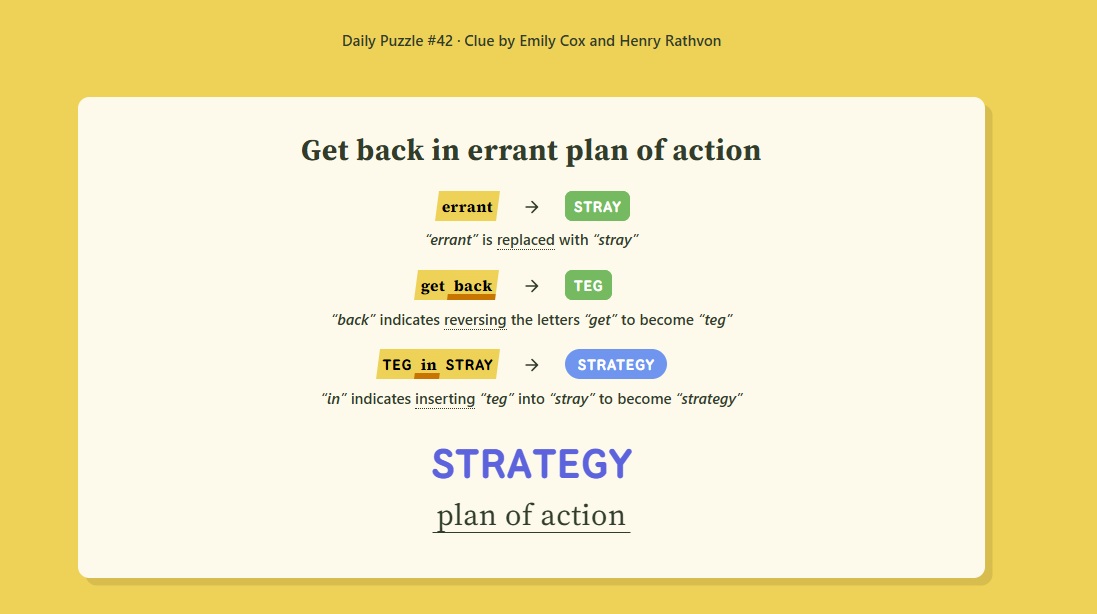
I found the reverse quickly. GET BACK told me literally what I needed to do, so I highlighted the entire phrase, which gave me the options to replace the phrase with a synonym like RECLAIM or RETAKE, or to literally turn “get” back, reversing it to read TEG.

“In” tells me the container aspect of the puzzle. TEG would be placed inside of something. But I couldn’t think of any way to play with the word ERRANT that would get me to a synonym of “plan.”

I clicked on ERRANT and the program gave me several replacement options: Wrong, Stray, and Guilty.

I clicked on STRAY, which replaced ERRANT in the clue.

Finally, I highlighted all three, allowing me to place TEG in STRAY, giving me the answer word for “plan of action”, STRATEGY.

It’s a really playful, visual way to describe how Cryptic Crossword cluing works, giving solvers chances to try replacements and anagrams, then reset when they’ve gone astray.

I don’t exactly expect it to take the world by storm the way Wordle did, but there’s something wonderful about a puzzle that trains you to be better at another kind of puzzle. It’s puzzly community and encouragement, which is one of the best things about being a solver.

I haven’t checked out today’s Parseword yet, but I’m looking forward to it.


What do you think of Parseword, fellow solver? Are you a Cryptic Crossword fan? A Parseword enthusiast? If not, will this get you to try the British sibling to our beloved American crosswords? Let us know in the comments section below! We’d love to hear from you.

[Thank you to our friends at Penny/Dell Puzzles for the examples of Cryptic Crossword cluing. Check out their marvelous How to Solve Cryptic Crosswords guide here!]

The World Cryptic Crossword Championship Is Almost Here!

Are you a fan of cryptic crosswords and looking for a challenge that suits your skill set and tricky puzzle of choice?

Then you should consider testing your puzzly mettle in this year’s World Cryptic Crossword Championship!

Debuting on the weekend of June 28th and 29th, the WCCC is composed of two events: an individual online championship on the 28th (which is open to any and all competitors) and a World Cup-style offline team championship format on the 29th.

The individual championship involves two cryptic grids, each of which must be solved within 30 minutes. Click here to register!

But please be aware that you’re competing in IST — Indian Standard Time — so you’ll have to adjust your schedule accordingly to have a chance at the cash prize for the top three solvers!

The World Cup Final is being held in person in London on the 29th, and consists of two rounds. The first puzzle will whittle down the field of competitors to the four top contestants from four different countries, who will then compete onstage to solve the final puzzle.

Some of the World Cup competitors have been invited for their past puzzly achievements, but there is an offline preliminary for anyone seeking to try their hand (and can be in London on the day in question to compete).

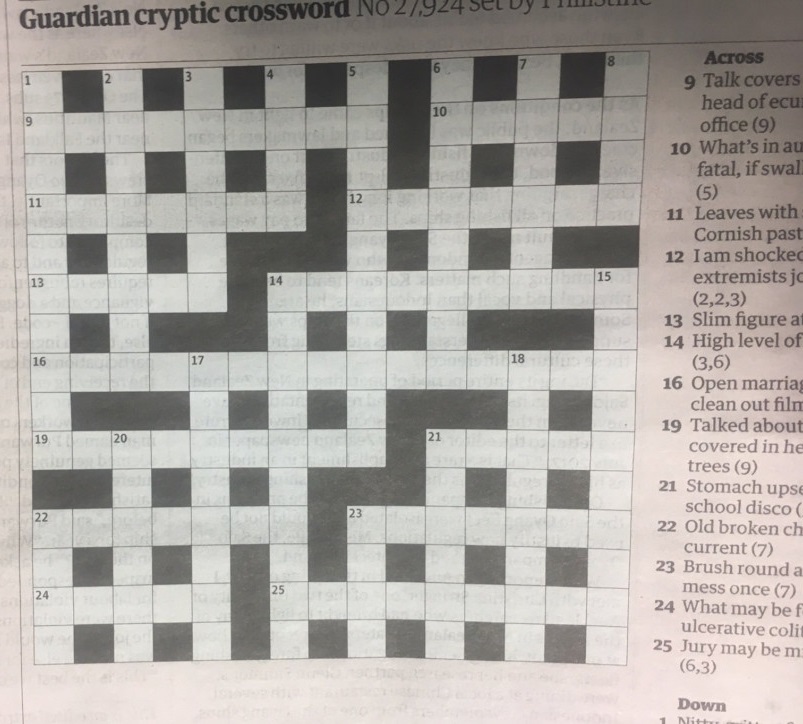
This looks like my scribblings while solving a cryptic… minus the wedding ring, that is.

I’m definitely not the fastest cryptic crossword solver, so I’m not sure I’ll try my hand at this competition… this year. But if it returns next year, I might just shoot my shot.

Cryptic crossword solving involves many of the same skills as American-style crosswords, but there’s also the wordplay element that makes it quite a different experience for those unaccustomed to that puzzly style.

For a good primer on getting into cryptic crosswords, check out this breakdown of cryptic-style cluing from our friends at Penny Dell Puzzles.


Will you be trying your hand at competitive cryptic crossword solving, fellow puzzlers? Let us know in the comments section below, we’d love to hear from you!

5 Questions with Wrestling Commentator (and Crossword Constructor) Dave Bradshaw!

Welcome to 5 Questions, our recurring interview series where we reach out to puzzle constructors, game designers, writers, filmmakers, musicians, artists, and puzzle enthusiasts from all walks of life!

It’s all about exploring the vast and intriguing puzzle community by talking to those who make puzzles and those who enjoy them! (Click here to check out previous editions of 5 Questions!)

And we’re excited to welcome Dave Bradshaw as our latest 5 Questions interviewee!

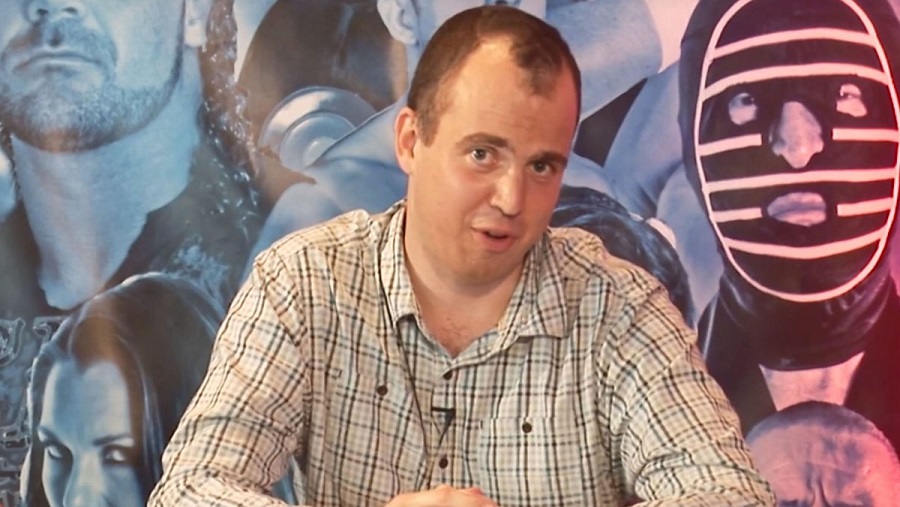
dave bradshaw 1

To many wrestling fans in the UK and around the world — myself included — Dave Bradshaw is the voice of British wrestling. A prolific commentator who has represented companies like New Generation Wrestling, Defiant Wrestling, Wrestle Carnival, and more, Dave calls the in-ring action, keeps the audience informed about the performers and their storylines, and serves as the welcoming committee for new viewers.

In addition to his commentary work, he contributes to outlets like WrestleTalk Magazine, where he recently penned a wonderful piece about the history of LGBTQIA+ performers and representation in wrestling. In an incredibly personal moment, Dave came out in the article, joining an increasingly vocal and influential community of performers in the wrestling business championing LGBTQIA+ representation and mental health awareness.

On a much less impactful but still interesting note, he also started creating wrestling-themed British-style crosswords on Sporcle last year, and as part of a new series of interviews with relatively new constructors and puzzlers, I asked if Dave would take part in 5 Questions.

Dave was gracious enough to take some time out to talk to us, so without further ado, let’s get to the interview!


5 Questions for Dave Bradshaw

1. When and how did your interest in puzzles start?

I’ve always liked puzzles, but to be honest last year they were a bit of a lifesaver. Like so many people I’ve had rough patches with my mental health during the pandemic – for me the worst part was six weeks last summer for some reason, but I became a bit addicted to doing quizzes on Sporcle and it was a welcome distraction in some difficult times.

Also, I learned where every country is on a map of Europe, so that’s cool!

2. What inspired you to start making wrestling trivia crosswords?

One of the things I got into over the summer was crosswords, which for some reason I’d never really liked before, and I noticed that there weren’t many on Sporcle on the subject of pro wrestling, which is what I know the most about. So, having done loads of other people’s puzzles, I decided to try my hand at making my own and see if anyone would be interested.

I literally thought I would get maybe 5 people play the first one, but it was quickly over 500, so I decided to keep going and ended up doing them for 10 weeks in a row, with another series of them planned for later this year, all being well!

dave bradshaw 2

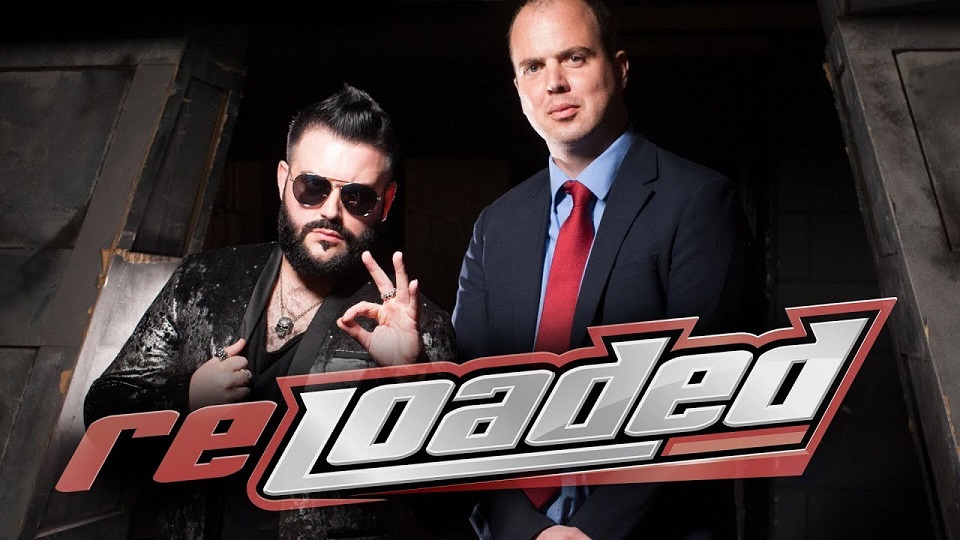
[Dave Bradshaw, alongside James R. Kennedy, presenting
ReLoaded for WCPW. Image courtesy of Defiant Wrestling.]

3. With ten puzzles under your belt now, what did you learn along the way? Are you finding it easier to make them, or does each still present its own challenge?

First I had to learn how to actually use the interface on the website, but that was pretty user-friendly, otherwise I probably would have given up! After the first one or two I started using a technique where I would decide on 4 or 5 long words that I wanted as answers in the grid and slot them in, then try to plot out which of the remaining squares I wanted to contain letters and which I wanted blacked out.

Also, I soon invested in the latest WWE Encyclopedia to give me more inspiration for answers! A few other things helped too – I found a website called http://crosswordsolver.org where I could find words that would fit in whatever gaps I still had – that was kind of essential.

Oh, and I learned that when you narrow your topic, e.g. by doing a crossword on a specific wrestling event rather than just on wrestling in general, it makes it much much harder to create!

4. What’s next for Dave Bradshaw?

As much as I like doing puzzles – and I plan to do more – my first love is being a pro wrestling commentator, and I am desperate for us to get to a point where people are able to congregate indoors again, so that the UK and European wrestling scene can restart!

I’m also doing some written journalism nowadays for WrestleTalk Magazine, including an article in the latest issue where I discuss the history of LGBTQ+ representation in our sport and talk for the first time about my own experiences as a gay man who is both a fan and someone who works in the industry.

I’m keen to be more open and visible with that part of my life, in case my story is useful for others, and the same is true about mental health – I’d like to be helpful to others who have had difficulties with that kind of thing. So hopefully I should be pretty busy, once we finally get out of lockdown!

[In this recent interview with WrestleTalk’s Luke Owen,
Dave discusses his article, coming out, and more!]

5. What’s one piece of advice you would offer fellow solvers, aspiring constructors/setters, and puzzle enthusiasts?

Just try it! I literally got started because I was bored one afternoon, and the next 10 weeks of it were way more fun than I ever anticipated. You’ll also find that you get better at making them as you go, and hopefully you start to develop a bit of a following of people who like to do your quizzes each week, which can be really motivating if people are saying nice things and giving your work high ratings.


A huge thank you to Dave for his time. You can follow him on Twitter for all of his wrestling and social outreach endeavors. Be sure to check out his wrestling trivia puzzles on Sporcle, and please take time out to read his incredible piece on LGBTQIA+ representation in wrestling in WrestleTalk Magazine. I cannot wait to see what he does next.

Thanks for visiting PuzzleNation Blog today! Be sure to sign up for our newsletter to stay up-to-date on everything PuzzleNation!

You can also share your pictures with us on Instagram, friend us on Facebook, check us out on TwitterPinterest, and Tumblr, and explore the always-expanding library of PuzzleNation apps and games on our website!

Crosswords, Cryptics, Constructors, and… Setters?

One of the privileges of writing two or three posts a week for this blog is that it pushes me to expand my own horizons when it comes to puzzles. I reach out to puzzlers, game designers, and pop culture personalities of all sorts; I try out new games and puzzles; I obsessively scour the Internet for new projects, new products, and new stories that involve puzzles.

Oftentimes, that continuous search takes me beyond the borders of the United States, allowing me to explore what puzzles mean to other countries and cultures. And I am forever intrigued by the differences in crossword puzzles between America and the UK.

The world of cryptic crosswords (or British-style crosswords, as some call them) is a bit different from the world of American crosswords. Instead of constructors, they have compilers or setters, and while constructor bylines and attributions were a long time coming on this side of the Atlantic, setters in the UK have been drawing loyal followings for decades, thanks to their unique and evocative pseudonyms.

While Will Shortz, Merl Reagle, Patrick Blindauer, Brendan Emmett QuigleyPatrick Berry, Trip Payne, Matt Gaffney, and Bernice Gordon represent some of the top puzzlers to grace the pages of the New York Times Crossword, names such as Araucaria, Qaos, Arachne, Crucible, Otterden, Tramp, Morph, Gordius, Shed, Enigmatist, and Paul are their word-twisting counterparts featured in The Guardian and other UK outlets.

In fact, beloved setter Araucaria will soon be the subject of a documentary. For more than 50 years, he challenged and delighted cryptic crossword fans, amassing a loyal following. In January of 2013, he even shared his cancer diagnosis with the audience through a puzzle in The Guardian.

While the Wordplay documentary, as well as interviews on PuzzleNation Blog and other sites, have given solvers some insight into the minds and lives of constructors and setters, it’s wonderful to know that the life of a fellow puzzler will be chronicled in so intimate a format.

Thanks for visiting PuzzleNation Blog today! You can share your pictures with us on Instagram, friend us on Facebook, check us out on TwitterPinterest, and Tumblr, and be sure to check out our library of PuzzleNation apps and games!