Demystifying Role-Playing Games

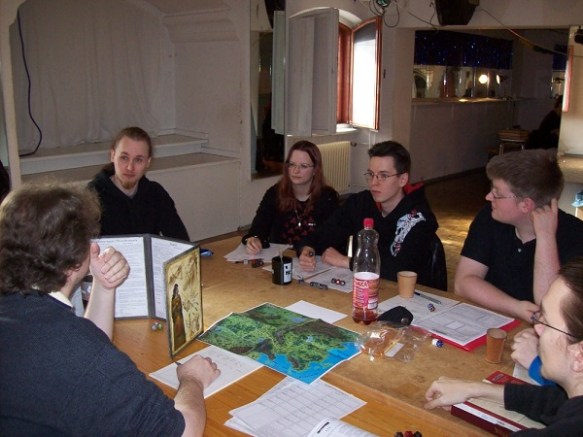
When you hear the words “role-playing game,” what comes to mind? A bunch of nerds in a basement, hunched around a table debating weird and esoteric rules? Practitioners of the black arts, thumbing their noses at God and all that is natural? Or nothing at all?
rpg-2009-berlin-2

Some TV shows, like Community and Freaks & Geeks, have displayed role-playing games in a positive light, but for the most part, role-playing games in general, and Dungeons & Dragons in particular, have gotten a bad rap over the last few decades, maligned as (at best) a game for lonely friendless types and (at worst) a tool to corrupt children.

(This might sound ridiculous to many of you, but folks like Pat Robertson continue to talk about role-playing games as if they’re synonymous with demon worship.)

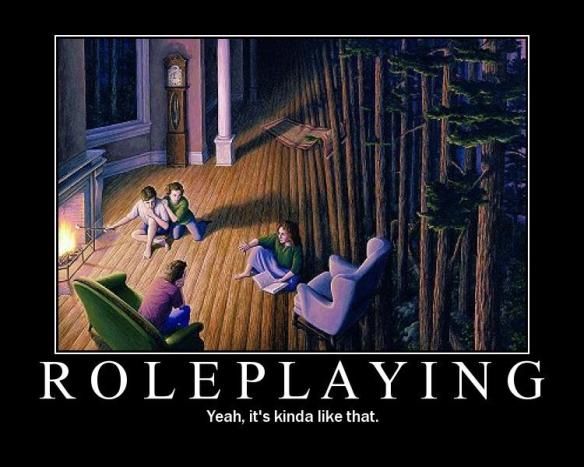
But in reality, role-playing games are simply a way for a group to tell one collaborative story.
roleplaying-kinda-like-that

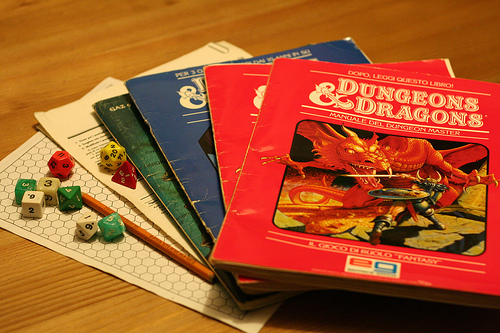
There are two major elements to this storytelling. The first is managed by a single person who oversees that particular game or gaming session. In Dungeons & Dragons, this person is called the Dungeon Master, or DM; in other games, this person is the Game Master, the Storyteller, or bears some other title tied to the game or setting. For the sake of simplicity, from this point on, I’ll refer to this person as the DM.

So, the DM manages the setting and sets up the adventure. In this role, the DM will describe what the player characters (or PCs) see and explain the results of their actions. The DM also plays any characters the players interact with. (These are known as NPCs, or non-player characters.) Essentially, the DM creates the sandbox in which the other players play.
1951073350_7e357dbdec_3

Which brings us to the second element in role-playing storytelling: the players. Each player assumes a role, a character, and plays that character for the length of the session, or the game, if there are multiple sessions. (Some games last months or years, so these characters evolve and grow; players often become quite attached to their characters.)

The PCs navigate the world created by the DM, but their actions and decisions shape the narrative. No matter how prepared a DM is or how carefully he or she has plotted out a given scene or adventure, the PCs determine much of what happens. They might follow the breadcrumbs exactly as the DM laid them out, or they might head off in an unexpected direction, forcing the DM to think on the fly in order to continue the adventure.
dd2

That’s what makes role-playing games so amazing: you never quite know what you’re going to get. The PCs usually don’t know what the DM has in store, and no DM can predict with perfect clarity what the PCs will do. You’re all crafting a story together and none of you knows what exactly will happen or how it all ends.

For instance, I run a role-playing game for several friends that is set in the universe of Buffy the Vampire Slayer, and my PCs routinely come up with solutions to problems and puzzles that I didn’t expect, but that nonetheless would work. They constantly keep me on my toes as a DM, and it’s one of my favorite aspects of the game.

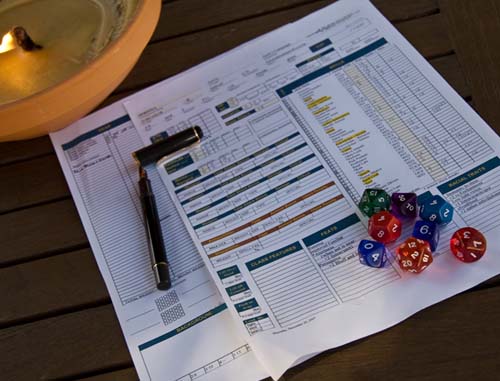
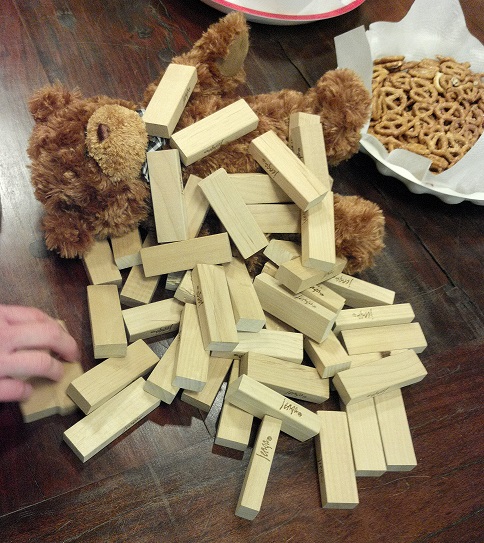
Oftentimes, major events and key moments are determined by dice rolls, adding an element of chance to the story. (In some games, players have replaced dice rolls with a Jenga-style block tower, and they must remove pieces from it to achieve certain goals. That adds a marvelous sense of real-world tension to the narrative tension already present!)
tabletop6

And while I’ve talked quite a bit about the game aspect, some of you might be wondering where the puzzly aspect comes in.

Some of the best, most satisfying puzzle-solving experiences of my life have come from role-playing games.

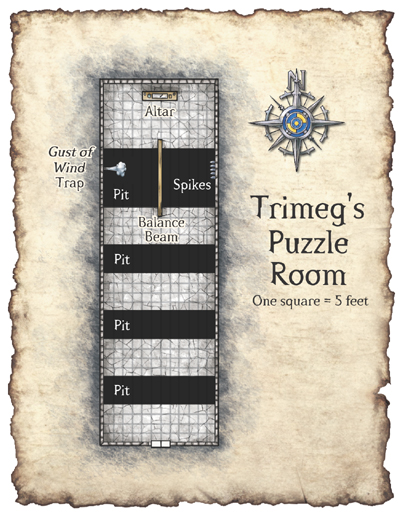
These puzzles can be as simple as figuring out how to open a locked door or as complicated as unraveling a villain’s dastardly plot for world domination. It can be a poem to be parsed and understood or a trap to be escaped.

There are riddles of goblins and sphinxes, or the three questions of trolls, or even the brain teasers and logic problems concocted by devious fey hoping to snare me with clever wordplay. I’ve encountered all sorts of puzzles in role-playing games, and some of them were fiendish indeed.
trimegspuzzleroom

One time, during a LARP session (Live-Action Role-Playing, meaning you actually act out the adventure and storytelling), I thought I’d unraveled the meaning of a certain bit of scripture (regarding a key that would allow me to escape the room) and acquired a sword as my prize, only to realize much much later that the key I’d spent the entire session searching for was the sword itself, which unlocked the door and released me.

And designing puzzles for my players to unravel is often as much fun as solving the puzzles myself. Especially when they’re tailored to specific storytelling universes or particular player characters.

(Trust me, it doesn’t matter if you’re dealing with a Jedi or a paladin; riddles stop pretty much everybody in their tracks.)

b7052aee1c93bff98f4c513e4470fbb6

Whether it’s Dungeons & Dragons or Pathfinder, Legend of the Five Rings or Star Wars, GURPS or Ninja Burger, there’s a role-playing game out there for everyone, if you’re just willing to look.


This post was meant as a brief overview of role-playing games as a whole. If you’d like me to get more in depth on the subject, or if you have specific questions about role-playing games, please let me know! I’d be happy to revisit this topic in the future.

Thanks for visiting PuzzleNation Blog today! Be sure to sign up for our newsletter to stay up-to-date on everything PuzzleNation!

You can also share your pictures with us on Instagram, friend us on Facebook, check us out on TwitterPinterest, and Tumblr, and explore the always-expanding library of PuzzleNation apps and games on our website!

The spooky app no one has solved!

Do Not Believe His Lies.

Sounds ominous, doesn’t it?

It’s the name of an app that has baffled solvers for more than a year with increasingly complex riddles, puzzles, and challenges.

It starts out simply, with the messages “We were expecting you,” “Your journey begins now,” “We await you on the other side,” and “Good luck” in simple white text on an otherwise pitch black screen.

From the very start, it’s an evocative presentation. It sets the mood immediately.

Then the first puzzle starts. You have to find a code word or phrase hidden on the screen (which is easy if your phone or computer’s brightness is turned all the way up.) When you input the code “The first time,” you get the second puzzle, which is in Morse Code and reads “I saw him there.”

The next puzzle was a scrambled grid, similar to the tile-shifting games many puzzlers know. One player inverted the colors, printed out the puzzle, cut it into squares and solved it that way, leading to this solution:

“The first time I saw him there, I was just a child.”

Here’s where the Halloween-appropriate element emerges. Each solution to these puzzles provides part of an ongoing narrative. Later messages include “I have to go now” and “Be careful friend.”

Anagramming, braille, music theory, cryptography, chemistry… as the puzzles increase in difficulty and complexity, they require an ever-growing skill set, challenging users in impressive fashion.

A dedicated community of solvers has come together to tackle the challenge of Do Not Believe His Lies, and they have fought, clawed, collaborated, and ingeniously solved their way to Puzzle #48, which they believe they’ve cracked, but they’re unsure of where to proceed from here.

[Another DNBHL puzzle, apparently a constellation…]

In an update on October 1, one of these diehard solvers posted this:

Welp, as most of you who have stayed logged in to our IRC channel can attest…we are pretty much out of ideas. But I’ll give a quick update for those of you who don’t regularly sign in…

The newest activity we have noticed has been the “Puzzle Solved” counter on the official DNBHL website. It’s not automatically updated, so we know that the Dev has been lurking around still. But whether it’s just a sign of life, or an unintentional “push” to let us know we have everything we need to progress further…none can say.

He goes on to discuss some of the lingering clues they’ve uncovered, as well as the theory that they’ll have to leave “the app and the old puzzles behind,” meaning the game will venture into the real world and involve physical locations!

The general theory going forward seems to be that the next puzzle is somehow time-sensitive, and cannot be solved before December 31. This does support what the app’s designer said in an interview with IO9:

Matablewski says that he does expect people to beat the game…but not anytime soon. “Not this year though, it’s not how it has been designed,” he told me. “If they work together, and only then … they will find the answer and complete the whole riddle someday next year.”

[These wavy words, upon closer inspection, are mathematical formulas. But to what end?]

Although solvers of this diabolical horror-fueled puzzle app are frustrated, they aren’t disheartened. The same diehard solver quoted above concluded his post with this:

So…until we get something a little better to work with, I think we’re all just taking a break…waiting for a Eureka moment to strike. Don’t get too disheartened though…I’m sure all the friends you’ve made on here will jump right back in to the fray as soon as things get busy again.

You can try Do Not Believe His Lies for yourself here. (For other stories on immersive online puzzle experiences, check out my previous posts on Cicada 3301 and the Portal ARG.)


Thanks for visiting PuzzleNation Blog today! Be sure to sign up for our newsletter to stay up-to-date on everything PuzzleNation!

You can also share your pictures with us on Instagram, friend us on Facebook, check us out on TwitterPinterest, and Tumblr, and explore the always-expanding library of PuzzleNation apps and games on our website!

(More Than) 5 Questions: Escape the Room edition!

Welcome to a very special edition of 5 Questions!

Usually, 5 Questions is simply that: five individual questions answered by our guest. But this time around, we’ve ditched the 5 Q format in lieu of a more relaxed, conversational interview. I hope you enjoy!


Escape the Room games started as a video-game phenomenon, but have since moved into the real world with great success as teams are tasked with physically finding clues and solving puzzles in order to escape!

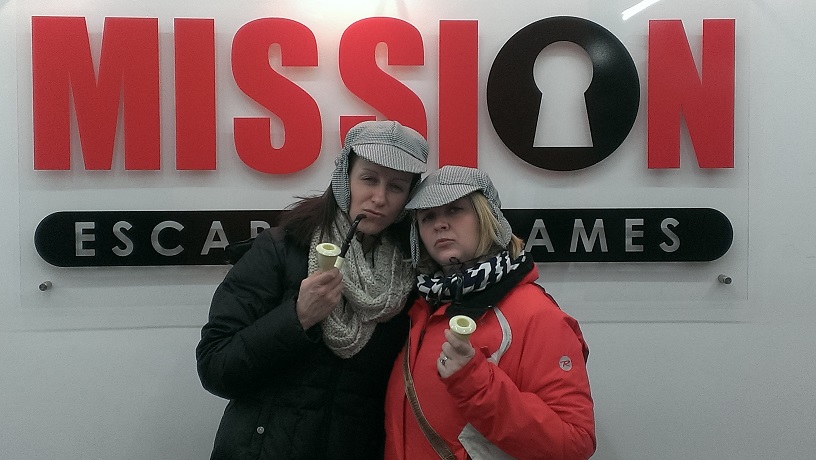
[Darcy, right, poses with another solver, complete with
deerstalker and Meerschaum pipe a la Sherlock Holmes.]

Penny Dell Puzzles social media coordinator (and friend of the blog) Darcy recently tackled the challenge posed by Mission Escape Games, and she was gracious enough to take the time out to answer some questions about this intriguing puzzle-solving experience.

So without further ado, let’s get to it in a very special edition of 5 Questions!


So, Darcy, correct me if I’m wrong, but your friend invited you to be locked in a room with her, with only your wits and cunning to help you both escape within a certain amount of time? How did this come about?

As unfavorable as it may seem, it was actually a birthday gift. My husband bought me tickets to Mission Escape Games in NYC, and we went with a group of friends.

Oh, so how many of you could be in a given escape room? (I’m assuming there is more than one.)

There are a few rooms. We had 9 people in our room. Our group was teamed up with another group to find out what happened to Dr. Jekyll before Mr. Hyde showed up.

All the other rooms have other themes, and the owners try to change up the challenges frequently. That’s so people can keep coming back and playing something fresh, but also so others who have played won’t give away the secrets of how to escape

So your group and another team are all in a room together. What does the room look like? Is there someone there to guide you and answer questions, or are you on your own?

You’re on your own! We were told that we had an hour to escape and to look everywhere — and they mean everywhere — for clues. We walked into a small Victorian-era room with a fireplace and other period props and just started searching. We upended tables, took out drawers, you name it.

Many clues didn’t make sense at first, but as the game progressed, we realized every clue was there for a reason. There was also a small TV screen in the corner of the room that very ominously counted down your time.

But as we found out, the TV screen served a dual purpose. We had someone watching us the entire time who would provide clues, if necessary, through the screen.

Can you give us an example of some of the clues you found, and how they made more sense as the game progressed?

Not to give too much away, but we found a key that seemed to have no relevance at first, since it didn’t open the only door in the room. We soon discovered our little room was not as small as it seemed.

Most clues turned out to be more than they seemed at first. There were a lot of puzzles solved by trying to find out what was missing, rather than where something was hiding.

You said that the people running the game could give you clues through the television. Could you elaborate on that?

If we got stuck, we could ask for a hint. At one point, we were all standing over a chess board, befuddled because we knew it needed to come into play, we just didn’t know how. After discussing chess moves for a while, the TV screen showed us a poem using the words “King,” “Queen,” and “Knight.”

This reminded us that much earlier, we had found a deck of cards, so we knew that the deck of cards and the chess board were both necessary to solving that part of the puzzle.

How long did you have to escape?

One hour.

And did you?

Technically, no. But we came so close, our “handler” gave us an extra two minutes to finish.

Do you feel like a bigger or smaller group would have helped more?

You know, at first I wasn’t so sure about working with complete strangers, but by the end of the mission, I felt that every single person contributed in some way.

In my case, the more people present, the more knowledge brought to the table. For instance, I’m terrible with numbers, but others in the group used their very strong math skills to keep us afloat. My strength is in brain teasers and optical illusions, so I could help identify some of the riddles and visual tricks.

So you would definitely go again?

Absolutely! We had such a good time! We made new friends and, despite not escaping in time, we still felt very proud of ourselves.


Many thanks to Darcy for her time and her story about Mission Escape Games! You can check out her social media skills on the Facebook and Twitter accounts for Penny Dell Puzzles!

Thanks for visiting PuzzleNation Blog today! Be sure to sign up for our newsletter to stay up-to-date on everything PuzzleNation!

You can also share your pictures with us on Instagram, friend us on Facebook, check us out on TwitterPinterest, and Tumblr, and explore the always-expanding library of PuzzleNation apps and games on our website!

A pickle of a puzzler!

A little touch of absurdity never hurts when it comes to a good logic problem or brain teaser.

There’s the classic river-crossing puzzle (with either a fox, a goose, and a bag of beans and or a wolf, a goat, and a cabbage) that challenges you to get all three across without one eating one of the others, but it never explains why you have a wolf or a fox in the first place!

We never really question why we need to know the weights of castaways or why knowing the color of your hat might save your life; we just accept the parameters and forge onward.

Some brain teasers, curiously enough, seem intentionally nonsensical by design. Many claim that Lewis Carroll’s famous Alice in Wonderland riddle “Why is a raven like a writing-desk?” was created without a solution. Of course, that hasn’t stopped many (myself included) from posing solutions to the riddle anyway.

And that brings us to today’s brain teaser — “Pickled Walnuts” by Hubert Phillips — which I discovered on io9.com:

You are given a series of statements which may seem to you more or less absurd. But, on the assumption that these statements are factually correct, what conclusion (if any) can be drawn?

1. Pickled walnuts are always provided at Professor Piltdown’s parties.
2. No animal that does not prefer Beethoven to Mozart ever takes a taxi in Bond Street
3. All armadillos can speak the Basque dialect.
4. No animal can be registered as a philatelist who does not carry a collapsible umbrella.
5. Any animal that can speak Basque is eligible for the Tintinnabulum Club.
6. Only animals that are registered philatelists are invited to Professor Piltdown’s parties.
7. All animals eligible for the Tintinnabulum Club prefer Mozart to Beethoven.
8. The only animals that enjoy pickled walnuts are those who get them at Professor Piltdown’s.
9. Only animals that take taxis in Bond Street carry collapsible umbrellas.

I will tell you, as a starter, that a conclusion CAN definitively be drawn from these statements. (Honestly, if there wasn’t some solution, I wouldn’t waste your time with it.)

So, what conclusion can be drawn from these statements?

Armadillos do not enjoy pickled walnuts!

How do I know this for sure? Allow me to walk you through my deductive process.

We know that all armadillos speak Basque, according to statement 3. Therefore, according to statement 5, armadillos are eligible for the Tintinnabulum Club.

Now, according to statement 7, armadillos prefer Mozart to Beethoven. But, in statement 2, we’re told that no animal that does not prefer Beethoven to Mozart ever takes a taxi in Bond Street, which means that armadillos do NOT take taxis in Bond Street.

Therefore, according to statement 9, armadillos do not carry collapsible umbrellas, which also disqualifies them from being registered as philatelists, according to statement 4. And since only registered philatelists are invited to Professor Piltdown’s parties (according to statement 6), armadillos are not invited to the Professor’s parties.

Finally, statement 8 tells us that the only animals that enjoy pickled walnuts are those who get them at Professor Piltdown’s, which means armadillos do not enjoy pickled walnuts!

Honestly, I didn’t find this brain teaser particularly difficult because you can find those middle links very quickly, and by linking more and more statements, you eventually find the two ends — armadillos and pickled walnuts — and your conclusion is waiting for you.

This would’ve been a more difficult puzzle if some red-herring statements were thrown in that didn’t connect to the rest, like “All squirrels on Beaumont Avenue have Tuesdays off” or “The birdbaths on Bond Street were designed by a German sculptor who enjoyed hot dogs.”

Nonetheless, this is a terrific exercise in finding order in what at first appears to be chaos. It’s what puzzlers do: we make sense of the universe, one puzzle at a time.


Thanks for visiting PuzzleNation Blog today! Be sure to sign up for our newsletter to stay up-to-date on everything PuzzleNation!

You can also share your pictures with us on Instagram, friend us on Facebook, check us out on TwitterPinterest, and Tumblr, and explore the always-expanding library of PuzzleNation apps and games on our website!

It’s Follow-Up Friday: Rubik’s Magic edition!

Welcome to Follow-Up Friday!

By this time, you know the drill. Follow-Up Friday is a chance for us to revisit the subjects of previous posts and bring the PuzzleNation audience up to speed on all things puzzly.

And today I’d like to return to the subject of puzzle magic!

Oh yes, puzzle magic is most definitely a thing. Arguably the most famous practitioner is friend of the blog and crossword constructor David Kwong, who not only contributes both puzzles and magic to television shows and film projects, but has created some truly mindblowing magic tricks involving puzzles.

The other night, I was watching Penn and Teller: Fool Us, a show where magicians and performers from all around the world present their best tricks, illusions, and bits of magical wizardry to try and stump the famous duo. And lo and behold, another master of puzzle magic appeared!

But where David Kwong works his magic with crosswords, Steven Brundage uses a different puzzly tool: Rubik’s Cubes.

Check out this video where he dazzles Penn and Teller with several quick solves and feats of puzzly manipulation:

That behind-the-back trick was pretty fantastic, wasn’t it? You can check out more of Steven’s magic on his YouTube page! And let me know if you’ve seen any other acts of puzzle magic! I’d love to check them out!


Thanks for visiting PuzzleNation Blog today! Be sure to sign up for our newsletter to stay up-to-date on everything PuzzleNation!

You can also share your pictures with us on Instagram, friend us on Facebook, check us out on TwitterPinterest, and Tumblr, and explore the always-expanding library of PuzzleNation apps and games on our website!
A ten-digit brain teaser to melt your mind!

I’ve started to develop a reputation as something of a brain-teaser pro, given some of the beastly brain teasers we’ve featured on the blog over the last few months.

And, as such, I’ve started to receive brain teasers from friends and fellow puzzlers, challenging me to unravel them AND explain my methods to the PuzzleNation audience.

I’ve never been one to shirk a challenge, so here we go! This puzzle is entitled Mystery Number, and a little googling after solving it reveals it most likely came from this Business Insider link. (Although their solution is slightly flawed.)

Enjoy!


There is a ten-digit mystery number (not starting with zero) represented by ABCDEFGHIJ, where each numeral, 0 through 9, is used once. Given the following clues, what is the number?

1. A + B + C + D + E = a multiple of 6.
2. F + G + H + I + J = a multiple of 5.
3. A + C + E + G + I = a multiple of 9.
4. B + D + F + H + J = a multiple of 2.
5. AB = a multiple of 3.
6. CD = a multiple of 4.
7. EF = a multiple of 7.
8. GH = a multiple of 8.
9. IJ = a multiple of 10.
10. FE, HC, and JA are all prime numbers.

(And to clarify here for clues 5 through 9, AB is a two-digit number reading out, NOT A times B.)


[Image courtesy of Wikipedia.]

Now, anyone who has solved Kakuro or Cross Sums puzzles will have a leg up on other solvers, because they’re accustomed to dealing with multiple digits adding up to certain sums without repeating numbers. If they see three boxes (which would essentially be A + B + C) and a total of 24, they know that A, B, and C will be 7, 8, and 9 in some order.

[For those unfamiliar with Cross Sums or Kakuro solving, feel free to refer to this solving aid from our friends at Penny/Dell Puzzles, which includes a terrific listing of possible number-combinations that will definitely prove useful with this brain teaser.]

And since the digits 0 through 9 add up to 45, that provides a valuable starting hint for clues 1 and 2 (in which all 10 digits appear exactly once). A multiple of 6 (6, 12, 18, 24, 30, 36, 42) plus a multiple of 5 (5, 10, 15, 20, 25, 30, 35, 40, 45) will equal 45. And there’s only one combination that works.

So A + B + C + D + E must equal 30, and F + G + H + I + J must equal 15.

The same logic applies to clues 3 and 4 (in which all 10 digits appear exactly once). A multiple of 9 (9, 18, 27, 36, 45) plus a multiple of 2 (2, 4, 6, 8, 10, etc.) will equal 45. And there’s only one combination that works.

So A + C + E + G + I must equal 27, and B + D + F + H + J must equal 18.

And now, we jump to clue 9. Since IJ is a multiple of 10, and all multiples of 10 end in 0, we know J = 0.

This tells us something about JA in clue 10. J is 0, which means A can only be 2, 3, 5, or 7.

There may a quicker, more deductive manner of solving this puzzle, but I couldn’t come up with it. I went for a brute force, attrition-style solve.

So I wrote out all of the possibilities for clues 5 through 9, and began crossing them off according to what I already knew. Here’s what we start with:

AB = 12, 15, 18, 21, 24, 27, 30, 33, 36, 39, 42, 45, 48, 51, 54, 57, 60, 63, 66, 69, 72, 75, 78, 81, 84, 87, 90, 93, 96, 99
CD = 12, 16, 20, 24, 28, 32, 36, 40, 44, 48, 52, 56, 60, 64, 68, 72, 76, 80, 84, 88, 92, 96
EF = 14, 21, 28, 35, 42, 49, 56, 63, 70, 77, 84, 91, 98
GH = 16, 24, 32, 40, 48, 56, 64, 72, 80, 88, 96
IJ = 10, 20, 30, 40, 50, 60, 70, 80, 90

Now, we can remove any double numbers like 33 because we know each letter represents a different number.

AB = 12, 15, 18, 21, 24, 27, 30, 36, 39, 42, 45, 48, 51, 54, 57, 60, 63, 69, 72, 75, 78, 81, 84, 87, 90, 93, 96
CD = 12, 16, 20, 24, 28, 32, 36, 40, 48, 52, 56, 60, 64, 68, 72, 76, 80, 84, 92, 96
EF = 14, 21, 28, 35, 42, 49, 56, 63, 70, 84, 91, 98
GH = 16, 24, 32, 40, 48, 56, 64, 72, 80, 96
IJ = 10, 20, 30, 40, 50, 60, 70, 80, 90

[Sorry guys, you’re out.]

And we know that J = 0, so we can remove any numbers that end in zero for AB, CD, EF, and GH.

AB = 12, 15, 18, 21, 24, 27, 36, 39, 42, 45, 48, 51, 54, 57, 63, 69, 72, 75, 78, 81, 84, 87, 93, 96
CD = 12, 16, 24, 28, 32, 36, 48, 52, 56, 64, 68, 72, 76, 84, 92, 96
EF = 14, 21, 28, 35, 42, 49, 56, 63, 84, 91, 98
GH = 16, 24, 32, 48, 56, 64, 72, 96
IJ = 10, 20, 30, 40, 50, 60, 70, 80, 90

And for AB, we know that A can only be 2, 3, 5, or 7, so we can delete any numbers that don’t start with one of those four digits.

AB = 21, 24, 27, 36, 39, 51, 54, 57, 72, 75, 78
CD = 12, 16, 24, 28, 32, 36, 48, 52, 56, 64, 68, 72, 76, 84, 92, 96
EF = 14, 21, 28, 35, 42, 49, 56, 63, 84, 91, 98
GH = 16, 24, 32, 48, 56, 64, 72, 96
IJ = 10, 20, 30, 40, 50, 60, 70, 80, 90

Hmmm, that’s still a LOT of options. What else do we know?

Well, we know from clue 10 that FE and HC are prime numbers. So they can’t be even numbers OR end in a 5. So we can eliminate any options from CD and EF that begin with an even number or a 5.

AB = 21, 24, 27, 36, 39, 51, 54, 57, 72, 75, 78
CD = 12, 16, 32, 36, 72, 76, 92, 96
EF = 14, 35, 91, 98
GH = 16, 24, 32, 48, 56, 64, 72, 96
IJ = 10, 20, 30, 40, 50, 60, 70, 80, 90

Alright, now we need to look at those big addition formulas again. Specifically, we need to look at B + D + F + H + J = 18.

We know J = 0, so the formula becomes B + D + F + H = 18. Now, take a look at our lists of multiples for AB, CD, EF, and GH. Look at the second digit for each. There’s a little nugget of information hiding inside there.

Every D and H digit is an even number. Which means that B and F must either both also be even, or both be odd in order to make an even number and add up to 18.

But, wait, if they were both even, then they would use all of our even numbers, and some combination of B, D, F and H would be 2 + 4 + 6 + 8, which equals 20. That can’t be right!

So let’s delete any even numbered options from AB and EF.

AB = 21, 27, 39, 51, 57, 75
CD = 12, 16, 32, 36, 72, 76, 92, 96
EF = 35, 91
GH = 16, 24, 32, 48, 56, 64, 72, 96
IJ = 10, 20, 30, 40, 50, 60, 70, 80, 90

Okay, we’ve whittled down EF to 2 possibilities: 35 and 91. [Here is where the Business Insider solution goes awry, because they never eliminate one of these two options.]

Clue 10 tells us that FE is a prime number, but that doesn’t help, because both 53 and 19 are prime. So now what?

Let’s return to those starting formulas.

We know that A + B + C + D + E = 30, and our handy-dandy number-combination listing tells us there are six possible ways that five digits can add up to 30: 1-5-7-8-9; 2-4-7-8-9; 2-5-6-8-9; 3-4-6-8-9; 3-5-6-7-9; and 4-5-6-7-8.

Look at the possibilities for A, B, C, D, and E according to our work thus far:

AB = 21, 27, 39, 51, 57, 75
CD = 12, 16, 32, 36, 72, 76, 92, 96
EF = 35, 91

There’s not a single 8 in any of those pairings! And five of our six possible answers for A + B + C + D + E = 30 include an 8 as one of the five digits.

Therefore, 3-5-6-7-9 and A-B-C-D-E match up in some order.

EF is either 35 or 91, but with both 3 and 5 counted among the letters in A-B-C-D-E, EF cannot be 35, so EF is 91. Let’s eliminate any option for AB, CD, GH, or IJ that include 9 or 1.

AB = 27, 57, 75
CD = 32, 36, 72, 76
EF = 91
GH = 24, 32, 48, 56, 64, 72
IJ = 20, 30, 40, 50, 60, 70, 80

Because E = 9, that leaves 3, 5, 6, and 7 as the only possible digits available for A, B, C, and D. So let’s eliminate any combinations that use numbers other than those four.

AB = 57, 75
CD = 36, 76
EF = 91
GH = 24, 32, 48, 56, 64, 72
IJ = 20, 30, 40, 50, 60, 70, 80

We can also eliminate any combinations for GH and IJ that include those four numbers.

AB = 57, 75
CD = 36, 76
EF = 91
GH = 24, 48
IJ = 20, 40, 80

Since our only possibilities for AB use 5 and 7 in some order, CD cannot be 76, so it must be 36.

AB = 57, 75
CD = 36
EF = 91
GH = 24, 48
IJ = 20, 40, 80

So, here are our options at this point:

AB = 57, 75
CD = 36
EF = 91
GH = 24, 48
IJ = 20, 40, 80

All possible solutions for GH include the number 4, so we can delete 40 as a possibility for IJ.

AB = 57, 75
CD = 36
EF = 91
GH = 24, 48
IJ = 20, 80

Let’s look at those formulas one more time. We know A + C + E + G + I = 27.

We also know C = 3 and E = 9, so A + G + I = 15. And the only combination of available digits that allows for that is 5, 2, and 8, meaning AB = 57, GH = 24, and IJ = 80.

So ABCDEFGHIJ = 5736912480.


I don’t think I’ve tackled a puzzle this tough since the seesaw brain teaser!

Thanks for visiting PuzzleNation Blog today! You can share your pictures with us on Instagram, friend us on Facebook, check us out on TwitterPinterest, and Tumblr, and be sure to check out the growing library of PuzzleNation apps and games!