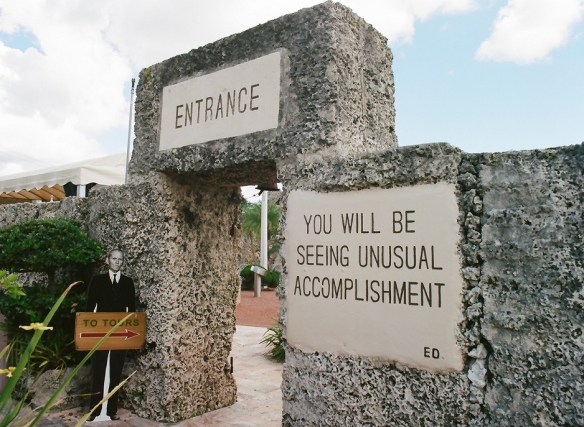
The Strange Mystery of Florida’s Coral Castle

coral castle entrance

[Image courtesy of Bitter Southerner.]

At the center of every great mystery, there is a puzzle. When people look at the pyramids of Egypt or the Moai statues of Easter Island, the puzzle at heart is obvious: how? How were these incredible objects created?

A similar, and no less puzzling mystery, can be found much closer to home for most Americans: the Coral Castle of Florida.

The-Coral-Castle-14

[Image courtesy of The Bohemian Blog.]

Less a castle and more a varied arrangement of stones into walls, shapes, doorways, and more, the Coral Castle is composed not of coral, but of oolite limestone blocks weighing literal tons. More than 1,000 tons of rock are part of the Coral Castle’s elaborate layout, which was assembled and expanded from 1923 to 1951.

Some of those monstrous stones are seamlessly joined into different structures. Others are so perfectly balanced that they can open like a revolving door with the gentlest push.

There is a sundial, a telescope, and even stone rocking chairs carved from single pieces of rock.
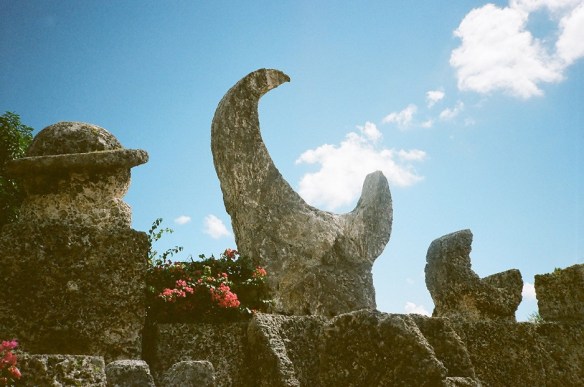
coral castle moon

[Image courtesy of Bitter Southerner,]

It’s an engineering marvel, to be sure, but what separates the Coral Castle from some of those other creations we mentioned above is the fact that we know who built the Coral Castle.

One man. Ed Leedskalnin.

coral castle tools

[Image courtesy of LiveScience.]

Using basic tools like picks, winches, ropes, and pulleys, Leedskalnin created the Coral Castle in secret, allowing visitors to ponder just how he was accomplishing this remarkable feat.

It’s particularly remarkable when you consider that Leedskalnin only had a fourth-grade education, having gone to work at a young age.
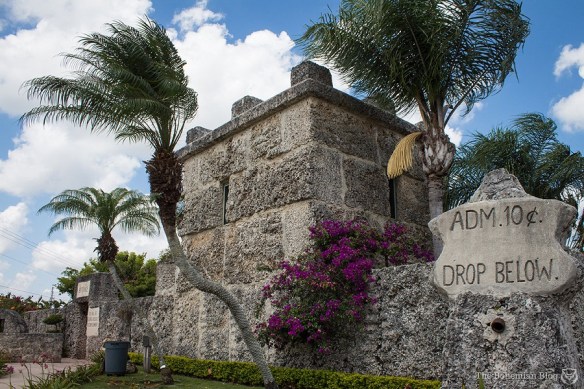
The-Coral-Castle-3

[Image courtesy of The Bohemian Blog.]

Of course, it’s also worth noting that Leedskalnin was a bit of a kook, claiming he had learned the secrets of the architects of King Solomon’s temples by studying books about the pyramids at the local library.

And yet, he created something amazing. So amazing, in fact, many people attribute the Coral Castle to supernatural efforts, not merely the engineering prowess, cleverness, and determination of a hardworking man.
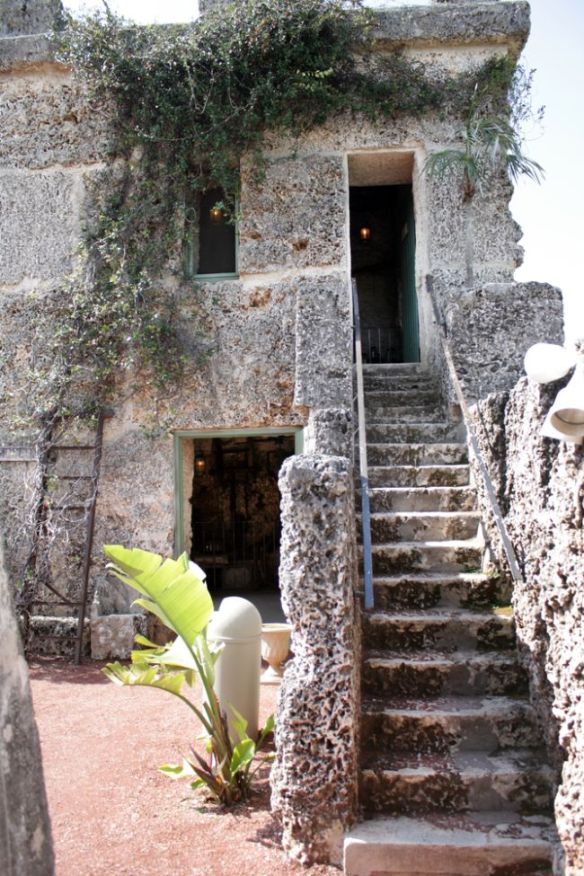
coral castle stairs

[Image courtesy of LiveScience.]

Over the years, many peculiar theories have circulated surrounding the Coral Castle and Ed Leedskalnin. Unreliable eyewitnesses claimed to see coral blocks floating in the air like balloons while Leedskalnin worked at night.

Some believe Leedskalnin levitated the blocks with telekinesis or psychic powers, or by singing the stones into place. Others attribute the Castle to some sort of strange manipulation of gravity, antigravity, magnetism, ley lines, or earth energies. And, of course, alien technology has been floated as a possibility as well.

(Some people even believe there’s a hidden cipher lurking in several tracts written by Leedskalnin, just waiting to be found to reveal his secrets.)
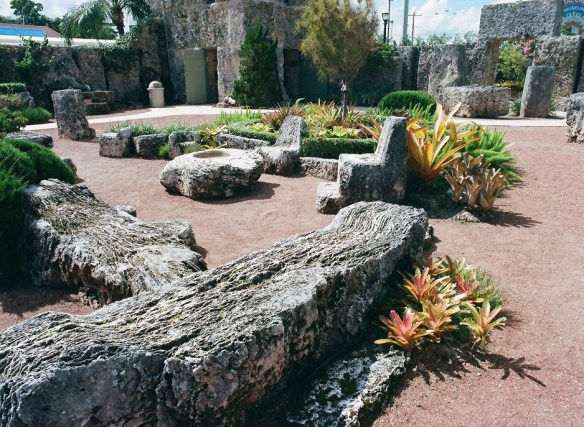
coral castle chairs

[Image courtesy of Bitter Southerner.]

A friend of Leedskalnin’s wrote a book about the physics and engineering of the Coral Castle, entitled Mr. Can’t Is Dead. It’s one of many books that claims to explain how the Coral Castle came to be.

To me, the Coral Castle seems like one giant mechanical brain teaser, a math problem more about leverage and patience than the paranormal.

And yet, I can’t help but stare at some of these creations with awe. Maybe this one of those puzzles that’s better left unsolved.

The-Coral-Castle-1

[Image courtesy of The Bohemian Blog.]


Thanks for visiting PuzzleNation Blog today! Be sure to sign up for our newsletter to stay up-to-date on everything PuzzleNation!

You can also share your pictures with us on Instagram, friend us on Facebook, check us out on TwitterPinterest, and Tumblr, and explore the always-expanding library of PuzzleNation apps and games on our website!
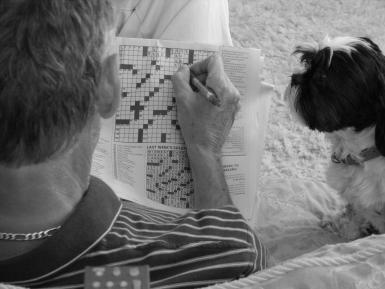
The New York Times Crossword Now Accepts Online Submissions!

Photo by Matt MacGillivray, licensed via Creative Commons

There’s good news for aspiring and established crossword constructors out there, as The New York Times crossword is now accepting online submissions.

I could be cynical and say it’s about time for a change like this, given that The Los Angeles Times has been accepting online submissions for at least a decade now, and many of the other major outlets made the transition well before 2020.

But I won’t. This is a moment worth celebrating.

True, it was inevitable that the Times would move in this direction. I don’t know if the tipping point was the pandemic, given how many other companies and businesses have been forced to adapt to a paperless/lower-contact way of doing business, or if the department was simply following a directional shift the industry had already taken.

But I’m glad they have. This may seem like a relatively small change, but it’s significant for several reasons.

1.) It’s simply easier

People send emails, attach documents, and share files every day. How often do you hit the post office?

2.) Electronic submission encourages younger solvers to get involved

New blood is a necessity for any industry, crosswords included, and when the standard-bearer makes a shift toward inclusivity (even if it’s just a matter of technological familiarity), it’s a step in the right direction.

3.) Electronic submission helps level the playing field

Having to mail submissions has a price attached, through envelopes, paper, and postage, whereas electronic submissions don’t. Yes, the price of crossword construction programs is still a hindrance, limiting access to some, but again, this is a step in the right direction.

The submission page is loaded with information, including specs on puzzles, file formats for submission, and the submission form itself.

Plus NYT-savvy constructors and staff like Joel Fagliano have already posted answers online to Frequently Asked Questions in forums like the Crossword Puzzle Collaboration Directory, and have offered to answer any other questions constructors have.

Hopefully this change means not only an influx of new talent, but greater accessibility for underrepresented groups in crosswords.


Thanks for visiting PuzzleNation Blog today! Be sure to sign up for our newsletter to stay up-to-date on everything PuzzleNation!

You can also share your pictures with us on Instagram, friend us on Facebook, check us out on TwitterPinterest, and Tumblr, and explore the always-expanding library of PuzzleNation apps and games on our website!
Game Conventions Moving Online Soon! *UPDATE*

UPDATE: We have removed all information regarding the Origins Online event in solidarity with the mass outpouring of support for POC and other marginalized voices, in the wake of GAMA’s lack of response to the recent protests.


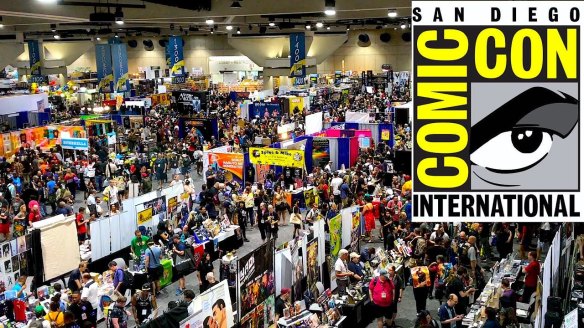
san diego comic con

[Image courtesy of coolduder.]

Although some businesses and public spaces are beginning to open up, there’s no denying that the coronavirus is still having a devastating effect on large public gatherings.

For example, San Diego Comic Con, one of the premiere destination events for film, TV, and comic book fandom, is trying to figure out how to move the convention, or some significant aspect of it, online. But with so many participants and vendors to wrangle into some shared virtual space, things aren’t looking good for one of the biggest events on the entertainment calendar.

Maybe they can take a few pointers from the puzzle and game industry, because it seems like those fields are way ahead.

Not only did crossword fans get to enjoy Crossword Tournament From Your Couch back in March, but several gaming conventions are moving online in the hopes of bringing fans together and salvaging at least part of the year’s usual revelry and profit.

PaizoConOnline 2

Over Memorial Day weekend, the team at Paizo are hosting PaizoCon Online, a celebration of roleplaying games under the Paizo banner!

Six days of gaming — spanning May 26th through May 31st — allow for fans to stay safe at home as they play Pathfinder and Starfinder games.

If you’re looking to explore some D&D-style fun, either as an experienced player or a newcomer, click here to check out the full details on PaizoCon Online!

renegade con

And not long after that, the team at Renegade Game Studios is hosting Renegade Con: Virtual Edition.

Running from Friday, June 5th, to Sunday, June 7th, this free event (just sign up here!) brings together digital demos of new Renegade games, workshops, and panels featuring game designers and artists!

Everyone who signs up for a free ticket will have access to:

  • Shop the convention specials during the event
  • Get into free panels and workshops including The State of Renegade where we’ll talk about future projects on the horizon!
  • Demo upcoming and new games!

Several of these events are also serving as fundraisers for various companies and event organizers that have suffered losses during the pandemic — including the Con of Champions fundraiser this weekend for Tabletop Events — so if you want to support the games industry, be sure to sign up and check out one of these events.

Maybe the folks at San Diego Comic Con will do so as well and pick up a trick or two along the way.


Thanks for visiting PuzzleNation Blog today! Be sure to sign up for our newsletter to stay up-to-date on everything PuzzleNation!

You can also share your pictures with us on Instagram, friend us on Facebook, check us out on TwitterPinterest, and Tumblr, and explore the always-expanding library of PuzzleNation apps and games on our website!

A Conway Puzzle Solution (And Some Hints for the Other Puzzle)

John_H_Conway_2005_(cropped)

Two weeks ago, in honor of mathematician and puzzly spirit John Horton Conway, we shared two of his favorite brain teasers and challenged our fellow PuzzleNationers.

So today, we happily share the solution for puzzle #1, The Miracle Builders.

I had a window in the north wall of my house. It was a perfect square, 1 meter wide and 1 meter high. But this window never let in enough light. So I hired this firm, the Miracle Builders, who performed the impossible. They remodeled the window so it let in more light. When when they’d finished the window was a perfect square, 1 meter high and 1 meter wide.

How did they do it?

Both windows are perfect squares, 1 meter wide and 1 meter high. So how can there be a difference in the amount of light?

The trick of this puzzle is in the description. Although the original window was a perfect square, the dimensions of the square aren’t 1 meter by 1 meter. No, it was a square placed like a diamond, with one corner directly above its opposite. So the 1 meter dimensions were the diagonals, not the sides.

All the Miracle Builders had to do was build a square window in the usual arrangement (two sides horizontal, two sides vertical) with dimensions of 1 meter by 1 meter. That creates a larger window (with a diagonal of √2m) and allows more light.

Very tricky indeed.


We had several solvers who successfully cracked the Miracle Builders puzzle, but there was less success with puzzle #2, The Ten Divisibilities.

So, in addition to the original puzzle, we’re going to post some solving hints for those intrepid solvers who want another crack at the puzzle.

The Ten Divisibilities

I have a ten digit number, abcdefghij. Each of the digits is different, and:

  • a is divisible by 1
  • ab is divisible by 2
  • abc is divisible by 3
  • abcd is divisible by 4
  • abcde is divisible by 5
  • abcdef is divisible by 6
  • abcdefg is divisible by 7
  • abcdefgh is divisible by 8
  • abcdefghi is divisible by 9
  • abcdefghij is divisible by 10

What’s my number?

[To clarify: a, b, c, d, e, f, g, h, i, and j are all single digits. Each digit from 0 to 9 is represented by exactly one letter. The number abcdefghij is a ten-digit number whose first digit is a, second digit is b, and so on. It does not mean that you multiply a x b x c x…]

Here’s a few hints that should help whittle down the possibilities for any frustrated solvers:

-If you add all the digits in a number, and the total is divisible by 3, then that number is also divisible by 3.
-If the last two digits of a number are divisible by 4, then that number is divisible by 4.
-If the last three digits of a number are divisible by 8, then that number is divisible by 8.

Good luck, and happy puzzling!


Thanks for visiting PuzzleNation Blog today! Be sure to sign up for our newsletter to stay up-to-date on everything PuzzleNation!

You can also share your pictures with us on Instagram, friend us on Facebook, check us out on TwitterPinterest, and Tumblr, and explore the always-expanding library of PuzzleNation apps and games on our website!
Famous Director Stumbles Into Trivia Trap!

pub-trivia-750-x-340

[Image courtesy of Buzztime.]

It’s no secret that I love trivia. I enjoy bar and pub trivia nights, I compete in an online trivia league (Learned League), and I’ve served as a quizmaster myself. I delight in slipping trivia into puzzles — from encrypted content to tricky crossword clues — and I happily peruse trivia books whenever I find them.

Recently I was reminded of one of my favorite trivia stories, and I thought I’d share that story with you today.

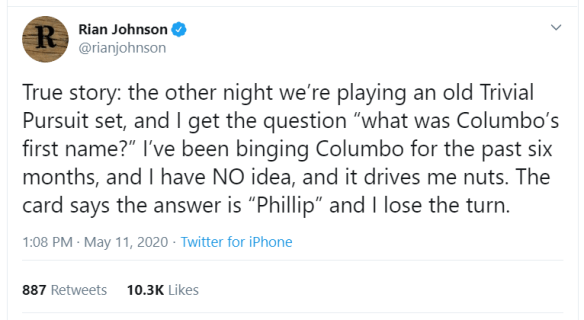
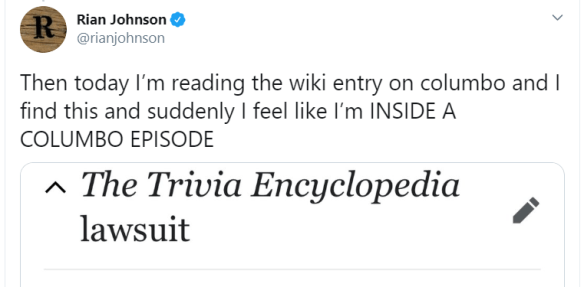
It all starts with a few tweets by filmmaker Rian Johnson, director of Brick, Looper, Star Wars: The Last Jedi, and Knives Out.

rian johnson 1

rian johnson 2

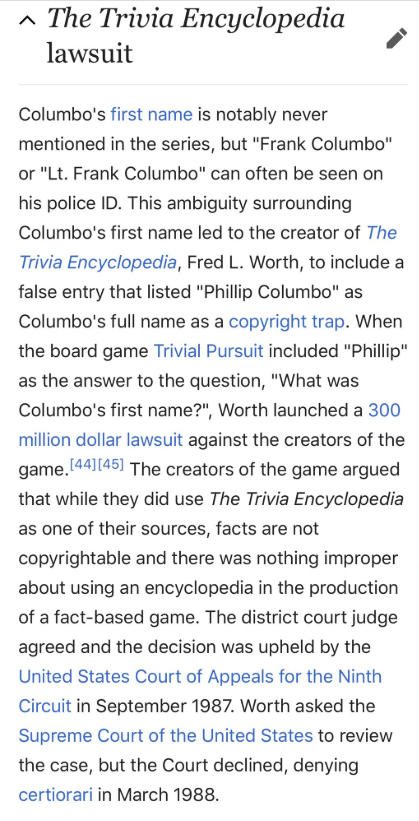
He then shared this text from Wikipedia:

rian johnson 3

Yes, as many fans and readers had commented, keen-eyed Columbo viewers had discovered the name “Frank” on Columbo’s ID, but the famous detective’s first name was never spoken or mentioned onscreen.

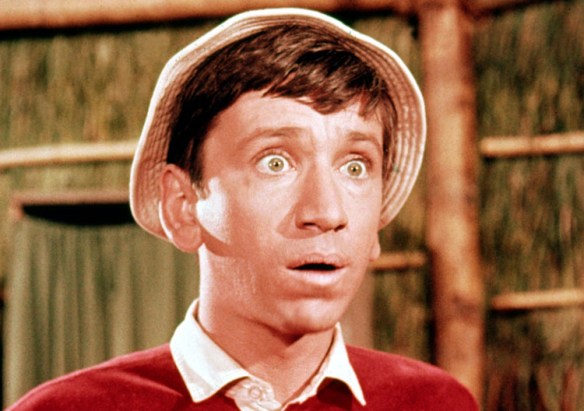
I had encountered a similar problem with a trivia game years ago that asked for the first name of the character Gilligan from the TV show Gilligan’s Island. I had no idea, and got the question wrong.

But as it turns out, Willy, Gilligan’s first name, was never mentioned on the show. The show’s creator always envisioned the character with that name, but it was never officially canon. (Bob Denver, who played Gilligan on the show, often joked that the character’s name was actually Gil Egan, but it ran together when yelled, as it so often was.)

GilligansIsland_74.jpg

[Image courtesy of Gilligan’s Island Wiki.]

As far as I know, the Gilligan error was simply that, a mistake. But the Columbo error, as mentioned in the Wikipedia article, is an example of a copyright trap.

A copyright trap is an intentionally false, seemingly trivial piece of information in a larger work, intended to help demonstrate plagiarism if the larger work is ever stolen or copied. (After all, anyone who had done their own research would have discovered it was incorrect and left it out, or at the very least, not included it as part of a wholesale act of plagiarism.)

And the more you learn about copyright traps, the more ridiculous and intricate they become.

There have been:

  • false cities (aka paper towns) on maps, like Agloe, New York, and the paired cities of Beatosu and Goblu in Ohio, as well as trap streets, fake mountain peaks, and more
  • false dictionary entries (like esquivaliance in the second edition New Oxford American Dictionary)
  • false encyclopedia entries (like the story of a photographer named Lillian Mountweazel who exploded on a shoot for Combustibles magazine)
  • false movies (like Dog of Norway, a fictional film mentioned in The Golden Turkey Awards, a book I actually own, alongside its sequel, Son of Golden Turkey Awards)
  • a false member of the German parliament
  • false Google searches (which were used to purposely expose the search engine Bing for copying Google’s search results)

columbo

[Image courtesy of RadioTimes.]

Although Mr. Worth’s Columbo trap did reveal the thieving nature of the designers of the original Trivial Pursuit, it failed to protect him. It also failed to protect trivia fans, as this and other spurious bits of trivia continue to percolate throughout trivia books, webpages, and other sources. (I’ve found easily misproven false trivia everywhere from IMDB to Ripley’s Believe It or Not books.)

So enjoy your trivia, but keep your eyes peeled, fellow puzzlers and trivia-hounds. You might just get tripped up by a copyright trap one of these days.


Thanks for visiting PuzzleNation Blog today! Be sure to sign up for our newsletter to stay up-to-date on everything PuzzleNation!

You can also share your pictures with us on Instagram, friend us on Facebook, check us out on TwitterPinterest, and Tumblr, and explore the always-expanding library of PuzzleNation apps and games on our website!

A Two-For-One Visual Puzzle

Given the technology available to us — be it Photoshop or other visual manipulation software — there is truly no end to what we can create.

An Instagram account called morphy_me is doing something interesting with celebrity photos. The artist, credited only as Benji, merges elements of both celebrities, somehow creating an image that is reminiscent of both, and yet feels strangely new.

For example, this is a combination of Johnny Depp and Brad Pitt:

benji 0

It’s an intriguing approach that has garnered the account over 100,000 followers. It’s also something of a puzzly challenge sometimes to figure out who the two celebrities are that have been merged.

Can you puzzle out the 15 pairs of celebrities that have been combined in these images by Benji?


#1

benji 1

#2

benji 2

#3

benji 3

#4

benji 4

#5

benji 5

#6

benji 6

#7

benji 7

#8

benji 8

#9

benji 9

#10

benji 10

#11

benji 11

#12

benji 12

#13

benji 13

#14

benji 14

#15

benji 15


How many did you get, fellow puzzlers and PuzzleNationers? Let us know in the comments section below! We’d love to hear from you!

Thanks for visiting PuzzleNation Blog today! Be sure to sign up for our newsletter to stay up-to-date on everything PuzzleNation!

You can also share your pictures with us on Instagram, friend us on Facebook, check us out on TwitterPinterest, and Tumblr, and explore the always-expanding library of PuzzleNation apps and games on our website!