The World of Wooden Puzzles!

dragon1

Puzzles come in all shapes and sizes, adopting numerous forms that challenge the mind in seemingly endless ways.

While I spend a lot of time on PuzzleNation Blog talking about pen-and-paper puzzles (and their electronic siblings), today I’d like to focus on a brand of physical puzzles: ones made of wood!

As you’d expect, there are hundreds of different puzzles to choose from when discussing wooden puzzles, but I’ve tried to narrow the field down to a manageable size. Enough chatter, let’s get to it!


Sliding Tile Puzzles

[Available from FineWoodenToys.com.]

One of the oldest varieties of physical puzzles, sliding tile puzzles can be found in plastic, electronic, and wooden forms. And whether you’re shifting pieces in order to create a picture or pushing tiles around in order to put numbers in a specific order, the chain-solving technique is the same.


Tangrams

[Available from BrilliantPuzzles.com.]

A tactile and intuitive brand of puzzling, tangrams are a staple of the wooden puzzle market, utilizing simple geometric shapes in order to match designs or fit the pieces into a given space, as in the image above.


Brain Teasers

[Available from Mango Trees.]

These beautiful and elegant puzzles involve a level of craftsmanship and attention to detail that goes far beyond the usual mechanical puzzle experience.

Sometimes, you’re figuring out how to disassemble a shape into its component pieces (six examples of this sort of puzzle-solving appear above), while in others, you have to remove a given piece from a more complex arrangement, often involving ropes and other obstacles that interact with the wooden puzzle itself.


Puzzle Boxes

[Image found on FineWoodworking.com.]

A practical sibling of the brain teasers above, a puzzle box offers an additional incentive to the solving experience, since puzzle boxes can make terrific delivery mechanisms for cash or other gifts. (Sometimes solving them involves only one step, other times it can involve a dozen or more!)

My younger sister has a habit of employing puzzle boxes like the one pictured below to make my oldest nephews work a little harder for their birthday money. (One particularly diabolical design involved concealed magnets holding the trick access point shut.)

[Available from Pandora’s Puzzle Boxes.]


Labyrinths
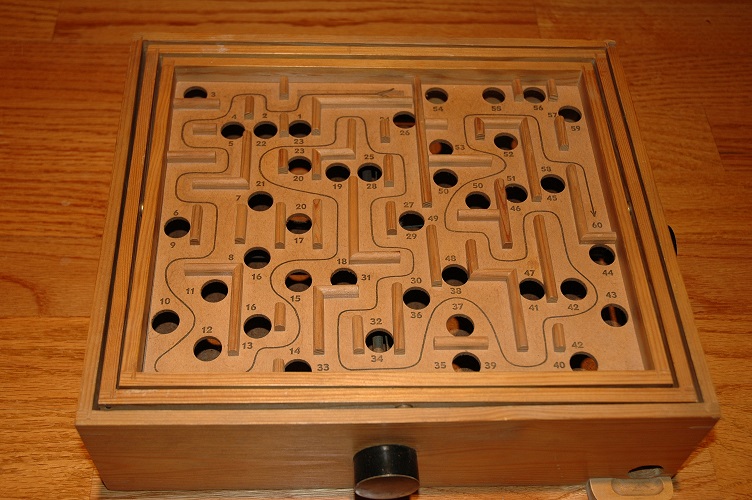
Everyone knows the goal of a maze or labyrinth: to get through it with as few wrong turns as possible. But when you have to navigate a steel ball through the labyrinth without falling into one of many pits, that becomes an even greater challenge.
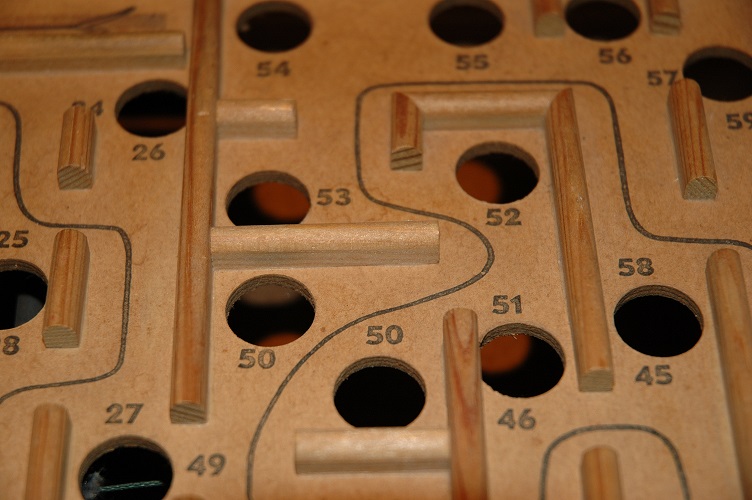
Whether you’re using handles to manipulate the maze and allow gravity to shift the ball from point to point or turning the labyrinth this way and that in order to move the ball toward the finish line, your dexterity and patience are sure to be pushed to the limit.


Jigsaw Puzzles
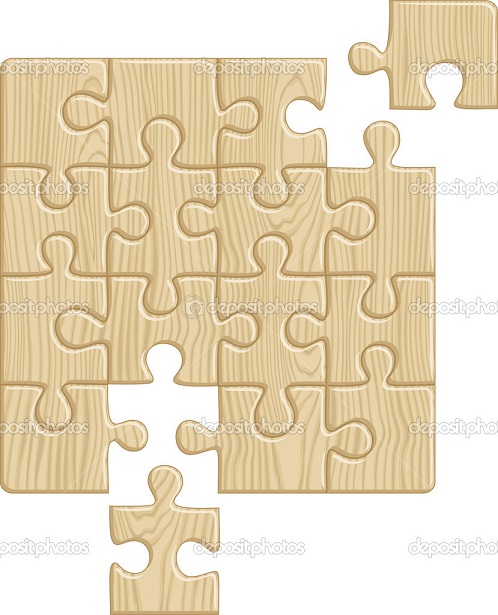
I would be remiss if I ignored the most common variety of wooden puzzle: the jigsaw puzzle!

Whether we’re talking about the more traditional shapes in a Ravensburger puzzle or a jigsaw incorporating unique and interesting pieces like those produced by Wentworth or our friend Rachel Happen of Baffledazzle (like the ones pictured below), jigsaw puzzles are among the first puzzles to which a young child is exposed.


3-D Jigsaw Puzzles

Of course, despite the many tough jigsaw puzzles available these days, you might be looking for a jigsaw with an additional dimension of difficulty. Thankfully, there are 3-D puzzles to give your spatial reasoning a run for its money!

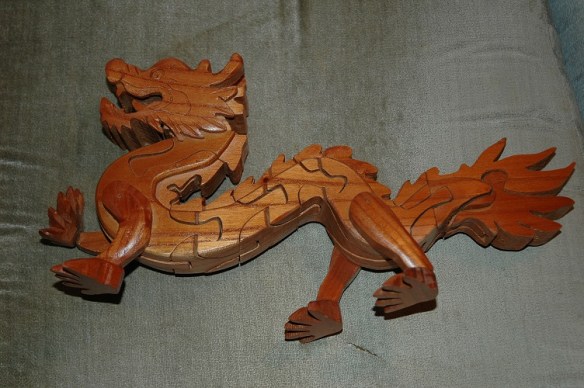
Both the dragon at the top of the page and the camel pictured above are 3-D puzzles that were sent to me by the lovely Sara Kingsland, owner of Completely Puzzled in Port Townsend, Oregon.

And let me tell you, these puppies put my jigsaw skills to the test. Let’s look at the camel disassembled:

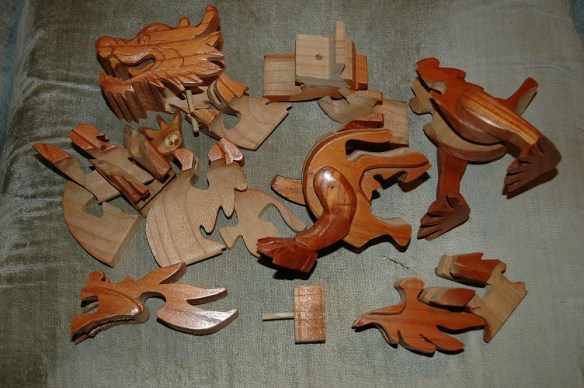
Is it immediately clear to you how to proceed? It certainly wasn’t to me! Now let’s look at the dragon disassembled:
dragon2

Believe it or not, I solved the dragon before the camel!
dragon3

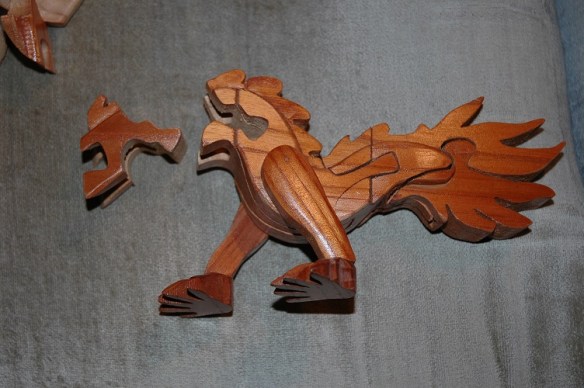
This is because the puzzles involve different approaches. The dragon was designed to be assembled from tail to head, and rarely required me to hold more than two pieces at a time to continue solving it.

The camel, on the other hand, has to be solved legs first, which means holding numerous pieces in place while manipulating others in order for everything to come together.


With the advent of laser printing, the sky is truly the limit when it comes to imagining new and challenging wooden puzzles. I can’t wait to see what these wickedly brilliant puzzlers come up with next.

Are there any types of wooden puzzle I missed, fellow puzzlers and PuzzleNationers? Let me know! (Other than Scrabble, that is. I left that one off the list intentionally.) And while you’re at it, tell me what your favorite kind of wooden puzzle is!

Thanks for visiting PuzzleNation Blog today! You can share your pictures with us on Instagram, friend us on Facebook, check us out on TwitterPinterest, and Tumblr, and be sure to check out the growing library of PuzzleNation apps and games!

Color My Puzzle World

I’ve written about jigsaw puzzles often in the past, because they’re an integral part of the puzzle world.

Whether we’re talking about the world’s largest jigsaw puzzle or a stone jigsaw puzzle curtain, an incredibly difficult puzzle with only 14 pieces or an entire house disassembled and rebuilt jigsaw-style, there seem to be endless variations in how jigsaw puzzles are brought to life.

Puzzle designer Clemens Habicht has an intriguing new take on the jigsaw puzzle, one that plays with a common solving technique.

Many jigsaw solvers organize pieces by color, focusing on one part of the final image and then moving on to the next. But what if every single puzzle piece was a different color?

Habicht has created a 1000-piece jigsaw puzzle that abandons any image clues other than color. There are no buildings, no animals, no hard lines or edges to locate. You’re using only your natural ability to distinguish between various color gradients to complete the puzzle.

Eschewing the classic ROY G BIV rainbow, this puzzle instead uses the color printing model known as CMYK, which stands for the four inks used in color printing: cyan, magenta, yellow, and key (a.k.a. black).

Habicht claims that the puzzle is actually easier to solve than the average jigsaw, because each piece is connected to every other piece in one continuous spectrum, creating an associative puzzle-solving experience.

What do you think, fellow puzzlers and PuzzleNationers? Is color-based solving more intuitive or less?

Thanks for visiting PuzzleNation Blog today! You can share your pictures with us on Instagram, friend us on Facebook, check us out on TwitterPinterest, and Tumblr, and be sure to check out the growing library of PuzzleNation apps and games!

It’s Follow-Up Friday: Kickstarter Round-up edition!

Welcome to Follow-Up Friday!

By this time, you know the drill. Follow-Up Friday is a chance for us to revisit the subjects of previous posts and bring the PuzzleNation audience up to speed on all things puzzly.

And in today’s post, I’m returning to the subject of puzzly crowdfunding campaigns!

I’ve covered various campaigns for board games, card games, and puzzle projects across the Kickstarter and Indiegogo crowdfunding platforms over the years, and today I’d like to share three more that could use your attention.

The first is Peter Gordon’s Fireball Newsflash Crosswords.

Culturally timely clues and entries are a hallmark of this marvelous variation on his long-running Fireball Crosswords brand, and Gordon has a knack for melding flowing grid design with sharp, topical entry words.

He’s in the home stretch (only hours left in the campaign!) and Gordon’s history of topnotch puzzles is all the incentive you need to contribute.

But he’s not the only puzzler going straight to the puzzle audience with a new collection.

Constructor Brendan Emmett Quigley has a new collection of Marching Bands puzzles, and he’s offering a great deal! Twenty-six Marching Bands puzzles. Talk about value!

The last Kickstarter I want to highlight today comes from the board game end of the spectrum.

The folks at Calliope Games — responsible for Tsuro, one of my new favorites from the last year — have masterminded a three-year, nine-game program with some of the top names in the field, and they want your help bringing the Titan Series to fruition.


These are three intriguing and very worthy projects, and I hope you contribute to one or more of them. As someone who has become a regular donor to various Kickstarter and Indiegogo campaigns, I am proud to have funded some marvelous new ideas and watched them take shape over the months that followed.

Thanks for visiting PuzzleNation Blog today! You can share your pictures with us on Instagram, friend us on Facebook, check us out on TwitterPinterest, and Tumblr, and be sure to check out the growing library of PuzzleNation apps and games!

PuzzleNation Product Review: Just Desserts

Whether it’s the speedy pattern-matching of Loonacy, the time-traveling strategy of Chrononauts, or the festive rule-shifting chaos of Holiday Fluxx, the folks at Looney Labs are constantly crafting new games that are visually engaging and offer high replay value. They sent us a copy of their newest card game, and we’re happy to give it the full PuzzleNation Blog treatment.

So, without further ado, let’s explore Just Desserts!

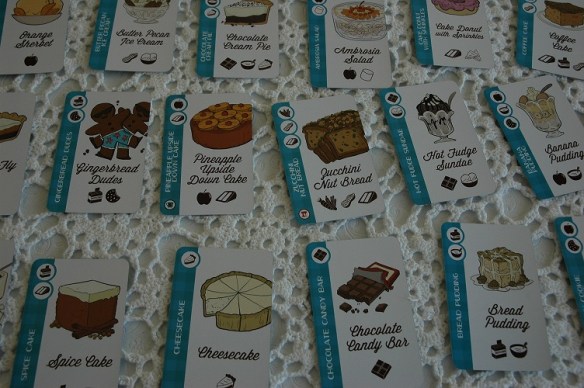
pic2453795

Just Desserts employs a similar game mechanic to Looney Labs’ flagship game, Fluxx: collect Keeper cards and be the first to match a pair of Keeper cards to the current Goal card.

In Just Desserts, you’re collecting Dessert cards and trying to match them to various sweet-toothed guests. You see, each Dessert card represents different ingredients that your guests enjoy or dislike. You want to play desserts that a given guest will enjoy, hoping to match each of their preferred ingredients without including an ingredient they hate.

justdesserts2

So, for instance, The Little Boy likes chocolate, cookies, and marshmallow, so you need Dessert cards representing each of those flavors. But he also has a favorite dessert: S’mores. If you had the S’mores Dessert card, you can cover all of his favorite ingredients with a single card, adding him to the happy guests you’ve collected, and earning yourself a bonus Dessert card.

The guests belong to six different-colored suits, and to win, you must collect three guests of the same suit or five of different suits.

And the relatively few Guest cards available — when compared to the massive number of Dessert cards you can collect — makes each guest a prized commodity.

justdesserts1

The simple game mechanic and wide variety of Dessert cards makes this not only a terrific introductory game for new players or younger players, but also gives the game great replay value, as you try new combinations of sweets to satisfy your picky guests and gather a winning array of cards.

From a puzzle point of view, scanning the various ingredients represented by the Dessert cards in your hand — not to mention figuring out the most economical way to employ them — and secure Guest cards effectively definitely makes for a fun, and constantly evolving, puzzle experience.

The one problem with this game? It makes me hungry.

Nonetheless, Just Desserts is a treat you can indulge in over and over without gaining a pound.


Thanks for visiting PuzzleNation Blog today! You can share your pictures with us on Instagram, friend us on Facebook, check us out on TwitterPinterest, and Tumblr, and be sure to check out the growing library of PuzzleNation apps and games!

ACPT Wrap-up!

The 38th annual American Crossword Puzzle Tournament was this weekend, and puzzlers descended on the Stamford Marriott Hotel in the hopes of putting their puzzly chops to the test in what has been dubbed “the Nerd Olympics.”

The tournament takes place over two days — with six puzzles to solve on Saturday, followed by one on Sunday — and then the championship puzzle, which the top 3 solve on white boards in front of the audience. On Friday and Saturday night, there are often puzzle events, demonstrations, and panels by top puzzlers and figures in the puzzle world as well.

I ventured down to Stamford myself Saturday morning amidst some unexpected snow flurries and sat in with my friends from Penny/Dell Puzzles at their booth.

They were armed to the teeth with tote bags, magazines, pencils, and freebie copies of The Crosswords Club, The Uptown Puzzle Club, Will Shortz’s Sudoku, and some of the tougher Penny Press and Dell Magazines titles. It was a sumptuous buffet of puzzly goodness, to be sure.

Joining me behind the tables were Penny Press proofreader and puzzler Debra Yurschak Rich and PuzzleNation‘s very own Director of Game Development, Fred Galpern, who was on hand to show off the Penny Dell Crosswords App.

We had a few hours before Puzzle #1 would kick off the tournament, so I wandered around, checked out the ballroom where the competition would take place, surveyed the other booths, and chatted with many tournament competitors and puzzlers.

Not only did I get to see friends of the blog like Uptown Crossword Club editor Patti Varol, author and puzzler Eric Berlin, constructor Ian Livengood and Penny Press variety editor Keith Yarbrough, but it was a great opportunity to match names and faces, since I’d had the chance to tweet, email, and otherwise interact with many of them online over the last few years, but never actually met them in person.

Among the folks I got to meet were crossword gentleman Doug Peterson, New York Times Wordplay blogger Deb Amlen, constructor and Pre-Shortzian Puzzle Project curator David Steinberg, constructor Joon Pahk, top solver and former champion Ellen Ripstein, Los Angeles Times crossword editor Rich Norris, constructor Alan Olschwang, Evan Birnholz of Devil Cross, top competitor and former champion Tyler Hinman, and New York Times puzzle editor Will Shortz.

[Will stops in at the Penny/Dell Puzzles booth, and poses with his namesake titles.]

One of my favorite things about the tournament is the absolute and unabashed puzzle love shown by so many competitors. I saw crossword-patterned sweaters, ties, shirts, and earrings, as well as punny t-shirts of all kinds. One guy even dressed up in full papal regalia, but with a crossword theme!

[Fred poses with the eye-catching Puzzle Pope. In nomine puzzle…]

Finally, it was time for the tournament to begin, so the competitors filed into the ballroom where Will Shortz introduced Puzzle #1, created by Tracy Bennett, which would be a Monday difficulty puzzle.

It’s an excellent warm-up puzzle for competitors, and rarely one that poses a significant challenge. Dan Feyer, reigning five-time champion, set a new tournament record by completing Puzzle #1 in under two minutes. WOW.

But, as it turns out, there was a bit of a kerfuffle surrounding the first puzzle. From the Puzzle Brothers blog:

A weird scoring anomaly took place when the Puzzle 1 results were announced, when a solver named William Hall appeared to have solved Puzzle 1 a full four minutes before Dan Feyer did. Since Dan solved the puzzle in less than two minutes – believed to be an ACPT first – that meant that Hall would have had to do some serious messing with the time-space continuum to finish the puzzle TWO MINUTES BEFORE HE EVEN STARTED.

[I believe I met a third of the names on this list over the course of the day.]

The glitch was soon resolved and Dan Feyer returned to his proper spot at the top of the leaderboard.

Puzzles #2 and #3 (constructed by Joel Fagliano and Merl Reagle, respectively) proceeded without any scoring scandals, and throughout the day, I was getting great insight into the puzzles themselves and the energy of the room with post-puzzle updates from Keith, Patti, Doug, and some of the other competitors.

After a break for lunch, the ballroom filled once more for Puzzle #4, Paula Gamache’s contribution to the tournament. And then, it was time for Puzzle #5.

If you recall my report from last year’s tournament, Puzzle #5 is routinely the toughest puzzle in the tournament. While Brendan Emmett Quigley’s puzzle last year was widely regarded to be a brutally challenging one, Will Shortz said this year’s entry (constructed by Jeff Chen) was “easy for Puzzle #5.” Which is akin to calling something “the friendliest volcano” or “the warmest Eskimo.”

I happened to bump into Dan Feyer outside the ballroom after he completed Puzzle #5, and he jokingly inquired, “Where is everyone?” I looked at him point-blank and replied, “You know exactly where everyone is, Dan!”

Not long after, I received the following text, from another competitor: Puzzle 5. *sad trombone*

The day’s puzzle wrapped up with Puzzle #6, a Lynn Lempel creation that helped set the stage for Sunday’s remaining two crosswords: Patrick Berry’s Puzzle #7 and Byron Walden’s championship closer.

And although I wasn’t present for Sunday’s tournament finale, I continued to get updates from friends and fellow puzzlers throughout the day. When it came time for the top three to solve on their white boards in front of their fellow competitors, a familiar trio of names were listed: Dan Feyer, Tyler Hinman, and Howard Barkin.

Due to his performance over the previous seven puzzles, Dan began with a 5-second head start over Tyler. And that made all the difference.

Watch as Dan and Tyler race to the finish:

Only a half-second separated Dan and Tyler’s times, a nail-biter in ANY competition, but Dan Feyer locked up his sixth straight ACPT championship!

Not only did he top Tyler’s streak of 5 straight wins, but he’s put himself in contention to match Jon Delfin’s record of seven tournament victories next year! Names like Anne Erdmann, Francis Heaney, Joon Pahk, and Al Sanders were not far behind.

And out of more than 560 competitors, friends of the blog had a strong showing themselves! David Steinberg ranked 36th overall, and was named the Division C champion, the youngest ever!

Patti Varol placed 109th, and only a few steps behind her was Eric Berlin at 112th! Keith Yarbrough placed 177th, and Doug Peterson was the top performer in our little cabal of puzzlers, delivering some outstanding solves and placing 14th overall!

(In case anyone was curious, the Puzzle Pope placed 463rd.)

I’ve never experienced anything quite like the ACPT, but I’m definitely going back next year. Congratulations to all the competitors!

Thanks for visiting PuzzleNation Blog today! You can share your pictures with us on Instagram, friend us on Facebook, check us out on TwitterPinterest, and Tumblr, and be sure to check out the growing library of PuzzleNation apps and games!

It’s Follow-Up Friday: ACPT Eve edition!

Welcome to Follow-Up Friday!

By this time, you know the drill. Follow-Up Friday is a chance for us to revisit the subjects of previous posts and bring the PuzzleNation audience up to speed on all things puzzly.

And in today’s post, I’m returning to the subject of the American Crossword Puzzle Tournament!

The 38th annual tournament kicks off tomorrow, and I’m definitely excited to be attending for the very first time! I’ll be sitting in with my pals at the Penny Press/Dell Magazines booth, offering some great puzzles and meeting topnotch competitors and constructors alike.

How many PuzzleNationers and fellow puzzle fiends are attending? Come by, I’d love to meet you!

Not only that, but Fred, our Director of Game Development, will be on hand to show off the Penny Dell Crosswords App!

This week, the names of the constructors contributing puzzles to the tournament this year were revealed, and it’s a terrific mix of first-class constructors. Some you may know, some you may not!

Merl Reagle (who masterminded Google’s 100th Anniversary of the Crossword puzzle) is contributing, along with prolific puzzlers Lynn Lempel, Joel Fagliano (currently Will Shortz’s assistant at The New York Times), and Jeff Chen (XWordInfo‘s webmaster)!

They’re joined by constructors Tracy Bennett, Paula Gamache, Patrick Berry, and Byron Walden (a Saturday NYT regular known for some seriously tough puzzles)! It’s entirely possible that the diabolical Puzzle #5 at this year’s tournament will be a Walden original.

Not only that, but several friends of the blog will be in attendance, like Penny Press variety editor Keith Yarbrough, constructor Ian Livengood, puzzler and author Eric Berlin, crossword gentleman Doug Peterson, and Uptown Puzzle Club editor Patti Varol!

Tuesday’s blog post will be a recap of the tournament, complete with pictures, but stay tuned to Twitter and Facebook this weekend for bonus posts and previews!

Thanks for visiting PuzzleNation Blog today! You can share your pictures with us on Instagram, friend us on Facebook, check us out on TwitterPinterest, and Tumblr, and be sure to check out the growing library of PuzzleNation apps and games!