If you don’t recall, a 91-year-old woman was visiting the Neues Museum in Nuremberg with a senior citizens group when she found the piece, “Reading-work-piece” by artist Arthur Koepcke, and began filling in the empty grid, mistakenly thinking it was an interactive art work.
The museum was none too pleased with her efforts, and restored the piece to its original condition.
But as it turns out, that’s not the end of the story.
You see, the woman claims — in a seven-page rebuttal to the German police’s investigation of her vandalism — that she has not harmed the work, instead arguing that she has brought the work greater public attention thanks to her efforts, reinvigorating interest in the piece and increasing its value.
Frau K.’s lawyer claimed that her additions meant that she now held the copyright of the combined artwork — and that, in theory, the private collector might sue the museum for destroying that new collaboration by restoring it to its original state.
Yes, they assert that the private collector who loaned the Koepcke work to the Neues Museum might not only approve of her defacement of the piece, but be angry with the museum for their efforts to ensure that the piece was returned to him in the same condition.
Well, that’s certainly doubling down on your hand. It takes a certain confidence and bombast to make a claim like that, but the woman believes she’s in the right artistically.
The argument is based around the spirit of Koepcke’s work, which was part of the Fluxus movement. They go on to explain that “Fluxus artists did not agree with the authority of museums to determine the value of art, nor did they believe that one must be educated to view and understand a piece of art.”
It will certainly be interesting to see where the case goes from here. Naturally, I can’t help but wonder. Heck, if Da Vinci had been a Fluxus devotee. I could’ve drawn a mustache on the Mona Lisa and made millions.
Thanks for visiting PuzzleNation Blog today! Be sure to sign up for our newsletter to stay up-to-date on everything PuzzleNation!
By this time, you know the drill. Follow-Up Friday is a chance for us to revisit the subjects of previous posts and bring the PuzzleNation audience up to speed on all things puzzly.
And today, I’d like to return to the subject of crowdfunding.
First, let’s talk about Herbaceous. Ed and the Herbaceous team were hoping for $6500 to make the game a reality, and they absolutely crushed that goal!
The final total was a staggering $59,032! Congrats to everyone involved, and kudos to all the PuzzleNationers that contributed!
And in the spirit of such marvelous Kickstarter success, let’s take a look at four very different projects that might appeal to puzzle fans and game enthusiasts!
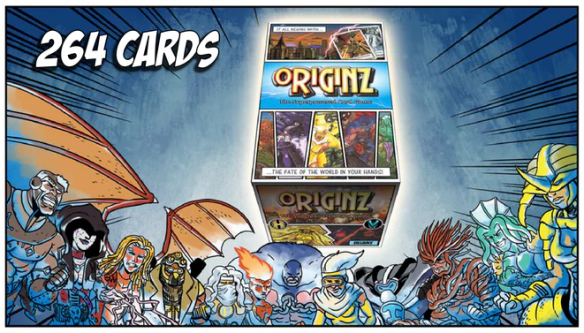
In this deck-building game, you try to equip your villain or hero with the best mix of powers imaginable to keep your foes at bay! This accessible game is richly illustrated and detailed, a sure-fire hit with any fans of superheroics in your household.
If you’re looking for a more traditional style of puzzling, there are only a few days left to get in on the ground floor of LightBox, a Rubik’s-style light-up puzzle box.
By rotating and rearranging the layers of plastic that form the cube, you will illuminate different layers and create different patterns of light! Whether you’re solving to create a particular pattern or to shut the LightBox off entirely, you’re sure to work your brain into knots with this curious puzzle box.
And speaking of short deadlines, there are only a few days left to contribute to Word Domination, an intriguing mix of Scrabble-style spelling and a strategy card game.
The concept is devilishly simple: by spelling words, you acquire artifacts to help you in your criminal escapades. The mix of tactical spelling — sometimes, shorter words have more value than longer words — with the roguish qualities of an evildoer allow for all sorts of gameplay possibilities.
I don’t think I’ve ever seen these two puzzle-game formats combined like this before, and the result could be something great.
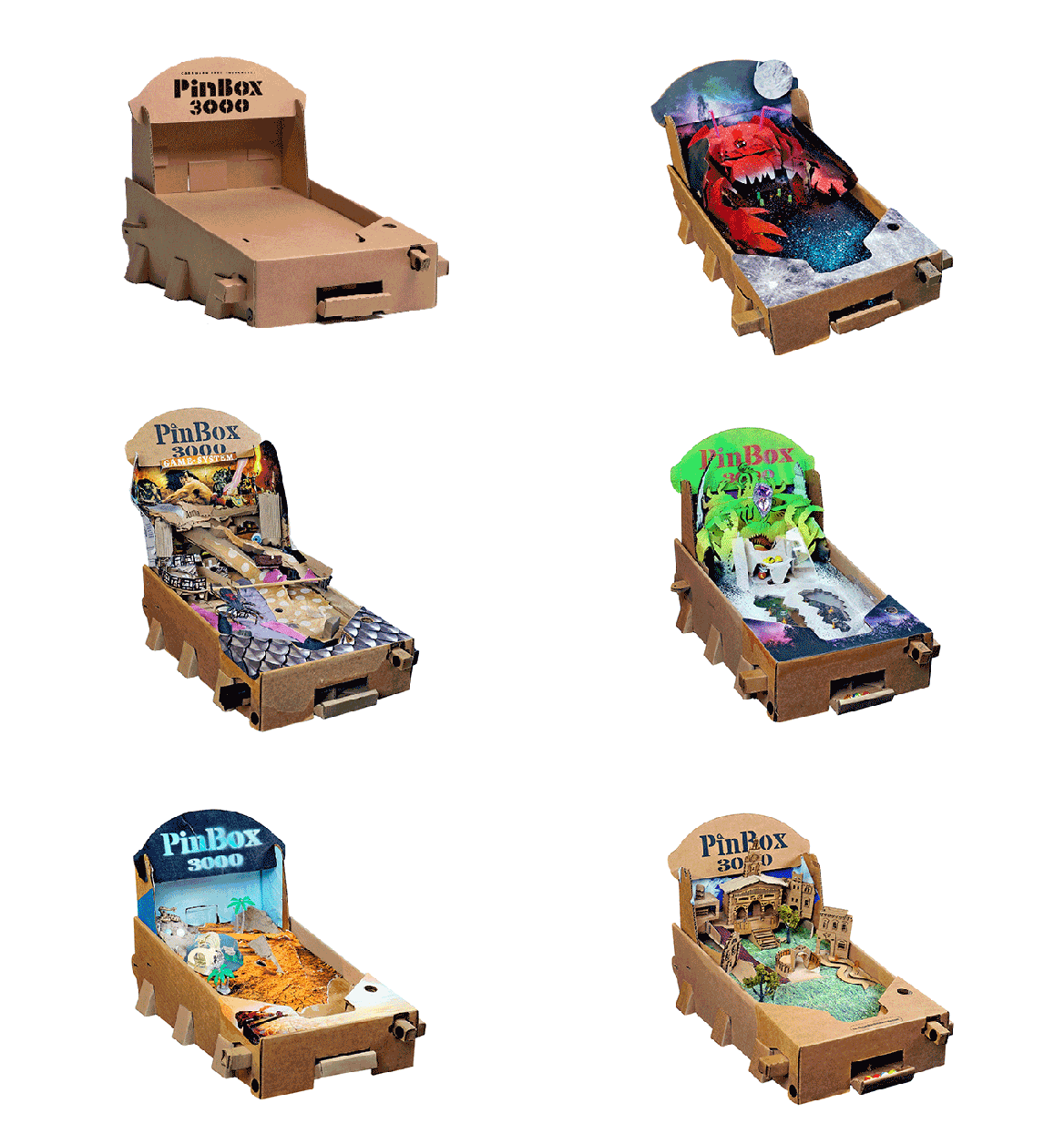
Our fourth and final project today has the most potential, simply because of its design. It’s the PinBox 3000, and it’s a foundation for designing, decorating, and constructing your very own pinball game.
Merging DIY possibilities with a classic form of game play seems like a no-brainer, and I can’t believe we haven’t seen something like this on the market before. This is the perfect community builder, and I can foresee forums and Pinterest pages popping up all over, as fans and creators share their unique designs. What an awesome palette to work with!
Hopefully one or more of these projects piques your interest, my fellow puzzlers and PuzzleNationers! I wish all of these creators the best of luck in shepherding their brainchildren toward success!
Thanks for visiting PuzzleNation Blog today! Be sure to sign up for our newsletter to stay up-to-date on everything PuzzleNation!
Only two months ago, I wrote a blog post about a Slate article discussing how The New York Times crossword can be socially tone-deaf at times. So it’s heartening today to write about a New York Times crossword puzzle that’s progressive, one that is bringing the conversation forward instead of feeling out-of-touch.
On Thursday, September 1, the paper published a crossword by constructor Ben Tausig. Even on the surface, this was a rare puzzle, because it allows for multiple entries that fit a given definition. These puzzles are known as Quantum puzzles or Schrödinger puzzles.
The most famous example is the 1996 Election Day crossword pictured below, which “predicted” the outcome of the election quite cleverly by allowing for either CLINTON ELECTED or BOB DOLE ELECTED to read out, depending on how the solver answered seven down clues.
In Ben Tausig’s puzzle, there are four across entries and four down entries that each allow for two possible answers. For instance, 67 Across is clued “Tough stuff to walk through” and the answer can be FIRE or MIRE. That entry crosses 60 Down, which is clued “Word that can precede sex,” allowing for the answers SAME or SAFE.
What separates Tausig’s puzzle from this elite group of masterfully constructed Quantum crosswords is what it represents on a social inclusiveness level.
The letter variability — allowing for M or F to appear in the box and still fit the definition — is a wonderful metaphor for the fluidity of gender, especially in the limiting, but generally accepted, binary concept of male or female. Having GENDER FLUID as the revealer entry helps demystify both the theme and the topic at hand for solvers.
The theme letters don’t move from M to F or from F to M, in the manner of a binary, but float in an unresolved place in between. That’s a simple but reasonable way of representing queer sexuality — as a forever-exploration of identity and desire.
And although those two concepts only scratch the surface of the rich panoply of emerging terms and definitions with which people can express their gender or identity, this is an excellent step forward.
Kudos to Tausig and the crew at The New York Times crossword for a puzzle that’s elegant and inclusive in more ways than one.
Thanks for visiting PuzzleNation Blog today! Be sure to sign up for our newsletter to stay up-to-date on everything PuzzleNation!
It’s difficult to write about the potential health benefits of puzzles. Believe me, I’ve tried.
But many scientific articles, research studies, and other professional analyses disagree on the short-term or long-term benefits that puzzles have on the brain. There’s a wealth of material out there on brain health and the impact of puzzles, but much of it is inconclusive.
I’ve always tried to be careful to discuss any scientific articles on brain health for that reason, especially after Lumosity’s two-million-dollar payout earlier this year for falsely advertising that their puzzle games could “reduce or delay cognitive impairment associated with age and other serious health conditions,” as well as “stave off memory loss, dementia, and even Alzheimer’s disease.”
That’s less of an issue, thankfully, when writing about other puzzle-solving creatures, though. In the past, we’ve seen crafty cockatoos, clever crows, outwitting octopuses, and deductive dogs. Apparently, we can also add cats to the list of fellow puzzlers!
[A mobile feeder toy. Image courtesy of Purina One.]
A recent article in the Journal of Feline Medicine and Surgery reports that their findings indicate that a healthy dose of puzzle-solving at mealtime is beneficial to a kitty’s welfare.
According to the folks at Gizmodo, by utilizing food puzzles that require cats to roll a toy to release some food or manipulate a game board to reveal food, “these puzzles take advantage of the feline hunting instinct, fulfilling their ingrained desires. By ‘foraging’ for food in this way, cats are more physically active, they experience reduced levels of stress, and they become less demanding of their owners.”
Apparently, it’s all about engaging the cats, giving them something to work against in order to earn the food. The case studies cited by the report include behavioral issues and obesity that were overcome thanks to the use of food puzzles.
I already knew that cats were skilled at treasure and scavenger hunts — based on the absolutely ludicrous places I would find the toys my sister’s cats left behind, often weeks after their visits — but I had no idea they belonged among the elite puzzle-solving animals we’ve previously chronicled here.
Makes sense, though. I solve puzzles for snacks sometimes. *shrugs* It’s a living.
Thanks for visiting PuzzleNation Blog today! Be sure to sign up for our newsletter to stay up-to-date on everything PuzzleNation!
By this time, you know the drill. Follow-Up Friday is a chance for us to revisit the subjects of previous posts and bring the PuzzleNation audience up to speed on all things puzzly.
And today, I’d like to return to the subject of one of the classic deduction games: Clue.
Clue (also known as Cluedo) is a classic in several respects. It is a beloved board game, mentioned alongside Monopoly, Scrabble, Battleship, and Candyland as staples of board game culture, but one that is quite rare: a deduction-based game where you’re playing against both your opponents and the game itself. (The only other game I can think of that captures the same spirit of gameplay is Gameworthy Labs’ Oh My Gods!)
But the film version is also beloved by game devotees and comedy lovers alike. And although I’m dubious about the recently-announced remake of Cluecoming to theaters in the near future, there is one revamp of the mystery property that I can get behind: a playable LEGO version of the game.
As part of the 2014 MOCOlympics — a competition between amateur LEGO designers, where MOC stands for “my own creation” — master builder Ian Spacek created this delightful set, which captures the spirit of each character and each of the game’s signature rooms in impressive miniature fashion.
You see, the challenge was to “build a game that you would choose to play on a rainy afternoon when the power’s out and you don’t have any juice left on your iDevices.” And I think Spacek’s design fits the bill with gusto.
[Spacek even designed a punch card to aid players. Image courtesy of Nerdist.]
I’d much rather see a company put money into releasing this little beauty than an unnecessary retread of one of my favorite films. (Unfortunately, since the MOC Olympics aren’t associated with the LEGO company, this set isn’t available for purchase.)
Somebody just needs to whip up a LEGO version of Murder By Deathand I’ll be set for any rainy day to come.
Thanks for visiting PuzzleNation Blog today! Be sure to sign up for our newsletter to stay up-to-date on everything PuzzleNation!
Welcome to 5 Questions, our recurring interview series where we reach out to puzzle constructors, game designers, writers, filmmakers, musicians, artists, and puzzle enthusiasts from all walks of life!
It’s all about exploring the vast and intriguing puzzle community by talking to those who make puzzles and those who enjoy them! (Click here to check out previous editions of 5 Questions!)
And I’m excited to continue this series with Lily Hevesh (aka Hevesh5) as our latest 5 Questions interviewee!
Lily Hevesh, better known as Hevesh5 on YouTube, is a professional domino artist, a Rube Goldberg machine master, and an advertising whiz who uses skill, patience, and creativity to design wonderfully transfixing works of kinetic art.
She has appeared on The Today Show (auditioning for America’s Got Talent), helped set Guinness World Records — setting up 200,000 dominoes in group displays, as well as 22,000 dominoes on her own for certain projects — and her videos have accumulated over 200 million views on YouTube.
Hevesh5 was gracious enough to take some time out to talk to us, so without further ado, let’s get to the interview!
5 Questions for Hevesh5
1. What is your process when creating one of these ambitious works of kinetic art? How much planning goes into them before the first domino is laid? How do you know if you’re heading in the right direction or if you need to stop, reassess, and try something else?
Planning time varies a lot depending on the type of project. Sometimes I do absolutely zero planning and just start building and see where things go. I think of ideas while building which keeps me going. Other times (especially for live events) I have to plan out the whole setup by digitally drawing out the domino path from start to finish.
[A video thank you posted when Lily reached 2,000,000 views on YouTube.]
First I have to decide what I am going to build — whether that be a logo, an image of something, some sort of text, etc. Then I have to figure out the best way to build this as a domino trick. Dominoes can be built in many ways: lines, domino fields, walls, 3D structures, and other creative tricks, so I have to decide which technique is best for each individual project. Then it’s a matter of connecting every trick with domino lines and figuring out the position on the floor.
If I’m heading in the wrong direction, I’ll usually realize something is wrong — maybe it doesn’t look like what I envisioned, the structure looks risky or is becoming too difficult to build, it looks sloppy, etc. In those cases, I will make the best of the situation and try to correct the mistakes, sometimes even knocking it down and starting over if I feel like it doesn’t live up to what I’m picturing.
[Lily and several other domino artists craft a 30,000 domino masterpiece at the
Brattleboro Museum and Art Center for the 9th annual Domino Toppling Extravaganza!]
2. On your YouTube page, you answer the question “How did I get into dominoes?” with “I searched ‘dominoes’ on YouTube.” Was that the spark of all of your kinetic art (like your Rube Goldberg devices) or were you into mechanical puzzles before that?
The reason I searched dominoes was because I loved to play with the classic dotted dominoes and set them up for fun. I was intrigued by the knock down and wanted to find out if there were others who set up dominoes like I did as a kid. Searching dominoes certainly fueled my love for kinetic art an extraordinary amount though.
3. You have helped set world records and amassed over 200 million views on YouTube. Amongst all those awesome, mind-blowing projects, which are some of your favorites? And what’s the best part of collaborating with fellow domino artists and kinetic sculptors?
Amongst all the projects I’ve been involved with, 2 stand out: “The Incredible Science Machine” (new American domino record with 250,000 dominoes and world record for most dominoes in a circle field) and working on a domino segment for the upcoming feature film Collateral Beauty starring Will Smith.
The best part about collaborating with other domino artists is finally being able to talk to someone who understands your “domino language”. Meeting new people is always exciting, but it’s even more exciting when they share the same passion for such a unique art form. It’s always fun learning from other builders and seeing different styles of building.
[A stick-bomb chain reaction.]
4. What’s next for Hevesh5?
Right now I am just starting my gap year to do dominoes and YouTube full time. I plan to make as many domino videos as possible and create an inventory so that I can post them periodically when I go to college (I won’t have time to make videos in college, so I’m making a lot now to save up for the future).
I plan to post a video on my channel (YouTube.com/hevesh5) every week while also doing side projects for companies, ad agencies, and others who may need domino art.
5. If you could give the readers, writers, puzzle fans, aspiring YouTubers, and kinetic art enthusiasts in the audience one piece of advice, what would it be?
Don’t give up on what you love. Patience and perseverance are key, even in the most challenging times.
A huge thank you to Hevesh5 for her time. Be sure to visit her YouTube page for new videos and updates on her latest projects. I cannot wait to see what she has in store for us next!
Thanks for visiting PuzzleNation Blog today! Be sure to sign up for our newsletter to stay up-to-date on everything PuzzleNation!







 PuzzCulture