Nominees Announced for the World Video Game Hall of Fame!

Rochester, New York is the home of The Strong National Museum of Play, and they have a very important mission: to chronicle the history and importance of play.

Child development, social interaction, imagination… all of these key features in a healthy individual are facilitated by play, and the staff at The Strong help us not only understand that process, but celebrates it by hosting both the National Toy Hall of Fame and the World Video Game Hall of Fame under its brightly-colored umbrella.

As you might have guessed, puzzles and games play a significant role in The Strong’s work, and they’re represented in both Halls of Fame. Clue, Chess, Scrabble, the Rubik’s Cube, and Dungeons & Dragons are all inductees in the National Toy Hall of Fame, while Myst, Tetris, The Oregon Trail, and Where in the World is Carmen Sandiego? are among the puzzlier inductees on the video game side of things.

And The Strong have recently announced the nominees for this year’s class of video games to be inducted in the World Video Game Hall of Fame.

This year’s finalists for the 2025 class run the gamut from 8-bit classes, modern phenomenon, and games that took play to surprising new places, and they represent different genres, play styles, and aspects of gaming across decades.

The 2025 finalists are: Age of Empires, Angry Birds, Call of Duty 4: Modern Warfare, Defender, Frogger, Golden Eye, Golden Tee, Harvest Moon, Mattel Football, Quake, NBA 2K and Tamagotchi.

What a field! Everywhere from arcades (Frogger) to pocket games (Tamagotchi) are on display here, as well as social gaming both in person (Golden Eye) and online (Quake).

The nominees were chosen from thousands of nominations online. The field was then narrowed by staff members at The Strong based on “longevity, geographical reach, and influence on game design and pop culture.” Only a small handful of these finalists will be selected by an international committee of experts as this year’s inductees.

Everyone has an award show that they geek out over, and you’re probably not surprised to discover that these Halls of Fame are two of my favorite awards given out each year. I love seeing deserving games and puzzles get the spotlight they deserve for helping change how we play and interact with each other.

You can check out the full list of National Toy Hall of Fame inductees and World Video Game Hall of Fame inductees at these links. Do yourself a favor and take a stroll through not only your childhood, but the childhoods of generations past. It’s a real treat.

What toys and games would you like to see inducted in the future? Let us know in the comments below!

Fictional Games That Became Real!

Many TV shows, films, and novels help add character to their narrative universes by mentioning the games played by the characters.

Shows and franchises as wildly disparate as Battlestar Galactica, New Girl, It’s Always Sunny in Philadelphia, The Witcher, and Pretty Little Liars have fictional games that enrich their worlds.

But sometimes, either through clever marketing or the affection of fans, these games go from fictional recreational activities to real ones, crawling fully formed from the imagination to be enjoyed across tabletops worldwide.

Today, I’d like to introduce you to a few of them. Let’s play, shall we?


Tri-Dimensional Chess

Star Trek has been a source of many fictional games and sports over the years. Dom-jot, Chula, Dabo, Parrises Squares, and Stratagema are some of the more famous ones, but the granddaddy of Star Trek games is Tri-Dimensional Chess.

First appearing in the original series back in 1966, Tri-Dimensional Chess follows the normal rules of chess, but spread across different vertical levels. So a knight could move in its usual L-shaped format, but on its own board OR the boards above and below.

Over the years — and across different Star Trek series — we’ve heard stories about key maneuvers like the Aldabren Exchange and the Kriskov Gambit in games of Tri-Dimensional Chess, helping flesh out how influential the game is for several characters. (Heck, in one episode, Spock beats the Enterprise computer at the game, saving Kirk from a court martial!)

The Franklin Mint has released limited edition versions of the game on two occasions, and I’ve seen homemade games of Tri-Dimensional Chess at gaming and pop culture conventions over the years.

Chess remains incredibly popular — as do many variants of Chess — so it’s no surprise this fictional game made the leap to the real world. (I suspect the complicated three-person Chess game developed by Sheldon in The Big Bang Theory is less likely to make a similar leap. Especially since there are already three-person Chess games on the market today.)


Cones of Dunshire

Ben Wyatt of Parks and Recreation enjoyed many nerdy pastimes, but Cones of Dunshire was his masterpiece.

Initially treated as a mistake, a nonsensical result of his boredom and frustrations, the game becomes a running gag in the show after Ben leaves a copy as a gift for the accounting firm that he has been hired by (and walked away from) several times during the show’s run.

Later, we find out the game has been commercially produced, and Ben stumbles across it when dealing with a dotcom company. He mentions that he invented it, but his claims are dismissed. He then proves not only his gaming skill but his authorship of the game when he beats the dotcom bosses in a tense playthrough.

It’s mentioned once that a gaming magazine called Cones of Dunshire “punishingly intricate,” a point that makes Ben proud.

Part of the fun of Cones of Dunshire (other than the parody of Settlers of Catan) is that the viewer never really understands what’s going on, so supposedly dramatic moments can be played for laughs. (I also appreciate that the name of the game is basically a fancy way of saying “dunce hat.”)

And, in the sort of cyclical storytelling that could only happen in a nerdly pursuit like board games, the company that made Settlers of Catan — Mayfair Games — produced a giant version of the game as part of a charity event at GenCon.

2783642-2767076242-563bb

Both the silliest and most ambitious game to cross from fictional to real, Cones of Dunshire is a nerdy highlight of a now classic sitcom.


tak1

Tak: A Beautiful Game

Originally introduced in Patrick Rothfuss’s Kingkiller Chronicles novels as a tavern game, Tak made the leap to the real world as a stretch goal in a Kickstarter campaign for another game.

Game designer James Ernest accepted the challenge of bringing the game to life, and his collaboration with Rothfuss created one of my all-time favorite board games.

Tak has a very simple concept: two players each attempt to build a road connecting opposite sides of the game board. The first player to successfully complete their road wins.

tak2

To do so, you place game pieces called stones, one at a time, on various spaces on the board. The stones can either be played flat (meaning they’re part of your road) or standing on edge (meaning they’re a wall, blocking any road’s passage through that space).

It’s a rare thing when a new game feels like something that could’ve been played in taverns centuries ago. For me, this is the gold standard when it comes to adapting fictional games to the real world.


Image courtesy of Glowforge.com

Pai Sho

A key storytelling device in the much-beloved show Avatar: The Last Airbender, Pai Sho was a tactical tile-based game that reinforced important themes in the show.

The game had many variants (often played differently depending on the faction or nation featured) but each had the feeling of an ancient game passed down across generations.

In the most popular variant, Skud Pai Sho, the goal is to form a harmony ring around the center point of the board. Players create harmonies by placing two harmonious tiles on the same line without other tiles or obstacles. There are gates, gardens, and lines that help dictate play, as well as multiple flower tiles for players to place that accomplish different things when placed properly.

There are entire forums and websites dedicated to the rules of Pai Sho and its many variants, and the thriving fan community that continues to nurture these games well after the show’s conclusion make this one of the most heartfelt and successful transitions from fictional to real life that I can think of.


Image courtesy of starwars.com.

Sabacc

In The Empire Strikes Back, we learn about the friendly rivalry between Lando Calrissian and Han Solo, and how a wager led to the Millennium Falcon changing hands.

But exactly how it happened was only revealed later in supplementary material like the Star Wars Visual Encyclopedia and the novel Lando Calrissian and the Mindharp of Sharu.

The second draft of the script for The Empire Strikes Back mentioned that Lando won Cloud City in a “sabacca” game, but by the time additional stories fleshed out the relationship between Lando and Han, the game had been shortened to Sabacc.

It’s sort of a combination of poker and Blackjack. You want the value of the cards in your hand to be as close to 23 or -23 as possible. Sounds simple, right?

Well, imagine a game of poker where the cards in your hand changed periodically unless you publicly locked them in by placing them on the table, where they stayed until the hand was over. That’s the basic idea behind Sabacc.

There were numerous fan versions of the game over the years, but now you can get Sabacc decks at Disney theme parks (alongside many, many, MANY other items).


Do you have a favorite fictional game that made the leap to the real world? Did we miss any major ones? Let us know in the comments below!

RPG Actual Play News Roundup!

A lot of cool things are happening in the actual play RPG scene these days.

For the uninitiated, actual play games (also known as liveplay games) are when a party of roleplaying game enthusiasts share their gameplay for viewers.

Some of them simply record a regular session around the table, while others create sets, graphics, and expend a fair bit of coin on their production values to enhance the viewing experience.

There are LOADS of podcasts and video series in the actual play RPG arena, and over the last few weeks, several of the heavy hitters in the genre have announced big projects.

So let’s do a roundup of actual play RPG news!


Dimension 20 + WWE

The comedy streaming service Dropout is the home of Dimension 20, one of the premiere liveplay games running today. Fresh off of selling 20,000 tickets for a show at Madison Square Garden, Dimension 20 recently announced a new campaign featuring their flagship Dungeonmaster Brennan Lee Mulligan. And his four players at the table are all WWE superstars!

Xavier Woods, Kofi Kingston, Bayley, and Chelsea Green will be tackling a gladiatorial arena in the time of ancient Greece in Titan Takedown, starting April 2nd!

It’s interesting that they’re using D&D rules instead of any pro wrestling RPG systems, but otherwise, I’m excited to see this campaign play out!


Critical Role 10th Anniversary

The top dogs in the RPG actual play scene are undoubtedly Critical Role, a self-proclaimed group of “nerdy-ass voice actors who sit around and play Dungeons & Dragons.”

They have a hit show on Amazon Prime, The Legend of Vox Machina, which is based on their original RPG campaign.

They just wrapped up their third multiyear campaign with a huge crossover event featuring the characters from all three campaigns. (The final episode lasted a whopping EIGHT AND A HALF HOURS.

They’re currently running a short follow-up game, Divergence.

Not only that, but there are big expectations for the announcement for their fourth campaign, which could feature their in-house RPG system, Daggerheart.

Ten years after their debut on Geek & Sundry, Critical Role is still shaping the actual play landscape.


Geek & Sundry

And speaking of Geek & Sundry, they recently announced a tabletop charity event featuring several top names in the actual play community.

Alongside Geek & Sundry’s own Felicia Day, Matt Mercer of Critical Role is returning to Geek & Sundry for this special one-shot event, and he is joined by Daredevil star (and RPG influencer) Deborah Ann Woll, Superman portrayer Brandon Routh, and comedian Reggie Watts. The game is being DMed by Bill Rehor of Beadle & Grimm’s, which not only produces topnotch specialty RPG products, but also created the D&D/improv comedy show Faster, Purple Worm! Kill! Kill!

This Pathfinder one-shot game, entitled Lost Odyssey: Godfall, will raise money for the Children’s Miracle Network Hospitals and their Extra Life program.

And it’s also advertising a unique opportunity for viewers to experience the game “firsthand” by using VR headsets to virtually sit at the table alongside the players!

I have no idea if the technology will back up the interactive promises made, but at the very least, this should be a very entertaining round of roleplaying for a very worthy cause!


Baldur’s Gate Liveplays at Conventions

One of the biggest success stories in RPG-inspired video games over the last few years was the 2023 release of Baldur’s Gate 3. Set in the Forgotten Realms D&D setting, the video game brought many new eyes to the world of Dungeons & Dragons, giving them a sampling of the worldbuilding and storytelling potential of traditional tabletop gaming.

But an unexpected and delightful spinoff of the game’s success has been the series of actual play games inspired by Baldur’s Gate 3 at major fan conventions.

The voice actors for some of the game’s most popular characters have been playing D&D for live audiences, and seeing the voice actors learn to love the game that inspired their video game roles has been a wonderful treat.

Astarion, Karlach, Lae’zel, and Wyll have all come to life for gamers and D&D fans alike as the actors themselves roll dice and take control of the story.


Did any of these projects grab your attention, fellow puzzler? What’s your favorite actual play group or campaign? Let us know in the comments below!

Farewell, Ann.

The puzzle world is a relatively small one, and sadly, it grew smaller a few weeks ago, as friend of the blog Ann Santoro passed away.

Born July 26, 1936, Ann’s love of language and learning was evident throughout her life. She earned a Bachelor’s degree from the University of Pennsylvania and a Master’s degree from Cornell. She became a teacher herself, specializing in both English and Latin.

Penny Press’s owner Peter Kanter remembers discussing Latin with Ann:

I was always fascinated and impressed by Ann’s knowledge of the classics. She translated ancient Greek to Latin, and back. For a while I was on a Latin kick based on Ann’s example. Ann recommended a Latin primer and told me I should just get at it. She had no airs or pretensions about her hobby or her erudition. She made everything very matter of fact. She also told me her favorite translator of Homer. I think it was Lattimore or Lombardo.

I made a few half-hearted gestures at finding a Latin teacher; I got the Latin primer and I got the Lattimore and Lombardo translations. But I never did much with them. In the end I concluded that that was best left to Ann!

After her teaching career, Ann went on to work for Penny Press, where she was a fixture for decades, rising to the title of Senior Editor.

In fact, she was with the company for so long that there was a bit of a debate regarding when she actually started! Her “official” hire date is marked as 11/8/1976, but it’s more likely that she was freelancing for the company before then. I firmly believe she started back in 1974, meaning she spent fifty years coordinating and correcting pretypes for the company, shaping generations of puzzle editors.

And her pretypes were the stuff of legend. When she wasn’t schooling me on the differences between transitive and intransitive verbs, she was demanding verification of any slang or phrases she couldn’t find in reputable sources.

As Annamarie Spero of Penny Press pointed out:

Ann knew the rules of grammar forward and back. As a senior editor, she didn’t just point out an error; she explained why it was wrong so that editors could learn from mistakes and hone their skills, the hallmark of a good teacher.


In one of my favorite interactions with her, where we disagreed on the spelling of DeMille (Agnes de Mille uses two words, while Cecil B. DeMille uses one), she grew so exasperated with my spelling that she provided the incredible notation “SEE HIS TOMBSTONE.”

I looked up his tombstone and, lo and behold, it backed up my spelling, not hers. (I still have the “SEE HIS TOMBSTONE” note on my bulletin board.)

Of course, being such a stickler for grammar sometimes caused problems. Punny clues that played with language (and wandered outside traditional grammar) often got corrected by her in pretypes… until they were no longer punny OR effective. But with a stet and a chuckle, you moved on with your corrections, inevitably taking a LOT of Ann’s notes to heart.

One correction (regarding actor Emil Jannings) actually lead to a long friendship, as Annamarie Spero explains:

I met the cape-wearing, five-foot-tall powerhouse senior editor during my first year at Penny Press. She reviewed my blurbs for the Word Seek line of puzzle magazines. On one particular occasion, she and a long-time crossword editor were discussing a clue/answer that involved actor Emil Jannings, who co-starred with Marlene Dietrich in 1930’s “The Blue Angel.”

The editor was trying to think of his name and I said it, pronouncing it “AY-mill YAN-ings.” The editor corrected me, pronouncing it “EE-MEAL JAN-ings.” Ann then spoke up and said to the editor, “No, she’s [meaning me] right. It’s AY-mil YAN-ings. He was German.” (And that was the German pronunciation.) Ann was impressed and at that moment, I gained her respect, and we became friends.


Ann balanced her no-nonsense approach to pretypes with a love of learning and new experiences outside of work. In addition to her Latin studies, she shared Chinese cooking classes and jewelry making courses with crossword guru Eileen Saunders, and enjoyed sharing her vast knowledge of classical music with others.

She was also an early adopter of new technology! When e-books emerged into the market, Ann switched from a wholly physical reference library to a mostly digital one, and followed that by digitizing her CDs onto a music server.

Of course, this also led to a misunderstanding in one of my pretypes, when Ann couldn’t verify one of my clues… and turned to Urban Dictionary for explanation. Through tears of laughter, I explained why Urban Dictionary might not be the best resource for verification, and from that point on, Ann stuck to the more legitimate recommendations from Onelook.com.


Ann was uncompromising, fiercely opinionated, and keenly observant of the world around her. She made every puzzle magazine she touched better, and she educated a lot of solvers and editors alike along the way.

It’s so easy to imagine that she carried all the answers you’d ever need in her ubiquitous giant purse. Or, as Peter Kanter hoped, a copy of her favorite translation of Homer’s works.

There will truly never be another Ann Santoro. Ann, we’ll miss you.


Please forgive the delay in finalizing this post.

It took longer than usual to write, not only because I wanted to make sure I captured as much of Ann’s unique spirit as possible, but also because I wanted to reach out to friends and colleagues, both past and present, to share their thoughts about Ann.

Thank you to all the kind folks at Penny Press and beyond who shared their memories and anecdotes of Ann with me, and all of you, today.

Let’s Talk Puzzle Codes!

Puzzly information is concealed in all sorts of ways. Rephrasings, anagrams, riddles, puns… these are all ways to challenge solvers by hiding information in plain sight.

But puzzle codes are one of the most prominent techniques… and one of the most ways to do so.

Codes in puzzles come in all shapes and sizes. And if you’re venturing beyond the confines of crossword-style puzzling, you’re bound to encounter a coded puzzle from time to time.

So, to better equip you for your puzzly sojourns in the future, today we’ll be breaking down a few common ways puzzles get encoded!


Letter Replacement

This is what you’ll see in your standard Cryptogram puzzle. Each letter in a quotation has been replaced with a different letter, and you need to notice utilize patterns, punctuation clues, and context in order to unravel what the letters in front of you truly represent.

For example:

Guvf vf n frperg zrffntr. Jryy, yrff frperg guna vg hfrq gb or, fvapr lbh’er nyzbfg svavfurq qrpbqvat vg.

Now, the order of letter replacement is usually randomized, but sometimes, a letter shift cipher has been applied. A letter shift cipher (like ROT13) means that there is a pattern to the letter replacement, rather than the randomness of traditional Cryptograms.

For example, A is actually M, B is actually N, and so on. Once you recognize the pattern, filling in the rest of the quote is easy.


Alphanumeric

After Letter Replacement, this is the most common style of coded puzzle. And like Letter Replacement codes, Alphanumeric puzzles can either be randomized or have a pattern.

For the former, each letter has been randomly assigned a number, and you need to figure out which number represents which letter. Our friends at Penny Dell Puzzles have a puzzle called Codewords that employs this code quite effectively:

By using a crossword-style or cryptic crossword-style grid, you can use letter repetition, placement, and frequency to figure out which letters go where.

But there are also alphanumeric puzzles that are not randomized. In these, each letter is replaced by the number that represents its order in the alphabet. A is 1, B is 2, all the way to Z is 26.

You can create a devious little puzzle by writing out a message, replacing each letter with its alphanumeric counterpart, and then jamming all the numbers together without spacing. Now the solver must figure out if that’s a 12 OR a 1 and a 2 next to each other.

For example:

25152118575202091477151541203154541621262612519225208919161591420

or, for a slightly easier version:

251521185 7520209147 715154 120 315454 1621262612519 225 208919 161591420

There are also puzzles that rely on older telephone keypads, where each digit represented several letters of the alphabet. 2 is ABC, 3 is DEF, all the way to 9 is WXYZ.

So each number in the sequence can represent three or four possible letters, and you need to puzzle out the message.


Coded Math

Letter Replacement can also work in reverse, where numbers in an equation have been replaced with letters, and you need to figure out which letter represents what number. Sometimes you’ll see this with a long-division problem (often employing 10 different letters to represent the digits 0-9).

Other times, it’s more of a logic puzzle where several equations are listed in sequence, like A + C = 10 and C – B = 4, and you must use the relationships provided to figure out what letters represent what numbers.

Another variation is combining Cryptogram-style letter replacement with logic puzzles. Imagine a 3×3 grid with equations overlapping, and all of the missing numbers are two, three, or four digits, but replaced with letters instead. This is called a Cross Arithmetic. Could you solve it?


Letter Blanks

Excluding letters from a word is also an effective way to create a puzzly code for someone.

There can be a pattern, like each word missing its center letter. (And then all the missing letters spell out a message).

Or perhaps there’s a pattern to the letters missing from several words (like a letter pair or a smaller word that’s been extracted from each incomplete word).

Or maybe there are multiple blanks in a word, and you need to figure out which letter fills every blank.


These are some of the codes and methods of obfuscation you’ll encounter in variety crosswords. How did you do? Did you unravel them all?

(Originally I was going to conclude this entry with Cryptic Crossword-style cluing, which is written in a coded language all its own, but I think that topic deserves a full blog post of its own.)

Happy puzzling, everyone!

A Boggle Grid Big Enough For Every Word?

Puzzly minds are often analytical minds, so I’m no stranger to wild attempts at puzzle-inspired calculation.

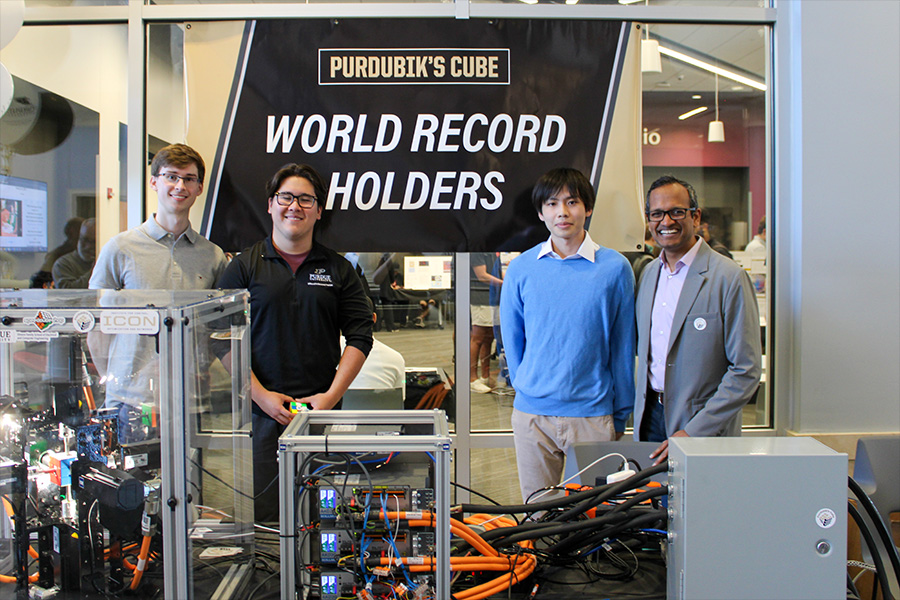
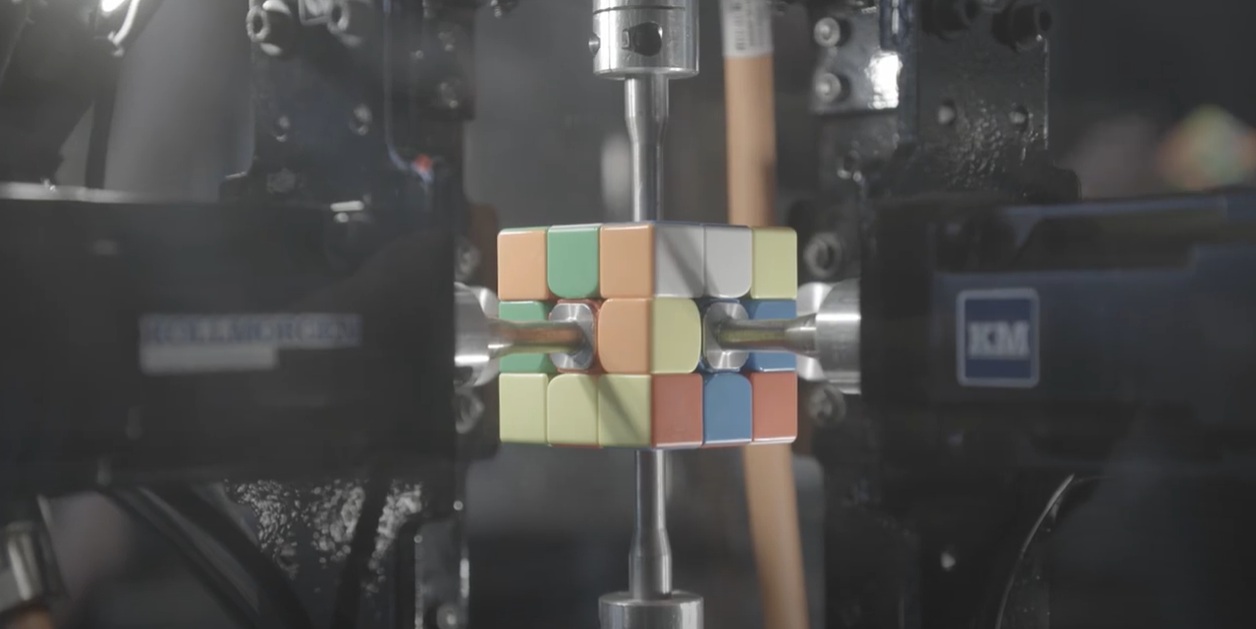
Puzzle people have previously calculated the human limit for solving a Rubik’s Cube, as well as the fastest known mechanical solve of a Rubik’s Cube. Years ago, I myself tried to figure out how many years it would take to use every unique Sudoku grid possible.

But optimization is something altogether different, and it’s a intriguing way to look at the potential of puzzles.

A Redditor by the name of AntiqueRevolution5 posed the following question a few days ago, and it absolutely fits the bill of both puzzly calculation and optimization:

What would a Boggle grid look like that contained every word in the English language?

Well, there are somewhere between 1 million and 1.5 million words in the English language, so I imagine it would be pretty big.

The redditor is an artist, and their goal is to make a sculpture composed of Boggle dice. And their concept is fascinating:

The idea for the piece is that it’s a linguistic Rorschach that conveys someone could find whatever they want in it. But it would be even cooler if it literally contained any word someone might reasonable want to say or write.

So, where do you start with something like this? Our artist has a suggestion:

To simplify, we could scope it to the 3000 most important words according to Oxford. True to the nature of Boggle, a cluster of letters could contain multiple words. For instance, a 2 x 2 grid of letter dice T-R-A-E could spell the words EAT, ATE, TEA, RATE, TEAR, ART, EAR, ARE, RAT, TAR, ERA. Depending on the location, adding an H would expand this to HEART, EARTH, HATE, HEAT, and THE...

What would be the process for figuring out the smallest configuration of Boggle dice that would let you spell those 3k words linked above? What if the grid doesn’t have to be a square but could be a rectangle of any size?


Naturally, creative minds accepted the challenge.

One user claimed that an online Boggle website called Squaredle has two 10×10 boards with just under 900 words of 4 or more letters.

Another user, a programmer, was able to create an 18×18 grid with approximately 450 words in under 10 minutes.

As you might expect, I was unable to resist diving into this one. But I’m not a programmer, so let’s do some meatball mathematics to get a sense of the scope of the puzzly conundrum before us.


We can extrapolate that if we get 450 words in an 18×18 grid, we’d need seven 18×18 grids connected to approach 3,000 words, assuming there’s some consistency in letter efficiency.

If we stick to the rectangular suggestion of the original post, a 63×36 rectangle (six 18×18 grids in a 2×3 arrangement, plus a 9×36 grid attached at the bottom) should allow for those 3,000 words.

Now, I can’t verify that. But 63×36 means 2,268 letters in the grid. Which, with a 3,000 word goal (including two- and three-letter words) kinda feels possible.

Of course, this is just to cover that 3,000 word list. Remember that the English language is estimated to contain between 1 million and 1.5 million words total.

That’s 333-and-a-third times more, if we use a million words. It’s 500 times more words if we assume 1.5 million words.

So, that’s 2,268 letters in our 3,000 word grid. Multiply that by 500 and you get 1,134,000 letters in the grid.

That means we’d need a grid that’s 1,065 x 1,065 to cover the entire English language.

So what does that mean in Boggle terms?

A standard six-sided die is 16 millimeters. That’s 17,040 millimeters, or 17.04 meters. That’s 67.09 inches. We’re talking about a Boggle game that’s FIVE AND A HALF FEET ACROSS.

That’s one heck of a Boggle grid.

Now, of course, these numbers are all estimates, and dubious ones at that. But I couldn’t resist TRYING to find an answer, even if it’s just a ballpark number.


You see, fellow puzzlers, this brand of puzzle efficiency tickles something in my brain, as there are several Penny Press puzzles I quite enjoy that employ a similar idea.

Starspell (pictured above) involves finding words in a star-shaped grid, except unlike Boggle, you can reuse letters. So you could bounce back and forth from A to N and spell BANANA, for instance.

Word Maze involves a small grid with many words hidden inside Boggle-style (though it’s actually a themed word list, meaning it’s not optimized to just cram as many words inside as possible).

Letter Perfect is a reversal of the idea, seeing if the solver can arrange letters in a mostly-empty 4×4 grid to fit every word in a given wordlist. It’s excellent training for a challenge like this, since you learn about efficiency of letter placement and how many words can spell out with neighboring letters if you’re clever.


I don’t know if any programmers will figure out how to build a language-spanning Boggle grid, but I look forward to seeing them try!

Happy puzzling, everyone.