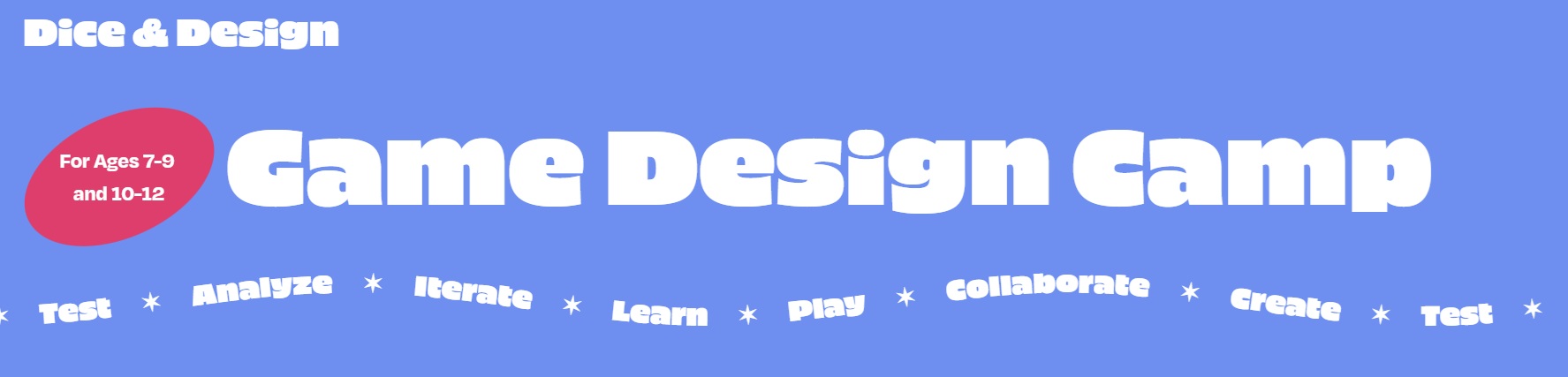
This summertime gaming festival of fun is the creation of Caro Murphy, an award-winning game designer who not only founded the Boston Festival of Indie Games, but has lectured on game design at the university level and contributed heavily to Disney’s Star Wars: Galactic Starcruiser interactive experience and Club Drosselmeyer events like this year’s Cthulhu Luau!
They’ve put together a five-day program to teach kids about game design and help them create their own card games, board games, roleplaying games, or LARPs, whatever interests them!
With morning and afternoon sessions to choose from, this seems like an awesome way to get the youngsters in your life started on a lifelong journey of game creating, appreciating, and collaborating.
Do you know of any other kid-friendly puzzly or game-fueled events happening this summer, fellow puzzlers? Let us know in the comments section below! We’d love to hear from you.
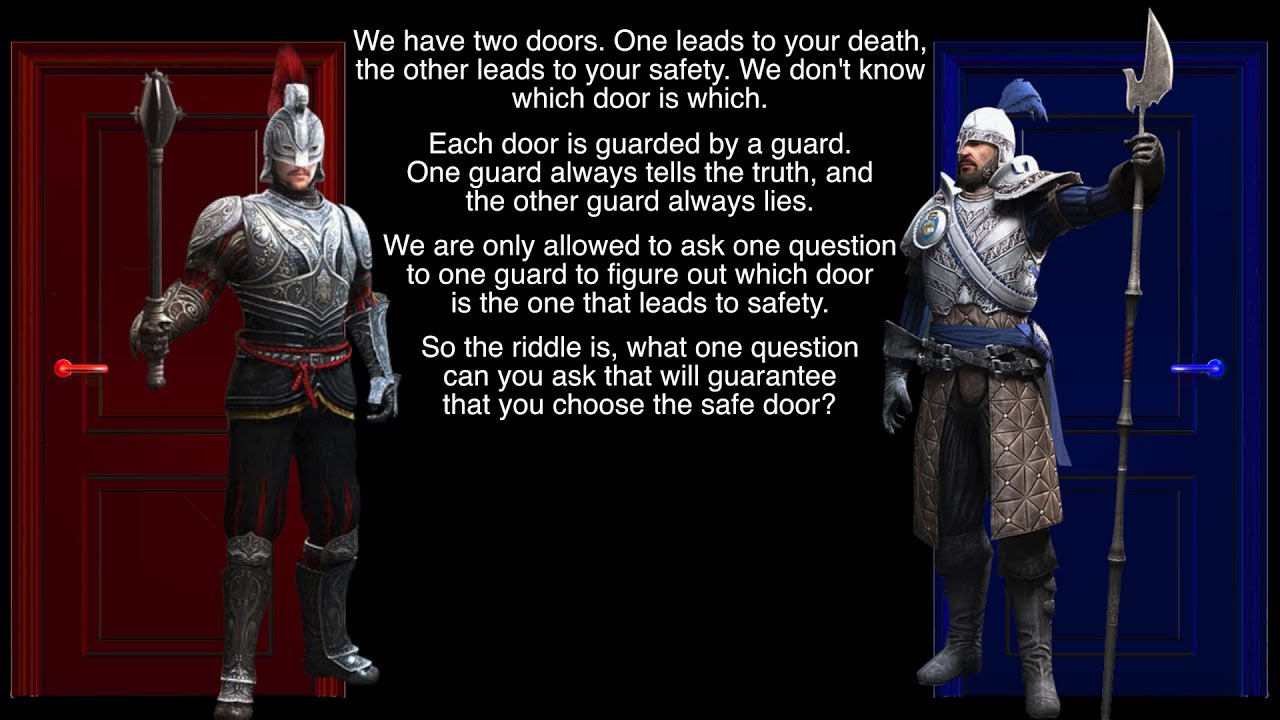
Hey there, fellow puzzler. Stop me if you’ve heard this one before:
Ah yes, the riddle of the two guards. Also known as the two doors puzzle, the two guards/two doors puzzle, and, my personal favorite, that awful crap riddle.
It’s easily the most famous example of a Knights and Knaves logic puzzle, which all work off the idea of individuals who always lie or always tell the truth, and a solver who needs to deduce how to proceed.
I think the best and most colorful presentation of the riddle was in the film Labyrinth, thanks to Jennifer Connolly and some very lovely puppetry:
I’ve always wondered about this riddle. Is there a sign posted that explains the rules? Because otherwise, you’d assume the guard who tells the truth would have to explain the rules…
Unless the one who lies tells you the rules, which are a lie, and it’s a trap and you’re totally screwed!
Geez, this is getting complicated already.
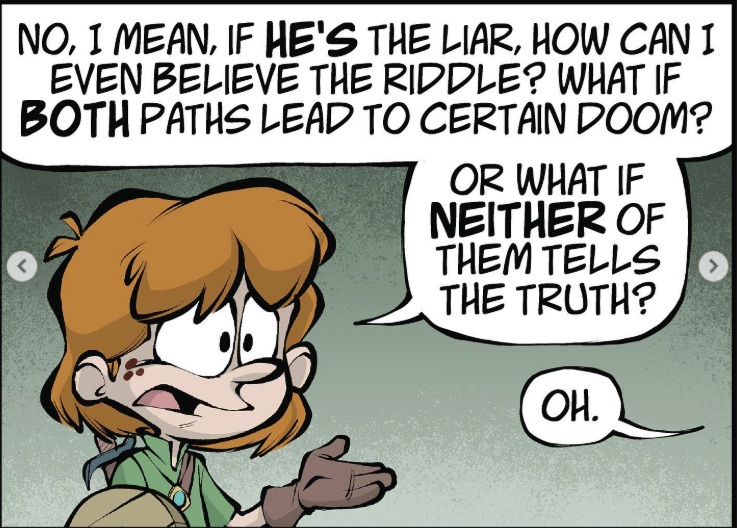
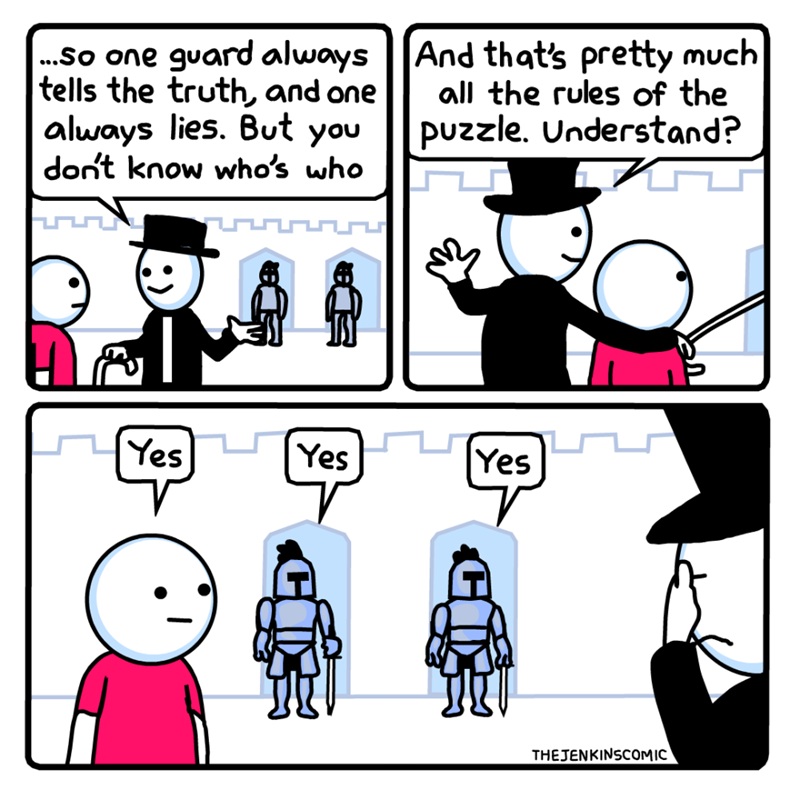
Oh good, I’m not the only one who agonizes over this sort of thing. Image courtesy of Crabgrass Comic.
Let’s assume the rules are fair. There’s a guard who always lies and a guard who always tells the truth, and you need a single question to root out which door is the safe one to enter.
The traditional answer is to ask one guard which door the OTHER guard would say leads out.
But what if one of the guards is INVISIBLE?!
If the guard you asked is the one who lies, then he will lead you astray by telling you (falsely) that the other guard—the truthful guard—will point you towards door B. This makes door A the safe bet.
If the guard you ask is the one who tells the truth, he will tell you (honestly) that the other guard—the lying guard—will point you towards door B. This makes door A the safe bet.
In both cases, the outcome is the same: walk through the opposite door.
Naturally, people have tried to find ways around this.
Some suggest that you ask the guards to walk through their respective doors and report back what they see. I don’t know that this would work, because it’s not clear if the guards would have to follow your orders. Also, we don’t know if certain doom for US would be certain doom for the guards. If they both walk out totally fine, it probably won’t work.
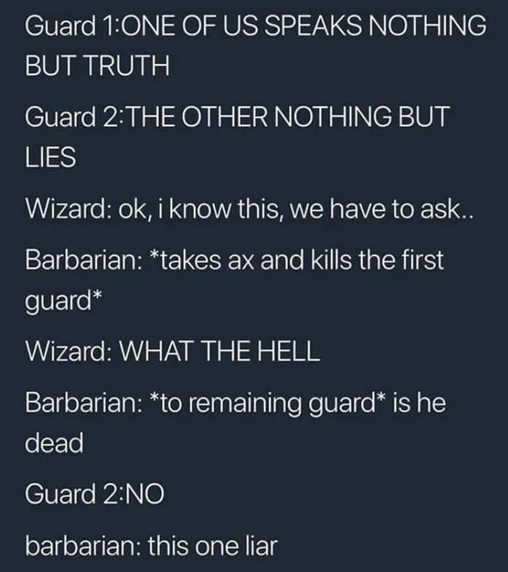
For another option, you can act in typical Dungeons and Dragons-fueled fashion and use what I call the direct approach:
But unfortunately, it misses the meat of the riddle. It’s not just knowing which guard lies and which guard tells the truth, it’s about knowing which door to take as well.
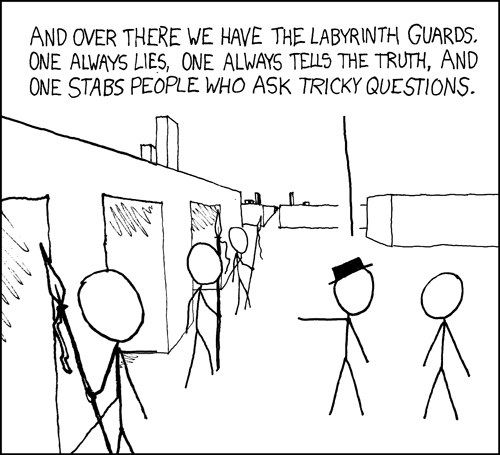
Of course, if you believe the folks at XKCD, there are consequences for cleverness as well:
Although it is a riddle easily given to weasel words and pedantry, it has led to some wonderful comedy.
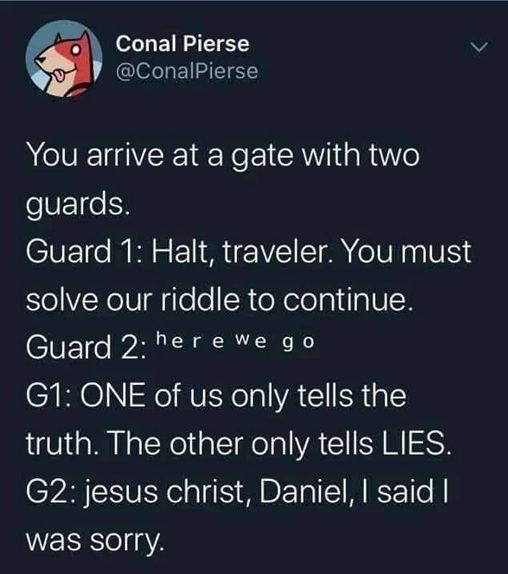
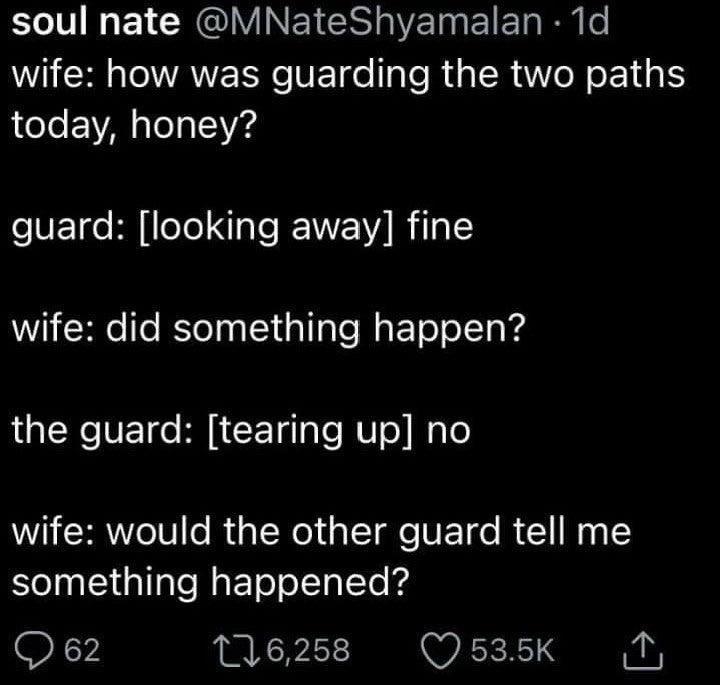
This joke, for instance, gives us some much-needed backstory to the guards and their current circumstances:
In a similar vein, this one lets us see one guard’s life after clocking out for the day:
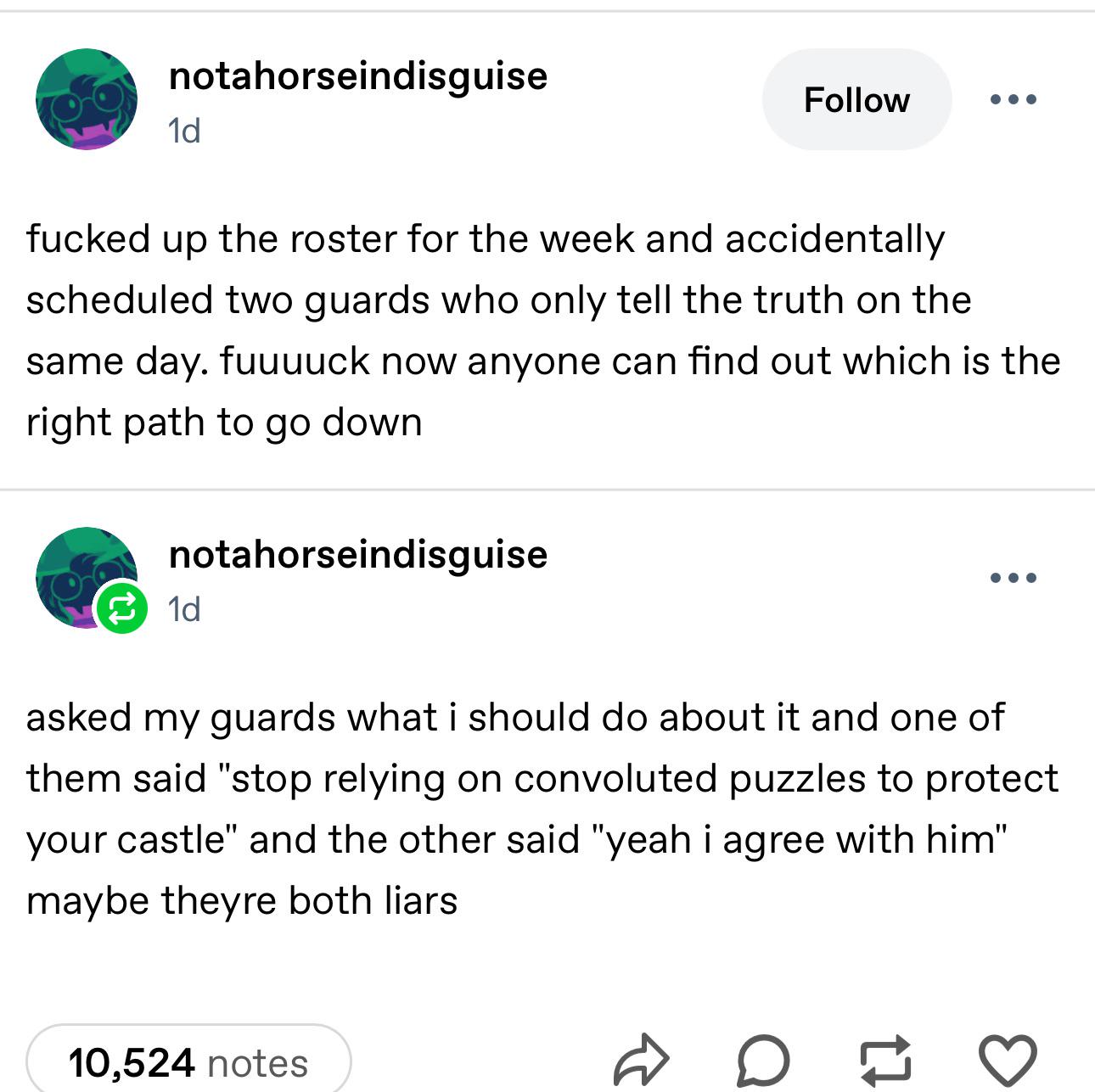
I also enjoy this one, which ponders what sort of person would employ a riddle like this as a security measure in the first place:
So I put it to you, fellow puzzler: how would you tackle the riddle of the two guards? Labyrinth style? Barbarian style? Or have you conjured up a different question to ask the guards?
Let us know in the comment section below. We’d love to hear from you!
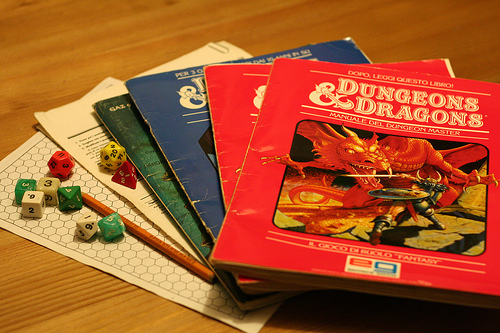
It’s a little sad that the only time Dungeons & Dragons hits the headlines these days, it’s for stupid behind-the-scenes reasons and not terrific storytelling reasons.
Over the last two years, Dungeons & Dragons has been in the news for:
-trying to destroy the third-party market from which they profited by releasing a new OGL (the gaming license that allows third-party companies to make content for the D&D brand) -repeatedly using AI-generated material after claiming they would not -sending actual Pinkerton agents to someone’s house for revealing a Magic the Gathering product ahead of time -being accused of racial stereotyping and social tone-deafness for one of the playable races in Spelljammer –gutting their Sigil team and continuing to push for more AI-fueled content (including the idea of AI Dungeon Masters to run their games)
Except for the successes of Baldur’s Gate 3 (which is more due to the video game company than Wizards of the Coast or Hasbro) and the D&D movie (which has no follow-up plans that we’re aware of), it’s been a cavalcade of poor choices, mismanagement, and actions that seem designed to burn good will with the audience rather than build it.
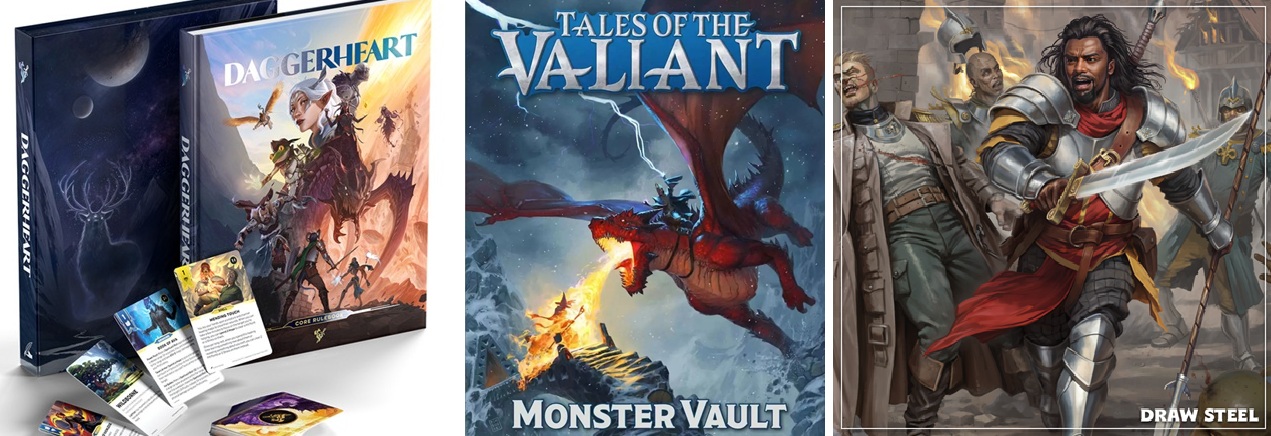
In the aftermath of the OGL scandal, several competitors have risen to challenge D&D’s status as the RPG juggernaut, including Matt Colville’s MCDM RPG/Draw Steel, Kobold Press’s Tales of the Valiant, and Critical Role/Darrington Press’s Daggerheart.
And now they’re hemorrhaging talent on the creative side as well.
Back in April, Chris Perkins and Jeremy Crawford both departed from Wizards of the Coast, D&D’s parent company.
This was rightfully seen as a huge blow to the brand, as Perkins and Crawford were not just the most visible representatives D&D had to the playing public, but also the architects of modern D&D over the last two decades or so.
They were the smiling public faces that endured the slings and arrows from an unhappy fanbase, doing their damnedest to explain away the poor choices foisted on them by WOTC and Hasbro. Whatever good will the brand had, much of it was due to those two.
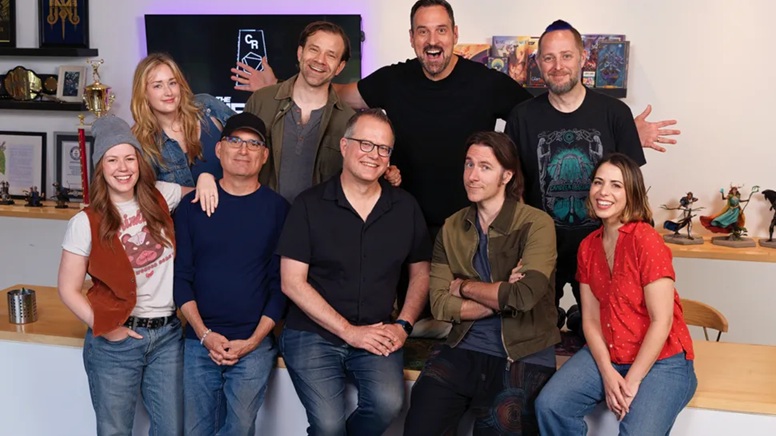
A few days ago, Perkins and Crawford announced they were joining Darrington Press, the publishers of D&D competitor Daggerheart, with the intent of producing new non-D&D RPG content. Given that Critical Role has been credited with a large chunk of D&D’s continued popularity over the last decade, seeing two of the most influential voices in D&D join them should give Wizards of the Coast shivers.
This week also marked the departure of two more important voices at WOTC, one by choice, and one not by choice.
Jess Lanzillo, vice president of the D&D brand announced she was stepping away from WOTC after eight years working on both Magic: The Gathering and D&D. She has been credited with pushing for new releases, helping shepherd 2024’s revised rules, and increasing branding opportunities for Magic: The Gathering.
Head of content (and face of much of D&D’s video/online content) Todd Kenreck announced he was laid off from D&D this week as well. Losing another popular public face of the brand — and doing so by choice this time — marks another short-sighted decision by WOTC/Hasbro higher-ups.
Now, let me be clear, I’m not ringing alarm bells and claiming that D&D is dying. Far from it. D&D IS roleplaying to so many people, and they could coast on that for years.
But it’s worth noting that this FEELS like a sea change in the market. I would argue consumer confidence in D&D hasn’t been this low since the late 90s/early 2000s when the brand floundered wildly after the release of Fourth Edition (and the rise of Pathfinder in its wake), but that doesn’t mean doom and gloom.
All those alternatives are looking to build a name for themselves, particularly on the Darrington Press side by hiring Crawford and Perkins, as well as Daggerheart making waves by completely selling out every edition of their new releases.
Hasbro and WOTC desperately need to reassess what they THINK the audience wants, as well as what Dungeons & Dragons should be.
The ship isn’t sinking yet, but it’s leaking. And who knows when the iceberg might hit.
There’s so much going on this week in the intertwined worlds of puzzles and games to get into, so let’s skip the intro and get to the good stuff!
Boswords Summer Tournament registration is open!
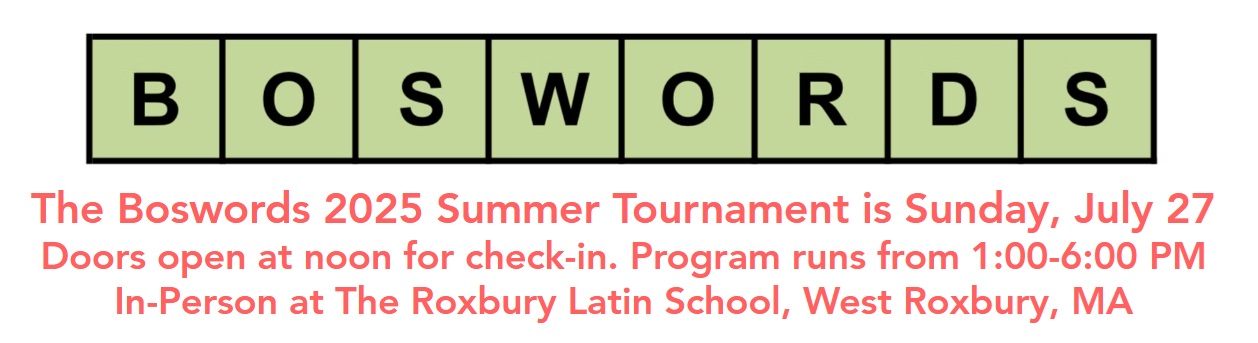
Sunday July 27th marks the latest edition of the Boswords crossword puzzle tournament, and that’s only six weeks away! Thankfully, registration is now open to reserve your spot in this year’s event.
You can participate either in-person or online (as an individual or in pairs) and test your mettle in 5 themed puzzles and a themeless championship puzzle constructed by a marvelous lineup of cruciverbalists: Ross Trudeau, Chandi Deitmer, Hemant Mehta, John Harrington, Mary Tobler, and Quiara Vasquez!
Go to boswords.org for details, to register, or to sample content from previous Boswords events!
Westwords this weekend!
Boswords may be six weeks in the future, but the second annual Westwords Crossword Tournament is happening this Sunday, June 22nd!
This event is also being held both in-person and online, with four themed puzzles and two themeless/freestyle puzzles to challenge solvers. The list of constructors for this year’s event is quite impressive: Amie Walker, Caitlin Reid, David Steinberg, Kevin Christian, Nate Cardin, and Willa Angel Chen Miller!
Last, but certainly not least, Free RPG Day is this Saturday, June 21st.
The concept behind Free RPG Day is simple. All over the world (but mostly in the United States), local game shops, hobby shops, and other outlets team up with RPG publishers to distribute new, fresh, and most importantly, free material for all sorts of different roleplaying games, systems, and settings.
Explore the world of roleplaying games at your friendly local game shop and pick up some game quickstarts and free swag along the way!
Will you be participating in any of these puzzle- and game-fueled activities this weekend, fellow puzzler? Let us know in the comments section below. We’d love to hear from you!
Are you familiar with the concept of twin films, fellow puzzlers?
The basic idea involves the commercial release of two films with extremely similar plots or concepts being released in proximity to each other.
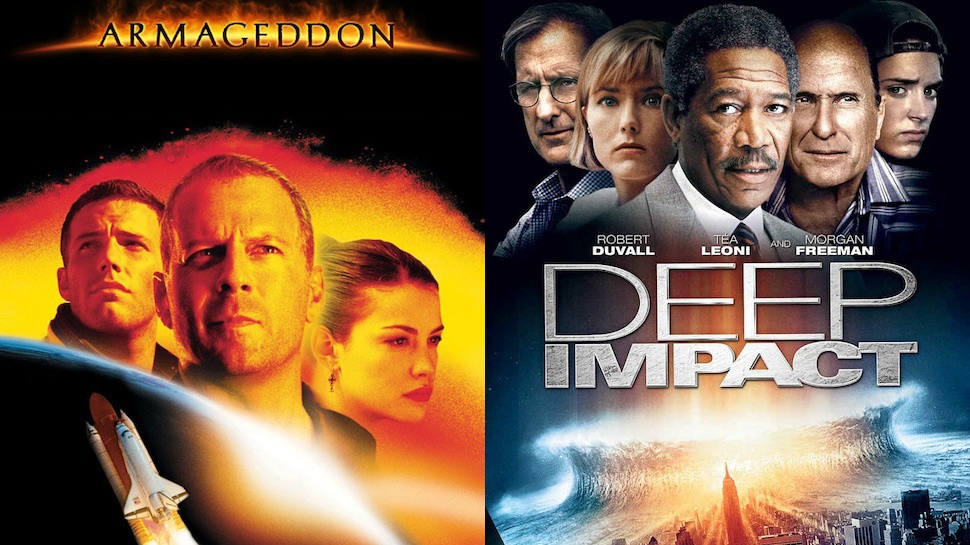
For example, if I described a 1998 global disaster film centered around an impending impact event that threatens to end most or all life on Earth, what film would you name?
You could answer Deep Impact or Armageddon and be correct either way. These are quintessential twin films.
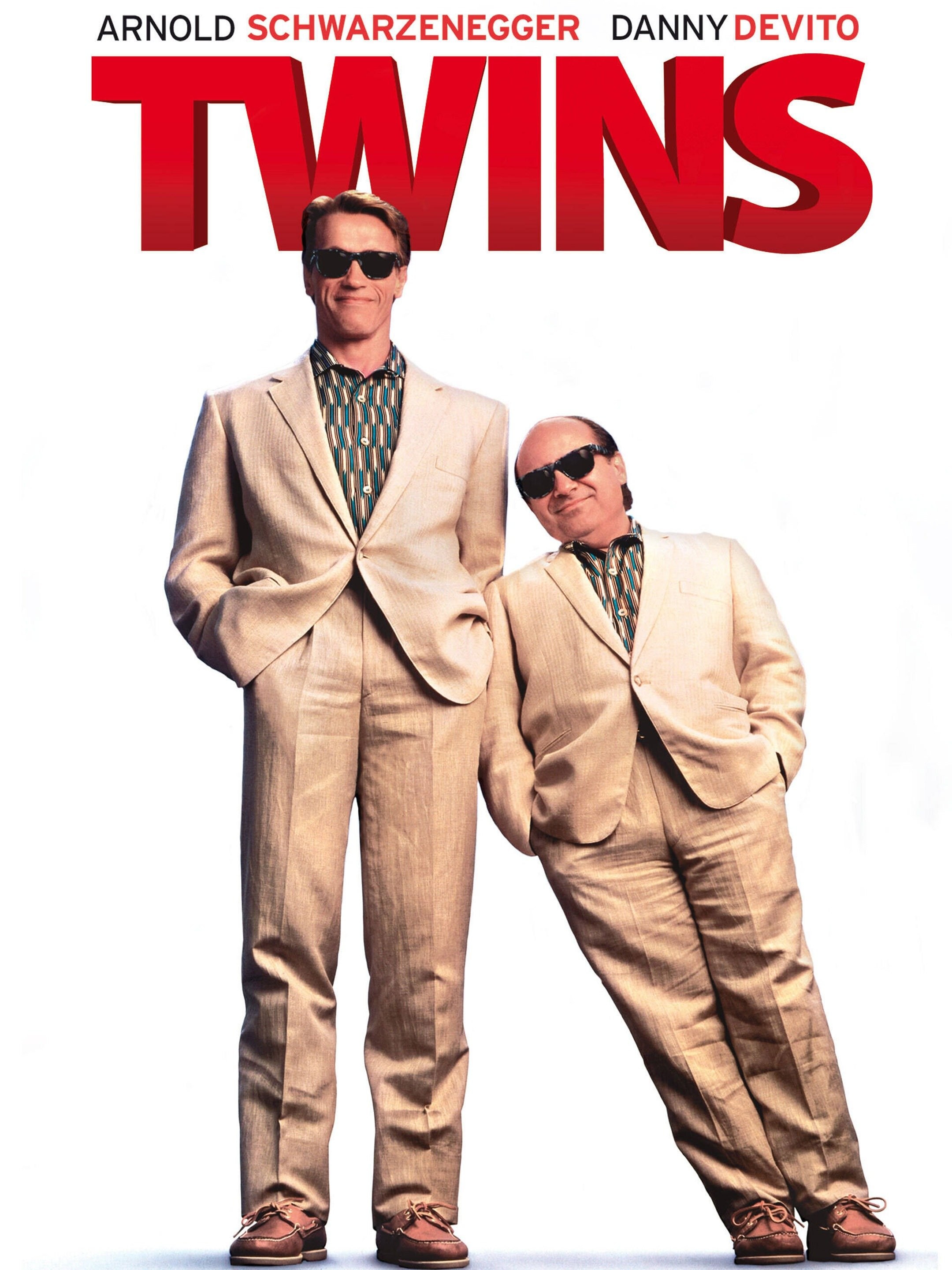
Wait, no, not this kind of Twins film…
So if I give you the year of release and a description, can you name the twin films that fit the clue?
Let’s find out, shall we?
Twin Films Film Festival Test!
1997: disaster films centered around volcanic eruptions
2012: loose adaptations of the fairy tale Snow White
2024: fourth installments of action-comedy franchises centered around African-American cops
2004: romantic comedy films about the rebellious daughter of the President of the United States
1999: supernatural horror films with a man and his relatives, experiencing a series of frightening visions and having the ability to interact with ghosts.
2017: films prominently feature the planning of the evacuation of Dunkirk.
1998: computer-animated films about insects, starring a non-conformist ant who falls in love with an ant princess, leaves the mound, eventually returns, and is hailed as a hero
2018/2019: computer-animated films about abominable snowmen making first contact with humans, both set in the Himalayas.
2006: films about 19th-century magicians
2022/2023: adolescent girls who transform into larger creatures under certain conditions.
1994/1995: films with drag queens going on a road trip across their country (in one case Australia, in the other, the United States) in a journey of self-discovery. Both have eight-word titles.
2023: films based on Dracula released by Universal Pictures
1999: caper films focused on the relationship between an attractive female insurance investigator and a male thief who steals an expensive painting by a famous artist. (Coincidentally, the male lead in both films is also played by an actor who has portrayed James Bond.)
2010: films featuring a stereotypical villain as the protagonist
1996: alien invasion films where the earth is rapidly and suddenly overwhelmed, only to be defeated by a ragtag group with borrowed technology
2005/2006: computer-animated films involving similar animal characters from New York’s Central Park Zoo being introduced to the wild.
How many did you get? Let us know in the comments section below, we’d love to hear from you!
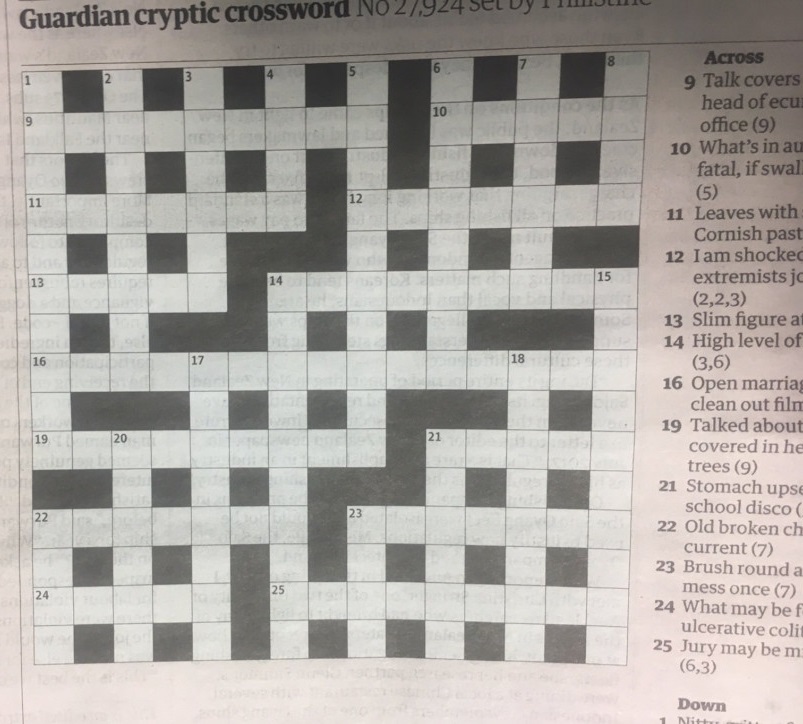
Debuting on the weekend of June 28th and 29th, the WCCC is composed of two events: an individual online championship on the 28th (which is open to any and all competitors) and a World Cup-style offline team championship format on the 29th.
The individual championship involves two cryptic grids, each of which must be solved within 30 minutes. Click here to register!
But please be aware that you’re competing in IST — Indian Standard Time — so you’ll have to adjust your schedule accordingly to have a chance at the cash prize for the top three solvers!
The World Cup Final is being held in person in London on the 29th, and consists of two rounds. The first puzzle will whittle down the field of competitors to the four top contestants from four different countries, who will then compete onstage to solve the final puzzle.
Some of the World Cup competitors have been invited for their past puzzly achievements, but there is an offline preliminary for anyone seeking to try their hand (and can be in London on the day in question to compete).
This looks like my scribblings while solving a cryptic… minus the wedding ring, that is.
I’m definitely not the fastest cryptic crossword solver, so I’m not sure I’ll try my hand at this competition… this year. But if it returns next year, I might just shoot my shot.
Cryptic crossword solving involves many of the same skills as American-style crosswords, but there’s also the wordplay element that makes it quite a different experience for those unaccustomed to that puzzly style.
Will you be trying your hand at competitive cryptic crossword solving, fellow puzzlers? Let us know in the comments section below, we’d love to hear from you!





 PuzzCulture