A Barrage of Brain Teasers!

[Image courtesy of SharpBrains.com.]

One of our favorite pastimes here on PuzzleNation Blog is cracking brain teasers. From riddles to logic problems, we accept challenges from all comers, be they TV detectives or fellow PuzzleNationers!

I got an email a few days ago from a reader who needed help unraveling a few brain teasers from a list she found online. She was proud to have solved most of them, but a few had eluded her.

We’re always happy to assist a fellow puzzler, so let’s take a look at those brain teasers!


In case you want to try them for yourself before we reveal the answers and how to solve each puzzle, I’ll list the original puzzles here and put a nice spoiler-safe break between the questions and the answers.

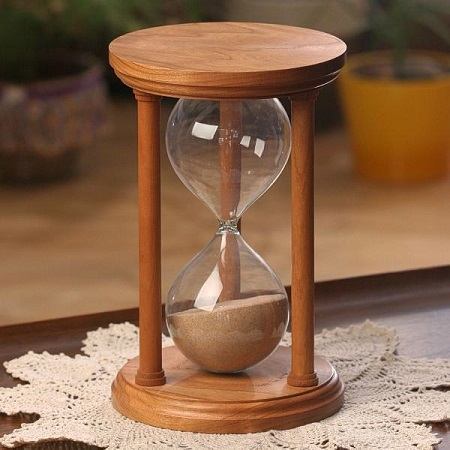
QUESTION 1: If you have a 7-minute hourglass and an 11-minute hourlass, how can you boil an egg for exactly 15 minutes?

QUESTION 2: Name the next number in the following sequence: 1, 11, 21, 1211, 111221, 312211, _____.

QUESTION 3: Four people want to cross a river, but the only option is a narrow bridge. The bridge can only support two people at a time. It’s nighttime, and the group has one torch, which they’ll need to use every time they cross the bridge. Person A can cross the bridge in 1 minute, Person B in 2 minutes, Person C in 5 minutes, and Person D in 8 minutes. When two people cross the bridge together, they must move at the slower person’s pace. Can all four get across the bridge in 15 minutes or less?

QUESTION 4: During a recent census, a man told a census taker that he had three children. When asked their ages, he replied, “The product of their ages is 72. The sum of their ages is the same as my house number.” The census taker ran to the man’s front door and looked at the house number. “I still can’t tell,” she complained. The man replied, “Oh, that’s right, I forgot to tell you that the oldest one likes chocolate pudding.” The census taker then promptly wrote down the ages of all three children. How old are they?

QUESTION 5: There are five bags of gold that all look identical, and each contains ten gold pieces. One of the five bags has fake gold, though. All five bags are identical, and the real gold and fake gold are identical in every way, except the pieces of fake gold each weigh 1.1 grams and the pieces of real gold each weigh 1 gram. You have a perfectly accurate digital scale available to you, but you can only use it once. How do you determine which bag has the fake gold?


[Image courtesy of AwesomeJelly.com.]

Okay, here’s your spoiler alert warning before we start unraveling these brain teasers.

So if you don’t want to see them, turn away now!

Last chance!

Ready? Okay, here we go!


[Image courtesy of Just Hourglasses.com.]

QUESTION 1: If you have a 7-minute hourglass and an 11-minute hourlass, how can you boil an egg for exactly 15 minutes?

A variation on the two jugs of water puzzle we’ve covered before, this puzzle is basically some simple math, though you need to be a little abstract with it.

  • Step 1: Start boiling the egg and flip over both hourglasses.
  • Step 2: When the 7-minute hourglass runs out, flip it over to start it again. (That’s 7 minutes boiling.)
  • Step 3: When the 11-minute hourglass runs out, the 7-minute hourglass has been running for 4 minutes. Flip it over again. (That’s 11 minutes boiling.)
  • Step 4: When the 7-minute hourglass runs out, another 4 minutes has passed, and you’ve got your 15 minutes of egg-boiling time.

QUESTION 2: Name the next number in the following sequence: 1, 11, 21, 1211, 111221, 312211, _____.

The answer is 13112221. This looks like a math or a pattern-matching puzzle, but it’s far more literal than that.

Each subsequent number describes the number before it. 11, for instance, isn’t eleven, it’s one one, meaning a single one, representing the number before it, 1.

The third number, 21, isn’t twenty-one, it’s “two one,” meaning the previous number consists of two ones, aka 11.

The fourth number, 1211, translates to “one two, one one,” or 21. The fifth number, 111221, becomes “one one, one two, two one.” And the sixth, 312211, becomes “three one, two two, one one.”

So, the number we supplied, 13112221, is “one three, one one, two two, two one.”

[Image courtesy of Do Puzzles.]

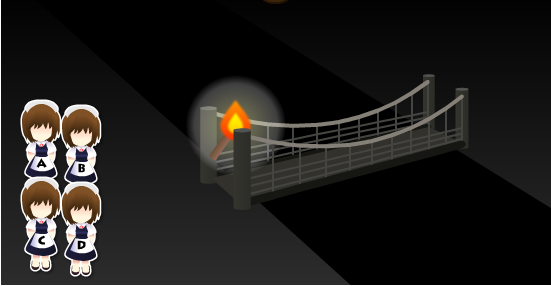
QUESTION 3: Four people want to cross a river, but the only option is a narrow bridge. The bridge can only support two people at a time. It’s nighttime, and the group has one torch, which they’ll need to use every time they cross the bridge. Person A can cross the bridge in 1 minute, Person B in 2 minutes, Person C in 5 minutes, and Person D in 8 minutes. When two people cross the bridge together, they must move at the slower person’s pace. Can all four get across the bridge in 15 minutes or less?

Yes, you can get all four across the bridge in 15 minutes.

This one’s a little tougher, because people have to cross the bridge in both directions so that the torch remains in play. Also, there’s that pesky Person D, who takes so long to get across.

So what’s the most time-efficient way to get Person D across? You’d think it would be so send D across with Person A, so that way, you lose 8 minutes with D, but only 1 minute going back with the torch with A. But that means only 6 minutes remain to get A, B, and C across. If you send A and C together, that’s 5 minutes across with C, and 1 minute back with A, and there’s your 15 minutes gone, and A and B aren’t across.

So the only logical conclusion is to send C and D across together. That’s 8 minutes down. But if you send C back down, that’s another 5 minutes gone, and there’s no time to bring A, B, and C back across in time.

So, C and D have to cross together, but someone faster has to bring the torch back. And suddenly, a plan comes together.

  • Step 1: A and B cross the bridge, which takes 2 minutes. A brings the torch back across in 1 minute. Total time used so far: 3 minutes.
  • Step 2: C and D cross the bridge, which takes 8 minutes. B brings the torch back across in 2 minutes. Total time used so far: 13 minutes.
  • Step 3: A and B cross the bridge again, which takes 2 minutes. Total time used: 15 minutes.

(It technically doesn’t matter if A returns first and B returns second or if B returns first and A returns second, so long as they are the two returning the torch.)


QUESTION 4: During a recent census, a man told a census taker that he had three children. When asked their ages, he replied, “The product of their ages is 72. The sum of their ages is the same as my house number.” The census taker ran to the man’s front door and looked at the house number. “I still can’t tell,” she complained. The man replied, “Oh, that’s right, I forgot to tell you that the oldest one likes chocolate pudding.” The census taker then promptly wrote down the ages of all three children. How old are they?

Their ages are 3, 3, and 8.

Let’s pull the relevant information from this puzzle to get started. There are three children, and the product of their ages is 72.

So let’s make a list of all the three-digit combinations that, when multiplied, equal 72: 1-1-72, 1-2-36, 1-3-24, 1-4-18, 1-6-12, 1-8-9, 2-2-18, 2-3-12, 2-4-9, 2-6-6, 3-3-8, 3-4-6. We can’t eliminate any of them, because we don’t know how old the man is, so his children could be any age.

But remember, after being told that the sum of the children’s ages is the same as the house number, the census taker looks at the man’s house number, and says, “I still can’t tell.” That tells us that the sum is important.

Let’s make a list of all the sums of those three-digit combinations: 74, 39, 28, 23, 19, 18, 22, 17, 15, 14, 14, 13.

The census taker doesn’t know their ages at this point. Which means that the sum has multiple possible combinations. After all, if there was only one combination that formed the same number as the house number, the census taker would know.

And there is only one sum that appears on our list more than once: 14.

So the two possible combinations are 2-6-6 and 3-3-8.

The chocolate pudding clue is the deciding fact. The oldest child likes chocolate pudding. Only 3-3-8 has an oldest child, so 3-3-8 is our answer.

[Image courtesy of Indy Props.com.]

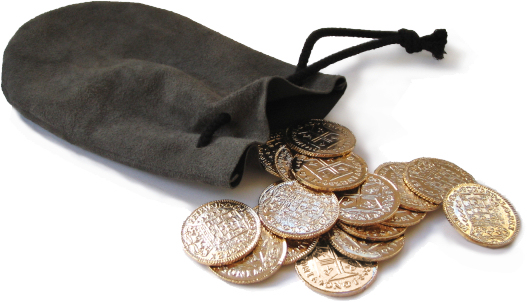
QUESTION 5: There are five bags of gold that all look identical, and each contains ten gold pieces. One of the five bags has fake gold, though. All five bags are identical, and the real gold and fake gold are identical in every way, except the pieces of fake gold each weigh 1.1 grams and the pieces of real gold each weigh 1 gram. You have a perfectly accurate digital scale available to you, but you can only use it once. How do you determine which bag has the fake gold?

With only one chance to use the scale, you need to maximize how much information you can glean from the scale. That means you need a gold sample from at lesst four bags (because if they all turn out to have real gold, then the fifth must be fake). But, for the sake of argument, let’s pull samples from all five bags.

How do we do this? If we pull one coin from each bag, there’s no way to distinguish which bag has the fake gold. But we can use the variance in weight to our advantage. That .1 difference helps us.

Since all the real gold will only show up before the decimal point, picking a different number of coins from each bag will help us differentiate which bag has the fake gold, because the number after the decimal point will vary.

For instance, if you take 1 coin from the first bag, 2 coins from the second, 3 coins from the third, 4 coins from the fourth, and 5 coins from the fifth, you’re covered. If the fake gold is in the first bag, your scale’s reading will end in .1, because only one coin is off. If the fake gold is in the second bag, your scale’s reading will end in .2, because two coins are off. And so on.


Thanks for visiting PuzzleNation Blog today! Be sure to sign up for our newsletter to stay up-to-date on everything PuzzleNation!

You can also share your pictures with us on Instagram, friend us on Facebook, check us out on TwitterPinterest, and Tumblr, and explore the always-expanding library of PuzzleNation apps and games on our website!

Crosswords LA is on the horizon!

It’s kind of cool that it feels like there’s always another crossword tournament on the horizon. Just last month, we had BosWords AND Lollapuzzoola 10.

And now, we’re about a month out from Crosswords LA! It’s happening on Saturday, October 21, at the University of Southern California, and registration is open now!

The format is simple. Four divisions — Expert, Regular, Rookie, and Doubles (allowing you to team up to solve) — pit their puzzly minds against clever clues and crafty constructors. Plus there’s an unscored Casual division for spectators and puzzlers who don’t want to compete!

Competitors will complete five themed puzzles made by constructors C.C Burnikel, Andrea Carla Michaels, Susan Gelfand, Lynn Lempel, Aimee Lucido, Erin Rhode, and friend of the blog Patti Varol! That’s right, an all-female lineup of constructors!

Then the top three solvers will tackle a championship puzzle, complete with live play-by-play commentary!

You can check out their webpage here for full details!

Are you planning on attending Crosswords LA, fellow puzzlers and PuzzleNationers? Let me know! I’d love to hear from you!


Thanks for visiting PuzzleNation Blog today! Be sure to sign up for our newsletter to stay up-to-date on everything PuzzleNation!

You can also share your pictures with us on Instagram, friend us on Facebook, check us out on TwitterPinterest, and Tumblr, and explore the always-expanding library of PuzzleNation apps and games on our website!
Delving into the Lollapuzzoola 10 puzzles!

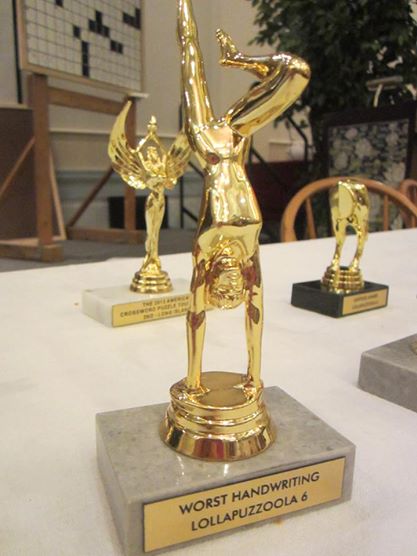
Lollapuzzoola celebrated ten years of puzzling this year, and although I was not in attendance, I did sign up for the Solve At Home puzzles. Last weekend, I finally had a chance to sit down and try my hands at this year’s tournament puzzles, and I was not disappointed. Lollapuzzoola continues to push the envelope with topnotch themes and unique spins on how to bring crosswords to life.

This year’s theme was “Passing the Torch,” so every puzzle had something Olympic or athletic about it, and the constructors were clearly inspired in all sorts of ways. Let’s take a look at what they came up with.


Warm-Up: Twinlets by Brian Cimmet

This puzzle felt more like hitting the ground running than warming up, but it definitely got the creative juices flowing. The solver is presented with two identical grids and two sets of clues, and you have to figure out which grid each answer applies to.

This was complicated by the fact that several of the clues were the same for multiple entries. For example, the clue to 1 Across for both grids was “Olympic season.” The grids themselves also made for a tough solve, since there were several sections only connected by a single word, so you had fewer ins to tell you which answer applied.

That being said, the Olympic theme was well-executed and working back and forth made for an enjoyable solve.

Interesting grid entries included BALLSY, ONE-NIL, BIONIC and A-MINOR, and my favorite clues were “Asian river (or mountains) (or maybe both, I can never remember)” for URAL and “One might check it at the door” for EGO.

[Image courtesy of The Odyssey Online.]

Puzzle 1: Let the Games Begin by Paolo Pasco

The tournament proper gets off to a strong start with Puzzle 1, a really clever opening solve where the letters in various Olympic events have been removed from the other entries along that row. For instance, the first answer in the top row, JUDO, has each of its letters removed from the four subsequent entries: (J)ABS, FA(U)ST, (D)RIPS, and GO(O)DS.

This technique made for a curiously sized grid — 23×13 — but an impressive grid overall, since each of the words with missing letters still formed actual words. BENCHED became BEND and TRYOUTS became TOUTS when the CHE and RY were removed to be part of ARCHERY.

Interesting grid entries included K-POP, LABOR DAY, NASCAR DAD, and SIREE, and my favorite clues were “Mythological character who had a problem with hot wings?” for ICARUS, “Prop for Fred Astaire or Yoda” for CANE, and “Pair in a boat” for OARS.

Puzzle 2: Crossword De-Cat-hlon by C.C. Burnikel

Puzzle 2 was unlike anything I’ve ever seen before. It was a relatively easy solve, one that most solvers would no doubt finish well before the end of the 20 minutes allotted. But it was also hilariously interactive. The themed entries were instructions for different catlike actions for you to perform aloud!

For instance, MEOW FOR SOME MILK was one answer, and the clue instructed you to do so nine times, one for each “life.” It’s a very funny idea that no doubt must have made for a fairly unique and chaotic experience at the tournament.

Interesting grid entries included HOOKUP, PALE ALE, and HEEHAW, and my favorite clues were “Palindromic Swedish band with a palindromic hit” for ABBA and “Car mechanic’s wiper” for RAG.

Puzzle 3: Gym Playlist by Erik Agard

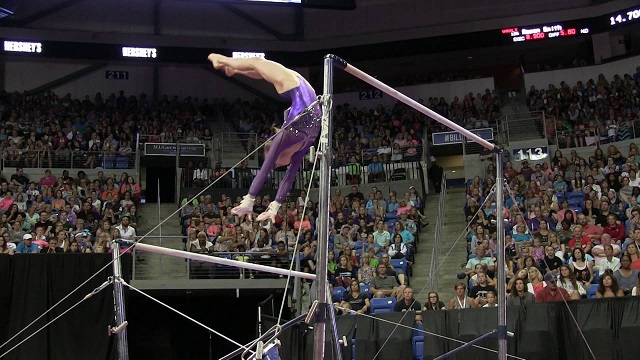
We take a break from the Olympics specifically to focus on music in Puzzle 3, where we have song titles broken into two parts on different lines, like NINETOFIVE, which would have read out in order, except TOFIVE was one row lower. Why? Well, because they become UNEVEN BARS, as the revealer explains.

It’s a very playful theme that mixed well with some engaging grid fillers, and a really fun solve overall.

Interesting grid entries included MAURITANIA, SCHMOE, MENUDO, MEDICO, and POUFS, and my favorite clues were “Titular thief of literature” for GRINCH and “Singer Lavigne who allegedly died in 2003 and was replaced by a lookalike” for AVRIL. (Now that’s some trivia!)

[Image courtesy of YouTube.]

Puzzle 4: New Biathlons by Francis Heaney

Probably the toughest puzzle of the tournament, save for the finals, Puzzle 4’s themed clues felt more like clues for a cryptic puzzle than a regular crossword. There were essentially two clues for each answer. The first was a “new biathlon” — a sport formed by combining two events into one hybrid event, like skiing and shooting — bookended by parts of an additional word. The second clue was a description of the word chain also formed both those letters.

For instance, 20 Across was clued “Indian instrument + new biathlon = Caption of a photo in which reviewer Gene and an alien sit atop a carpet, next to a sailor.” That’s a LOT of information, but it does make sense when you complete the answer: SISKELETONRUGBYTAR. You have SITAR with SKELETON RUGBY inside it, and you also have SISKEL ET ON RUG BY TAR.

Couple that with some hard grid fill, and you have a difficult but really engaging puzzle.

Interesting grid entries included CATARRH, UNICEF, ESTADOS, LAUNDROMAT, and TELL ME THIS, and my favorite clues were “When repeated, ‘Look, Senorita Sorvino’!” for MIRA and “What the wicked get” for NO REST.

Puzzle 5: Stick the Landing by joon pahk

The tournament puzzles closed with joon pahk’s immensely clever Puzzle 5, which presented four themed entries that vaulted the black squares between neighboring spaces on the same row in order to complete the answer. You see, each black square represented a pole vault, and those poles — MAY, SOUTH, SKI, and TOTEM — were found elsewhere in the grid. So 86 Across, MAY, bridged the gap between 24 Across’s JOHNM and YER to form JOHNMAYER.

This gimmick meant that, for instance, there was no 25 Across clue, because 25 Across was part of 24 Across, just separated by a black square, which I confess was confusing at the outset until I figured out the puzzle’s hook. Still, it was a very satisfying solve and one of the highlights of the day.

Interesting grid entries included BROUHAHA, I GOT THIS, UM OK, DC AREA, and DASHIELL, and my favorite clues were “Insult that Bugs Bunny mistakes for ‘maroon’” for MORON and “Cow who hasn’t had a cow” for HEIFER.

[Image courtesy of Wikipedia.org.]

Puzzle 6: Finals by Mike Nothnagel and Doug Peterson

As always, there were two sets of clues for the Finals puzzle, the Local and the more difficult Express clues. But this year, there was an additional challenge to tackle.

As both solvers in person and at home were warned, “Each finalist will have a personal Marker Caddy. The Marker Caddy will be holding a cup of several markers. We aren’t going to say anything else, except that we’ve never had Marker Caddies before. Just this year. That is all.” Non-finalists were provided with a small four-pack of crayons containing a green, a red, a blue, and a yellow crayon.

Those colors would come in handy, as there were four O’s in the grid that needed to be marked with the colored markers. The first O in LOW RESOLUTION was blue, so that OSTATES would really be BLUE STATES, just as the last O in LOW RESOLUTION was red, so that OPEPPER was really RED PEPPER.

The same followed for the O in AS TO and the O in OUTS, so that BIGOTAXI would read BIG YELLOW TAXI and THEOMILE would read THE GREEN MILE.

Couple that with some very tough cluing — in the Express Finals anyway — and you’ve got one heck of a finale to the tournament.

Interesting grid entries included SQUAWKS, HEY WAIT, LA PLATA and GAMETE, and my favorite clues were “Station not popular with Rush fans” for MSNBC and “Nancy who solved ‘The Clue in the Crossword Cipher'” for DREW.

There was also a tiebreaker puzzle I quite enjoyed, especially with clues like “Do goo” for GEL and “Boxing great, or her father” for ALI.


The puzzles at Lollapuzzoola always impress, and this year was no exception. The grids were tight, there was very little crosswordese, and the creative puzzle gimmicks — the markers, the cat activities, the athletics in the grids (like pole vaunting or uneven bars) — ensured that not only would fun be had by all, but that the unique puzzles would linger in your memory longer.

Mission accomplished, and congratulations on the competitors and the organizers who made it all happen. The tenth year of the tournament showed that Lollapuzzoola is only getting more creative, more groundbreaking, and more clever with each passing year.

I can’t wait to see what they come up with next year!


Thanks for visiting PuzzleNation Blog today! Be sure to sign up for our newsletter to stay up-to-date on everything PuzzleNation!

You can also share your pictures with us on Instagram, friend us on Facebook, check us out on TwitterPinterest, and Tumblr, and explore the always-expanding library of PuzzleNation apps and games on our website!

An Anniversary Crossword Cruise!

Someone once told me that part of the appeal of a crossword puzzle is its old-world charm. It’s just you, a pencil, and your wits, pitted against an empty grid and some dastardly clues.

And although crosswords have moved leaps and bounds beyond those humble origins and into the modern day with online solving and puzzle apps galore, they still retain those old-school trappings.

So it seems apropos that Cunard Cruise Line is offering The Crossword Crossing, a 7-night transatlantic journey aboard the Queen Mary 2 in honor of The New York Times crossword’s 75th anniversary! What’s more old-school that sailing across the Atlantic whilst celebrating a major anniversary?

From the announcement on the Cunard website:

With daily game sessions, lectures and crossword-themed activities, you’ll have the opportunity to solve your way across the Atlantic.

They’ve already announced several special guests, including constructor Joel Fagliano and “Wordplay” columnist and champion of all things puzzly Deb Amlen, and I suspect more names will be announced as the December launch date nears.

It’s a very cool idea, a puzzly variation on the yearly gaming-, music-, and comedy-fueled JoCo Cruise we’ve discussed in the past.

So what do you think, fellow puzzlers and PuzzleNationers? Is The Crossword Cruise for you? Let us know in the comments section below!


Thanks for visiting PuzzleNation Blog today! Be sure to sign up for our newsletter to stay up-to-date on everything PuzzleNation!

You can also share your pictures with us on Instagram, friend us on Facebook, check us out on TwitterPinterest, and Tumblr, and explore the always-expanding library of PuzzleNation apps and games on our website!
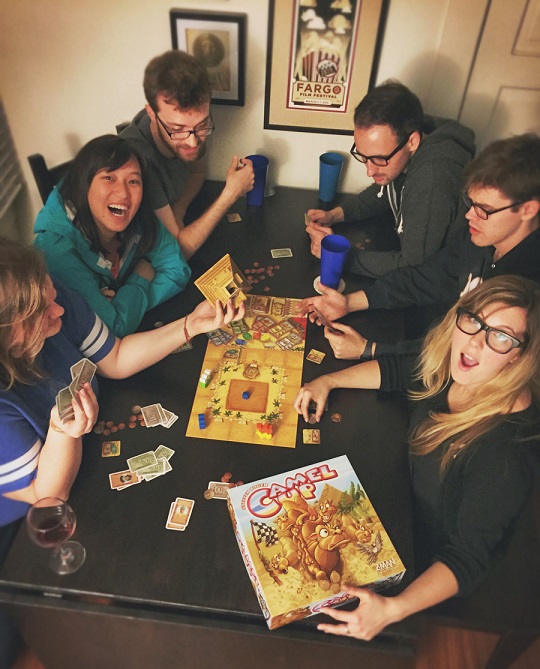
Board Games: A Good Reason to Gather

Are board games the cure for what ails ya?

According to Quartz writer Annaliese Griffin, they just might be.

She suggests that board games provide a “temporary respite from the problems of 21st-century life.”

By bringing people together — something often lacking from today’s increasingly isolated lifestyles where people interact more through social media than face-to-face engagement — board games become a community builder, a catalyst for socialization.

From the article:

A good board game builds in enough chance so that any reasonably skilled player can win. Even in chess, famously associated with warfare and military strategy, the emphasis is not on who ultimately wins, but on the ingenuity that players display in the process.

In all of these ways, board games release players — however temporarily — from the maxim that life is divided into clear, consistent categories of winners and losers, and that there is a moral logic as to who falls into which category. As film and media studies professor Mary Flanagan tells The Atlantic, board games prompt us to reflect on “turn-taking and rules and fairness.”

[Image courtesy of Catan Shop.]

What’s interesting to me about the article is that she mentions Euro-style games like Settlers of Catan and Carcassonne — which are two of the industry leaders, no doubt — but still games that pit players against each other.

What’s interesting to me about an article that’s meant to be about how board games can make you “a nicer person with better relationships” is that the author focuses exclusively on competitive games. I am a huge fan of a smaller subsection of board games — cooperative games — which invite the players to team up against the game itself. You collaborate, strategize, and work together to overcome challenges, succeeding or failing as a group.

In cooperative games, the glow of your successes are heightened because you get to share them with your teammates. And the failures don’t sting as much for the same reason.

[Image courtesy of Analog Games.]

Co-op games like SpaceTeam, Castle Panic!, Forbidden Island, The Oregon Trail card game, and Pandemic — not to mention many roleplaying games like Dungeons & Dragons — reinforce the positive, social qualities of all board games. I highly recommend checking them out.

And with the rise of board game cafes like The Uncommons in New York and Snakes and Lattes in Toronto, plus play areas at conventions like Gen Con and events at your Friendly Local Game Shop, there are more opportunities than ever to engage in some dice rolling camaraderie.

You can even make it a regular thing. Every Wednesday, we play a game at lunch time, and it quickly became one of the highlights of the week. (This week, we celebrated winning Forbidden Desert on our Instagram account! I always intend to post something every Game Wednesday, but I often forget because I’m so focused on playing the game.)

Take the time out to enjoy puzzles and games. You won’t regret it.


Thanks for visiting PuzzleNation Blog today! Be sure to sign up for our newsletter to stay up-to-date on everything PuzzleNation!

You can also share your pictures with us on Instagram, friend us on Facebook, check us out on TwitterPinterest, and Tumblr, and explore the always-expanding library of PuzzleNation apps and games on our website!

PuzzleNation Product Review: //CODE: On the Brink

[Note: I received a free copy of this game in exchange for a fair, unbiased review. Due diligence, full disclosure, and all that. /end disclaimer]

There has been a tidal shift over the last few decades from the analog realm to digital. So much happens in cyberspace, by email, and in the liminal spaces between smartphones and computers, that it feels like we’re leaving behind physical media entirely. In the next decade, knowledge of programming will become an essential skill.

And it’s never too early to begin laying the foundation for that future. The folks at ThinkFun have been ahead of the curve there for a long time — their game Robot Turtles is a prime example — and they continue to push forward with their new //CODE Programming Game Series, a line of puzzly products designed to teach the basics of programming to young solvers.

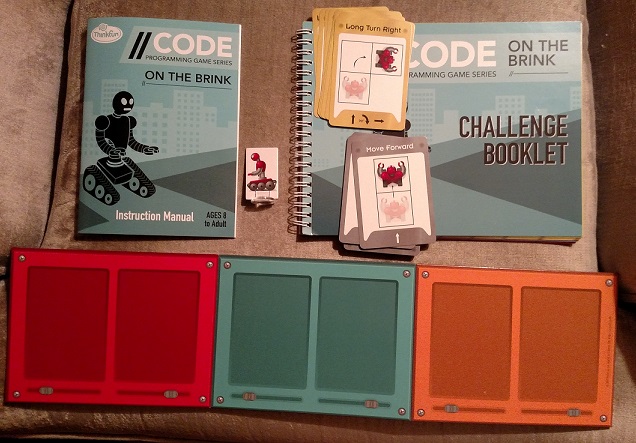
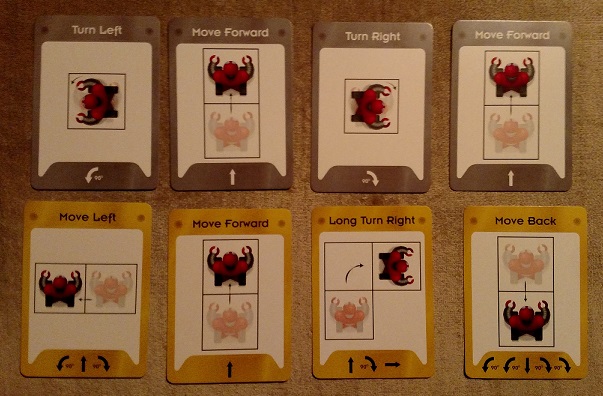
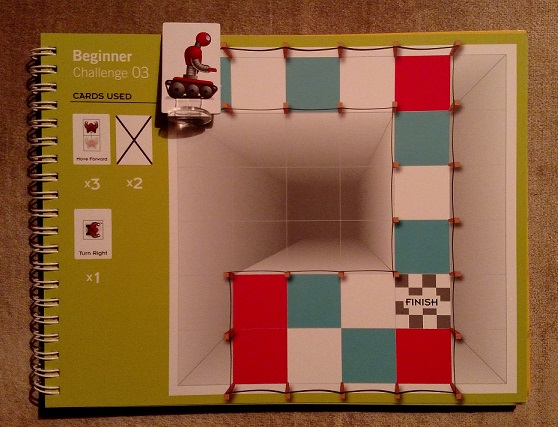
The first game in the series, On the Brink, serves as an excellent primer. The game is based around a simple concept: navigating a robot along a particular path. This path can twist, turn, and even cross itself. But it’s up to the solver to figure out how to use the available programming cards to control and determine the robot’s path.

There are two sets of programming cards, one simpler deck designed for the first 20 challenges and one larger deck designed for the more difficult challenges that follow. Just as you learn simpler commands before you learn finer, more detail-oriented, and more complex ones, you must master the basic commands in On the Brink before moving forward.

Whereas Robot Turtles required players to be supervised by a Turtle Master who governed the setup, difficulty, and execution of commands, On the Brink can be played alone, as the solver tackles each puzzle in the challenge booklet, complete with starting cards, a given path to replicate, and colored boxes on the board that align with the three sections of the control panel.

I was impressed by the amount of variety to be found in a relatively small deck of commands. A cagey programmer can navigate the robot through some unexpectedly thorny paths, reminding me a bit of the step-by-step deductive reasoning that made Lunar Landing such a delightful challenge.

One way that On the Brink improves upon Robot Turtles is with the concept of commands that continue to run once activated. In On the Brink, your robot will follow a command for as long as the programming cards and colored spaces on the challenge booklet page dictate. Just as a command in programming requires parameters in order to know when to stop, your robot needs similar commands. Otherwise, it’s liable to pass right over the finish square instead of landing there perfectly.

On the Brink invites players as young as 8 to tackle the various challenges in the booklet, either alone or in groups, and the steady ratcheting-up of difficulty teaches the young programmer as they advance, putting new wrinkles and obstacles in the player’s path.

It’s the sort of patient, clever gameplay we’ve come to expect from ThinkFun, and they do not disappoint here. Figuring out how to utilize the available commands and complete the path given makes for an excellent puzzly challenge — especially the later scenarios! — but it never feels inaccessible or overwhelming.

You’re always in good hands with ThinkFun, and they’ve proven it again here with On the Brink.

On the Brink is available from ThinkFun and participating brick-and-mortar and online retailers for $14.99.


Thanks for visiting PuzzleNation Blog today! Be sure to sign up for our newsletter to stay up-to-date on everything PuzzleNation!

You can also share your pictures with us on Instagram, friend us on Facebook, check us out on TwitterPinterest, and Tumblr, and explore the always-expanding library of PuzzleNation apps and games on our website!