No Prep Road Trip Games!

Summer is nearly upon us, and with the arrival of summer, one cannot help but think of road trips with friends and ways to pass the time in the car.

While singalongs, I Spy, and the License Plate Game are all well and good, perhaps you would like a little more challenge with your road trip games.

Well, you’ve come to the right place. Here’s a few suggestions for road trip games that require no preparation, save for a little imagination!


The Movie Game

I learned this game while stuck on a long train ride, and it certainly made the delays go faster.

Someone starts with a film, and the next player names an actor in that film. The next person names ANOTHER film that actor has appeared in, and the next person names ANOTHER actor from that film. And you keep going until someone can’t continue the game.

(If you present an actor or film in the chain that the next player can’t continue, you can only eliminate them by offering another answer, showing that the chain can continue. If you give them a chain link you can’t continue either, you’re out!)

It’s surprisingly difficult, because the more you play, the more devious you try to get. You want to lure other players down garden paths, but you have to make sure you don’t go so obscure that you can’t find your way out as well.


Playlist

Friend of the blog Jen Cunningham created a music-themed version of The Movie Game: Playlist.

In this version, you start with a song and an artist, and the next player either names another song by that artist OR another song using one of the key words in the song.

So, for instance, if you say “Sgt. Pepper’s Lonely Hearts Club Band” by the Beatles and you need to match the song, you could do “Owner of the Lonely Heart” by Yes or “Only the Lonely” by Roy Orbison. Then someone needs to name another Yes song or another Roy Orbison song, and then the chain continues.

I find this game slightly more challenging than The Movie Game because of both the musical knowledge (which isn’t as strong as my movie knowledge) and the associative nature of the song title aspect. But many hours have been wiled away with this game!


My Friend Is An Expert… / Conspiracy Theory

In this game, the first player picks two random subjects, and then prompts the next player with them, and it’s the next player’s job to explain in entertaining fashion something fascinating about them that only an expert would know.

For instance, the first player would go “My friend is an expert in ancient archaeology and polka music” and the next player has to riff on those subjects for a bit. Other players can ask questions to continue the silliness.

The game continues with different topics and additional nonsense.

There’s a similar game to this called Conspiracy Theory where someone has to rant about the grand conspiracy behind two seemingly unrelated topics provided by the other players.

Both of these are great fun with a group of improvisers or snake oil salesman during a long road trip.


Alien Ambassador

(I haven’t played this one yet, but a friend recommended it, so I’m happily including it.)

In this game, one player is selected to be the alien ambassador, an alien visiting Earth for the very first time. The other players must answer the alien’s questions and explaining simple concepts to them. (It’s sorta like that comic strip with the aliens.)

As the alien ambassador asks more questions about this, the players will invariably scramble to explain the very weird things we accept as normal, everyday life, and laughter will ensue.

Hastur Horta Hodor Mordor

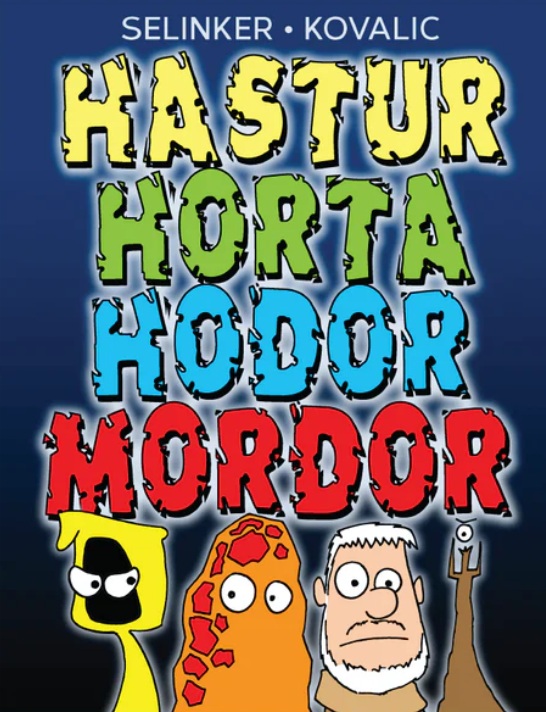
Inspired by a Dork Tower comic, Hastur Horta Hodor Mordor is a road trip game that actually became a real card game. But let’s focus on the road trip version.

This is a memory game where one player says a word — preferably one related to fandom, geek culture, etc. — in order to begin a nerdy tongue twister. The next player says that word AND another word. The next player says the two previous words AND another word, and the chain continues.

If you can’t complete the chain or you hesitate too long, you get a Hodor point, and a new chain begins.

If you get 3 Hodor points, you can only say “Hodor” for the rest of the car ride. (That’s a reference for the Game of Thrones fans in the audience, if there are any of you left after those dismal final seasons.)


Do you have any favorite no prep road trip games, fellow puzzlers? Let us know in the comments section below! We’d love to hear from you.


A-Ha Moments Stick in the Brain!

It’s one of the best moments in puzzle solving.

When all the pieces click into place brilliantly. When the wordplay is unraveled. When the cryptic crossword clue is deciphered. When the trickery behind the riddle is revealed.

That rush, that satisfaction that coincides with overcoming the clever, devious creation of another keen mind.

The a-ha moment.

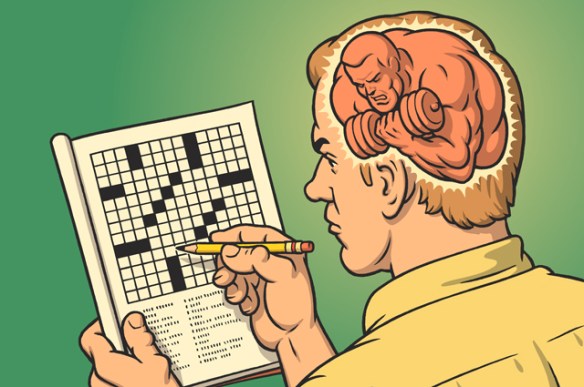
And it turns out that the a-ha moment isn’t just significant for puzzly spirits, it’s biochemically significant as well.

According to a study by Maxi Becker, Tobias Summer, and Roberto Cabeza, the brain remembers a-ha moments better than solutions reached through traditional methodologies.

From a report by Gizmodo:

As study participants solved brain teasers, he [Cabeza] and his colleagues recorded their brain activity with functional magnetic resonance imaging, a technique that measures changes in blood flow associated with brain activity. The brain teasers were visual fill-in-the-blank puzzles that revealed a previously hidden picture once participants completed the image.

And the brain activity resulting from an a-ha moment was comparable to the brain characteristics of important insight events. This means that the solutions derived from a-ha moments were remembered more clearly and with greater detail than those derived from traditional solving or process of elimination-style solving. Some of the solvers still recalled their a-ha moment solution a full five days later!

Researchers are already looking to revamp the ways we teach by utilizing techniques that inspire more a-ha moments, hoping that students will benefit more in the long term from inspiration-focused learning, rather than rote memorization.

Here’s hoping for more a-ha moments for all us! They’re good for the soul and good for the memory banks.

Happy puzzling, everyone!

Antonym TV Shows!

In today’s post, I’ve got a silly little puzzly challenge for you. I’m going to give you the antonym of a television show’s title, and you need to give me the show.

For example, “Not at All Justified” would mean “Justified” or “Lawlessness and Chaos” would be “Law and Order.”

And yes, they do get wackier, more specious, and more elaborate as we go.

So, without further ado, let’s play!


ANTONYM TV SHOWS

  1. Enemies
  2. Found
  3. The Idle Alive
  4. Less Peculiar Nothings
  5. Misery
  6. Before Twelve
  7. Southern Obscurity
  8. Me
  9. Saving Adam
  10. White Non-Reflective Surface
  11. The First of Them
  12. Ugly Large Honest People
  13. Heaven’s Dining Room
  14. The Small Pop Certainty
  15. Very Vulnerable
  16. The Basses
  17. Unfettered Lack of Progress
  18. Water Walk
  19. Near Stay
  20. Many Whole
  21. Unseriousness Rises
  22. Truth Angel
  23. Attachment
  24. Drives and Work
  25. Minor Childless Man
  26. Keep a Potato in Pristine Condition
  27. Bullgirl Classical
  28. Legal Disobeys
  29. Uncertain Key
  30. Jeers

How many did you get, fellow solver? And how many did you groan at when you figured them out? Let me know in the comment section below!

A Gateway Puzzle for Crossword Solving?

Where do you get started with crossword solving?

I see that question a lot. And the advice offered to new solvers varies. Sometimes they’re pointed particular crossword outlets promising a more newbie-friendly solve. You certainly don’t want someone tackling a crossword too difficult for their skill level and getting discouraged.

Often, they’re told to just plug away at it, since the only way to get better at crosswords… is by solving crosswords.

None of this advice is wrong. I’m sure people follow these suggestions and slowly start to enjoy this puzzly world that many of us have embraced for decades.

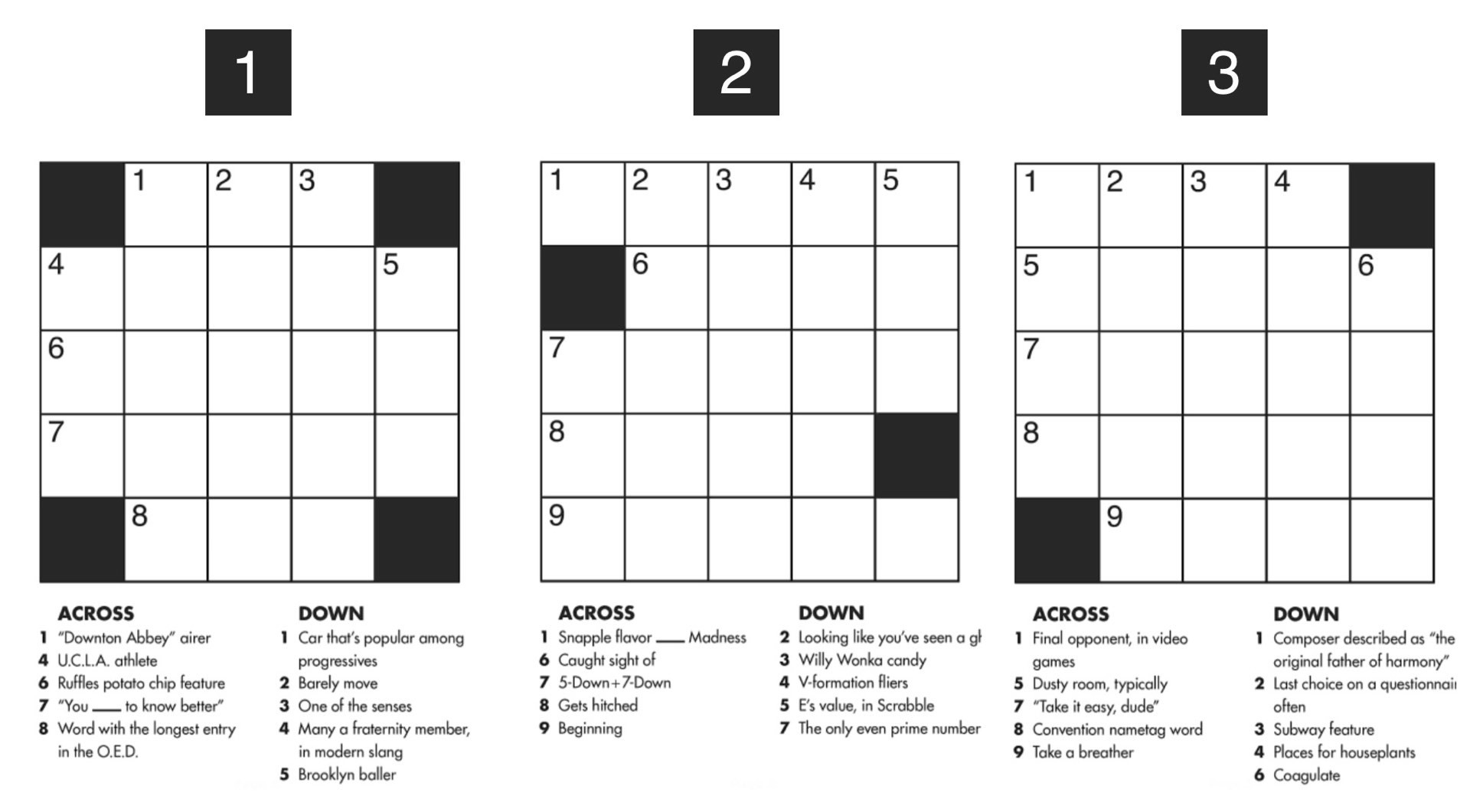
You might think that Mini Crosswords, like those featured in the New York Times puzzle app, are the way to go. But while the grid is smaller, that also means new solvers have fewer chances to find crossings and work on their solving.

Imagine a regular crossword. A Mini is essentially one corner of the grid. If you started a crossword in one corner, and didn’t get any entries, you can move to another spot. But if you’re stumped on a Mini, where do you go?

I also think the running timer feature — although obviously not a necessity for solvers — can add to a new solver’s anxiety. If you’re stumped, and you’re just sitting there, watching the timer tick away, that’s going to eat at your confidence a bit.

crisscross

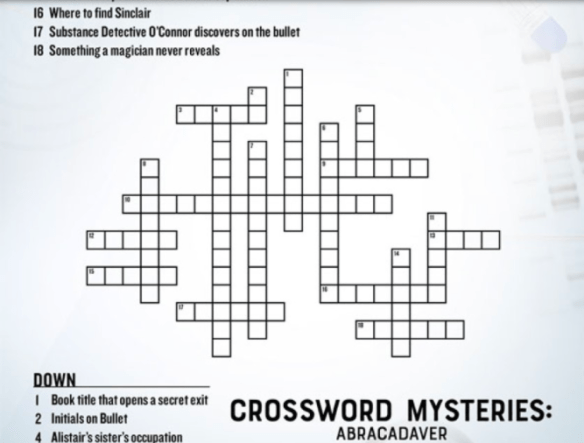
You might think that crisscross-style puzzles (like the one above) would be less intimidating, since they don’t have the same dense grid surrounded by clues that crosswords have, but I’ve found that folks don’t warm to those quickly. No matter how well-constructed the crisscross, it tends to remind people of activity books for kids, and no one wants to feel patronized when trying out a new hobby or giving it another go.

Not only that, but they are missing one of the most helpful components to crossword solving: all the overlapping letters! In a crossword, you have two chances at every single box because of the across and down clues. But in a crisscross, you usually only have one or two points of overlap, so if the clue isn’t helpful or intuitive, you’re just stuck. That doesn’t build solver confidence.

I do have a suggestion, though.

I’ve tried this with several friends and acquaintances who had sworn off crosswords entirely, and not only introduced them to a new puzzle they didn’t know, but opened their eyes to the possibility of more puzzle solving in the future.

My solution was: Fill-Ins.

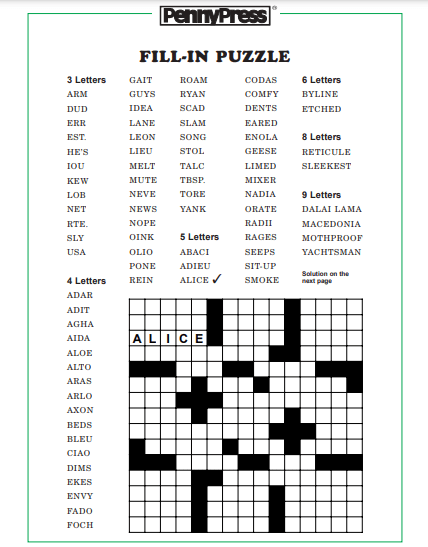
fillin sample
A sample puzzle from our friends at Penny Dell Puzzles.
Check out their fill-in library here!

For the uninitiated, fill-ins utilize the same general grid style as a crossword. But instead of answering numbered clues to place the words in the grid, you’re already given the answer words, organized by word length. Your task is to place them all into the grid, using other words and letters in the grid to guide you.

It’s closer to Sudoku-style solving than crosswords, because you’re eliminating options in a logical manner, rather than figuring out clues to place the words.

I believe solving fill-ins helps remove the intimidation factor of crosswords in three ways:

1. No trivia or outside knowledge is required, which removes a huge burden from a solver who has probably felt overwhelmed by crossword cluing in the past.

2. It makes empty crossword grids less intimidating. Do you ever have those moments where you read three or four crossword clues in a row and you don’t immediately conjure up answers? And then you look at all those empty spaces in the grid and feel dumb? It happens. But fill-ins often have a set word to get you started, and once you start placing letters, recognizing useful crossings, and filling the grid, all that goes away.

3. Fill-ins help strengthen another skill valuable in crossword solving: letter-blank recognition. If you see B _ U _ , a regular solver instantly starts listing off possibilities: BOUT, BLUE, BLUR, BAUD, etc. But a new solver — who might not have that reflexive knowledge of possible words — can read through the list of four-letter words and see what fits, helping to build that mental lexicon for future solving.

120718_crossword_L

After solving a handful of fill-ins, word placement goes quicker, confidence in filling in those letter blanks increases, and empty grids become fields of potential puzzle fun, not stark empty spaces.

I’ve suggested fill-ins to several crossword-shy or puzzle-shy friends, and usually, a few weeks later or so, they start asking what other puzzles are out there, or where a good place to start with crosswords might be. And that’s a win.

Happy puzzling, everyone!

New Rubik’s Speed-Solving Record: Blink and You’ll Miss It!

Clever, quick-fingered solvers are constantly pushing the boundaries of what can be accomplished with a Rubik’s Cube.

I’ve seen the world’s most complex Rubik’s-style cube being solved, a building turned into a solvable Rubik’s Cube, and a Rubik’s Cube solved one move at a time by strangers across the globe.

I’ve even seen a Rubik’s Cube solved during a skydive.

But, amidst all those amazing achievements, there has been something lurking in the background. Over the years, there has been an escalating cold war in the world of Rubik’s Cubes.

The two sides? Human and machine.

The battlefield? Speed-solving.

Human speed-solvers often count their records in seconds, not minutes. The current record for a 3×3 cube solve is 3.05 seconds!

But speed-solving devices are often so fast that they end up ripping the cube to pieces instead of completing the solve. So puzzly designers must carefully walk a tightrope between speed and power in order to challenge speed records for mechanical solvers.

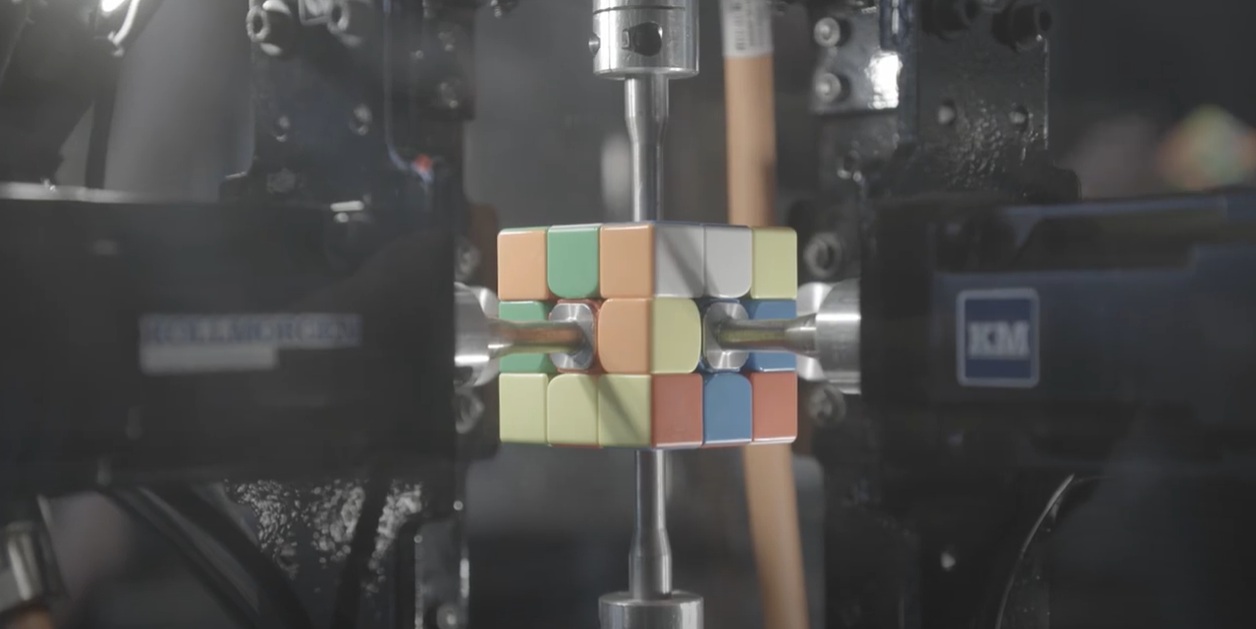
The record for an automated solve is an astonishing 0.305 seconds – ten times faster than the fastest human solve! — set by Mitsubishi Electric engineers in Japan in May 2024.

Or it was, until a few days ago.

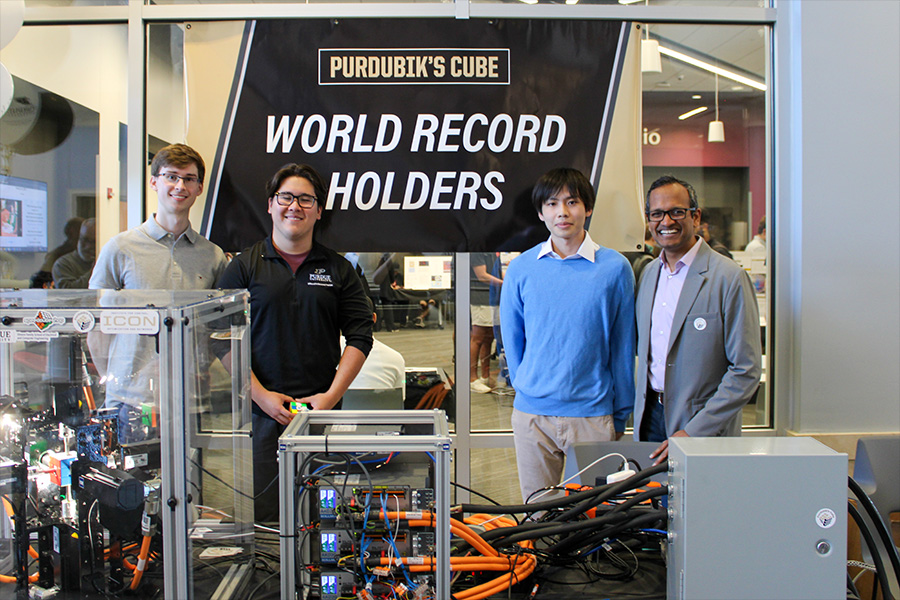
The new Guinness World Record for “Fastest robot to solve a puzzle cube” belongs to Purdubik’s Cube, the robot created by Junpei Ota, Aden Hurd, Matthew Patrohay, and Alex Berta, a team of students from Purdue University’s Elmore Family School of Electrical and Computer Engineering.

The new record? 0.103 seconds.

It’s hard to fathom how quick that is. Thankfully, one of Purdubik’s Cube’s creators has an apt analogy:

“We solve in 103 milliseconds,” Patrohay said. “A human blink takes about 200 to 300 milliseconds. So, before you even realize it’s moving, we’ve solved it.”

Utilizing a combination of color recognition and finely-tuned industrial-grade motion-control hardware — guided by algorithms written by the students themselves — Purdubik’s Cube carefully accelerates and decelerates its movements faster than the eye can see.

And despite the fact that a team of four college students smashed a record previously held by a billion-dollar corporation, they’re not done yet.

They aspire to solve a Rubik’s Cube with Purdubik’s Cube in less than a tenth of a second! I don’t know how they expect to shave a few milliseconds off their time to achieve their goal, but you know what? I fully believe they can do it. In less than a year, they set their goal of a new Guinness World Record and achieved it.

Who knows what they’ll achieve next?

[You can read the full story of their journey from the initial goal to their world record success on the Purdue Engineering website. I highly recommend it!]

The RPG and Board Game Community Reaches Out!

One of the best parts of being a puzzle and board game guy is the amazing community of fellow players, puzzlers, and game designers that surrounds you. Yes, puzzles and games are a business, obviously, but every week I see examples of creators and companies giving back, doing charitable acts, and participating in fundraisers for good causes.

Today, I’d like to highlight a few and hopefully bring more attention to these worthwhile endeavors.


Accessible Games: Global Accessibility Awareness Day

Accessible Games understands that every person is different, and that there are many people who don’t feel represented in modern roleplaying games. To that end, they created Survival of the Able, an RPG with disabled protagonists set in medieval Europe during a zombie plague. It shows the challenges people face every day, but also shows that those people are capable of accomplishing extraordinary things. (They even published a special edition of the game that is designed to be more accessible for dyslexic players.)

Between Survival of the Able, their zine Accessible Gaming Quarterly, and their guide to more inclusive tabletop creation — Accessible Guide to RPG Layout — they’re doing a lot of advance the cause of gaming for everybody.

In honor of Global Accessibility Awareness Day (which is Thursday May 15th), they’re offering a 30% discount on their entire accessibility-focused library. You can get your discounted copies between May 15th and May 22nd at this link. Please consider participating.


Kids in the Attic: Hershey Family Recovery Bundle

Kids in the Attic is a roleplaying game company that likes to highlight the weird and whimsical in their fantasy, space, and horror games, but this week, they’re turning their attention to bringing light and kindness to a horrible situation.

They’re currently organizing the Hershey Family Recovery Bundle to support the family of Rick Hershey, a prolific artist in the tabletop roleplaying game community. All of his children were involved in a devastating car accident caused by another driver. Thankfully, they all survived, but the road ahead will be long, and everyone knows the burden that medical bills can impose.

You can click this link to see everything included in the Hershey Family Recovery Bundle and to learn more about Rick. Please consider donating to help Rick’s family get back on their feet.


Tycoon Games: The Box of Giving

Tycoon Games has been an industry leader in charitable work and outreach for years, donating to Toys for Tots, the Boys and Girls Club, and many other worthy organizations.

Their latest endeavor is The Box of Giving, a collection of games intended to help underserved communities, schools, libraries, gaming conventions, and local non-profits experience the joy and camaraderie that comes with playing games. For the cost of shipping alone, each organization receives $500 worth of games!

Please click this link to apply for the Box of Giving program and share the link for any groups that you think would benefit from this wonderful endeavor.


Are there any charitable efforts in the board game or roleplaying world that you’d like to shout-out? Let us know in the comments below! We’d love to hear from you.
Happy gaming, everyone!