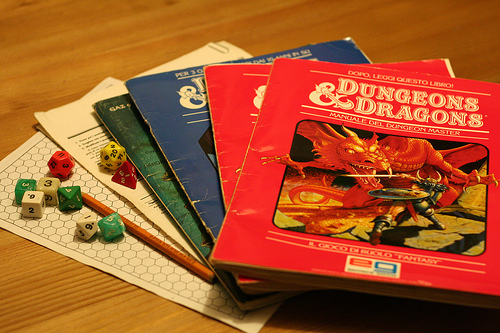
Playing Dungeons & Dragons Like Royalty!

Dungeons & Dragons (or any roleplaying game, for that matter) is about telling a story together. Many Dungeon Masters go above and beyond to immerse players in the roleplaying experience.

Some use miniatures or models atop battlemats to help players visualize the events that are taking place (especially combat). Others use music to set the tone, create atmosphere, or provide dramatic effect.

These little bits of set dressing can be simple or elaborate, but they all contribute to a better roleplaying experience.

Now imagine if you could turn the dial up to 11 and really immerse yourself in your setting. Say, by playing D&D in an actual castle.

That’s the idea behind D&D in a Castle, a special event being held in Challain-la-Potherie, France, from July 1st to the 5th.

Check out the sales pitch:

Spend four days playing Dungeons and Dragons in a castle with world class DMs in a vacation like none you have ever experienced. Retreat into a magnificently restored castle for a spot of luxury, relaxation, and, of course, role-playing.

Yup, a team of professional Dungeon Masters help attendees to build their characters and familiarize themselves with the game before they even walk through the door. And after that, there are two daily RPG sessions and optional ones in the evening.

Over the course of the five days, you are guaranteed to play at least 24 hours of Dungeons & Dragons.

Now THAT is immersion.

With names like Jeremy Crawford (the lead rules developer for D&D) and Satine Phoenix (actress, artist, and DM) involved, this is sure to be a massively creative event, and I am thoroughly envious of anyone and everyone attending.

This will certainly raise the bar for D&D night at the house afterward. Dimming the lights and putting on some mood music will pale in comparison to the palatial spread at Challain-la-Potherie.

Of course, if you’re looking for a more affordable option here in the US, I highly recommend Troll Haven in Sequim, Washington. The Gate Keeper’s Castle is absolutely awesome, and the perfect setting for a LARP, an escape room, or some immersive D&D.

Just be careful if you invite a rogue to the castle, folks. They have sticky fingers.


Thanks for visiting PuzzleNation Blog today! Be sure to sign up for our newsletter to stay up-to-date on everything PuzzleNation!

You can also share your pictures with us on Instagram, friend us on Facebook, check us out on TwitterPinterest, and Tumblr, and explore the always-expanding library of PuzzleNation apps and games on our website!

The Penny Dell Crosswords App Summer Sale!

Hey there, fellow puzzlers and PuzzleNationers. I’ve got a quick question for you…

Have you been solving the free daily puzzle in the Penny Dell Crosswords App that shows up every day like clockwork?

If you have been, then you’re already in the know.

But if you haven’t, you really should.

Because not only is there a terrific free crossword delivered right to your phone every single day, but every day for the entire month of June, we’re throwing in a bonus deal exclusively for PDCW solvers!

That’s right, folks! By solving the free puzzle of the day, you’ll then be notified of that day’s awesome deal! It could be a deep discount on a puzzle bundle OR a limited time offer for a rare puzzle set or app upgrade! Some of the deals are worth up to 75% off!

And the only way to find out about these fantastic deals is to solve the daily puzzle every day!

As if a free daily puzzle in your pocket wasn’t incentive enough, right?

Keep puzzling, friends!


Thanks for visiting PuzzleNation Blog today! Be sure to sign up for our newsletter to stay up-to-date on everything PuzzleNation!

You can also share your pictures with us on Instagram, friend us on Facebook, check us out on TwitterPinterest, and Tumblr, and explore the always-expanding library of PuzzleNation apps and games on our website!

Puzzle Fight? Them’s Fightin’ Words!

In this blog, I try to talk about puzzles in all their forms. We’ve explored everything from puzzle games and mechanical brain teasers to pencil-and-paper puzzles, from riddles and deduction puzzles to escape rooms and puzzle hunts. That covers a pretty impressive swath of puzzly varieties.

Naturally, I’ve spent some time talking about puzzle apps as well. Not only our own marvelous offerings — like Daily POP Crosswords and Penny Dell Crosswords App — but others as well that’ve piqued the interest of our in-house app reviewer, Sherri.

And today, I’d like to return to the subject, because there’s a curious subset of puzzle apps that I didn’t even know existed: puzzly fighting games.

[Image courtesy of Mario’s Hat.]

Now, your standard fighting game has a simple concept: two fighters go head-to-head in a match, and the first to drain his opponent’s life bar wins.

There are numerous famous fighting games across many video game systems. Franchises like Street Fighter, Mortal Kombat, Soul Calibur, Tekken, Dead or Alive, Darkstalkers, and Marvel vs. Capcom have built devoted followings with eyecatching fighters, innovative attack combos, and ever-improving graphics.

But in a puzzle fighting game, the outcome of the fight does not depend on button-mashing skill, tricky combinations, or well-timed strikes… it depends on your puzzly talents.

[Image courtesy of YouTube.]

Take, for example, the standard bearer for the genre: Puzzle Fighter.

The layout probably looks familiar. The game combines the aesthetics of Tetris — blocks dropping into a contained play area and being rotated and placed by the player — with the gameplay of Bejeweled, Candy Crush, and other color-matching puzzle games.

You want to group pairs of blocks (or gems) together, because you can clear them from the play area by using “crash gems,” which wipe out any neighboring gems of that color. So, with proper planning, you can wipe out huge sections of your board.

As you clear gems from your play area, your fighter does battle with the opponent’s fighter, succeeding or struggling based on how well you’re doing with your puzzling. (You can play against other opponents online in multiplayer mode or against computer-controlled opponents on your own.)

[Image courtesy of Emu Paradise.]

Puzzle Fighter was followed by a sequel, Super Puzzle Fighter II Turbo, a fun reference to the Street Fighter franchise, which also allows some of its characters to appear as sprites in this puzzly spinoff. There was also a short-lived WWE wrestling-related app  that was more like Tetris in its gameplay, but similar in execution to the Puzzle Fighter series.

It’s an intriguing idea, if only because other head-to-head puzzle games like Dr. Mario and Tetris Arena feel a touch less adversarial. In head-to-head Tetris, it’s simply who’s the better puzzler. In Dr. Mario, as you eradicate the little viruses with color-matching pills, you can also bury your opponent under pill pieces, which adds a form of interaction to the gameplay.

[Watch the player on the left engineer chain reactions that hinder the player on the right.]

In Puzzle Fighter, the game goes two steps further. Not only are you allowed to visualize how you’re winning or losing based on the character sprites fighting above the play area, but your successful use of crash gems will send additional gems into your opponent’s play area, with only a limited amount of time to neutralize them.

But an upcoming entry in the genre has added a curious wrinkle to the puzzly fighting experience: magic.

[Image courtesy of Kotaku.]

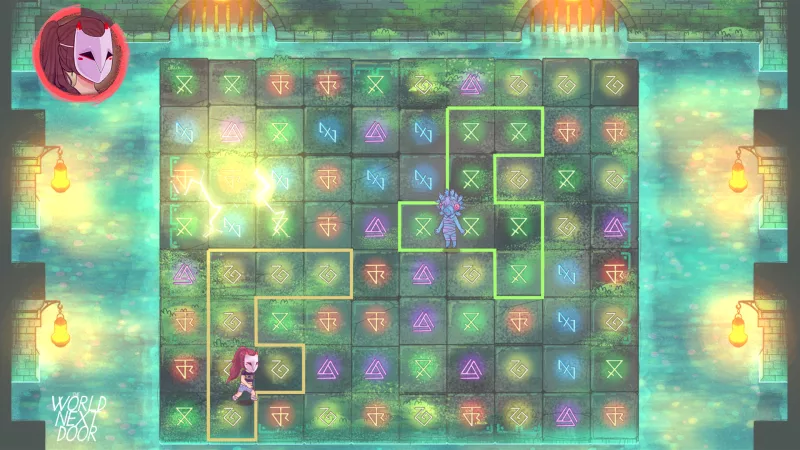
The World Next Door features characters actually running across a shared game board featuring all sorts of colored runes. Your goal is to swap and connect runes of the same color so that they form chains of runes that can be activated.

Each colored rune represents a different attack, which means that, like in Dr. Mario and Puzzle Fighter, a crafty puzzler can create chain reactions where wiping out one set of runes causes another set to connect, triggering another attack.

In The World Next Door, this can lead to devastating combination attacks.

Of course, since you’re sharing a game board with your opponent, there’s the additional elements of defense and sabotage. While you’re building your rune chains, you’re going to want to defend them from your opponent while also disrupting their own attempts to form chains. Defense can truly become a strong offense, if you choose to play that way.

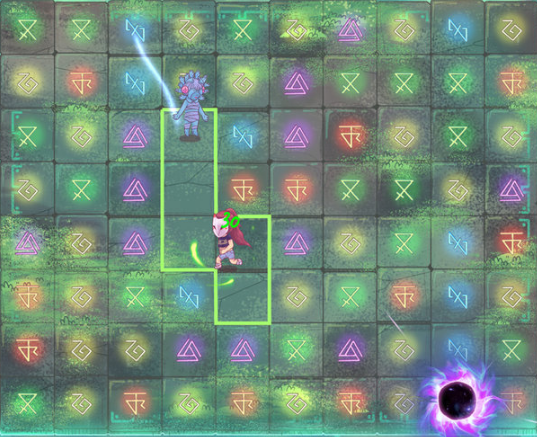
[Here, you can see the result of a rune spell, the small black hole in the corner, waiting for a sprite to wander too close. Image courtesy of The World Next Door.]

This is probably the most direct iteration of puzzly fighting I’ve encountered thus far, since you’re still using puzzle skills to make your attacks, but you’re also interacting head-to-head with your opponent’s game board AND sprite, which really ratchets up both the tension level and the challenge factor.

I’m definitely interested in seeing how this relatively minor subset of puzzle games continues to evolve and grow. The World Next Door is an impressive step up in complexity and style, and with this sort of creativity and innovation at play, the sky is truly the limit.

And let me know if you’d like us to discuss more puzzle apps, puzzly video games, or other related topics on the blog in the future!


Thanks for visiting PuzzleNation Blog today! Be sure to sign up for our newsletter to stay up-to-date on everything PuzzleNation!

You can also share your pictures with us on Instagram, friend us on Facebook, check us out on TwitterPinterest, and Tumblr, and explore the always-expanding library of PuzzleNation apps and games on our website!

The Countess Who Revolutionized European Spycraft

[Image courtesy of Derek Bruff.org.]

The history of codebreaking is a fascinating subject not only for the mythic figures and their brain-melting accomplishments, but also for the unsung heroes who are only recently being rediscovered.

A few months ago, I wrote a blog post about Elizebeth Smith Friedman, a woman who shaped a new foundation for American codebreaking, but has long since been overshadowed by the reputation of her husband William Friedman (as well as FBI sexism and self-promotion which helped to bury and/or co-opt her accomplishments as their own).

[Image courtesy of Wikipedia. Of course, not her page. The page on her family line.]

And as part of my research into Elizebeth’s story, I encountered a curious anecdote from the 1600s about another codebreaker and influential spymaster who history had forgotten.

From The Woman Who Smashed Codes by Jason Fagone:

Monks, librarians, linguists, pianists and flutists, diplomats, scribes, postal clerks, astrologers, alchemists, players of games, lotharios, revolutionaries in coffee shops, kings and queens: these are the ones who built the field across the centuries and pushed the boundaries forward, stubborn individuals with a lot of time to sit and think and not give up. Most were men who did not believe women intellectually or morally capable of breaking codes; some were women who took advantage of this prejudice to steal secrets in the shadows.

One of the more cunning and effective codebreakers of the seventeenth century was a Belgian countess named Alexandrine, who upon the death of her husband in 1628 took over the management of an influential post office, The Chamber of the Thurn and Taxis, which routed mail all throughout Europe.

[Image courtesy of Wikipedia.]

Naturally, I was intrigued. But there’s surprisingly little out there about Alexandrine, whose full title was Alexandrine of Rye-Varax, Countess of Taxis, widow of Leonard II, Count of Taxis, occasionally shortened to Alexandrine von Taxis. She gets merely a paragraph on Wikipedia, and most Google searches only feature her as part of noble family trees.

Which is amazing, because she created the first verifiable Black Chamber in Europe — better known ones in England, France, and Germany weren’t established until the late seventeenth century. (A Black Chamber is a secret spy room or intelligence office, and Alexandrine’s was not only one of the first, but it was one of the most expansive.)

Despite her status as a widow, she was sworn into office as Postmistress in 1628 (serving as such until 1646, when her son would come of age), using those years to improve the wealth and status of her family while expanding the reach of the Taxis postal business, based in the Spanish Netherlands.

[The Taxis postal service, circa 1505-1516.
Blurry image courtesy of ApfelbaumInc.com.]

Alexandrine took over the Taxis postal service — the primary postal service across the continent, save for private couriers. She had a monopoly over the post in Europe, and was the de facto postmistress for the entire Holy Roman Empire.

And she used that position to her advantage, forming the Chamber of Taxis, an elite intelligence team composed of agents, forgers, scribes, codebreakers, and artisans. In a couple of hours, they could melt the wax seals off letters, copy their contents (in short-hand, often), decipher any coded messages, forge a new seal (and any other marks, including signatures, that would authenticate a seal), reseal the letter, and send it on its way, the invasion of privacy undetected.

She spoke four languages — French, Dutch, Italian, and German — and was very politcally savvy, cultivating relationships with fellow nobles even as she prowled through their private messages.

It’s not clear for whom she was spying. Some sources claim she sold her information to the highest bidder, while others claim she worked for both Emperor Ferdinand II and his son and successor Ferdinand III.

[Image courtesy of Wikipedia.]

What is clear, however, is that many discounted her and the Chamber of Taxis as a possible threat because of who she was. Sir Balthazar Gerbier, an agent of Charles I, suspected her early on, but discounted his own instincts because of “her honesty, dignity, and sex.”

Yes, the fact that she was a woman disqualified her in the minds of many from being capable of the sort of deceit and spycraft going on in the Chamber. (It also rankled some, like several German princes, that she was in a position of power at all, given her sex.)

And discounting her was a mistake, given that she commanded a crucial hub in the postal network.
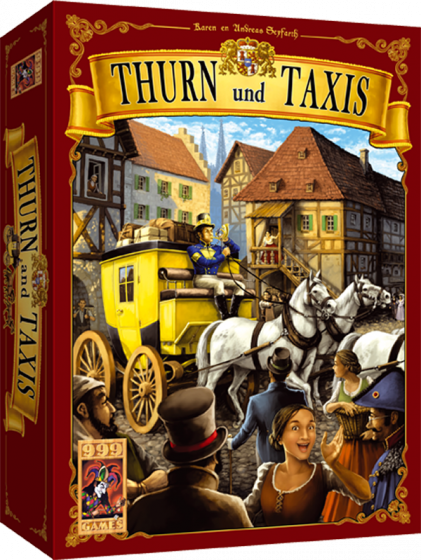
[Yes, there’s even a board game based on the family business.
No spycraft though, unfortunately. Image courtesy of 999 Games.]

From Diplomacy and Early Modern Culture, edited by R. Adams and R. Cox:

Since the 1490s Brussels had been the gateway to Europe’s postal network, connecting international postal routes from Spain, France, Italy, Austria, Germany, Scandinavia, and England. One single family, the Counts of Taxis (from 1649/50 Thurn and Taxis), commanded the mounted couriers over these many-branched routes.

Yes, the family name and title changed, and that was also Alexandrine’s doing.

When those aforementioned German princes questioned having a woman running the Taxis postal service, she ordered a full ancestral workup. That examination revealed her family’s ties to another important lineage, and from that point on, The Thurn and Taxis postal service (as well as her spy organization, The Chamber of the Thurn and Taxis) would bear that additional name, increasing the prestige and reputation of both family and business alike.

For eighteen years, Countess Alexandrine commanded both a business and a spy network that spanned the European continent, influencing the information flowing between various noble families, and no doubt helping to shape the future of Europe.

I sincerely hope more is revealed about her life and the work of The Chamber of the Thurn and Taxis in the future. I feel like we’ve only just scratched the surface of the role she (and the group) played in European history.


Thanks for visiting PuzzleNation Blog today! Be sure to sign up for our newsletter to stay up-to-date on everything PuzzleNation!

You can also share your pictures with us on Instagram, friend us on Facebook, check us out on TwitterPinterest, and Tumblr, and explore the always-expanding library of PuzzleNation apps and games on our website!

The Indie 500 Crossword Tournament returns tomorrow!

That’s right! Tomorrow, June 2nd, will mark the fourth annual edition of the tournament, and registration is still open for $30, plus you can participate from home for only $10! Click here for details!

Not only that, but once again they’ve whipped up a meta-suite of puzzles to boot, and you name your own price for it!

I expect great things from the immensely talented team of constructors and directors they’ve assembled: Laura Braunstein, Erik Agard, Lily Silverstein, Sophia Maymudes, Angela Olson Halsted, Andy Kravis, Peter Broda, Anna Gundlach, and Neville Fogarty. With a “Dressed to Fill” theme, topnotch constructors, and pie (there’s always pie), you can’t go wrong!

You can click here for the Indie 500 home page, and click here for a rundown of last year’s puzzles!

Will you be competing? Or participating from home? Let us know in the comments below!


Thanks for visiting PuzzleNation Blog today! Be sure to sign up for our newsletter to stay up-to-date on everything PuzzleNation!

You can also share your pictures with us on Instagram, friend us on Facebook, check us out on TwitterPinterest, and Tumblr, and explore the always-expanding library of PuzzleNation apps and games on our website!
PuzzleNation Product Review: IcoSoKu

[Note: I received a free copy of this game in exchange for a fair, unbiased review. Due diligence, full disclosure, and all that.]

Most puzzles — whether we’re talking about puzzle boxes, jigsaw puzzles, physical brain teasers, or mechanical puzzles — operate under a simple premise: the puzzle arrives in one configuration, and it’s up to you to solve it and put it into a different configuration.

With puzzle boxes, you’re opening them. With jigsaws, you’re assembling the pieces. With physical brain teasers and mechanical puzzles, you’re separating them, freeing a given piece, or accomplishing a particular task. But in each case, they’ve arrived that way. You have been pitted against the designer.

Project Genius‘s IcoSoKu is something different. IcoSoKu challenges you to create your own puzzle, and then solve it.

The setup is elegant in its simplicity. It’s a puzzle ball consisting of a twenty-sided icosahedron base, twelve numbered pegs, and twenty triangular tiles with different combinations of pips at the corners.

To start, remove all of the tiles and all of the pegs from the icosahedron. Place the numbered pegs wherever you wish on the puzzle ball.

Then, you must figure out how to arrange the triangular tiles on the puzzle ball.

This is tougher than it seems. Each triangular tile has a different combination of pips in its corners. Some corners have none, while others have one, two, or three pips. And each corner neighbors a different numbered peg. Each numbered peg is surrounded by five corners, and the pips on each corner, when added together, should total the number on the peg.

And with numbers ranging from 1 to 12, you have to be both clever and careful in your tile placement. That peg labeled “1” can only have a single pip neighboring it, meaning that the other four tiles surrounding that peg should have empty corners.

[Three different looks at the same solved puzzle ball.]

IcoSoKu combines the deduction of placement puzzles like Minesweeper or Blackout! with the mathematical puzzling of a magic square or a Sudoku puzzle. And by making the puzzle three-dimensional, it places a healthy demand on your puzzly faculties. You’re constantly tipping and turning the puzzle ball, because you can never see the whole puzzle at once, making it much harder to manage your tiles and maintain a good sense of just how many of those valuable little pips you’ve already used.

And as soon as you’ve placed the final tile and searched the puzzle ball all over, confirming a successful solution… all you want to do is strip away all of the tiles and pegs to test your wits again.

Assigning pegs randomly creates a completely different solving experience from bundling all the large numbers together on one side and all the small numbers together on the other side of the ball. Although you will begin to spot certain patterns and techniques that will come in handy as you solve each successive permutation of the puzzle, you’ll still find IcoSoKu to be an engaging and satisfying challenge.

Plus there are other ways you can enjoy the puzzle after cracking it yourself. I challenged a fellow puzzler to a timed IcoSoKu solve-off! First, I arranged the pegs and timed how long it took her to solve the puzzle ball I’d devised. Then, she arranged the pegs and timed how long it took me to unravel the puzzle ball she’d created. It added a fun touch of competition and uncertainty to the solving experience, one that my patient solo-solving didn’t capture.

But whether you’re tackling IcoSoKu yourself or with a puzzly rival, you’ll find plenty to enjoy here. It’s a DIY puzzle, masterfully put together and waiting for you to execute.

IcoSoKu is available from Project Genius and other participating retailers, appropriate for solvers 9 and up!


Thanks for visiting PuzzleNation Blog today! Be sure to sign up for our newsletter to stay up-to-date on everything PuzzleNation!

You can also share your pictures with us on Instagram, friend us on Facebook, check us out on TwitterPinterest, and Tumblr, and explore the always-expanding library of PuzzleNation apps and games on our website!