The D’Agapeyeff Cipher, Unsolved for 80 Years!

[Image courtesy of Derek Bruff.org.]

One of my all-time favorite cryptography stories comes from the book The Spy That Couldn’t Spell, a true-life espionage story about a dyslexic man who hid, then encrypted the locations of, thousands of pages of sensitive documents he had stolen from the U.S government.

Why is it one of my favorite stories? Well, because the man in question FORGOT one of the cipher words he used to encrypt the location of his caches.

And it sort of unravels your master plan when you can’t remember a key element of it.

Amazingly enough, this isn’t the only example of a self-trained cryptographer who forgot how to solve his own creation. In fact, one example of this very dilemma remains one of the most famous unsolved codes and ciphers in the world:

The D’Agapeyeff Cipher.

daga

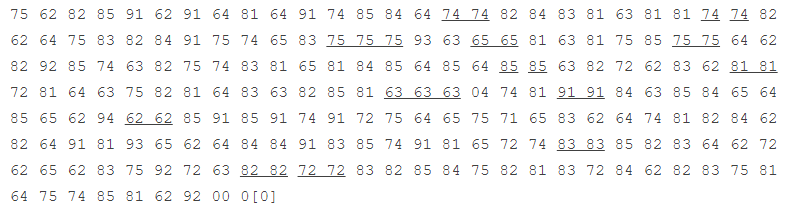
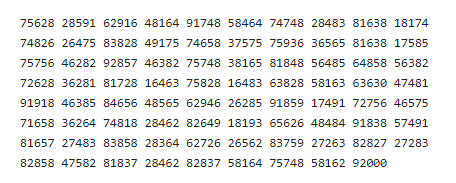
This is the D’Agapeyeff Cipher. This seemingly simple list of numbers contains a secret message. The only problem is… the creator, Alexander D’Agapeyeff, can’t remember how to decrypt it.

When he published a starter book on cryptography — Codes and Ciphers, first edition — D’Agapeyeff included this chain of 5-digit number bundles as a final challenge for the readers to unravel.

One of the first steps many aspiring cryptographers take is to break the numbers down into pairs instead of groups of five:

daga 2

One result of this is the pattern that every pair has 6, 7, 8, 9, or 0 in the tens column and 1, 2, 3, 4, or 5 in the ones column, which doesn’t seem like a coincidence.

And see those sequences where the same number appears three times in a row? Some cryptographers believe that is also not a coincidence.

Then, they cut off the two double-zero pairings at the end — because they believe they were nulls, empty space-filling characters simply designed to fit the 5-letter groupings pattern of the original code as a way to throw off codecrackers. (And, to be fair, D’Agapeyeff himself wrote about null entries in the book Codes and Ciphers.)

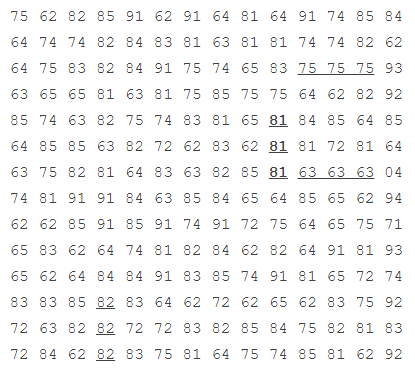
If you remove those double-zero pairings, you can arrange the numbers into a 14×14 pairing grid, like so:

daga 3

See those sequences where the same number appears three times in a row? More of them now.

Many cryptographers consider this to be the true starting point of cracking the D’Agapeyeff Cipher.

But then what?

Some believe that the key to solving the grid lies in the Polybius Square, another encryption device mentioned by D’Agapeyeff.

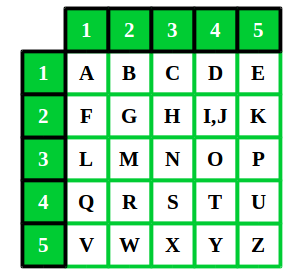
Essentially, you place the alphabet into a 5×5 grid, and use those numbers to encrypt the letters. Here’s a straightforward example:

daga 4

In this case, the word PUZZLE would be 35 45 55 55 31 15.

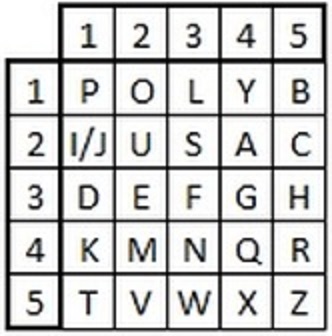
Another way to use the cipher is to pick a keyword to start it. For instance, if you chose POLYBIUS as the key word, then you go across, then down, writing POLYBIUS and then the rest of the unused letters of the alphabet in order, like so:

daga 5

Instead of 1-5 both across and down, you could do 1-5 across the top and 6-0 across the side, reflecting the pairings in the D’Agapeyeff Cipher.

Or, as someone pointed out, perhaps we’re thinking in the wrong language. Triple-letters are uncommon in English words, but more common in Russian words, and D’Agapeyeff was Russian born.

Overlooking simple things like that can make you miss crucial ways into an encrypted message.

So, do you have any thoughts on how to solve this 80-year-old encrypted challenge, fellow puzzlers? Let us know in the comments section below! We’d love to hear from you.


dailypopwsicon

Have you checked out our special summer deals yet? You can find them on the Home Screen for Daily POP Crosswords and Daily POP Word Search! Check them out!

Thanks for visiting PuzzleNation Blog today! Be sure to sign up for our newsletter to stay up-to-date on everything PuzzleNation!

Younger Solvers and Constructors Building Online Crossword Communities!

It’s a dynamic, fluid time for crosswords. It feels like we’re on the cusp of a sea change.

Women, people of color, and members of the LGBTQIA+ community are featured more often, although we still have a LONG way to go on all of those fronts where representation is concerned, both for constructors and editorial staff.

Younger voices are rising up the ranks, and helping to influence the direction of crossword language through projects like the Expanded Crossword Name Database. Online resources like more inclusive word lists, free or discounted editing software (often constructed by younger solvers!), and words of guidance from online crossword collaboration groups are more available than ever.

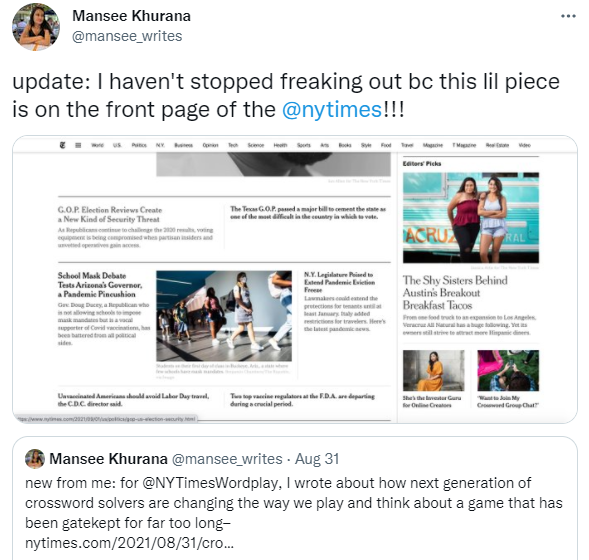
Recently, these topics were tackled in The New York Times itself in an article about younger crossword enthusiasts penned by freelance writer and reporter Mansee Khurana.

mansee

Her article is a terrific snapshot of the modern crossword world.

It discusses the divide between older solvers and younger, and how the content of crosswords doesn’t always serve both sides. It tackles the concept of “evergreen puzzles” — crosswords edited for timeless reprint value, eschewing up-to-date and provocative references that would appeal to younger solvers and underrepresented groups for the sake of republication later.

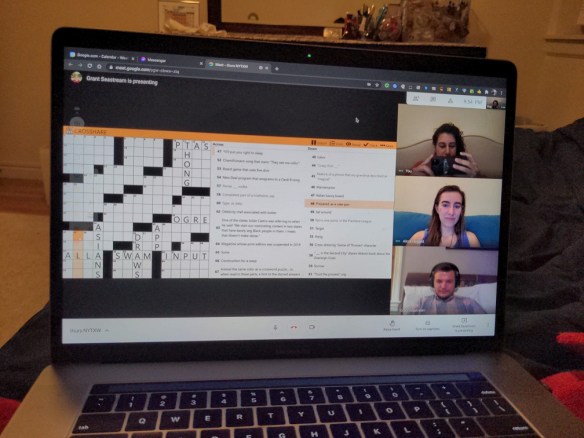
The article mentions the many virtual and online spaces that are now comfortable haunts for younger crossword fans. Facebook forums, Discord chats, Zoom solving parties, Crossword Twitter, r/crossword on Reddit, and even Tiktok accounts dedicated to crosswords got some time in the sun, and it’s really cool to see how these new spaces have emerged and grown more influential.

[A solve-along video from YouTube, Twitch, and Crossword Tiktok user
Coffee and Crosswords. Actual solving starts around 10 minutes in.]

Several names familiar to crossword solvers were cited as well. Constructors like Sid Sivakumar (mentioned just yesterday in our Lollapuzzoola wrap-up), Nate Cardin, and Malaika Handa were all quoted in the piece, reflecting many of the same concerns we’ve heard from new and upcoming solvers in some of our recent 5 Questions interviews.

I actually remember the author’s post reaching out to the contributors and readers of r/crossword a few months ago, and I was glad to see the subreddit getting some mainstream attention. Yes, like any internet forum, it can be combative and argumentative at times, but that’s a rarity.

Most of the time, it’s a supportive community for crossword fans and aspiring constructors, a place where they share questions, bravely offer up their first attempts for input and criticism, and discuss all things puzzly. It’s genuinely inspiring to see new solvers on a near-weekly basis reaching out and being embraced by fellow solvers and cruciverbalists-in-progress.

I highly recommend you take the time out to read Mansee’s piece. She captures a true sense of not just where crosswords are now, but where they’re headed. And if these young people have anything to say about it, it’s headed somewhere very bright indeed.


dailypopwsicon

Have you checked out our special summer deals yet? You can find them on the Home Screen for Daily POP Crosswords and Daily POP Word Search! Check them out!

Thanks for visiting PuzzleNation Blog today! Be sure to sign up for our newsletter to stay up-to-date on everything PuzzleNation!

Delving into the Lollapuzzoola 14 Puzzles!

lolla-logo

The fourteenth edition of Lollapuzzoola, as is tradition, arrived on a Saturday in August, but for the second year in a row, it was hosted online to allow tournament solving from home.

I was not in virtual attendance, but I did sign up for the Next Day Division puzzle packet. Last weekend, I finally had a chance to sit down and try my hands at this year’s tournament puzzles, and I was not disappointed. Lollapuzzoola continues to push the envelope with inventive themes and unique spins on how to bring crosswords to life.

This year’s theme was “This Time, It’s Virtual… Again.” Every puzzle had something to do with social media, social distancing, or some other aspect of virtual life that emerged during the pandemic, and the constructors were clearly inspired in all sorts of ways. Let’s take a look at what they came up with.


hit-me-up

Two rehearsal puzzles served as a warm-up for this year’s tournament crosswords. The first was constructed by Brooke Husic and Sid Sivakumar and entitled “Hit Me Up!” This puzzle immediately reminded solvers that anything could happen at Lollapuzzoola.

Not only were the theme entries reading down — which isn’t that weird, but it’s fairly uncommon — but there were animated GIFs as clues for three of the answers. The theme was fairly accessible: phrases that started off with a method of communication like ZOOM or TEXT, confirmed by the revealer CONTACT HIGH (since the method of contact was the highest part of the down entry). All in all, a puzzle with a solid hook, complimented by good grid fill. Exactly what you want from a warm-up.

The second rehearsal puzzle was constructed by the same duo (but with Sid leading off the byline this time) and entitled “Box Score.”

This was a strong follow-up, featuring the word WIN as a rebus-style single-box entry, which allowed for some devious crossings (like ENTWINE crossing RAW INGREDIENTS). The fill was smooth and I learned that KOREA is the home of the Baekdu-daegan mountains. Neat!
casual

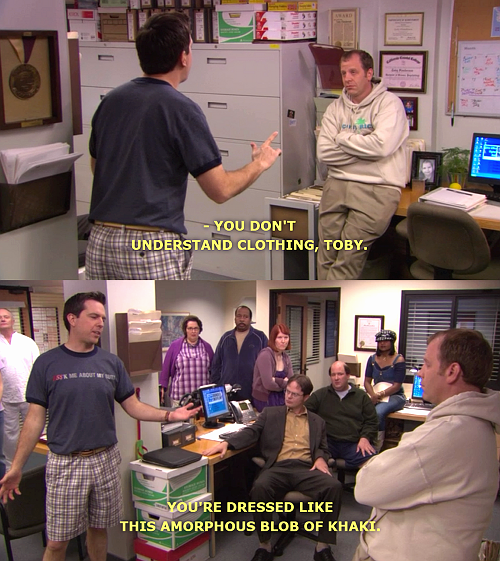
Puzzle 1: Extremely Casual Friday by Robyn Weintraub

The tournament puzzles kicked off with this enjoyable opener, a 15x grid with clean fill and quite the appropriate theme for a virtual tournament.

Each theme entry was a phrase starting with a type of pants — SWEAT, PAJAMA, YOGA, and hilariously, NO — tied together with the answer word PANTS in the bottom-right corner.

Well constructed, humorous, and a great solve… it’s the recipe for an ideal Lollapuzzoola puzzle #1.

Interesting grid entries included REPLY ALL, SLOPPY JOES, and BEST BET, and my favorite clue was “This puzzle was constructed by Brooke Husic, e.g.” for LIE.
debamlen

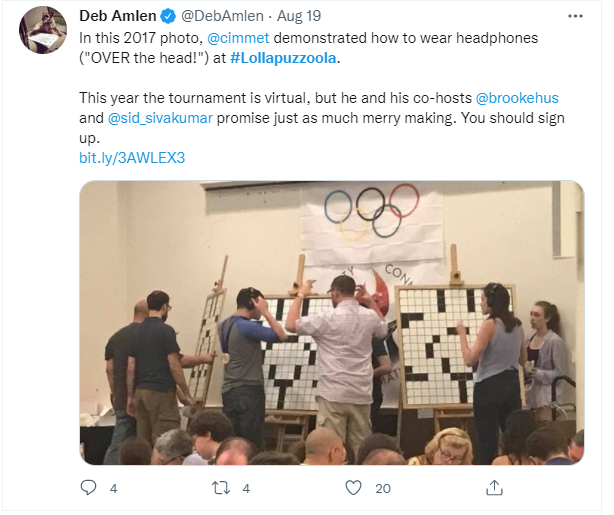
[Here, Deb Amlen (blue checkmark and all) demonstrates Twitter tagging.]

Puzzle 2: Tag! by Amanda Rafkin

This 17x puzzle embraced the social media theme by embedding @ symbols in the grid as starters for the theme entries (where @ represented AT, like in @ASTANDSTILL), allowing for some fun crossings.

The theme was encouraged further by the revealer TWITTER MENTIONS, as well as a blue checkmark next to Amanda’s byline. (For the uninitiated, the blue checkmark, aka the blue tick, is used on Twitter to indicate someone is a verified user. It’s often a source of some small social media clout as well.)

With strong fill and some signature Rafkin flare — it’s very Amanda to have a Sondheim reference — this was a great confidence-building solve with a heap of style. I quite enjoyed this puzzle.

Interesting grid entries included AW NUTS, EYE DOC, and STAYED INSIDE, and my favorite clue was “Sound that might drown out some $%!#ing bad words” for BLEEP.
textspeak

Puzzle 3: Get the Message by Sid Sivakumar

This 19x grid with vertical symmetry was a definite step-up in difficulty after the first two puzzles, but it’s also a strong puzzle with a great design.

The theme for this one involved chat/texting slang like TTYL and ROFL, and like the second rehearsal puzzle, it had a rebus element where those abbreviations were contained in a single box, used by two crossing entries. This was supported not only by the cluing — which included a fake username and comment to indicate some chat or textspeak was involved — but the revealer CHATBOX in the middle of the grid.

I probably wouldn’t have realized as quickly that there was a rebus involved if I hadn’t had rebuses on the brain after solving the rehearsal puzzles. But even without all hints, this was a fairly tight grid that made the most of its theme. (I wasn’t a huge fan of IN appearing three times in the grid, but that might be seen as a nitpick.)

Interesting grid entries included PRESS KIT, SASHAY AWAY, SIERRA MIST, and EVIL ONE, and my favorite clue was “Bar, barn, or barrel” for UNIT.

200

Puzzle 4: Connecting… by Brooke Husic

Okay, here we go.

Puzzle 4 was a 15x grid with one doozy of a gimmick. Most of the down clues were replaced with an animated GIF of three dots moving (like the one above), the instantly-recognizable image of a message either being typed or incoming, but that hasn’t arrived yet. (For Next Day Division solvers, there was no animation, just three dots, but the message was still clear.)

All the across clues were still there, and SOME of the down clues as well. The remaining down clues were long, and almost felt like the clues from a cryptic or British-style crossword, because they didn’t seem to quite fit the answers in the grid.

I can only imagine the baffled terror I would have felt in the moment during the tournament if I tackled this puzzle live. I imagine it would have been similar to this poor soul’s experience:
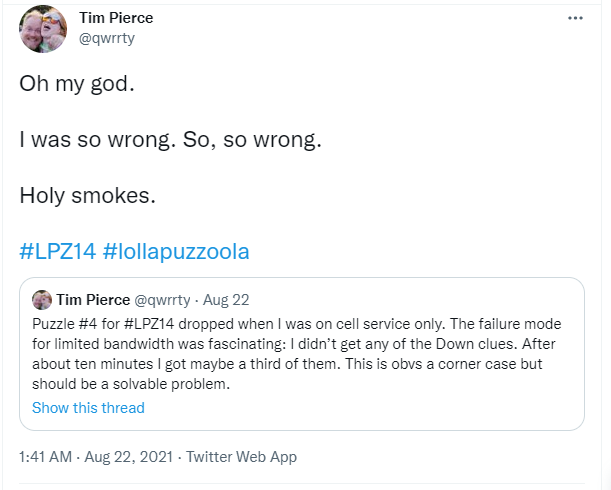
tim pierce

Thankfully, I finally realized what was going on. The down clues weren’t just for their particular coordinate, they were for all of the words in that column. For instance, 55-Down was clued “A+ hosts,” and the answer to 55-Down was MCS. That could fit. But only “hosts” applied to 55-Down. “A” and “+” were the clues for the two down entries above 55-Down: 1-Down ALPHA and 32-Down AND.

Across-only solvers probably got farther than most with this one at the start, and I can imagine the grid would feel almost impenetrable if you didn’t figure out the gimmick.

But man, this is clever as hell and a solving experience nobody is going to forget anytime soon.

Interesting grid entries included HIGGS, OPEN SECRET, and SVELTE, and my favorite clue was either “A+ hosts,” as listed above, or “Get the picture SO much” because “SO” clued BOO and I thought the misdirect was very clever.
8826947_0

Puzzle 5: You’re Muted by Patti Varol

After a brain-melter like Puzzle 4, Puzzle 5 was clearly designed as a cool-down puzzle before the tournament final. And I’m sure it served that purpose amiably for many solvers.

But for some reason, this theme took me the longest to get, and I felt so dumb when I realized how obvious it was.

This 21x grid featured theme entries where part of the phrase that sounded like “You’re” had been removed. For instance, JUNIOR EXECUTIVES became JUNE EXECUTIVES, and VEGETABLE PUREE became VEGETABLE PAY.

For some reason, the sound aspect of it just blew past me several times on the way to the forum, and I was done with the grid for MINUTES before it finally dawned on me. Patti is going to be so disappointed with me.

The theme is terrific and the grid fill is solid. This was a great capper for the tournament proper, helping bring (most) solvers back down to earth after the whirlwind that was Puzzle 4.

Interesting grid entries included SNIVEL, SINEWED, MOONSTRUCK, PHOTOBOMB, and ALL TIME LOW, and my favorite clues were “Dirt pie ingredient” for OREO and “Notable Ford of the 1970s” for GERALD.
finals

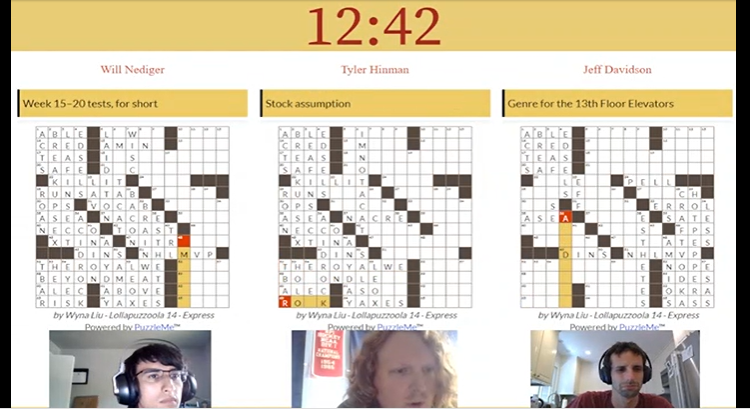
[The tournament finals, live on Twitch!]

Puzzle 6: Finals by Wyna Liu

As always, there were two sets of clues for the Finals puzzle, the Local and the more difficult Express clues. No matter which clues you were working with, you were in for a terrific tournament finale.

This themeless 15x was tough but engaging, featuring lots of long entries and unusual phrases crossing, making for a satisfyingly challenge finale and a suitable final boss for the top contenders. The entry NHL MVP tripped me up more than once, what a brutal combination of letters, but the tight grid and strong cluing for both the Local and Express solvers made this an excellent wrap-up to a great day of puzzling

Interesting grid entries included CRAFT VODKA, THE ROYAL WE, “I’M NOT A CAT” (referencing that amazing online legal proceeding debacle), ACID ROCK, Y-AXES, and LEO X. Both the Local and Express sets of clues had some gems, so I’ll list them separately below:

Local clues:

  • “Saved butt” for ROACH
  • “Ah, this is the life (to Mario and Luigi)!” for ONE-UP
  • “Ones for the books?” for SCHOLARS
  • “Moving parts of a painting on ‘Scooby-Doo'” for EYES

Express clues:

  • “What might require a blunt instrument?” for ROACH
  • “Congress, after adjourning?” for BREAKUPSEX
  • “Video game life form?” for ONE-UP
  • “Cabs, e.g.” for REDS
  • “Whence a popular countdown in Times Sq.” for TRL

There was also a tiebreaker themeless mini by Nam Jin Yoon. The mini was a quick and satisfying solve, anchored around the grid-spanning entries GATECRASHER and READ THE ROOM. Loaded with great vocabulary, this puzzle offered a nice wind-down after a strong tournament and several really engaging puzzles.

Interesting grid entries included RAHRAH and TOO SOON, and my favorite clue from the mini was “Some fishy characters?” for MERMEN.

[There was also a meta-puzzle suite AND a collection of ten mini-crosswords dubbed the Mid-Day Mini Meta which was constructed by a small army of strong up-and-coming constructors, both of which are absolutely worth your time.]


The puzzles at Lollapuzzoola always impress, and this year was no exception. The grids were neatly constructed, there was little crosswordese, and the creative themes, grid designs, clues, and puzzle mechanics ensured that not only would fun be had by all, but that the puzzles would linger in your memory. Especially Puzzle 4.

The puzzles were varied and engaging, and the Next Day Division solving experience is always a treat. Congratulations on the competitors and the organizers who made it all happen, especially in a virtual format with so many additional solvers. (Click here to check out the Twitch feed of the entire tournament!)

Lollapuzzoola is only getting more creative, more groundbreaking, and more clever with each passing year, and it’s just awesome to watch it grow and evolve.

I can’t wait to see what they come up with next year!


dailypopwsicon

Have you checked out our special summer deals yet? You can find them on the Home Screen for Daily POP Crosswords and Daily POP Word Search! Check them out!

Thanks for visiting PuzzleNation Blog today! Be sure to sign up for our newsletter to stay up-to-date on everything PuzzleNation!

PN Product Review: Zendo Expansion #2

[Note: I received a free copy of this game in exchange for a fair, unbiased review. Due diligence, full disclosure, and all that.]

Even the best designed games need a little sprucing up from time to time. This is especially true of logic/deduction games, where after a while, it can feel like you’ve seen every trick either the game or the other players can offer.

And there are very few game companies that consistently deliver great expansions. It’s a brutal tightrope to walk; you have to add to the established game in an interesting or fresh way, but without breaking the rules, introducing problems that players won’t know how to handle mechanically, or betraying in some manner the spirit of the original game.

For the team at Looney Labs, though, creating an expansion pack seems like another day at the office. We’ve reviewed expansion packs in the past for Fluxx (Fluxx Dice), Just Desserts (Just Coffee/Better with Bacon), and Star Trek Fluxx (the Bridge Expansion), and each one revitalizes the game and adds delightful new wrinkles without hampering any of the qualities that made the original game such a treat.

Today, we’re looking at a new expansion pack for one of the company’s most immersive and challenging puzzle games: Zendo.

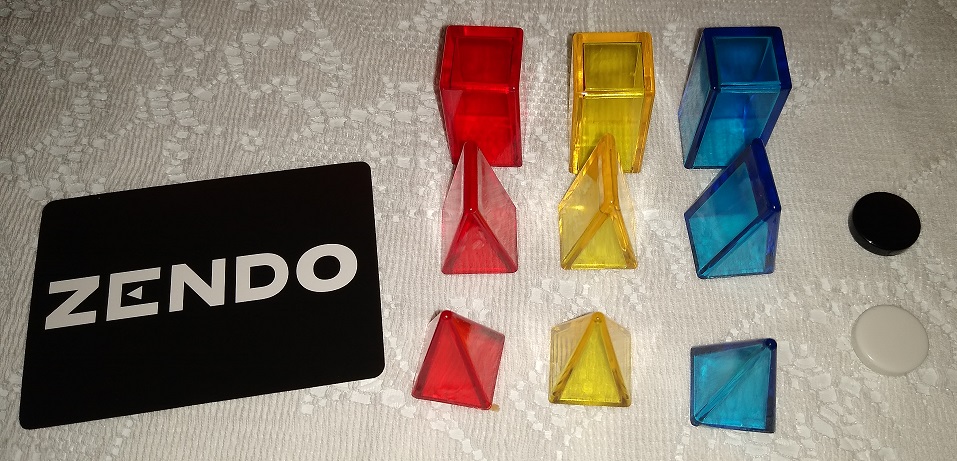
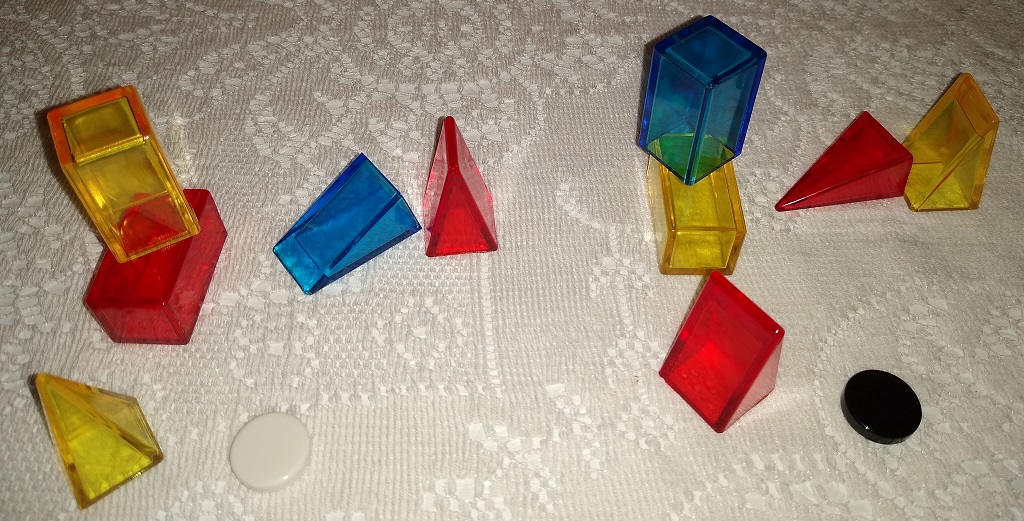
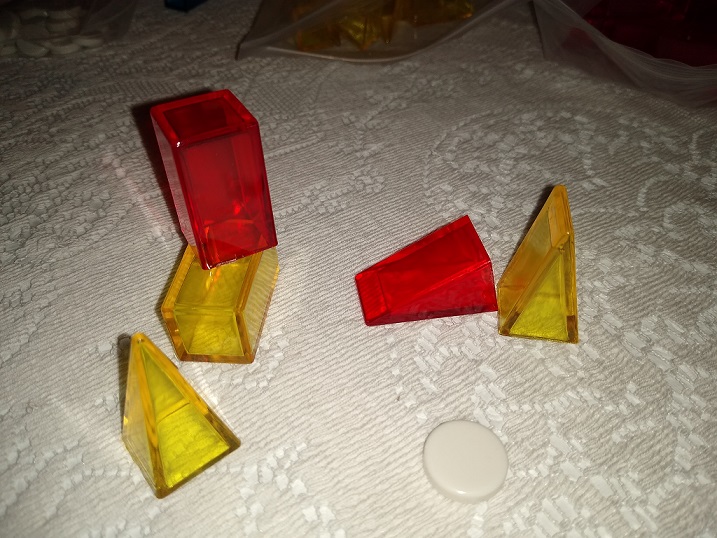
In Zendo, the players pull pieces from a communal pile in order to build different structures, using pyramids, wedges, and blocks. One player, the moderator, chooses a secret rule for the players to uncover, and builds two structures. One of these structures follows the secret rule, and one does not, and both are marked as such.

Secret rules can be as simple as “must contain all three shapes” or “must contain exactly four pieces.” They can be as complex as “must contain more blue pieces than blocks” or “must contain at least one yellow piece pointing at a blue piece.” Some rules involve how pieces touch, or how they’re stacked, while others demand no touching or stacking whatsoever. The field is wide open at the start of the game.

Players then try to deduce the secret rule by building structures themselves, arranging pieces from the communal pile into various patterns and asking the moderator for more information.

So, how does Zendo Expansion #2 affect the original?

[Here are two sculptures: one that follows the secret rule and one that doesn’t. Can you figure out the secret rule? Is it about shapes? Colors? Placement? More?]

Zendo Expansion #2 is a ten-card deck of new secret rule cards that allow the moderator to create fresh challenges for the other players to unravel. The structures and arrangements may look the same, but players must reexamine what they think they know and observe to figure out the new secret rules.

Because, you see, the cards offer more than just the new rules. They demand greater cleverness from the moderator, in order to create designs that are fair for the players — not immediately obvious, but not impossible to discern either. It’s a difficult task for moderators.

And the challenge is even greater for players. After all, it’s not just about the shapes and how they interact, but all aspects of what the players see. Zendo Expansion #1 had cards where the rule involved the shape of the structure’s shadow. You could look at the pieces, the colors, how they’re placed, where they’re placed, how close, how far away, how many of each, and the shape of the shadow could NEVER occur to you.

[Here’s another sculpture that removes blue pieces as a possible
element in the secret rule. Have you figured it out yet?]

With one medium rule card and nine difficult rule cards (as opposed to the easy-to-difficult range of the first expansion pack), the game will only become more surprising and thoughtful from here.

These cards include rules about relationships between pieces, conditional rules (example: something that’s true of the sculpture if something else happens theoretically), and even rules regarding something that ISN’T happening in a particular sculpture. Players will have to wrack their brains and truly example both sculptures from every angle to puzzle out these new rules.

There are even decoy tags on certain cards, to make players think the card has more variables than there actually are! Diabolical!

Although I’m a moderator far more frequently than a player, I’m excited to try out both sides of these new rule cards. After all, with the base set and two expansions’ worth of cards, there’s no way I can remember ALL of the possible combinations available. I’m as likely to be outwitted and outpuzzled as the next player.

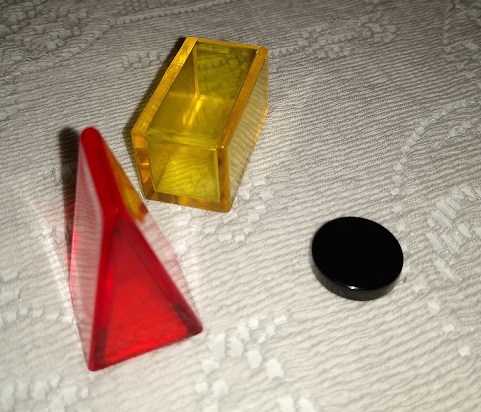
[One more chance. Here’s a much simplified version that DOESN’T
adhere to the secret rule. What can we learn from this one?]

And that’s the charm of Zendo. From a small gathering of pieces and rules, you can make practically any scenario you wish. Will the players figure it out first try, or will the moderator’s ability to reinvent their sculptures as needed be put to the ultimate test?

Zendo is at once the most collaborative and one of the most curiously devious puzzle-games in the Looney Labs catalog, and with this expansion pack, only the truly inventive and observant will thrive. What a treat.

[Zendo and the new Zendo Expansion #2 are available from Looney Labs, and the expansion pack is only $5!]


Oh, and if you figure out our secret rule for the post, we’ll send you a Zendo-themed prize!


dailypopwsicon

Have you checked out our special summer deals yet? You can find them on the Home Screen for Daily POP Crosswords and Daily POP Word Search! Check them out!

Thanks for visiting PuzzleNation Blog today! Be sure to sign up for our newsletter to stay up-to-date on everything PuzzleNation!

The Newest Twist on Twisty Puzzles!

history

[Picture courtesy of Rubiks.com.]

Rubik’s Cubes and other twisty puzzles come in all shapes and sizes. With the advent of 3-D printing and innovative home designs that can be shared with a few clicks, the field is constantly evolving. This is a huge plus for puzzle fans.

Naturally, there are puzzle designers who aspire to make the largest twisty puzzle possible. In previous blog posts, we’ve chronicled some of these ambitious endeavors.

One of the first to draw the attention of online solvers was Oskar van Deventer’s 17x17x17 cube known as the “Over the Top” Rubik’s Cube.

Here’s a video of someone solving this diabolical design:

This was later topped by a design by corenpuzzle, who created a 22x22x22 cube. The build was so complex that the cube actually exploded (twice!) during construction.

But it’s not only cube-style twisty puzzles that are drawing the attention of designers. There’s also the minx series of twisty puzzles.

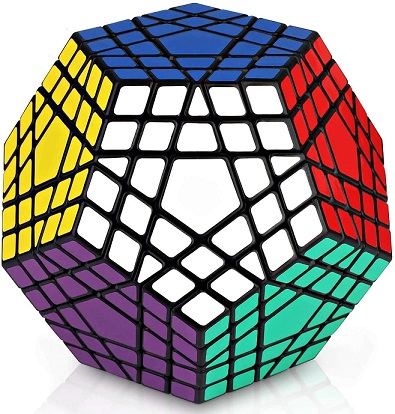
These are dodecahedrons rather than cubes. A dodecahedron is a 12-sided shape formed from pentagons. The smallest of this form is known as a kilominx.

71+IOUAhXQL._AC_SL1487_

The megaminx version (pictured above) was the first to attract greater attention in the puzzle world. It had 50 moving parts, as opposed to the 20 movable pieces of a standard Rubik’s Cube. You can find all sorts of solving videos on YouTube featuring megaminx puzzles.

The quest to build the largest minx-style twisty puzzle has taken puzzling to strange new places. Gigaminx, Petaminx, and more followed as the puzzles grew increasingly complex.

For a while, the champion of these puzzles was Matt Bahner, who created the Yottaminx. It’s a basketball-sized twisty puzzle that took four months to build. With 2,943 parts, it’s the twisty equivalent of a 15x15x15 cube.

Here you can see Bahner showing off his creation:

No record stands forever, though, and corenpuzzle recently returned to the top of the leaderboards with Atlasminx, the new record holder.

This 19-layer dodecahedron weighs in at over 17 pounds, and was assembled from 4,863 moving parts.

Skip to 1:53 to see the finished version of the puzzle and see it in action.

You could literally spend a lifestyle twisting and turning that puzzle and never reach the end.

These mindbending designs continue to wow solvers everywhere while pushing the creative envelope in clever new ways, and I’m definitely not alone in saying we cannot wait to see what comes next.


dailypopwsicon

Have you checked out our special summer deals yet? You can find them on the Home Screen for Daily POP Crosswords and Daily POP Word Search! Check them out!

Thanks for visiting PuzzleNation Blog today! Be sure to sign up for our newsletter to stay up-to-date on everything PuzzleNation!
How People Used Puzzles and Games to Endure the Pandemic

Puzzles and games have been there for many people during the pandemic.

Many puzzle and game companies offered (and continue to offer) “COVID discounts” and giveaways to help people financially impacted by the crisis. Companies released free online or zoom-compatible versions of their products to help people get by.

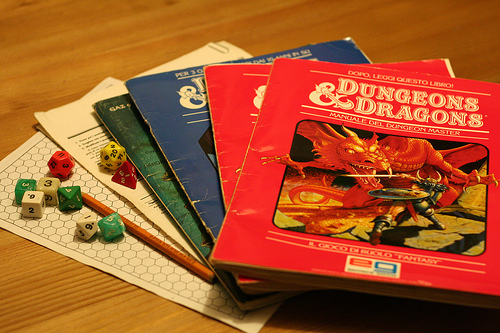
There are all sorts of articles out there about how Dungeons & Dragons and other roleplaying games have served as critical socializing tools in virtual hangouts. Bar-style trivia, zoom games, Jackbox, Board Game Arena, Fall Guys, Among Us… lots of communal activities went virtual as puzzles and games filled a rapidly growing niche.

Whether solved alone or with other members of the household, jigsaw puzzles sales increased 500% or more. Online sites to coordinate trades sprang up, allowing people to swap puzzles they’d solved before for ones new to them.

At a terrible time for many people, puzzles and games helped us cope.

And honestly, if you know the history of games and puzzles, it makes sense. Many of them have been born out of unpleasant circumstances.

Monopoly was a hit during the Great Depression, offering an escape and the illusory feeling of being rich. The game itself only cost two dollars, so it was a solid investment with a ton of replay value.

Candy Land was created to entertain children with polio (although that fact wasn’t commonly known for 50 years). Clue was designed during air raid drills as a way to pass the time. The Checkered Game of Life (later The Game of Life) was inspired by Milton Bradley’s own wild swing of business misfortune.

Risk and other conflict-heavy games weren’t popular in postwar Germany, so an entire genre of games that avoided direct conflict was born: Eurogames.

It’s just as true in the modern day. What game was flying off the shelves during COVID-19 lockdowns? Pandemic.

That combination of escapism and social interaction is so powerful. Games are low-stakes. They offer both randomness (a break from monotony) and a degree of control (something sorely missing during lockdown).

Puzzles too assisted folks in maintaining their mental health. And isn’t it interesting that crossword solving, something viewed by many as a solitary endeavor — I guess they never needed to ask someone else 5-Down — helped fill a crucial social role for people?

Constructors stepped up in interesting, inventive ways. The sense of community fostered by online crossword events like Crossword Tournament From Your Couch (which filled the void of ACPT in 2020) and the Boswords Themeless League was absolutely invaluable to puzzlers who couldn’t attend some of the highlights of the puzzle calendar year.

As I said before, there are numerous articles out there celebrating the benefits of roleplaying games like Dungeons & Dragons, Pathfinder, and more.

Roleplaying games certainly helped keep me sane during lockdown. It might sound ridiculous, but dealing with world-threatening threats, fiercely dangerous monsters, and sinister plots that I could DO something about was medicinal. It was escape in its truest form. It recharged me, allowing me to lose myself in storytelling with friends.

The last 18 months were hard. There may be hard months ahead. But I’m grateful for the puzzle/game community — and the many marvelous pastimes they’ve created — for helping me and many others get by. To smile. To cope. To socialize. And to enjoy.

What games and puzzles have helped you deal with unpleasant circumstances, fellow puzzlers? Let us know in the comments section below. We’d love to hear from you.


dailypopwsicon

Have you checked out our special summer deals yet? You can find them on the Home Screen for Daily POP Crosswords and Daily POP Word Search! Check them out!

Thanks for visiting PuzzleNation Blog today! Be sure to sign up for our newsletter to stay up-to-date on everything PuzzleNation!