Tackling the 2017 Indie 500 Puzzles!

indie5002017

Welcome to Follow-Up Friday!

By this time, you know the drill. Follow-Up Friday is a chance for us to revisit the subjects of previous posts and bring the PuzzleNation audience up to speed on all things puzzly.

June 3 marked the third annual Indie 500 Crossword Tournament, hosted in Washington, D.C., by constructors Erik Agard, Neville Fogarty, Andy Kravis, and Angela Olsen Halsted. The first tournament had a racing theme, the second had a prom theme, and this year was time-themed!

While I couldn’t attend the tournament, I did download the tournament puzzles, and after a few weeks, I had the opportunity to sit down and tackle the six puzzles prepared for the event. And today, I thought I’d offer my thoughts on those puzzles, for any interested PuzzleNationers who might be considering participating in the future.


as0pmwzlr4spizkpngph_feat_03-23-17_hermes_cover_1920x1080

[Image courtesy of IW Magazine.]

Puzzle 1: Before and After by Angela Olson Halsted

The opening puzzle got solvers off to a quick start with a well-constructed grid and some very accessible cluing. The theme had phrases where both words were connected when the word “TIME” was placed between them. For instance, HAMMER BANDITS combined HAMMER TIME and TIME BANDITS.

The hook made for a terrific introductory puzzle, setting the stage for more challenging crosswords to come. It was an excellent way to set the pace.

Interesting grid entries included SLIM JIMS, LAPDOG, and FAJITA, and my favorite clue was “Fourth name on a typical list of Santa’s reindeer” for VIXEN.

Puzzle 2: Jam Session by Paolo Pasco

The second puzzle of the day was all about CRUNCH TIME (as the revealer explained), and solvers had to figure out how to “jam” the correct theme answers into the limited grid space. Savvy solvers glommed onto the fact that each compressed entry (placing two letters in a single grid box) included a period of time (WEEK for FASHION WEEK, DECADE for THE ME DECADE, etc.).

Pasco’s CRUNCH TIME wordplay was well-represented in the cluing as well, as the last ten down clues were “rushed” — printed with spelling errors and other shortcuts. It was a fun way to reflect the theme further, and added a lot of personality to the cluing.

Interesting grid entries included NOT SO FAST, ALL THAT, LAUTRECA, and ALI PASHA, and my favorite clue was either “Connecting words?” for I DO or “The few, the proud (and the abbreviated)” for USMC.

20170607020601the_byrds_in_1965

[Image courtesy of Wikipedia.]

Puzzle 3: This Mashup’s for the Byrds by Tracy Bennett

Tracy Bennett brought a lyrical touch to the proceedings with this puzzle which not only namedropped a few time-based song titles, but also had punny themed clues written in the style of The Byrds’ song Turn Turn Turn. For instance, the clue “a time to be borne” led solvers to THE RAPTURE.

There was also a very impressive bit of wordplay involving how the 4 themed clues were written. Each was modified with a single letter — “a time to trend” instead of “a time to rend,” for example. These extra letters spelled out the answer RENT in 80-down (which was cited in another down clue). That’s some quality construction right there.

Interesting grid entries included BROAD CITY, TOE TAP, ISSA RAE (across two answers) and FEMINISTA, and my favorite clue was either “Cheap but inviting letters” for BYO, “Change one’s locks?” for DYE, or “Norman patronymic with ‘Gerald’ or ‘Hugh'” for FITZ.

Puzzle 4: Non-Linear Narratives by Erik Agard featuring Allegra Kuney

The toughest puzzle of the tournament thus far, Puzzle 4’s theme entries involved phrases which included animals, but not only were the animals replaced with their younger or older versions (KANGAROO for JOEY in PAL JOEY, for instance), but the animal portion of the phrase also read backward! So in the case of FROG IN ONE’S THROAT, the actual answer read ELOPDAT IN ONE’S THROAT.

Those entries were supported by the revealers GETTING UP THERE (for KANGAROO and RABBIT, since they were progressing from baby to adult) and BUTTONING UP (for TADPOLE and HATCHLING, since they were progressing from adult to baby like Benjamin Button). And all four were cited in the answer JUMPING AROUND IN TIME, offering a final touch of wordplay for solvers to enjoy.

Interesting grid entries included LENINIST, AM I HIGH, TIRAMISU, RING SIZE, and CHEERIO, and my favorite clue was either “Spot for a banjo” for KNEE or “Poet hidden (not very well) in this clue” for POE.

time

[Image courtesy of tutsplus.com.]

Puzzle 5: In Search of Lost Time by Neville Fogarty

The manipulation of time and space continued in Puzzle 5, as the word ERA was removed from some themed entries and inserted in others, giving us answers like OP(era)TION DESERT STORM and (ERA)SURE THING.

The construction is topnotch and the fill interesting, making for a nice palate cleanser and a really fun solve after the more strenuous efforts of Puzzle 4.

Interesting grid entries included MR. MOTO, NABBIT, HEE HAW, and FIERI, and my favorite clue was easily “Word clued as ‘Modern messages’ in a 1995 New York Times crossword” for FAXES.

Puzzle 6: Downs Only? by Andy Kravis

The closing puzzle of the tournament was offered in two difficulty levels: the Inside Track (designated for solvers who finished in the top 25% of the field in a crossword tournament with published standings in the past 5 years) and the Outside Track (designated for everyone else). I opted for the Inside Track, then looked over the cluing for the Outside Track.

The closing puzzle of the tournament is usually the most difficult, but this year, they threw a curveball at the competitors:

You will not receive all the clues at the start of this puzzle. Instead, you will start the puzzle with only the down clues. However, you may be able to figure out what happened to the rest of the clues while you are solving the puzzle. If you think you have figured out what happened to the rest of the clues, tell the official standing next to you. If you are correct, you will immediately be given the rest of the clues.

Some solvers make a habit of attempting to solve a crossword with only one set of clues, so using only the down clues wouldn’t trip up the most elite solvers. But for the rest of us, what a diabolical twist! (The theme entries spelled out that the missing Across clues were on the back of the whiteboard the competitors were filling in.)

The grid itself was packed long entries, but the tight construction left little room for crosswordese or obscurity to throw you off-track. It’s a great grid with some brutal cluing.

Interesting grid entries abounded in this one, including CAIMAN, MIND ERASER, YUCATAN, GESTAPO, and OSSO BUCO, and my favorite clues were either “The planets, e.g.” for OCTET (alas, poor Pluto), “Part of many a wedding toast” for ANECDOTE, or “Sea whose eastern basin dried up completely in 2014” for ARAL. (That area so often clued as a sea is in fact now referred to as the Aralqum Desert, and it’s nice to see crossworders picking up on that.)


Overall, this was the best Indie 500 yet. The puzzles mixed the inventiveness of the first two tournaments with a steadier hand and some really clever cluing. The constructors made the most of the time theme, resulting in some super-impressive wordplay and theme ideas. All in all, this was an engaging and worthy series of puzzles, designed to delight and challenge solvers in equal measure.

I look forward to its return next year, and hopefully some of you will join me in accepting the Indie 500 challenge!

Note: There were additional puzzles included in the puzzle packet, but since they were outside the regular tournament puzzles, I didn’t review them. But believe me, they are worth your time, particularly Tracy Bennett’s immensely fun “To Everything There Is a Season” companion puzzle.


Thanks for visiting PuzzleNation Blog today! Be sure to sign up for our newsletter to stay up-to-date on everything PuzzleNation!

You can also share your pictures with us on Instagram, friend us on Facebook, check us out on TwitterPinterest, and Tumblr, and explore the always-expanding library of PuzzleNation apps and games on our website!
Codecrafting with Crosswords!

We’ve discussed ciphers and codecracking numerous times in the past, and rightly so. It’s a style of puzzling that has literally affected the outcomes of battles, helped shape key historical moments, and changed the face of spycraft.

And it’s a puzzle form that continues to evolve to this day. We’ve moved far beyond the simple one-to-one replacement encryptions of your standard newspaper cryptogram, and intrepid solvers are always looking for newer and more devious ways to conceal their messages.

Tumblr user Cipherface has cooked up a pretty ingenious system that actually uses another style of puzzling in its execution: crosswords.

tumblr_nfh6mgvdtf1t4n39mo1_540

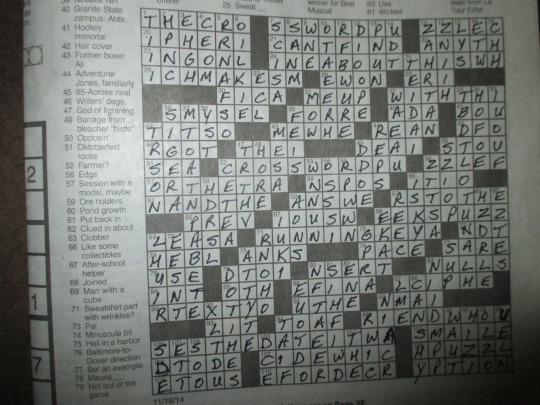
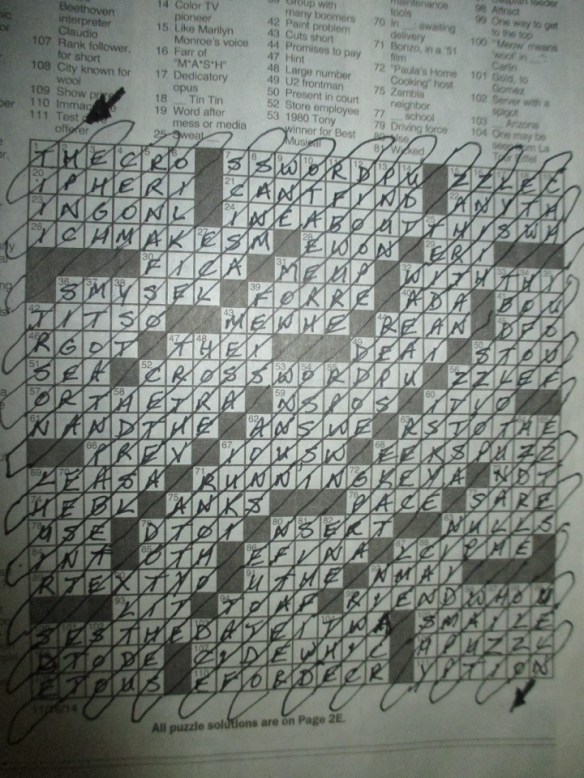
Here’s how it works. You write your message out in the open spaces of the crossword, ignoring the black squares.

tumblr_nfh6mgvdtf1t4n39mo2_r1_1280

Then, map out this diagonal path as the first step to encrypting your message.

tumblr_nfh6mgvdtf1t4n39mo4_r1_1280

Do the same with the puzzle’s answer key, and you’ve got your running key, the text used to substitute letters for the letters in your actual message.

table2

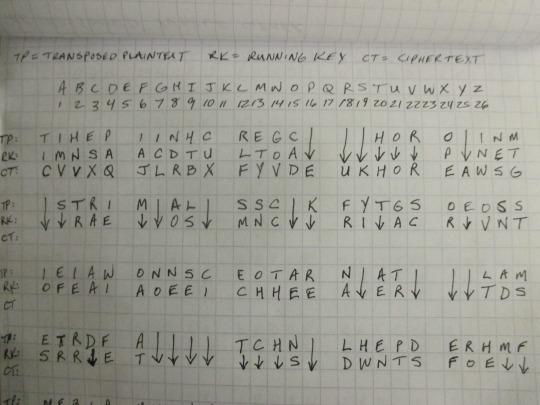
Then you run your message through the tabula recta, a table where you use the letter you want revealed and the letter in your running key to pick the letter in your encryption.

tumblr_nfh6mgvdtf1t4n39mo5_r1_540

Here, we can see Cipherface mapping out the encrypted message using this method.

From the Tumblr writeup:

The idea is to use a crossword puzzle for the transposition and the answers to the previous weeks puzzle as a running key. And the blank spaces are used to insert nulls into the final ciphertext. You then mail it to a friend who uses the date it was mailed to decide which puzzle to use for decryption.

It’s a pretty clever way to leave your encryption key in plain sight, and yet keep your messages secret. The running key keeps changing, so it’s more effective than traditional running keys, which stayed the same for longer periods of time.

Not to mention, using the puzzle’s publishing date? What a quick and easy way to keep your friend informed in an innocuous way. You’d just need to decide ahead of time which newspaper to use.

And it figures. The best way to make a puzzle better? Add another puzzle.


Thanks for visiting PuzzleNation Blog today! Be sure to sign up for our newsletter to stay up-to-date on everything PuzzleNation!

You can also share your pictures with us on Instagram, friend us on Facebook, check us out on TwitterPinterest, and Tumblr, and explore the always-expanding library of PuzzleNation apps and games on our website!
Pun in the Sun! It’s a Summer Wordplay Party!

Oh yes, it’s that time again! It’s to unleash our puzzly and punny imaginations and engage in a bit of sparkling wordplay!

summerpuzzles

You may be familiar with the board game Schmovie, hashtag games on Twitter, or @midnight’s Hashtag Wars segment on Comedy Central.

For years now, we’ve been collaborating on puzzle-themed hashtag games with our pals at Penny Dell Puzzles, and this month’s hook was #PennyDellSummerPuzzles, mashing up Penny Dell puzzles and vacations, the summer months, surf movies, camp, activities… anything and everything you associate with summer!

Examples include Summer Triangles, Beach Blanket Bingo, or Suntan-glewords!

So, without further ado, check out what the puzzlers at PuzzleNation and Penny Dell Puzzles came up with!


Summertime, and the Living is Easy Sudoku

School’s Out of Place for Summer

Camp Tanglewood

Which Way to San Jose Words

Summer lovin’, had me a blips

You’re invited to a neighborhood block party; come at 6’s and 7’s

Cancellations my reservation

Summerdoku

Picknic and Choose

Hopscotch the globe

Middle of the Road Warrior

Sisterhood of the Traveling Spanners

Grand Tourist Trap

The End-of-the-Line-less Summer

Rods & Wheels

Word Maze Runner

Kakuro Vs. the Volcano

A Perfect Hang Ten

Annetagrams Funicello

Fiddler’s Crab Frame

Surfs-Up and Downs

Ups and Dunes

Sun’rays’ burn

Junebox Jumble

Abagust

I Know What You Did First and Last Summer / Insiders Know What You Did Last Summer

Catalina Caperfect Fit

Bit Sand Pieces

Bricks Sand Mortar / Bricks and S’mortar

Surfin’-sert-a-Bird

Take a Letter from Camp

Point the Way Home


There were a few submissions that deserve their own section, as several of our intrepid puzzlers went above and beyond.

-Glossing and Burning in Extreme Sundoku

-Exchange Boardwalks featuring Ice Cream Dots and Dashes

-Have a nice cool “coco nutty crossword” smoothy!

-“Rapid Reader Encounters Bookworms on Word Trails; You Can Take It From There”

And one solver took it to an entirely unexpected rhyming level:

Kellermans we come together, Simon Says as one
We have Shared-a-Letter seasons Takeout, Piggybacks, and fun.
Summer days will soon be Odds & Evens, soonly Autumn starts
And tonight our Mixmaster whispers softly in our Heads & Tails.


Have you come up with any Penny Dell Summer Puzzles entries of your own? Let us know! We’d love to see them!

Thanks for visiting PuzzleNation Blog today! Be sure to sign up for our newsletter to stay up-to-date on everything PuzzleNation!

You can also share your pictures with us on Instagram, friend us on Facebook, check us out on TwitterPinterest, and Tumblr, and explore the always-expanding library of PuzzleNation apps and games on our website!

Cultural Sensitivity and Crosswords

crossword-newspaper

Last summer, I wrote a blog post discussing an article on Slate by Ruth Graham. The article was entitled “Why Is the New York Times Crossword So Clueless About Race and Gender?”

So, what sort of progress has been made over the previous 365 days? Clearly not enough, given the title of an article published last week on The Outline, entitled “The NYT Crossword is Old and Kind of Racist.”

Adrianne Jeffries makes a strong case for how out-of-touch the crossword often seems these days:

…the Times crosswords, which have been edited by the famed crossword giant Will Shortz since 1993, are vexing for how outdated some of the clues and answers are, especially since in some cases the terms have been abandoned by the paper itself. The puzzle clearly isn’t seeking new talent or a new audience, and in its stodginess, it becomes clear that it is composed for a very particular reader with a very particular view of the world.

15-crossword-w710-h473

[Image courtesy of New York Magazine.]

She backs up her supposition with numerous examples of tone-deaf cluing and grid fill, like ESKIMO, Oriental, and SISSIES.

There is some overlap with Ruth Graham’s points from last year — including the reductive use of HOMIE regarding black culture and the clue “One caught by the border patrol” for ILLEGAL — and Jeffries went on to include examples of the issue I raised last year with the objectionable “This, to Juan” cluing style that abounds in crosswords.

But she takes things one step further than previous efforts by pointing out how the crossword is out-of-step with the rest of the New York Times newspaper, citing the year that various terms were marked offensive in the Times style guide. (“Oriental” as a descriptor, for instance, was banned in 1999.)

64207-c4090678

[This is oriental. People are not. Image courtesy of Rashid Oriental Rugs.]

It’s disheartening that articles like this are so necessary. Women and people of color deserve better representation in the Times puzzles, both as contributors of puzzles AND as subjects of clues and entries themselves.

Jeffries offered another damning example of dubious Shortzian editing:

I also found an exchange from 2011 illuminating. Shortz asked puzzle constructor Elizabeth Gorski to change an answer on her submitted puzzle. “There was one thing about the construction I didn’t like, and that was at 35 Down,” Shortz told The Atlantic. “The answer was LORELAI, and the sirens on the Rhine are of course ‘Lorelei,’ with an ‘e-i.’ Liz’s clue was Rory’s mom on Gilmore Girls, and I didn’t think solvers should have to know that.” He had the constructor revise the answer to make it 1) more old and 2) refer to mythical women who are so distractingly beautiful that they cause men to crash their ships on the rocks, instead of, a cool mom from a television show that millions of women (and some men) love.

6358790824238732801426659592_tumblr_mfc1fvm21i1qhewe3o1_500

[Image courtesy of The Odyssey Online.]

Even as a (relatively) younger voice in puzzles, I can’t deny many of her points. Puzzles should do a better job of acknowledging modern culture, of serving as a tiny, daily time capsule of our world.

As I said last year, crosswords are a cultural microcosm, representing the commonalities and peculiarities of our language in a given time and place. They represent our trivia, our understanding, our cleverness, our humor, and, yes, sometimes our shortcomings.

One year later, I wonder if progress will continue to feel so gradual, or if, sometime soon, we’ll begin to feel the cultural quakes and shifts that indicate real change is approaching.


Thanks for visiting PuzzleNation Blog today! Be sure to sign up for our newsletter to stay up-to-date on everything PuzzleNation!

You can also share your pictures with us on Instagram, friend us on Facebook, check us out on TwitterPinterest, and Tumblr, and explore the always-expanding library of PuzzleNation apps and games on our website!

New puzzle sets for the Penny Dell Crosswords App!

Oh yes, it’s that time again! We’ve got the sweet and lowdown on the latest puzzle set for the Penny Dell Crosswords App for you right here!

We’re excited to announce that the June Deluxe puzzle set is now available! A fantastic fit for Father’s Day!

170607

Offering 30 easy, medium, and hard puzzles, plus 5 June-themed bonus puzzles to delight solvers of all skill levels, the June Deluxe set is just what the doctor ordered to scratch that puzzly itch!

But that’s not all!

170609

That’s right, you can double down on puzzle goodness with the June Deluxe Combo! That’s 70 puzzles, including June-themed bonus puzzles for your puzzly pleasure!

170608

But maybe you need more! If you want a great deal on PuzzleNation-quality crosswords, we’ve got you covered with the June Deluxe Bundle! That’s 105 puzzles, three times the terrific content and crafty cluing of a traditional June Deluxe set, loaded and ready for you to solve!

It’s available for iOS solvers right now, and it will be available for Android users in the next few hours!

170610

Check out Pop’s puzzle chops with these terrific puzzles! Treat yourself (or your dad) to these fantastic puzzle sets!

And happy puzzling!


Thanks for visiting PuzzleNation Blog today! Be sure to sign up for our newsletter to stay up-to-date on everything PuzzleNation!

You can also share your pictures with us on Instagram, friend us on Facebook, check us out on TwitterPinterest, and Tumblr, and explore the always-expanding library of PuzzleNation apps and games on our website!
The Diabolical Long Division Brain Teaser!

From time to time, I’ll receive an email with a brain teaser I’ve never seen before. Sometimes they come from friends, or fellow puzzlers. Other times, PuzzleNationers will ask for my assistance in solving a puzzle that has flummoxed them.

That was the case with today’s puzzle, and I’ll admit, this one was a bit of a doozy to unravel.

longdiv1

Yup, an entire long division problem with only a single digit set. No letters or encryption to let us know which digits were repeated, as there are in Word Math puzzles published by our friends at Penny Dell Puzzles.

Just a 7 and a bunch of asterisks. “Is this doable?” the sender asked.

Yes, this is entirely doable, friend. Let’s break it down step by step.

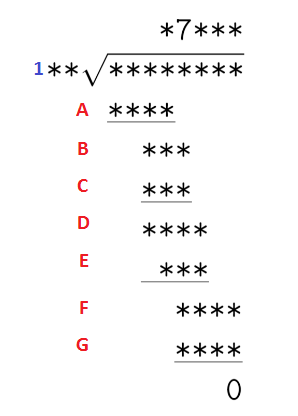
First, we need to know our terminology. The 8-digit number being divided is our dividend. The 3-digit number we’re dividing into it is the divisor. The 5-digit number on top is our quotient.

For the other lines, let’s label them A through G for ease of reference later.

longdiv2

There we go. Now, where do we go from here? We start with what we know.

We know that 7 is the second digit in our quotient.

So our divisor, times 7, equals the number on line C. That’s a 3-digit number, which means the first number in our divisor is 1. Why? Because if it was 2, 2 times 7 would give us 14, which would be a 4-digit number on that line.

longdiv3

That means the quotient is somewhere between 100 and 142. (Why 142? Easy. I divided 1000 by 7, and 142 is the last 3-digit number you can multiply 7 against and still end up with a 3-digit answer for line C. 143 times 7 is 1001, which is too high.)

What else do we know from the puzzle as it stands?

Well, look at lines E and F. We bring both of the last two digits in the dividend down for the final part of the equation. What does that mean?

Remember how long division works. You multiply the divisor by whatever number gets you closest to the given digits of the dividend, subtract the remainder, bring down the next digit from the dividend, and do it all over again until you get your answer.

You multiply the first digit of the quotient times the divisor to get the number on line A. You multiply 7 times the divisor to get the number on line C. You multiply the third digit of the quotient times the divisor to get the number on line E.

Following this route, you would multiply the fourth digit of the quotient against the divisor to get the number on line G. But bringing just one digit down didn’t give us a number high enough to be divided into. Instead of needing more lines (H and I, in this case), we bring the last digit of the dividend down and press onward.

That means the fourth digit of the quotient is 0, because the divisor went into the dividend zero times at that point.

longdiv4

And there’s more we can glean just from the asterisks and what we already know. We know that every one of those 4-digit numbers in the equation begin with the number 1.

How do we know that? Easy. That first number in the divisor. With a 1 there, even if the divisor is 199 and we multiply it times 9, the highest possible answer for any of those 4-digit numbers is 1791.

So let’s fill those numbers in as well:

longdiv5

Now look at lines D, E, and F. There’s nothing below the 1 on line D. The only way that can happen is if the second digit in line D is smaller than the first digit on line E. And on line F, you can see that those first two columns in lines D and E equal zero, since there’s nothing on line F until we hit that third column of digits.

That means the second digit on line D is either a 0 or a 1, and the first digit on line E is a 9. It’s the only way to end up with a blank space there on line F.

longdiv6

I realize there are a lot of asterisks left, but we’re actually very close to knowing our entire quotient by now.

Look at what we know. 7 times the divisor gives us a 3-digit answer on line C. We don’t yet know if that’s the same 3-digit answer on line E, but since it’s being divided into a 4-digit number on line E and only a 3-digit number on line C, that means the third digit in our quotient is either equal to or greater than 7. So, it’s 7 or 8.

Why not 9? Because of the 4-digit answers on lines A and G. Those would have to be higher than the multiplier for lines C and E because they result in 4-digit answers, not 3. So the digit in the first and fifth places in the quotient are higher than the digit in the third. So, if the third digit in the quotient is 7 or 8, the first and fifth are either 8 or 9.

So how do we know whether 7 or 8 is the third digit in the quotient?

Well, if it’s 7, then lines C and E would have the same 3-digit answer, both beginning with 9. But line C cannot have an answer beginning with 9, because line B is also 3 digits. The highest value the first digit in line B could have is 9, and 9 minus 9 is zero. But the number on line D begins with 1, ruling out the idea that the numbers on lines C and E are the same.

That makes the third digit in the quotient 8, and the first and fifth digits in the quotient 9.

longdiv7

We know our quotient now, 97809. What about our divisor?

Well, remember before when we narrowed it down to somewhere between 100 and 142? That’s going to come in handy now.

On line F, we know those first two digits are going to be 141 or below, because whatever our divisor is, it was larger than those three digits. That’s how we ended up with a 0 in our quotient.

So, the number on line D minus the number on line E equals 14 or below. So we need a 900-something number that, when added to a number that’s 14 or below, equals 1000 or more. That gives us a field from 986 to 999.

And that number between 986 and 999 has to be divisible by 8 for our quotient to work. And the only number in that field that fits the bill is 992. 992 divided by 8 gives us 124, which is our divisor.

longdiv8

From that point on, we can fill out the rest of the equation, including our lengthy dividend, 12128316.

longdiv9

And there you have it. With some math skills, some deduction, and some crafty puzzling, we’ve slain yet another brain teaser. Nice work everyone!

[After solving the puzzle, I did a little research, and apparently this one has been making the rounds after being featured in FiveThirtyEight’s recurring Riddler feature, so here’s a link.]


Thanks for visiting PuzzleNation Blog today! Be sure to sign up for our newsletter to stay up-to-date on everything PuzzleNation!

You can also share your pictures with us on Instagram, friend us on Facebook, check us out on TwitterPinterest, and Tumblr, and explore the always-expanding library of PuzzleNation apps and games on our website!