No Prep Road Trip Games!

Summer is nearly upon us, and with the arrival of summer, one cannot help but think of road trips with friends and ways to pass the time in the car.

While singalongs, I Spy, and the License Plate Game are all well and good, perhaps you would like a little more challenge with your road trip games.

Well, you’ve come to the right place. Here’s a few suggestions for road trip games that require no preparation, save for a little imagination!


The Movie Game

I learned this game while stuck on a long train ride, and it certainly made the delays go faster.

Someone starts with a film, and the next player names an actor in that film. The next person names ANOTHER film that actor has appeared in, and the next person names ANOTHER actor from that film. And you keep going until someone can’t continue the game.

(If you present an actor or film in the chain that the next player can’t continue, you can only eliminate them by offering another answer, showing that the chain can continue. If you give them a chain link you can’t continue either, you’re out!)

It’s surprisingly difficult, because the more you play, the more devious you try to get. You want to lure other players down garden paths, but you have to make sure you don’t go so obscure that you can’t find your way out as well.


Playlist

Friend of the blog Jen Cunningham created a music-themed version of The Movie Game: Playlist.

In this version, you start with a song and an artist, and the next player either names another song by that artist OR another song using one of the key words in the song.

So, for instance, if you say “Sgt. Pepper’s Lonely Hearts Club Band” by the Beatles and you need to match the song, you could do “Owner of the Lonely Heart” by Yes or “Only the Lonely” by Roy Orbison. Then someone needs to name another Yes song or another Roy Orbison song, and then the chain continues.

I find this game slightly more challenging than The Movie Game because of both the musical knowledge (which isn’t as strong as my movie knowledge) and the associative nature of the song title aspect. But many hours have been wiled away with this game!


My Friend Is An Expert… / Conspiracy Theory

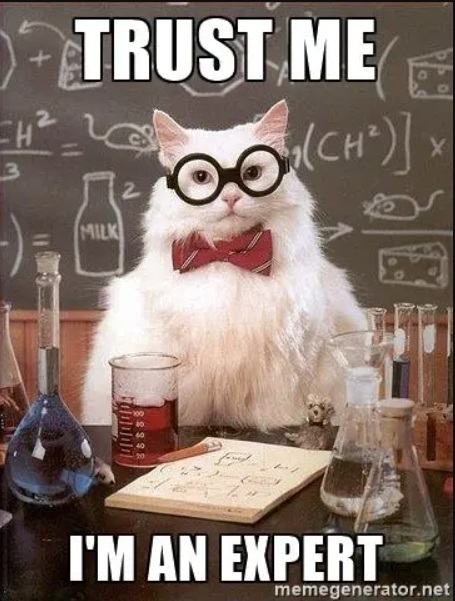
In this game, the first player picks two random subjects, and then prompts the next player with them, and it’s the next player’s job to explain in entertaining fashion something fascinating about them that only an expert would know.

For instance, the first player would go “My friend is an expert in ancient archaeology and polka music” and the next player has to riff on those subjects for a bit. Other players can ask questions to continue the silliness.

The game continues with different topics and additional nonsense.

There’s a similar game to this called Conspiracy Theory where someone has to rant about the grand conspiracy behind two seemingly unrelated topics provided by the other players.

Both of these are great fun with a group of improvisers or snake oil salesman during a long road trip.


Alien Ambassador

(I haven’t played this one yet, but a friend recommended it, so I’m happily including it.)

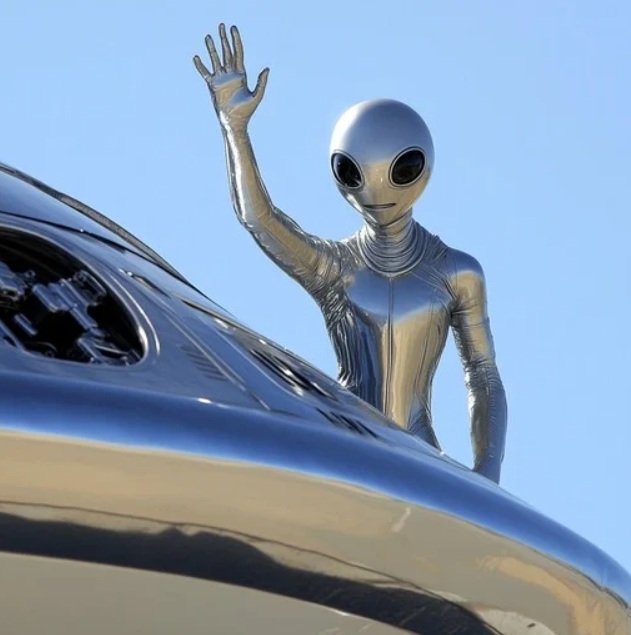
In this game, one player is selected to be the alien ambassador, an alien visiting Earth for the very first time. The other players must answer the alien’s questions and explaining simple concepts to them. (It’s sorta like that comic strip with the aliens.)

As the alien ambassador asks more questions about this, the players will invariably scramble to explain the very weird things we accept as normal, everyday life, and laughter will ensue.


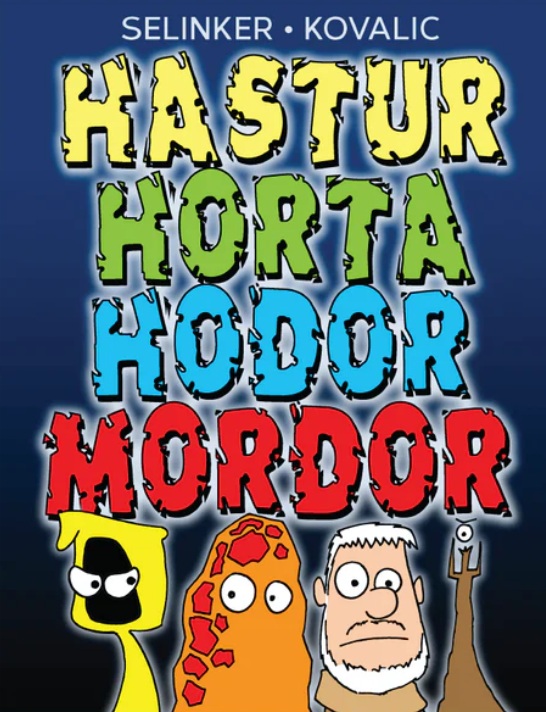
Hastur Horta Hodor Mordor

Inspired by a Dork Tower comic, Hastur Horta Hodor Mordor is a road trip game that actually became a real card game. But let’s focus on the road trip version.

This is a memory game where one player says a word — preferably one related to fandom, geek culture, etc. — in order to begin a nerdy tongue twister. The next player says that word AND another word. The next player says the two previous words AND another word, and the chain continues.

If you can’t complete the chain or you hesitate too long, you get a Hodor point, and a new chain begins.

If you get 3 Hodor points, you can only say “Hodor” for the rest of the car ride. (That’s a reference for the Game of Thrones fans in the audience, if there are any of you left after those dismal final seasons.)


Do you have any favorite no prep road trip games, fellow puzzlers? Let us know in the comments section below! We’d love to hear from you.

Antonym TV Shows!

In today’s post, I’ve got a silly little puzzly challenge for you. I’m going to give you the antonym of a television show’s title, and you need to give me the show.

For example, “Not at All Justified” would mean “Justified” or “Lawlessness and Chaos” would be “Law and Order.”

And yes, they do get wackier, more specious, and more elaborate as we go.

So, without further ado, let’s play!


ANTONYM TV SHOWS

  1. Enemies
  2. Found
  3. The Idle Alive
  4. Less Peculiar Nothings
  5. Misery
  6. Before Twelve
  7. Southern Obscurity
  8. Me
  9. Saving Adam
  10. White Non-Reflective Surface
  11. The First of Them
  12. Ugly Large Honest People
  13. Heaven’s Dining Room
  14. The Small Pop Certainty
  15. Very Vulnerable
  16. The Basses
  17. Unfettered Lack of Progress
  18. Water Walk
  19. Near Stay
  20. Many Whole
  21. Unseriousness Rises
  22. Truth Angel
  23. Attachment
  24. Drives and Work
  25. Minor Childless Man
  26. Keep a Potato in Pristine Condition
  27. Bullgirl Classical
  28. Legal Disobeys
  29. Uncertain Key
  30. Jeers

How many did you get, fellow solver? And how many did you groan at when you figured them out? Let me know in the comment section below!

Anagram Cluing: Hiding in Plain Sight!

I’ve got anagrams on the brain today.

The Puzzmo mini crossword is always accompanied by notes from the constructor and the editor. The comments from yesterday’s puzzle centered around anagrams, since the mini had not only an anagram in the theme entries — MAORI and MARIO — but actually had the word ANAGRAMMED crossing those entries.

In those comments, both Will Eisenberg and Brooke Husic discussed a really playful subset of cluing involving misdirection.

You give the solver an anagram, but present it is as a statement, rather than just saying “ABLE, to BALE.” When done properly, it takes a second for your brain to actually register the anagram, even though it’s right in front of you!

Will used the example “Ancients, for instance,” which cleverly employs the standard crossword trope of “for example / for instance / for one / e.g.” to conceal the anagram. Brooke had another banger example, offering “Anemone, to name one.”

I delved into the archives on Xwordinfo to look for other examples of this misdirection cluing style, and I found some fun ones. (Obviously, ANAGRAM isn’t an incredibly common entry, but I was genuinely surprised by the variety of options that awaited me in the archives.)

Back in 2011, Oliver Hill and Eliza Bagg gave us “Neo, for one,” which is such an effective misdirect than I can imagine writing the wrong answer more than once in the grid before realizing the trick, since this sort of clue is used so often for things like HERO or ROLE.

Other constructors phrased their anagrams as if they were slang or specialized jargon, leading solvers down the garden path while showing off their own impressive anagramming talents.

  • Ryan McCarty and Nelson Hardy gave us “Schoolmaster for the classroom, e.g.”
  • Margaret Saine offered “Illustration for an ill tourist?”
  • Sam Trabucco crafted “Nerd’s epithet for the president?”
  • Bryant White presented “Coasters for Socrates, e.g.”

Naturally, cryptic crossword or British-style crossword solvers probably suss out these clues faster, since this sort of stealthy wordplay is standard in cryptic cluing, where clues are written out like sentences, rather than the more direct cluing typically used in American crosswords. (Cryptic crossword icons Emily Cox and Henry Rathvon had one ANAGRAM clue in the Xwordinfo archives, the elegant “Broadcast of bad actors, e.g.”

Some constructors take it even further, employing the age-old trick of apropos anagrams for celebrities.

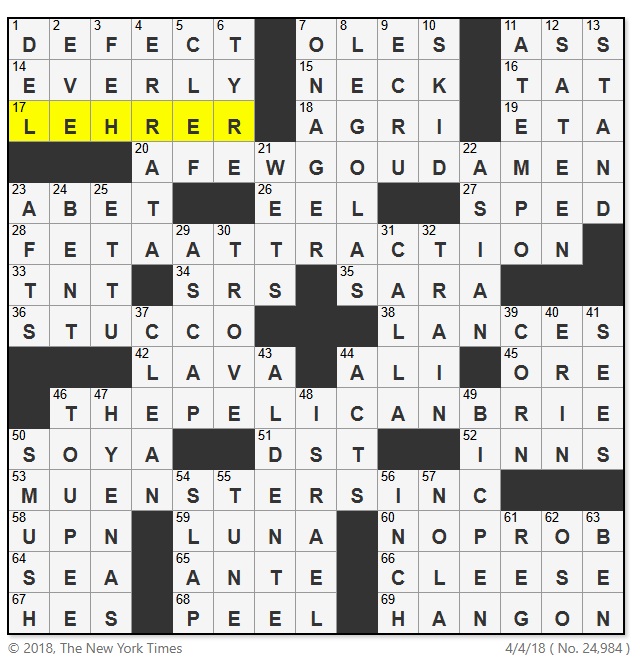
The Simpsons helped popularize knowledge of this game when Lisa learned that ALEC GUINNESS anagrams into GENUINE CLASS. Another famous one is CLINT EASTWOOD anagramming to OLD WEST ACTION. FLORENCE NIGHTINGALE aptly anagrams to FLIT ON, CHEERING ANGEL.

Patrick Merrell employed this nicely with his clue for ANAGRAM, “Horrid glances from Charles Grodin?”

I could go on and on listing examples, but Patrick’s clue is hard to top.

I’m obviously a huge fan of misdirection clues, so it was a joy to deep-dive into a different genre of cluing and watch clever people work their magic. Hopefully you enjoyed taking this puzzly stroll with me.

Happy puzzling, everyone!

Crossword / Puzzle News Roundup!

It’s a good week to be a puzzle enthusiast. The Boswords Spring Themeless League kicked off on Monday, the same day one of my favorite puzzly people got her first puzzle published in The New York Times.

And we’ve got news on a crossword convention, upcoming tournaments, a worthwhile puzzle-fueled charity endeavor, and a new Hallmark puzzly mystery debuting tonight.

So, without further ado, let’s get to the puzzle news roundup!


Crossword Con

April 4th marks the second annual Crossword Con, presented by the puzzle app Puzzmo.

Crossword Con is all about bringing together crossword fans and constructors to discuss crosswords as a cultural touchstone and an art form.

For their second outing, the organizers are casting their eyes to the future, asking “what’s on the horizon for crosswords, and what changes are already bubbling just beneath the surface?”

Although it’s only a half-day event, it is certainly jam-packed with notable names with plenty to offer on the subject of crosswords! Speakers and guests include Kate Hawkins, Will Nediger, Ada Nicolle, Brendan Emmett Quigley, Laura Braunstein, Rob Dubbin, Natan Last, Adrienne Raphel, and Brooke Husic.

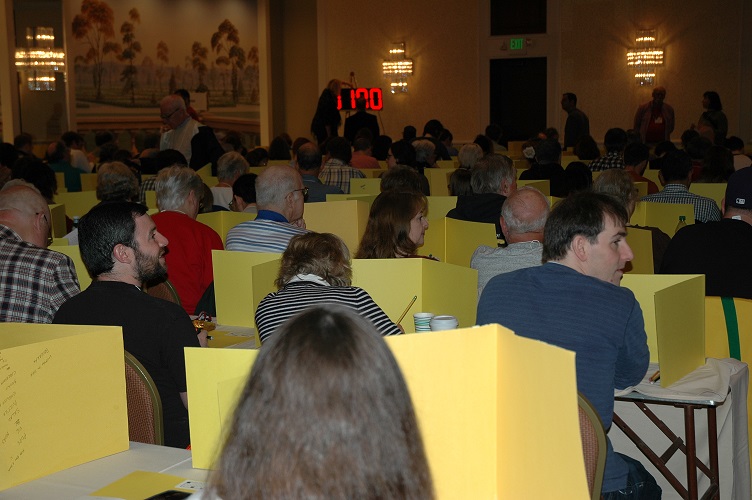
With Crossword Con in New York and the American Crossword Puzzle Tournament starting the same day in Stamford, April 4th is certainly an eventful day for crossword fans all over (and particularly those in New England).


120718_crossword_L

Crossword Tournaments

And speaking of crossword tournaments, if you’re a competitive crossword fan, the gears are already in motion for puzzly challenges all year long.

Registration for June’s Westwords Crossword Tournament is open right now.

The registration for October’s Midwest Crossword Tournament opens on April 2nd, just a few days before this year’s American Crossword Puzzle Tournament (April 4th through the 6th) will be held.

Of course, physical tickets for the ACPT sold out a while ago, but you’re still welcome to register for the virtual tournament to participate!

And the activities alongside this year’s tournament are a doozy. There’s an event celebrating the 20th anniversary of the “Wordplay” documentary, a magical puzzly performance from David Kwong, and an acrostics event on Friday night!

Lots of competitive puzzle fun coming up!


These Puzzles Fund Abortion 5

There’s a long history of activism and advocacy through puzzles. Women of Letters, Grids for Good, Queer Qrosswords… these are just a few prominent examples of constructors and creators donating their time and puzzly efforts to benefit the world at large.

And for the fifth year in a row, cruciverbalists and editors have united to help fund safe and affordable abortion care.

These Puzzles Fund Abortion 5 contains 23 puzzles “centered around social and reproductive justice themes,” all for a minimum donation of $25.

If you donate $50 or more, you will also receive the puzzle packs for the previous four years of TPFA.

It’s a very worthy cause and I hope you find it in your heart to contribute to the health and safety of others.


Mystery Island: Winner Takes All

To close out today’s puzzle news roundup, I’m happy to spread the word about a new Hallmark original mystery movie.

Mystery Island: Winner Takes All returns to the setting of last year’s Mystery Island.

In the original, a luxury private island murder mystery experience turns real when a dead body is found during the event. It falls to psychologist Dr. Emilia Priestly and detective Jason Trent to unravel riddles, deceit, and shadowy motives to solve the murder.

In tonight’s sequel, we return to the island for another murder mystery game, this time created by our crime-solving duo of Emilia and Jason. With a cash prize on the line, tensions are already high, but things take a dark turn when an employee turns up dead during the game.

Anyone who enjoyed my recaps and reviews of Hallmark’s Crossword Mysteries will be happy to hear that I will be reviewing not only the new Mystery Island sequel, but the original as well!

Mystery Island: Winner Takes All debuts tonight at 8 PM Eastern on Hallmark Mystery.


Phew! So much puzzly goodness going on. Will you be attending any crossword events this year? Let us know in the comments below.

Happy puzzling, everyone!

A Boggle Grid Big Enough For Every Word?

Puzzly minds are often analytical minds, so I’m no stranger to wild attempts at puzzle-inspired calculation.

Puzzle people have previously calculated the human limit for solving a Rubik’s Cube, as well as the fastest known mechanical solve of a Rubik’s Cube. Years ago, I myself tried to figure out how many years it would take to use every unique Sudoku grid possible.

But optimization is something altogether different, and it’s a intriguing way to look at the potential of puzzles.

A Redditor by the name of AntiqueRevolution5 posed the following question a few days ago, and it absolutely fits the bill of both puzzly calculation and optimization:

What would a Boggle grid look like that contained every word in the English language?

Well, there are somewhere between 1 million and 1.5 million words in the English language, so I imagine it would be pretty big.

The redditor is an artist, and their goal is to make a sculpture composed of Boggle dice. And their concept is fascinating:

The idea for the piece is that it’s a linguistic Rorschach that conveys someone could find whatever they want in it. But it would be even cooler if it literally contained any word someone might reasonable want to say or write.

So, where do you start with something like this? Our artist has a suggestion:

To simplify, we could scope it to the 3000 most important words according to Oxford. True to the nature of Boggle, a cluster of letters could contain multiple words. For instance, a 2 x 2 grid of letter dice T-R-A-E could spell the words EAT, ATE, TEA, RATE, TEAR, ART, EAR, ARE, RAT, TAR, ERA. Depending on the location, adding an H would expand this to HEART, EARTH, HATE, HEAT, and THE...

What would be the process for figuring out the smallest configuration of Boggle dice that would let you spell those 3k words linked above? What if the grid doesn’t have to be a square but could be a rectangle of any size?


Naturally, creative minds accepted the challenge.

One user claimed that an online Boggle website called Squaredle has two 10×10 boards with just under 900 words of 4 or more letters.

Another user, a programmer, was able to create an 18×18 grid with approximately 450 words in under 10 minutes.

As you might expect, I was unable to resist diving into this one. But I’m not a programmer, so let’s do some meatball mathematics to get a sense of the scope of the puzzly conundrum before us.


We can extrapolate that if we get 450 words in an 18×18 grid, we’d need seven 18×18 grids connected to approach 3,000 words, assuming there’s some consistency in letter efficiency.

If we stick to the rectangular suggestion of the original post, a 63×36 rectangle (six 18×18 grids in a 2×3 arrangement, plus a 9×36 grid attached at the bottom) should allow for those 3,000 words.

Now, I can’t verify that. But 63×36 means 2,268 letters in the grid. Which, with a 3,000 word goal (including two- and three-letter words) kinda feels possible.

Of course, this is just to cover that 3,000 word list. Remember that the English language is estimated to contain between 1 million and 1.5 million words total.

That’s 333-and-a-third times more, if we use a million words. It’s 500 times more words if we assume 1.5 million words.

So, that’s 2,268 letters in our 3,000 word grid. Multiply that by 500 and you get 1,134,000 letters in the grid.

That means we’d need a grid that’s 1,065 x 1,065 to cover the entire English language.

So what does that mean in Boggle terms?

A standard six-sided die is 16 millimeters. That’s 17,040 millimeters, or 17.04 meters. That’s 67.09 inches. We’re talking about a Boggle game that’s FIVE AND A HALF FEET ACROSS.

That’s one heck of a Boggle grid.

Now, of course, these numbers are all estimates, and dubious ones at that. But I couldn’t resist TRYING to find an answer, even if it’s just a ballpark number.


You see, fellow puzzlers, this brand of puzzle efficiency tickles something in my brain, as there are several Penny Press puzzles I quite enjoy that employ a similar idea.

Starspell (pictured above) involves finding words in a star-shaped grid, except unlike Boggle, you can reuse letters. So you could bounce back and forth from A to N and spell BANANA, for instance.

Word Maze involves a small grid with many words hidden inside Boggle-style (though it’s actually a themed word list, meaning it’s not optimized to just cram as many words inside as possible).

Letter Perfect is a reversal of the idea, seeing if the solver can arrange letters in a mostly-empty 4×4 grid to fit every word in a given wordlist. It’s excellent training for a challenge like this, since you learn about efficiency of letter placement and how many words can spell out with neighboring letters if you’re clever.


I don’t know if any programmers will figure out how to build a language-spanning Boggle grid, but I look forward to seeing them try!

Happy puzzling, everyone.

What Makes a Good Brain Teaser?

I was going through a collection of brain teasers a fellow puzzler gave me, and it occurs to me that “brain teaser” is one of the least specific puzzle terms around.

Riddles, logic and deduction, math puzzles, and wordplay games all fall under the brain teaser umbrella. So you never know what you’re gonna get. Are your math skills required? Your outside-the-box thinking? Your ability to pay attention to the specifics of the question itself?

In this collection alone, I found examples of each of these types of puzzles:

Riddle: Sometimes I’m green, sometimes I’m black. When I’m yellow, I’m a very nice fellow. That’s when I’m feeling mighty a-peeling. What am I?

Logic / deduction: 3 guys go into a hardware store, all looking for the same thing. William buys 1 for $1. Billy buys 99 for $2. Finally, Willie buys 757 for $3. What were they buying?

Math puzzle: The sum is 12 and the same digit is used 3 times to create the sum. Since the digit is not 4, what is the digit?

Wordplay: Which state capitals would you visit to find a ram, cord, bus, and dove?

So, if someone challenged you to a brain teaser, these would all be fair game. Would you be able to solve all four of them?


It’s possible you wouldn’t, because good and bad brain teasers alike employ tricks to keep you on your toes.

Some hide the answer in plain sight:

Homer’s mother has 4 children. 3 of them are named Spring, Summer, and Autumn. What is the 4th named?

Some use misdirection, purposely phrasing the question to get you thinking one way and steering you away from the real solution:

The big man in the butcher shop is exactly 6’4″ tall. What does he weigh?

In fact, both of these examples use plain sight (Homer, butcher shop) and misdirection (implying a pattern with seasons, specifying his height) to distract you.

I suspect you weren’t fooled by either of them, though.

Others try to overwhelm you with information so you bog yourself down in the details instead of clearly analyzing the problem at hand:

Nina and Lydia start from their home and each runs 2 miles. Nina can run a mile in 8 minutes 30 seconds and Lydia can run a mile in 9 minutes 10 seconds. When they finish running, what is the furthest apart they can be?

A lot of numbers get thrown at you, but they’re irrelevant, since the question only asks about the distance, not the time. So if they each run 2 miles, the furthest apart they can be is 4 miles. The rest is just smoke.

These are all effective techniques for teasing a solver’s brain. You’re given all the information you need to solve the puzzle, plus a little extra to distract, mislead, or overwhelm you.


Unfortunately, some brain teasers use unfair techniques to try to stump you:

Jacob and Seth were camping in June. Before going to sleep they decided to read a book. They both agreed to stop reading when it got dark. They were not fast readers, but they finished the entire encyclopedia. How?

Ignoring the fact that these two boys somehow brought an entire encyclopedia with them on a camping trip, we’re not actually given a lot of information here.

So that makes the intended answer seem like more of an insane leap than a logical jump to the conclusion: They were in Lapland, land of the midnight sun, and the sun didn’t set until September.

WHAT?

There’s no reasonable way for someone to reach this conclusion based on the information given. In fact, it makes less sense the more you read it. Presumably Jacob and Seth know where they are camping, and that it wouldn’t get dark for months. So why would Jacob and Seth agree to stop reading when it got dark IF THAT MEANT THEY’D BE READING UNTIL SEPTEMBER!?

This is gibberish, and you’d be surprised how often something like this gets passed off as acceptable in a collection of brain teasers. (I discussed a similar issue with detective riddles in a previous blog post.)


Let’s close out today’s discussion of the ins and outs of brain teasers with a few fun, fair examples, shall we?

  • In what northern hemisphere city can you find indigenous tigers and lions?
  • Scientists have found that cats are furrier on one side than the other. The side with the most fur is the side that cats most often lie on. Which side of a cat has more fur?
  • A woman married over 50 men without ever getting divorced. None of the men died and no one thought she acted improperly. Why?

Did you solve them all? Let us know! Also, please share your favorite brain teasers (or your tales of treacherous and unfair brain teasers) in the comments below!

Happy puzzling, everyone!