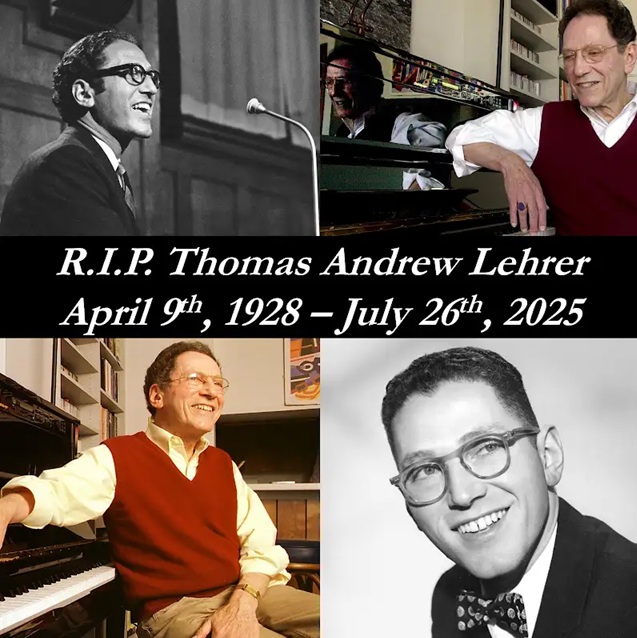
Farewell, Tom Lehrer.

The world of puzzles and games is larger than constructors and game designers. There are artists, writers, editors, wordsmiths, hosts, musicians, and influences that help shape puzzles and games in so many different ways. Their efforts enrich and popularize these beloved pastimes, contributing to the world by celebrating wordplay, creativity, and nerdy pursuits.

And sadly, the world grew a little less witty, a little less clever, and a lot less bold and outspoken about so many important topics when Tom Lehrer passed away a few days ago.

It’s hard to know where to begin.

How do you describe the cultural influence of a man whose songs still delight, inform, and push boundaries today, even though he wrote most of them over sixty years ago?

How do you describe a successful musician who walked away from public performance after three brilliant albums — thirty-seven songs, each an intricately-crafted dissection of some aspect of culture, science, or current events, often as poignant and sharp-tongued as they were hilarious — and spent the bulk of his life as a teacher and college professor instead?

How do you describe the genius of a man for whom wordplay flowed as easily as scientific lingo or political commentary, a man who could make you laugh (and think, really think) about nuclear annihilation, questionable post-war government programs, or even the Catholic Church itself?

His influence on pop culture can’t be overestimated. Across generations, his songs educated and inspired, and his legacy is bulletproof. He created songs for The Electric Company, Square One TV, and That Was The Week That Was. (Those shows were decades apart!)

He inspired performers like “Weird Al” Yankovic, and I think his fingerprints are unmistakable on other hilarious and educational projects, like the songs of Randy Rogel for Animaniacs. (Trust me, you can’t listen to “the Multiplication song” from Animaniacs and NOT think of Lehrer’s “New Math”.)

Tom retired from live performance in the late 1960s, having felt like he’d said everything he wanted to say with his music. (Plus, as he famously pointed out, “political satire became obsolete when Henry Kissinger was awarded the Nobel peace prize.”)

But his songs wouldn’t be denied.

Dr. Demento’s radio show brought Lehrer’s work to new ears in the 1970s, 80s, and 90s, and Honest2Betsy has brought him to yet another generation’s attention with her videos over the last few years.

His songs are timeless. “The Elements” alone has appeared in Better Call Saul, NCIS, Gilmore Girls, and The Big Bang Theory. (Not to mention Daniel Radcliffe’s famous rendition of the song on The Graham Norton Show, where he called Lehrer his hero. This actually led to Radcliffe starring in the film Weird: The Al Yankovic Story.)

Speaking of “Weird Al,” his New York Times crossword puzzle with constructor Eric Berlin namedropped Tom as part of the grid fill in this pun-heavy collaboration:
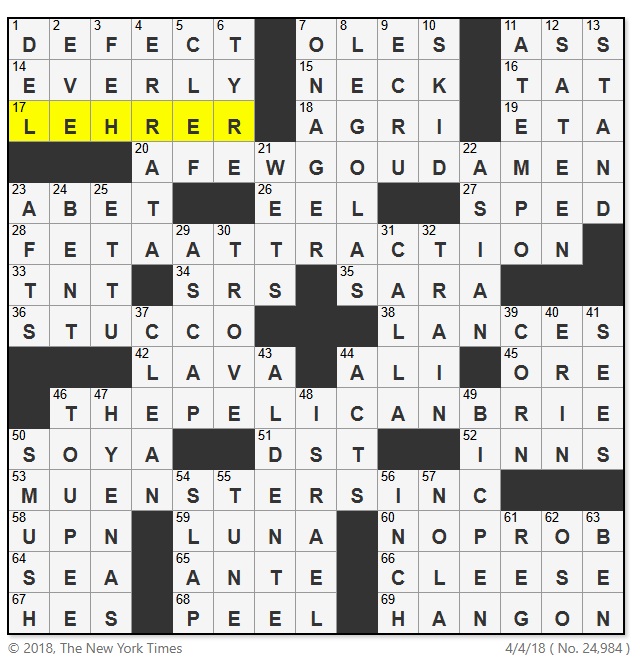
And it is a love of wordplay that sparked this tribute today.

Lehrer’s work is absolutely riddled with clever puns, comedic craftsmanship, and playing with the listener’s expectations: all things that great crossword cluing employs.

You can’t listen to songs like “Silent E” or “Without an S” and NOT imagine clues or themes that Lehrer’s linguistic legerdemain could inspire.

Not to mention this gem:
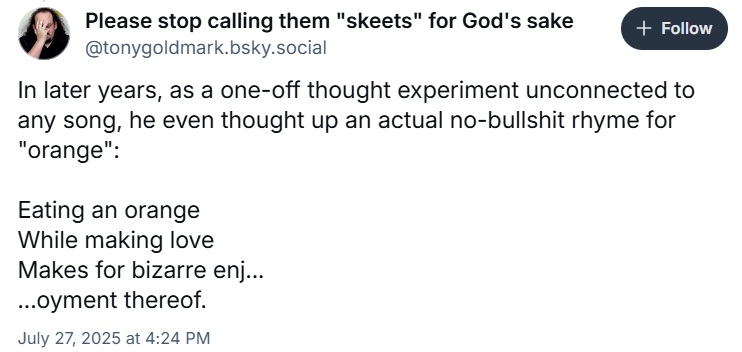
There’s a playfulness there, paired with technique, creativity, and an absolute willingness to bend conventions to their breaking point in order to make something new. How can you not love it?

But wordplay, commentary, and scientific and mathematical literacy weren’t Lehrer’s only gifts to the world.

He claimed to have invented the jello shot while in the military (to skirt rules about alcohol consumption). He wrote the song “Don’t Major in Physics,” which would have been good advice to me in freshman year of college, had I cared to listen.
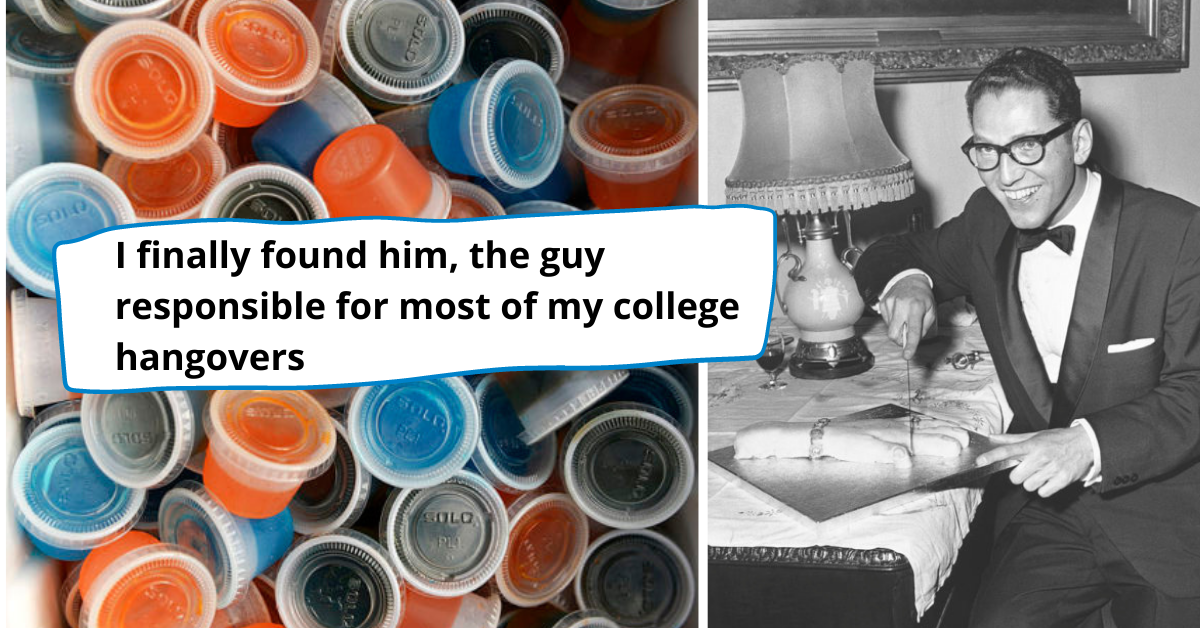
Image courtesy of warhistoryonline.

And he also made the incredible gesture in 2022 of transferring the music and lyrics for all the songs he had ever written into the public domain. He relinquished the copyright and performing/recording rights for his songs as well, making his music and lyrics free for anyone to use. Downloadable lyric and music files are available on his website.

His statement releasing all his works into the public domain concluded with this note: “This website will be shut down at some date in the not too distant future, so if you want to download anything, don’t wait too long.”

For now, at least, the website remains online.

And it seems so apropos that the man who walked away from music decades ago to share his love of mathematics, science, and teaching with others is also the man who would happily sign away the rights to his music to enrich the lives of others once again.

The humanities and the STEM fields both owe Tom Lehrer a debt that can never be repaid.

The world was blessed with his presence for 97 years, and I have no doubt that his words, his music, and the forceful spirit that infused both will be around for many many years to come.

Farewell, Tom. Thanks for warning us about Shakespeare.

Oh, and for this lovely little ditty:

The Search for the Greatest Palindrome

[Palindrome, written as an ambigram.]

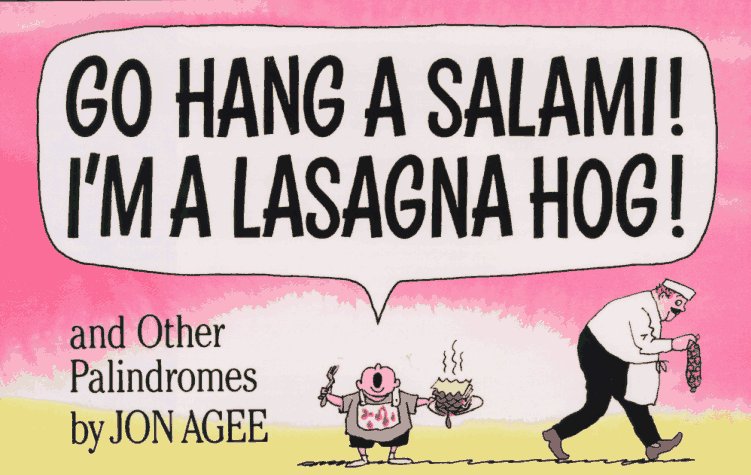
Palindromes are a classic — and challenging — form of wordplay. Essentially, you’re trying to come up with phrases or entire sentences that read the same backwards and forwards.

Although palindromes have been around for a very long time — dating back to magic squares — they’ve gained additional prominence in recent years. The 2017 World Palindrome Championship was determined alongside the American Crossword Puzzle Tournament the same year. They have their own awards ceremony: The SymmyS Awards. There was even a documentary on the subject.

Palindrome creation was a popular pastime in Bletchley Park during the off-time of the codebreakers and staff. And those palindromic magic squares we referenced earlier? It was once believed that they held magical properties and served as incantations to ward off threats both spiritual and physical.

Musician, parodist, and wordsmith “Weird Al” Yankovic, no stranger to palindromes himself, once said that “the writing of a brilliant palindrome is a small miracle, and that, I think, deserves to be honored more than a lot of the stupid and inconsequential things we often celebrate in our culture.”

They’re an integral part of puzzle history.

But why do I have palindromes on the brain today? Because I’ve been trying to figure out which one is the best one ever created.

It’s a tricky topic, extremely subjective. What parameters do I use to choose the palindrome in the top spot?

The most famous one is either “Madam, I’m Adam” or “a man, a plan, a canal… Panama!”

I prefer the latter. It’s not just thematically appropriate to its subject, but it’s also a univocalic, a sentence using only one vowel. There’s a lot of linguistic legerdemain going on here.

It has been expanded upon, of course. I’ve seen this wordier version around:

A man, a plan, a canoe, pasta, heros, rajahs, a coloratura, maps, snipe, percale, macaroni, a gag, a banana bag, a tan, a tag, a banana bag again (or a camel), a crepe, pins, Spam, a rut, a Rolo, cash, a jar, sore hats, a peon, a canal — Panama!

Do I go by sheer length? Some palindromes are incredibly long, but are mostly nonsense.

My friend Troy recently shared this lengthy palindrome with me:

Dennis, Nell, Edna, Leon, Nedra, Anita, Rolf, Nora, Alice, Carol, Leo, Jane, Reed, Dena, Dale, Basil, Rae, Penny, Lana, Dave, Denny, Lena, Ida, Bernadette, Ben, Ray, Lila, Nina, Jo, Ira, Mara, Sara, Mario, Jan, Ina, Lily, Arne, Bette, Dan, Reba, Diane, Lynn, Ed, Eva, Dana, Lynne, Pearl, Isabel, Ada, Ned, Dee, Rena, Joel, Lora, Cecil, Aaron, Flora, Tina, Arden, Noel, and Ellen sinned.

It makes more sense than the Panama one, but just barely. It’s a thinly disguised list, that’s all.

So, is narrative coherence a necessity for the best palindrome ever?

World Champion Palindromist Mark Saltveit claims that his first palindrome was “Resoled in Saratoga, riveting in a wide wale suit, I use law, Ed. I, wan, ignite virago, tar a snide loser.”

It’s lengthy, and it mostly makes sense. But Saltveit rarely worries about that. One of his most famous creations is this borderline nonsensical concoction:

Devil Kay fixes trapeze part; sex if yak lived.

Sure, it manages to use Xs and a Z, but it’s gibberish. I much prefer his winner from the First World Palindrome Championship in 2012:

I tan. I mull. In a way, Obama, I am a boy, a wan Illuminati.

The Bletchley Park palindromists demanded some level of coherence. One of the most impressive produced there was “Doc, note, I dissent. A fast never prevents a fatness. I diet on cod.”

It’s certainly impressive, and feels like it could be spoken casually.

Maybe the ideal palindrome walks the tightrope of cleverness, innovation, length, and coherence.

Although it’s quite short, I do enjoy this existential one from the 2018 SymmyS Awards: “Am I man-made? Damn! Am I, Ma?”

I’ve pored over dozens and dozens of palindromes, trying to find one that best represents the wordplay and the art form. And I’ve made my choice.

In my humble, puzzly opinion as a self-appointed adjudicator of palindromic magnificence, I choose Anthony Etherin’s “The Failed Cartographer” as the best palindrome I’ve ever seen.

Please enjoy this wistful, almost operatic bit of wordplay:

Demand a hill, at solid nadir…. Damn it! One morn I saw I was in Rome,
not in Madrid, and I lost all I had named…

Magical.

Can you think of a palindrome that better epitomizes the genre? Please share in the comments section below. We’d love to hear from you!

Oh, and as for my favorite palindrome? That’s easy. It’s a stupid one I wrote for a friend.

“My friend Sean has a really weird last name: Emantsaldriewyllaerasahnaesdnierfym.”


Thanks for visiting PuzzleNation Blog today! Be sure to sign up for our newsletter to stay up-to-date on everything PuzzleNation!

You can also share your pictures with us on Instagram, friend us on Facebook, check us out on TwitterPinterest, and Tumblr, and explore the always-expanding library of PuzzleNation apps and games on our website!

Final Jeopardy for James Holzhauer

Alas, all great runs must come to an end, and so it is with a heavy heart that I report that James Holzhauer — sports gambler, trivia whiz, and Jeopardy! champion — has been defeated, relinquishing his title as champion after 32 days.

He amassed an impressive total of $2,464,216, the second highest in game history during regular-season play. And his impressive daily totals have yielded some impressive stats. He now holds 21 of the top 25 spots on the show’s list of the highest single-day winnings.

Only $58,484 separated him from Ken Jennings’ long-standing total of $2,520,700, which was amassed in 74 games back in 2004.

holzhauertweet

Holzhauer was complimentary toward both Jennings and his Jeopardy! opponent Emma Boettcher on social media, stating, “CONGRATULATIONS to Emma on a world-beating performance. There’s no greater honor than knowing an opponent had to play a perfect game to defeat me.”

He then cited one of the predictions as to how his reign would end, quoting, “James will eventually beat himself by flubbing one of his big bets,” before responding, “Nope, James got his ass kicked straight up by an elite player who nailed her own big bets.”

Naturally, the buzz around social media regarding this unexpected turn of events is mixed. Some viewers are glad to see a new champion crowned, while others are sad to see Holzhauer go.

There are also a few conspiracy theories brewing. Some viewers believe that James intentionally threw this match, citing slower reaction times, gimme questions being missed, and a general lack of energy from the normally bullish champion. He went into Final Jeopardy in second place.

The capper for many was his performance in Final Jeopardy where he made an uncharacteristically low wager (only $1300 or so, when he was at $23k), meaning that despite his correct answer, he wouldn’t defeat his rival for this game. (Emma Boettcher, on the other hand, bet $20k on Final Jeopardy, perhaps anticipating a similarly aggressive bet from Holzhauer.)

But Holzhauer has already explained his unexpected move, telling The Atlantic that, “By the time Final Jeopardy rolled around I knew my goose was cooked if Emma answered correctly. It’s a little like needing a team to miss a last-second field goal ― nothing you can really do but watch. I made peace with my fate before the clue for Final was even revealed.”

Holzhauer seems pleased with his Jeopardy! performance despite not dethroning Jennings. “My only real goals were: Win $110,914 on an episode to honor my daughter’s birthday, and play my absolute best every game. I achieved both, and I’m very proud of myself for that.”

Congratulations to James Holzhauer for a very notable run as champion, and congratulations to Emma Boettcher for proving to be a more than worthy champion in her own right.

And now, there’s really only one way to conclude a saga like this, and that’s with a song. Take it, “Weird Al”…


Thanks for visiting PuzzleNation Blog today! Be sure to sign up for our newsletter to stay up-to-date on everything PuzzleNation!

You can also share your pictures with us on Instagram, friend us on Facebook, check us out on TwitterPinterest, and Tumblr, and explore the always-expanding library of PuzzleNation apps and games on our website!

The New York Times Crossword, Accordion to Weird Al

 In February of 2017, The New York Times celebrated a landmark in the history of puzzles: the 75th anniversary of the NYT crossword.

And ever since, to commemorate that puzzly milestone, top constructors and Times favorites have been pairing up with celebrity fans and puzzle enthusiasts to co-construct puzzles for the Times!

This year, you might’ve encountered some of these collaborations, like news pundit Rachel Maddow’s March 2nd puzzle with constructor Joe DiPietro, or “How I Met Your Mother” star Josh Radner’s meditation-themed puzzler from January 31st with constructor Jeff Chen.

Over the last year, names as diverse as John Lithgow, Elayne Boosler, Joy Behar, Lisa Loeb, Neil deGrasse Tyson, and Bill Clinton have contributed their puzzly efforts to this marvelous project.

And yesterday, another famous wordsmith and master of punnery made his New York Times debut.

[Image courtesy of Instagram.]

Yes, the immortal “Weird Al” Yankovic teamed up with Puzzle Your Kids mastermind and friend of the blog Eric Berlin for a cheese-themed Wednesday outing that delighted fans and solvers alike.

Al has certainly been keeping busy lately, launching his Ridiculously Self-Indulgent, Ill-Advised Vanity Tour — his words, not mine; I loved the show I attended! — and working with Lin-Manuel Miranda to create The Hamilton Polka, an ambitious and hilarious take on the wildly successful musical.

The puzzle was Eric’s 40th Times puzzle, and Al’s first. Not only did the puzzle feature those signature cinematic cheese puns — like A FEW GOUDA MEN and THE PELICAN BRIE — but there was plenty of nerd culture featured in the fill and cluing.

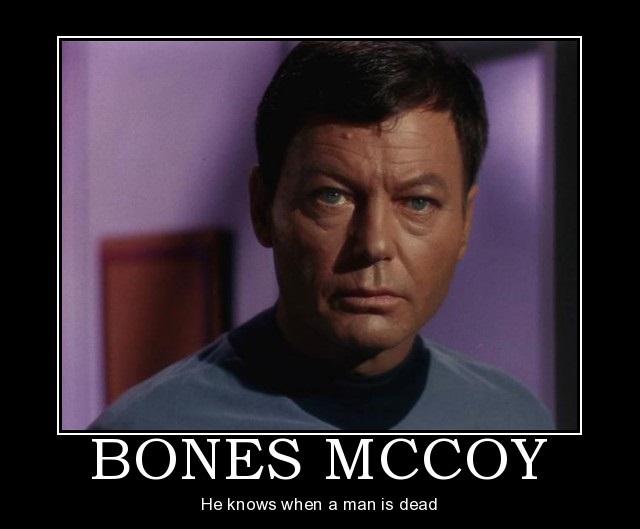
Tom Lehrer and John Cleese were both name-dropped, as well as Legolas, Wile E. Coyote, WALL-E, Mr. Clean, and Bones from the original Star Trek.

Eric offered some insight into the puzzle’s creation while discussing the puzzle with Wordplay’s Deb Amlen:

My very first attempt at the grid included one of my favorites from his list, QUESOBLANCA. I was under the misapprehension that queso is not just the Spanish word for cheese but also a specific kind of cheese. Whoops, not quite. (This was entirely on me, I should note — Al, not knowing during his brainstorming that the end result would be restricted to specific cheeses, had several cheese-adjacent puns in his list, including FONDUE THE RIGHT THING and CHEESY RIDER.)

And appropriately enough, Al had a bit of fun promoting the puzzle on his Instagram, claiming, “If you’re REALLY good, you don’t NEED the clues!”

For the record, I needed the clues.


Thanks for visiting PuzzleNation Blog today! Be sure to sign up for our newsletter to stay up-to-date on everything PuzzleNation!

You can also share your pictures with us on Instagram, friend us on Facebook, check us out on TwitterPinterest, and Tumblr, and explore the always-expanding library of PuzzleNation apps and games on our website!

It’s Follow-Up Friday: Hashtag Hilarity edition!

Welcome to Follow-Up Friday!

By this time, you know the drill. Follow-Up Friday is a chance for us to revisit the subjects of previous posts and bring the PuzzleNation audience up to speed on all things puzzly.

And today, I’m posting the results of our #PennyDellPuzzleComedy hashtag game!

You may be familiar with the board game Schmovie, hashtag games on Twitter, or@midnight’s Hashtag Wars segment on Comedy Central.

For the last few months, we’ve been collaborating on puzzle-themed hashtag games with our pals at Penny Dell Puzzles, and this month’s hook was #PennyDellPuzzleComedy, mashing up Penny Dell puzzles and anything and everything having to do with stand-up comics, film and television comedians, funny movies, funny shows, funny plays… even one-liners or jokes!

Examples include: David Letterboxesman, The Three Anagr-amigos, or “Take a Letter, Please!”

So, without further ado, check out what the puzzlers at PuzzleNation and Penny Dell Puzzles came up with!


Puzzle Comedians!

Rodney Danger-Textfields

George Carlinkwords

“Weird Al”-phagrid Yankovic

Dr. Dementossing and Turning

Fill-In Diller / Phyll-Ins Diller

Kenken Jeong

David Cross Pairs

Lewis Blackout!

Andrew Dice Game

Cryptomedian Adam Scrambler

Rows-anne Garden

Alphabet Soupy Sales

Dan Ayk-wordplay

Gilda-Quote Radner

Rose-anagrams Rose-anagrams Dannagrams


Puzzle Comedy Films!

History of the World, Part One and Only

Happy Fill-in More!

Meet the Frameworks

You Don’t Maze with the Zohan

Austin Flower Powers

April Sillycrostics!

Four Square Weddings and a Funeral

Three from Nine to Five

Roxanne-agrams

Across and Down and Out in Beverly Hills

Alphabet Duck Soup

Animal Crackers House


Puzzle Comedy TV Shows!

A Bits and Pieces of Fry and Laurie

Two for One and a Half Men

Rowan and Martin’s Fill-In

Three of a Kind’s Company

“I Love Loosey Tiles!”

Saturday Night Line ‘Em Up

Sanford and Sunrays

All in the Family Ties

Happy Daisy

Leave It to Weaver Words

The Odds and Evens Couple

[Plus there were a few Seinfeld references in puzzly form:]

“By the way, they’re real, and they’re Sudoku Spectacular!”

“The Bubbles Boy”


Puzzle Jokes and Routines!

“Who’s on first and last?” / “Who’s Calling on first! What’s Left on second!”

Knock, Knock! Who’s Calling?

Why did the chicken cross the Middle of the Road? To get to the other Slide-o-gram!

“Nehh…What’s Left, Doc?”

How do you send a message to a skeleton? By Crypt-O-Gram!

What do you get when you insult a puzzle editor’s work? Cross words!

Have you heard about the most amazing Framework ever constructed? It was a Revelation!

Knock-knock.
Who’s there?
Guess
Guess Who?
Hey, that’s my favorite puzzle!

Knock-knock
Who’s there?
Lotto
Lotto who?
I bet there’s a lotto people entering this hashtag game!

Knock-knock
Who’s there?
The Wizard
The Wizard who?
The Wizard is wise and humorous. Didn’t you read the blurb?

Knock-knock
Who’s there?
Zip It
Zip It who?
Zip it, you! I’ve had enough of your knock-knock jokes


And the PuzzleNation audience got involved as well! @_screenhog tweeted the excellent entries Funny or Diagramless and Patchwords Adams!

Have you come up with any Penny Dell Puzzle Comedy entries of your own? Let us know! We’d love to see them!

Thanks for visiting PuzzleNation Blog today! Be sure to sign up for our newsletter to stay up-to-date on everything PuzzleNation!

You can also share your pictures with us on Instagram, friend us on Facebook, check us out on TwitterPinterest, and Tumblr, and explore the always-expanding library of PuzzleNation apps and games on our website!

Puzzles in Pop Culture: Square One TV

Puzzles in Pop Culture is all about chronicling those moments in TV, film, literature, art, and elsewhere in which puzzles play a key role. In previous installments, we’ve tackled everything from The West Wing, The Simpsons, and M*A*S*H to MacGyver, Gilmore Girls, and various incarnations of Sherlock Holmes.

And in today’s edition, we’re jumping into the Wayback Machine and looking back at the math-fueled equivalent of Sesame Street: Square One TV!

[The intro to Square One TV, looking more than a little dated these days.]

This PBS show ran from 1987 to 1994 (although reruns took over in 1992), airing five days a week and featuring all sorts of math-themed programming. Armed with a small recurring group of actors, the writers and producers of Square One TV offered many clever (if slightly cheesy) ideas for presenting different mathematical concepts to its intended audience.

Whether they were explaining pie charts and percentages with a game show parody or employing math-related magic tricks with the aid of magician Harry Blackstone, Jr., the sketches were simple enough for younger viewers, but funny enough for older viewers.

In addition to musical parodies performed by the cast, several famous musicians contributed to the show as well. “Weird Al” Yankovic, Bobby McFerrin, The Fat Boys, and Kid ‘n’ Play were among the guests helped explain fractions, tessellations, and other topics.

[One of the many math-themed songs featured on the show.]

Two of the most famous recurring segments on Square One TV were Mathman and Mathcourt. (Sensing a theme here?)

Mathman was a Pac-Man ripoff who would eat his way around an arcade grid until he reached a number or a question mark (depending on this particular segment’s subject).

For instance, if he came to a question mark and it revealed “3 > 2”, he could eat the ratio, because it’s mathematically correct, and then move onward. But if he ate the ratio “3 < 2”, he would be pursued by Mr. Glitch, the tornado antagonist of the game. (The announcer would always introduce Mr. Glitch with an unflattering adjective like contemptible, inconsiderate, devious, reckless, insidious, inflated, ill-tempered, shallow, or surreptitious.)

Mathcourt, on the other hand, gave us a word problem in the form of a court case, leaving the less-than-impressed district attorney and judge to establish whether the accused (usually someone much savvier at math than them) was correct or incorrect. As a sucker for The People’s Court-style shenanigans, this recurring segment was a personal favorite of mine.

But from a puzzle-solving standpoint, MathNet was easily the puzzliest part of the program. Detectives George Frankly and Kate Tuesday would use math to solve baffling crimes. Whether it was a missing house, a parrot theft, or a Broadway performer’s kidnapping, George and Kate could rely on math to help them save the day.

These segments were told in five parts (one per day for a full week), using the Dragnet formula to tackle all sorts of mathematical concepts, from the Fibonacci sequence to calculating angles of reflection and refraction.

These were essentially word problems, logic problems, and other puzzles involving logic or deduction, but with a criminal twist. Think more Law & Order: LCD than Law & Order: SVU.

Granted, given all the robberies and kidnappings the MathNet team faced, these segments weren’t aiming as young or as silly as much of Square One TV‘s usual fare, but they are easily the most fondly remembered aspect of the show for fans and casual viewers alike.

Given the topic of Tuesday’s post — the value of recreational math — it seemed only fitting to use today’s post to discuss one of the best examples of math-made-fun in television history.

Square One TV may not have been nearly as successful or as long-lasting as its Muppet-friendly counterpart, but its legacy lives on in the hearts and memories of many puzzlers these days.


Thanks for visiting PuzzleNation Blog today! Be sure to sign up for our newsletter to stay up-to-date on everything PuzzleNation!

You can also share your pictures with us on Instagram, friend us on Facebook, check us out on TwitterPinterest, and Tumblr, and explore the always-expanding library of PuzzleNation apps and games on our website!